

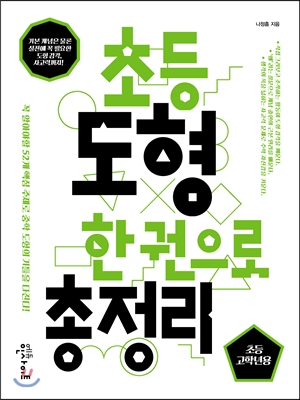
Elementary Geometry in One Book: For Upper Elementary Students
 |
Description
Book Introduction
From 30 years of teaching and textbook writing experience
The definitive guide to learning elementary school shapes!
Why a complete summary of elementary shapes?
I recommend this to friends who have mastered arithmetic well but have difficulty with shapes or do not get good scores in shapes.
You can study the core concepts of shapes that were scattered throughout the six years of elementary school in a systematic order, making it much easier to complete your study of shapes.
Also, by approaching the concept through various activities such as re-reporting and creating, the study of shapes becomes much more concrete.
I realized why I was weak in geometry.
If you only memorize formulas without asking 'why', you will have limitations in doing advanced mathematics that becomes more difficult.
Studying geometry becomes clear only when you can reconstruct the formulas yourself with a deep understanding of the concepts.
Additionally, it is difficult to improve one's ability to solve geometric problems without developing the geometric sense and thinking skills that require synesthetic judgment.
By the time I finish this book, I will be able to tell you what I've been lacking in my study of geometry and what skills I need in real life.
The definitive guide to learning elementary school shapes!
Why a complete summary of elementary shapes?
I recommend this to friends who have mastered arithmetic well but have difficulty with shapes or do not get good scores in shapes.
You can study the core concepts of shapes that were scattered throughout the six years of elementary school in a systematic order, making it much easier to complete your study of shapes.
Also, by approaching the concept through various activities such as re-reporting and creating, the study of shapes becomes much more concrete.
I realized why I was weak in geometry.
If you only memorize formulas without asking 'why', you will have limitations in doing advanced mathematics that becomes more difficult.
Studying geometry becomes clear only when you can reconstruct the formulas yourself with a deep understanding of the concepts.
Additionally, it is difficult to improve one's ability to solve geometric problems without developing the geometric sense and thinking skills that require synesthetic judgment.
By the time I finish this book, I will be able to tell you what I've been lacking in my study of geometry and what skills I need in real life.
- You can preview some of the book's contents.
Preview
index
52 Core Topics in Elementary Geometry That Apply Even in Middle School!
01 Line segment, half-line, straight line
02 Angles, right angles, right triangles
03 Rectangle, square
04 won
05 Angles and Classification of Angles
06 Sum and difference of angles
07 Vertical and Perpendicular
08 Parallel and parallel lines
09 Angle between parallel lines
10 Sum of the angles of a polygon
Classification of triangles according to the size of their 11 angles
Classification of triangles according to the length of their 12 sides
13 Find the number of shapes
14 Trapezoid, parallelogram
15 Rhombus, rectangle, square
16 Relationships between squares
17 Polygon, regular polygon
18 diagonal
19 Angles in various shapes
20 Push and Flip Shapes
21 Rotate the shape
22 Perimeter of a figure
Area using 23 unit area
24 Area of rectangles and right angles
25 Area of parallelograms and triangles
26 Area of trapezoid and rhombus
27 Areas of various polygons
Congruence of 28 figures and their properties
29 Drawing congruent triangles
30 Line-symmetrical and point-symmetrical figures
31 Properties of line-symmetric figures
32 Properties of point symmetry figures
33 Rectangular solid and cube, aiming diagram
34 Properties of a rectangular solid
35 Development of a rectangular solid
36 pillars
37 pyramids
38 Development of a prism and a pyramid
39 Stacking Trees
40 Views of the stacking tree from above, front, and side
41 The shape of the entire stacking tree
42 Shapes that meet the conditions (connected cubes)
43 Surface area of a rectangular solid
44 Volume of a rectangular solid
45 Surface area and volume of stacked wood
Circumference of a circle of 46
Area of 47 circles
48 Cylinders and their development
49 Surface area and volume of a cylinder
50 cones and spheres
51 Rotor
52 Cross-section of a solid figure
Search
01 Line segment, half-line, straight line
02 Angles, right angles, right triangles
03 Rectangle, square
04 won
05 Angles and Classification of Angles
06 Sum and difference of angles
07 Vertical and Perpendicular
08 Parallel and parallel lines
09 Angle between parallel lines
10 Sum of the angles of a polygon
Classification of triangles according to the size of their 11 angles
Classification of triangles according to the length of their 12 sides
13 Find the number of shapes
14 Trapezoid, parallelogram
15 Rhombus, rectangle, square
16 Relationships between squares
17 Polygon, regular polygon
18 diagonal
19 Angles in various shapes
20 Push and Flip Shapes
21 Rotate the shape
22 Perimeter of a figure
Area using 23 unit area
24 Area of rectangles and right angles
25 Area of parallelograms and triangles
26 Area of trapezoid and rhombus
27 Areas of various polygons
Congruence of 28 figures and their properties
29 Drawing congruent triangles
30 Line-symmetrical and point-symmetrical figures
31 Properties of line-symmetric figures
32 Properties of point symmetry figures
33 Rectangular solid and cube, aiming diagram
34 Properties of a rectangular solid
35 Development of a rectangular solid
36 pillars
37 pyramids
38 Development of a prism and a pyramid
39 Stacking Trees
40 Views of the stacking tree from above, front, and side
41 The shape of the entire stacking tree
42 Shapes that meet the conditions (connected cubes)
43 Surface area of a rectangular solid
44 Volume of a rectangular solid
45 Surface area and volume of stacked wood
Circumference of a circle of 46
Area of 47 circles
48 Cylinders and their development
49 Surface area and volume of a cylinder
50 cones and spheres
51 Rotor
52 Cross-section of a solid figure
Search
Publisher's Review
“≪Elementary Geometry in One Book≫… basically, we tried to include as much of the core know-how of learning geometry that has been tested and successfully supplemented in the educational field for a long time for children who have difficulty with geometry, children who are good at solving problems but do not have a clear concept of geometry, and children who need a sense of geometry and thinking skills in a short period of time.” - From the author’s preface
Lay the foundation for middle school geometry with 52 essential topics you need to know!
A 4-step study plan to become stronger in math shapes!
Step 1: Systematic Systematic Learning
This book contains the scattered, six-year elementary school geometry learning content in one volume.
You can study concepts step by step, from the basics of points, lines, and planes to advanced problems in three-dimensional shapes.
This learning pattern, which is organized step-by-step into one book due to the distinct nature of mathematics study, is a very useful learning method for students who lack the basics of geometry.
Furthermore, it will be very helpful for students who have organized elementary geometry and are about to enter middle school.
Step 2: Various concept manipulation activities
There is a limit to understanding the essence of shapes by only thinking about them, such as measuring, drawing, and making them.
In middle school, everything is logical and abstract concept learning is the main focus, but until elementary school, it is necessary to understand through concrete activities.
For elementary school students in the concrete operational stage, activities that involve drawing and manipulating shapes, rather than just solving problems, will be a very vivid experience.
Through these activities, studying shapes becomes more familiar and your sense of shapes is renewed.
3-step in-depth concept learning
Rather than just memorizing the formulas, it is more important to understand the hidden meaning behind the concepts and how the formulas were derived.
Especially in middle school, problems such as congruence, similarity, and proof of geometric shapes that children have the most difficulty with cannot be solved by memorizing formulas alone.
Even if you forget the formula, you can say that you have properly learned the concept only when you can reconstruct the formula.
This book asks the question "why" about important concepts.
Step 4: Developing Shape Sense and Thinking Skills to Improve Problem-Solving Abilities
This book covers a total of 52 themes, focusing primarily on concepts that students find difficult and problems that they frequently make mistakes on.
In particular, we have placed a large number of problems that can develop the geometric sense and thinking skills necessary to solve geometric problems, thereby helping to improve the problem-solving skills of friends who are weak in geometric problems.
You will come to realize that learning shapes isn't just about solving a lot of problems; there are times when you need an intuitive sense of shapes.
Lay the foundation for middle school geometry with 52 essential topics you need to know!
A 4-step study plan to become stronger in math shapes!
Step 1: Systematic Systematic Learning
This book contains the scattered, six-year elementary school geometry learning content in one volume.
You can study concepts step by step, from the basics of points, lines, and planes to advanced problems in three-dimensional shapes.
This learning pattern, which is organized step-by-step into one book due to the distinct nature of mathematics study, is a very useful learning method for students who lack the basics of geometry.
Furthermore, it will be very helpful for students who have organized elementary geometry and are about to enter middle school.
Step 2: Various concept manipulation activities
There is a limit to understanding the essence of shapes by only thinking about them, such as measuring, drawing, and making them.
In middle school, everything is logical and abstract concept learning is the main focus, but until elementary school, it is necessary to understand through concrete activities.
For elementary school students in the concrete operational stage, activities that involve drawing and manipulating shapes, rather than just solving problems, will be a very vivid experience.
Through these activities, studying shapes becomes more familiar and your sense of shapes is renewed.
3-step in-depth concept learning
Rather than just memorizing the formulas, it is more important to understand the hidden meaning behind the concepts and how the formulas were derived.
Especially in middle school, problems such as congruence, similarity, and proof of geometric shapes that children have the most difficulty with cannot be solved by memorizing formulas alone.
Even if you forget the formula, you can say that you have properly learned the concept only when you can reconstruct the formula.
This book asks the question "why" about important concepts.
Step 4: Developing Shape Sense and Thinking Skills to Improve Problem-Solving Abilities
This book covers a total of 52 themes, focusing primarily on concepts that students find difficult and problems that they frequently make mistakes on.
In particular, we have placed a large number of problems that can develop the geometric sense and thinking skills necessary to solve geometric problems, thereby helping to improve the problem-solving skills of friends who are weak in geometric problems.
You will come to realize that learning shapes isn't just about solving a lot of problems; there are times when you need an intuitive sense of shapes.
GOODS SPECIFICS
- Date of publication: March 7, 2017
- Page count, weight, size: 212 pages | 774g | 210*280*14mm
- ISBN13: 9788966267163
- ISBN10: 8966267165
- KC Certification: Certification Type: Conformity Confirmation
You may also like
카테고리
korean


korean

![GQ KOREA Mark (Monthly): December [2025]](http://librairie.coreenne.fr/cdn/shop/files/8ef265dbbfbf186523ed75ba7319009d.jpg?v=1765340328&width=3840)


