

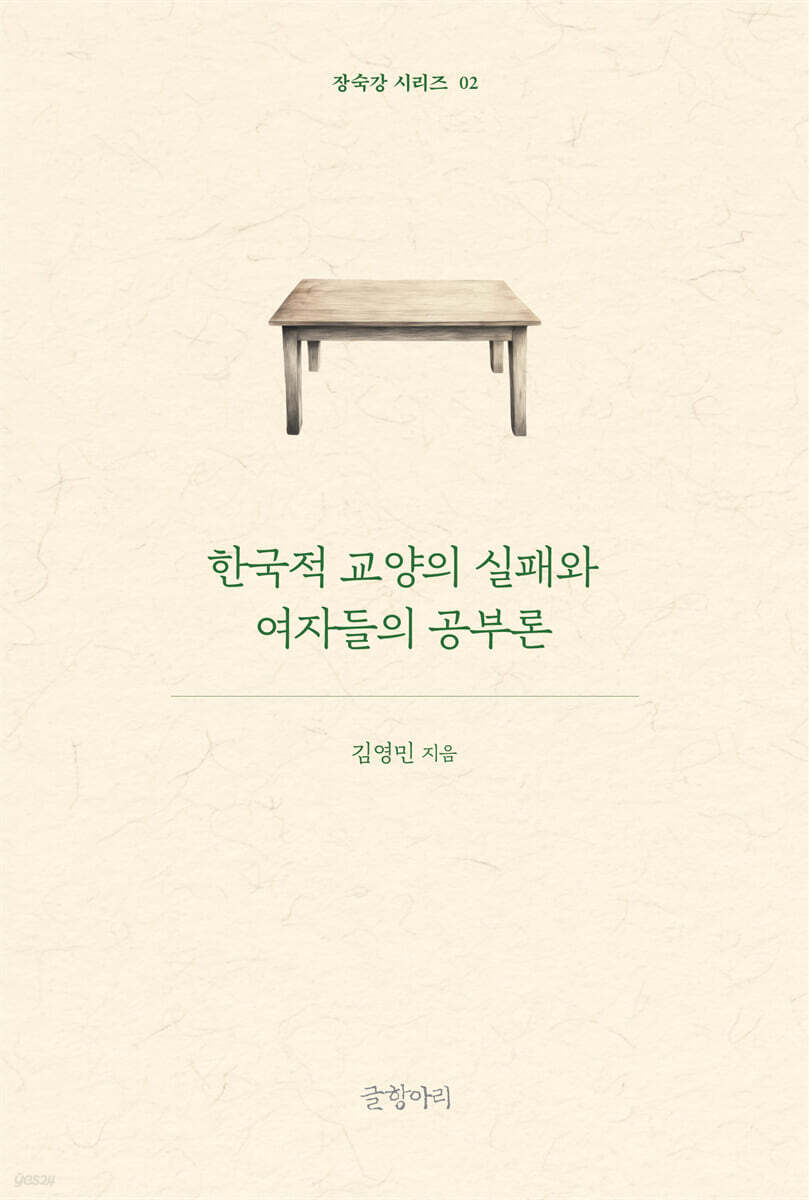
The Failure of Korean Education and Women's Study Theory
 |
Description
Book Introduction
Why Citizens Should Cultivate Ethics in Transaction and a Culture of Hospitality
When society as a whole becomes a market, how do form and procedure become 'spirit'?
Why are 'weak' women so good at studying?
Humanities for the Self-Employed
Trust that must be earned by breaking through the clutter of psychology
Just as writing is a method of studying, speaking is also an important method of studying as a way of 'responding' to others.
The 'Jangsuk River Series' by philosopher Kim Young-min, published by Ggulhangari, aims to provide opportunities for study through writing, meeting others, and speaking.
The second volume of the series, following the first volume, Facing the World with Fragmented Wisdom, consists of nine lectures and points out how superficial and superficial education becomes when it fails to take root in daily life.
Superficiality flourishes where transactional relationships dominate, and in Korea, a paradise for the self-employed, examples of this are common in restaurants, for example.
Lecture 1 talks about the ‘humanities of restaurants.’
Just because you're a self-employed person who's tied up in business all day doesn't mean you lack agency.
Food is the basis of life and an important medium for encounters, so restaurant owners must not only demonstrate professional skills but also have a compassionate understanding of their customers.
But restaurant owners and employees are often caught up in their own emotions.
Some owners have an annoyed expression on their faces, while others yawn when customers order. We need to reflect on what attitudes are tied to the emotions that determine the quality of life.
When you make money through business, your life often has a distorted commercial ethic.
The material infrastructure is often at odds with and creaks with the superstructure that shapes our emotions, fantasies, and habits.
It is not easy to discuss enlightenment when faced with such ingrained emotions and habits.
Nevertheless, the author emphasizes that individuals entering the business must adhere to the universal principles of professional responsibility and the ethics of hospitality.
If they do not treat business merely as a means to amass wealth, they cannot help but find human, ethical, and philosophical rewards in it, and even if it is mere business, if there is etiquette, it can radiate a holy aura.
The spirit that runs throughout this book is 'practicality.'
From that perspective, the humanities of restaurants are also connected to the third lecture, ‘From Not Being Cruel to Trust.’
Trust is the shining pinnacle of human virtue, comparable to the ridge or eaves of a Korean traditional house.
Why trust is important in practical life.
Because it is the key to cost reduction.
However, the trust the author speaks of is not confined to personal feelings or their content.
This is a luminous form, resembling the theatrical performance that the author always emphasizes.
This is a fruit that can be achieved through consistency in maintaining one's own command system, rather than through relationships with others, which arise from the messy and chaotic state of one's own psychology.
Trust bears fruit from such people and eventually shines as ‘ability.’
When society as a whole becomes a market, how do form and procedure become 'spirit'?
Why are 'weak' women so good at studying?
Humanities for the Self-Employed
Trust that must be earned by breaking through the clutter of psychology
Just as writing is a method of studying, speaking is also an important method of studying as a way of 'responding' to others.
The 'Jangsuk River Series' by philosopher Kim Young-min, published by Ggulhangari, aims to provide opportunities for study through writing, meeting others, and speaking.
The second volume of the series, following the first volume, Facing the World with Fragmented Wisdom, consists of nine lectures and points out how superficial and superficial education becomes when it fails to take root in daily life.
Superficiality flourishes where transactional relationships dominate, and in Korea, a paradise for the self-employed, examples of this are common in restaurants, for example.
Lecture 1 talks about the ‘humanities of restaurants.’
Just because you're a self-employed person who's tied up in business all day doesn't mean you lack agency.
Food is the basis of life and an important medium for encounters, so restaurant owners must not only demonstrate professional skills but also have a compassionate understanding of their customers.
But restaurant owners and employees are often caught up in their own emotions.
Some owners have an annoyed expression on their faces, while others yawn when customers order. We need to reflect on what attitudes are tied to the emotions that determine the quality of life.
When you make money through business, your life often has a distorted commercial ethic.
The material infrastructure is often at odds with and creaks with the superstructure that shapes our emotions, fantasies, and habits.
It is not easy to discuss enlightenment when faced with such ingrained emotions and habits.
Nevertheless, the author emphasizes that individuals entering the business must adhere to the universal principles of professional responsibility and the ethics of hospitality.
If they do not treat business merely as a means to amass wealth, they cannot help but find human, ethical, and philosophical rewards in it, and even if it is mere business, if there is etiquette, it can radiate a holy aura.
The spirit that runs throughout this book is 'practicality.'
From that perspective, the humanities of restaurants are also connected to the third lecture, ‘From Not Being Cruel to Trust.’
Trust is the shining pinnacle of human virtue, comparable to the ridge or eaves of a Korean traditional house.
Why trust is important in practical life.
Because it is the key to cost reduction.
However, the trust the author speaks of is not confined to personal feelings or their content.
This is a luminous form, resembling the theatrical performance that the author always emphasizes.
This is a fruit that can be achieved through consistency in maintaining one's own command system, rather than through relationships with others, which arise from the messy and chaotic state of one's own psychology.
Trust bears fruit from such people and eventually shines as ‘ability.’
- You can preview some of the book's contents.
Preview
index
Lecture 1: The Humanities of Restaurants: Toward the Ethics of Transaction and Hospitality
Lecture 2: The Interpreting Human: The Practical Transformation of Conduct and Hermeneutics
Lecture 3: From "Not Being Cruel" to Trust: New Horizons in Social Ethics
The Four-Leaded Theory of Cumulative Cause: Method, Means, Cause, Self-Acquisition, and Salvation
Opening the way with the concept of 5 strong points and enjoying it as poetry
Lecture 6: The "Yoon Seok-yeol Phenomenon" and the Failure of Korean Culture
Lesson 7: Women's Study Theory
Humanities in Writing, Lecture 8
Lesson 9: What is Thought?: Gratitude and the Path of the Heart
Lecture 2: The Interpreting Human: The Practical Transformation of Conduct and Hermeneutics
Lecture 3: From "Not Being Cruel" to Trust: New Horizons in Social Ethics
The Four-Leaded Theory of Cumulative Cause: Method, Means, Cause, Self-Acquisition, and Salvation
Opening the way with the concept of 5 strong points and enjoying it as poetry
Lecture 6: The "Yoon Seok-yeol Phenomenon" and the Failure of Korean Culture
Lesson 7: Women's Study Theory
Humanities in Writing, Lecture 8
Lesson 9: What is Thought?: Gratitude and the Path of the Heart
Into the book
Trust is the unseen fruit of a long practice of promises, and especially the effectiveness of consistency in keeping one's command system.
Trust is a symbol of the formal will to transcend the muddle of psychological content, a message that one's own abilities have been accumulated, and the most efficient way of life that reduces costs both internally and externally and promotes convenience in life.
--- p.25
For example, the restaurants that can be called the idols of restaurants are the ones that are at the forefront of this unethical behavior.
The very message of success called "a good restaurant" is an anti-traditional space for accumulating wealth and showing off, a confusion that roughly excludes humanistic sensibilities and converts the quality of taste into the quantity of money.
Perception is already permeated with evaluation, evaluation has already involved intervention, and each intervention contains the silence and overlap of countless relationships.
--- p.30
Doing and knowing are inseparable, but their relationship is not causal.
Since the truth of that relationship is merely a correlation that cannot guarantee technical effectiveness, Siddhartha denied asceticism in an ironic attitude. However, the fact that he constantly emphasized practice and diligence must have been an acknowledgment of the existence of a somewhat valid correlation on the path of study that has no guarantee of cause and effect.
--- p.37
Knowledge is merely a process that proceeds through countless interactions and dialectical transformations in the flow of life that includes knowing and doing, but we stabilize a cross-section of that flow as knowledge for the sake of the limits of perception and the convenience of application.
(…) Just as the so-called ‘re-description’ method is effective when it is not possible to fix the truth in a single sentence, knowledge, which cannot help but be constantly drawn out or transformed by the actions of life, is already fatefully open to the productivity of (re)interpretation.
The very limitations of knowledge called interpretation are actually spurring its productivity.
--- p.38
The trick is to live life in a practical way and to break through with the spirit of seeking truth from facts.
--- p.49
A good starting point is to not be cruel.
What I am saying is that we should not be (cruel) like Syngman Rhee before April 3, like Chun Doo-hwan before May 18, like Park Geun-hye before Sewol, or like Yoon Seok-yeol before Itaewon.
Helping others requires wisdom and resourcefulness, but not cruelty—a round heart is all that is needed to be 'not cruel', and thus constitutes the lower limit of social ethics.
--- p.55
Therefore, it is wise and sustainable to approach all relationships minimally.
Of these minimum requirements, the most universally applicable and specific is ‘not being cruel.’
The same is true in the ethics of love.
The relationship between love and pleasure is not easy to manage through harmony or moderation, so it tends to slide towards disaster and unhappiness like a falling avalanche.
--- p.65
The attitude of going back to the beginning and being careful at each stage and opportunity of that memory is similar to rebooting in that it attempts to deal with mistakes in actions or errors in preconceptions.
But the human mind is not a computer, and thoughts are not calculations, so this caution also goes back to some impossible zero point, with caution, re-re-re-careful…
Even so, since people themselves are involved in complex and intense processes, there is no way to attain the position of infallible and scrupulously independent thought.
--- p.129
Culture is, first and foremost, a dialogue with the past.
--- p.163
It is about reading and practicing new possibilities for enjoyment and sharing in small solidarities driven by the power of the spirit that is not sold, not forced, and not herded in any way.
--- p.172
If you believe that you are studying when you start reading a book, it is probably nothing more than swimming practice on a tatami mat.
As the path of study becomes longer, self-study naturally becomes the key, the motivation, the topic, and the goal.
Self-sufficiency is like the blood flow of a living being.
It goes without saying that self-sufficiency fosters freedom.
--- p.194
Far beyond questions like, "How can I write well?", writing is an activity that strikes at the very essence of humanism, a boundless effort to transcend humanity itself.
And this driving force of effort is also a worldly pilgrimage of detours, substitutions, supplements, and deviations that weave ceaselessly.
Trust is a symbol of the formal will to transcend the muddle of psychological content, a message that one's own abilities have been accumulated, and the most efficient way of life that reduces costs both internally and externally and promotes convenience in life.
--- p.25
For example, the restaurants that can be called the idols of restaurants are the ones that are at the forefront of this unethical behavior.
The very message of success called "a good restaurant" is an anti-traditional space for accumulating wealth and showing off, a confusion that roughly excludes humanistic sensibilities and converts the quality of taste into the quantity of money.
Perception is already permeated with evaluation, evaluation has already involved intervention, and each intervention contains the silence and overlap of countless relationships.
--- p.30
Doing and knowing are inseparable, but their relationship is not causal.
Since the truth of that relationship is merely a correlation that cannot guarantee technical effectiveness, Siddhartha denied asceticism in an ironic attitude. However, the fact that he constantly emphasized practice and diligence must have been an acknowledgment of the existence of a somewhat valid correlation on the path of study that has no guarantee of cause and effect.
--- p.37
Knowledge is merely a process that proceeds through countless interactions and dialectical transformations in the flow of life that includes knowing and doing, but we stabilize a cross-section of that flow as knowledge for the sake of the limits of perception and the convenience of application.
(…) Just as the so-called ‘re-description’ method is effective when it is not possible to fix the truth in a single sentence, knowledge, which cannot help but be constantly drawn out or transformed by the actions of life, is already fatefully open to the productivity of (re)interpretation.
The very limitations of knowledge called interpretation are actually spurring its productivity.
--- p.38
The trick is to live life in a practical way and to break through with the spirit of seeking truth from facts.
--- p.49
A good starting point is to not be cruel.
What I am saying is that we should not be (cruel) like Syngman Rhee before April 3, like Chun Doo-hwan before May 18, like Park Geun-hye before Sewol, or like Yoon Seok-yeol before Itaewon.
Helping others requires wisdom and resourcefulness, but not cruelty—a round heart is all that is needed to be 'not cruel', and thus constitutes the lower limit of social ethics.
--- p.55
Therefore, it is wise and sustainable to approach all relationships minimally.
Of these minimum requirements, the most universally applicable and specific is ‘not being cruel.’
The same is true in the ethics of love.
The relationship between love and pleasure is not easy to manage through harmony or moderation, so it tends to slide towards disaster and unhappiness like a falling avalanche.
--- p.65
The attitude of going back to the beginning and being careful at each stage and opportunity of that memory is similar to rebooting in that it attempts to deal with mistakes in actions or errors in preconceptions.
But the human mind is not a computer, and thoughts are not calculations, so this caution also goes back to some impossible zero point, with caution, re-re-re-careful…
Even so, since people themselves are involved in complex and intense processes, there is no way to attain the position of infallible and scrupulously independent thought.
--- p.129
Culture is, first and foremost, a dialogue with the past.
--- p.163
It is about reading and practicing new possibilities for enjoyment and sharing in small solidarities driven by the power of the spirit that is not sold, not forced, and not herded in any way.
--- p.172
If you believe that you are studying when you start reading a book, it is probably nothing more than swimming practice on a tatami mat.
As the path of study becomes longer, self-study naturally becomes the key, the motivation, the topic, and the goal.
Self-sufficiency is like the blood flow of a living being.
It goes without saying that self-sufficiency fosters freedom.
--- p.194
Far beyond questions like, "How can I write well?", writing is an activity that strikes at the very essence of humanism, a boundless effort to transcend humanity itself.
And this driving force of effort is also a worldly pilgrimage of detours, substitutions, supplements, and deviations that weave ceaselessly.
--- p.199~200
Publisher's Review
Humans, beings of mind and speech, live in a room of interpretation.
Philosophy is not about convergence into a system, but about diffusion.
Lecture 2, “The Interpreting Man,” does not deal with hermeneutics in the academic context discussed by Gadamer or Nietzsche.
As spiritual beings, humans already interpret and intervene in everything.
Looking back, decisions that lead to destruction or experiences that took us to the pinnacle of civilization were the result of a slight difference in interpretation.
Any text is incomplete and ambiguous, and therefore its interpretation is bound to be problematic.
The wisest approach to interpretation is always to be cautious, and the author's hermeneutics also follows a pragmatic perspective.
Interpretation is not just a matter of perception or understanding, but a complex thing that involves action.
Therefore, the author says that 'action and knowledge' condenses the truth of the situation.
If action and knowledge are thus intertwined, then just as knowledge is constantly transformed through re-description, interpretation can also be constantly re-created, thus spurring its own productivity.
Humans are, above all, beings who live in a room of interpretation, clothed in the clothes of the mind and words.
But prejudices are like traps that hang over our lives, delusions are like the air we breathe, and in the meantime, each individual pushes forward the ideology he or she has adopted in one direction.
Therefore, to view interpretation from the perspective of practice, we must constantly move away from convergence to a system and achieve 'diffusion' by permeating knowledge into life.
The moment philosophy becomes systematized, its practical aspect is degraded and risks becoming separated from life.
A human being can fall into the abyss with just one wrong interpretation.
So, what we must always remember is that interpretation is our responsibility.
But in life, most interpretations lie in a gray area that makes it easy to avoid responsibility.
This is because the degree, scope, and depth of the mutual intervention between the interpreter and the text, the subject and object, are so limitless that they cannot be measured.
Therefore, I recommend that you take the step of self-purification by maintaining the humility of “I don’t know” in everything and speaking in the direction of practicality.
A study of women who care for themselves and change their surroundings.
As the title suggests, this book deals with the intense study that women do outside of college.
Even in the study group led by the author, while the men were losing their presence, the women came in and grew their presence to the point of creating cracks in the existing landscape.
The author has previously discussed his experiences of how studying with women changed his body, and in Chapter 8, he explores how women are awakening to the potential of rhizomatic activities toward self-improvement, solidarity, and social change.
Because women have been marginalized for a long time in shaping the spiritual and cultural landscape, they have become well-versed in the principles and sensibilities of the lower echelons of the world of life, and have become adept at communicative compromise rather than functional perfection.
Women “sublimate and translate the evolutionary premise of reproduction into libidinal classification and the power of love through a civilized and cultural detour,” and even when men destroy everything in war, they smile cheerfully, preparing the zero degree for a new beginning.
The studies that women do outside of college are a laborious endeavor that involves looking beyond life and into life itself.
Above all, they are moving forward as the main subjects of study, trying to change their body's system and habits while carrying their husbands and children on their backs.
The author says that studying is something that is only for the weak.
Women show superior learning abilities compared to men, and in order to change the existing mental landscape established by strong men, they must devote themselves to studying above all else.
Here again, practicality is emphasized.
Learning for self-transformation and self-salvation is, above all, a matter of penetrating the principles of practicality.
Women are the historical figures who have mastered the practicalities of life, and their attitudes of wise submission and dominance, necessary for learning, always sparkle with a humanistic sensibility.
Women are embodying the previously emphasized "I don't know, I don't know, I don't know," and are opening their own paths of study with the sedimentation and flexibility of their experiences as weak.
Just as the first volume of the Jang Sook-gang series dealt with several politicians, the sixth chapter of this book examines the failure of Korean culture through politicians.
The 'Yoon Seok-yeol phenomenon' that has recently surfaced like a tumor can be seen as our own image, not that of others, rising to the surface of society.
Writing classes are held every time, but the repetition becomes broader and deeper, encouraging those who do not write to get back into writing.
Writing is something we must do every day, for it is a practice that goes beyond a tool for study and encompasses the depth of human desire.
The lecture on writing leads into the lecture on 'What is Thought?', guiding us into a deeper world of study.
Philosophy is not about convergence into a system, but about diffusion.
Lecture 2, “The Interpreting Man,” does not deal with hermeneutics in the academic context discussed by Gadamer or Nietzsche.
As spiritual beings, humans already interpret and intervene in everything.
Looking back, decisions that lead to destruction or experiences that took us to the pinnacle of civilization were the result of a slight difference in interpretation.
Any text is incomplete and ambiguous, and therefore its interpretation is bound to be problematic.
The wisest approach to interpretation is always to be cautious, and the author's hermeneutics also follows a pragmatic perspective.
Interpretation is not just a matter of perception or understanding, but a complex thing that involves action.
Therefore, the author says that 'action and knowledge' condenses the truth of the situation.
If action and knowledge are thus intertwined, then just as knowledge is constantly transformed through re-description, interpretation can also be constantly re-created, thus spurring its own productivity.
Humans are, above all, beings who live in a room of interpretation, clothed in the clothes of the mind and words.
But prejudices are like traps that hang over our lives, delusions are like the air we breathe, and in the meantime, each individual pushes forward the ideology he or she has adopted in one direction.
Therefore, to view interpretation from the perspective of practice, we must constantly move away from convergence to a system and achieve 'diffusion' by permeating knowledge into life.
The moment philosophy becomes systematized, its practical aspect is degraded and risks becoming separated from life.
A human being can fall into the abyss with just one wrong interpretation.
So, what we must always remember is that interpretation is our responsibility.
But in life, most interpretations lie in a gray area that makes it easy to avoid responsibility.
This is because the degree, scope, and depth of the mutual intervention between the interpreter and the text, the subject and object, are so limitless that they cannot be measured.
Therefore, I recommend that you take the step of self-purification by maintaining the humility of “I don’t know” in everything and speaking in the direction of practicality.
A study of women who care for themselves and change their surroundings.
As the title suggests, this book deals with the intense study that women do outside of college.
Even in the study group led by the author, while the men were losing their presence, the women came in and grew their presence to the point of creating cracks in the existing landscape.
The author has previously discussed his experiences of how studying with women changed his body, and in Chapter 8, he explores how women are awakening to the potential of rhizomatic activities toward self-improvement, solidarity, and social change.
Because women have been marginalized for a long time in shaping the spiritual and cultural landscape, they have become well-versed in the principles and sensibilities of the lower echelons of the world of life, and have become adept at communicative compromise rather than functional perfection.
Women “sublimate and translate the evolutionary premise of reproduction into libidinal classification and the power of love through a civilized and cultural detour,” and even when men destroy everything in war, they smile cheerfully, preparing the zero degree for a new beginning.
The studies that women do outside of college are a laborious endeavor that involves looking beyond life and into life itself.
Above all, they are moving forward as the main subjects of study, trying to change their body's system and habits while carrying their husbands and children on their backs.
The author says that studying is something that is only for the weak.
Women show superior learning abilities compared to men, and in order to change the existing mental landscape established by strong men, they must devote themselves to studying above all else.
Here again, practicality is emphasized.
Learning for self-transformation and self-salvation is, above all, a matter of penetrating the principles of practicality.
Women are the historical figures who have mastered the practicalities of life, and their attitudes of wise submission and dominance, necessary for learning, always sparkle with a humanistic sensibility.
Women are embodying the previously emphasized "I don't know, I don't know, I don't know," and are opening their own paths of study with the sedimentation and flexibility of their experiences as weak.
Just as the first volume of the Jang Sook-gang series dealt with several politicians, the sixth chapter of this book examines the failure of Korean culture through politicians.
The 'Yoon Seok-yeol phenomenon' that has recently surfaced like a tumor can be seen as our own image, not that of others, rising to the surface of society.
Writing classes are held every time, but the repetition becomes broader and deeper, encouraging those who do not write to get back into writing.
Writing is something we must do every day, for it is a practice that goes beyond a tool for study and encompasses the depth of human desire.
The lecture on writing leads into the lecture on 'What is Thought?', guiding us into a deeper world of study.
GOODS SPECIFICS
- Date of issue: November 17, 2025
- Page count, weight, size: 256 pages | 352g | 135*200*16mm
- ISBN13: 9791169094450
You may also like
카테고리
korean


korean

![GQ KOREA Mark (Monthly): December [2025]](http://librairie.coreenne.fr/cdn/shop/files/8ef265dbbfbf186523ed75ba7319009d.jpg?v=1765340328&width=3840)


