

come across
 |
Description
Book Introduction
EBS [Documentary Prime] [Knowledge Channel e] Director and
Kim Hyun-woo, translator of John Berger and Rebecca Solnit,
Crossing the 'borders' and traveling through the 'gaps' of 38 cities in 17 countries
The real world he passed through!
If you look closely, documentary producers and translators have strangely similar jobs.
The former allows for the expansion of space and time to the fullest extent, while the latter is different in that the condensed space of text is fixed, but the actions that take place within it are similar.
In the sense of ‘reading and recording’.
The former delicately observes the gaps between worldly affairs and human history and captures them in images, while the latter transcends linguistic boundaries and even highlights the subtle differences between the lines.
It is a job that requires intelligence, sensitivity, observation, and judgment.
Here's someone who does both of these things as a career.
[The Secret of 4 Billion Years of Life] (selected as the 'Good Program of the Month' by the Korea Communications Standards Commission in November 2011) which goes back in time using 'fossils' discovered all over the world to trace life from the beginning to the present, [Growing Pains] which is filled with interviews of various people without narration under the theme of 'human growth is endless', and [Confession of a School] (winner of the 25th Korea PD Awards TV Work Award in the Culture and Information category) which visits a school that has revealed its painful inner self and captures the intense concerns of the field are all documentaries that were aired on EBS [Documentary Prime].
The common point is that the director is the same person.
The translator of delicate and intellectual works such as John Berger's "Lucky Man," "A to X," and "Understanding Photography," Rebecca Solnit's "Far and Near," and Nicole Krauss's "The Great House" is also the same person. EBS producer and translator Kim Hyun-woo.
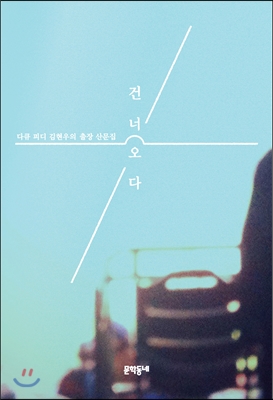
"Crossing" is a collection of writings by producer Kim Hyun-woo, written while traveling around the world for documentary planning and filming, and in between, for travel-like trips.
Among the many business trip destinations, we selected 38 cities in 17 countries, including familiar places like Paris, France and London, England, as well as somewhat unfamiliar places like Lawrence, Ann Arbor, and Missoula in the United States, Mount Isa in Australia, and Anilao in the Philippines.
It also includes records of Annecy, France, which he remembers as “not far from Haute-Savoie, where John Berger, the author he has been consistently translating for over a decade, lives,” and Bianwenjin and Qinhuangdao in China, which served as the background for his most recent film, [Kim Yeon-su’s Diary of a Journey to the West].
These are names that are difficult to come across in typical travel essays.
The author crosses the various 'boundaries' and 'gaps' of life, people, and the world in these familiar yet unfamiliar places, leading readers into a world of 'reality' that is on a different level from what one can read or hear about.
Kim Hyun-woo, translator of John Berger and Rebecca Solnit,
Crossing the 'borders' and traveling through the 'gaps' of 38 cities in 17 countries
The real world he passed through!
If you look closely, documentary producers and translators have strangely similar jobs.
The former allows for the expansion of space and time to the fullest extent, while the latter is different in that the condensed space of text is fixed, but the actions that take place within it are similar.
In the sense of ‘reading and recording’.
The former delicately observes the gaps between worldly affairs and human history and captures them in images, while the latter transcends linguistic boundaries and even highlights the subtle differences between the lines.
It is a job that requires intelligence, sensitivity, observation, and judgment.
Here's someone who does both of these things as a career.
[The Secret of 4 Billion Years of Life] (selected as the 'Good Program of the Month' by the Korea Communications Standards Commission in November 2011) which goes back in time using 'fossils' discovered all over the world to trace life from the beginning to the present, [Growing Pains] which is filled with interviews of various people without narration under the theme of 'human growth is endless', and [Confession of a School] (winner of the 25th Korea PD Awards TV Work Award in the Culture and Information category) which visits a school that has revealed its painful inner self and captures the intense concerns of the field are all documentaries that were aired on EBS [Documentary Prime].
The common point is that the director is the same person.
The translator of delicate and intellectual works such as John Berger's "Lucky Man," "A to X," and "Understanding Photography," Rebecca Solnit's "Far and Near," and Nicole Krauss's "The Great House" is also the same person. EBS producer and translator Kim Hyun-woo.
"Crossing" is a collection of writings by producer Kim Hyun-woo, written while traveling around the world for documentary planning and filming, and in between, for travel-like trips.
Among the many business trip destinations, we selected 38 cities in 17 countries, including familiar places like Paris, France and London, England, as well as somewhat unfamiliar places like Lawrence, Ann Arbor, and Missoula in the United States, Mount Isa in Australia, and Anilao in the Philippines.
It also includes records of Annecy, France, which he remembers as “not far from Haute-Savoie, where John Berger, the author he has been consistently translating for over a decade, lives,” and Bianwenjin and Qinhuangdao in China, which served as the background for his most recent film, [Kim Yeon-su’s Diary of a Journey to the West].
These are names that are difficult to come across in typical travel essays.
The author crosses the various 'boundaries' and 'gaps' of life, people, and the world in these familiar yet unfamiliar places, leading readers into a world of 'reality' that is on a different level from what one can read or hear about.
- You can preview some of the book's contents.
Preview
index
//I think a different life landscape than before is possible
Paris, France_Are you down there?
Annecy, France - This is all you need
Moscow, Russia: When will the mind catch up with reality?
Mount Isa, Australia - Sometimes it feels unreal
Tasmania, Australia: The End of the World, or the Beginning of Another World
Cannes, France - A Not-So-Great Bike Trip
//The moment of continuous movement
USA_Empty Times
Lawrence, USA_Barbecue with a couple of international students of the same age
Lawrence 2_KU Lawn and Broken Glider, USA
Lawrence 3, USA_Dusty Bookshelf's cat and the Kansas-only hamburger
Ann Arbor, USA - The traffic light is not at fault.
American Waltz_It'll be the same scenery for twelve hours.
Baltimore, USA - I was just trying to make it, but somehow I ended up eating it all.
New York, USA - Watching Major League Baseball in person
New Haven, USA_You should be!
The name Missoula Felicity in the United States
Los Angeles, USA_Free Time
London, England - That's what it was like back then
Florence, Italy_A Night Like a Gift
Anilao, Philippines_I'm scared because I imagine it.
Kota Kinabalu, Malaysia_The sky is full of stars.
Okayama, Japan - A chimpanzee often looks into the distance
Balkan Peninsula_All three windows were closed
Chiang Mai, Thailand_Not even seeing the report
Okinawa, Japan - the name 'Kokuba Nanko'
Macau, China - Will all those wishes come true?
San Francisco, USA - I am the sum of my choices.
//Memories don't remain unless you deliberately engrave them in your mind.
Kyushu, Japan: Abandoned Space and Time
Leipzig, Germany: The human body needs touch.
Tokyo, Japan - Will it be a horned trilobite or a shrunken trilobite?
Osaka, Japan_Some straight lines are sad
Dandong, China_People living on the border
China's Bian Wenjin_Crossing the border with a cigarette in Changbai Mountain
What to carry when crossing the border of Jinhuangdao, China
Amsterdam, Netherlands_This is what happened
Epilogue
Paris, France_Are you down there?
Annecy, France - This is all you need
Moscow, Russia: When will the mind catch up with reality?
Mount Isa, Australia - Sometimes it feels unreal
Tasmania, Australia: The End of the World, or the Beginning of Another World
Cannes, France - A Not-So-Great Bike Trip
//The moment of continuous movement
USA_Empty Times
Lawrence, USA_Barbecue with a couple of international students of the same age
Lawrence 2_KU Lawn and Broken Glider, USA
Lawrence 3, USA_Dusty Bookshelf's cat and the Kansas-only hamburger
Ann Arbor, USA - The traffic light is not at fault.
American Waltz_It'll be the same scenery for twelve hours.
Baltimore, USA - I was just trying to make it, but somehow I ended up eating it all.
New York, USA - Watching Major League Baseball in person
New Haven, USA_You should be!
The name Missoula Felicity in the United States
Los Angeles, USA_Free Time
London, England - That's what it was like back then
Florence, Italy_A Night Like a Gift
Anilao, Philippines_I'm scared because I imagine it.
Kota Kinabalu, Malaysia_The sky is full of stars.
Okayama, Japan - A chimpanzee often looks into the distance
Balkan Peninsula_All three windows were closed
Chiang Mai, Thailand_Not even seeing the report
Okinawa, Japan - the name 'Kokuba Nanko'
Macau, China - Will all those wishes come true?
San Francisco, USA - I am the sum of my choices.
//Memories don't remain unless you deliberately engrave them in your mind.
Kyushu, Japan: Abandoned Space and Time
Leipzig, Germany: The human body needs touch.
Tokyo, Japan - Will it be a horned trilobite or a shrunken trilobite?
Osaka, Japan_Some straight lines are sad
Dandong, China_People living on the border
China's Bian Wenjin_Crossing the border with a cigarette in Changbai Mountain
What to carry when crossing the border of Jinhuangdao, China
Amsterdam, Netherlands_This is what happened
Epilogue
Into the book
There really was a country called England that I had only heard of.
It goes without saying, but I realized that accepting something as it really is is on a whole different level from reading or hearing about it.
This obvious fact is surprisingly often ignored.
---From "Paris, France | Are you down there?"
I no longer wonder about my 'place'.
There is no such thing as a position that I 'want to be'.
This is because I came to realize that such a position is not a 'goal' to run towards, but rather a 'result' created by accumulating the time spent acknowledging myself moment by moment.
And before that, I learned that there is no secret to becoming what I want to be.
Once you know that, you can make peace with me.
From then on, I tried to stick to the things I was good at and the things I enjoyed doing, and not do things I couldn't do and things that made me feel like I wasn't myself anymore if I did them.
---From "Paris, France | Are you down there?"
I always envy people who have something to say, and above all, the courage to say, "This is all I need."
---From "Annecy, France | This is all you need"
How long does it take to feel safe in a certain place? What else is needed besides time?
---From "Moscow, Russia | When Does the Heart Catch Up with Reality"
There are many cases where looking at a river or the sea provides comfort and confirmation that certain events have passed.
If that water is from a travel destination far from my daily life, the thought that a 'different' life landscape from the one I've seen so far is even stronger, as the daily life is not visible.
Perhaps it is because of this expectation that people feel the real impact of traveling by the water and that travel destinations often emphasize 'water'.
Conversely, the ever-burning fire symbolizes that some things will never disappear.
A fire that symbolizes that some things must not be forgotten, and that losing them means losing a part of myself.
If life is such a mixture of water and fire, what must we forget and what must we remember to live a balanced life?
---"Moscow, Russia | When Will the Heart Catch Up with Reality?"
In my late twenties, I was not what I wanted to be as a teenager.
It seemed clear that it couldn't be that way.
I couldn't belong to any world I wanted to belong to.
That frustration may have turned into a disgust for the 'indifference' of the people in that world.
At that time, I was standing like that.
Because I couldn't help but think that I had been destroyed by such indifferent people.
At that time, I was moving not with the power of liking something, but with the energy of disliking something.
Because the world was 'that kind of', there was nothing I wanted to do in that world.
---From "Cannes, France | A Not-So-Great Bicycle Trip"
The reason I want to give a reason to every moment, or rather every time, is because I think I am moving toward some 'meaning', so that my past and future can be 'consistently' connected.
That's how life should be, I think, at least until I was in my thirties.
I couldn't stand the empty time, so I tried to give it some kind of meaning.
I was so tired.
---From "Los Angeles, USA | Empty Time"
I came to the diving house with the thought that trying anything is better than not trying anything, so I just wanted to try diving.
Since there were two other guests besides us, we decided to take a brief introductory skin scuba diving course together and then go into the water.
The Korean instructor, who was explaining breathing techniques, hand and foot movements, and simple underwater communication techniques, added at the end that the water was not scary.
Since we had never been there before, we could only imagine how scary it would be, but once we actually went in, there was nothing to be afraid of, and that was how we were reassured as we were about to enter the water, which looked dark from above.
It's scary because you imagine it.
Because I imagine… …
---From "Anilao, Philippines | I'm Afraid Because I Imagine"
Something that doesn't change and always stays in the same place is comforting.
If you think about it, most of the things that hurt us are changes.
Every time something that was there disappears and something new comes into being that was not there before, we feel regret.
As comfortable as it is to be 'tamed', it is frustrating and sometimes painful to have to break away from it against one's will.
It hurts when someone I loved leaves, it's sad when my hair turns white, and I can't help but be afraid of the new things I have to do tomorrow.
The reason I was afraid of the cars passing us on the forest roads in Kota Kinabalu was because I was not yet accustomed to them.
But the sky above the road was filled with stars that seemed ready to pour down.
The comfort of the stars, who are like reliable friends, always there, unchanging.
'are you okay.
The comfort of the stars who say, 'No matter what changes you've gone through so far or how much more changes you'll go through in the future, we'll still be here,' as if they were truly 'proud.'
---From "Kota Kinabalu, Malaysia | There Are Many Stars in the Sky"
If you feel sorry for being abandoned, it is because you believe that humans are not indifferent.
At the Nagasaki Atomic Bomb Memorial Park stands a pillar removed from the bombed cathedral.
The remains of Urakami Cathedral, which was the largest cathedral in Asia before being bombed, were moved here.
It seemed like a monument erected by a human being who was not indifferent, expressing regret for the things he had not actively protected, and promising that no one would fall victim to such indifference in the future.
Of course, things like memories and promises are sometimes too powerless.
There will be times when we have no choice but to become indifferent again, and then the powerlessness of that promise or memory will be clearly revealed.
The saying that history repeats itself seems to be somewhat true.
However, it is also undeniable that history has progressed, however slowly, in the direction of gradually believing more and more in the power of 'memory' and 'promise'.
---From "Kyushu, Japan | Abandoned Space and Time"
Just as the straight lines of the Hirano River, which were developed by Korean immigrants in Osaka, hide countless curves within them, some silences contain many words.
To understand someone is to read the curves in the straight lines they show and to hear the unspoken words in their silence.
It takes effort, and love is the willingness to put in that effort.
It goes without saying, but I realized that accepting something as it really is is on a whole different level from reading or hearing about it.
This obvious fact is surprisingly often ignored.
---From "Paris, France | Are you down there?"
I no longer wonder about my 'place'.
There is no such thing as a position that I 'want to be'.
This is because I came to realize that such a position is not a 'goal' to run towards, but rather a 'result' created by accumulating the time spent acknowledging myself moment by moment.
And before that, I learned that there is no secret to becoming what I want to be.
Once you know that, you can make peace with me.
From then on, I tried to stick to the things I was good at and the things I enjoyed doing, and not do things I couldn't do and things that made me feel like I wasn't myself anymore if I did them.
---From "Paris, France | Are you down there?"
I always envy people who have something to say, and above all, the courage to say, "This is all I need."
---From "Annecy, France | This is all you need"
How long does it take to feel safe in a certain place? What else is needed besides time?
---From "Moscow, Russia | When Does the Heart Catch Up with Reality"
There are many cases where looking at a river or the sea provides comfort and confirmation that certain events have passed.
If that water is from a travel destination far from my daily life, the thought that a 'different' life landscape from the one I've seen so far is even stronger, as the daily life is not visible.
Perhaps it is because of this expectation that people feel the real impact of traveling by the water and that travel destinations often emphasize 'water'.
Conversely, the ever-burning fire symbolizes that some things will never disappear.
A fire that symbolizes that some things must not be forgotten, and that losing them means losing a part of myself.
If life is such a mixture of water and fire, what must we forget and what must we remember to live a balanced life?
---"Moscow, Russia | When Will the Heart Catch Up with Reality?"
In my late twenties, I was not what I wanted to be as a teenager.
It seemed clear that it couldn't be that way.
I couldn't belong to any world I wanted to belong to.
That frustration may have turned into a disgust for the 'indifference' of the people in that world.
At that time, I was standing like that.
Because I couldn't help but think that I had been destroyed by such indifferent people.
At that time, I was moving not with the power of liking something, but with the energy of disliking something.
Because the world was 'that kind of', there was nothing I wanted to do in that world.
---From "Cannes, France | A Not-So-Great Bicycle Trip"
The reason I want to give a reason to every moment, or rather every time, is because I think I am moving toward some 'meaning', so that my past and future can be 'consistently' connected.
That's how life should be, I think, at least until I was in my thirties.
I couldn't stand the empty time, so I tried to give it some kind of meaning.
I was so tired.
---From "Los Angeles, USA | Empty Time"
I came to the diving house with the thought that trying anything is better than not trying anything, so I just wanted to try diving.
Since there were two other guests besides us, we decided to take a brief introductory skin scuba diving course together and then go into the water.
The Korean instructor, who was explaining breathing techniques, hand and foot movements, and simple underwater communication techniques, added at the end that the water was not scary.
Since we had never been there before, we could only imagine how scary it would be, but once we actually went in, there was nothing to be afraid of, and that was how we were reassured as we were about to enter the water, which looked dark from above.
It's scary because you imagine it.
Because I imagine… …
---From "Anilao, Philippines | I'm Afraid Because I Imagine"
Something that doesn't change and always stays in the same place is comforting.
If you think about it, most of the things that hurt us are changes.
Every time something that was there disappears and something new comes into being that was not there before, we feel regret.
As comfortable as it is to be 'tamed', it is frustrating and sometimes painful to have to break away from it against one's will.
It hurts when someone I loved leaves, it's sad when my hair turns white, and I can't help but be afraid of the new things I have to do tomorrow.
The reason I was afraid of the cars passing us on the forest roads in Kota Kinabalu was because I was not yet accustomed to them.
But the sky above the road was filled with stars that seemed ready to pour down.
The comfort of the stars, who are like reliable friends, always there, unchanging.
'are you okay.
The comfort of the stars who say, 'No matter what changes you've gone through so far or how much more changes you'll go through in the future, we'll still be here,' as if they were truly 'proud.'
---From "Kota Kinabalu, Malaysia | There Are Many Stars in the Sky"
If you feel sorry for being abandoned, it is because you believe that humans are not indifferent.
At the Nagasaki Atomic Bomb Memorial Park stands a pillar removed from the bombed cathedral.
The remains of Urakami Cathedral, which was the largest cathedral in Asia before being bombed, were moved here.
It seemed like a monument erected by a human being who was not indifferent, expressing regret for the things he had not actively protected, and promising that no one would fall victim to such indifference in the future.
Of course, things like memories and promises are sometimes too powerless.
There will be times when we have no choice but to become indifferent again, and then the powerlessness of that promise or memory will be clearly revealed.
The saying that history repeats itself seems to be somewhat true.
However, it is also undeniable that history has progressed, however slowly, in the direction of gradually believing more and more in the power of 'memory' and 'promise'.
---From "Kyushu, Japan | Abandoned Space and Time"
Just as the straight lines of the Hirano River, which were developed by Korean immigrants in Osaka, hide countless curves within them, some silences contain many words.
To understand someone is to read the curves in the straight lines they show and to hear the unspoken words in their silence.
It takes effort, and love is the willingness to put in that effort.
---From "Osaka, Japan | Some straight lines are sad"
Publisher's Review
What is your story?
"A story about all of us who pause for a moment in our busy daily lives and look up at the sky."
_Kim Yeon-su (novelist)
"Travelers seeking human stories might do well to set out on their journey while gazing up at this constellation."
_Jo Hae-jin (novelist)
The world that PD Kim Hyun-woo records can be expressed in one question.
“What is your story?” is the question.
Here, 'you' would also include 'myself'.
The same word has different meanings to people in different situations.
A word that is so ordinary and common to some may be a painful word to others that they cannot even bring themselves to say it.
'Needle', 'finger', 'fire', 'wind' - these ordinary words may have as many meanings as there are people in the world.
Perhaps education is the process of enabling the languages of such different individuals to communicate.
A process of training the imagination to understand the meaning and reasons behind a word to others in different situations.
But there are some meanings that are beyond the imagination of ordinary people, and there are cases where we can never feel them together.
When we recognize that such a wall exists, and when we experience an insurmountable wall despite our best efforts to understand the other person, we become either cynical or humble, depending on our personality.
I wasn't humble until I interviewed that kid.
What the children of Cheongju School for the Blind showed me in Thailand was beyond my imagination, and my worries before departure were unfounded.
There are worlds that even people with two eyes cannot see.
That fact was 'shown' by children who could not see ahead.
Page 158, "Chiang Mai, Thailand | Not even seeing the report"
A few years ago, he went to Chiang Mai with students from Cheongju School for the Blind.
At Thailand's Elephant Nature Park, blind children were filmed touching, feeding, and washing elephants, and then sculpting their own elephants out of clay.
By capturing the special art classes taught to children who are blind, the author was able to see a world he had never seen before going on a shoot.
Dandong, where China and North Korea face each other across the Yalu River, gave him a realistic glimpse into the lives of "people living on the border."
I was retracing the journey of novelist Kim Yeon-su and 『Yeolha Diary』.
Boundaries are drawn by decisions made by people who see each other as exclusive, most of them from far away from the boundaries.
But for those living on the edge, that line, that exclusivity, is just a condition of life, or another opportunity.
Life, which is not as clear as a boundary, does not flow smoothly like a line drawn from so far away.
Such a life moves without rest, just like the instructor's business items change.
always.
On the day I left Dandong, I left the hotel at 4 a.m. to capture the sunrise.
On the riverside road running along the Yalu River, there were only a few people doing their morning exercise, but most people were not yet awake.
Perhaps because people were missing, North Korea across the river seemed much closer than it had been the day before.
Perhaps it was because there were no people? The quiet roads and anchored boats, the scenery before the people's time began, was equally dark.
At that time, it could not be said that there was a division between this side and that side of the border.
Page 232, "Dandong, China | People Living on the Border"
In Okinawa, I stopped by the Himeyuri Tower.
A place to commemorate the 130 female students between the ages of thirteen and nineteen who were mobilized for combat and died.
Producer Kim Hyun-woo said that he couldn't shake off the thought of 'outsiders' there.
“The idea that those on the periphery are always sacrificed, that individuals on the periphery are not accepted as individuals but are only seen as concepts or numbers,” he said. What Okinawa needs to remember is the names of each of the female students.
The author believes that Okinawa's role is to instill this awareness.
As we follow his calm and contemplative sentences, which do not simply see the phenomenon before our eyes, but are 'conscious' of the history of the environment and the history of the individual that created the phenomenon with a delicate sensibility, we come closer to the simple yet easy-to-forget truth that not only the time spent on a trip, but also every moment of ordinary daily life can actually become a milestone that awakens me and expands my world.
‘I think that a different life landscape from before might be possible.’
What defines a human being
Not what he wants, not what he strives to have
He can't bring himself to throw it away
Traveling doesn't always add newness to life.
When we travel, we often encounter things that delight us, things that excite us, things we cannot give up, and things that remain inside us when we empty ourselves.
The answer given by the unfamiliar language, climate, and people is often closer to the latter.
If, like producer Kim Hyun-woo, I were to keenly consider where my age, in my early forties, lies in life, I would be even more attentive to the answer.
If youth is the time when you think about what you want to have or be, and work hard to get them or become them, then my youth is probably over.
At some point, I stopped trying to add new aspects to my appearance.
Instead, I worry more about how I can protect what I have.
Just because you're trying to protect me doesn't mean I'm just sitting still.
Decisions are needed there too.
If the environment changes and you cannot remain yourself in that changing environment, then leaving that environment is also a solution.
The fact that I am increasingly considering such decisions may also be due to my age.
Because, looking at myself and the people around me, I feel that the age of forty is the last time I can make such a 'decision'.
Here, reality means 'feeling it with the body'.
Page 211, 'Tokyo, Japan | Will it be a horned trilobite or a shrunken trilobite?'
'It ended up like this.'
Now I'm at an age where I have to say that too.
To borrow John Berger's expression, in front of his paintings, 'the inner memories that my body evoked' led to those words.
There is no need to tell the story in detail.
There was a time when I only thought about the 'bright light', and there was a time when I lived in darkness after that light went out, and now I can only say that I have come to recognize that state where light and shadow coexist, and that I have no choice but to recognize and accept even the dark parts hidden by the shadows.
Once you understand that light and shadow are always together, that one cannot exist without the other, and that you can capture them both in a single frame, you can understand that Rembrandt's self-portrait's expression is not just one of resignation.
The sentence 'It turned out like this' is not entirely directed towards the past.
That heart is still, though it cannot be said to be always, turned towards the future.
People cannot help but envision the days to come, or the days remaining, without any ‘expectations.’
That is a feeling that only someone who has finally reconciled with himself, who was both bright and dark, can have, knowing that light and shadow coexist.
-Pages 249-250, 'Amsterdam, Netherlands | This is what happened.'
Producer Kim Hyun-woo says that if I don't face myself as myself and acknowledge the self I face, "my life will be forever distorted."
If I can cherish the things within me that I cannot discard and empty out the rest, then there will be room for the stories of others.
Also, through such a process, the boundaries within me will gradually expand.
“I don’t know what lies beyond the border, so I am afraid and often exhausted, but I have no choice but to endure the dizziness of crossing the border.
Thankfully, if there is someone crossing with you, hold their hand tightly and do that… … ”
Recommendation
The world that PD Kim Hyun-woo sees is complete.
The world is vast and beautiful, and the people are peaceful and happy.
Even if you get angry, it's a place where you'll eventually get over it.
According to him, this whole world comforts us even as we change.
Just like the message from the stars he looked up at on a night in Kota Kinabalu.
'are you okay.
No matter what changes you've gone through so far, or how much more you'll go through in the future, we'll still be here.' Most of these are stories about peaceful times encountered on trips taken by broadcasting producers to produce documentaries, but ultimately, they're also stories of all of us who pause for a moment in our busy daily lives to look up at the sky.
A sentence with a strange feeling, similar to him, that makes you feel both excitement and a sense of loss at the same time, is a bonus.
_Kim Yeon-su (novelist)
Travel is lonely.
A traveler who leaves his daily life with ambition and arrives at a place where he witnesses the daily lives of others only then realizes that his own life is neither special nor extraordinary.
Travel is lonely, but it leaves traces.
For Kim Hyun-woo, the people he met while traveling became his traces.
From respected writers to local staff assisting with filming, Kim Hyun-woo's gaze is always focused on specific individuals.
So, Kim Hyun-woo's "Crossing" is a travel book and a collection of essays, but it is also a story about people, each with their own unique history, writing style, and fervent dreams.
Even if it's just a small part of the world, each person's story shines clearly in their own place, and when they transcend boundaries and connect with light, they become a constellation... ... Travelers seeking human stories might set out on a journey while looking up at this constellation.
_Jo Hae-jin (novelist)
"A story about all of us who pause for a moment in our busy daily lives and look up at the sky."
_Kim Yeon-su (novelist)
"Travelers seeking human stories might do well to set out on their journey while gazing up at this constellation."
_Jo Hae-jin (novelist)
The world that PD Kim Hyun-woo records can be expressed in one question.
“What is your story?” is the question.
Here, 'you' would also include 'myself'.
The same word has different meanings to people in different situations.
A word that is so ordinary and common to some may be a painful word to others that they cannot even bring themselves to say it.
'Needle', 'finger', 'fire', 'wind' - these ordinary words may have as many meanings as there are people in the world.
Perhaps education is the process of enabling the languages of such different individuals to communicate.
A process of training the imagination to understand the meaning and reasons behind a word to others in different situations.
But there are some meanings that are beyond the imagination of ordinary people, and there are cases where we can never feel them together.
When we recognize that such a wall exists, and when we experience an insurmountable wall despite our best efforts to understand the other person, we become either cynical or humble, depending on our personality.
I wasn't humble until I interviewed that kid.
What the children of Cheongju School for the Blind showed me in Thailand was beyond my imagination, and my worries before departure were unfounded.
There are worlds that even people with two eyes cannot see.
That fact was 'shown' by children who could not see ahead.
Page 158, "Chiang Mai, Thailand | Not even seeing the report"
A few years ago, he went to Chiang Mai with students from Cheongju School for the Blind.
At Thailand's Elephant Nature Park, blind children were filmed touching, feeding, and washing elephants, and then sculpting their own elephants out of clay.
By capturing the special art classes taught to children who are blind, the author was able to see a world he had never seen before going on a shoot.
Dandong, where China and North Korea face each other across the Yalu River, gave him a realistic glimpse into the lives of "people living on the border."
I was retracing the journey of novelist Kim Yeon-su and 『Yeolha Diary』.
Boundaries are drawn by decisions made by people who see each other as exclusive, most of them from far away from the boundaries.
But for those living on the edge, that line, that exclusivity, is just a condition of life, or another opportunity.
Life, which is not as clear as a boundary, does not flow smoothly like a line drawn from so far away.
Such a life moves without rest, just like the instructor's business items change.
always.
On the day I left Dandong, I left the hotel at 4 a.m. to capture the sunrise.
On the riverside road running along the Yalu River, there were only a few people doing their morning exercise, but most people were not yet awake.
Perhaps because people were missing, North Korea across the river seemed much closer than it had been the day before.
Perhaps it was because there were no people? The quiet roads and anchored boats, the scenery before the people's time began, was equally dark.
At that time, it could not be said that there was a division between this side and that side of the border.
Page 232, "Dandong, China | People Living on the Border"
In Okinawa, I stopped by the Himeyuri Tower.
A place to commemorate the 130 female students between the ages of thirteen and nineteen who were mobilized for combat and died.
Producer Kim Hyun-woo said that he couldn't shake off the thought of 'outsiders' there.
“The idea that those on the periphery are always sacrificed, that individuals on the periphery are not accepted as individuals but are only seen as concepts or numbers,” he said. What Okinawa needs to remember is the names of each of the female students.
The author believes that Okinawa's role is to instill this awareness.
As we follow his calm and contemplative sentences, which do not simply see the phenomenon before our eyes, but are 'conscious' of the history of the environment and the history of the individual that created the phenomenon with a delicate sensibility, we come closer to the simple yet easy-to-forget truth that not only the time spent on a trip, but also every moment of ordinary daily life can actually become a milestone that awakens me and expands my world.
‘I think that a different life landscape from before might be possible.’
What defines a human being
Not what he wants, not what he strives to have
He can't bring himself to throw it away
Traveling doesn't always add newness to life.
When we travel, we often encounter things that delight us, things that excite us, things we cannot give up, and things that remain inside us when we empty ourselves.
The answer given by the unfamiliar language, climate, and people is often closer to the latter.
If, like producer Kim Hyun-woo, I were to keenly consider where my age, in my early forties, lies in life, I would be even more attentive to the answer.
If youth is the time when you think about what you want to have or be, and work hard to get them or become them, then my youth is probably over.
At some point, I stopped trying to add new aspects to my appearance.
Instead, I worry more about how I can protect what I have.
Just because you're trying to protect me doesn't mean I'm just sitting still.
Decisions are needed there too.
If the environment changes and you cannot remain yourself in that changing environment, then leaving that environment is also a solution.
The fact that I am increasingly considering such decisions may also be due to my age.
Because, looking at myself and the people around me, I feel that the age of forty is the last time I can make such a 'decision'.
Here, reality means 'feeling it with the body'.
Page 211, 'Tokyo, Japan | Will it be a horned trilobite or a shrunken trilobite?'
'It ended up like this.'
Now I'm at an age where I have to say that too.
To borrow John Berger's expression, in front of his paintings, 'the inner memories that my body evoked' led to those words.
There is no need to tell the story in detail.
There was a time when I only thought about the 'bright light', and there was a time when I lived in darkness after that light went out, and now I can only say that I have come to recognize that state where light and shadow coexist, and that I have no choice but to recognize and accept even the dark parts hidden by the shadows.
Once you understand that light and shadow are always together, that one cannot exist without the other, and that you can capture them both in a single frame, you can understand that Rembrandt's self-portrait's expression is not just one of resignation.
The sentence 'It turned out like this' is not entirely directed towards the past.
That heart is still, though it cannot be said to be always, turned towards the future.
People cannot help but envision the days to come, or the days remaining, without any ‘expectations.’
That is a feeling that only someone who has finally reconciled with himself, who was both bright and dark, can have, knowing that light and shadow coexist.
-Pages 249-250, 'Amsterdam, Netherlands | This is what happened.'
Producer Kim Hyun-woo says that if I don't face myself as myself and acknowledge the self I face, "my life will be forever distorted."
If I can cherish the things within me that I cannot discard and empty out the rest, then there will be room for the stories of others.
Also, through such a process, the boundaries within me will gradually expand.
“I don’t know what lies beyond the border, so I am afraid and often exhausted, but I have no choice but to endure the dizziness of crossing the border.
Thankfully, if there is someone crossing with you, hold their hand tightly and do that… … ”
Recommendation
The world that PD Kim Hyun-woo sees is complete.
The world is vast and beautiful, and the people are peaceful and happy.
Even if you get angry, it's a place where you'll eventually get over it.
According to him, this whole world comforts us even as we change.
Just like the message from the stars he looked up at on a night in Kota Kinabalu.
'are you okay.
No matter what changes you've gone through so far, or how much more you'll go through in the future, we'll still be here.' Most of these are stories about peaceful times encountered on trips taken by broadcasting producers to produce documentaries, but ultimately, they're also stories of all of us who pause for a moment in our busy daily lives to look up at the sky.
A sentence with a strange feeling, similar to him, that makes you feel both excitement and a sense of loss at the same time, is a bonus.
_Kim Yeon-su (novelist)
Travel is lonely.
A traveler who leaves his daily life with ambition and arrives at a place where he witnesses the daily lives of others only then realizes that his own life is neither special nor extraordinary.
Travel is lonely, but it leaves traces.
For Kim Hyun-woo, the people he met while traveling became his traces.
From respected writers to local staff assisting with filming, Kim Hyun-woo's gaze is always focused on specific individuals.
So, Kim Hyun-woo's "Crossing" is a travel book and a collection of essays, but it is also a story about people, each with their own unique history, writing style, and fervent dreams.
Even if it's just a small part of the world, each person's story shines clearly in their own place, and when they transcend boundaries and connect with light, they become a constellation... ... Travelers seeking human stories might set out on a journey while looking up at this constellation.
_Jo Hae-jin (novelist)
GOODS SPECIFICS
- Date of issue: November 30, 2016
- Page count, weight, size: 256 pages | 275g | 128*188*14mm
- ISBN13: 9788954643146
- ISBN10: 8954643140
You may also like
카테고리
korean


korean

![GQ KOREA Mark (Monthly): December [2025]](http://librairie.coreenne.fr/cdn/shop/files/8ef265dbbfbf186523ed75ba7319009d.jpg?v=1765340328&width=3840)


