

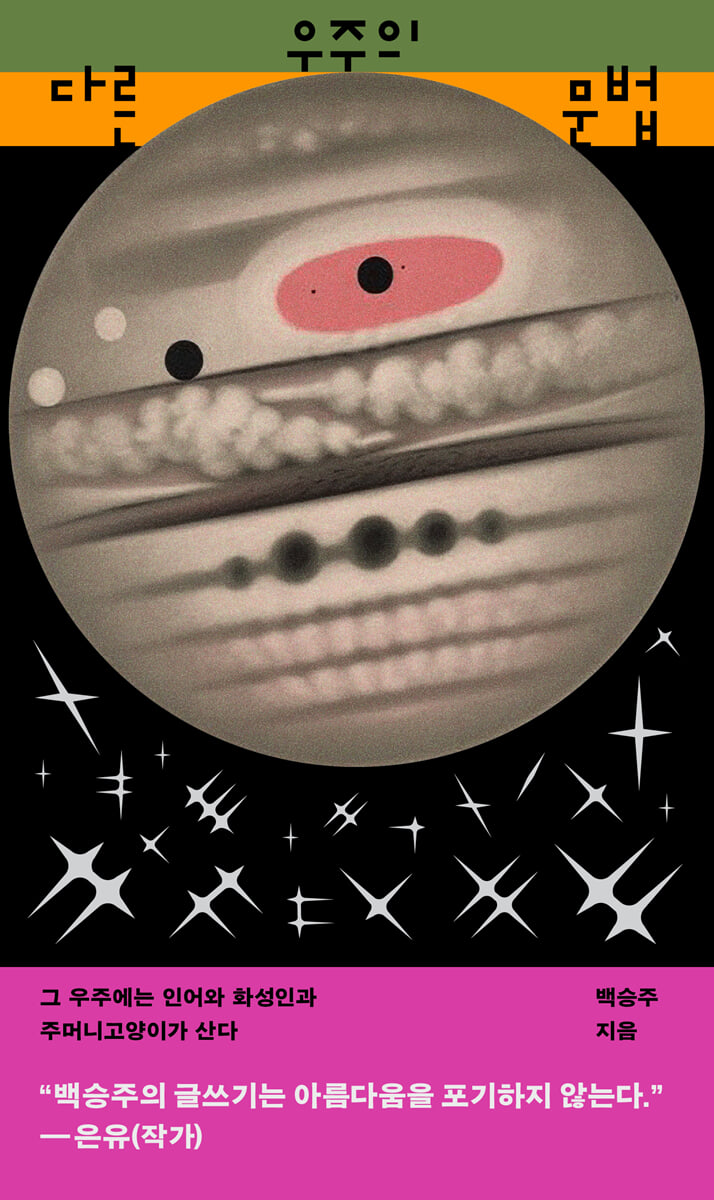
Grammar of another universe
 |
Description
Book Introduction
Nine odysseys exploring the vast universe created by language.
The moment the point of connection called language meets our experience, this point becomes the universe and creates this world.
A wondrous and fantastical odyssey that begins with the hazy experience of first love in childhood, passes through the twisted history of discrimination and massacre, the rippling language of mermaids, and the history of the Korean alphabet from Ju Si-gyeong to Madame Freedom, and returns to the vibrant reality of language that is being created and differentiated even at this very moment.
"How would you describe the feeling you get when teaching Korean to a foreigner for the first time? There are many expressions, but the one that comes to mind first is 'shipwrecked.'"
The feeling of being shipwrecked in a sea you know so well.
“The sea I knew so well became a place I knew nothing about.”_〈Shape of a Dream〉
The moment the point of connection called language meets our experience, this point becomes the universe and creates this world.
A wondrous and fantastical odyssey that begins with the hazy experience of first love in childhood, passes through the twisted history of discrimination and massacre, the rippling language of mermaids, and the history of the Korean alphabet from Ju Si-gyeong to Madame Freedom, and returns to the vibrant reality of language that is being created and differentiated even at this very moment.
"How would you describe the feeling you get when teaching Korean to a foreigner for the first time? There are many expressions, but the one that comes to mind first is 'shipwrecked.'"
The feeling of being shipwrecked in a sea you know so well.
“The sea I knew so well became a place I knew nothing about.”_〈Shape of a Dream〉
- You can preview some of the book's contents.
Preview
index
prolog
Chapter 1: A Name to Save
Chapter 2, depth 12 meters
Chapter 3 Your Triangle: The Pieces
Chapter 4: The Phonology of Wind
Chapter 5: The Shape of Dreams
Chapter 6: Reconstruction of the Experiment
Chapter 7: Terra Incognita
Chapter 8: Grammar of Other Universes
Chapter 9 Her.
mask.
sight.
Acknowledgements
main
References
Chapter 1: A Name to Save
Chapter 2, depth 12 meters
Chapter 3 Your Triangle: The Pieces
Chapter 4: The Phonology of Wind
Chapter 5: The Shape of Dreams
Chapter 6: Reconstruction of the Experiment
Chapter 7: Terra Incognita
Chapter 8: Grammar of Other Universes
Chapter 9 Her.
mask.
sight.
Acknowledgements
main
References
Detailed image

Into the book
"In German lands where Germans live, the German language and German fonts! The sacred triangle of one territory, one people, and one language was a powerful virtual reality that made the modern nation-state possible."
--- p.48
“Inside the triangle, we are the Gileadites who forced the Ephraimites to pronounce ‘Shibboleth’ at the Jordan River ferry, the Japanese vigilantes during the Great Kanto Earthquake who forced them to say ‘Juugoen Gojuusen,’ and the April 3rd Suppression Force who massacred the Jeju people as if it were nothing.”
--- p.71
“Mermaids speak taking into account wind speed, tidal range, wave direction, and surrounding terrain such as islands and reefs.
As the environment in the sea changes, so do the sounds of speech.
Not only that, our mermaids also use non-human communication channels, such as ultrasound.
Anderson refused to believe it.
“That mermaid language is more complex and diverse than human language, and that it can convey more.”
--- p.121
“When my mother tongue becomes a foreign language, things that were so obvious that I didn’t see them suddenly take on an unfamiliar appearance.
The bigger problem is that it is not easy to explain where such an unfamiliar appearance came from.
This kind of difficulty continues to repeat itself from pronunciation to teaching conversation.”
--- p.138
“Words are not objects that the speaker sends and the listener receives, and learning words is not practicing the exchange of objects between the speaker and the listener.
“Learning words is a process in which caregivers and children coordinate with each other to create a new society and a new world, and words are the product of that process.”
--- p.183
“The world inside the dictionary seems frozen.
There is no such thing as Terra Incognita in the dictionary world.
But the world outside the dictionary is constantly changing, and unknown lands continue to emerge.
New concepts arise, and words are created for them.
This is why new words like ‘Leeds era’ continue to appear.
“Words create reality, and reality is then circulated back into concepts.”
--- p.230
“The meaning of grammar lies in the countless social interactions between people who use that grammar, in what you call the breath.
Grammar is ultimately a kind of social construct created through such interactions.
So, a new order arises that we did not expect.
This is the nature of true grammar.”
--- p.284
“She” has taken a different path from the third-person feminine pronouns in Western languages, which function as automatic classification machines or masks that conceal women.
The Korean word 'she' has the potential to be rediscovered and reinvented, to become a name of liberation rather than a name of oppression.
I hope the Korean community will not give up on the potential of the tool of discovery called 'Her.'"
--- p.48
“Inside the triangle, we are the Gileadites who forced the Ephraimites to pronounce ‘Shibboleth’ at the Jordan River ferry, the Japanese vigilantes during the Great Kanto Earthquake who forced them to say ‘Juugoen Gojuusen,’ and the April 3rd Suppression Force who massacred the Jeju people as if it were nothing.”
--- p.71
“Mermaids speak taking into account wind speed, tidal range, wave direction, and surrounding terrain such as islands and reefs.
As the environment in the sea changes, so do the sounds of speech.
Not only that, our mermaids also use non-human communication channels, such as ultrasound.
Anderson refused to believe it.
“That mermaid language is more complex and diverse than human language, and that it can convey more.”
--- p.121
“When my mother tongue becomes a foreign language, things that were so obvious that I didn’t see them suddenly take on an unfamiliar appearance.
The bigger problem is that it is not easy to explain where such an unfamiliar appearance came from.
This kind of difficulty continues to repeat itself from pronunciation to teaching conversation.”
--- p.138
“Words are not objects that the speaker sends and the listener receives, and learning words is not practicing the exchange of objects between the speaker and the listener.
“Learning words is a process in which caregivers and children coordinate with each other to create a new society and a new world, and words are the product of that process.”
--- p.183
“The world inside the dictionary seems frozen.
There is no such thing as Terra Incognita in the dictionary world.
But the world outside the dictionary is constantly changing, and unknown lands continue to emerge.
New concepts arise, and words are created for them.
This is why new words like ‘Leeds era’ continue to appear.
“Words create reality, and reality is then circulated back into concepts.”
--- p.230
“The meaning of grammar lies in the countless social interactions between people who use that grammar, in what you call the breath.
Grammar is ultimately a kind of social construct created through such interactions.
So, a new order arises that we did not expect.
This is the nature of true grammar.”
--- p.284
“She” has taken a different path from the third-person feminine pronouns in Western languages, which function as automatic classification machines or masks that conceal women.
The Korean word 'she' has the potential to be rediscovered and reinvented, to become a name of liberation rather than a name of oppression.
I hope the Korean community will not give up on the potential of the tool of discovery called 'Her.'"
--- p.349
Publisher's Review
An axe that cracks the familiar and natural world
― Linguist of the Strange World
The language we use is not something we choose, but a world given to us.
We begin our lives through a system of language that has already been established.
What if we were to ask a question about a language so familiar we can barely even question it? "Have you ever taught Korean to a foreigner?" Only then will things we've never seen before suddenly reveal themselves in a new light.
When our mother tongue becomes a foreign language, the first thing we realize is that we know nothing about it.
The new book, "Grammar of Another Universe," is a record of the cracks raised by this provocative question, and a humanities essay that awakens us to the possibility of an unfamiliar world beyond the familiar.
Professor Baek Seung-ju, a linguist who has reinterpreted Korean society from a new perspective through “A Linguist’s Illiterate Sojourn” and “Sliding Words,” reaches its peak in “Grammar of Another Universe.”
This book builds on the core concepts of linguistics, such as phonetics, phonology, morphology, syntax, semantics, and pragmatics, but does not provide rigid and difficult explanations like a textbook.
Instead, it combines linguistics with the unfamiliar genres of imagination and fiction.
As a result, the knowledge of linguistics is directly reflected in our lives and recreated as vivid narratives and sensations.
In the prologue, Professor Baek Seung-ju recalls Primo Levi.
Like Primo Levi's "Periodic Table," which likened each element to a different element based on his own desperate experiences and the stories of his acquaintances, the author also confesses that he tried to use linguistic concepts as a tool for explanation.
But after writing the article, the author realizes:
This book is not about language, but rather a record of language borrowing itself to speak about the world and life.
《Grammar of Another Universe》 shows the realm of language, not as a fossilized language found in dictionaries or grammar books, but as an active volcano constantly branching out in life.
Like the pink-eyed white rabbit that led Alice into Wonderland, this book will guide readers through the rabbit hole of language into a vast new world.
"How would you describe the feeling you get when you first teach Korean to a foreigner? There are many expressions, but the one that comes to mind first is 'shipwrecked.'"
The feeling of being shipwrecked in a sea you know so well.
“The sea I knew so well became a place I knew nothing about.”_〈Shape of a Dream〉
The story of the world and life that language dreams of
―Eternal transformation and variation
Language is made up of sounds and objects.
And this relationship between sound and object is not inevitable but rather arbitrary.
That is why there are many different languages in the world that express the same content in different formats.
Like this relationship between sound and object, 《Grammar of Another Universe》 can be said to be a book that expresses the meaning of language in various forms.
The nine stories included in the book continue to transform formally and genre-wise, and serve as 'signifiers' that combine with the 'signified' of language.
From the moment the reader opens the book, he or she will not be able to tell whether he or she is reading a humanities book on 'linguistics' or an exciting novel.
The author's writing, which moves between fiction and nonfiction, does not view language from a single perspective, but rather from different angles and perspectives, in an unfamiliar and interesting way.
Starting with the author's hazy childhood first love story (〈A Name I Cherish〉), it traces how language played a role in solidifying discrimination and hatred in the turbulent history of the Kanto Massacre and the April 3 Incident (〈Your Triangle〉), and examines the process by which the Korean writing system was established as morphological through the actions of Joo Si-gyeong and the hidden history contained in 〈Madame Freedom〉 (Jeong Bi-seok, 1954) (〈Shape of a Dream〉).
On the other hand, “The Phonology of the Wind” is a short story that begins with the assumption that mermaids actually exist.
The novel uses the metaphor of a 'mermaid' to symbolically show that language is not just a means of communication.
It also captures the arbitrary, exclusive, and ghostly nature of language through the language of mermaids that changes with the waves.
The title work, “Grammar of Another Universe,” begins with an introduction to the science fiction novel “A Rose Offered to Ecclesiastes” and ends with a fictional debate between the author and the novel’s protagonist.
To those who claim that you can understand any language by simply memorizing the dictionary and grammar, the author rebukes them by saying, “Learning a language means sharing and learning about the lives of the people who use that language.”
In this way, 《Grammar of Another Universe》 explores the holistic nature of language, which has many faces like a chameleon, moving between real history and virtual fiction.
“The meaning of grammar lies in the countless social interactions between people who use that grammar, in what you call the breath.
Grammar is ultimately a kind of social construct created through such interactions.
So, a new order arises that we did not expect.
This is the nature of true grammar.”_〈Grammar of Another Universe〉
Language and the world in constant circulation
- Language becomes the world, and reality becomes words again.
During the Great Kanto Massacre, Japanese vigilantes would grab anyone and ask them to pronounce "Juugoen Gojusen (15 yen and 50 sen)".
It was a hunting method based on the fact that Koreans, who do not distinguish between voiced and voiceless sounds, had difficulty pronouncing this sound.
'Juugoen Gojuusen', which divided life and death, has been revived today as 'Jjang-gae, Femi, Mam-chung, Tteul-ttak, Gyeopsik-chung, Young-po-ti' and continues to be used.
We usually think of language as being influenced by reality, not that language influences reality.
But the author asks a question through the above horrific case.
Is language truly nothing more than a tool? If words shape thoughts, and thoughts determine reality, isn't language the most fundamental force that shapes our entire lives?
《Grammar of Another Universe》 says that language is not only a mirror that reflects the world, but also the framework itself that 'designs' and 'assembles' the world.
Language not only records reality, but also determines how we define and interpret it.
Furthermore, language even creates new reality.
Initially started as a joke about a society obsessed with academic background, 'Inseoul' lost its context and content, and gained immortality as a word symbolizing the desires of Koreans.
Now, Korea has been reorganized into a country consisting of Seoul and non-Seoul, and faithfully follows 'In-Seoul'.
A new word, 'Inseoul', is driving reality and changing the actual geography of Korea.
In this way, language reconstructs the world more powerfully and destructively than we can imagine.
The world we live in is constantly changing through a cycle in which words pass through people to become the world, and the world passes through people again to become words.
In it, the real protagonist is not us, but language.
Language is not a tool used by humans, but rather it awakens memories and desires that were dormant within us and moves us.
In that sense, this book shows in an interesting and persuasive way that understanding language is an experience in which the world expands and changes, and that if we change the language we have, we can also change the world we live in.
Even at this very moment, some words or sentences may already be stirring in our heads, resonating with our experiences.
Beyond the door opened by those unknown words and sentences, a colorful and wondrous grammar of the universe awaits us.
“Unlike my throbbing diaphragm, the water is calm and indifferent.
In that silence I realize.
“All the sounds in my mouth were ultimately the breath that filled my lungs.”_〈12 Meters Underwater〉
― Linguist of the Strange World
The language we use is not something we choose, but a world given to us.
We begin our lives through a system of language that has already been established.
What if we were to ask a question about a language so familiar we can barely even question it? "Have you ever taught Korean to a foreigner?" Only then will things we've never seen before suddenly reveal themselves in a new light.
When our mother tongue becomes a foreign language, the first thing we realize is that we know nothing about it.
The new book, "Grammar of Another Universe," is a record of the cracks raised by this provocative question, and a humanities essay that awakens us to the possibility of an unfamiliar world beyond the familiar.
Professor Baek Seung-ju, a linguist who has reinterpreted Korean society from a new perspective through “A Linguist’s Illiterate Sojourn” and “Sliding Words,” reaches its peak in “Grammar of Another Universe.”
This book builds on the core concepts of linguistics, such as phonetics, phonology, morphology, syntax, semantics, and pragmatics, but does not provide rigid and difficult explanations like a textbook.
Instead, it combines linguistics with the unfamiliar genres of imagination and fiction.
As a result, the knowledge of linguistics is directly reflected in our lives and recreated as vivid narratives and sensations.
In the prologue, Professor Baek Seung-ju recalls Primo Levi.
Like Primo Levi's "Periodic Table," which likened each element to a different element based on his own desperate experiences and the stories of his acquaintances, the author also confesses that he tried to use linguistic concepts as a tool for explanation.
But after writing the article, the author realizes:
This book is not about language, but rather a record of language borrowing itself to speak about the world and life.
《Grammar of Another Universe》 shows the realm of language, not as a fossilized language found in dictionaries or grammar books, but as an active volcano constantly branching out in life.
Like the pink-eyed white rabbit that led Alice into Wonderland, this book will guide readers through the rabbit hole of language into a vast new world.
"How would you describe the feeling you get when you first teach Korean to a foreigner? There are many expressions, but the one that comes to mind first is 'shipwrecked.'"
The feeling of being shipwrecked in a sea you know so well.
“The sea I knew so well became a place I knew nothing about.”_〈Shape of a Dream〉
The story of the world and life that language dreams of
―Eternal transformation and variation
Language is made up of sounds and objects.
And this relationship between sound and object is not inevitable but rather arbitrary.
That is why there are many different languages in the world that express the same content in different formats.
Like this relationship between sound and object, 《Grammar of Another Universe》 can be said to be a book that expresses the meaning of language in various forms.
The nine stories included in the book continue to transform formally and genre-wise, and serve as 'signifiers' that combine with the 'signified' of language.
From the moment the reader opens the book, he or she will not be able to tell whether he or she is reading a humanities book on 'linguistics' or an exciting novel.
The author's writing, which moves between fiction and nonfiction, does not view language from a single perspective, but rather from different angles and perspectives, in an unfamiliar and interesting way.
Starting with the author's hazy childhood first love story (〈A Name I Cherish〉), it traces how language played a role in solidifying discrimination and hatred in the turbulent history of the Kanto Massacre and the April 3 Incident (〈Your Triangle〉), and examines the process by which the Korean writing system was established as morphological through the actions of Joo Si-gyeong and the hidden history contained in 〈Madame Freedom〉 (Jeong Bi-seok, 1954) (〈Shape of a Dream〉).
On the other hand, “The Phonology of the Wind” is a short story that begins with the assumption that mermaids actually exist.
The novel uses the metaphor of a 'mermaid' to symbolically show that language is not just a means of communication.
It also captures the arbitrary, exclusive, and ghostly nature of language through the language of mermaids that changes with the waves.
The title work, “Grammar of Another Universe,” begins with an introduction to the science fiction novel “A Rose Offered to Ecclesiastes” and ends with a fictional debate between the author and the novel’s protagonist.
To those who claim that you can understand any language by simply memorizing the dictionary and grammar, the author rebukes them by saying, “Learning a language means sharing and learning about the lives of the people who use that language.”
In this way, 《Grammar of Another Universe》 explores the holistic nature of language, which has many faces like a chameleon, moving between real history and virtual fiction.
“The meaning of grammar lies in the countless social interactions between people who use that grammar, in what you call the breath.
Grammar is ultimately a kind of social construct created through such interactions.
So, a new order arises that we did not expect.
This is the nature of true grammar.”_〈Grammar of Another Universe〉
Language and the world in constant circulation
- Language becomes the world, and reality becomes words again.
During the Great Kanto Massacre, Japanese vigilantes would grab anyone and ask them to pronounce "Juugoen Gojusen (15 yen and 50 sen)".
It was a hunting method based on the fact that Koreans, who do not distinguish between voiced and voiceless sounds, had difficulty pronouncing this sound.
'Juugoen Gojuusen', which divided life and death, has been revived today as 'Jjang-gae, Femi, Mam-chung, Tteul-ttak, Gyeopsik-chung, Young-po-ti' and continues to be used.
We usually think of language as being influenced by reality, not that language influences reality.
But the author asks a question through the above horrific case.
Is language truly nothing more than a tool? If words shape thoughts, and thoughts determine reality, isn't language the most fundamental force that shapes our entire lives?
《Grammar of Another Universe》 says that language is not only a mirror that reflects the world, but also the framework itself that 'designs' and 'assembles' the world.
Language not only records reality, but also determines how we define and interpret it.
Furthermore, language even creates new reality.
Initially started as a joke about a society obsessed with academic background, 'Inseoul' lost its context and content, and gained immortality as a word symbolizing the desires of Koreans.
Now, Korea has been reorganized into a country consisting of Seoul and non-Seoul, and faithfully follows 'In-Seoul'.
A new word, 'Inseoul', is driving reality and changing the actual geography of Korea.
In this way, language reconstructs the world more powerfully and destructively than we can imagine.
The world we live in is constantly changing through a cycle in which words pass through people to become the world, and the world passes through people again to become words.
In it, the real protagonist is not us, but language.
Language is not a tool used by humans, but rather it awakens memories and desires that were dormant within us and moves us.
In that sense, this book shows in an interesting and persuasive way that understanding language is an experience in which the world expands and changes, and that if we change the language we have, we can also change the world we live in.
Even at this very moment, some words or sentences may already be stirring in our heads, resonating with our experiences.
Beyond the door opened by those unknown words and sentences, a colorful and wondrous grammar of the universe awaits us.
“Unlike my throbbing diaphragm, the water is calm and indifferent.
In that silence I realize.
“All the sounds in my mouth were ultimately the breath that filled my lungs.”_〈12 Meters Underwater〉
GOODS SPECIFICS
- Date of issue: October 22, 2025
- Page count, weight, size: 364 pages | 432g | 125*210*21mm
- ISBN13: 9791173323539
- ISBN10: 1173323538
You may also like
카테고리
korean


korean

![GQ KOREA Mark (Monthly): December [2025]](http://librairie.coreenne.fr/cdn/shop/files/8ef265dbbfbf186523ed75ba7319009d.jpg?v=1765340328&width=3840)


