

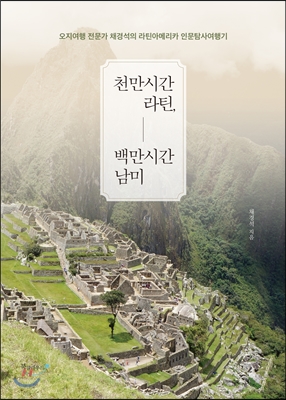
Ten Million Hours Latin, One Million Hours South America
 |
Description
Book Introduction
A million hours of time travel across time and space in South America.
The strange geoglyphs left behind on the Nazca plains, the vast swamps and primeval forests of the Amazon, Aconcagua, the highest peak in the Andes, and the thousand-year-old glaciers…
As you walk into the South American landscapes you must see before you die, the mysteries of the Inca and Aztec civilizations, the life and death of revolutionary Che Guevara, and even the century-old romance of 'Evita' - stories, history, and cultures that don't appear on maps accumulate in your mind.
The author's voice, which not only sings of the blueness of the Atlantic and Pacific Oceans, but also tells the history and stories of the vast ocean, is as affectionate as a grandfather sitting next to your pillow, yet as serious as a professor in a new semester classroom.
On the journey with that voice, it would be good to add beautiful and beneficial words to each step: travel, history, and culture.
The strange geoglyphs left behind on the Nazca plains, the vast swamps and primeval forests of the Amazon, Aconcagua, the highest peak in the Andes, and the thousand-year-old glaciers…
As you walk into the South American landscapes you must see before you die, the mysteries of the Inca and Aztec civilizations, the life and death of revolutionary Che Guevara, and even the century-old romance of 'Evita' - stories, history, and cultures that don't appear on maps accumulate in your mind.
The author's voice, which not only sings of the blueness of the Atlantic and Pacific Oceans, but also tells the history and stories of the vast ocean, is as affectionate as a grandfather sitting next to your pillow, yet as serious as a professor in a new semester classroom.
On the journey with that voice, it would be good to add beautiful and beneficial words to each step: travel, history, and culture.
- You can preview some of the book's contents.
Preview
index
ROUTE 1 From Lima, the first stop in South America, to the Nazca Plains
Pizarro set out in search of the golden empire of the Incas
Finding traces of Spain in Lima
The enigmatic drawings, the Nazca Lines
Those who exist forever in Chauchiya
Island of Victors and Patriots
ROUTE 2 Hear the Sound of the Incas, Cusco
The Incas, who grew into an empire through wars of conquest
The fall of the empire
Thinking of the Old Ones in the Invisible Inca City
Wander through Incan architecture
The Secret of Abundance That Sustained the Incas
ROUTE 3 The Inca's Hidden Dream: The Inca Road and Machu Picchu
Secrets Hidden on the Inca Trail
Machu Picchu, the eternally unfinished city
ROUTE 4: A Hidden Culture in the Andes: Tiwanaku and Lake Titicaca
Titicaca, chosen by the founders of the Incas
A city like Tiwanaku, no less
ROUTE 5 Che Guevara, the revolutionary who was ignored by Bolivia, in search of his route and the Amazon
The land with the most mysterious nature in South America
Amazon, Earth's Giant Oxygen Factory
In search of Che Guevara's end
ROUTE 6: Mysterious lands holding secrets: Uyuni, Altiplano, and Atacama
Is Uyuni a desert or a lake?
Altiplano, the land of healing
The Valley of the Moon, which most resembles the moon
ROUTE 7 Three Historical Men of Chile: Allende, Pinochet, and Neruda
Traveling in Chile follows the people
Two men who changed Chilean history: Allende and Pinochet
A folk poet who sang about Chile's reality
ROUTE 8 Mendoza, the flower of the Andes
The city known as the flower of Argentina
Mendoza, the heart of the Andes
ROUTE 9 Pampas, a land that brings change
Don't cry for me, Argentina
Bariloche, the Alps of Latin America
ROUTE 10: Patagonia, the Fairy of South America
Fitzroy and Cerro Torre
People who climbed the impossible peak
Glacier trekking
ROUTE 11 Living Fossil, Torres del Paine National Park
Las Torres, the source of wind and sound
ROUTE 12 Crossing the Strait of Magellan to the End of the Continent, Punta Arenas and Ushuaia
Magellan, the man who set out in search of nutmeg
The Monkey Man of the Beagle Channel
Mityal Trekking and Penguin Cruise Tour
ROUTE 13 Buenos Aires, the City of Tango
May Square in the city of style and romance
ROUTE 14 Iguazu Falls, Home of the Guarani People
A great water that swallows everything
ROUTE 15 Rio de Janeiro, the city of samba
Witness the birth of a cosmic race
The tremendous energy called samba
Pizarro set out in search of the golden empire of the Incas
Finding traces of Spain in Lima
The enigmatic drawings, the Nazca Lines
Those who exist forever in Chauchiya
Island of Victors and Patriots
ROUTE 2 Hear the Sound of the Incas, Cusco
The Incas, who grew into an empire through wars of conquest
The fall of the empire
Thinking of the Old Ones in the Invisible Inca City
Wander through Incan architecture
The Secret of Abundance That Sustained the Incas
ROUTE 3 The Inca's Hidden Dream: The Inca Road and Machu Picchu
Secrets Hidden on the Inca Trail
Machu Picchu, the eternally unfinished city
ROUTE 4: A Hidden Culture in the Andes: Tiwanaku and Lake Titicaca
Titicaca, chosen by the founders of the Incas
A city like Tiwanaku, no less
ROUTE 5 Che Guevara, the revolutionary who was ignored by Bolivia, in search of his route and the Amazon
The land with the most mysterious nature in South America
Amazon, Earth's Giant Oxygen Factory
In search of Che Guevara's end
ROUTE 6: Mysterious lands holding secrets: Uyuni, Altiplano, and Atacama
Is Uyuni a desert or a lake?
Altiplano, the land of healing
The Valley of the Moon, which most resembles the moon
ROUTE 7 Three Historical Men of Chile: Allende, Pinochet, and Neruda
Traveling in Chile follows the people
Two men who changed Chilean history: Allende and Pinochet
A folk poet who sang about Chile's reality
ROUTE 8 Mendoza, the flower of the Andes
The city known as the flower of Argentina
Mendoza, the heart of the Andes
ROUTE 9 Pampas, a land that brings change
Don't cry for me, Argentina
Bariloche, the Alps of Latin America
ROUTE 10: Patagonia, the Fairy of South America
Fitzroy and Cerro Torre
People who climbed the impossible peak
Glacier trekking
ROUTE 11 Living Fossil, Torres del Paine National Park
Las Torres, the source of wind and sound
ROUTE 12 Crossing the Strait of Magellan to the End of the Continent, Punta Arenas and Ushuaia
Magellan, the man who set out in search of nutmeg
The Monkey Man of the Beagle Channel
Mityal Trekking and Penguin Cruise Tour
ROUTE 13 Buenos Aires, the City of Tango
May Square in the city of style and romance
ROUTE 14 Iguazu Falls, Home of the Guarani People
A great water that swallows everything
ROUTE 15 Rio de Janeiro, the city of samba
Witness the birth of a cosmic race
The tremendous energy called samba
Detailed image
Into the book
In Catholicism, burning at the stake is the most brutal punishment for heretics, a punishment that destroys their very existence.
It was the most brutal punishment not only among Catholics but also among the Incas.
For the Incas, who believed in the afterlife and reincarnation, the body was a conduit for communication with the gods and was also necessary for reincarnation, so burning the body to death meant its disappearance forever.
The mummies we met at Chauchiya were also created for that reason.
Hundreds and thousands of years later, they're meeting me like this, so I guess their dreams have come true.
Because it still exists.
Among those who exist forever in Chauchiya
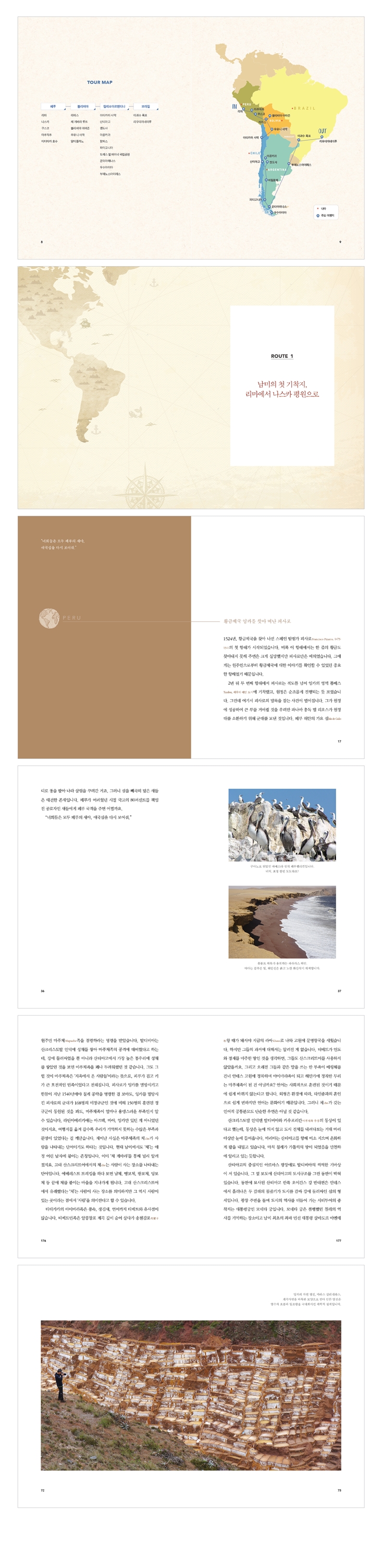
But the real owners of Ballestas Island are neither sea lions nor penguins, but the seabirds that cover the skies.
The island's surface is covered in white bird droppings that have hardened into rock-like particles, called 'guano'.
It is said that guano has been used as a main ingredient in fertilizer since around 1840, and there are records that even during the Inca era, bird droppings were regularly brought from the coast and spread.
In light of these circumstances, it appears that the guano from Ballestas Islands contributed greatly to the maintenance of power since the Inca era.
Peru, a newly independent nation with a weak economic foundation, exported 9 million tons of guano to European and North American markets between 1842 and 1870, accounting for 80 percent of the country's income. In short, the country was making a living by selling excrement.
So the birds that cover the island are a magnificent sight.
What if we gave Peruvian citizenship to the birds that were responsible for 80 percent of Peru's national treasury during its difficult times?
From 'The Island of Victors and Patriots'
All the broadcasting stations fell into the hands of the coup forces, but fortunately the radio station was unharmed.
Allende proceeds with his "Presidential Hour" via radio as scheduled.
Allende's cries over the radio were said to be tragic.
“At this very moment, a bomber is flying overhead.
I will give my life for my country.
I will repay the loyalty shown by the Chilean people with my death.
As President of Chile, I will fulfill my honorable responsibilities and duties.
I will always be with you.
Viva Chile!, Viva el Pueblo!, Viva losTrabajadores!”
From 'Two Men Who Changed Chile's History, Allende and Pinochet'
Running through the endless pampas in the middle of the day, the dry and barren land seems to go on forever, leaving even the onlooker feeling empty.
There is a woman born as an illegitimate child in this lonely and desolate land, who faces the world in pursuit of her dream, and who stands tall and proud at the top, no matter what the world says.
Eva Perón, also known as 'Evita', was the illegitimate child of the Pampas, where she now runs.
From 'Don't Cry for Me, Argentina'
It was the most brutal punishment not only among Catholics but also among the Incas.
For the Incas, who believed in the afterlife and reincarnation, the body was a conduit for communication with the gods and was also necessary for reincarnation, so burning the body to death meant its disappearance forever.
The mummies we met at Chauchiya were also created for that reason.
Hundreds and thousands of years later, they're meeting me like this, so I guess their dreams have come true.
Because it still exists.
Among those who exist forever in Chauchiya
But the real owners of Ballestas Island are neither sea lions nor penguins, but the seabirds that cover the skies.
The island's surface is covered in white bird droppings that have hardened into rock-like particles, called 'guano'.
It is said that guano has been used as a main ingredient in fertilizer since around 1840, and there are records that even during the Inca era, bird droppings were regularly brought from the coast and spread.
In light of these circumstances, it appears that the guano from Ballestas Islands contributed greatly to the maintenance of power since the Inca era.
Peru, a newly independent nation with a weak economic foundation, exported 9 million tons of guano to European and North American markets between 1842 and 1870, accounting for 80 percent of the country's income. In short, the country was making a living by selling excrement.
So the birds that cover the island are a magnificent sight.
What if we gave Peruvian citizenship to the birds that were responsible for 80 percent of Peru's national treasury during its difficult times?
From 'The Island of Victors and Patriots'
All the broadcasting stations fell into the hands of the coup forces, but fortunately the radio station was unharmed.
Allende proceeds with his "Presidential Hour" via radio as scheduled.
Allende's cries over the radio were said to be tragic.
“At this very moment, a bomber is flying overhead.
I will give my life for my country.
I will repay the loyalty shown by the Chilean people with my death.
As President of Chile, I will fulfill my honorable responsibilities and duties.
I will always be with you.
Viva Chile!, Viva el Pueblo!, Viva losTrabajadores!”
From 'Two Men Who Changed Chile's History, Allende and Pinochet'
Running through the endless pampas in the middle of the day, the dry and barren land seems to go on forever, leaving even the onlooker feeling empty.
There is a woman born as an illegitimate child in this lonely and desolate land, who faces the world in pursuit of her dream, and who stands tall and proud at the top, no matter what the world says.
Eva Perón, also known as 'Evita', was the illegitimate child of the Pampas, where she now runs.
From 'Don't Cry for Me, Argentina'
__From the text
Publisher's Review
From Peru to Bolivia, Chile, Argentina and Brazil
A humanities exploration encompassing the history and culture of Latin America
South America, a travel destination too far to get close to, on the other side of the globe.
Nevertheless, whenever I come across an unknown continent shrouded in mystery through books or TV, I find myself unconsciously making up my mind.
I will leave for South America someday.
A book has been published that will fulfill this 'South American romance' in your heart.
He kindly volunteers to be a guide for shy travelers, telling them everything about South America from its roots to the present day.
So, let's embark on a humanities exploration journey through Peru, Bolivia, Chile, Argentina, and Brazil, following the author, who is well-versed in South American culture and history.
Named Ten Million Hours Latin, a time-space journey that transcends the time and space of One Million Hours Latin America.
The strange geoglyphs left behind on the Nazca plains, the vast swamps and primeval forests of the Amazon, Aconcagua, the highest peak in the Andes, and the thousand-year-old glaciers…
As you walk into the South American landscapes you must see before you die, the mysteries of the Inca and Aztec civilizations, the life and death of revolutionary Che Guevara, and even the century-old romance of 'Evita' - stories, history, and cultures that don't appear on maps accumulate in your mind.
The author's voice, which not only sings of the blueness of the Atlantic and Pacific Oceans, but also tells the history and stories of the vast ocean, is as gentle as a grandfather sitting next to your pillow, yet as serious as a professor in a new semester classroom.
On the journey with that voice, it would be good to add beautiful and beneficial words to each step: travel, history, and culture.
To you who is going to South America now, and who will go to South America someday
A map for traveling to an unknown continent
Going to South America means heading to an 'unknown continent'.
Fly to the other side of the globe and embark on a journey across Peru, Bolivia, Chile, Argentina, and Brazil to find God's creation and lost civilizations.
The mysterious city in the sky, Machu Picchu; Uyuni, the boundary between heaven and earth; Atacama, the valley that resembles the moon; Patagonia, the end of the world; Iguazu Falls, the destination of all water…
What should I prepare to travel a continent where I don't know where to start and where to end?
A smartphone with Google Maps downloaded? A guidebook showcasing South American restaurants and accommodations? A travel essay celebrating the beauty of South America?
All correct, but not all correct.
What we need right now is a map that contains the path to South America's past, present, and future: "10 Million Hours Latin, 1 Million Hours South America."
In search of a shortcut across time and space in South America, traveler Chae Kyung-seok trekked through the Andes Mountains, gathering and recording the hidden stories and history of the land.
It adds humanistic depth by including not only the beautiful scenery and touching glimpses of life in South America, but also historical tragedies.
The moment you open the 378-page map, a new journey begins, exploring the landscapes, history, and culture of South America.
Follow the time traveler who walked ahead of you and travel to the distant past of South America, to a place you've never been before.
The behind-the-scenes story of South America you're most curious about
From the Inca gold legend to Evita's love story
Why did the Inca Empire, with its splendid culture, surrender to 168 invaders despite an army of 80,000? Who drew the Nazca Lines, whose full forms can only be seen from the sky? How did the unknown actress Eva become Argentina's most beloved First Lady? The pages of "10 Million Hours Latin, 1 Million Hours South America" are packed with fascinating behind-the-scenes stories of history.
Rather than ending with a hypothesis based on interest, it traces historical facts based on references and records, and sometimes adds interesting hypotheses with added imagination, providing travelers with the opportunity to understand the history of South America within the flow of world history.
It's not just about the land.
It's also fun to read the words and stories of giants related to each region, such as legendary mountaineer Reinhold Messner, the leading figure in the theory of evolution Charles Darwin, and Nobel Prize-winning poet Pablo Neruda.
My eyes are filled with the overflowing scenery of South America wherever I look, and my ears are filled with stories I don't want to miss.
When traveling with a storyteller with a gift for the gab, it's best to keep your eyes and ears open.
A Guide to South America for Those Tired of Superficial Travel
A journey filled with emotion and a wealth of humanities knowledge.
There was a time when all trips started with 'good restaurant-tour-accommodation' and ended with 'accommodation-tour-good restaurant'.
However, as travelers' knowledge grows, the density of travel is also increasing.
There is a growing number of people who want to travel not for a one-time visit, but to learn something and return with it as a legacy.
To quench this thirst, bookstores are steadily publishing humanities travel books that incorporate elements of the humanities, such as literature, history, and philosophy, into their travels.
"10 Million Hours Latin, 1 Million Hours South America" is a book that answers the call of such readers.
Unlike Europe, where travel information from transportation to accommodations is well-organized, the author suggests "time travel" as the smartest way to travel in South America, which is still shrouded in mystery.
Rather than simply climbing over overlapping mountain ranges to reach the summit, it tells the story of the Inca kings and Spanish invaders who passed the same path 100 and 1,000 years ago.
The hidden stories of the land, unknown to both locals and outsiders, are constantly whispered into the ears of travelers.
If you're curious about the author's intimate stories of South America and nod along to the saying, "You see as much as you know when you travel," don't miss this in-depth, humanistic travel book.
It will be the most reliable compass for traveling to an unknown continent you have never been to.
A humanities exploration encompassing the history and culture of Latin America
South America, a travel destination too far to get close to, on the other side of the globe.
Nevertheless, whenever I come across an unknown continent shrouded in mystery through books or TV, I find myself unconsciously making up my mind.
I will leave for South America someday.
A book has been published that will fulfill this 'South American romance' in your heart.
He kindly volunteers to be a guide for shy travelers, telling them everything about South America from its roots to the present day.
So, let's embark on a humanities exploration journey through Peru, Bolivia, Chile, Argentina, and Brazil, following the author, who is well-versed in South American culture and history.
Named Ten Million Hours Latin, a time-space journey that transcends the time and space of One Million Hours Latin America.
The strange geoglyphs left behind on the Nazca plains, the vast swamps and primeval forests of the Amazon, Aconcagua, the highest peak in the Andes, and the thousand-year-old glaciers…
As you walk into the South American landscapes you must see before you die, the mysteries of the Inca and Aztec civilizations, the life and death of revolutionary Che Guevara, and even the century-old romance of 'Evita' - stories, history, and cultures that don't appear on maps accumulate in your mind.
The author's voice, which not only sings of the blueness of the Atlantic and Pacific Oceans, but also tells the history and stories of the vast ocean, is as gentle as a grandfather sitting next to your pillow, yet as serious as a professor in a new semester classroom.
On the journey with that voice, it would be good to add beautiful and beneficial words to each step: travel, history, and culture.
To you who is going to South America now, and who will go to South America someday
A map for traveling to an unknown continent
Going to South America means heading to an 'unknown continent'.
Fly to the other side of the globe and embark on a journey across Peru, Bolivia, Chile, Argentina, and Brazil to find God's creation and lost civilizations.
The mysterious city in the sky, Machu Picchu; Uyuni, the boundary between heaven and earth; Atacama, the valley that resembles the moon; Patagonia, the end of the world; Iguazu Falls, the destination of all water…
What should I prepare to travel a continent where I don't know where to start and where to end?
A smartphone with Google Maps downloaded? A guidebook showcasing South American restaurants and accommodations? A travel essay celebrating the beauty of South America?
All correct, but not all correct.
What we need right now is a map that contains the path to South America's past, present, and future: "10 Million Hours Latin, 1 Million Hours South America."
In search of a shortcut across time and space in South America, traveler Chae Kyung-seok trekked through the Andes Mountains, gathering and recording the hidden stories and history of the land.
It adds humanistic depth by including not only the beautiful scenery and touching glimpses of life in South America, but also historical tragedies.
The moment you open the 378-page map, a new journey begins, exploring the landscapes, history, and culture of South America.
Follow the time traveler who walked ahead of you and travel to the distant past of South America, to a place you've never been before.
The behind-the-scenes story of South America you're most curious about
From the Inca gold legend to Evita's love story
Why did the Inca Empire, with its splendid culture, surrender to 168 invaders despite an army of 80,000? Who drew the Nazca Lines, whose full forms can only be seen from the sky? How did the unknown actress Eva become Argentina's most beloved First Lady? The pages of "10 Million Hours Latin, 1 Million Hours South America" are packed with fascinating behind-the-scenes stories of history.
Rather than ending with a hypothesis based on interest, it traces historical facts based on references and records, and sometimes adds interesting hypotheses with added imagination, providing travelers with the opportunity to understand the history of South America within the flow of world history.
It's not just about the land.
It's also fun to read the words and stories of giants related to each region, such as legendary mountaineer Reinhold Messner, the leading figure in the theory of evolution Charles Darwin, and Nobel Prize-winning poet Pablo Neruda.
My eyes are filled with the overflowing scenery of South America wherever I look, and my ears are filled with stories I don't want to miss.
When traveling with a storyteller with a gift for the gab, it's best to keep your eyes and ears open.
A Guide to South America for Those Tired of Superficial Travel
A journey filled with emotion and a wealth of humanities knowledge.
There was a time when all trips started with 'good restaurant-tour-accommodation' and ended with 'accommodation-tour-good restaurant'.
However, as travelers' knowledge grows, the density of travel is also increasing.
There is a growing number of people who want to travel not for a one-time visit, but to learn something and return with it as a legacy.
To quench this thirst, bookstores are steadily publishing humanities travel books that incorporate elements of the humanities, such as literature, history, and philosophy, into their travels.
"10 Million Hours Latin, 1 Million Hours South America" is a book that answers the call of such readers.
Unlike Europe, where travel information from transportation to accommodations is well-organized, the author suggests "time travel" as the smartest way to travel in South America, which is still shrouded in mystery.
Rather than simply climbing over overlapping mountain ranges to reach the summit, it tells the story of the Inca kings and Spanish invaders who passed the same path 100 and 1,000 years ago.
The hidden stories of the land, unknown to both locals and outsiders, are constantly whispered into the ears of travelers.
If you're curious about the author's intimate stories of South America and nod along to the saying, "You see as much as you know when you travel," don't miss this in-depth, humanistic travel book.
It will be the most reliable compass for traveling to an unknown continent you have never been to.
GOODS SPECIFICS
- Date of issue: July 15, 2016
- Page count, weight, size: 378 pages | 641g | 150*210*30mm
- ISBN13: 9791158461058
- ISBN10: 1158461054
You may also like
카테고리
korean


korean

![GQ KOREA Mark (Monthly): December [2025]](http://librairie.coreenne.fr/cdn/shop/files/8ef265dbbfbf186523ed75ba7319009d.jpg?v=1765340328&width=3840)


