

Kang Won-guk's manuscript collection
 |
Description
Book Introduction
‘Collection’ of good sentences and ‘imitation’ of writing them down
Make writing easy!
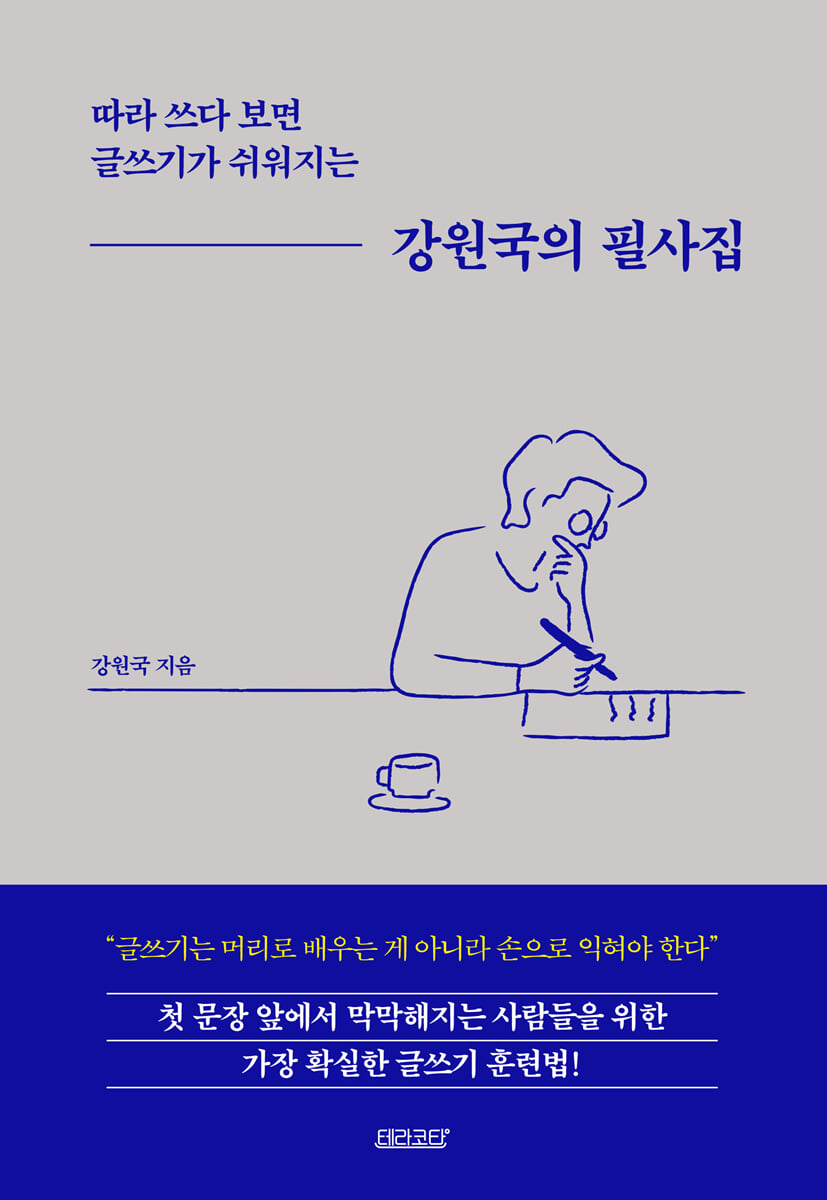
Kang Won-guk, a Korean writing mentor who has received the love of 1 million readers for his books such as “The President’s Writing,” “Kang Won-guk’s Writing,” and “I Write as I Speak,” has published “Kang Won-guk’s Handwriting Collection,” which provides the most reliable writing training method, and writing becomes easier as you follow along.
“How have you been able to write until now?”
This is a question I often hear after author Kang Won-guk gives his lectures.
The secret to writing that he has mastered over decades is surprisingly simple.
It's 'collection' and 'imitation'.
Writing is simply collecting good sentences and copying them.
So how can we collect and imitate it?
Dedication is the answer.
He realized this while working at the Blue House, writing and refining the speeches and writings of Presidents Kim Dae-jung and Roh Moo-hyun, and copying the writings of the two presidents day and night.
If you copy someone else's sentences, your own sentences will eventually be created.
This book is not just a simple handwritten notebook.
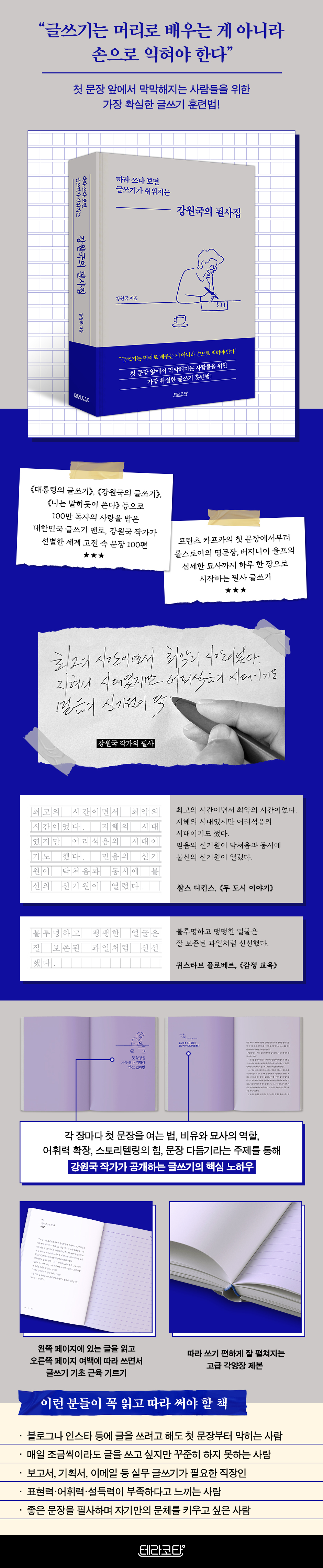
Each chapter explores core writing skills through topics such as how to open the first sentence, the role of metaphor and description, expanding vocabulary, the power of storytelling, and polishing sentences.
Through this, readers will be able to build their basic writing skills by following along line by line.
Make writing easy!
Kang Won-guk, a Korean writing mentor who has received the love of 1 million readers for his books such as “The President’s Writing,” “Kang Won-guk’s Writing,” and “I Write as I Speak,” has published “Kang Won-guk’s Handwriting Collection,” which provides the most reliable writing training method, and writing becomes easier as you follow along.
“How have you been able to write until now?”
This is a question I often hear after author Kang Won-guk gives his lectures.
The secret to writing that he has mastered over decades is surprisingly simple.
It's 'collection' and 'imitation'.
Writing is simply collecting good sentences and copying them.
So how can we collect and imitate it?
Dedication is the answer.
He realized this while working at the Blue House, writing and refining the speeches and writings of Presidents Kim Dae-jung and Roh Moo-hyun, and copying the writings of the two presidents day and night.
If you copy someone else's sentences, your own sentences will eventually be created.
This book is not just a simple handwritten notebook.
Each chapter explores core writing skills through topics such as how to open the first sentence, the role of metaphor and description, expanding vocabulary, the power of storytelling, and polishing sentences.
Through this, readers will be able to build their basic writing skills by following along line by line.
- You can preview some of the book's contents.
Preview
index
Starting with a sentence, it resembles a person.
If you keep writing and erasing the first sentence of Chapter 1
001 Franz Kafka's "The Metamorphosis"
002 F.
Scott Fitzgerald's The Great Gatsby
003 Jane Austen's Pride and Prejudice
004 Herman Melville's Moby Dick
005 Gabriel García Márquez's "Love in the Time of Cholera"
006 Natsume Soseki's "I Am a Cat"
007 Nikos Kazantzakis' Zorba the Greek
008 Oscar Wilde's The Picture of Dorian Gray
009 Jerome David Salinger's The Catcher in the Rye
010 Hermann Hesse's "Demian"
011 Emile Zola, The Bar at the Wood
012 Charles Dickens, A Tale of Two Cities
013 Leo Tolstoy's Anna Karenina
014 Fyodor Dostoevsky's Notes from the Underground
015 Yasunari Kawabata's "Snow Country"
016 Virginia Woolf, To the Lighthouse
017 Charles Dickens' Great Expectations
018 Max Müller's "German Love"
019 Sylvia Plath's The Bell Jar
020 Fyodor Dostoevsky's "Poor Folk"
Chapter 2: Emotional writing is created through metaphors and descriptions.
021 The Fall of the House of Usher by Edgar Allan Poe
022 Gustave Flaubert's "Madame Bovary"
023 Stendhal's The Red and the Black
024 Charlotte Brontë's Jane Eyre
025 Hermann Hesse's "Klingsor's Last Summer"
026 Akutagawa Ryunosuke's "Rashomon"
027 André Gide, The Strait Gate
028 Gustave Flaubert's "Three Stories"
029 Emily Dickinson, "Hope Has Wings"
030 Hermann Hesse's "The Glass Bead Game"
031 Alexandre Dumas, The Black Tulip
032 Johann Wolfgang von Goethe's The Sorrows of Young Werther
033 Joseph Conrad's "Lord Jim"
034 William Henry Davis, Leisure
035 Gustave Flaubert's "Sentimental Education"
036 Somerset Maugham, The Poet
037 Hermann Hesse's "Demian"
038 Robert Browning, "The Best Things"
039 Yasunari Kawabata's "Snow Country"
040 Thomas Mann's "Luischen"
Chapter 3: Writing becomes easier when you build your vocabulary.
041 Marcel Proust, Swann's Way
042 Friedrich Nietzsche, The Gay Science
043 Michel de Montaigne's Essays
044 Johann Wolfgang von Goethe's "Faust"
045 Oscar Wilde's The Picture of Dorian Gray
046 Hermann Hesse's Beneath the Wheel
047 Jean-Paul Sartre's "Nausea"
048 Charles Pierre Baudelaire, Paris Spleen
049 Somerset Maugham, "Of Human Bondage"
050 Leo Tolstoy's The Death of Ivan Ilyich
051 André Malraux's The Conquerors
052 Gabriel García Márquez's "Rotten Leaves"
053 Fyodor Dostoevsky's "Netochka Nezbanova"
054 Honoré de Balzac, Old Goriot
055 Jane Austen's Sense and Sensibility
056 Emily Brontë's Wuthering Heights
057 Thomas Hardy, The Blackbird in the Dark
058 Thomas Mann's The Magic Mountain
059 George Orwell's "1984"
060 Hermann Hesse's "Night Thoughts"
Chapter 4: Storytelling is a Writing Weapon
061 Victor Hugo's Les Misérables
062 Alexandre Dumas The Count of Monte Cristo
063 Leo Tolstoy's "War and Peace"
064 Charles Dickens' Great Expectations
065 Gabriel García Márquez's One Hundred Years of Solitude
066 Johann Wolfgang von Goethe, The Sorrows of Young Werther
067 Osamu Dazai's "No Longer Human"
068 Jack London's The Call of the Wild
069 Henry James's The Turn of the Screw
070 Jack Kerouac, On the Road
071 Hermann Hesse's Siddhartha
072 Ingeborg Bachmann's "The Barking of a Dog"
073 Ivan Turgenev's "First Love"
074 D.
H. Lawrence's "Rainbow"
075 Max Müller, "German Love"
076 Natsume Soseki "I am a Cat"
077 Victor Hugo's The Man Who Laughs
078 Manuel Puig's Kiss of the Spider Woman
079 Charles Dickens' David Copperfield
080 Ingeborg Bachmann's "Malina"
Chapter 5: The more you polish a sentence, the better it gets.
081 Henry David Thoreau's "Walden"
082 Ralph Waldo Emerson's "Self-Reliance"
083 Leo Tolstoy's The Death of Ivan Ilyich
084 Virginia Woolf, To the Lighthouse
085 Franz Kafka's "The Metamorphosis"
086 Jean-Paul Sartre's "Nausea"
087 Harper Lee's To Kill a Mockingbird
088 William Faulkner, As I Lay Dying
089 Edith Wharton's "Ethan Frome"
090 Leo Tolstoy's "War and Peace"
091 Fyodor Dostoevsky's "The Demons"
092 John Stuart Mill, On Liberty
093 Herman Melville's Moby Dick
094 Charles Dickens' David Copperfield
095 Fyodor Dostoevsky's "Poor Folk"
096 Osamu Dazai's "No Longer Human"
097 Samuel Johnson's "Rasselas"
098 Viktor Frankl, "Man's Search for Meaning"
099 Albert Camus, The Plague
100 Ernest Hemingway's The Old Man and the Sea
If you keep writing and erasing the first sentence of Chapter 1
001 Franz Kafka's "The Metamorphosis"
002 F.
Scott Fitzgerald's The Great Gatsby
003 Jane Austen's Pride and Prejudice
004 Herman Melville's Moby Dick
005 Gabriel García Márquez's "Love in the Time of Cholera"
006 Natsume Soseki's "I Am a Cat"
007 Nikos Kazantzakis' Zorba the Greek
008 Oscar Wilde's The Picture of Dorian Gray
009 Jerome David Salinger's The Catcher in the Rye
010 Hermann Hesse's "Demian"
011 Emile Zola, The Bar at the Wood
012 Charles Dickens, A Tale of Two Cities
013 Leo Tolstoy's Anna Karenina
014 Fyodor Dostoevsky's Notes from the Underground
015 Yasunari Kawabata's "Snow Country"
016 Virginia Woolf, To the Lighthouse
017 Charles Dickens' Great Expectations
018 Max Müller's "German Love"
019 Sylvia Plath's The Bell Jar
020 Fyodor Dostoevsky's "Poor Folk"
Chapter 2: Emotional writing is created through metaphors and descriptions.
021 The Fall of the House of Usher by Edgar Allan Poe
022 Gustave Flaubert's "Madame Bovary"
023 Stendhal's The Red and the Black
024 Charlotte Brontë's Jane Eyre
025 Hermann Hesse's "Klingsor's Last Summer"
026 Akutagawa Ryunosuke's "Rashomon"
027 André Gide, The Strait Gate
028 Gustave Flaubert's "Three Stories"
029 Emily Dickinson, "Hope Has Wings"
030 Hermann Hesse's "The Glass Bead Game"
031 Alexandre Dumas, The Black Tulip
032 Johann Wolfgang von Goethe's The Sorrows of Young Werther
033 Joseph Conrad's "Lord Jim"
034 William Henry Davis, Leisure
035 Gustave Flaubert's "Sentimental Education"
036 Somerset Maugham, The Poet
037 Hermann Hesse's "Demian"
038 Robert Browning, "The Best Things"
039 Yasunari Kawabata's "Snow Country"
040 Thomas Mann's "Luischen"
Chapter 3: Writing becomes easier when you build your vocabulary.
041 Marcel Proust, Swann's Way
042 Friedrich Nietzsche, The Gay Science
043 Michel de Montaigne's Essays
044 Johann Wolfgang von Goethe's "Faust"
045 Oscar Wilde's The Picture of Dorian Gray
046 Hermann Hesse's Beneath the Wheel
047 Jean-Paul Sartre's "Nausea"
048 Charles Pierre Baudelaire, Paris Spleen
049 Somerset Maugham, "Of Human Bondage"
050 Leo Tolstoy's The Death of Ivan Ilyich
051 André Malraux's The Conquerors
052 Gabriel García Márquez's "Rotten Leaves"
053 Fyodor Dostoevsky's "Netochka Nezbanova"
054 Honoré de Balzac, Old Goriot
055 Jane Austen's Sense and Sensibility
056 Emily Brontë's Wuthering Heights
057 Thomas Hardy, The Blackbird in the Dark
058 Thomas Mann's The Magic Mountain
059 George Orwell's "1984"
060 Hermann Hesse's "Night Thoughts"
Chapter 4: Storytelling is a Writing Weapon
061 Victor Hugo's Les Misérables
062 Alexandre Dumas The Count of Monte Cristo
063 Leo Tolstoy's "War and Peace"
064 Charles Dickens' Great Expectations
065 Gabriel García Márquez's One Hundred Years of Solitude
066 Johann Wolfgang von Goethe, The Sorrows of Young Werther
067 Osamu Dazai's "No Longer Human"
068 Jack London's The Call of the Wild
069 Henry James's The Turn of the Screw
070 Jack Kerouac, On the Road
071 Hermann Hesse's Siddhartha
072 Ingeborg Bachmann's "The Barking of a Dog"
073 Ivan Turgenev's "First Love"
074 D.
H. Lawrence's "Rainbow"
075 Max Müller, "German Love"
076 Natsume Soseki "I am a Cat"
077 Victor Hugo's The Man Who Laughs
078 Manuel Puig's Kiss of the Spider Woman
079 Charles Dickens' David Copperfield
080 Ingeborg Bachmann's "Malina"
Chapter 5: The more you polish a sentence, the better it gets.
081 Henry David Thoreau's "Walden"
082 Ralph Waldo Emerson's "Self-Reliance"
083 Leo Tolstoy's The Death of Ivan Ilyich
084 Virginia Woolf, To the Lighthouse
085 Franz Kafka's "The Metamorphosis"
086 Jean-Paul Sartre's "Nausea"
087 Harper Lee's To Kill a Mockingbird
088 William Faulkner, As I Lay Dying
089 Edith Wharton's "Ethan Frome"
090 Leo Tolstoy's "War and Peace"
091 Fyodor Dostoevsky's "The Demons"
092 John Stuart Mill, On Liberty
093 Herman Melville's Moby Dick
094 Charles Dickens' David Copperfield
095 Fyodor Dostoevsky's "Poor Folk"
096 Osamu Dazai's "No Longer Human"
097 Samuel Johnson's "Rasselas"
098 Viktor Frankl, "Man's Search for Meaning"
099 Albert Camus, The Plague
100 Ernest Hemingway's The Old Man and the Sea
Detailed image
Publisher's Review
“Writing is not something you learn with your head, but with your hands.”
For those who feel lost before the first sentence
The most reliable writing training method!
Why do we feel stuck and overwhelmed by the first sentence when we start writing? It's because we haven't yet mastered the art of writing a good sentence.
Author Kang Won-guk says, “Writing must be learned through writing.”
Rather than simply following theories or lectures, the fastest and most reliable way to learn writing is to practice writing yourself and get used to the rhythm of sentences with your fingertips.
He says the same principle applies to AI's ability to write. AI collects countless human-written sentences and imitates various sentence patterns to create text.
After all, even AI must go through a process similar to transcription to be able to write, so transcription is an extremely natural training method for humans.
By transcribing 100 sentences from world classics, from Franz Kafka's first sentence to Tolstoy's famous lines and Virginia Woolf's delicate descriptions, readers will make the rhythm and rhythm of those sentences their own.
Through this, you will realize that the path to good writing is a steady process of building good sentences.
If you want to write well, start by writing good sentences.
Author Kang Won-guk says that writing is not learned through books or lectures, but rather through the process of learning to write by imitating good sentences.
Rather than obsessing over the perfect first sentence, it's important to start, revise, and perfect it.
By conveying feelings and emotions through metaphors and descriptions, the writing will remain in the reader's mind for a long time, and a rich vocabulary will add depth to the writing.
Moreover, the power to unfold a story, that is, storytelling, is a weapon that makes writing shine, and good sentences are completed through constant refinement.
This book is organized into five topics: writing the first sentence, metaphors and descriptions, vocabulary, storytelling, and sentence polishing.
If you keep writing and erasing the first sentence of Chapter 1
Everyone gets stuck on the first sentence when they start writing, but what matters is not the perfect first sentence, but completing the writing to the end.
Just write whatever comes to mind and edit it later.
The first sentence is a desperate appeal to the reader and a signal of beginning, so it is important to write it first.
Chapter 2: Emotional writing is created through metaphors and descriptions.
He explains that writing should not simply convey information, but also convey feelings and emotions to leave a lasting impression on the reader.
This requires novel metaphors and detailed descriptions.
Metaphors make abstractions concrete, and descriptions stimulate the reader's five senses to create vivid scenes.
Chapter 3: Writing becomes easier when you build your vocabulary.
Writing is ultimately a battle of vocabulary, and a rich vocabulary broadens the range of expression.
Learning and using a variety of words gives depth and individuality to your writing.
It is emphasized that reading and writing good sentences is the most certain way to improve vocabulary.
Chapter 4: Storytelling is a Writing Weapon
Humans are instinctively drawn to stories, and storytelling can easily convey complex concepts and make dry information come alive, he explains.
All great works move the reader's heart with powerful storytelling.
Also, a good story must find universal meaning through small experiences.
Chapter 5: The more you polish a sentence, the better it gets.
A well-written piece is not something that is perfect from the start, but rather something that is completed through constant revision.
A draft is just a transfer of thoughts, and real writing begins with a revision.
As you refine and edit your writing, your sentences will become better and the quality of your writing will increase.
By transcribing and following along with the sentences of numerous authors in five chapters on topics necessary for writing, readers will naturally learn the essentials of writing and be able to create their own sentences.
For those who feel lost before the first sentence
The most reliable writing training method!
Why do we feel stuck and overwhelmed by the first sentence when we start writing? It's because we haven't yet mastered the art of writing a good sentence.
Author Kang Won-guk says, “Writing must be learned through writing.”
Rather than simply following theories or lectures, the fastest and most reliable way to learn writing is to practice writing yourself and get used to the rhythm of sentences with your fingertips.
He says the same principle applies to AI's ability to write. AI collects countless human-written sentences and imitates various sentence patterns to create text.
After all, even AI must go through a process similar to transcription to be able to write, so transcription is an extremely natural training method for humans.
By transcribing 100 sentences from world classics, from Franz Kafka's first sentence to Tolstoy's famous lines and Virginia Woolf's delicate descriptions, readers will make the rhythm and rhythm of those sentences their own.
Through this, you will realize that the path to good writing is a steady process of building good sentences.
If you want to write well, start by writing good sentences.
Author Kang Won-guk says that writing is not learned through books or lectures, but rather through the process of learning to write by imitating good sentences.
Rather than obsessing over the perfect first sentence, it's important to start, revise, and perfect it.
By conveying feelings and emotions through metaphors and descriptions, the writing will remain in the reader's mind for a long time, and a rich vocabulary will add depth to the writing.
Moreover, the power to unfold a story, that is, storytelling, is a weapon that makes writing shine, and good sentences are completed through constant refinement.
This book is organized into five topics: writing the first sentence, metaphors and descriptions, vocabulary, storytelling, and sentence polishing.
If you keep writing and erasing the first sentence of Chapter 1
Everyone gets stuck on the first sentence when they start writing, but what matters is not the perfect first sentence, but completing the writing to the end.
Just write whatever comes to mind and edit it later.
The first sentence is a desperate appeal to the reader and a signal of beginning, so it is important to write it first.
Chapter 2: Emotional writing is created through metaphors and descriptions.
He explains that writing should not simply convey information, but also convey feelings and emotions to leave a lasting impression on the reader.
This requires novel metaphors and detailed descriptions.
Metaphors make abstractions concrete, and descriptions stimulate the reader's five senses to create vivid scenes.
Chapter 3: Writing becomes easier when you build your vocabulary.
Writing is ultimately a battle of vocabulary, and a rich vocabulary broadens the range of expression.
Learning and using a variety of words gives depth and individuality to your writing.
It is emphasized that reading and writing good sentences is the most certain way to improve vocabulary.
Chapter 4: Storytelling is a Writing Weapon
Humans are instinctively drawn to stories, and storytelling can easily convey complex concepts and make dry information come alive, he explains.
All great works move the reader's heart with powerful storytelling.
Also, a good story must find universal meaning through small experiences.
Chapter 5: The more you polish a sentence, the better it gets.
A well-written piece is not something that is perfect from the start, but rather something that is completed through constant revision.
A draft is just a transfer of thoughts, and real writing begins with a revision.
As you refine and edit your writing, your sentences will become better and the quality of your writing will increase.
By transcribing and following along with the sentences of numerous authors in five chapters on topics necessary for writing, readers will naturally learn the essentials of writing and be able to create their own sentences.
GOODS SPECIFICS
- Date of issue: September 30, 2025
- Page count, weight, size: 280 pages | 145*210*20mm
- ISBN13: 9791193540381
- ISBN10: 1193540380
You may also like
카테고리
korean


korean

![GQ KOREA Mark (Monthly): December [2025]](http://librairie.coreenne.fr/cdn/shop/files/8ef265dbbfbf186523ed75ba7319009d.jpg?v=1765340328&width=3840)


