

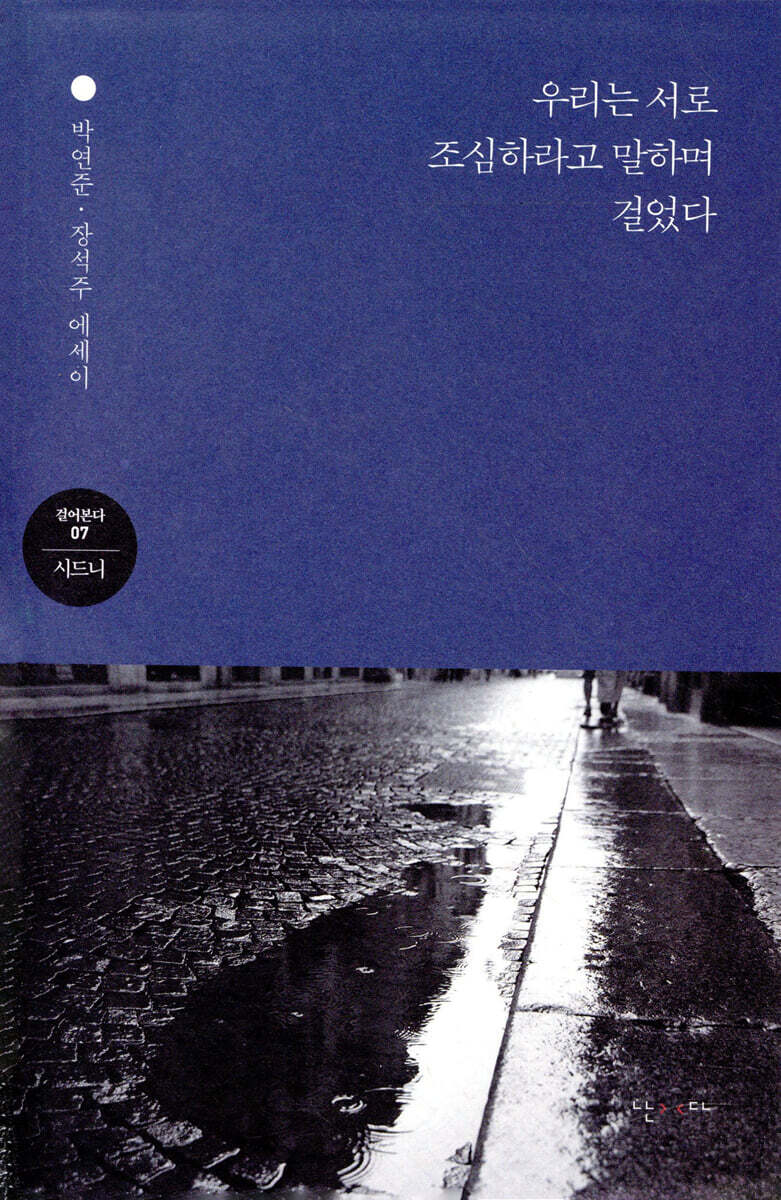
We walked, telling each other to be careful.
 |
Description
Book Introduction
Knowing your own emotions,
Love starts there.
Now I am gentle.
Until the bitterness takes off its own clothes,
Because I loved you.
-Park Yeon-jun
Now shake off your hesitation and take courage.
You can call it love.
No cypress tree fears the wind,
You can just stand there as you have been.
-Jang Seok-ju
The seventh story in the Walk series.
"We Walked Telling Each Other to Be Careful" is a book that brings together the records of a man who has experienced Sydney and a woman who has not experienced Sydney, who walked together for the first time in a foreign land after leaving Korea.
Embracing their differences as a man and a woman, and their commonality as poets, they spend a month living in a house lent to them by an acquaintance living in Sydney.
While living together in one house, they recorded in detail how different men and women are, and how love helps them overcome those differences.
In other words, I think the marriage created by the text, “We walked while telling each other to be careful,” is another name for the wedding ceremony held by a book.
The two main characters of this simple feast are the groom, poet Jang Seok-ju, and the bride, poet Park Yeon-jun.
Love starts there.
Now I am gentle.
Until the bitterness takes off its own clothes,
Because I loved you.
-Park Yeon-jun
Now shake off your hesitation and take courage.
You can call it love.
No cypress tree fears the wind,
You can just stand there as you have been.
-Jang Seok-ju
The seventh story in the Walk series.
"We Walked Telling Each Other to Be Careful" is a book that brings together the records of a man who has experienced Sydney and a woman who has not experienced Sydney, who walked together for the first time in a foreign land after leaving Korea.
Embracing their differences as a man and a woman, and their commonality as poets, they spend a month living in a house lent to them by an acquaintance living in Sydney.
While living together in one house, they recorded in detail how different men and women are, and how love helps them overcome those differences.
In other words, I think the marriage created by the text, “We walked while telling each other to be careful,” is another name for the wedding ceremony held by a book.
The two main characters of this simple feast are the groom, poet Jang Seok-ju, and the bride, poet Park Yeon-jun.
- You can preview some of the book's contents.
Preview
index
Part 1
Preface_ We are like 'Two Trees at Dawn'... 11
First time living… 14
First day… 20
Let the boredom be… 24
I am at your house… 32
The clouds are flowing and the corn is young… 37
That damn 'platwhite'... 41
A bottle of wine is lying there… 45
Touching the mind… 54
Rain Forest… 56
Flapping humanity… 60
Today's Events… 66
Walking alone… 69
Star City… 76
Live it once… 81
The night is so dark… 88
Book sofa…94
Even after returning, I still have to wander… 97
Part 2
Introduction: From "Solitude for One Person" to "Solitude for Two"… 107
Things that enrich your life… 110
Welcome to Sydney! … 112
The Economics of Slowness… 120
To enter the monastery, one must have 'honor'... 128
The scale of blue is 'Do'... 139
The Right Attitude for Beauty… 146
Happiness in Parentheses… 154
Don't go gently into that night! … 161
The Birth of a Walking Man… 168
All day, wind… 177
The wind blows and the beard grows… 185
In the eucalyptus forest… 194
One morning… 200
What we seek from afar is within us… 202
Stars rise above the 'forest horizon'… 208
My last week in Sydney… 214
Farewell… 219
Preface_ We are like 'Two Trees at Dawn'... 11
First time living… 14
First day… 20
Let the boredom be… 24
I am at your house… 32
The clouds are flowing and the corn is young… 37
That damn 'platwhite'... 41
A bottle of wine is lying there… 45
Touching the mind… 54
Rain Forest… 56
Flapping humanity… 60
Today's Events… 66
Walking alone… 69
Star City… 76
Live it once… 81
The night is so dark… 88
Book sofa…94
Even after returning, I still have to wander… 97
Part 2
Introduction: From "Solitude for One Person" to "Solitude for Two"… 107
Things that enrich your life… 110
Welcome to Sydney! … 112
The Economics of Slowness… 120
To enter the monastery, one must have 'honor'... 128
The scale of blue is 'Do'... 139
The Right Attitude for Beauty… 146
Happiness in Parentheses… 154
Don't go gently into that night! … 161
The Birth of a Walking Man… 168
All day, wind… 177
The wind blows and the beard grows… 185
In the eucalyptus forest… 194
One morning… 200
What we seek from afar is within us… 202
Stars rise above the 'forest horizon'… 208
My last week in Sydney… 214
Farewell… 219
Into the book
After thinking about it, I came to the word 'first'.
We may not be able to escape the condition of living only once, but we can insist on living every moment as if we were living for the first time.
Today, this moment is a time I am experiencing for the first time.
From this time on, it is a time I have never experienced before, a life I am living for the first time.
The moment you think that everyday life will repeat itself, you lose.
Who knows how life will turn out.
It's our first time!
Given this "first life," what should I do? Should I go to Australia and see kangaroos? It sounds like a full-on, foolish idea, like someone saying they'd go to Japan to eat udon.
But really! I got to live in Australia for a month.
An acquaintance of mine who lives in Australia suggested that I come and stay with him as he was away from home for a long trip.
Of course, it is not for tourism purposes.
We move into someone else's house and start eating, sleeping, and living there.
It's as if I've decided to briefly swap lives with someone else's! Now, the limitation implied in the word "just once" has been replaced by the boundlessness and hope contained in the word "first."
The beginning is an unopened Pandora's box.
It's at the very front.
It's before departure.
Anything or everything.
Events crouching in the first moments, the implications of each day! The meaning of life! --- pp. 17-18
When we fight, we fight about some fundamental issues, probably similar to those of other couples.
Those who fight are ultimately fighting for their own 'happiness'.
Hey you.
You who say that I love you and that you love me.
To make me happier, shouldn't you do this? Something like this.
Therefore, if it is a fight between lovers, it must be dealt with properly.
Because it's for each other's happiness.
Couples who don't fight even when they have problems are dangerous.
Couples who don't fight have no will to solve their problems and just rot away quietly, dully, in the midst of chaos, like a dying tree.
--- p.46
People often say that love is like a pea in a pod, but I don't think so.
Love is a person who is good even though the husk has been peeled off a long time ago.
Love is the state of incomprehension that compensates for all shortcomings.
I could name ten bad things about him (and really, he would), but I love him nonetheless.
On the other hand, if you ask me what the best thing is, I can't easily come up with an answer.
I can't say it simply, it's just good.
I can't say why it's good, and I can say many bad things about it, but that person is good.
An illogical and incomprehensible situation.
So when someone confesses that they like their lover's buck teeth, or that they can stick their finger in his nose and pick his booger, or even (as one of my friends does) that they like his fat, slacker-like body, we shouldn't try to understand.
Because love is the opposite of understanding.
How do you understand love? Just accept it.
--- pp.52-53
Since I came to Sydney, I've been walking and walking and walking every day, and when I walk, someone inside stops.
When I stop, someone inside starts walking.
Who is that someone?
It is probably a being called 'I', but I do not know that 'I' at all.
What makes up 'me' is not just flesh and bones.
The body is clearly made of flesh and bones, but somewhere in the five internal organs lies the soul.
In the soul there is a handful of dreams, a handful of pity, a handful of loneliness, and a handful of desire.
All of this comes together as you walk the streets of Sydney, flaunting the majesty of the city.
--- p.183
What is it like to live for the first time in an unfamiliar place?
We slept in unfamiliar bedrooms, cooked in unfamiliar kitchens, and spent time in unfamiliar living rooms.
I wake up at dawn to an unfamiliar temperature, unfamiliar sounds, and unfamiliar atmosphere.
What meaning does a life of idleness, struggling to overcome the evil of seeking usefulness in an unfamiliar city, create?
If a life filled only with slowness, a life filled with boredom, were possible, what color would this life appear before us?
At first, living life was an experiment and exploration that thrust our existence into an unfamiliar environment and explored new possibilities.
--- pp.219-220
We each set sail on our own ship called time.
Daily life is actually a great voyage through strong winds and waves.
If you lived Sydney time in Sydney, you must return to Seogyo-dong, Seoul and live Seogyo-dong time.
On my last night in Sydney, I wasted my time in Sydney and packed my bags.
Tomorrow morning, I'm going back to Seoul.
I will be leaving for Sydney Airport before dawn.
The Korean Air flight to Incheon Airport takes off from Sydney Airport at 7:40 AM.
At 2 a.m., as I pack my bags, I absentmindedly say, "Hello, Sydney."
We may not be able to escape the condition of living only once, but we can insist on living every moment as if we were living for the first time.
Today, this moment is a time I am experiencing for the first time.
From this time on, it is a time I have never experienced before, a life I am living for the first time.
The moment you think that everyday life will repeat itself, you lose.
Who knows how life will turn out.
It's our first time!
Given this "first life," what should I do? Should I go to Australia and see kangaroos? It sounds like a full-on, foolish idea, like someone saying they'd go to Japan to eat udon.
But really! I got to live in Australia for a month.
An acquaintance of mine who lives in Australia suggested that I come and stay with him as he was away from home for a long trip.
Of course, it is not for tourism purposes.
We move into someone else's house and start eating, sleeping, and living there.
It's as if I've decided to briefly swap lives with someone else's! Now, the limitation implied in the word "just once" has been replaced by the boundlessness and hope contained in the word "first."
The beginning is an unopened Pandora's box.
It's at the very front.
It's before departure.
Anything or everything.
Events crouching in the first moments, the implications of each day! The meaning of life! --- pp. 17-18
When we fight, we fight about some fundamental issues, probably similar to those of other couples.
Those who fight are ultimately fighting for their own 'happiness'.
Hey you.
You who say that I love you and that you love me.
To make me happier, shouldn't you do this? Something like this.
Therefore, if it is a fight between lovers, it must be dealt with properly.
Because it's for each other's happiness.
Couples who don't fight even when they have problems are dangerous.
Couples who don't fight have no will to solve their problems and just rot away quietly, dully, in the midst of chaos, like a dying tree.
--- p.46
People often say that love is like a pea in a pod, but I don't think so.
Love is a person who is good even though the husk has been peeled off a long time ago.
Love is the state of incomprehension that compensates for all shortcomings.
I could name ten bad things about him (and really, he would), but I love him nonetheless.
On the other hand, if you ask me what the best thing is, I can't easily come up with an answer.
I can't say it simply, it's just good.
I can't say why it's good, and I can say many bad things about it, but that person is good.
An illogical and incomprehensible situation.
So when someone confesses that they like their lover's buck teeth, or that they can stick their finger in his nose and pick his booger, or even (as one of my friends does) that they like his fat, slacker-like body, we shouldn't try to understand.
Because love is the opposite of understanding.
How do you understand love? Just accept it.
--- pp.52-53
Since I came to Sydney, I've been walking and walking and walking every day, and when I walk, someone inside stops.
When I stop, someone inside starts walking.
Who is that someone?
It is probably a being called 'I', but I do not know that 'I' at all.
What makes up 'me' is not just flesh and bones.
The body is clearly made of flesh and bones, but somewhere in the five internal organs lies the soul.
In the soul there is a handful of dreams, a handful of pity, a handful of loneliness, and a handful of desire.
All of this comes together as you walk the streets of Sydney, flaunting the majesty of the city.
--- p.183
What is it like to live for the first time in an unfamiliar place?
We slept in unfamiliar bedrooms, cooked in unfamiliar kitchens, and spent time in unfamiliar living rooms.
I wake up at dawn to an unfamiliar temperature, unfamiliar sounds, and unfamiliar atmosphere.
What meaning does a life of idleness, struggling to overcome the evil of seeking usefulness in an unfamiliar city, create?
If a life filled only with slowness, a life filled with boredom, were possible, what color would this life appear before us?
At first, living life was an experiment and exploration that thrust our existence into an unfamiliar environment and explored new possibilities.
--- pp.219-220
We each set sail on our own ship called time.
Daily life is actually a great voyage through strong winds and waves.
If you lived Sydney time in Sydney, you must return to Seogyo-dong, Seoul and live Seogyo-dong time.
On my last night in Sydney, I wasted my time in Sydney and packed my bags.
Tomorrow morning, I'm going back to Seoul.
I will be leaving for Sydney Airport before dawn.
The Korean Air flight to Incheon Airport takes off from Sydney Airport at 7:40 AM.
At 2 a.m., as I pack my bags, I absentmindedly say, "Hello, Sydney."
--- p.221
Publisher's Review
Knowing your own emotions,
Love starts there.
Now I am gentle.
Until the bitterness takes off its own clothes,
Because I loved you.
-Park Yeon-jun
Now shake off your hesitation and take courage.
You can call it love.
No cypress tree fears the wind,
You can just stand there as you have been.
-Jang Seok-ju
The seventh story of Walking is about Sydney.
Sydney is a place that some people have walked before, and for others it is their first time walking there.
Among those who picked up this book, there are probably quite a few who have experienced Sydney.
There are probably quite a few people who haven't set foot there yet. "We Walked While Telling Each Other to Be Careful" is a book written by a man who has experienced Sydney and a woman who has not, collecting their records of their first walk together in a foreign land after leaving Korea.
Embracing their differences as a man and a woman, and their commonality as poets, they spend a month living in a house lent to them by an acquaintance living in Sydney.
The difference between love and marriage is probably in the 'life'. While living together in one house, they recorded in detail how different men and women are, and how 'love' helps them overcome those differences.
And so, we have come to present the results and evidence in one book.
In other words, the marriage created by the phrase, "We walked while telling each other to be careful," is another name for the wedding held by a book. I would like to introduce the two main characters of this simple feast at this point.
As you might have guessed, the man and groom is poet Jang Seok-ju, and the woman and bride is poet Park Yeon-jun.
I'm sure many of you were surprised.
Or maybe you'll nod your heads.
In fact, I am one of those people who was yo-yoing between the former and the latter.
This is because, before I became the editor who planned this book, I had promised to live my life as poet Park Yeon-jun's older sister while she was still alive.
Her second collection of poems, “Father Called Me Sister-in-Law,” was also something I had created with my own hands.
It's also a title I gave myself, boasting that I knew the story of a father who mistakenly called his daughter "sister-in-law" while in a state of confusion just before his death, and Yeonjun who witnessed his father's final moments. However, the connection between this book and poet Yeonjun Park was strong until it was published.
A poet with extraordinary talent when it comes to writing, a poet born with an honesty that no one can fool, yet a poet who has kept his most secret love affair a secret for a long time.
Poet Park Yeon-jun said that he was dating me, whom he called his older sister.
Who is that name?
Poet Park Yeon-jun did not speak until the end.
There is one hint, he said he was an older man of letters.
At that time, the name Jang Seok-ju came out of my mouth.
I don't know what instinct whispered in my ear and made my mouth quiver, but at that moment, my vague suspicion that it might be him was turning out to be true.
I still remember the surprise I felt at my master's side with a pounding heart.
I said I would live without a wedding.
I told you to do that because I knew the awkwardness, discomfort, and embarrassment that a certain ‘food’ format would bring.
However, he said he was worried because people around him advised him that he should at least eat one meal.
What suddenly occurred to me at that time was the power of the physical object called a ‘book.’
Yes, let's make it public through a book, let's let everyone know through a book, and let everyone congratulate us through a book!
That's how our secret project began.
Poet Jang Seok-ju, who has an amazing sensibility and has written and created books all his life, and who never seems to age and repeats the combing of his innate delicacy every day, also readily joined us.
I know it's not an easy choice to make now, telling them.
This is because we know all too well that books, and the author's name, are things that cannot disappear, no matter how much one risks one's life to burn and bury books.
How could poet Jang Seok-ju, who was once the head of Cheongha, a publishing company that made a surprising mark on the Korean publishing world, not have known about this fact?
This passage clearly shows the commitment and will to fulfill their responsibilities and duties not only in the relationship between a man and a woman, but also in their relationship as writers.
Although they set up shop in Seogyo-dong, they decided to explore Sydney on foot.
I said I was looking forward to that much more fun.
In a foreign country where communication is difficult, and in a remote rural village, only two people are thrown into the situation.
As the first person to glimpse their meticulously documented daily life in Sydney, my first impression was that it felt like a hot woman and a cold man had met.
The temperature of the water in the bathtub filled with a woman who prioritizes emotion over reason and a man who prioritizes reason over emotion was truly just right for bathing.
The warmth, just right for submerging one's body up to the neck, was, if I may exaggerate a bit, like floating in amniotic fluid, a feeling I couldn't quite recall.
A tired sleep came over me and I woke up refreshed.
There was no doubt that it was one of the miracles wrought by love.
There are so many books in the world that deal with love between men and women, romance between men and women, and marriage between men and women.
But after reading it, I feel like there really wasn't a book that helped me put my love into practice.
The reason is simple.
Logically, I only choose the right words within the scope of my understanding, but there was no book that gave me the confidence to apply it in real life.
Although the story of two people in love, and thus two people who get married, is premised on this, the most important theme of this book is not 'love'.
It's not 'marriage' either.
In my view, the greater virtue of this book lies in ‘understanding.’
If you don't understand, you can't look into the other person's eyes.
If you don't look into the other person's eyes, you can't pour out your true feelings.
This book is merely a partial introduction to the process of healing the anxiety that a man and a woman experience over a long period of time as they struggle to make eye contact.
However, this is a book that promises to believe in the power of 'time'.
A book that replaces a wedding.
I looked into cases and it seems like something like that has never happened before.
Because they are a man and a woman with opposite temperaments, and because they are poets who write poetry, and because they have overcome the age difference of the bride being born in 1980 and the groom in 1955, I think this cute performance is acceptable.
Due to the publication of this book, their wedding took place on December 24th, Christmas Eve.
Every year, the couple would invite each other for a drink on Christmas Eve to celebrate their togetherness.
I sincerely congratulate you on your marriage.
I sincerely hope that you will congratulate the couple by reading the book.
Author's Note
We are like 'Two Trees of Dawn'
“Several stars shatter like ice on my lips as I pronounce your name.”
A long time ago I received an email that started like this:
I've memorized the first sentence so far.
In excitement and fear, my name is on your lips,
I imagined a few stars breaking apart.
It seemed like stars were walking towards me from afar.
As evening came, I became sad.
I got down on my knees and wrote a poem titled 'Please Give Me Ice'.
I didn't know that I would become a poet with that poem, but the moment I started writing poetry,
I remember feeling like I was a blue flame.
Knowing your own emotions,
Love starts there.
Now I am gentle.
Until the bitterness takes off its own clothes,
Because I loved you.
We are like two trees at dawn
I am happy.
Like a pair of daggers walking through a ember
You are brave.
Why did the stars walk this way at that time?
I think I know.
This book will serve as our marriage declaration.
May each of your writings be like bread and sauce,
I hope it reads well and harmoniously.
Poet Kim Min-jeong is featured at the beginning and end of the book.
If it weren't for her 'love',
This book would never have been published.
People I met in Sydney,
I would also like to express my gratitude to my mother and my younger brother, Taejun.
The person who thinks of me before me,
To my JJ too
I send my gratitude and love.
Let's take a long, slow walk, us!
- December 2015, in Seogyo-dong
Park Yeon-jun
From 'Solitude for One Person' to 'Solitude for Two Persons'
One person's solitude
The unexpected personal interest you showed was enough to surprise me.
I was surprised by your confession of 'I love you', even though it was a socially accepted customary way.
And I was happy.
Palm trees in full bloom, rain falling on the sea, and you.
It's a list of things that make me happy.
Just imagining your golden body like fertile farmland, your youthful thoughts bouncing dazzlingly like water droplets, your cool gaze makes my heart pound.
Love! Do you know Wadi?
A desert river, a dry river with only traces of the water that flowed during the rainy season.
I'm just like that wadi.
A wadi of a stingy and narrow-minded heart that no one can accept.
I have long dreamed of you becoming a flowing river, filling and flowing through this narrow wadi of my heart.
I dreamed of watering my dead roots with your river water, so that they would finally sprout leaves and flowers and bear fruit.
Ah, but I cannot help but say that I cannot readily accept that.
It's not that I don't have a desire to bite into the fruit of love and taste the overflowing juice of its pleasure.
After days of agonizing deliberation, I have decided to reject your love.
I hope you don't get hurt by my rejection.
I am already a man of the old days, so I might be startled by the fresh, oxygen-laden air of those wild trees you bring, and my lungs might shrink terribly.
So leave me alone.
Let me be more honest.
I've long been accustomed to the loneliness of being alone, sleeping alone, waking up alone, and walking alone.
I have been enriching my thoughts in the dark with a portion of secrets and a portion of silence.
Exhaustion and dryness are already sufficient conditions for life.
I am a scorpion, buried in the sand of the desert, drying up, deprived of all moisture.
My Aquarius life now accepts a part of solitude, a part of peace, a part of freedom as my nature.
You can just stand there as you have been.
One summer we watched a meteor shower together at the beach.
I want to live the rest of my life maintaining that distance between you and me, not too far, not too close.
Solitude for two
When I looked into my inner self, which was curled up in ‘loneliness of one person’,
There, the beast called fear lurked with anxious eyes.
I felt sorry for the beast because its eyes were filled with fear.
I was afraid of losing that 'solitude of one person', that freedom and tranquility.
Now shake off your hesitation and take courage.
You can call it love.
No cypress tree fears the wind.
So, I embrace the ‘solitude of two people’.
Love is accepting the loneliness of two people warmly and proudly.
With my beloved P, who will share the brilliant moments of life with me
I would like to thank poet Kim Min-jeong for creating this wonderful book as a wedding gift.
- December 2015, in Seogyo-dong
Jang Seok-ju
Love starts there.
Now I am gentle.
Until the bitterness takes off its own clothes,
Because I loved you.
-Park Yeon-jun
Now shake off your hesitation and take courage.
You can call it love.
No cypress tree fears the wind,
You can just stand there as you have been.
-Jang Seok-ju
The seventh story of Walking is about Sydney.
Sydney is a place that some people have walked before, and for others it is their first time walking there.
Among those who picked up this book, there are probably quite a few who have experienced Sydney.
There are probably quite a few people who haven't set foot there yet. "We Walked While Telling Each Other to Be Careful" is a book written by a man who has experienced Sydney and a woman who has not, collecting their records of their first walk together in a foreign land after leaving Korea.
Embracing their differences as a man and a woman, and their commonality as poets, they spend a month living in a house lent to them by an acquaintance living in Sydney.
The difference between love and marriage is probably in the 'life'. While living together in one house, they recorded in detail how different men and women are, and how 'love' helps them overcome those differences.
And so, we have come to present the results and evidence in one book.
In other words, the marriage created by the phrase, "We walked while telling each other to be careful," is another name for the wedding held by a book. I would like to introduce the two main characters of this simple feast at this point.
As you might have guessed, the man and groom is poet Jang Seok-ju, and the woman and bride is poet Park Yeon-jun.
I'm sure many of you were surprised.
Or maybe you'll nod your heads.
In fact, I am one of those people who was yo-yoing between the former and the latter.
This is because, before I became the editor who planned this book, I had promised to live my life as poet Park Yeon-jun's older sister while she was still alive.
Her second collection of poems, “Father Called Me Sister-in-Law,” was also something I had created with my own hands.
It's also a title I gave myself, boasting that I knew the story of a father who mistakenly called his daughter "sister-in-law" while in a state of confusion just before his death, and Yeonjun who witnessed his father's final moments. However, the connection between this book and poet Yeonjun Park was strong until it was published.
A poet with extraordinary talent when it comes to writing, a poet born with an honesty that no one can fool, yet a poet who has kept his most secret love affair a secret for a long time.
Poet Park Yeon-jun said that he was dating me, whom he called his older sister.
Who is that name?
Poet Park Yeon-jun did not speak until the end.
There is one hint, he said he was an older man of letters.
At that time, the name Jang Seok-ju came out of my mouth.
I don't know what instinct whispered in my ear and made my mouth quiver, but at that moment, my vague suspicion that it might be him was turning out to be true.
I still remember the surprise I felt at my master's side with a pounding heart.
I said I would live without a wedding.
I told you to do that because I knew the awkwardness, discomfort, and embarrassment that a certain ‘food’ format would bring.
However, he said he was worried because people around him advised him that he should at least eat one meal.
What suddenly occurred to me at that time was the power of the physical object called a ‘book.’
Yes, let's make it public through a book, let's let everyone know through a book, and let everyone congratulate us through a book!
That's how our secret project began.
Poet Jang Seok-ju, who has an amazing sensibility and has written and created books all his life, and who never seems to age and repeats the combing of his innate delicacy every day, also readily joined us.
I know it's not an easy choice to make now, telling them.
This is because we know all too well that books, and the author's name, are things that cannot disappear, no matter how much one risks one's life to burn and bury books.
How could poet Jang Seok-ju, who was once the head of Cheongha, a publishing company that made a surprising mark on the Korean publishing world, not have known about this fact?
This passage clearly shows the commitment and will to fulfill their responsibilities and duties not only in the relationship between a man and a woman, but also in their relationship as writers.
Although they set up shop in Seogyo-dong, they decided to explore Sydney on foot.
I said I was looking forward to that much more fun.
In a foreign country where communication is difficult, and in a remote rural village, only two people are thrown into the situation.
As the first person to glimpse their meticulously documented daily life in Sydney, my first impression was that it felt like a hot woman and a cold man had met.
The temperature of the water in the bathtub filled with a woman who prioritizes emotion over reason and a man who prioritizes reason over emotion was truly just right for bathing.
The warmth, just right for submerging one's body up to the neck, was, if I may exaggerate a bit, like floating in amniotic fluid, a feeling I couldn't quite recall.
A tired sleep came over me and I woke up refreshed.
There was no doubt that it was one of the miracles wrought by love.
There are so many books in the world that deal with love between men and women, romance between men and women, and marriage between men and women.
But after reading it, I feel like there really wasn't a book that helped me put my love into practice.
The reason is simple.
Logically, I only choose the right words within the scope of my understanding, but there was no book that gave me the confidence to apply it in real life.
Although the story of two people in love, and thus two people who get married, is premised on this, the most important theme of this book is not 'love'.
It's not 'marriage' either.
In my view, the greater virtue of this book lies in ‘understanding.’
If you don't understand, you can't look into the other person's eyes.
If you don't look into the other person's eyes, you can't pour out your true feelings.
This book is merely a partial introduction to the process of healing the anxiety that a man and a woman experience over a long period of time as they struggle to make eye contact.
However, this is a book that promises to believe in the power of 'time'.
A book that replaces a wedding.
I looked into cases and it seems like something like that has never happened before.
Because they are a man and a woman with opposite temperaments, and because they are poets who write poetry, and because they have overcome the age difference of the bride being born in 1980 and the groom in 1955, I think this cute performance is acceptable.
Due to the publication of this book, their wedding took place on December 24th, Christmas Eve.
Every year, the couple would invite each other for a drink on Christmas Eve to celebrate their togetherness.
I sincerely congratulate you on your marriage.
I sincerely hope that you will congratulate the couple by reading the book.
Author's Note
We are like 'Two Trees of Dawn'
“Several stars shatter like ice on my lips as I pronounce your name.”
A long time ago I received an email that started like this:
I've memorized the first sentence so far.
In excitement and fear, my name is on your lips,
I imagined a few stars breaking apart.
It seemed like stars were walking towards me from afar.
As evening came, I became sad.
I got down on my knees and wrote a poem titled 'Please Give Me Ice'.
I didn't know that I would become a poet with that poem, but the moment I started writing poetry,
I remember feeling like I was a blue flame.
Knowing your own emotions,
Love starts there.
Now I am gentle.
Until the bitterness takes off its own clothes,
Because I loved you.
We are like two trees at dawn
I am happy.
Like a pair of daggers walking through a ember
You are brave.
Why did the stars walk this way at that time?
I think I know.
This book will serve as our marriage declaration.
May each of your writings be like bread and sauce,
I hope it reads well and harmoniously.
Poet Kim Min-jeong is featured at the beginning and end of the book.
If it weren't for her 'love',
This book would never have been published.
People I met in Sydney,
I would also like to express my gratitude to my mother and my younger brother, Taejun.
The person who thinks of me before me,
To my JJ too
I send my gratitude and love.
Let's take a long, slow walk, us!
- December 2015, in Seogyo-dong
Park Yeon-jun
From 'Solitude for One Person' to 'Solitude for Two Persons'
One person's solitude
The unexpected personal interest you showed was enough to surprise me.
I was surprised by your confession of 'I love you', even though it was a socially accepted customary way.
And I was happy.
Palm trees in full bloom, rain falling on the sea, and you.
It's a list of things that make me happy.
Just imagining your golden body like fertile farmland, your youthful thoughts bouncing dazzlingly like water droplets, your cool gaze makes my heart pound.
Love! Do you know Wadi?
A desert river, a dry river with only traces of the water that flowed during the rainy season.
I'm just like that wadi.
A wadi of a stingy and narrow-minded heart that no one can accept.
I have long dreamed of you becoming a flowing river, filling and flowing through this narrow wadi of my heart.
I dreamed of watering my dead roots with your river water, so that they would finally sprout leaves and flowers and bear fruit.
Ah, but I cannot help but say that I cannot readily accept that.
It's not that I don't have a desire to bite into the fruit of love and taste the overflowing juice of its pleasure.
After days of agonizing deliberation, I have decided to reject your love.
I hope you don't get hurt by my rejection.
I am already a man of the old days, so I might be startled by the fresh, oxygen-laden air of those wild trees you bring, and my lungs might shrink terribly.
So leave me alone.
Let me be more honest.
I've long been accustomed to the loneliness of being alone, sleeping alone, waking up alone, and walking alone.
I have been enriching my thoughts in the dark with a portion of secrets and a portion of silence.
Exhaustion and dryness are already sufficient conditions for life.
I am a scorpion, buried in the sand of the desert, drying up, deprived of all moisture.
My Aquarius life now accepts a part of solitude, a part of peace, a part of freedom as my nature.
You can just stand there as you have been.
One summer we watched a meteor shower together at the beach.
I want to live the rest of my life maintaining that distance between you and me, not too far, not too close.
Solitude for two
When I looked into my inner self, which was curled up in ‘loneliness of one person’,
There, the beast called fear lurked with anxious eyes.
I felt sorry for the beast because its eyes were filled with fear.
I was afraid of losing that 'solitude of one person', that freedom and tranquility.
Now shake off your hesitation and take courage.
You can call it love.
No cypress tree fears the wind.
So, I embrace the ‘solitude of two people’.
Love is accepting the loneliness of two people warmly and proudly.
With my beloved P, who will share the brilliant moments of life with me
I would like to thank poet Kim Min-jeong for creating this wonderful book as a wedding gift.
- December 2015, in Seogyo-dong
Jang Seok-ju
GOODS SPECIFICS
- Date of issue: December 24, 2015
- Page count, weight, size: 224 pages | 328g | 138*210*20mm
- ISBN13: 9788954638999
- ISBN10: 8954638996
You may also like
카테고리
korean


korean

![GQ KOREA Mark (Monthly): December [2025]](http://librairie.coreenne.fr/cdn/shop/files/8ef265dbbfbf186523ed75ba7319009d.jpg?v=1765340328&width=3840)


