

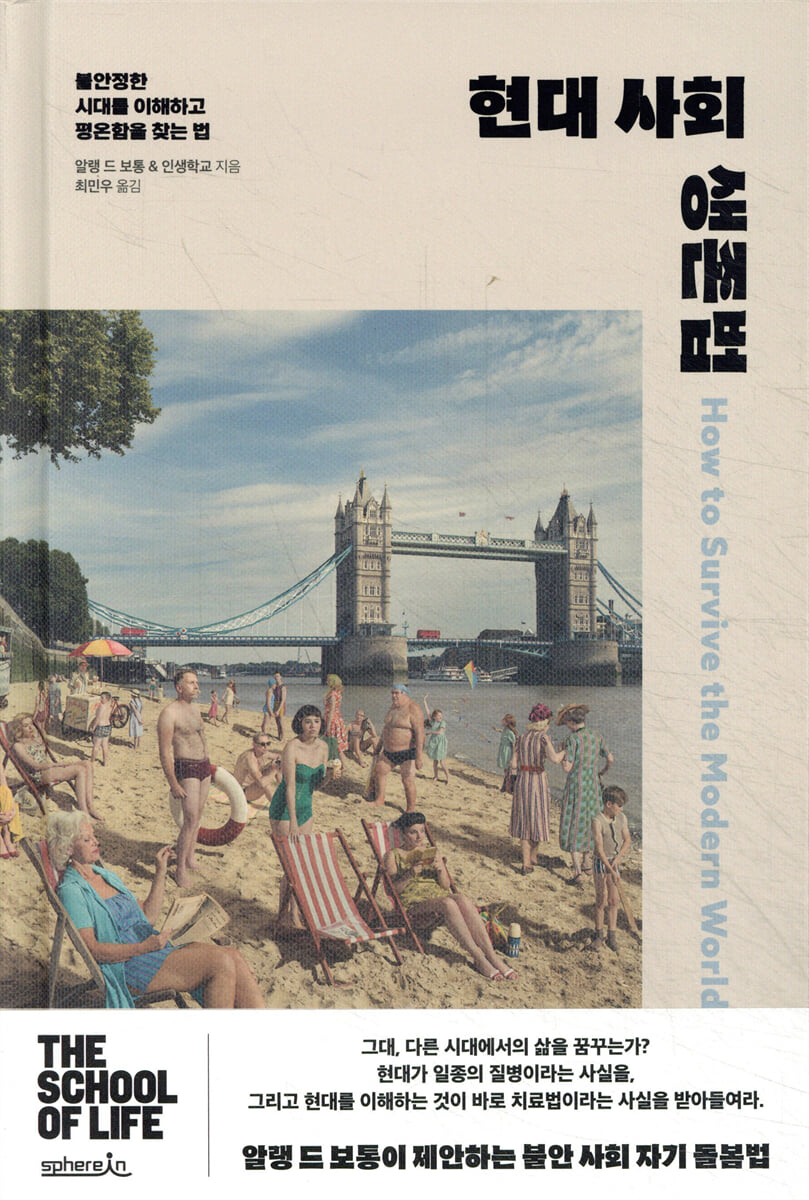
How to survive in modern society
 |
Description
Book Introduction
Systematically diagnosing the disease called ‘modern’
A treatment that offers hope called 'comfort'
Amid the complexity and uncertainty of modern society, many people are struggling to find peace and stability.
In the midst of this, the latest work, 『How to Survive in Modern Society』, written by world-renowned bestselling author Alain de Botton and the School of Life, has been published.
This book will provide modern people with the wisdom and insight they need to navigate uncertain times.
In recent years, we have witnessed a deepening of global anxiety and turmoil, driven by the COVID-19 pandemic, economic recession, political instability, and seemingly endless wars.
Moreover, due to information overload in the digital age and the influence of social media, individual mental health has long emerged as a serious social problem.
But even without discussing recent global issues or the situations faced by individuals, this book argues that the modern world itself is an age of anxiety and confusion.
"Survival in Modern Society" delves deeply into the roots of the anxiety and confusion of this modern era and systematically analyzes the various problems of modern society.
Modern times have brought about remarkable advancements, abundance, and benefits in technology, medicine, transportation, and industry.
At the same time, the blind faith in progress, the pursuit of perfection, information overload, and social expectations and comparisons have left people feeling mentally empty, pressured, fearful of failure, frustrated, and jealous.
This book provides a detailed and systematic analysis of the historical, philosophical, and cultural processes and stages through which the modern era reached its current state, helping readers gain a clearer understanding of modern society.
“The good news is that you don’t have to suffer alone.
Although we each suffer, our circumstances are a product of our times, not of our own minds.
By learning to diagnose our situation, we come to realize that we are living in turbulent times, not of individual madness, but of unprecedented intensity and societal turmoil.
We also come to accept that modernity is a kind of disease, and that understanding modernity is the cure for it.” (Page 20)
We suffer when we feel an unexplained anxiety.
But knowing the cause and source of your anxiety can give you the courage to accept it and move forward to find a breakthrough.
This book helps us understand the complex problems of modern society, and it also contains practical methods and helpful suggestions for overcoming the problems that cause anxiety and confusion.
This book will serve as a valuable guide for modern people who endure each difficult day, consumed by inexplicable anxiety and endless confusion, and for all those who seek to resolve this anxiety.
A treatment that offers hope called 'comfort'
Amid the complexity and uncertainty of modern society, many people are struggling to find peace and stability.
In the midst of this, the latest work, 『How to Survive in Modern Society』, written by world-renowned bestselling author Alain de Botton and the School of Life, has been published.
This book will provide modern people with the wisdom and insight they need to navigate uncertain times.
In recent years, we have witnessed a deepening of global anxiety and turmoil, driven by the COVID-19 pandemic, economic recession, political instability, and seemingly endless wars.
Moreover, due to information overload in the digital age and the influence of social media, individual mental health has long emerged as a serious social problem.
But even without discussing recent global issues or the situations faced by individuals, this book argues that the modern world itself is an age of anxiety and confusion.
"Survival in Modern Society" delves deeply into the roots of the anxiety and confusion of this modern era and systematically analyzes the various problems of modern society.
Modern times have brought about remarkable advancements, abundance, and benefits in technology, medicine, transportation, and industry.
At the same time, the blind faith in progress, the pursuit of perfection, information overload, and social expectations and comparisons have left people feeling mentally empty, pressured, fearful of failure, frustrated, and jealous.
This book provides a detailed and systematic analysis of the historical, philosophical, and cultural processes and stages through which the modern era reached its current state, helping readers gain a clearer understanding of modern society.
“The good news is that you don’t have to suffer alone.
Although we each suffer, our circumstances are a product of our times, not of our own minds.
By learning to diagnose our situation, we come to realize that we are living in turbulent times, not of individual madness, but of unprecedented intensity and societal turmoil.
We also come to accept that modernity is a kind of disease, and that understanding modernity is the cure for it.” (Page 20)
We suffer when we feel an unexplained anxiety.
But knowing the cause and source of your anxiety can give you the courage to accept it and move forward to find a breakthrough.
This book helps us understand the complex problems of modern society, and it also contains practical methods and helpful suggestions for overcoming the problems that cause anxiety and confusion.
This book will serve as a valuable guide for modern people who endure each difficult day, consumed by inexplicable anxiety and endless confusion, and for all those who seek to resolve this anxiety.
index
Entering
1___Consumer Capitalism
2___Advertisement
3___materialism
4___Media
5___Democracy
6___family
7___love
8___ star
9___Loneliness
10___days
11___Individualism
12___A quiet life
13___Busy
14___Ugliness
15___Education
16___Perfectionism
17___Science and Religion
18___Nature
Going out
1___Consumer Capitalism
2___Advertisement
3___materialism
4___Media
5___Democracy
6___family
7___love
8___ star
9___Loneliness
10___days
11___Individualism
12___A quiet life
13___Busy
14___Ugliness
15___Education
16___Perfectionism
17___Science and Religion
18___Nature
Going out
Detailed image

Into the book
Many of the changes that have occurred in modern times are incredibly exciting, even thrilling.
'Modern' is still a word that connotes a state of glamour, desire, and ambitious aspiration.
… … But at the same time, the advent of the modern era is also a history of tragedy.
Our new freedom came at a very high price.
We have never come this close to collective madness or planetary extinction.
Modernity has mercilessly devastated our inner and outer landscapes.
--- p.14
Modernity may have enriched us materially, but it has also exacted a tremendous emotional toll.
It alienated us, fostered jealousy, and multiplied shame.
It divided us, made us bewildered, made us smile insincerely, and made us angry and bitter.
--- p.20
We are still learning to discover and maintain our own identity, even amidst cleverly designed pressures to conform.
We all know enough about the desire to make money, and we devote most of our lives to making money.
The challenge now before us is to cultivate a corresponding ambition around an activity that has so far been largely ignored: shopping.
Shopping is a fundamental issue that underlies the entire socio-economic reality of modern times.
--- p.39
The conflict between work and home life isn't due to our incompetence or lack of motivation.
We are simply living in a period of history where two huge, opposing themes are colliding.
Caring for and raising a family requires a lot of time and effort.
Likewise, work, efficiency, profit, and competition require a lot of time and effort.
Both are based on important insights, but they exclude each other.
We deserve great sympathy.
--- p.125
Although we are interested in wealth and salary, this interest is not based on 'materialism'.
We simply live in a world where owning certain material goods has become the only way to obtain the emotional rewards we crave deep down.
What we pursue is not things or titles.
It's heartbreaking, really, that what we're after is a feeling of being "noted" and "popular," a feeling that can only be achieved through material means.
--- p.185
If we knew how to derive unique value from what we have already experienced and seen, we would not need to have so many experiences.
Our drive to constantly move may be a confession of our inability to fully process our inner experiences.
The reason I feel like I need a lot of new experiences is because I haven't been able to properly absorb what I've already experienced.
--- p.196
Busy people avoid different types of tasks.
They are busy like a swarm of bees, but they don't have time to reflect on their true feelings about what they are doing.
They endlessly postpone investigating the direction they are going and are lazy about understanding the purpose of life.
Their busyness is a subtle but powerful form of distraction, a kind of laziness in fact.
--- p.204
In a perfectionist's world, even living as the most ordinary of beings feels incompetent and humiliating.
Filled with flaws, obsessions, mistakes, and irrationalities, we find ourselves in a cursed night where we constantly ruminate on our shortcomings, deeming ourselves unforgivable.
What we really need is to remember that the way we exist now is the only possibility we have.
We must remember that stumbling, making mistakes, regretting, and realizing things too late are inherent characteristics of most imperfectly evolved, clumsy animals.
--- p.231
We have never been 'me'.
We have only borrowed a part of the universe for a while, and over time it will become something else of equal value.
Like all living things, we are made from fragments of stars.
We have traveled between supernovae.
We are as old as the universe.
'I' am just a passing phase.
What the Earth has lent us will, in time, stir new life again.
There is no need to be embarrassed by these facts.
Scientific reality can inspire philosophical thought that is far more comforting than any book or prayer.
We don't have to hold on to life so tightly.
We are never whole, and sooner or later we will return to being small pieces.
--- p.256
We must reach out to our suffering fellow citizens of today.
Being able to choose but choosing wrongly, being able to move but being afraid to even flinch, knowing that a major hypothesis is wrong but lacking the courage or mental fortitude to think of an alternative, knowing that there are many people around us who dislike us but worrying excessively about what they think of us – this is not our failure, it is human nature.
--- p.285
The unique agony of modernity comes from seeing a better future, from knowing that suffering is not inevitable, from seeing a lifeline on the horizon, but recognizing that by the time it arrives, we will be dead.
--- p.294
The present may be a time of confusion, but the inevitable future direction is clear.
Rather than continuing to suffer in a cycle of constant, repetitive motions, like a hamster wheel, we must gradually illuminate the fundamental darkness in a more nuanced way, in keeping with our own high potential, and discover ways to escape the perils of modern life.
'Modern' is still a word that connotes a state of glamour, desire, and ambitious aspiration.
… … But at the same time, the advent of the modern era is also a history of tragedy.
Our new freedom came at a very high price.
We have never come this close to collective madness or planetary extinction.
Modernity has mercilessly devastated our inner and outer landscapes.
--- p.14
Modernity may have enriched us materially, but it has also exacted a tremendous emotional toll.
It alienated us, fostered jealousy, and multiplied shame.
It divided us, made us bewildered, made us smile insincerely, and made us angry and bitter.
--- p.20
We are still learning to discover and maintain our own identity, even amidst cleverly designed pressures to conform.
We all know enough about the desire to make money, and we devote most of our lives to making money.
The challenge now before us is to cultivate a corresponding ambition around an activity that has so far been largely ignored: shopping.
Shopping is a fundamental issue that underlies the entire socio-economic reality of modern times.
--- p.39
The conflict between work and home life isn't due to our incompetence or lack of motivation.
We are simply living in a period of history where two huge, opposing themes are colliding.
Caring for and raising a family requires a lot of time and effort.
Likewise, work, efficiency, profit, and competition require a lot of time and effort.
Both are based on important insights, but they exclude each other.
We deserve great sympathy.
--- p.125
Although we are interested in wealth and salary, this interest is not based on 'materialism'.
We simply live in a world where owning certain material goods has become the only way to obtain the emotional rewards we crave deep down.
What we pursue is not things or titles.
It's heartbreaking, really, that what we're after is a feeling of being "noted" and "popular," a feeling that can only be achieved through material means.
--- p.185
If we knew how to derive unique value from what we have already experienced and seen, we would not need to have so many experiences.
Our drive to constantly move may be a confession of our inability to fully process our inner experiences.
The reason I feel like I need a lot of new experiences is because I haven't been able to properly absorb what I've already experienced.
--- p.196
Busy people avoid different types of tasks.
They are busy like a swarm of bees, but they don't have time to reflect on their true feelings about what they are doing.
They endlessly postpone investigating the direction they are going and are lazy about understanding the purpose of life.
Their busyness is a subtle but powerful form of distraction, a kind of laziness in fact.
--- p.204
In a perfectionist's world, even living as the most ordinary of beings feels incompetent and humiliating.
Filled with flaws, obsessions, mistakes, and irrationalities, we find ourselves in a cursed night where we constantly ruminate on our shortcomings, deeming ourselves unforgivable.
What we really need is to remember that the way we exist now is the only possibility we have.
We must remember that stumbling, making mistakes, regretting, and realizing things too late are inherent characteristics of most imperfectly evolved, clumsy animals.
--- p.231
We have never been 'me'.
We have only borrowed a part of the universe for a while, and over time it will become something else of equal value.
Like all living things, we are made from fragments of stars.
We have traveled between supernovae.
We are as old as the universe.
'I' am just a passing phase.
What the Earth has lent us will, in time, stir new life again.
There is no need to be embarrassed by these facts.
Scientific reality can inspire philosophical thought that is far more comforting than any book or prayer.
We don't have to hold on to life so tightly.
We are never whole, and sooner or later we will return to being small pieces.
--- p.256
We must reach out to our suffering fellow citizens of today.
Being able to choose but choosing wrongly, being able to move but being afraid to even flinch, knowing that a major hypothesis is wrong but lacking the courage or mental fortitude to think of an alternative, knowing that there are many people around us who dislike us but worrying excessively about what they think of us – this is not our failure, it is human nature.
--- p.285
The unique agony of modernity comes from seeing a better future, from knowing that suffering is not inevitable, from seeing a lifeline on the horizon, but recognizing that by the time it arrives, we will be dead.
--- p.294
The present may be a time of confusion, but the inevitable future direction is clear.
Rather than continuing to suffer in a cycle of constant, repetitive motions, like a hamster wheel, we must gradually illuminate the fundamental darkness in a more nuanced way, in keeping with our own high potential, and discover ways to escape the perils of modern life.
--- p.295
Publisher's Review
Shaking off the foolishness and unnecessary worries of the modern age
Discover authentic, useful, and powerful resilience in life.
With 『How to Survive in Modern Society』, Alain de Botton and the School of Life once again present a fresh and original perspective.
It provides a clear and rational perspective on important topics in modern life: consumer capitalism, advertising, materialism, media, democracy, family, love, sex, loneliness, work, individualism, quiet life, busyness, ugliness, education, perfectionism, science and religion, and nature.
It invites us to evaluate or re-evaluate our lives today by clearly and objectively examining various aspects of modern life and how the world has developed to the present day.
And it offers a way for us to think broadly and deeply about how we should live our lives to live happily and properly in the modern world.
It explores various aspects of modern society, offering practical life wisdom, including work-life balance, social understanding and coping strategies through in-depth analysis of various social issues, overcoming disconnection from nature and living a sustainable lifestyle, and the importance of a quiet life and finding mental peace in the digital age.
This book offers a deep and multifaceted look at the modern world, offering a balanced perspective and a variety of images.
Filled with valuable and thought-provoking ideas, this is a useful and insightful book that will help you shed unnecessary worries and gain clarity about our times.
I highly recommend this book to anyone seeking to understand and find peace in the uncertain times of modern society.
It will serve as an excellent guide on how to live in the modern world despite various challenges and obstacles.
“We are moving towards a better future, but we must also acknowledge that we ourselves are in what could be called a ‘transitional period,’ to put it nicely.
“The world of the past, which had been circulating, has been abolished, and the future has not yet arrived.” (Page 291)
Discover authentic, useful, and powerful resilience in life.
With 『How to Survive in Modern Society』, Alain de Botton and the School of Life once again present a fresh and original perspective.
It provides a clear and rational perspective on important topics in modern life: consumer capitalism, advertising, materialism, media, democracy, family, love, sex, loneliness, work, individualism, quiet life, busyness, ugliness, education, perfectionism, science and religion, and nature.
It invites us to evaluate or re-evaluate our lives today by clearly and objectively examining various aspects of modern life and how the world has developed to the present day.
And it offers a way for us to think broadly and deeply about how we should live our lives to live happily and properly in the modern world.
It explores various aspects of modern society, offering practical life wisdom, including work-life balance, social understanding and coping strategies through in-depth analysis of various social issues, overcoming disconnection from nature and living a sustainable lifestyle, and the importance of a quiet life and finding mental peace in the digital age.
This book offers a deep and multifaceted look at the modern world, offering a balanced perspective and a variety of images.
Filled with valuable and thought-provoking ideas, this is a useful and insightful book that will help you shed unnecessary worries and gain clarity about our times.
I highly recommend this book to anyone seeking to understand and find peace in the uncertain times of modern society.
It will serve as an excellent guide on how to live in the modern world despite various challenges and obstacles.
“We are moving towards a better future, but we must also acknowledge that we ourselves are in what could be called a ‘transitional period,’ to put it nicely.
“The world of the past, which had been circulating, has been abolished, and the future has not yet arrived.” (Page 291)
GOODS SPECIFICS
- Date of issue: May 2, 2025
- Format: Hardcover book binding method guide
- Page count, weight, size: 296 pages | 150*225*20mm
- ISBN13: 9791199203402
- ISBN10: 1199203408
You may also like
카테고리
korean


korean

![GQ KOREA Mark (Monthly): December [2025]](http://librairie.coreenne.fr/cdn/shop/files/8ef265dbbfbf186523ed75ba7319009d.jpg?v=1765340328&width=3840)


