

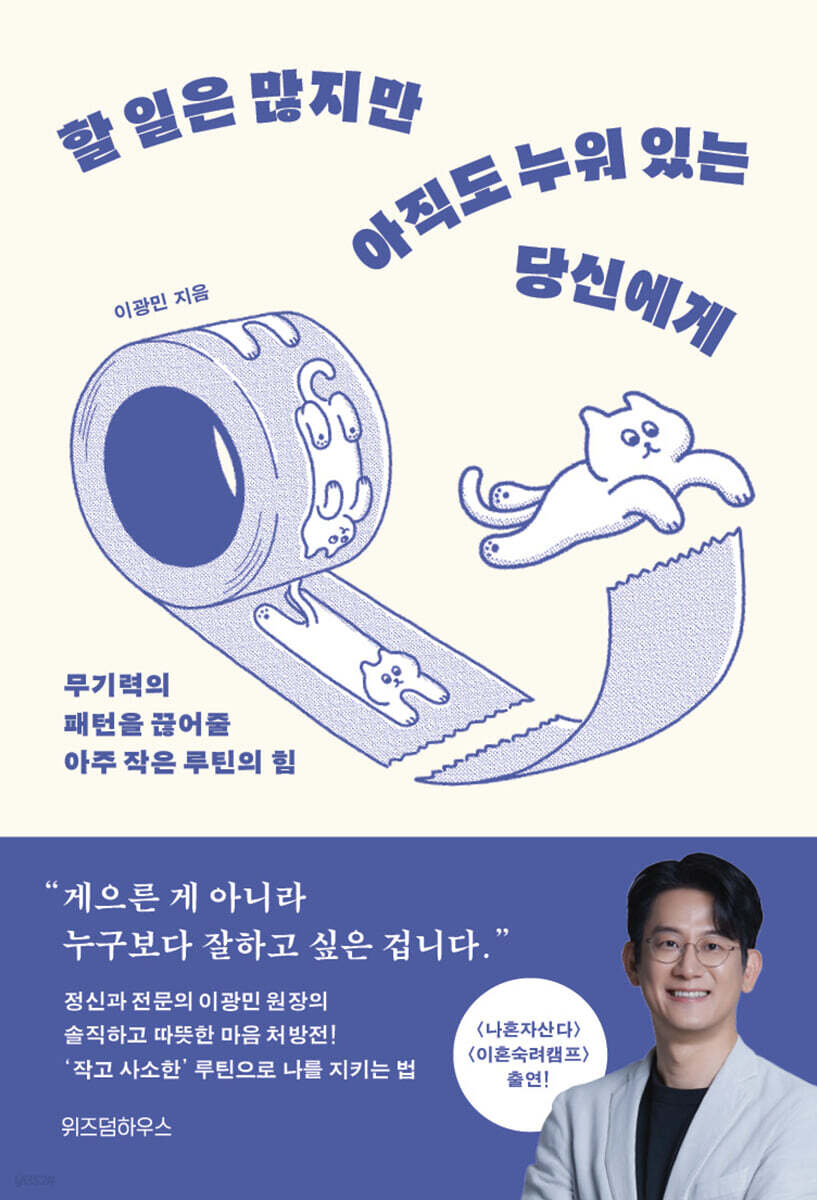
To you who still has a lot to do but is lying down
 |
Description
Book Introduction
★★★ MC Jeon Hyun-moo recommends violinist Danny Koo! ★★★
A new book has been published by psychiatrist Dr. Lee Kwang-min, who has garnered attention through his appearances on JTBC's "Divorce Consideration Camp" and MBC's "I Live Alone."
This book is for those who have a lot of work to do but "don't want to do anything." It analyzes the causes of the lethargy we experience, examines our daily routines such as sleep and exercise, and even provides methods for maintaining unhurt interpersonal relationships and restoring our disturbed inner selves.
This book will provide expert and practical advice to readers who are feeling down and helpless, as it offers solutions that can help them change through small, insignificant routines rather than grand plans.
A new book has been published by psychiatrist Dr. Lee Kwang-min, who has garnered attention through his appearances on JTBC's "Divorce Consideration Camp" and MBC's "I Live Alone."
This book is for those who have a lot of work to do but "don't want to do anything." It analyzes the causes of the lethargy we experience, examines our daily routines such as sleep and exercise, and even provides methods for maintaining unhurt interpersonal relationships and restoring our disturbed inner selves.
This book will provide expert and practical advice to readers who are feeling down and helpless, as it offers solutions that can help them change through small, insignificant routines rather than grand plans.
- You can preview some of the book's contents.
Preview
index
Prologue Are you struggling between 'I don't want to' and 'I have to'?
Chapter 1 Why Don't I Want to Do Anything?
- To you who continues to lie down today
- It's not that I'm lazy, I just want to do well.
- When it gets harder because of my helplessness
- If lethargy continues, it can lead to depression.
- Small movements save my life
- The power of a 'very small routine' that will change my listlessness.
Chapter 2: Finding Your Own Standard to Straighten Out a Disorganized Life _ Daily Routine
- Resilience also needs standards.
- Sleep, how to correct your body clock
- If you don't want to exercise, do it first.
- If I could control my meals and eat as I wish
- Self-development, growing myself through small, consistent efforts
Chapter 3: How to Protect Myself from Getting Hurt _ Human Relationship Routines
- The harder you work, the more you get hurt.
- Consider minor injuries as default
How to Take Control of a Relationship Without Trying
- Realistic Routines to Avoid Gaslighting
- Sometimes cut it off firmly, and sometimes endure it patiently.
- Human relationships are like water.
Chapter 4: Mental Routines to Avoid Being Swept Away by Negative Thoughts and Emotions
- If both body and mind are exhausted
- Relaxation routine of doing nothing
- Why can't I stop thinking?
- Meditation, a time to empty and refill
- Sometimes it's okay to run away
- Surviving to the end even in frustration
Americas
Chapter 1 Why Don't I Want to Do Anything?
- To you who continues to lie down today
- It's not that I'm lazy, I just want to do well.
- When it gets harder because of my helplessness
- If lethargy continues, it can lead to depression.
- Small movements save my life
- The power of a 'very small routine' that will change my listlessness.
Chapter 2: Finding Your Own Standard to Straighten Out a Disorganized Life _ Daily Routine
- Resilience also needs standards.
- Sleep, how to correct your body clock
- If you don't want to exercise, do it first.
- If I could control my meals and eat as I wish
- Self-development, growing myself through small, consistent efforts
Chapter 3: How to Protect Myself from Getting Hurt _ Human Relationship Routines
- The harder you work, the more you get hurt.
- Consider minor injuries as default
How to Take Control of a Relationship Without Trying
- Realistic Routines to Avoid Gaslighting
- Sometimes cut it off firmly, and sometimes endure it patiently.
- Human relationships are like water.
Chapter 4: Mental Routines to Avoid Being Swept Away by Negative Thoughts and Emotions
- If both body and mind are exhausted
- Relaxation routine of doing nothing
- Why can't I stop thinking?
- Meditation, a time to empty and refill
- Sometimes it's okay to run away
- Surviving to the end even in frustration
Americas
Detailed image

Into the book
The reason I need a routine is because it keeps me going.
When our lifestyle patterns are broken, our minds, our mental realm, also collapse.
In fact, in my practice, I often see cases where depression or burnout syndrome has occurred due to a disruption in the rhythm of daily life.
In such cases, the first thing to do is to check how much effort you put into maintaining a consistent daily pattern of sleep, meals, and physical activity, and whether you are managing your energy well.
(…) Even if there are many unexpected environmental factors, the effort to re-establish a unique daily routine becomes the basis for my body and mind to function properly.
--- From the "Prologue"
If you continue this daily routine, your life will change.
Beyond breaking free from lethargy, you will gradually gain confidence and regain the joy of everyday life.
But there is one thing to be careful about.
The more grandiose a routine starts, the more likely it is to fail.
Let's say you're feeling lethargic right now.
I'm feeling weak and don't want to do anything.
But can you suddenly achieve something extraordinary? Can you immediately resume your usual routine? Sure, some people might succeed, but most won't be able to stick with it and eventually give up.
So, I need to adjust it step by step, starting with easy actions, depending on the level of helplessness I am in.
(…) The Big Step Ladder allows you to reach your goal in just a few quick steps.
Most people would like to climb the Big Step ladder quickly.
Or, because they want to 'look good' to those around them, they set grand routines out of pride about themselves.
Of course, if you are in good condition, you will be able to climb the Big Step ladder.
But the ladder called routine is not needed when I am in good condition, but when I am lethargic.
When you're feeling lethargic, even climbing a single step is incredibly difficult.
So, your routine should be chosen in small steps.
After trying many things, the only way I found was to 'force the move'.
The researchers lifted the lethargic dog and carried it outside the fence.
I forced myself to run away from the electric shock.
But even if I force myself to move once, I can't get rid of learned helplessness.
If you move it back to the electric shock room, it still gives up.
After two, three, and repeated attempts to move the dog over the railing, the dog learned helplessness and began to jump over the railing on its own to avoid the electric shock.
What can we learn from this experiment? To overcome learned helplessness, we must force ourselves to move beyond the helplessness, no matter how uncomfortable, bothersome, or difficult it may be.
The dogs in the experiment could be moved by force by the researchers, but people cannot do that.
We have to move our bodies ourselves.
--- From "Chapter 1: Why Don't I Want to Do Anything?"
Exercise shouldn't be too hard.
Then you give up.
If exercise is too difficult, of course you won't want to do it.
It is recommended to start with an appropriate intensity for your needs, such as feeling warm and sweating a little, and then slowly increase the intensity of the exercise as you feel more comfortable.
But especially when you go to receive personal training, there are many coaches who push you from the beginning.
This way, we can see visible results and members can feel rewarded for spending a lot of money to exercise.
But this method has a blind spot.
It means you'll give up quickly.
We want to exercise as a routine.
I'm not trying to lose weight and build muscle in a short period of time to compete.
So the goal of exercise should be consistency, not visible results.
--- From "Chapter 2: Finding Your Own Standard to Straighten Up a Disorganized Life"
It takes a certain level of experience to build positive relationships with people.
No one is good at everything from the beginning.
Experience is definitely necessary.
By developing an eye for recognizing beneficial people through experience and developing criteria for filtering out harmful ones, you can reduce the number of times you get hurt and build healthier relationships.
How do we gain this kind of experience? It requires constant interaction with people.
Then, just as calluses form on your hands, you will naturally develop calluses from the wounds in your relationships.
Relationships with people are similar to RPG games.
When playing a game, you first gain experience by hunting light monsters, and when you level up as those experience points accumulate, your abilities increase and you can hunt more difficult monsters.
Human relationships also start out as a relationship where both parties feel comfortable and then steadily build up experience.
As you do this, your ability to deal with people, avoid hurt, and protect yourself will increase, and you will be able to communicate, cooperate, negotiate, and mediate.
--- From "Chapter 3: How to Protect Myself Without Getting Hurt"
Perfectionism has something in common with stabilityism.
What should our daily lives be like to be perfect? They should be stable, without error.
I can only maintain perfectionism if everything goes according to my control and plan.
As a result, life becomes more peaceful.
On the other hand, even a small unexpected variable can cause it to falter.
So, I encourage you to enter an environment where tomorrow is unpredictable.
I realized how frustrated I had been living, and I tried to become someone who could deal with problems flexibly.
Also, people who have always strived for perfection in order to achieve their goals can experience recoverable failure through this experience.
Failures in social life are irreversible, but small failures in daily life are completely recoverable.
You build courage through small failures.
When our lifestyle patterns are broken, our minds, our mental realm, also collapse.
In fact, in my practice, I often see cases where depression or burnout syndrome has occurred due to a disruption in the rhythm of daily life.
In such cases, the first thing to do is to check how much effort you put into maintaining a consistent daily pattern of sleep, meals, and physical activity, and whether you are managing your energy well.
(…) Even if there are many unexpected environmental factors, the effort to re-establish a unique daily routine becomes the basis for my body and mind to function properly.
--- From the "Prologue"
If you continue this daily routine, your life will change.
Beyond breaking free from lethargy, you will gradually gain confidence and regain the joy of everyday life.
But there is one thing to be careful about.
The more grandiose a routine starts, the more likely it is to fail.
Let's say you're feeling lethargic right now.
I'm feeling weak and don't want to do anything.
But can you suddenly achieve something extraordinary? Can you immediately resume your usual routine? Sure, some people might succeed, but most won't be able to stick with it and eventually give up.
So, I need to adjust it step by step, starting with easy actions, depending on the level of helplessness I am in.
(…) The Big Step Ladder allows you to reach your goal in just a few quick steps.
Most people would like to climb the Big Step ladder quickly.
Or, because they want to 'look good' to those around them, they set grand routines out of pride about themselves.
Of course, if you are in good condition, you will be able to climb the Big Step ladder.
But the ladder called routine is not needed when I am in good condition, but when I am lethargic.
When you're feeling lethargic, even climbing a single step is incredibly difficult.
So, your routine should be chosen in small steps.
After trying many things, the only way I found was to 'force the move'.
The researchers lifted the lethargic dog and carried it outside the fence.
I forced myself to run away from the electric shock.
But even if I force myself to move once, I can't get rid of learned helplessness.
If you move it back to the electric shock room, it still gives up.
After two, three, and repeated attempts to move the dog over the railing, the dog learned helplessness and began to jump over the railing on its own to avoid the electric shock.
What can we learn from this experiment? To overcome learned helplessness, we must force ourselves to move beyond the helplessness, no matter how uncomfortable, bothersome, or difficult it may be.
The dogs in the experiment could be moved by force by the researchers, but people cannot do that.
We have to move our bodies ourselves.
--- From "Chapter 1: Why Don't I Want to Do Anything?"
Exercise shouldn't be too hard.
Then you give up.
If exercise is too difficult, of course you won't want to do it.
It is recommended to start with an appropriate intensity for your needs, such as feeling warm and sweating a little, and then slowly increase the intensity of the exercise as you feel more comfortable.
But especially when you go to receive personal training, there are many coaches who push you from the beginning.
This way, we can see visible results and members can feel rewarded for spending a lot of money to exercise.
But this method has a blind spot.
It means you'll give up quickly.
We want to exercise as a routine.
I'm not trying to lose weight and build muscle in a short period of time to compete.
So the goal of exercise should be consistency, not visible results.
--- From "Chapter 2: Finding Your Own Standard to Straighten Up a Disorganized Life"
It takes a certain level of experience to build positive relationships with people.
No one is good at everything from the beginning.
Experience is definitely necessary.
By developing an eye for recognizing beneficial people through experience and developing criteria for filtering out harmful ones, you can reduce the number of times you get hurt and build healthier relationships.
How do we gain this kind of experience? It requires constant interaction with people.
Then, just as calluses form on your hands, you will naturally develop calluses from the wounds in your relationships.
Relationships with people are similar to RPG games.
When playing a game, you first gain experience by hunting light monsters, and when you level up as those experience points accumulate, your abilities increase and you can hunt more difficult monsters.
Human relationships also start out as a relationship where both parties feel comfortable and then steadily build up experience.
As you do this, your ability to deal with people, avoid hurt, and protect yourself will increase, and you will be able to communicate, cooperate, negotiate, and mediate.
--- From "Chapter 3: How to Protect Myself Without Getting Hurt"
Perfectionism has something in common with stabilityism.
What should our daily lives be like to be perfect? They should be stable, without error.
I can only maintain perfectionism if everything goes according to my control and plan.
As a result, life becomes more peaceful.
On the other hand, even a small unexpected variable can cause it to falter.
So, I encourage you to enter an environment where tomorrow is unpredictable.
I realized how frustrated I had been living, and I tried to become someone who could deal with problems flexibly.
Also, people who have always strived for perfection in order to achieve their goals can experience recoverable failure through this experience.
Failures in social life are irreversible, but small failures in daily life are completely recoverable.
You build courage through small failures.
--- From Chapter 4, “How to avoid being swept away by negative thoughts and emotions”
Publisher's Review
“Why don’t I want to do anything?”
A mental guide for those of you who put off today's work until tomorrow!
'Why do I feel so lazy and don't want to do anything?' 'Everyone else is doing well, but why am I the only one who's living a mess?' 'Why can't I stop having negative thoughts?' We've all probably been stuck in these worries at least once, putting off things and just lying around.
Particularly in today's society, the chaos and uncertainty, coupled with the various internal struggles of modern people, have fueled a sense of apathy. Psychiatrist Dr. Lee Kwang-min, who counseled MC Jeon Hyun-moo on MBC's "I Live Alone" and offered insightful advice to countless couples on JTBC's "Divorce Camp," offers tips for breaking the cycle of apathy and regaining normalcy in "To You Who Still Have So Much to Do."
The author diagnoses that the reason we keep putting off things is not because we are lazy, but because we want to do better than anyone else.
There are many people who are so greedy about wanting to do things perfectly that they end up not being able to take even a single step forward.
He proposes a 'very small routine' as a solution to change these 'lazy perfectionists', and he persuasively explains how to correct the pattern of life through small, trivial, and consistent routines based on psychological and medical research results.
That's why this book is so easy and practical that even readers who are stuck in a vicious cycle of apathy can put it into practice right away.
Unique sleep patterns, small but consistent exercise,
Human relationships that don't hurt, mental training that empties and fills…
Only when 'very small routines' accumulate do I change!
Why would a psychiatrist who treats the mind talk about "routine"? The author of this book, Dr. Lee Kwang-min, says he frequently encounters patients suffering from depression or burnout due to disruptions in their daily rhythms.
Each time, he starts by checking how consistent he is with his daily routines, including sleep, meals, and physical activity, and how well he is managing his energy.
If your life is irregular and chaotic, the author says, it is evidence that you are not taking proper care of your body and mind.
The reason I need a routine is because it keeps me going.
This book offers actionable routines in three key areas, drawing on a variety of relatable examples.
First, in the 'Daily Routine' that straightens out a messy life, we check our body and lifestyle patterns through sleep, exercise, eating, and self-development.
Secondly, I will introduce a 'human relationship routine' that can protect me from getting hurt, and lastly, I will share a 'mental routine' that will prevent me from being swept away by negative thoughts and emotions.
The key to the routine presented in this book is the 'very small' step, that is, the small step, not the big step.
The author says, “The more grandiose the routine, the more likely it is to fail,” and suggests changing it by even 1% every day.
Only when small, insignificant movements accumulate steadily can I change.
Readers who are struggling and feeling lethargic will find that this book will help them immediately apply the essential routines for physical and mental recovery into their daily lives, and will also give them the courage to live a better life.
A mental guide for those of you who put off today's work until tomorrow!
'Why do I feel so lazy and don't want to do anything?' 'Everyone else is doing well, but why am I the only one who's living a mess?' 'Why can't I stop having negative thoughts?' We've all probably been stuck in these worries at least once, putting off things and just lying around.
Particularly in today's society, the chaos and uncertainty, coupled with the various internal struggles of modern people, have fueled a sense of apathy. Psychiatrist Dr. Lee Kwang-min, who counseled MC Jeon Hyun-moo on MBC's "I Live Alone" and offered insightful advice to countless couples on JTBC's "Divorce Camp," offers tips for breaking the cycle of apathy and regaining normalcy in "To You Who Still Have So Much to Do."
The author diagnoses that the reason we keep putting off things is not because we are lazy, but because we want to do better than anyone else.
There are many people who are so greedy about wanting to do things perfectly that they end up not being able to take even a single step forward.
He proposes a 'very small routine' as a solution to change these 'lazy perfectionists', and he persuasively explains how to correct the pattern of life through small, trivial, and consistent routines based on psychological and medical research results.
That's why this book is so easy and practical that even readers who are stuck in a vicious cycle of apathy can put it into practice right away.
Unique sleep patterns, small but consistent exercise,
Human relationships that don't hurt, mental training that empties and fills…
Only when 'very small routines' accumulate do I change!
Why would a psychiatrist who treats the mind talk about "routine"? The author of this book, Dr. Lee Kwang-min, says he frequently encounters patients suffering from depression or burnout due to disruptions in their daily rhythms.
Each time, he starts by checking how consistent he is with his daily routines, including sleep, meals, and physical activity, and how well he is managing his energy.
If your life is irregular and chaotic, the author says, it is evidence that you are not taking proper care of your body and mind.
The reason I need a routine is because it keeps me going.
This book offers actionable routines in three key areas, drawing on a variety of relatable examples.
First, in the 'Daily Routine' that straightens out a messy life, we check our body and lifestyle patterns through sleep, exercise, eating, and self-development.
Secondly, I will introduce a 'human relationship routine' that can protect me from getting hurt, and lastly, I will share a 'mental routine' that will prevent me from being swept away by negative thoughts and emotions.
The key to the routine presented in this book is the 'very small' step, that is, the small step, not the big step.
The author says, “The more grandiose the routine, the more likely it is to fail,” and suggests changing it by even 1% every day.
Only when small, insignificant movements accumulate steadily can I change.
Readers who are struggling and feeling lethargic will find that this book will help them immediately apply the essential routines for physical and mental recovery into their daily lives, and will also give them the courage to live a better life.
GOODS SPECIFICS
- Date of issue: March 19, 2025
- Page count, weight, size: 260 pages | 336g | 128*188*20mm
- ISBN13: 9791171713905
- ISBN10: 1171713908
You may also like
카테고리
korean


korean

![GQ KOREA Mark (Monthly): December [2025]](http://librairie.coreenne.fr/cdn/shop/files/8ef265dbbfbf186523ed75ba7319009d.jpg?v=1765340328&width=3840)


