

Together Forest
 |
Description
Book Introduction
The deep and broad reflections of Professor Shin Young-bok, read across centuries,
We are publishing a new edition of 『Together Forest』.
Professor Shin Young-bok's 『Together Forest』 was first published in 1998 in two volumes.
This book is a compilation of records of a trip to 22 countries in 1997, the year of the end of the 20th century, with the theme of “In Search of a New Century.”
From a place of memory where world history was turned upside down to a place of life swept by the cold wave of globalization, the teacher's journey was a deep and wide one.
This book, which literally encompasses the teacher's extensive knowledge of the East and the West, his humble yet sharp perception of reality, and his honest and warm insight into the world, is woven with text, illustrations, and photographs. Since its first publication, it has become a steady seller, beloved by countless readers.
In 2003, it was also published as a single volume.
In this way, 『Together Forest』, which has become a classic of our time, is being published in a new form by Dolbegae 18 years after its first publication.
This revised edition is a single softcover volume, reducing the weight of the book.
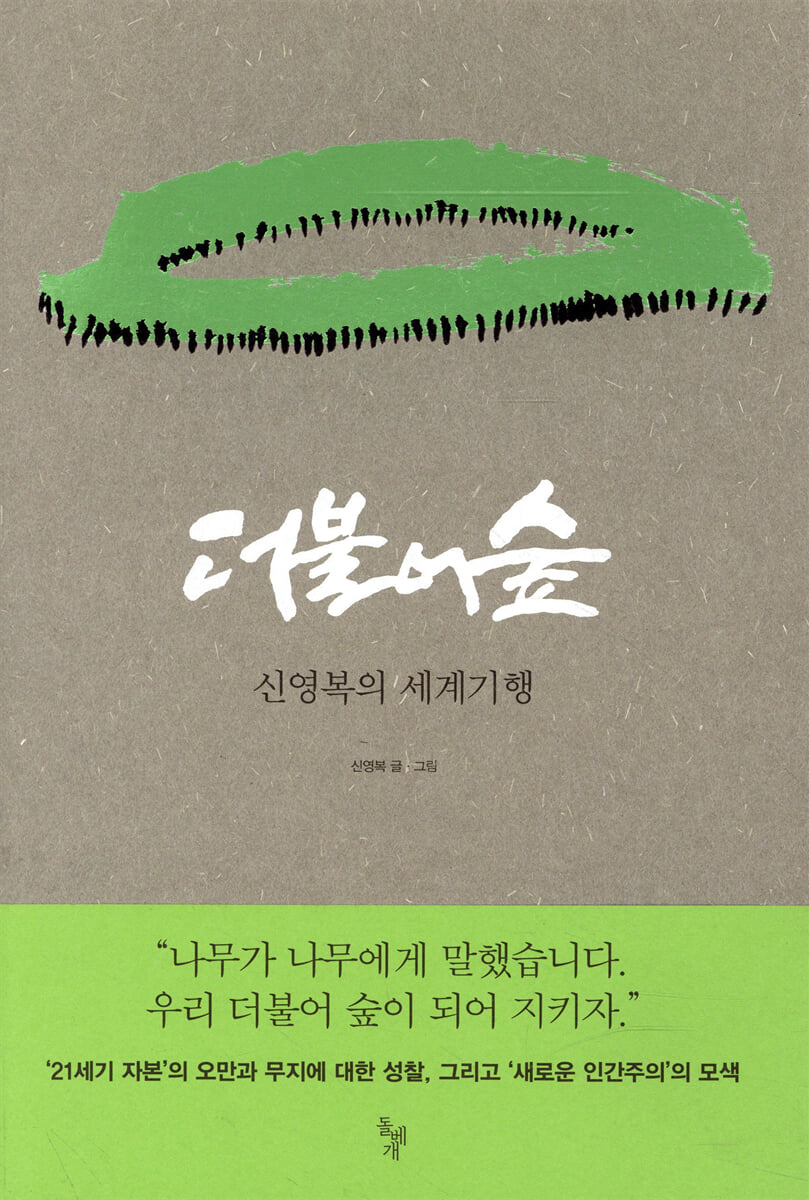
The content has been partially revised, and the cover title and cover/text design have all been changed.
Of course, the reflections and emotions that permeate the book remain intact, and the timeliness of the teacher's message seems even more relevant.
We are publishing a new edition of 『Together Forest』.
Professor Shin Young-bok's 『Together Forest』 was first published in 1998 in two volumes.
This book is a compilation of records of a trip to 22 countries in 1997, the year of the end of the 20th century, with the theme of “In Search of a New Century.”
From a place of memory where world history was turned upside down to a place of life swept by the cold wave of globalization, the teacher's journey was a deep and wide one.
This book, which literally encompasses the teacher's extensive knowledge of the East and the West, his humble yet sharp perception of reality, and his honest and warm insight into the world, is woven with text, illustrations, and photographs. Since its first publication, it has become a steady seller, beloved by countless readers.
In 2003, it was also published as a single volume.
In this way, 『Together Forest』, which has become a classic of our time, is being published in a new form by Dolbegae 18 years after its first publication.
This revised edition is a single softcover volume, reducing the weight of the book.
The content has been partially revised, and the cover title and cover/text design have all been changed.
Of course, the reflections and emotions that permeate the book remain intact, and the timeliness of the teacher's message seems even more relevant.
- You can preview some of the book's contents.
Preview
index
Table of Contents of 『Together Forest』
To the revised edition
Let's become a forest together and protect it / To those who read this book
Part 1
Why Columbus Went West / The Santa Maria in the Port of Huelva
For Whom the Bell Tolls / The Cross in the Valley of the Fallen
The starting point of the marathon is the starting point of Europe / on the plains of Marathon
TV is inferior to the stage, and the stage cannot reach the scene of life / The tragedy of the theater of Dionysus
Tolerance is love for what is different from oneself, for what one lacks / Hagia Sophia and the Blue Mosque
No money, no problem, no problem, no spirit / The heart of India, the Ganges River
Progress is the simplification of life / Gandhi's Spinning Wheel
Culture is a crop that grows from people / Childhood in Kathmandu
New grasses on the scorched earth wave their hands and call out to the white cranes / The White Cranes of Saigon
A country of short grasses at the foot of Mount Fuji / On the Tokyo subway
A person is better than a wall / Climb the Great Wall
A city that can give affection is a strong city / St. Petersburg
Forgiveness without condemnation and apology without responsibility are agreements of concealment / The Red Rose of Auschwitz
Thoughts are as free as the flight of birds / The Berlin Wall
The combination of the character "士" and the character "心" becomes "志" / Tower Bridge in London
The Seine still flows today, wetting the stones of the Bastille / The French Revolution at the Place de la Concorde
Is there no great Colosseum that puts us to sleep today? / Rome, a pity
Our Self-Portrait Waiting for the Soul That Never Returns / The Pyramids of Egypt
Animals don't get mentally ill / The Leopard of Kilimanjaro
The word "half" means half and also means companion / The Cape of Good Hope and Robben Island in Africa
Awakening is a shining achievement in itself / On the road from Rio to São Paulo
The Nazca Lines Make Us Think About the Hidden Reasons for Modern Civilization in Their Layers / A Time Travel Through Nazca, Peru
The foundation of identity is independence / National University of Mexico
Invisible Power, Invisible Philosophy / The Face of America
Part 2
Even in our dreams, we sometimes have the awareness that this is a dream / The American Dream
Human salvation is possible only through human sacrifice / The Sun of Mexico
Civilization is a vast, irreplaceable forest / Cuzco, the capital of the Inca Empire
All that remains must be the fallen leaves / Machu Picchu, the last city of the Incas
A natural person is more praiseworthy than a human person / Green Hope, Amazon
Real change must be underground, not aboveground / Moscow and the Kremlin
When houses are bigger than people, people feel oppressed / Welfare State Sweden
Songs are honest emotions that face life with the heart / From Manchester to Liverpool
Continuous liberation is art / Paris, the city of art
We make the way as we go / Mondragon Producer Cooperative
A bird flying in the sky lightens the bones / From Vienna to Salzburg
We must create a space where we can transcend ourselves and the world / Free Space in Venice
The new humanism is independence from self-accumulated capital and desires / Acropolis of Greece
The Silk Road is a two-way road for literature and goods / The Silk Road of the 21st Century
The harshness of life is a wake-up call, like a pulse that pulses through our entire body / Sama Dance and Cappadocia
Poverty can be a darkness that buries beauty, or a light that reveals it / The Face of India
We are continuing someone's life and continuing to be someone else's life / In the shade of the barley tree
As the night deepens, the stars shine brighter / At the foot of the Himalayas
New styles are created in distant and inconvenient lands / 21st-century management in Hanoi
There is no Confucius on a moving cart / The new city, Kanazawa
When the water of the Yangtze River is clear, I wash my hat strap. When the water of the Yangtze River is cloudy, I wash my feet. / The waves of the Yangtze River
Those who guard the dark night raise a new sun / Waiting for the sunrise on Mount Tai
To the revised edition
Let's become a forest together and protect it / To those who read this book
Part 1
Why Columbus Went West / The Santa Maria in the Port of Huelva
For Whom the Bell Tolls / The Cross in the Valley of the Fallen
The starting point of the marathon is the starting point of Europe / on the plains of Marathon
TV is inferior to the stage, and the stage cannot reach the scene of life / The tragedy of the theater of Dionysus
Tolerance is love for what is different from oneself, for what one lacks / Hagia Sophia and the Blue Mosque
No money, no problem, no problem, no spirit / The heart of India, the Ganges River
Progress is the simplification of life / Gandhi's Spinning Wheel
Culture is a crop that grows from people / Childhood in Kathmandu
New grasses on the scorched earth wave their hands and call out to the white cranes / The White Cranes of Saigon
A country of short grasses at the foot of Mount Fuji / On the Tokyo subway
A person is better than a wall / Climb the Great Wall
A city that can give affection is a strong city / St. Petersburg
Forgiveness without condemnation and apology without responsibility are agreements of concealment / The Red Rose of Auschwitz
Thoughts are as free as the flight of birds / The Berlin Wall
The combination of the character "士" and the character "心" becomes "志" / Tower Bridge in London
The Seine still flows today, wetting the stones of the Bastille / The French Revolution at the Place de la Concorde
Is there no great Colosseum that puts us to sleep today? / Rome, a pity
Our Self-Portrait Waiting for the Soul That Never Returns / The Pyramids of Egypt
Animals don't get mentally ill / The Leopard of Kilimanjaro
The word "half" means half and also means companion / The Cape of Good Hope and Robben Island in Africa
Awakening is a shining achievement in itself / On the road from Rio to São Paulo
The Nazca Lines Make Us Think About the Hidden Reasons for Modern Civilization in Their Layers / A Time Travel Through Nazca, Peru
The foundation of identity is independence / National University of Mexico
Invisible Power, Invisible Philosophy / The Face of America
Part 2
Even in our dreams, we sometimes have the awareness that this is a dream / The American Dream
Human salvation is possible only through human sacrifice / The Sun of Mexico
Civilization is a vast, irreplaceable forest / Cuzco, the capital of the Inca Empire
All that remains must be the fallen leaves / Machu Picchu, the last city of the Incas
A natural person is more praiseworthy than a human person / Green Hope, Amazon
Real change must be underground, not aboveground / Moscow and the Kremlin
When houses are bigger than people, people feel oppressed / Welfare State Sweden
Songs are honest emotions that face life with the heart / From Manchester to Liverpool
Continuous liberation is art / Paris, the city of art
We make the way as we go / Mondragon Producer Cooperative
A bird flying in the sky lightens the bones / From Vienna to Salzburg
We must create a space where we can transcend ourselves and the world / Free Space in Venice
The new humanism is independence from self-accumulated capital and desires / Acropolis of Greece
The Silk Road is a two-way road for literature and goods / The Silk Road of the 21st Century
The harshness of life is a wake-up call, like a pulse that pulses through our entire body / Sama Dance and Cappadocia
Poverty can be a darkness that buries beauty, or a light that reveals it / The Face of India
We are continuing someone's life and continuing to be someone else's life / In the shade of the barley tree
As the night deepens, the stars shine brighter / At the foot of the Himalayas
New styles are created in distant and inconvenient lands / 21st-century management in Hanoi
There is no Confucius on a moving cart / The new city, Kanazawa
When the water of the Yangtze River is clear, I wash my hat strap. When the water of the Yangtze River is cloudy, I wash my feet. / The waves of the Yangtze River
Those who guard the dark night raise a new sun / Waiting for the sunrise on Mount Tai
Into the book
What we always confirmed in front of the many ruins was the weight of a long and heavy history.
It was quite depressing to realize that fundamentally nothing had changed from ancient times to the present.
Liquidating the past is bound to be difficult.
That's how we think, that's how the rigid structure of reality is.
Leaving means not only leaving the 'castle of thought' we have built up until now, but also destroying that castle.
--- p.12
I climbed onto the deck of the Santa Maria and looked out into the distance at the Atlantic Ocean.
The New World was nowhere to be seen, only the blue waves of the Atlantic Ocean rippling.
There will already be a continent of suffering, not a new continent, across the sea.
In contrast to the indifferent sea water before my eyes, countless voices can be heard in the wind that brushes my ears.
We hear Native Americans protesting, “What does it mean to us that the Earth is round?”
I hear you say, “The world was never round.”
And even now, I think of the countless Columbuses taking off by plane from various parts of the world in search of the New World.
--- p.32
There is a world of difference between shouting 'We won' and shouting 'I won'.
The reason this difference makes us feel so lonely is probably because the reality of today is that 'I' must overcome 'we', and this has become our philosophy as we live today.
〔--- p.46
A revolution whose ideals are shared by all the people of the time, rather than being monopolized by a small group or individual, is essentially a victory, even if it ends in failure.
The failures of countless people become history and become a reflection of history, and eventually reveal themselves in a new form in the next chapter of history.
(Omitted) The way we remember the countless frustrations that dot our modern and contemporary history should be no different.
Because changing the way we remember victory and defeat is truly a transformation in our understanding of history.
--- p.139~141
Was the Roman Empire really just an ancient empire of the past?
Are there any empires today whose prosperity ends when conquest, whether war, goods, or capital, ceases?
Aren't we truly yearning for Rome?
And finally, I have to ask:
Don't we have a huge coliseum to put us to sleep?
--- p.150
Just as the ancient Egyptian pharaohs built pyramids to achieve immortality and eternal life, it is true that we too are building our own pyramids today, and it is also true that we are infinitely faithful to the belief that what we have built will never disappear.
--- p.156
We still don't have the capacity to devote our minds to the meaning of 'growing up well'.
We don't have time to reflect on the enormous wrongdoings of competition, efficiency, and other things that harm people and divide relationships.
However, we must not forget that relationships between people are something that we will always regret if we do not put in sincerity from the beginning.
--- p.268
However, what we must not forget is the stark fact that the goods that traveled along the Silk Road always contained more texts.
Conversely, it is becoming increasingly difficult to find a door in today's products.
Moreover, when it comes to financial capital that dominates the global market, there is not even a single word of it.
--- p.320
Ultimately, our enlightenment must be cultivated through our own lives and our own work.
Even the determination that it can be achieved through a single awakening must be abandoned.
I believe that all enlightenment is merely the sum total of a process of constantly increasing enlightenment itself by building tomorrow's enlightenment on top of today's enlightenment.
It was quite depressing to realize that fundamentally nothing had changed from ancient times to the present.
Liquidating the past is bound to be difficult.
That's how we think, that's how the rigid structure of reality is.
Leaving means not only leaving the 'castle of thought' we have built up until now, but also destroying that castle.
--- p.12
I climbed onto the deck of the Santa Maria and looked out into the distance at the Atlantic Ocean.
The New World was nowhere to be seen, only the blue waves of the Atlantic Ocean rippling.
There will already be a continent of suffering, not a new continent, across the sea.
In contrast to the indifferent sea water before my eyes, countless voices can be heard in the wind that brushes my ears.
We hear Native Americans protesting, “What does it mean to us that the Earth is round?”
I hear you say, “The world was never round.”
And even now, I think of the countless Columbuses taking off by plane from various parts of the world in search of the New World.
--- p.32
There is a world of difference between shouting 'We won' and shouting 'I won'.
The reason this difference makes us feel so lonely is probably because the reality of today is that 'I' must overcome 'we', and this has become our philosophy as we live today.
〔--- p.46
A revolution whose ideals are shared by all the people of the time, rather than being monopolized by a small group or individual, is essentially a victory, even if it ends in failure.
The failures of countless people become history and become a reflection of history, and eventually reveal themselves in a new form in the next chapter of history.
(Omitted) The way we remember the countless frustrations that dot our modern and contemporary history should be no different.
Because changing the way we remember victory and defeat is truly a transformation in our understanding of history.
--- p.139~141
Was the Roman Empire really just an ancient empire of the past?
Are there any empires today whose prosperity ends when conquest, whether war, goods, or capital, ceases?
Aren't we truly yearning for Rome?
And finally, I have to ask:
Don't we have a huge coliseum to put us to sleep?
--- p.150
Just as the ancient Egyptian pharaohs built pyramids to achieve immortality and eternal life, it is true that we too are building our own pyramids today, and it is also true that we are infinitely faithful to the belief that what we have built will never disappear.
--- p.156
We still don't have the capacity to devote our minds to the meaning of 'growing up well'.
We don't have time to reflect on the enormous wrongdoings of competition, efficiency, and other things that harm people and divide relationships.
However, we must not forget that relationships between people are something that we will always regret if we do not put in sincerity from the beginning.
--- p.268
However, what we must not forget is the stark fact that the goods that traveled along the Silk Road always contained more texts.
Conversely, it is becoming increasingly difficult to find a door in today's products.
Moreover, when it comes to financial capital that dominates the global market, there is not even a single word of it.
--- p.320
Ultimately, our enlightenment must be cultivated through our own lives and our own work.
Even the determination that it can be achieved through a single awakening must be abandoned.
I believe that all enlightenment is merely the sum total of a process of constantly increasing enlightenment itself by building tomorrow's enlightenment on top of today's enlightenment.
--- p.348
Publisher's Review
The deep and broad reflections of Professor Shin Young-bok, read across centuries,
We are publishing a new edition of 『Together Forest』.
Professor Shin Young-bok's 『Together Forest』 was first published in 1998 in two volumes.
This book is a compilation of records of a trip to 22 countries in 1997, the year of the end of the 20th century, with the theme of “In Search of a New Century.”
From a place of memory where world history was turned upside down to a place of life swept by the cold wave of globalization, the teacher's journey was a deep and wide one.
This book, which literally encompasses the teacher's extensive knowledge of the East and the West, his humble yet sharp perception of reality, and his honest and warm insight into the world, is woven with text, illustrations, and photographs. Since its first publication, it has become a steady seller, beloved by countless readers.
In 2003, it was also published as a single volume.
In this way, 『Together Forest』, which has become a classic of our time, is being published in a new form by Dolbegae 18 years after its first publication.
This revised edition is a single softcover volume, reducing the weight of the book.
The content has been partially revised, and the cover title and cover/text design have all been changed.
Of course, the reflections and emotions that permeate the book remain intact, and the timeliness of the teacher's message seems even more relevant.
In today's 21st century Korean society, terms such as the sorrow of the second generation, Hell Joseon, and the 5-po generation, as well as the 3-po generation, are being circulated, and the gap and slogan of "everyone for themselves" are overflowing.
They are trying to resolve conflicts in politics, society, economy, culture, ideology, etc. through the unilateral coercion of 'A' rather than the logic of coexistence.
As we examine these sharp social contradictions, the message of "coexistence, solidarity, and new humanism" consistently emphasized by Professor Shin Young-bok in this book resonates more deeply than ever.
“Tree spoke to tree.
The soft language of “Let us protect the forest together” likely means that we should uphold the principle of “humility and coexistence” against the logic of domination by the “arrogant” strong, and protect the “logic of humanity” against the logic of “ruthless” capital.
Here, the 'relationship theory' of respecting and solidarity with others is the foundation.
The attitude of "reflection" and "searching" that the teacher constantly revisits in this book will become our philosophy and way of living together, to which we must respond without change even in the 21st century.
What is truly strong, what is truly right?
“Trees come together to create a magnificent forest of history.”
Starting from Huelva, Spain, where Columbus set sail for America, and passing through Europe and South America, and ending his journey at Mount Tai in China, Professor Shin Young-bok personally visited historical sites around the world and wrote down his impressions in the form of letters, as if sending a postcard to "you."
We visit the world's historical cities, such as Rome, Beijing, Moscow, Athens, and Istanbul, and tour the massive ruins they hold, such as the Colosseum, the Great Wall of China, the Kremlin, the Acropolis, and Hagia Sophia. We marvel at their overwhelming scale, but the teacher's gaze is drawn to the other side of those places and memories that we tend to ignore.
Human history is marked by the logic of the strong, but at its foundation lies the sacrifice of countless lives and the blood, sweat, and tears of those who have perished.
When the teacher looks at the Great Wall of China and the pyramids, he first thinks of the people who sacrificed themselves to build them.
The logic of the powerful is clearly revealed in the words of Columbus's discovery of the New World.
The land they discovered was by no means a new continent.
This is especially true when we consider the countless massacres committed by European powers, including Cortés, after Columbus entered the American continent.
While the Great Wall of China may offer some solace in the fact that it was built for defensive rather than offensive purposes, the bodies of countless people who sacrificed their lives to build it still lie buried beneath its walls.
The teacher delicately contemplates the meaning and value of sacrifice, which has been submerged under hegemony and materialism.
The teacher does not simply visit the site of a historical event, but shows both the past that has already passed and the future that has yet to come.
It confirms that there has been little fundamental change from ancient times to the present, and it speaks to the difficulty of clearing up the past.
In order to break down this stubborn structure of reality, we must not only break free from the 'castle of thought' we have built, but also tear it down.
Travelogues that convey the profound message that travel should be the beginning of such "humble encounters" so honestly and quietly are rare and precious.
Reflections on the arrogance and ignorance of '21st Century Capital'
And the search for a 'new humanism'
So, what the teacher confirmed while traveling the wide world was the arrogance, ignorance, and anti-humanity of capitalism.
By being connected to the “infinite desire for vanity” that we want to satisfy every day, no one can be free from ‘capital’.
The teacher confronts the dual structure of the current world system and the mutual penetration of the unequal division of labor, in which advanced capital is the head, intermediate capital is the body, and less advanced capital is the feet.
The logic of domination by the strong, enforced under the guise of globalization, is not limited to seizing political and economic dominance, but is also homogenizing people's minds by reconstructing the aesthetics of past relics.
He confesses that it is difficult to live sustainably under such a logic of domination by the strong, and proposes a 'new humanism' as a way to overcome this difficult situation.
The new humanism may not be about independence from nature, nor independence from poverty, but rather independence from the capital accumulated by humans and from the endless desire for vanity.
Looking back, we have truly come a long way from Greece to today.
Perhaps our current location is that we are carrying that long journey behind us and walking towards an even longer journey.
_In the text
Professor Hong Yun-gi of Dongguk University has argued that this “new humanism” of the teacher is “a natural human orientation based on solidarity between humans that goes beyond the classical humanism of ‘human self-fulfillment’ and the modern humanism of ‘human self-realization’” (『Reading Shin Young-bok Together』, ?Earthly Relationships, Human Solidarity - Rereading 『Forest Together』) The resonant echo of “Let’s become a forest together and protect it” spreads as “the most honest way of love is to walk together,” and what is important is “making a path while moving forward from where we stand.”
The financial crisis and the global threat of terrorism threaten the modern capitalist system, and the cracks in the hegemony and uniformity of unilateral neoliberalism are becoming apparent everywhere.
"What is strong and what is weak?" What shall we study and dream together? In this "autumn of civilization," where other dreams are desperately needed, "awakening" from the illusions of capital must come first. "Together in the Forest" will long be a landmark in our reading.
“Globalization is the logic of capital, not human logic.
We must join hands and create a stronghold to resist the logic of capital.”
We are publishing a new edition of 『Together Forest』.
Professor Shin Young-bok's 『Together Forest』 was first published in 1998 in two volumes.
This book is a compilation of records of a trip to 22 countries in 1997, the year of the end of the 20th century, with the theme of “In Search of a New Century.”
From a place of memory where world history was turned upside down to a place of life swept by the cold wave of globalization, the teacher's journey was a deep and wide one.
This book, which literally encompasses the teacher's extensive knowledge of the East and the West, his humble yet sharp perception of reality, and his honest and warm insight into the world, is woven with text, illustrations, and photographs. Since its first publication, it has become a steady seller, beloved by countless readers.
In 2003, it was also published as a single volume.
In this way, 『Together Forest』, which has become a classic of our time, is being published in a new form by Dolbegae 18 years after its first publication.
This revised edition is a single softcover volume, reducing the weight of the book.
The content has been partially revised, and the cover title and cover/text design have all been changed.
Of course, the reflections and emotions that permeate the book remain intact, and the timeliness of the teacher's message seems even more relevant.
In today's 21st century Korean society, terms such as the sorrow of the second generation, Hell Joseon, and the 5-po generation, as well as the 3-po generation, are being circulated, and the gap and slogan of "everyone for themselves" are overflowing.
They are trying to resolve conflicts in politics, society, economy, culture, ideology, etc. through the unilateral coercion of 'A' rather than the logic of coexistence.
As we examine these sharp social contradictions, the message of "coexistence, solidarity, and new humanism" consistently emphasized by Professor Shin Young-bok in this book resonates more deeply than ever.
“Tree spoke to tree.
The soft language of “Let us protect the forest together” likely means that we should uphold the principle of “humility and coexistence” against the logic of domination by the “arrogant” strong, and protect the “logic of humanity” against the logic of “ruthless” capital.
Here, the 'relationship theory' of respecting and solidarity with others is the foundation.
The attitude of "reflection" and "searching" that the teacher constantly revisits in this book will become our philosophy and way of living together, to which we must respond without change even in the 21st century.
What is truly strong, what is truly right?
“Trees come together to create a magnificent forest of history.”
Starting from Huelva, Spain, where Columbus set sail for America, and passing through Europe and South America, and ending his journey at Mount Tai in China, Professor Shin Young-bok personally visited historical sites around the world and wrote down his impressions in the form of letters, as if sending a postcard to "you."
We visit the world's historical cities, such as Rome, Beijing, Moscow, Athens, and Istanbul, and tour the massive ruins they hold, such as the Colosseum, the Great Wall of China, the Kremlin, the Acropolis, and Hagia Sophia. We marvel at their overwhelming scale, but the teacher's gaze is drawn to the other side of those places and memories that we tend to ignore.
Human history is marked by the logic of the strong, but at its foundation lies the sacrifice of countless lives and the blood, sweat, and tears of those who have perished.
When the teacher looks at the Great Wall of China and the pyramids, he first thinks of the people who sacrificed themselves to build them.
The logic of the powerful is clearly revealed in the words of Columbus's discovery of the New World.
The land they discovered was by no means a new continent.
This is especially true when we consider the countless massacres committed by European powers, including Cortés, after Columbus entered the American continent.
While the Great Wall of China may offer some solace in the fact that it was built for defensive rather than offensive purposes, the bodies of countless people who sacrificed their lives to build it still lie buried beneath its walls.
The teacher delicately contemplates the meaning and value of sacrifice, which has been submerged under hegemony and materialism.
The teacher does not simply visit the site of a historical event, but shows both the past that has already passed and the future that has yet to come.
It confirms that there has been little fundamental change from ancient times to the present, and it speaks to the difficulty of clearing up the past.
In order to break down this stubborn structure of reality, we must not only break free from the 'castle of thought' we have built, but also tear it down.
Travelogues that convey the profound message that travel should be the beginning of such "humble encounters" so honestly and quietly are rare and precious.
Reflections on the arrogance and ignorance of '21st Century Capital'
And the search for a 'new humanism'
So, what the teacher confirmed while traveling the wide world was the arrogance, ignorance, and anti-humanity of capitalism.
By being connected to the “infinite desire for vanity” that we want to satisfy every day, no one can be free from ‘capital’.
The teacher confronts the dual structure of the current world system and the mutual penetration of the unequal division of labor, in which advanced capital is the head, intermediate capital is the body, and less advanced capital is the feet.
The logic of domination by the strong, enforced under the guise of globalization, is not limited to seizing political and economic dominance, but is also homogenizing people's minds by reconstructing the aesthetics of past relics.
He confesses that it is difficult to live sustainably under such a logic of domination by the strong, and proposes a 'new humanism' as a way to overcome this difficult situation.
The new humanism may not be about independence from nature, nor independence from poverty, but rather independence from the capital accumulated by humans and from the endless desire for vanity.
Looking back, we have truly come a long way from Greece to today.
Perhaps our current location is that we are carrying that long journey behind us and walking towards an even longer journey.
_In the text
Professor Hong Yun-gi of Dongguk University has argued that this “new humanism” of the teacher is “a natural human orientation based on solidarity between humans that goes beyond the classical humanism of ‘human self-fulfillment’ and the modern humanism of ‘human self-realization’” (『Reading Shin Young-bok Together』, ?Earthly Relationships, Human Solidarity - Rereading 『Forest Together』) The resonant echo of “Let’s become a forest together and protect it” spreads as “the most honest way of love is to walk together,” and what is important is “making a path while moving forward from where we stand.”
The financial crisis and the global threat of terrorism threaten the modern capitalist system, and the cracks in the hegemony and uniformity of unilateral neoliberalism are becoming apparent everywhere.
"What is strong and what is weak?" What shall we study and dream together? In this "autumn of civilization," where other dreams are desperately needed, "awakening" from the illusions of capital must come first. "Together in the Forest" will long be a landmark in our reading.
“Globalization is the logic of capital, not human logic.
We must join hands and create a stronghold to resist the logic of capital.”
GOODS SPECIFICS
- Date of issue: December 7, 2015
- Page count, weight, size: 388 pages | 694g | 153*224*23mm
- ISBN13: 9788971996942
- ISBN10: 8971996943
You may also like
카테고리
korean


korean

![GQ KOREA Mark (Monthly): December [2025]](http://librairie.coreenne.fr/cdn/shop/files/8ef265dbbfbf186523ed75ba7319009d.jpg?v=1765340328&width=3840)


