

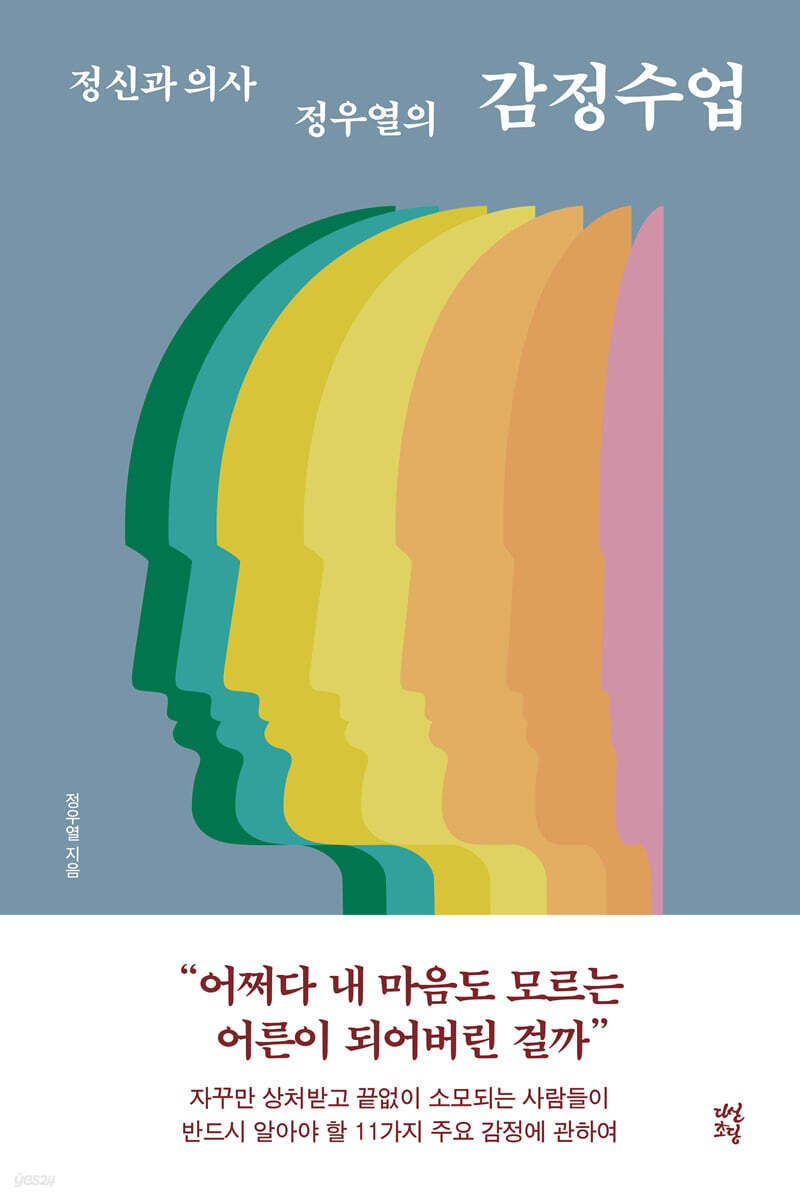
Psychiatrist Jeong Woo-yeol's Emotional Education
 |
Description
Book Introduction
“How did I become an adult who doesn’t even know my own heart?”
30 million cumulative views, 230,000 YouTube subscribers
Published as a book on emotional education by 'Psychiatrist Jeong Woo-yeol'!
“I have no motivation no matter what I do”, “I feel anxious and tense every day because I’m worried that my plans will go awry or go wrong”, “I feel a surge of self-loathing every time my boss points something out”, “Why do I keep hating that person?”, “I keep having to confirm my love for my friend of the opposite sex” Even as adults, there are many people who are restless and anxious due to emotions that well up in them.
No matter how much I repeat to myself, “My heart is mine,” why is it so hard to control my emotions as I wish?
Woo-Yeol Jeong, a psychiatrist and YouTuber with 230,000 subscribers, says the reason is the impatience to solve the problem before even understanding the true nature of the emotion.
In his new book, "Psychiatrist Jeong Woo-yeol's Emotional Class," he repeatedly emphasizes the importance of clearly recognizing emotions that are considered cumbersome and attempting to understand oneself.
“My mentality is like glass… Thanks to you, teacher, I am able to hold on without breaking!”, “You are the only one who understands my emotions so accurately.” This book, which can be considered the final version of Jeong Woo-yeol’s emotional education class that has received enthusiastic support from subscribers, explains the reality of 11 major emotions such as anger, sadness, depression, anxiety, joy, intimacy, and compassion, and suggests ways to deal with them in a healthy way.
This journey will serve as a friendly guide to using emotions for readers who struggle with emotions that come and go from time to time.
30 million cumulative views, 230,000 YouTube subscribers
Published as a book on emotional education by 'Psychiatrist Jeong Woo-yeol'!
“I have no motivation no matter what I do”, “I feel anxious and tense every day because I’m worried that my plans will go awry or go wrong”, “I feel a surge of self-loathing every time my boss points something out”, “Why do I keep hating that person?”, “I keep having to confirm my love for my friend of the opposite sex” Even as adults, there are many people who are restless and anxious due to emotions that well up in them.
No matter how much I repeat to myself, “My heart is mine,” why is it so hard to control my emotions as I wish?
Woo-Yeol Jeong, a psychiatrist and YouTuber with 230,000 subscribers, says the reason is the impatience to solve the problem before even understanding the true nature of the emotion.
In his new book, "Psychiatrist Jeong Woo-yeol's Emotional Class," he repeatedly emphasizes the importance of clearly recognizing emotions that are considered cumbersome and attempting to understand oneself.
“My mentality is like glass… Thanks to you, teacher, I am able to hold on without breaking!”, “You are the only one who understands my emotions so accurately.” This book, which can be considered the final version of Jeong Woo-yeol’s emotional education class that has received enthusiastic support from subscribers, explains the reality of 11 major emotions such as anger, sadness, depression, anxiety, joy, intimacy, and compassion, and suggests ways to deal with them in a healthy way.
This journey will serve as a friendly guide to using emotions for readers who struggle with emotions that come and go from time to time.
- You can preview some of the book's contents.
Preview
index
Prologue - Is Your Heart Well?
Chapter 1 Why Are My Emotions So Burdensome?
To those who have become adults without even knowing what their feelings are
Changing your thoughts doesn't change your life.
Ride the waves of emotion like surfing
Why do ignoring my feelings cause problems in my relationships?
To those who are obsessed with self-development without self-awareness
Chapter 2: A Story I Want to Tell Those Who Keep Blaming Me
(Anger and rage | Depression | Anxiety | Shame | Envy and jealousy and disgust | Loneliness and alienation)
Even negative emotions love me
Why a Life of Constant Endurance is Dangerous - Anger and Fury
Depression is the desperate advice my heart sends me - Depression
A friend who should be with you forever - Anxiety
When I can't accept myself - shame
What I Have and Have Not - Envy, Jealousy, and Hatred
When the feeling of being alone suddenly comes over you - loneliness and alienation
Chapter 3: How to avoid stumbling over positivity
(Joy and pleasure | Intimacy | Passion and excitement | Pride | Compassion)
How to avoid stumbling over positivity
Why You Should Pursue Joy Rather Than Pleasure - Joy and Pleasure
On the Fake Intimacy That Deceives Me - Intimacy
The Trap of Passion, Betrayal of Effort - Passion and Excitement
Actually, I am not confident in myself - self-esteem
Why Self-Compassion Is More Important Than Self-Esteem - Compassion
Chapter 4: Caring for My Emotions Today - Practice
One - Why I Should Only Consider My Position
Two - If you can't refuse, be silent.
3. Being angry and being upset are two different things.
Fourth - Why Cutting Off Ends Isn't the Answer in Relationships
Five - Write an emotional diary, not a planner.
Six - Grief Takes Time
Seven - If you want to be well, don't try to look good.
Eight - Why You Should Live Here Now
Epilogue - With the mindset of 'It's just so-so'
Chapter 1 Why Are My Emotions So Burdensome?
To those who have become adults without even knowing what their feelings are
Changing your thoughts doesn't change your life.
Ride the waves of emotion like surfing
Why do ignoring my feelings cause problems in my relationships?
To those who are obsessed with self-development without self-awareness
Chapter 2: A Story I Want to Tell Those Who Keep Blaming Me
(Anger and rage | Depression | Anxiety | Shame | Envy and jealousy and disgust | Loneliness and alienation)
Even negative emotions love me
Why a Life of Constant Endurance is Dangerous - Anger and Fury
Depression is the desperate advice my heart sends me - Depression
A friend who should be with you forever - Anxiety
When I can't accept myself - shame
What I Have and Have Not - Envy, Jealousy, and Hatred
When the feeling of being alone suddenly comes over you - loneliness and alienation
Chapter 3: How to avoid stumbling over positivity
(Joy and pleasure | Intimacy | Passion and excitement | Pride | Compassion)
How to avoid stumbling over positivity
Why You Should Pursue Joy Rather Than Pleasure - Joy and Pleasure
On the Fake Intimacy That Deceives Me - Intimacy
The Trap of Passion, Betrayal of Effort - Passion and Excitement
Actually, I am not confident in myself - self-esteem
Why Self-Compassion Is More Important Than Self-Esteem - Compassion
Chapter 4: Caring for My Emotions Today - Practice
One - Why I Should Only Consider My Position
Two - If you can't refuse, be silent.
3. Being angry and being upset are two different things.
Fourth - Why Cutting Off Ends Isn't the Answer in Relationships
Five - Write an emotional diary, not a planner.
Six - Grief Takes Time
Seven - If you want to be well, don't try to look good.
Eight - Why You Should Live Here Now
Epilogue - With the mindset of 'It's just so-so'
Detailed image

Into the book
I have been working as a psychiatrist for a long time and have written and read many books.
And after realizing that many of the stories I've covered in the book ultimately revolve around the larger theme of "emotion," I decided I wanted to demonstrate the true utility of emotions, which are often treated as "emotional and cumbersome things."
I started writing with the thought that I should break down old prejudices and preconceptions about emotions, and now I have compiled this into a book.
I wanted to share with many readers the study of emotions, something we had never learned during our regular elementary, middle, and high school education.
So this book is an emotional guide for adults.
This book is also for those who are still lost and wandering, having gone through the wanderings of their thirties and the belated adolescence of their forties.
As a psychiatrist, I have only one piece of advice for you.
Let's put aside our efforts for self-improvement and prioritize examining and caring for our emotions.
--- From "Prologue - Is Your Heart Well?"
This emotional release, which we take for granted, becomes a huge driving force in our lives.
If your life doesn't change no matter how hard you try to develop yourself, the answer must now be found in emotional release.
When you feel emotionally free, you develop a spontaneous desire for growth, and from then on, you are less easily frustrated.
Life doesn't change easily just by listening to someone's advice or changing your mind.
Of course, among those who pride themselves on their success in self-development, there are those who taboo emotions and insist that "reason must always be guarded against being dominated by emotions."
Even if you just think about the MBTI, which is popular these days, you get the feeling that T-types are considered superior and the epitome of successful people, while F-types are considered relatively weak and inferior, like people who are impulsive.
But is that really true?
--- From "Changing your thoughts doesn't change your life"
People have a desire for 'self-directed living' and 'independence', but as social beings, they want to feel 'intimacy' and 'bondage' by being entangled and connected with others rather than living alone.
We want to continue to be connected in order to feel a sense of attachment.
These conflicting desires have long been studied in psychology.
Since psychoanalyst Sigmund Freud introduced Schopenhauer's hedgehog fable in his book Group Psychology and Ego-Analysis, related research has continued.
So what happens if these two needs aren't properly met? We lose the drive to properly recognize our emotions.
When you are constantly emotionally hurt and oppressed in your relationships with others, your will to care for your emotions is broken.
This is how we come to ignore our feelings.
And to make matters worse, the ego declares a strike.
--- From "Why do relationships have problems when I ignore my feelings?"
Especially when it comes to anger or rage, it is important to control the volume when expressing emotions.
Therefore, rather than unconditionally ignoring or suppressing it, first, thoroughly examine the other emotions hidden behind anger or rage, and second, if a healthy conflict with the other person is needed, practice conflict training by expressing anger.
Lastly, it is also very important to carefully examine whether the relationship between you and your partner is horizontal or not.
If the relationship should be horizontal but isn't, you need to find ways to improve it. If that's not possible, then severing the relationship may be the last resort.
Or, if the relationship cannot be horizontal from the beginning, it might be a good idea to find a way to resolve anger and improve the relationship through conversation in a way other than conflict.
--- From "Why a Life of Constant Endurance is Dangerous - Anger and Fury"
The real problem is that if you have repeated experiences of having your existence denied from a young age, you will later label yourself as a bad person, someone with a problem or a pathetic person, regardless of how others evaluate you.
And people who have set their self-image, or self-concept, in such a negative way become extremely sensitive even when they feel that others do not respect them in the slightest.
This is the point I pay the most attention to when dealing with shame.
The basis of shame is not others, but the feeling of not being able to acknowledge oneself.
--- From "When I Can't Acknowledge Myself - Shame"
We often envy the success and happiness of others, but consider it a blow to our pride.
That's why we often say, 'If you're jealous, you lose.'
But I think differently.
Only those who truly envy me can live my life to the fullest.
A life lived in constant comparison between oneself and others is a life completely stripped of control.
The control over my life is something that should never be taken away by others.
When I think about it, I always seem to have a soft spot for people who honestly say, “I’m so jealous!”
I even felt like sharing what I had with such people.
So don't waste your life being jealous and envious of someone.
Everyone, feel free to envy and express yourself.
If you're jealous, you don't lose; if you're jealous, you win.
--- From "What I Have and What I Have Not - Envy, Jealousy, and Hatred"
Perhaps because we cannot escape or escape from everyday life or reality forever, we should pursue joy rather than pleasure or enjoyment.
That's also how I reduce travel hangovers.
If you only pursue pleasure and enjoyment throughout your trip, you will have to expend a lot of energy to get out of the dopamine swamp.
--- From "Why We Should Pursue Joy Rather Than Pleasure - Joy and Pleasure"
If self-esteem, which was a keyword of an era, is an emotion that seems to be maintained only by constantly filling oneself with something, self-compassion is a more comfortable and friendly emotion in that it is possible without such compulsion.
Self-compassion is an emotion that we can practice right away simply by being honest with ourselves.
There is no emotion more profound than a healthy compassion for ourselves amidst the surging emotions that are uncomfortable and difficult to accept.
--- From "Why Self-Compassion Is More Important Than Self-Esteem - Compassion"
When you throw a rag into a wood fire, the fire will instantly burst into flames.
But the flame soon dies down.
The same goes for the energy for success that is shown to others.
It may initially produce a lot of firepower, but it quickly goes out.
A fire that never goes out is impossible without heavy fuel.
It may take a while for the firewood to catch fire, but it will burn for a much longer time than a rag.
I hope that through this book, you will be able to discover many such solid fuels.
I hope you also gain the courage to cultivate a strong inner self like well-dried firewood in the sun.
I sincerely hope that I can enjoy the countless different emotions that come to me for a long time with the mindset of 'it's just so-so'.
And after realizing that many of the stories I've covered in the book ultimately revolve around the larger theme of "emotion," I decided I wanted to demonstrate the true utility of emotions, which are often treated as "emotional and cumbersome things."
I started writing with the thought that I should break down old prejudices and preconceptions about emotions, and now I have compiled this into a book.
I wanted to share with many readers the study of emotions, something we had never learned during our regular elementary, middle, and high school education.
So this book is an emotional guide for adults.
This book is also for those who are still lost and wandering, having gone through the wanderings of their thirties and the belated adolescence of their forties.
As a psychiatrist, I have only one piece of advice for you.
Let's put aside our efforts for self-improvement and prioritize examining and caring for our emotions.
--- From "Prologue - Is Your Heart Well?"
This emotional release, which we take for granted, becomes a huge driving force in our lives.
If your life doesn't change no matter how hard you try to develop yourself, the answer must now be found in emotional release.
When you feel emotionally free, you develop a spontaneous desire for growth, and from then on, you are less easily frustrated.
Life doesn't change easily just by listening to someone's advice or changing your mind.
Of course, among those who pride themselves on their success in self-development, there are those who taboo emotions and insist that "reason must always be guarded against being dominated by emotions."
Even if you just think about the MBTI, which is popular these days, you get the feeling that T-types are considered superior and the epitome of successful people, while F-types are considered relatively weak and inferior, like people who are impulsive.
But is that really true?
--- From "Changing your thoughts doesn't change your life"
People have a desire for 'self-directed living' and 'independence', but as social beings, they want to feel 'intimacy' and 'bondage' by being entangled and connected with others rather than living alone.
We want to continue to be connected in order to feel a sense of attachment.
These conflicting desires have long been studied in psychology.
Since psychoanalyst Sigmund Freud introduced Schopenhauer's hedgehog fable in his book Group Psychology and Ego-Analysis, related research has continued.
So what happens if these two needs aren't properly met? We lose the drive to properly recognize our emotions.
When you are constantly emotionally hurt and oppressed in your relationships with others, your will to care for your emotions is broken.
This is how we come to ignore our feelings.
And to make matters worse, the ego declares a strike.
--- From "Why do relationships have problems when I ignore my feelings?"
Especially when it comes to anger or rage, it is important to control the volume when expressing emotions.
Therefore, rather than unconditionally ignoring or suppressing it, first, thoroughly examine the other emotions hidden behind anger or rage, and second, if a healthy conflict with the other person is needed, practice conflict training by expressing anger.
Lastly, it is also very important to carefully examine whether the relationship between you and your partner is horizontal or not.
If the relationship should be horizontal but isn't, you need to find ways to improve it. If that's not possible, then severing the relationship may be the last resort.
Or, if the relationship cannot be horizontal from the beginning, it might be a good idea to find a way to resolve anger and improve the relationship through conversation in a way other than conflict.
--- From "Why a Life of Constant Endurance is Dangerous - Anger and Fury"
The real problem is that if you have repeated experiences of having your existence denied from a young age, you will later label yourself as a bad person, someone with a problem or a pathetic person, regardless of how others evaluate you.
And people who have set their self-image, or self-concept, in such a negative way become extremely sensitive even when they feel that others do not respect them in the slightest.
This is the point I pay the most attention to when dealing with shame.
The basis of shame is not others, but the feeling of not being able to acknowledge oneself.
--- From "When I Can't Acknowledge Myself - Shame"
We often envy the success and happiness of others, but consider it a blow to our pride.
That's why we often say, 'If you're jealous, you lose.'
But I think differently.
Only those who truly envy me can live my life to the fullest.
A life lived in constant comparison between oneself and others is a life completely stripped of control.
The control over my life is something that should never be taken away by others.
When I think about it, I always seem to have a soft spot for people who honestly say, “I’m so jealous!”
I even felt like sharing what I had with such people.
So don't waste your life being jealous and envious of someone.
Everyone, feel free to envy and express yourself.
If you're jealous, you don't lose; if you're jealous, you win.
--- From "What I Have and What I Have Not - Envy, Jealousy, and Hatred"
Perhaps because we cannot escape or escape from everyday life or reality forever, we should pursue joy rather than pleasure or enjoyment.
That's also how I reduce travel hangovers.
If you only pursue pleasure and enjoyment throughout your trip, you will have to expend a lot of energy to get out of the dopamine swamp.
--- From "Why We Should Pursue Joy Rather Than Pleasure - Joy and Pleasure"
If self-esteem, which was a keyword of an era, is an emotion that seems to be maintained only by constantly filling oneself with something, self-compassion is a more comfortable and friendly emotion in that it is possible without such compulsion.
Self-compassion is an emotion that we can practice right away simply by being honest with ourselves.
There is no emotion more profound than a healthy compassion for ourselves amidst the surging emotions that are uncomfortable and difficult to accept.
--- From "Why Self-Compassion Is More Important Than Self-Esteem - Compassion"
When you throw a rag into a wood fire, the fire will instantly burst into flames.
But the flame soon dies down.
The same goes for the energy for success that is shown to others.
It may initially produce a lot of firepower, but it quickly goes out.
A fire that never goes out is impossible without heavy fuel.
It may take a while for the firewood to catch fire, but it will burn for a much longer time than a rag.
I hope that through this book, you will be able to discover many such solid fuels.
I hope you also gain the courage to cultivate a strong inner self like well-dried firewood in the sun.
I sincerely hope that I can enjoy the countless different emotions that come to me for a long time with the mindset of 'it's just so-so'.
--- From "Epilogue - With a 'Just Like That' Mind"
Publisher's Review
“Why is my heart so heavy?”
People who are constantly hurt and endlessly consumed
About the 11 Major Emotions You Must Know
Do you, like an adult, truly understand the true nature of my emotions and know how to appropriately express them at each moment? Few people would answer "yes" to this question.
This book is a guide to using emotions for adults who still find their emotions difficult and burdensome.
In a world where emotions are treated as "emotional and cumbersome," this book begins with the thought of how wonderful it would be if we could clearly recognize the true nature of emotions and understand ourselves.
The author, a psychiatrist, points out that emotional problems are deeply rooted in the difficulties many clients experience in interpersonal relationships, mental health, and workplace.
Although many people are reluctant to do so, expressing my feelings is neither selfish nor childish.
By accepting the natural flow of emotions that come and go, fear disappears, allowing you to live a more proactive life. And since you're not swayed by emotions, you can form healthy relationships.
How can jealousy and envy that escalate to hatred ruin human relationships? What emotions lie behind the anger that sometimes leads to unexpected and impulsive actions? Which emotion should we focus on between joy and happiness to avoid being addicted to dopamine?
If you properly understand the operating principles and properties of the 11 major emotions that you feel most frequently in life, such as anger, sadness, depression, anxiety, joy, intimacy, and compassion, and that can be said to be the most important emotions, even the emotions that used to bother you will finally become your ally.
Those who had access to some of the book's content in advance through the author's own content responded enthusiastically, saying things like, "My mentality is like glass... Thanks to you, teacher, I'm holding on without breaking!", "You're the only one who understands my emotions so accurately," and "My daily life has changed since I learned that my emotions weren't wrong!"
"It's not reason, but emotion that protects your mental health."
I have never studied 'my feelings' for a long time.
Psychology commentary for you
Woo-yeol Jeong, a psychiatrist and well-known YouTuber, has been seeing patients for 18 years and in 2018, he opened a YouTube channel called 'Psychiatrist Woo-yeol Jeong', and is also known as a mental guardian with 230,000 subscribers.
The author, who has written numerous bestsellers in various fields, including parenting and self-help books, says that many of the stories he has written so far are ultimately connected by one keyword: "emotion."
Unfortunately, we never systematically learned about emotions during our formal education in elementary, middle, and high school.
The author argues that the idea that reason should be prioritized over emotion when faced with a problem is merely a stereotype, saying, “It is emotion, not reason, that protects the mind,” and that it is more important for us to completely separate the two.
Only when we learn to distinguish between the pure emotions we feel and the thoughts that arise from them can we experience healthy emotional release and an improved quality of life.
In Chapter 1, this book explains what the true nature and properties of 'emotions' are and why it is important to feel them fully and express them wisely.
Chapters 2 and 3 introduce 11 major emotions that represent the emotions we feel as positive and negative, and cover the operating principles and hidden aspects of each. The final chapter 4 provides practical solutions on how healthy adults can accept their emotions, showing how to deal with our minds and emotions in order to solve common everyday problems.
Through this book, readers will learn how to become adults who recognize and deal with their emotions in a mature and wise manner, rather than struggling and struggling to know what to do with their emotions.
People who are constantly hurt and endlessly consumed
About the 11 Major Emotions You Must Know
Do you, like an adult, truly understand the true nature of my emotions and know how to appropriately express them at each moment? Few people would answer "yes" to this question.
This book is a guide to using emotions for adults who still find their emotions difficult and burdensome.
In a world where emotions are treated as "emotional and cumbersome," this book begins with the thought of how wonderful it would be if we could clearly recognize the true nature of emotions and understand ourselves.
The author, a psychiatrist, points out that emotional problems are deeply rooted in the difficulties many clients experience in interpersonal relationships, mental health, and workplace.
Although many people are reluctant to do so, expressing my feelings is neither selfish nor childish.
By accepting the natural flow of emotions that come and go, fear disappears, allowing you to live a more proactive life. And since you're not swayed by emotions, you can form healthy relationships.
How can jealousy and envy that escalate to hatred ruin human relationships? What emotions lie behind the anger that sometimes leads to unexpected and impulsive actions? Which emotion should we focus on between joy and happiness to avoid being addicted to dopamine?
If you properly understand the operating principles and properties of the 11 major emotions that you feel most frequently in life, such as anger, sadness, depression, anxiety, joy, intimacy, and compassion, and that can be said to be the most important emotions, even the emotions that used to bother you will finally become your ally.
Those who had access to some of the book's content in advance through the author's own content responded enthusiastically, saying things like, "My mentality is like glass... Thanks to you, teacher, I'm holding on without breaking!", "You're the only one who understands my emotions so accurately," and "My daily life has changed since I learned that my emotions weren't wrong!"
"It's not reason, but emotion that protects your mental health."
I have never studied 'my feelings' for a long time.
Psychology commentary for you
Woo-yeol Jeong, a psychiatrist and well-known YouTuber, has been seeing patients for 18 years and in 2018, he opened a YouTube channel called 'Psychiatrist Woo-yeol Jeong', and is also known as a mental guardian with 230,000 subscribers.
The author, who has written numerous bestsellers in various fields, including parenting and self-help books, says that many of the stories he has written so far are ultimately connected by one keyword: "emotion."
Unfortunately, we never systematically learned about emotions during our formal education in elementary, middle, and high school.
The author argues that the idea that reason should be prioritized over emotion when faced with a problem is merely a stereotype, saying, “It is emotion, not reason, that protects the mind,” and that it is more important for us to completely separate the two.
Only when we learn to distinguish between the pure emotions we feel and the thoughts that arise from them can we experience healthy emotional release and an improved quality of life.
In Chapter 1, this book explains what the true nature and properties of 'emotions' are and why it is important to feel them fully and express them wisely.
Chapters 2 and 3 introduce 11 major emotions that represent the emotions we feel as positive and negative, and cover the operating principles and hidden aspects of each. The final chapter 4 provides practical solutions on how healthy adults can accept their emotions, showing how to deal with our minds and emotions in order to solve common everyday problems.
Through this book, readers will learn how to become adults who recognize and deal with their emotions in a mature and wise manner, rather than struggling and struggling to know what to do with their emotions.
GOODS SPECIFICS
- Date of issue: February 13, 2025
- Page count, weight, size: 268 pages | 410g | 140*210*20mm
- ISBN13: 9791130663388
- ISBN10: 1130663388
You may also like
카테고리
korean


korean

![GQ KOREA Mark (Monthly): December [2025]](http://librairie.coreenne.fr/cdn/shop/files/8ef265dbbfbf186523ed75ba7319009d.jpg?v=1765340328&width=3840)


