

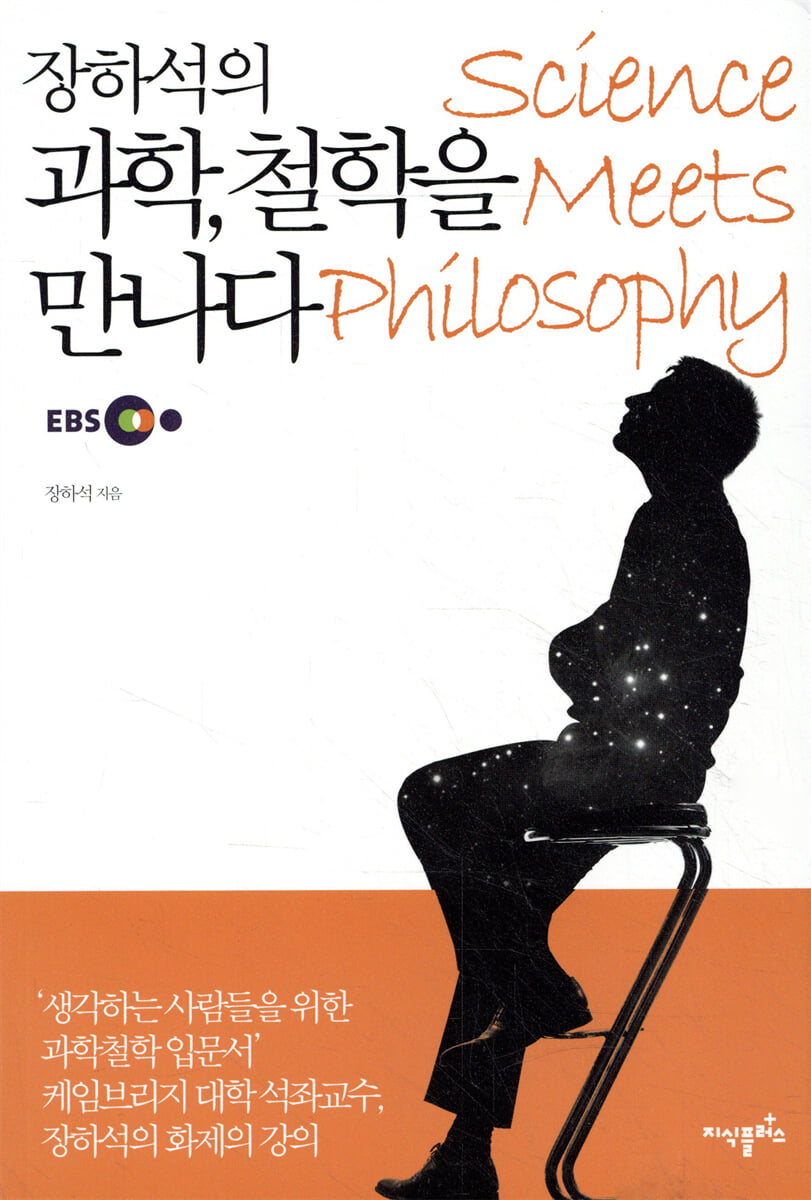
Jang Ha-seok's Science Meets Philosophy
 |
Description
Book Introduction
An Introduction to the Philosophy of Science for Thinkers
A fascinating look at science through philosophy and history
A book that provides useful discussions across various fields of science and humanities!
Cambridge University Professor Ha-seok Jang has been teaching the 'Philosophy of Science' for 20 years, making it easier and more accessible!
Science must be based on history and philosophy to become correct knowledge!
An exquisite collaboration of science and philosophy
It's a meeting of science and philosophy... It's unfamiliar, yet intriguing.
The meeting of science, heavily armed with theories and experiments, formulas and equations, leaving no room for human intervention, and philosophy, the essence of the exploration of life and humanity! How can these two seemingly disparate disciplines possibly meet? Or why should they meet at all?
In fact, no one would deny the importance of science in modern society.
The forest of buildings that never sleeps, the cell phone we can't put down, the gas stove and microwave oven we use every day to cook food - these are all the results of science, and we depend on them to live each day.
However, when faced with questions like, "What is science, really?", "How can I trust scientific knowledge?", or "What are the principles behind these tools I use without thinking?", not many people would be able to give a proper answer.
Even though we live our daily lives relying on science, most people are unable to properly talk about it, and most of the so-called "scientific common sense" that everyone knows is actually just something they have memorized, without knowing the exact process through which that knowledge was formed or what its principles are.
And yet, we accept and use that knowledge without any doubt.
They simply praise the achievements of science without even thinking about the exact meaning of science, the reliability of scientific theories, the direction of science, the basis of scientific creativity, etc.
What really matters is knowing the nature of science, setting its direction properly, and finding interest in scientific inquiry.
Another problem is that even if you want to think like that, there is no suitable guide to help you.
In this context, Jang Ha-seok's "Science Meets Philosophy" is a guidebook that broadens and deepens one's thinking about science.
Ha-seok Chang, a distinguished professor at Cambridge University and recipient of the Laker-Tosh Award, often called the "Nobel Prize of the Philosophy of Science," has lectured on the philosophy of science as a liberal arts subject to undergraduates at the University of London and the University of Cambridge for over 20 years. He has reorganized the content to make it easier to understand and more relevant to Korean society and published this book.
Reading the book, with its interesting examples, friendly explanations, and straightforward writing style, can sometimes feel like attending a live lecture.
The philosophical questions, insights, and fascinating stories behind the history of science are enough to immerse you in the world of philosophy of science.
This book, which advertises itself as an introductory text to the philosophy of science for the general public and students who want to think, will serve as an excellent guide to the philosophy of science for those interested in science and those concerned with what academia should be like.
A fascinating look at science through philosophy and history
A book that provides useful discussions across various fields of science and humanities!
Cambridge University Professor Ha-seok Jang has been teaching the 'Philosophy of Science' for 20 years, making it easier and more accessible!
Science must be based on history and philosophy to become correct knowledge!
An exquisite collaboration of science and philosophy
It's a meeting of science and philosophy... It's unfamiliar, yet intriguing.
The meeting of science, heavily armed with theories and experiments, formulas and equations, leaving no room for human intervention, and philosophy, the essence of the exploration of life and humanity! How can these two seemingly disparate disciplines possibly meet? Or why should they meet at all?
In fact, no one would deny the importance of science in modern society.
The forest of buildings that never sleeps, the cell phone we can't put down, the gas stove and microwave oven we use every day to cook food - these are all the results of science, and we depend on them to live each day.
However, when faced with questions like, "What is science, really?", "How can I trust scientific knowledge?", or "What are the principles behind these tools I use without thinking?", not many people would be able to give a proper answer.
Even though we live our daily lives relying on science, most people are unable to properly talk about it, and most of the so-called "scientific common sense" that everyone knows is actually just something they have memorized, without knowing the exact process through which that knowledge was formed or what its principles are.
And yet, we accept and use that knowledge without any doubt.
They simply praise the achievements of science without even thinking about the exact meaning of science, the reliability of scientific theories, the direction of science, the basis of scientific creativity, etc.
What really matters is knowing the nature of science, setting its direction properly, and finding interest in scientific inquiry.
Another problem is that even if you want to think like that, there is no suitable guide to help you.
In this context, Jang Ha-seok's "Science Meets Philosophy" is a guidebook that broadens and deepens one's thinking about science.
Ha-seok Chang, a distinguished professor at Cambridge University and recipient of the Laker-Tosh Award, often called the "Nobel Prize of the Philosophy of Science," has lectured on the philosophy of science as a liberal arts subject to undergraduates at the University of London and the University of Cambridge for over 20 years. He has reorganized the content to make it easier to understand and more relevant to Korean society and published this book.
Reading the book, with its interesting examples, friendly explanations, and straightforward writing style, can sometimes feel like attending a live lecture.
The philosophical questions, insights, and fascinating stories behind the history of science are enough to immerse you in the world of philosophy of science.
This book, which advertises itself as an introductory text to the philosophy of science for the general public and students who want to think, will serve as an excellent guide to the philosophy of science for those interested in science and those concerned with what academia should be like.
index
Introduction | Science and Philosophy Must Meet
PART 1: In Search of the Essence of Scientific Knowledge
Chapter 1: What is Science?
Is science really that great?
Does science have its own unique method?
Popper: Falsificationism and Critical Thinking
Kuhn: Normal science following a paradigm
Solve the puzzle
Science: Between Tradition and Criticism
Chapter 2: The Limits of Knowledge
Descartes' epistemological despair
Rabbit in the Moon
Theoretical relevance of observation: Observations are influenced by theory.
The problem of induction
How to determine the direction of induction
Chapter 3: Quantifying Nature
The Importance of Measurement in Science
Modern society is a society of measurement.
Quantification as a scientific achievement
The Difficulty of Creating Standards: The Example of a Thermometer
Measurement of other fundamental physical quantities: length, mass, time
Repetition of the recognition process
Chapter 4 Scientific Revolutions
Some examples of scientific revolutions
How can there be a revolution in science?
Inconsistency
Controversy over scientific revolutions
The paradox of 'revolutionary progress'
Chapter 5 Scientific Truth
Does science pursue truth?
The unobservable world
Science Report Card
Desire for truth
Concepts of the True
Active realism
The relationship between theory and reality
Chapter 6: Scientific Progress
Is science really progressing?
Building without a foundation
Conformism: Noirat's Ship
Complaints about conformism?
progressive conformism
Two remaining questions
PART 2: Adding Practical Sense to the Philosophy of Science
Chapter 7 Oxygen and Phlogiston
Why a revolution in chemistry?
Phlogiston chemistry, which was excellent in its own way
Competition between the oxygen paradigm and the phlogiston paradigm
Why is oxygen called oxygen?: Unsolved problems of the oxygen paradigm.
Was it really necessary to kill phlogiston?
Chapter 8 Is water H2O?
How do we know that water is H2O?
The History of H2O: Dalton and Avogadro
The Realism Debate About Atoms
Conclusion of H2O from organic chemistry
Lessons from the History of Atomic Theory for Science Education
Chapter 9 Does water always boil at 100 degrees?
The boiling point of water was difficult to fix
Try boiling water
The curious and complex formation of bubbles
Deuluk Passion
Physics or Engineering
Specialization and Life Sciences
Chapter 10: Electrochemistry at Home
Invention of the battery
Is electrochemistry a folk science?
Debate over how batteries work
Wollaston's Experiment: The Interesting Difficulty of Modern Explanation
Growing a silver tree
Electrochemistry of salt water
Complementary Scientific Knowledge: Recovery and Extension
PART 3: The Rich Creation of Scientific Knowledge
Chapter 11: Creating Scientific Knowledge: Inquiry and Education
Discussion of creativity
Science also requires skill.
The basis of language that cannot be expressed in words
Metaphors that Enter Knowledge
Creation and development of concepts
Education for inquiry and creativity
Chapter 12 Pluralistic Science
The Prospect of Pluralism
Unification of scientific knowledge?
The Benefits of Pluralism
Concerns about pluralism
The Science of Humility
Beyond a homogenous society
Acknowledgements
References
Search
PART 1: In Search of the Essence of Scientific Knowledge
Chapter 1: What is Science?
Is science really that great?
Does science have its own unique method?
Popper: Falsificationism and Critical Thinking
Kuhn: Normal science following a paradigm
Solve the puzzle
Science: Between Tradition and Criticism
Chapter 2: The Limits of Knowledge
Descartes' epistemological despair
Rabbit in the Moon
Theoretical relevance of observation: Observations are influenced by theory.
The problem of induction
How to determine the direction of induction
Chapter 3: Quantifying Nature
The Importance of Measurement in Science
Modern society is a society of measurement.
Quantification as a scientific achievement
The Difficulty of Creating Standards: The Example of a Thermometer
Measurement of other fundamental physical quantities: length, mass, time
Repetition of the recognition process
Chapter 4 Scientific Revolutions
Some examples of scientific revolutions
How can there be a revolution in science?
Inconsistency
Controversy over scientific revolutions
The paradox of 'revolutionary progress'
Chapter 5 Scientific Truth
Does science pursue truth?
The unobservable world
Science Report Card
Desire for truth
Concepts of the True
Active realism
The relationship between theory and reality
Chapter 6: Scientific Progress
Is science really progressing?
Building without a foundation
Conformism: Noirat's Ship
Complaints about conformism?
progressive conformism
Two remaining questions
PART 2: Adding Practical Sense to the Philosophy of Science
Chapter 7 Oxygen and Phlogiston
Why a revolution in chemistry?
Phlogiston chemistry, which was excellent in its own way
Competition between the oxygen paradigm and the phlogiston paradigm
Why is oxygen called oxygen?: Unsolved problems of the oxygen paradigm.
Was it really necessary to kill phlogiston?
Chapter 8 Is water H2O?
How do we know that water is H2O?
The History of H2O: Dalton and Avogadro
The Realism Debate About Atoms
Conclusion of H2O from organic chemistry
Lessons from the History of Atomic Theory for Science Education
Chapter 9 Does water always boil at 100 degrees?
The boiling point of water was difficult to fix
Try boiling water
The curious and complex formation of bubbles
Deuluk Passion
Physics or Engineering
Specialization and Life Sciences
Chapter 10: Electrochemistry at Home
Invention of the battery
Is electrochemistry a folk science?
Debate over how batteries work
Wollaston's Experiment: The Interesting Difficulty of Modern Explanation
Growing a silver tree
Electrochemistry of salt water
Complementary Scientific Knowledge: Recovery and Extension
PART 3: The Rich Creation of Scientific Knowledge
Chapter 11: Creating Scientific Knowledge: Inquiry and Education
Discussion of creativity
Science also requires skill.
The basis of language that cannot be expressed in words
Metaphors that Enter Knowledge
Creation and development of concepts
Education for inquiry and creativity
Chapter 12 Pluralistic Science
The Prospect of Pluralism
Unification of scientific knowledge?
The Benefits of Pluralism
Concerns about pluralism
The Science of Humility
Beyond a homogenous society
Acknowledgements
References
Search
Into the book
Part 1 of this book (Chapters 1-6) covers the general nature of scientific knowledge and introduces various ideas put forward by leading figures in the philosophy of science.
We'll explore these questions: "What exactly is science? They say observation is the foundation of scientific knowledge, but are human observations trustworthy? And can those observations be used to prove theories? Does scientific knowledge accumulate steadily, or is it subject to revolutionary reform? What is scientific truth, and can we truly attain it? In what sense, exactly, does science progress?"
Part 2 (Chapters 7-10) fleshes out the somewhat abstract framework with the basics of the history of science.
We'll explore: 'How was oxygen discovered, and why is it called oxygen? Does water always boil at 100 degrees Celsius at 1 atmosphere of pressure? How do we know that water molecules are H2O? How were the batteries we use everyday invented, and how do they generate electricity?'
By following the path explored by scientists of old, rather than relying on the answers in textbooks, we will be able to expand our own thinking as we solve these questions.
After providing the experience of scientific inquiry in this way, Part 3 (Chapters 11-12) synthesizes all the content.
We discuss the process of creating scientific knowledge, the educational process that fosters creativity, and why pluralism is necessary and useful in science.
We invite you to a fascinating exploration of science through philosophy and history.
--- From the "Preface"
Popper believed that such beliefs were not necessarily wrong, but they were unscientific.
Because science is a process of constantly learning new things, it is important and beneficial to abandon existing theories and acquire new, better theories.
On the other hand, religious doctrines are unchanging, and faith means never giving up your beliefs no matter what happens (even if it means killing you).
Popper saw such a pious and dogmatic attitude as the antithesis of the scientific attitude.
--- From "Chapter 1: What is Science?"
The term "theoretical relevance of observation" is used in the philosophy of science to describe the influence of observation on theory.
This is a term that uses the metaphor that observations always carry theories, just as ships and trucks carry goods.
More directly, it is also called 'theory dependence', but for some reason, the term 'load dependence' is more firmly established and used.
Before we discuss theoretical relevance, a more general point to consider is that human perception itself is shaped by the circumstances in which we find ourselves.
You may not be able to see what is right in front of you.
No, people can't even see their own nose, let alone what's right in front of them.
When I close my right eye, I see something strange in the lower right corner of my vision. That is my nose.
Also, if I close my left eye, I see it in the lower left part of my field of vision.
So, our nose is always in our field of vision, but if we keep seeing it, it's not useful and it's a nuisance, so our brain automatically edits it out so that it doesn't enter our consciousness.
Similarly, someone who has been wearing glasses for a long time may not even realize that the frames are in their field of vision.
If you look closely, you will see that this is actually always visible.
People who wear glasses for the first time feel uncomfortable because the frames are visible.
Our sense of smell has a similar mechanism, so if we smell something for a long time, we can no longer detect it.
--- From "Chapter 2: The Limits of Knowledge"
The philosophical discussion of measurement began with the concern that trying to create standards where no standards exist would lead to circular reasoning.
But looking back, scientific inquiry does not begin with a complete lack of standards.
When humans build knowledge based on experience, they first start by relying on their senses.
This means that we start by assuming that our senses are correct.
Once you have created a measuring instrument based on the knowledge gained through that sense, you can use that instrument to modify the sense itself.
Let's go back to the temperature example.
When you go outside in the cold in the winter and then come back inside the house, it feels very hot.
But when I look at the thermometer, the indoor temperature is the same as before I left.
Then I judge that my perception is distorted.
But if we think about why we originally trusted and used thermometers, it was because they roughly matched our perception.
If the weather is definitely getting warmer and the liquid in the thermometer doesn't expand, then I would consider that 'thermometer' to be a dud and not use it at all.
However, there are thermometers that show the temperature more precisely and mostly match the feeling, so once you adopt them, you trust them more than the feeling.
Sometimes I trust the thermometer and ignore my feelings and make corrections.
For example, it's not really cold, but I think I'm shivering because I have a fever.
At this time, I can tell whether the weather is really cold by relying on the thermometer, and I can also tell whether I have a fever by using the thermometer.
This is a paradoxical yet very important cognitive process.
It is to start an inquiry based on certain criteria, and then, based on the results of that inquiry, to modify and improve the criteria that were originally adopted.
--- From "Chapter 3 Quantification of Knowledge"
There are several reasons why Kuhn found it difficult to objectively select a scientific paradigm, and we will now discuss them in detail.
But first, let me put it in a nutshell: a paradigm encompasses not only a theory but also a worldview and values.
So the same observations can be interpreted completely differently, and the same achievements can be evaluated very differently.
To understand this, the 'duck-rabbit' diagram from Chapter 2 is helpful.
Someone might look at this picture as a duck for a long time and then suddenly realize it's a rabbit, or they might decide that from now on they're going to look at it as a rabbit.
Then everything, even things you knew before, seems new.
If you see it as a rabbit and then as a duck, your interpretation of every line in the picture will suddenly change.
The part that was a rabbit's ear becomes a duck's beak, the rabbit's mouth becomes the back of a duck's head, and so the meaning of each part changes.
The eyes are still eyes, but they are not the same because they have transformed from rabbit eyes to duck eyes.
--- From "Chapter 4 Scientific Revolutions"
In the process of developing scientific theories, we can draw very clean pictures by using concepts we can easily understand, solving problems with mathematics we are familiar with, and ideally simplifying various phenomena.
But the nature we can glimpse is actually quite complex and messy, somewhat difficult to understand, and mysteriously complex.
That is, if you try various experiments or observations, the results are not that simple and clean.
Traditional realist thinking holds that the observations are not perfect because the experimental apparatus may be inaccurate, other factors may be contributing to the confusion, or we may not have been able to observe them perfectly for various reasons.
This assumes that reality itself is ultimately simple and pure.
I think that also comes from a monotheistic religious idea.
The question is, why did God create nature so messy?
But can humans be confident that they know with what intention God created nature?
--- From "Chapter 5 Scientific Truth"
If we are to truly grasp the nature of scientific knowledge, we need to slowly and deeply learn how scientific inquiry actually takes place.
So, in Part 2, I will select one important anecdote from the history of science per chapter and introduce it in detail.
So, we're going to discuss in detail how certain theories were developed, what experiments were conducted, what arguments were made, how one side won, and whether the verdict was fair.
Since I will be explaining all the science necessary for such discussions, I cannot cover difficult topics such as modern physics, and instead, I have selected very easy scientific content.
These are basic questions like, "How do we know that water is H2O? Why is oxygen called 'oxygen'?" But if you dig deeper, you'll find that it's not that simple.
--- From "Chapter 6: The Progress of Science"
Both the phlogiston and oxygen systems of chemistry were excellent, each explaining commonly accepted facts well, and each had its own strengths and weaknesses.
It wasn't a victory because one side was right and clearly superior.
Just remembering why Lavazier named oxygen "oxygen" brings back a lot of things.
As with general history, a history of science written solely from the perspective of the victors is neither truthful nor interesting, nor particularly informative.
--- From "Chapter 7 Oxygen and Phlogiston"
Another interesting thing is that we often forget why some scientific knowledge was initially accepted.
If that's the case, then we're saying that we believe in scientific knowledge without any clear reason, and it's questionable whether that can really be called knowledge.
If you think about it, we modern people know a lot of scientific facts as common sense.
The Earth revolves around the Sun, heredity is carried out through DNA molecules, and dinosaurs once lived and then became extinct… … .
But in reality, these are not easy stories.
We laugh at those who do not know this knowledge, and we lament that such ignorant people still exist.
For example, a recent poll found that 26 percent of Americans still believe the sun revolves around the earth, and 52 percent don't know that humans evolved from other creatures.
Looking at this trend, there are concerns that if things continue this way, society will become more degraded.
But even those who place such importance on scientific knowledge don't really understand how scientists first established scientific common sense.
--- From "Chapter 8: Is Water H2O?"
If you've cooked at all, you might know that when you boil water in the kitchen, the type of pot or bowl you use can affect how it boils.
It's worth looking at this closely.
For example, let's boil water in a pot, which we use a lot.
If you use a pot, it boils well even at low temperatures.
When I tried it, it boiled vigorously at around 97 degrees, enough to put in the ramen, and no matter how long I kept boiling it, it wouldn't go above 98 degrees.
Results like this make you wonder if your thermometer might not be accurate.
But how do you verify that?
--- "Chapter 9 Does water always boil at 100 degrees?"
The reason why creative science education is not working well can be found here.
This is because there is a fundamental assumption in science that there is a right answer to every problem, and that good teaching is about helping students discover that right answer.
If knowing the right answer is the ultimate goal, why bother having students explore and understand the basics on their own? The most effective way is to simply teach them the answers systematically from the beginning.
Creativity can only be developed later, when you deal with difficult problems that no one knows the answer to yet.
Injection training has the effect of getting you to that point quickly.
However, there is one major blind spot in the clear logic of this spoon-fed education.
If you delve into the content of science, you'll find that there are too many cases where there are no clear answers, even to the simplest problems.
For such problems, we teach by creating a simple answer, such as 'Water boils at 100 degrees.'
--- From "Chapter 10 Does Water Always Boil at 100 Degrees?"
To summarize the discussion so far, there is no absolute knowledge in science, nor is there an absolute method for best acquiring knowledge.
The questions themselves vary depending on the diverse perspectives and needs of each individual and subgroup, and therefore, different types of answers are bound to emerge.
The idea that science could pursue and discover unique truths was a truly wonderful dream.
In the early days of science, people like Newton dreamed that if they could just come up with one good theory, they would be able to understand how God really created the universe.
It was a wonderful dream, but in the end it was nothing more than an illusion.
I would like to propose a different vision that corresponds to that dream.
It's pluralism.
Even within the same field, different types of scientists can pursue knowledge in different directions simultaneously, using different methods, thereby maximizing human creativity and learning from nature.
It is not much different from how various writers and artists maximize human cultural potential by expressing the same subject in various ways.
We'll explore these questions: "What exactly is science? They say observation is the foundation of scientific knowledge, but are human observations trustworthy? And can those observations be used to prove theories? Does scientific knowledge accumulate steadily, or is it subject to revolutionary reform? What is scientific truth, and can we truly attain it? In what sense, exactly, does science progress?"
Part 2 (Chapters 7-10) fleshes out the somewhat abstract framework with the basics of the history of science.
We'll explore: 'How was oxygen discovered, and why is it called oxygen? Does water always boil at 100 degrees Celsius at 1 atmosphere of pressure? How do we know that water molecules are H2O? How were the batteries we use everyday invented, and how do they generate electricity?'
By following the path explored by scientists of old, rather than relying on the answers in textbooks, we will be able to expand our own thinking as we solve these questions.
After providing the experience of scientific inquiry in this way, Part 3 (Chapters 11-12) synthesizes all the content.
We discuss the process of creating scientific knowledge, the educational process that fosters creativity, and why pluralism is necessary and useful in science.
We invite you to a fascinating exploration of science through philosophy and history.
--- From the "Preface"
Popper believed that such beliefs were not necessarily wrong, but they were unscientific.
Because science is a process of constantly learning new things, it is important and beneficial to abandon existing theories and acquire new, better theories.
On the other hand, religious doctrines are unchanging, and faith means never giving up your beliefs no matter what happens (even if it means killing you).
Popper saw such a pious and dogmatic attitude as the antithesis of the scientific attitude.
--- From "Chapter 1: What is Science?"
The term "theoretical relevance of observation" is used in the philosophy of science to describe the influence of observation on theory.
This is a term that uses the metaphor that observations always carry theories, just as ships and trucks carry goods.
More directly, it is also called 'theory dependence', but for some reason, the term 'load dependence' is more firmly established and used.
Before we discuss theoretical relevance, a more general point to consider is that human perception itself is shaped by the circumstances in which we find ourselves.
You may not be able to see what is right in front of you.
No, people can't even see their own nose, let alone what's right in front of them.
When I close my right eye, I see something strange in the lower right corner of my vision. That is my nose.
Also, if I close my left eye, I see it in the lower left part of my field of vision.
So, our nose is always in our field of vision, but if we keep seeing it, it's not useful and it's a nuisance, so our brain automatically edits it out so that it doesn't enter our consciousness.
Similarly, someone who has been wearing glasses for a long time may not even realize that the frames are in their field of vision.
If you look closely, you will see that this is actually always visible.
People who wear glasses for the first time feel uncomfortable because the frames are visible.
Our sense of smell has a similar mechanism, so if we smell something for a long time, we can no longer detect it.
--- From "Chapter 2: The Limits of Knowledge"
The philosophical discussion of measurement began with the concern that trying to create standards where no standards exist would lead to circular reasoning.
But looking back, scientific inquiry does not begin with a complete lack of standards.
When humans build knowledge based on experience, they first start by relying on their senses.
This means that we start by assuming that our senses are correct.
Once you have created a measuring instrument based on the knowledge gained through that sense, you can use that instrument to modify the sense itself.
Let's go back to the temperature example.
When you go outside in the cold in the winter and then come back inside the house, it feels very hot.
But when I look at the thermometer, the indoor temperature is the same as before I left.
Then I judge that my perception is distorted.
But if we think about why we originally trusted and used thermometers, it was because they roughly matched our perception.
If the weather is definitely getting warmer and the liquid in the thermometer doesn't expand, then I would consider that 'thermometer' to be a dud and not use it at all.
However, there are thermometers that show the temperature more precisely and mostly match the feeling, so once you adopt them, you trust them more than the feeling.
Sometimes I trust the thermometer and ignore my feelings and make corrections.
For example, it's not really cold, but I think I'm shivering because I have a fever.
At this time, I can tell whether the weather is really cold by relying on the thermometer, and I can also tell whether I have a fever by using the thermometer.
This is a paradoxical yet very important cognitive process.
It is to start an inquiry based on certain criteria, and then, based on the results of that inquiry, to modify and improve the criteria that were originally adopted.
--- From "Chapter 3 Quantification of Knowledge"
There are several reasons why Kuhn found it difficult to objectively select a scientific paradigm, and we will now discuss them in detail.
But first, let me put it in a nutshell: a paradigm encompasses not only a theory but also a worldview and values.
So the same observations can be interpreted completely differently, and the same achievements can be evaluated very differently.
To understand this, the 'duck-rabbit' diagram from Chapter 2 is helpful.
Someone might look at this picture as a duck for a long time and then suddenly realize it's a rabbit, or they might decide that from now on they're going to look at it as a rabbit.
Then everything, even things you knew before, seems new.
If you see it as a rabbit and then as a duck, your interpretation of every line in the picture will suddenly change.
The part that was a rabbit's ear becomes a duck's beak, the rabbit's mouth becomes the back of a duck's head, and so the meaning of each part changes.
The eyes are still eyes, but they are not the same because they have transformed from rabbit eyes to duck eyes.
--- From "Chapter 4 Scientific Revolutions"
In the process of developing scientific theories, we can draw very clean pictures by using concepts we can easily understand, solving problems with mathematics we are familiar with, and ideally simplifying various phenomena.
But the nature we can glimpse is actually quite complex and messy, somewhat difficult to understand, and mysteriously complex.
That is, if you try various experiments or observations, the results are not that simple and clean.
Traditional realist thinking holds that the observations are not perfect because the experimental apparatus may be inaccurate, other factors may be contributing to the confusion, or we may not have been able to observe them perfectly for various reasons.
This assumes that reality itself is ultimately simple and pure.
I think that also comes from a monotheistic religious idea.
The question is, why did God create nature so messy?
But can humans be confident that they know with what intention God created nature?
--- From "Chapter 5 Scientific Truth"
If we are to truly grasp the nature of scientific knowledge, we need to slowly and deeply learn how scientific inquiry actually takes place.
So, in Part 2, I will select one important anecdote from the history of science per chapter and introduce it in detail.
So, we're going to discuss in detail how certain theories were developed, what experiments were conducted, what arguments were made, how one side won, and whether the verdict was fair.
Since I will be explaining all the science necessary for such discussions, I cannot cover difficult topics such as modern physics, and instead, I have selected very easy scientific content.
These are basic questions like, "How do we know that water is H2O? Why is oxygen called 'oxygen'?" But if you dig deeper, you'll find that it's not that simple.
--- From "Chapter 6: The Progress of Science"
Both the phlogiston and oxygen systems of chemistry were excellent, each explaining commonly accepted facts well, and each had its own strengths and weaknesses.
It wasn't a victory because one side was right and clearly superior.
Just remembering why Lavazier named oxygen "oxygen" brings back a lot of things.
As with general history, a history of science written solely from the perspective of the victors is neither truthful nor interesting, nor particularly informative.
--- From "Chapter 7 Oxygen and Phlogiston"
Another interesting thing is that we often forget why some scientific knowledge was initially accepted.
If that's the case, then we're saying that we believe in scientific knowledge without any clear reason, and it's questionable whether that can really be called knowledge.
If you think about it, we modern people know a lot of scientific facts as common sense.
The Earth revolves around the Sun, heredity is carried out through DNA molecules, and dinosaurs once lived and then became extinct… … .
But in reality, these are not easy stories.
We laugh at those who do not know this knowledge, and we lament that such ignorant people still exist.
For example, a recent poll found that 26 percent of Americans still believe the sun revolves around the earth, and 52 percent don't know that humans evolved from other creatures.
Looking at this trend, there are concerns that if things continue this way, society will become more degraded.
But even those who place such importance on scientific knowledge don't really understand how scientists first established scientific common sense.
--- From "Chapter 8: Is Water H2O?"
If you've cooked at all, you might know that when you boil water in the kitchen, the type of pot or bowl you use can affect how it boils.
It's worth looking at this closely.
For example, let's boil water in a pot, which we use a lot.
If you use a pot, it boils well even at low temperatures.
When I tried it, it boiled vigorously at around 97 degrees, enough to put in the ramen, and no matter how long I kept boiling it, it wouldn't go above 98 degrees.
Results like this make you wonder if your thermometer might not be accurate.
But how do you verify that?
--- "Chapter 9 Does water always boil at 100 degrees?"
The reason why creative science education is not working well can be found here.
This is because there is a fundamental assumption in science that there is a right answer to every problem, and that good teaching is about helping students discover that right answer.
If knowing the right answer is the ultimate goal, why bother having students explore and understand the basics on their own? The most effective way is to simply teach them the answers systematically from the beginning.
Creativity can only be developed later, when you deal with difficult problems that no one knows the answer to yet.
Injection training has the effect of getting you to that point quickly.
However, there is one major blind spot in the clear logic of this spoon-fed education.
If you delve into the content of science, you'll find that there are too many cases where there are no clear answers, even to the simplest problems.
For such problems, we teach by creating a simple answer, such as 'Water boils at 100 degrees.'
--- From "Chapter 10 Does Water Always Boil at 100 Degrees?"
To summarize the discussion so far, there is no absolute knowledge in science, nor is there an absolute method for best acquiring knowledge.
The questions themselves vary depending on the diverse perspectives and needs of each individual and subgroup, and therefore, different types of answers are bound to emerge.
The idea that science could pursue and discover unique truths was a truly wonderful dream.
In the early days of science, people like Newton dreamed that if they could just come up with one good theory, they would be able to understand how God really created the universe.
It was a wonderful dream, but in the end it was nothing more than an illusion.
I would like to propose a different vision that corresponds to that dream.
It's pluralism.
Even within the same field, different types of scientists can pursue knowledge in different directions simultaneously, using different methods, thereby maximizing human creativity and learning from nature.
It is not much different from how various writers and artists maximize human cultural potential by expressing the same subject in various ways.
--- From "Chapter 12 Pluralistic Science"
Publisher's Review
A book that makes you rethink how to 'study'!
Broaden your horizons and deepen your creative thinking.
The greatest virtue of "Jang Ha-seok's Science Meets Philosophy" is that it broadens the horizon of understanding of science through philosophical questions.
The book starts with fundamental questions about science, such as "What is the difference between science and religion?", "The word scientific is used positively, and the word unscientific is used negatively, but what is the difference between the two?", and examines issues of human cognition, such as "What is truth, and can science properly pursue it?", "Can scientific knowledge obtained through observation be 100% reliable?", and "Does the foundation of knowledge really exist?", and also questions scientific knowledge we encounter in everyday life, such as "How can we measure the accuracy of a thermometer?", "Does water really boil at 100 degrees?", and "Why is water H2O?", and also introduces historical events related to these.
It goes without saying that in this process, you will have the opportunity to understand science a little more deeply and look back at its fundamentals.
It also gives you the opportunity to think about how you can truly unleash your creativity.
The second virtue of the book is that it awakens the 'attitude to study'.
You can question things you take for granted, carefully reexamine things you thought you knew, and naturally realize in which direction you should develop your thinking while reading the book.
True study is not about memorizing everything or acquiring fragmented knowledge.
True study can only be achieved through continuous exploration and enjoyment in the process.
Instead of just nagging your children to "study" or pushing yourself to "learn something to fill your head," you can reconsider what true studying is and create an opportunity to start studying for real.
The author says, “The more you know, the more questions you have about what you don’t know, and that’s why you can feel the endless joy of exploration.”
He also says that “if it is a problem worth thinking about, you should think about it persistently even if it is difficult and confusing,” and that this is the attitude of a scholar.
You will be able to feel the joy of exploration through the book.
You will also find hints on how to really study.
The third virtue of the book is that it not only provides specificity through historical events, but also piques the interest of readers.
No matter how many philosophical questions you ask about science, if they lack specificity, they are likely to end up as nothing more than empty talk.
However, the book interestingly reconstructs and presents the results of science that we accept and use without question in our daily lives, such as the discovery of oxygen, the boiling point of water, and the invention of the battery, through history.
This not only makes the philosophy of science easier to understand, but also helps readers enter the world of philosophy of science without burden.
We explore the essence of science, its reality, and its future.
A book that reveals the inner workings and bare face of science
When it comes to science, the general public will first remember the boring memorization of the periodic table without even understanding it, and the order of the planets in the solar system, saying, "Mercury, Venus, Earth, Mars, Jupiter, Saturn, Heaven, and Earth."
But according to the book, remembering details like facts or formulas is not true science.
No matter how well-educated you are or how hard you study, that knowledge will be forgotten in just a few years unless it is solidified into a specialized field.
When we say that we have properly learned science, what remains is the experience of scientific inquiry, the scientific way of thinking acquired through that experience, and the understanding of the essence of scientific knowledge.
Only those who understand this dimension of science can properly evaluate the significance of science in our society and, furthermore, make decisions about how to support science to achieve the greatest cultural, social, and technological benefits.
Difficult and meaningless science education only drives people away from science and leaves them with only fear and hatred of science.
This book, divided into three parts, reveals the true nature and bare face of science, which is so human, and vividly shows how interesting and close to our lives scientific inquiry is.
It also provides an opportunity to think about the future direction in which science should move forward.
First, Part 1, "In Search of the Essence of Science," provides a deeper and broader perspective on science by introducing general theories on the essence of scientific knowledge and various ideas put forward by leading figures in the philosophy of science.
"What is science? Can we trust the observations that form the basis of scientific knowledge? Can observations prove theories? Does scientific knowledge accumulate steadily, or is it subject to revolutionary reform? What is scientific truth, and can we truly attain it? In what sense, exactly, does science progress?" These questions bring us one step closer to understanding the essence of science.
Not only can you come into contact with the ideas of giants in the field of philosophy of science, such as Popper and Kuhn, but you can also learn about Descartes' epistemology and Kant's philosophy, which most people think they have a general understanding of, more easily and clearly.
Part 2, 'Adding Practical Sense to the Philosophy of Science,' provides experiences of scientific inquiry by selecting important anecdotes from the history of science.
To understand the essence of scientific knowledge, we must carefully and deeply learn how the research was actually conducted.
"How was oxygen discovered, and why is it called oxygen? Does water always boil at 100 degrees Celsius at 1 atmosphere of pressure? How do we know that water molecules are H2O? How were batteries invented, and how do they generate electricity?" This book offers the opportunity to explore these questions firsthand, following the path explored by scientists of old.
In this process, each person's thinking will deepen and broaden.
Finally, Part 3, “Creating Abundant Scientific Knowledge,” discusses the direction in which science, a thoroughly humanistic discipline, should advance.
Through discussions on "How do we create scientific knowledge? What kind of education should foster creativity? Why is pluralism necessary and useful in science?", we explore the direction science should take.
What should we do for a better world?
Reflecting on the intersection of science and society
The meeting of two seemingly unrelated disciplines, science and philosophy, offers insights in many ways.
As the field becomes increasingly specialized and scientists have little interest or knowledge outside their respective areas of expertise, it is important for laypeople, who are not experts in science, to think philosophically about the nature of scientific knowledge.
Because it allows us to ask questions from various directions and advise on the direction science should take.
This is why even if you are not a scientist, you should study the philosophy of science.
Furthermore, as the author ultimately suggests, pluralism is necessary for a healthy society, and science, too, should abandon its ambition to unify all fields of knowledge and instead achieve pluralism.
By maintaining multiple practice systems, we can reap the benefits of each system.
Philosophy of science can play a vital role in promoting pluralism by asking questions that scientists might not otherwise consider.
For a better society, science also needs philosophical thinking.
Broaden your horizons and deepen your creative thinking.
The greatest virtue of "Jang Ha-seok's Science Meets Philosophy" is that it broadens the horizon of understanding of science through philosophical questions.
The book starts with fundamental questions about science, such as "What is the difference between science and religion?", "The word scientific is used positively, and the word unscientific is used negatively, but what is the difference between the two?", and examines issues of human cognition, such as "What is truth, and can science properly pursue it?", "Can scientific knowledge obtained through observation be 100% reliable?", and "Does the foundation of knowledge really exist?", and also questions scientific knowledge we encounter in everyday life, such as "How can we measure the accuracy of a thermometer?", "Does water really boil at 100 degrees?", and "Why is water H2O?", and also introduces historical events related to these.
It goes without saying that in this process, you will have the opportunity to understand science a little more deeply and look back at its fundamentals.
It also gives you the opportunity to think about how you can truly unleash your creativity.
The second virtue of the book is that it awakens the 'attitude to study'.
You can question things you take for granted, carefully reexamine things you thought you knew, and naturally realize in which direction you should develop your thinking while reading the book.
True study is not about memorizing everything or acquiring fragmented knowledge.
True study can only be achieved through continuous exploration and enjoyment in the process.
Instead of just nagging your children to "study" or pushing yourself to "learn something to fill your head," you can reconsider what true studying is and create an opportunity to start studying for real.
The author says, “The more you know, the more questions you have about what you don’t know, and that’s why you can feel the endless joy of exploration.”
He also says that “if it is a problem worth thinking about, you should think about it persistently even if it is difficult and confusing,” and that this is the attitude of a scholar.
You will be able to feel the joy of exploration through the book.
You will also find hints on how to really study.
The third virtue of the book is that it not only provides specificity through historical events, but also piques the interest of readers.
No matter how many philosophical questions you ask about science, if they lack specificity, they are likely to end up as nothing more than empty talk.
However, the book interestingly reconstructs and presents the results of science that we accept and use without question in our daily lives, such as the discovery of oxygen, the boiling point of water, and the invention of the battery, through history.
This not only makes the philosophy of science easier to understand, but also helps readers enter the world of philosophy of science without burden.
We explore the essence of science, its reality, and its future.
A book that reveals the inner workings and bare face of science
When it comes to science, the general public will first remember the boring memorization of the periodic table without even understanding it, and the order of the planets in the solar system, saying, "Mercury, Venus, Earth, Mars, Jupiter, Saturn, Heaven, and Earth."
But according to the book, remembering details like facts or formulas is not true science.
No matter how well-educated you are or how hard you study, that knowledge will be forgotten in just a few years unless it is solidified into a specialized field.
When we say that we have properly learned science, what remains is the experience of scientific inquiry, the scientific way of thinking acquired through that experience, and the understanding of the essence of scientific knowledge.
Only those who understand this dimension of science can properly evaluate the significance of science in our society and, furthermore, make decisions about how to support science to achieve the greatest cultural, social, and technological benefits.
Difficult and meaningless science education only drives people away from science and leaves them with only fear and hatred of science.
This book, divided into three parts, reveals the true nature and bare face of science, which is so human, and vividly shows how interesting and close to our lives scientific inquiry is.
It also provides an opportunity to think about the future direction in which science should move forward.
First, Part 1, "In Search of the Essence of Science," provides a deeper and broader perspective on science by introducing general theories on the essence of scientific knowledge and various ideas put forward by leading figures in the philosophy of science.
"What is science? Can we trust the observations that form the basis of scientific knowledge? Can observations prove theories? Does scientific knowledge accumulate steadily, or is it subject to revolutionary reform? What is scientific truth, and can we truly attain it? In what sense, exactly, does science progress?" These questions bring us one step closer to understanding the essence of science.
Not only can you come into contact with the ideas of giants in the field of philosophy of science, such as Popper and Kuhn, but you can also learn about Descartes' epistemology and Kant's philosophy, which most people think they have a general understanding of, more easily and clearly.
Part 2, 'Adding Practical Sense to the Philosophy of Science,' provides experiences of scientific inquiry by selecting important anecdotes from the history of science.
To understand the essence of scientific knowledge, we must carefully and deeply learn how the research was actually conducted.
"How was oxygen discovered, and why is it called oxygen? Does water always boil at 100 degrees Celsius at 1 atmosphere of pressure? How do we know that water molecules are H2O? How were batteries invented, and how do they generate electricity?" This book offers the opportunity to explore these questions firsthand, following the path explored by scientists of old.
In this process, each person's thinking will deepen and broaden.
Finally, Part 3, “Creating Abundant Scientific Knowledge,” discusses the direction in which science, a thoroughly humanistic discipline, should advance.
Through discussions on "How do we create scientific knowledge? What kind of education should foster creativity? Why is pluralism necessary and useful in science?", we explore the direction science should take.
What should we do for a better world?
Reflecting on the intersection of science and society
The meeting of two seemingly unrelated disciplines, science and philosophy, offers insights in many ways.
As the field becomes increasingly specialized and scientists have little interest or knowledge outside their respective areas of expertise, it is important for laypeople, who are not experts in science, to think philosophically about the nature of scientific knowledge.
Because it allows us to ask questions from various directions and advise on the direction science should take.
This is why even if you are not a scientist, you should study the philosophy of science.
Furthermore, as the author ultimately suggests, pluralism is necessary for a healthy society, and science, too, should abandon its ambition to unify all fields of knowledge and instead achieve pluralism.
By maintaining multiple practice systems, we can reap the benefits of each system.
Philosophy of science can play a vital role in promoting pluralism by asking questions that scientists might not otherwise consider.
For a better society, science also needs philosophical thinking.
GOODS SPECIFICS
- Date of issue: December 31, 2024
- Page count, weight, size: 440 pages | 152*223*30mm
- ISBN13: 9791198659422
- ISBN10: 1198659424
You may also like
카테고리
korean


korean

![GQ KOREA Mark (Monthly): December [2025]](http://librairie.coreenne.fr/cdn/shop/files/8ef265dbbfbf186523ed75ba7319009d.jpg?v=1765340328&width=3840)


