

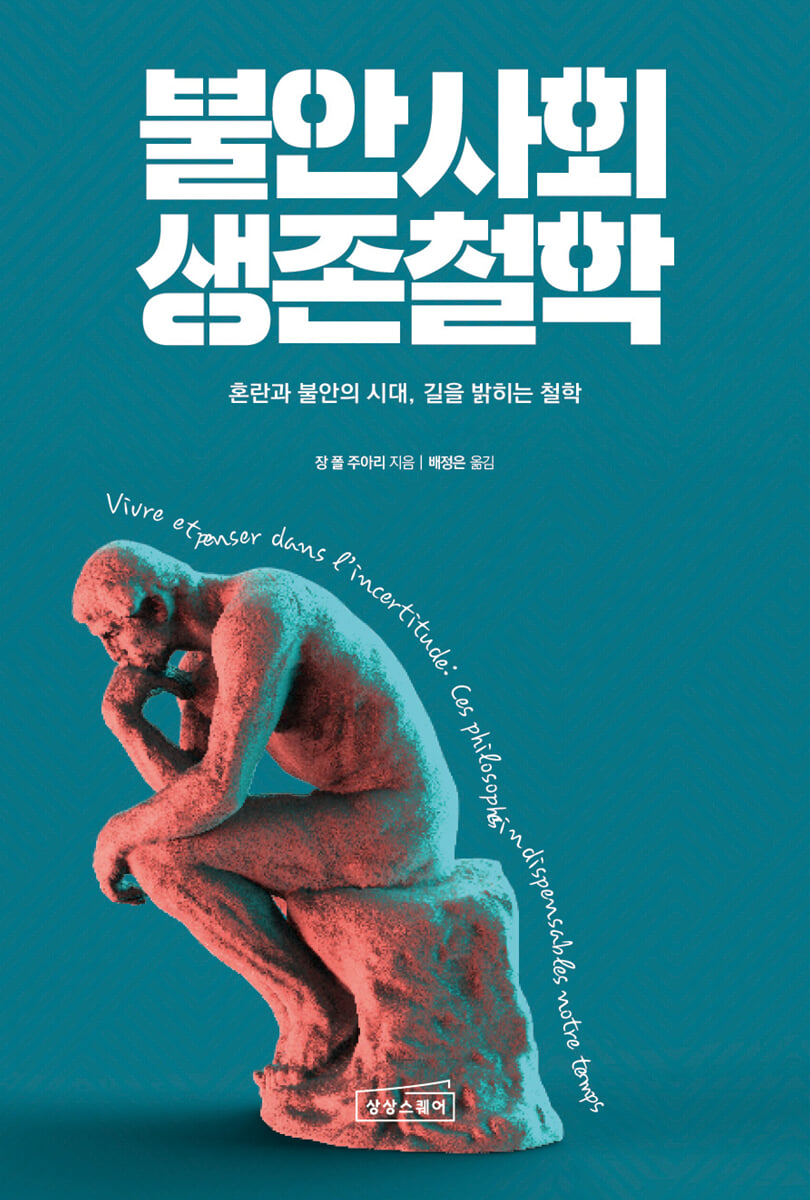
Survival Philosophy in an Anxious Society
 |
Description
Book Introduction
Philosophy is medicine for the soul.
Epicurus
“All philosophies are closest to our lives and spirit today.
“The power of philosophy to heal anxiety is always in progress.”
From Socrates and Plato
Through Galileo, Descartes, Rousseau, Olympe de Gouges, and Darwin
Up to Einstein,
The answers I am seeking now are in the lives and philosophies of countless philosophers!
Borrowing from Kant's words, "Someone's intelligence can be measured by the quantity of uncertainties that he can bear," Jean-Paul Jouary, a modern French philosopher who has taught philosophy for a long time, unfolds the lives and thoughts of great philosophers who were not so different from us.
The major problems that modern people are facing today are new problems that were not seen in the past, but at the same time, they are also the most common problems.
The important thing is to address the problem with a deep approach.
Because if we only touch the surface, we will never find a fundamental solution.
Fortunately, for over 25 centuries, our philosophers have addressed a variety of issues that transcend the times and have passed them on to us as a legacy.
For example, representative topics include the separation of church and state, democracy, oppression of women, ethics, and freedom.
To reason about reality, it is important to clearly distinguish between what we believe and what we know.
Speaking of beliefs, there are not only religious beliefs in the world, but also scientific beliefs, racist beliefs, and sexist beliefs.
The thing to keep in mind in all of this is reason.
If there's one thing that sets modern society apart from ancient Greece or the Renaissance, it's that we live in an age of unprecedented educational expansion, widespread scientific research, and a paradoxical coexistence of overflowing dogmatic beliefs.
Reason is the only true driving force that can unlock the temporary truth.
Epicurus
“All philosophies are closest to our lives and spirit today.
“The power of philosophy to heal anxiety is always in progress.”
From Socrates and Plato
Through Galileo, Descartes, Rousseau, Olympe de Gouges, and Darwin
Up to Einstein,
The answers I am seeking now are in the lives and philosophies of countless philosophers!
Borrowing from Kant's words, "Someone's intelligence can be measured by the quantity of uncertainties that he can bear," Jean-Paul Jouary, a modern French philosopher who has taught philosophy for a long time, unfolds the lives and thoughts of great philosophers who were not so different from us.
The major problems that modern people are facing today are new problems that were not seen in the past, but at the same time, they are also the most common problems.
The important thing is to address the problem with a deep approach.
Because if we only touch the surface, we will never find a fundamental solution.
Fortunately, for over 25 centuries, our philosophers have addressed a variety of issues that transcend the times and have passed them on to us as a legacy.
For example, representative topics include the separation of church and state, democracy, oppression of women, ethics, and freedom.
To reason about reality, it is important to clearly distinguish between what we believe and what we know.
Speaking of beliefs, there are not only religious beliefs in the world, but also scientific beliefs, racist beliefs, and sexist beliefs.
The thing to keep in mind in all of this is reason.
If there's one thing that sets modern society apart from ancient Greece or the Renaissance, it's that we live in an age of unprecedented educational expansion, widespread scientific research, and a paradoxical coexistence of overflowing dogmatic beliefs.
Reason is the only true driving force that can unlock the temporary truth.
- You can preview some of the book's contents.
Preview
index
Introduction
Part 1: Maintaining Reason
Chapter 1: Galileo, Christianity, and the Separation of Church and State
Galileo, from Glory to Misery; Descartes, from Anger to Philosophy; Devil or Good God?; From Obscurity to Enlightenment; Faith and Belief
Chapter 2: Averroes, Islam and the Separation of Church and State
Some facts and reason need not remain silent. The process of large-scale liberation.
Chapter 3: Moses Maimonides, Jews, and the Separation of Church and State
God, in other words?ㆍLearning how to read
Chapter 4 Spinoza, Excommunicated Wisdom
Blessed and Cursed Children, Contagious Wisdom, The Philosophy of the Education System, Classical and Modern Ideas
Part 2: Creating Your Own Freedom
Chapter 5: Epictetus, Self-Inflicted Slavery
A True StoryㆍSeneca, the Emperor of the SubstituteㆍEpictetus, Becoming InvincibleㆍPascal, Impossible VictoryㆍIs It a Society of Entertainment or a Society of Despair?
Chapter 6: Diderot, Moral Consciousness with Pleasure
False morality mocks morality. The price of free thought. Morality without prohibitions or threats. Doing good for the sake of good?. Perspectives on life.
Chapter 7: Descartes, the Judge and the Assassin
Music, dance, fencing... and murder, absolute human freedom, and is there a God in all of this? Is a definite act still an act?
Part 3: Becoming Human
Chapter 8: Darwin, the Devout Evolutionist
Creationist Darwin, Real Obstacles, Scandals, The Origin of Man, Man Does Not Exist
Chapter 9: Diogenes, in Search of Man
A Dog's Life, Philosophy in Action, Nothing Between the Sun and Me, Nothing Above Man, Cynicism is Humanism
Chapter 10: Crates and Hipparchia
A test of a certain truth, a viewpoint, a person outside of oneself, the viewpoint of others, something looking at me
Chapter 11: Kant, Creative Freedom, and the Paleolithic Age
A True Story, Art That Is Everywhere and Nowhere, Kant's Excellence, Imitating Nature?, The Art of Being Human
Part 4: Maintaining Yourself
Chapter 12: Mandela, Justice Beyond the Law
A Thousand Reasons to RevengeㆍHuman, All Too HumanㆍJudge without RevengeㆍBelow the Law and Above the LawㆍBeyond the Law
Chapter 13: Rousseau, the Desire for Freedom
Some true stories, images and texts, money against the real economy, obey yourself, elected officials and voters, voluntary obedience, what is power?
Chapter 14: Pascal, Impossible Isolation
Who is the Lonely Walker? Who is the Misanthrope? What's on the Front of Your Head? What's on the Back of Your Head?
Chapter 15: Socrates, Not to Draw Conclusions
A True Story: The Accusations of Meletus, Lycon, and Anytus; Who is Socrates?; What is a Dialogue?; The Trial; The Death of Socrates; The Universal Legacy
Epilogue: Are There Female Philosophers?
Philosophy of the Oppressed, Hundreds of Women Philosophers, The Oppression of Women, The Renaissance of Women's Philosophy, The Light of Enlightenment for Women?, The Real Basis of Equality, Again: Are There No Women Philosophers?
References
Part 1: Maintaining Reason
Chapter 1: Galileo, Christianity, and the Separation of Church and State
Galileo, from Glory to Misery; Descartes, from Anger to Philosophy; Devil or Good God?; From Obscurity to Enlightenment; Faith and Belief
Chapter 2: Averroes, Islam and the Separation of Church and State
Some facts and reason need not remain silent. The process of large-scale liberation.
Chapter 3: Moses Maimonides, Jews, and the Separation of Church and State
God, in other words?ㆍLearning how to read
Chapter 4 Spinoza, Excommunicated Wisdom
Blessed and Cursed Children, Contagious Wisdom, The Philosophy of the Education System, Classical and Modern Ideas
Part 2: Creating Your Own Freedom
Chapter 5: Epictetus, Self-Inflicted Slavery
A True StoryㆍSeneca, the Emperor of the SubstituteㆍEpictetus, Becoming InvincibleㆍPascal, Impossible VictoryㆍIs It a Society of Entertainment or a Society of Despair?
Chapter 6: Diderot, Moral Consciousness with Pleasure
False morality mocks morality. The price of free thought. Morality without prohibitions or threats. Doing good for the sake of good?. Perspectives on life.
Chapter 7: Descartes, the Judge and the Assassin
Music, dance, fencing... and murder, absolute human freedom, and is there a God in all of this? Is a definite act still an act?
Part 3: Becoming Human
Chapter 8: Darwin, the Devout Evolutionist
Creationist Darwin, Real Obstacles, Scandals, The Origin of Man, Man Does Not Exist
Chapter 9: Diogenes, in Search of Man
A Dog's Life, Philosophy in Action, Nothing Between the Sun and Me, Nothing Above Man, Cynicism is Humanism
Chapter 10: Crates and Hipparchia
A test of a certain truth, a viewpoint, a person outside of oneself, the viewpoint of others, something looking at me
Chapter 11: Kant, Creative Freedom, and the Paleolithic Age
A True Story, Art That Is Everywhere and Nowhere, Kant's Excellence, Imitating Nature?, The Art of Being Human
Part 4: Maintaining Yourself
Chapter 12: Mandela, Justice Beyond the Law
A Thousand Reasons to RevengeㆍHuman, All Too HumanㆍJudge without RevengeㆍBelow the Law and Above the LawㆍBeyond the Law
Chapter 13: Rousseau, the Desire for Freedom
Some true stories, images and texts, money against the real economy, obey yourself, elected officials and voters, voluntary obedience, what is power?
Chapter 14: Pascal, Impossible Isolation
Who is the Lonely Walker? Who is the Misanthrope? What's on the Front of Your Head? What's on the Back of Your Head?
Chapter 15: Socrates, Not to Draw Conclusions
A True Story: The Accusations of Meletus, Lycon, and Anytus; Who is Socrates?; What is a Dialogue?; The Trial; The Death of Socrates; The Universal Legacy
Epilogue: Are There Female Philosophers?
Philosophy of the Oppressed, Hundreds of Women Philosophers, The Oppression of Women, The Renaissance of Women's Philosophy, The Light of Enlightenment for Women?, The Real Basis of Equality, Again: Are There No Women Philosophers?
References
Detailed image
.jpg)
Publisher's Review
To us who live in uncertain and anxious times,
Are the philosophies of ancient philosophers really valid?
The four main themes addressed in this book—the relationship between belief and reason, individual freedom, determinism, and the certainty of identity—lead to four more questions.
'How do we find a harmonious balance between faith that sometimes transcends reason and rational knowledge?'
'What role does freedom play in our actions?'
'Do I have a 'nature' that determines my life?'
"How can I live authentically in this age of rampant stereotypes, prejudice, and social media dominance?"
Surrounding this question, the reader encounters anecdotes of various philosophers, including Descartes investigating a crime, Rousseau being attacked by a dog, Diderot in prison, Darwin the evolutionist pleading with God, and Olympe de Gouges meditating on his way to the guillotine, confirming that philosophy was always present in their daily lives.
Let's ask a question about 'freedom', one of the four topics covered in this book.
'Can the cause of modern uncertainty then be traced to the decline of freedom?' No.
Freedom will never be lost.
First, it is important to properly define the meaning of freedom. Freedom does not mean the absence of rules, but rather the establishment of rules in which members of society participate.
Unlike the 'truths' that are forced upon everyone in the name of God or nature, democracy can be said to be the result of the process of freedom.
As Rousseau emphasized, 'truths' are determined by majority opinion and can be mistaken.
How can we distinguish between diverse beliefs? What is free in human behavior? Does nature determine human life, or can we constantly cultivate our character? How can we sustain ourselves within all that surrounds us in society? There are never definitive answers to these questions, and each question fosters the thinking of those who seek to take control of their own lives. Ultimately, we arrive at the Socratic methodology, the birthplace of modern philosophy.
A 'soul's conversation with itself' can never lead to a definitive conclusion.
This is why, etymologically, a philosopher is not a wise person, but someone who wants to be wise.
Never before have there been so many philosophers, writers, professors, and students from all walks of life, regardless of gender, as today.
Never before have so many books, magazines, and media devoted to the dynamism of modern philosophy been so available.
However, the problem facing modern society is that individuals do not participate in dialogue, and dialogue among thinkers alone cannot satisfy the current era.
All philosophical systems are rooted in real life.
Denis Diderot's motto, 'popularization of philosophy,' is more important than ever.
In these times of uncertainty and anxiety, we must seek the light that illuminates our path in contemplation, that is, in philosophy.
Are the philosophies of ancient philosophers really valid?
The four main themes addressed in this book—the relationship between belief and reason, individual freedom, determinism, and the certainty of identity—lead to four more questions.
'How do we find a harmonious balance between faith that sometimes transcends reason and rational knowledge?'
'What role does freedom play in our actions?'
'Do I have a 'nature' that determines my life?'
"How can I live authentically in this age of rampant stereotypes, prejudice, and social media dominance?"
Surrounding this question, the reader encounters anecdotes of various philosophers, including Descartes investigating a crime, Rousseau being attacked by a dog, Diderot in prison, Darwin the evolutionist pleading with God, and Olympe de Gouges meditating on his way to the guillotine, confirming that philosophy was always present in their daily lives.
Let's ask a question about 'freedom', one of the four topics covered in this book.
'Can the cause of modern uncertainty then be traced to the decline of freedom?' No.
Freedom will never be lost.
First, it is important to properly define the meaning of freedom. Freedom does not mean the absence of rules, but rather the establishment of rules in which members of society participate.
Unlike the 'truths' that are forced upon everyone in the name of God or nature, democracy can be said to be the result of the process of freedom.
As Rousseau emphasized, 'truths' are determined by majority opinion and can be mistaken.
How can we distinguish between diverse beliefs? What is free in human behavior? Does nature determine human life, or can we constantly cultivate our character? How can we sustain ourselves within all that surrounds us in society? There are never definitive answers to these questions, and each question fosters the thinking of those who seek to take control of their own lives. Ultimately, we arrive at the Socratic methodology, the birthplace of modern philosophy.
A 'soul's conversation with itself' can never lead to a definitive conclusion.
This is why, etymologically, a philosopher is not a wise person, but someone who wants to be wise.
Never before have there been so many philosophers, writers, professors, and students from all walks of life, regardless of gender, as today.
Never before have so many books, magazines, and media devoted to the dynamism of modern philosophy been so available.
However, the problem facing modern society is that individuals do not participate in dialogue, and dialogue among thinkers alone cannot satisfy the current era.
All philosophical systems are rooted in real life.
Denis Diderot's motto, 'popularization of philosophy,' is more important than ever.
In these times of uncertainty and anxiety, we must seek the light that illuminates our path in contemplation, that is, in philosophy.
GOODS SPECIFICS
- Date of issue: December 11, 2024
- Page count, weight, size: 396 pages | 152*225*25mm
- ISBN13: 9791198854346
- ISBN10: 1198854340
You may also like
카테고리
korean


korean

![GQ KOREA Mark (Monthly): December [2025]](http://librairie.coreenne.fr/cdn/shop/files/8ef265dbbfbf186523ed75ba7319009d.jpg?v=1765340328&width=3840)


