

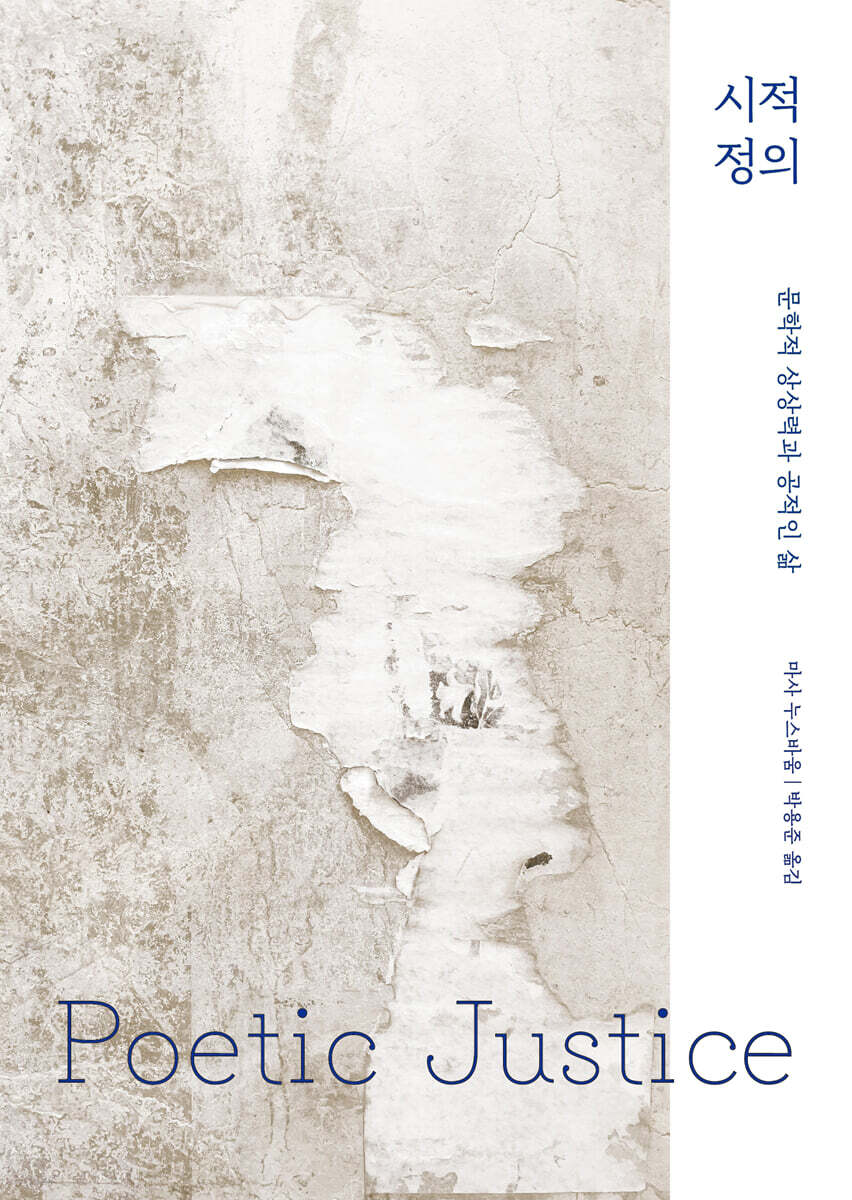
poetic justice
 |
Description
Book Introduction
The harsher the world becomes, the more powerful literature becomes!
In this age where law and justice have surrendered to the power of the strong,
Why We Need to Read Literature Again
The publication of this book began with a journey by the team at Indigo Bookstore, a humanities bookstore for young adults, to meet historian Howard Zinn in 2009.
At the time, Indigo Books conducted interviews with Howard Zinn, Martha Nussbaum, Noam Chomsky, and Francis Moore Lappé on the topic of “justice and hope.” After returning and organizing the interviews, I realized that the scholars I met all had something in common: “literature’s public contribution” to justice and hope.
Then, I discovered Nussbaum's book, Poetic Justice, and began actively pursuing its publication.
Since its first publication in 2013, it has been actively encouraging readers to expand their reading and reflection by persuasively discussing the role and power of literature, and is consistently used as a reference in law schools and other institutions.
This book, presented with a new cover, will provide an opportunity to reflect on literature, a field that becomes increasingly precious as the world becomes more challenging.
In this age where law and justice have surrendered to the power of the strong,
Why We Need to Read Literature Again
The publication of this book began with a journey by the team at Indigo Bookstore, a humanities bookstore for young adults, to meet historian Howard Zinn in 2009.
At the time, Indigo Books conducted interviews with Howard Zinn, Martha Nussbaum, Noam Chomsky, and Francis Moore Lappé on the topic of “justice and hope.” After returning and organizing the interviews, I realized that the scholars I met all had something in common: “literature’s public contribution” to justice and hope.
Then, I discovered Nussbaum's book, Poetic Justice, and began actively pursuing its publication.
Since its first publication in 2013, it has been actively encouraging readers to expand their reading and reflection by persuasively discussing the role and power of literature, and is consistently used as a reference in law schools and other institutions.
This book, presented with a new cover, will provide an opportunity to reflect on literature, a field that becomes increasingly precious as the world becomes more challenging.
- You can preview some of the book's contents.
Preview
index
introduction
Chapter 1 Literary Imagination
Chapter 2 Fantasy
Chapter 3 Rational Emotions
Chapter 4 The Poet as Judge
Acknowledgements
Translator's Note
main
Search
Chapter 1 Literary Imagination
Chapter 2 Fantasy
Chapter 3 Rational Emotions
Chapter 4 The Poet as Judge
Acknowledgements
Translator's Note
main
Search
Publisher's Review
What can literature do?
Martha Nussbaum, one of the world's top 100 intellectuals and professor emeritus at the University of Chicago, questions the social value of literature.
There is an old question about literature.
What can literature do? Is it merely entertainment, a refuge from the harsh realities of life, or an essential element in creating a better society? This is the question of the relationship between literature and politics.
The author of this book, Martha Nussbaum, a world-renowned legal and political philosopher, read the works of Sophocles, Plato, Seneca, and Dickens with her law students at the University of Chicago.
Why do students who plan to become lawyers, judges, or politicians read literature? Because the empathy, imagination, and compassion that novels evoke in us play a crucial role in making rational public judgments.
This book, which details how literary imagination becomes an essential element of just public discourse and a democratic society, is a book that discusses the social value of literature.
The author, who previously held the Distinguished Professorship at Harvard and Brown Universities and currently lectures as a Distinguished Professor of Law and Ethics at the Departments of Philosophy, Law School, and Theology at the University of Chicago, conducted joint research with economist Amartya Sen at the World Institute for Development Economics at the United Nations University from 1986 to 1993 on methods for assessing a country's quality of life.
Sen and Nussbaum, in opposition to the mainstream economists' model that focused on income levels such as gross national product (GNP) per capita, created a new model to assess the quality of life using a multi-level measure that included "health, education, political rights, and relations between ethnicity, race, and gender." This approach later became the basis for the Human Development Index (HDI), which the United Nations publishes annually.
This book draws heavily on the research Nussbaum conducted with Sen, as well as lectures the author gave at the University of Chicago, Northwestern University, Yale Law School, Hamlin College, and Trinity College Dublin.
Seeing the world through numbers and seeing it through novels
Literary imagination transforms public life!
What Nussbaum criticizes in this book is 'economic utilitarianism', which has been advocated as normative in mainstream development economics or the public sector.
According to him, in a world of cold calculation where economic efficiency is the primary value and everything is reduced to numbers, it is difficult to create citizens who empathize with the pain of others and feel anger.
For example, if you look at the world in terms of numbers like an economic growth rate of 4% or a per capita gross national product (GNP) of $20,000, the world seems livable.
This is true even if the total or average figures do not tell us anything about the distribution problems or inequality in society.
The reason we are indifferent to the news that the elderly poverty rate is 40.4%, the world's starving population has doubled in three years, and there are 300 victims of the dictatorship is because these are abstract numbers.
On the other hand, if there is a character with a specific name and story before us, we easily respond to his situation and his suffering.
This is precisely why Nussbaum believes in the social value of literature.
According to him, literature brings before our eyes human beings who live lives separate from us.
Literature describes his situation and inner world in vivid and specific language.
As the reader progresses through the novel, he or she empathizes with the situation he or she is in as if it were his or her own, and sympathizes with the happiness, joy, pain, fear, dread, and hope he or she feels.
When we encounter the faces of “the miserable, the oppressed, and the excluded” through novels and witness the injustice and tragedy of the world, we naturally become interested in “equality rather than inequality, and democratic values rather than aristocratic ideals.”
Literature has the subversive power to change the world for the better.
Nussbaum analyzes literary works such as Charles Dickens's Hard Times, Richard Wright's American Son, Forster's Maurice, and Walt Whitman's "Song of Myself" to discuss the relationship between literary imagination and public reasoning.
The discussion on 'rational emotions' is also given significant weight.
It is true that emotions have long been considered irrational and thus excluded from public reasoning.
As a classicist, Nussbaum delves into the thought of various philosophers, utilitarians, and economists throughout history, including Plato, Aristotle, the Stoics, Spinoza, Kant, Smith, Bentham, and Sidgwick, and discusses the role of emotions in public judgment in depth.
In particular, Adam Smith's Theory of Moral Sentiments provided much inspiration for the author in planning this book.
The final chapter examines a wealth of legal precedents and explains the concepts of 'literary judge' and 'poet-judge.'
Literary works contain a deep understanding of humanity and are inherently interested in minorities and the socially disadvantaged.
The author explores this debate, which is also an issue of social equality, using novels and court cases that deal with issues of gender, homosexuality, and race.
A healthy society is,
It's a society with many politicians, lawyers, and citizens who love literature!
It is a society overflowing with numbers.
Government reports, political economy papers, and the news we see every day are closer to cold "calculators" than to "literary texts."
As the author points out, the models recommended in the public sphere are forms of cost-benefit analysis or economic utilitarianism.
This trend of calculating the 'costs' and 'benefits' of implementing a public policy and selecting the most efficient plan (cost-benefit analysis) or prioritizing economic efficiency has recently had a significant impact not only on public policy decisions but also on the legal field.
It may sound a little unfamiliar to us, but in the United States, the law and economics movement, which analyzes law from an economic perspective, is growing day by day.
However, this approach has many limitations.
As the author repeatedly argues, abstract statistical figures like totals and averages lack an understanding of human individuality, qualitative differences, and the complexity of life, and that “not all human problems can be solved with simple arithmetic.”
Literature is different.
Because it contains “the mystery and complexity that permeates each life,” reading the novel allows us to understand the specific human existence in its entirety and ultimately realize the universal values that we must share as humans.
I am talking about the values of dignity and equality that all human beings should enjoy.
Therefore, there is good reason for Nussbaum to link the act of 'reading a novel', which is often considered a private act, to a public act.
Nussbaum advocates the concept of poetic justice, emphasizing that:
“Literary imagination will guide judges in their decisions, legislators in their laws, and policymakers in their measurement of the various qualities of human life.”
It's easy to think of politics as difficult and distant.
Because politics, by its very nature, is an act of imagining what is not visible before one's eyes.
In other words, politics is realizing that something or someone that you thought had nothing to do with you is connected to you.
Therefore, the disappearance of politics from daily life, the fact that our society has moved away from the values of justice and equality, may mean that fewer people are seeking out literature.
As Nussbaum argues, novels allow us to imagine what it is like to live the lives of others, and this experience of empathy and identification becomes the force that creates a better world.
To exaggerate, the novel is a great political text.
Because it enables us to recognize others, society, and the world beyond ourselves, and leads us to become political beings who think about a better world.
In these difficult times, when law and justice have yielded to the power of the strong, this is why we must not let go of literature.
“This book argues for the usefulness of literature.
That is, it asks how we can revive our sense of life in the face of the superficiality of life and the vulgarity of humanity, and how we can restore justice to the sorrowful and the wronged.
Literature is inherently concerned with the totality of the times, and without a deep understanding of humanity, we would find it difficult to dream of any change.
Having witnessed the world's injustice and tragedy through literature, having faced the suffering faces of others, it is impossible to cling to the way of life we have lived so far.
This is the power of poetry and novels, that is, of literature.
“Don Quixote’s delusions, which lead us to dream of a hope that does not yet exist and a world that has not yet arrived, will lead us to a new world, and literature will be at the center of it.”
-From the translator's note
Martha Nussbaum, one of the world's top 100 intellectuals and professor emeritus at the University of Chicago, questions the social value of literature.
There is an old question about literature.
What can literature do? Is it merely entertainment, a refuge from the harsh realities of life, or an essential element in creating a better society? This is the question of the relationship between literature and politics.
The author of this book, Martha Nussbaum, a world-renowned legal and political philosopher, read the works of Sophocles, Plato, Seneca, and Dickens with her law students at the University of Chicago.
Why do students who plan to become lawyers, judges, or politicians read literature? Because the empathy, imagination, and compassion that novels evoke in us play a crucial role in making rational public judgments.
This book, which details how literary imagination becomes an essential element of just public discourse and a democratic society, is a book that discusses the social value of literature.
The author, who previously held the Distinguished Professorship at Harvard and Brown Universities and currently lectures as a Distinguished Professor of Law and Ethics at the Departments of Philosophy, Law School, and Theology at the University of Chicago, conducted joint research with economist Amartya Sen at the World Institute for Development Economics at the United Nations University from 1986 to 1993 on methods for assessing a country's quality of life.
Sen and Nussbaum, in opposition to the mainstream economists' model that focused on income levels such as gross national product (GNP) per capita, created a new model to assess the quality of life using a multi-level measure that included "health, education, political rights, and relations between ethnicity, race, and gender." This approach later became the basis for the Human Development Index (HDI), which the United Nations publishes annually.
This book draws heavily on the research Nussbaum conducted with Sen, as well as lectures the author gave at the University of Chicago, Northwestern University, Yale Law School, Hamlin College, and Trinity College Dublin.
Seeing the world through numbers and seeing it through novels
Literary imagination transforms public life!
What Nussbaum criticizes in this book is 'economic utilitarianism', which has been advocated as normative in mainstream development economics or the public sector.
According to him, in a world of cold calculation where economic efficiency is the primary value and everything is reduced to numbers, it is difficult to create citizens who empathize with the pain of others and feel anger.
For example, if you look at the world in terms of numbers like an economic growth rate of 4% or a per capita gross national product (GNP) of $20,000, the world seems livable.
This is true even if the total or average figures do not tell us anything about the distribution problems or inequality in society.
The reason we are indifferent to the news that the elderly poverty rate is 40.4%, the world's starving population has doubled in three years, and there are 300 victims of the dictatorship is because these are abstract numbers.
On the other hand, if there is a character with a specific name and story before us, we easily respond to his situation and his suffering.
This is precisely why Nussbaum believes in the social value of literature.
According to him, literature brings before our eyes human beings who live lives separate from us.
Literature describes his situation and inner world in vivid and specific language.
As the reader progresses through the novel, he or she empathizes with the situation he or she is in as if it were his or her own, and sympathizes with the happiness, joy, pain, fear, dread, and hope he or she feels.
When we encounter the faces of “the miserable, the oppressed, and the excluded” through novels and witness the injustice and tragedy of the world, we naturally become interested in “equality rather than inequality, and democratic values rather than aristocratic ideals.”
Literature has the subversive power to change the world for the better.
Nussbaum analyzes literary works such as Charles Dickens's Hard Times, Richard Wright's American Son, Forster's Maurice, and Walt Whitman's "Song of Myself" to discuss the relationship between literary imagination and public reasoning.
The discussion on 'rational emotions' is also given significant weight.
It is true that emotions have long been considered irrational and thus excluded from public reasoning.
As a classicist, Nussbaum delves into the thought of various philosophers, utilitarians, and economists throughout history, including Plato, Aristotle, the Stoics, Spinoza, Kant, Smith, Bentham, and Sidgwick, and discusses the role of emotions in public judgment in depth.
In particular, Adam Smith's Theory of Moral Sentiments provided much inspiration for the author in planning this book.
The final chapter examines a wealth of legal precedents and explains the concepts of 'literary judge' and 'poet-judge.'
Literary works contain a deep understanding of humanity and are inherently interested in minorities and the socially disadvantaged.
The author explores this debate, which is also an issue of social equality, using novels and court cases that deal with issues of gender, homosexuality, and race.
A healthy society is,
It's a society with many politicians, lawyers, and citizens who love literature!
It is a society overflowing with numbers.
Government reports, political economy papers, and the news we see every day are closer to cold "calculators" than to "literary texts."
As the author points out, the models recommended in the public sphere are forms of cost-benefit analysis or economic utilitarianism.
This trend of calculating the 'costs' and 'benefits' of implementing a public policy and selecting the most efficient plan (cost-benefit analysis) or prioritizing economic efficiency has recently had a significant impact not only on public policy decisions but also on the legal field.
It may sound a little unfamiliar to us, but in the United States, the law and economics movement, which analyzes law from an economic perspective, is growing day by day.
However, this approach has many limitations.
As the author repeatedly argues, abstract statistical figures like totals and averages lack an understanding of human individuality, qualitative differences, and the complexity of life, and that “not all human problems can be solved with simple arithmetic.”
Literature is different.
Because it contains “the mystery and complexity that permeates each life,” reading the novel allows us to understand the specific human existence in its entirety and ultimately realize the universal values that we must share as humans.
I am talking about the values of dignity and equality that all human beings should enjoy.
Therefore, there is good reason for Nussbaum to link the act of 'reading a novel', which is often considered a private act, to a public act.
Nussbaum advocates the concept of poetic justice, emphasizing that:
“Literary imagination will guide judges in their decisions, legislators in their laws, and policymakers in their measurement of the various qualities of human life.”
It's easy to think of politics as difficult and distant.
Because politics, by its very nature, is an act of imagining what is not visible before one's eyes.
In other words, politics is realizing that something or someone that you thought had nothing to do with you is connected to you.
Therefore, the disappearance of politics from daily life, the fact that our society has moved away from the values of justice and equality, may mean that fewer people are seeking out literature.
As Nussbaum argues, novels allow us to imagine what it is like to live the lives of others, and this experience of empathy and identification becomes the force that creates a better world.
To exaggerate, the novel is a great political text.
Because it enables us to recognize others, society, and the world beyond ourselves, and leads us to become political beings who think about a better world.
In these difficult times, when law and justice have yielded to the power of the strong, this is why we must not let go of literature.
“This book argues for the usefulness of literature.
That is, it asks how we can revive our sense of life in the face of the superficiality of life and the vulgarity of humanity, and how we can restore justice to the sorrowful and the wronged.
Literature is inherently concerned with the totality of the times, and without a deep understanding of humanity, we would find it difficult to dream of any change.
Having witnessed the world's injustice and tragedy through literature, having faced the suffering faces of others, it is impossible to cling to the way of life we have lived so far.
This is the power of poetry and novels, that is, of literature.
“Don Quixote’s delusions, which lead us to dream of a hope that does not yet exist and a world that has not yet arrived, will lead us to a new world, and literature will be at the center of it.”
-From the translator's note
GOODS SPECIFICS
- Date of issue: October 31, 2024
- Page count, weight, size: 284 pages | 474g | 152*214*20mm
- ISBN13: 9788958209003
- ISBN10: 8958209003
You may also like
카테고리
korean


korean

![GQ KOREA Mark (Monthly): December [2025]](http://librairie.coreenne.fr/cdn/shop/files/8ef265dbbfbf186523ed75ba7319009d.jpg?v=1765340328&width=3840)


