

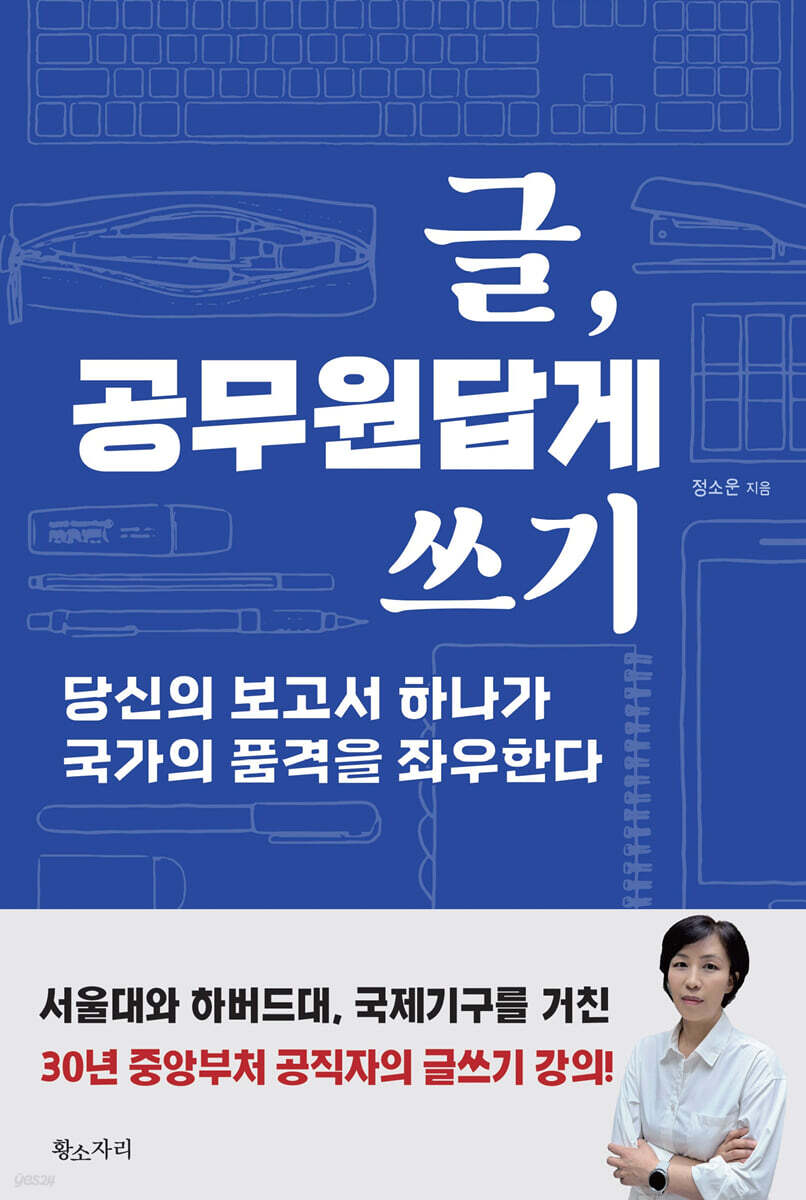
Writing like a civil servant
 |
Description
Book Introduction
After going through Seoul National University and Harvard International Organization
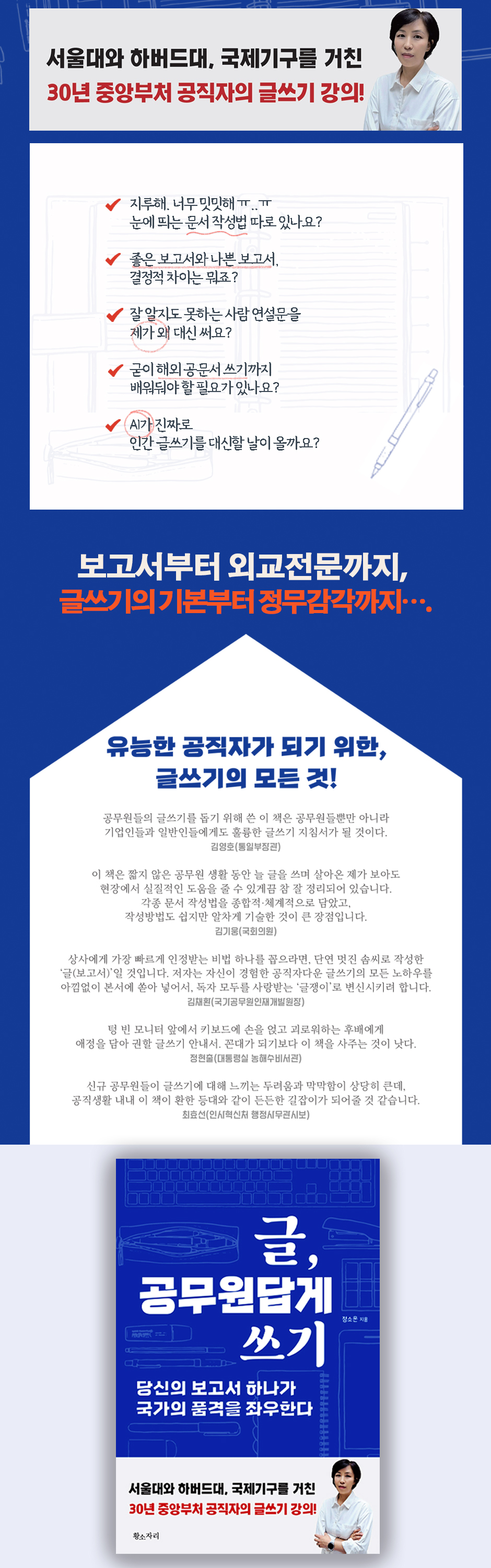
A writing lecture by a central government official with 30 years of experience!
From policy reports to diplomatic cables, from the basics of drafting official documents to political acumen, this book covers everything civil servants need to know about writing.
The author is Jeong So-woon, who entered the public service by passing the Higher Civil Service Examination in 1996 and has been working as a high-ranking civil servant in a central government agency of the Republic of Korea for nearly 30 years.
From his days as a new secretary, he was known for his work and writing skills. While working at the Presidential Transition Committee, the Office of the President, the secretariat of a committee under the Prime Minister's Office, a presidential committee, and the WHO, an international organization under the United Nations, he gained extensive experience in writing that varied depending on the job type and rank.
As befitting the author who has tirelessly written reports, National Assembly materials, speeches, responses to civil complaints, press releases, and diplomatic documents, which constitute the main types of civil servant writing, this book is packed with the know-how of writing various official documents that he has experienced over the years.
The author presents a new perspective on the utility and value of civil service writing, using personally written virtual reports, virtual reports, and virtual press releases, along with declassified domestic and international examples demonstrating the power of official documents that have sometimes changed the course of a nation's destiny or history.
In an annual survey of civil servants on job training needs, "How to Write a Report" consistently ranked first, demonstrating that writing is a difficult task for civil servants.
There are several books on writing for civil servants on the market, and related videos are also floating around, but they all roughly mimic "civil servant-like" writing or stop at superficial explanations.
In such a reality, this book vividly testifies to the real reasons why civil servants must write, the different types of document writing methods, and even the destructive power of a single well-written official document. It will serve as a valuable teacher and companion to many who have been looking for a writing textbook they can trust and follow.
A writing lecture by a central government official with 30 years of experience!
From policy reports to diplomatic cables, from the basics of drafting official documents to political acumen, this book covers everything civil servants need to know about writing.
The author is Jeong So-woon, who entered the public service by passing the Higher Civil Service Examination in 1996 and has been working as a high-ranking civil servant in a central government agency of the Republic of Korea for nearly 30 years.
From his days as a new secretary, he was known for his work and writing skills. While working at the Presidential Transition Committee, the Office of the President, the secretariat of a committee under the Prime Minister's Office, a presidential committee, and the WHO, an international organization under the United Nations, he gained extensive experience in writing that varied depending on the job type and rank.
As befitting the author who has tirelessly written reports, National Assembly materials, speeches, responses to civil complaints, press releases, and diplomatic documents, which constitute the main types of civil servant writing, this book is packed with the know-how of writing various official documents that he has experienced over the years.
The author presents a new perspective on the utility and value of civil service writing, using personally written virtual reports, virtual reports, and virtual press releases, along with declassified domestic and international examples demonstrating the power of official documents that have sometimes changed the course of a nation's destiny or history.
In an annual survey of civil servants on job training needs, "How to Write a Report" consistently ranked first, demonstrating that writing is a difficult task for civil servants.
There are several books on writing for civil servants on the market, and related videos are also floating around, but they all roughly mimic "civil servant-like" writing or stop at superficial explanations.
In such a reality, this book vividly testifies to the real reasons why civil servants must write, the different types of document writing methods, and even the destructive power of a single well-written official document. It will serve as a valuable teacher and companion to many who have been looking for a writing textbook they can trust and follow.
- You can preview some of the book's contents.
Preview
index
Preface 4
I Write a Report
1.
Understanding the Report 19
Reasons for Writing: Three Ways to Share Your Report
2.
Report, Good or Bad 45
Completeness, reliability, and persuasiveness - not late, not plagiarized, not boastful
3.
Step 57 of writing a report
Check the instructions, give it a title, structure it, get on eye level with it.
Select the bones, refine the form, and report
4.
Report, Going One Step Further 107
A true one-page report and a remodeling ceremony: Are they really that important?
@ For a useful report 129
II Writing a Speech Material
1.
Understanding the Words 135
This? Me? Why? How to share your message
2.
Speeches, Good or Bad 147
Speak in short, easy, colloquial language. Nothing boring, trite, or incorrect.
3.
Speech Writing Step 157
Selecting materials, creating a structure, bringing rhythm to life, and instilling soul into it
Listen to the speech
4.
Handling Talking Points 177
Preemptive type that includes keywords, predictive type that focuses on questions, and responsive type that reduces fatigue
@ Speaker, Writer 187
III Writing Media Materials
1.
Press Release 195
Working straight, writing roughly, and the conditions for a well-written press release
2.
Press Release 210
An explanation is needed. An explanatory material that provides an explanation.
3. PG 219
What is PG? Steps to Access PG
4.
Social Media 229
Social Media: Is This the Best? How to Use Social Media the Right Way
@ Writing and Writing Relationship 238
IV Writing a Report, Not a Report
1.
Presentation Report 245
Inserting reports into PT and using PPT effectively
2.
Messenger Report 261
How to Survive on Messenger and Messenger, the Reporter
3.
Email Report 269
When you need email and want to report well by email
4.
Professional Report 277
How is a report different from a professional report?
5.
Memo Report 287
What is a substitute memo? Report as a memo
V Writing for yourself
1.
Self-introduction should be honest 297
2.
Public records are not embarrassing 303
3.
The statement of purpose (statement of circumstances) is 310
4.
Sincere Farewell Address (Retirement Address) 318
@Being Yourself 326
VI Let AI write
1.
The Current State of AI Writing 333
2.
350 For more human writing
Finishing Writing 355
I Write a Report
1.
Understanding the Report 19
Reasons for Writing: Three Ways to Share Your Report
2.
Report, Good or Bad 45
Completeness, reliability, and persuasiveness - not late, not plagiarized, not boastful
3.
Step 57 of writing a report
Check the instructions, give it a title, structure it, get on eye level with it.
Select the bones, refine the form, and report
4.
Report, Going One Step Further 107
A true one-page report and a remodeling ceremony: Are they really that important?
@ For a useful report 129
II Writing a Speech Material
1.
Understanding the Words 135
This? Me? Why? How to share your message
2.
Speeches, Good or Bad 147
Speak in short, easy, colloquial language. Nothing boring, trite, or incorrect.
3.
Speech Writing Step 157
Selecting materials, creating a structure, bringing rhythm to life, and instilling soul into it
Listen to the speech
4.
Handling Talking Points 177
Preemptive type that includes keywords, predictive type that focuses on questions, and responsive type that reduces fatigue
@ Speaker, Writer 187
III Writing Media Materials
1.
Press Release 195
Working straight, writing roughly, and the conditions for a well-written press release
2.
Press Release 210
An explanation is needed. An explanatory material that provides an explanation.
3. PG 219
What is PG? Steps to Access PG
4.
Social Media 229
Social Media: Is This the Best? How to Use Social Media the Right Way
@ Writing and Writing Relationship 238
IV Writing a Report, Not a Report
1.
Presentation Report 245
Inserting reports into PT and using PPT effectively
2.
Messenger Report 261
How to Survive on Messenger and Messenger, the Reporter
3.
Email Report 269
When you need email and want to report well by email
4.
Professional Report 277
How is a report different from a professional report?
5.
Memo Report 287
What is a substitute memo? Report as a memo
V Writing for yourself
1.
Self-introduction should be honest 297
2.
Public records are not embarrassing 303
3.
The statement of purpose (statement of circumstances) is 310
4.
Sincere Farewell Address (Retirement Address) 318
@Being Yourself 326
VI Let AI write
1.
The Current State of AI Writing 333
2.
350 For more human writing
Finishing Writing 355
Detailed image
Into the book
Public officials' writings usually do not have names.
On the rare occasions when a name is mentioned, it is not to receive praise or reward, but to be questioned and held accountable.
Since there is no name in the text, there is naturally no name value.
(Omitted) You may wonder why you would put so much passion and effort into something that doesn't pay or anything, but isn't that why you became a civil servant?
I believe that the essence of being a civil servant is simply working with the pride of contributing to the country and helping people.
--- From the "Preface"
Articles written by civil servants are not free.
Even writing a single report costs the nation's hard-earned tax money.
Instead of grandly talking about the spirit of the times or public sentiment, shouldn't we start by making efforts to get on the same level as the public and write more useful, attractive, and competitive articles?
--- p.65
A speech is not a thesis.
To maximize the impact and appeal to the ear, sentences should be short.
Minimize conjunctions and cut sentences that can be broken as much as possible.
It shouldn't just be shortened without any reason.
Short sentences should create a sense of rhythm.
--- p.162
Social media is a medium that succeeds only when the speaker's personality and voice are alive.
So, while social media posts should be written in a vivid, direct tone as much as possible, it's difficult to find that on our government accounts.
--- p.233
Therefore, one thing we must always remember is the proposition that 'the worst report is a late report.'
Is a poor report worse or a late report worse?
Reports that require revision and reversal end in embarrassment and apologies.
But no matter how embarrassed you are or how many times you apologize, you won't actually die.
On the other hand, some late reports can lead to someone's death.
--- p.262~263
Why do we need to understand the concept of "memo," a document that isn't used in Korea? Shouldn't we simply take care of "memo reports" within our system? Let's not think so narrowly.
There is at least some reason to know about foreign notes that are different from ours.
First of all, to avoid confusion when working on international relations.
If we only know the concept of a memo as similar to a memo, it is difficult to understand the broader concept of a memo that includes reports, official documents, and even telegrams written by foreign governments and international organizations.
--- p.293
Simple, 'civil servant-like' writing can be replicated in any number of ways.
However, some writings written 'like a civil servant' as a human being are difficult to replace.
Only human civil servants can write articles that point out and correct AI errors, that require political judgment that AI cannot make, that pursue the public interest that AI can never replace, and that appeal to the human heart.
On the rare occasions when a name is mentioned, it is not to receive praise or reward, but to be questioned and held accountable.
Since there is no name in the text, there is naturally no name value.
(Omitted) You may wonder why you would put so much passion and effort into something that doesn't pay or anything, but isn't that why you became a civil servant?
I believe that the essence of being a civil servant is simply working with the pride of contributing to the country and helping people.
--- From the "Preface"
Articles written by civil servants are not free.
Even writing a single report costs the nation's hard-earned tax money.
Instead of grandly talking about the spirit of the times or public sentiment, shouldn't we start by making efforts to get on the same level as the public and write more useful, attractive, and competitive articles?
--- p.65
A speech is not a thesis.
To maximize the impact and appeal to the ear, sentences should be short.
Minimize conjunctions and cut sentences that can be broken as much as possible.
It shouldn't just be shortened without any reason.
Short sentences should create a sense of rhythm.
--- p.162
Social media is a medium that succeeds only when the speaker's personality and voice are alive.
So, while social media posts should be written in a vivid, direct tone as much as possible, it's difficult to find that on our government accounts.
--- p.233
Therefore, one thing we must always remember is the proposition that 'the worst report is a late report.'
Is a poor report worse or a late report worse?
Reports that require revision and reversal end in embarrassment and apologies.
But no matter how embarrassed you are or how many times you apologize, you won't actually die.
On the other hand, some late reports can lead to someone's death.
--- p.262~263
Why do we need to understand the concept of "memo," a document that isn't used in Korea? Shouldn't we simply take care of "memo reports" within our system? Let's not think so narrowly.
There is at least some reason to know about foreign notes that are different from ours.
First of all, to avoid confusion when working on international relations.
If we only know the concept of a memo as similar to a memo, it is difficult to understand the broader concept of a memo that includes reports, official documents, and even telegrams written by foreign governments and international organizations.
--- p.293
Simple, 'civil servant-like' writing can be replicated in any number of ways.
However, some writings written 'like a civil servant' as a human being are difficult to replace.
Only human civil servants can write articles that point out and correct AI errors, that require political judgment that AI cannot make, that pursue the public interest that AI can never replace, and that appeal to the human heart.
--- p.352
Publisher's Review
Having worked in major government organizations and international organizations
A writing lecture by a central government official with 30 years of experience!
From policy reports to diplomatic cables, from the basics of drafting official documents to political acumen, the book "Writing Like a Civil Servant" has been published, providing information on everything civil servants need to know about writing.
The author, Jeong So-woon, has been working as a high-ranking civil servant in a central government agency in the Republic of Korea for nearly 30 years since entering the public service through the Higher Civil Service Examination in 1996.
From his days as a new secretary, he was known for his work and writing skills. While working at the Presidential Transition Committee, the Office of the President, the secretariat of a committee under the Prime Minister's Office, a presidential committee, and the WHO, an international organization under the United Nations, he gained extensive experience in writing that varied depending on the job type and rank.
As befitting the author who has tirelessly written reports, National Assembly materials, speeches, responses to civil complaints, press releases, and diplomatic documents, which constitute the main types of civil servant writing, this book is packed with the know-how of writing various official documents that he has experienced over the years.
Furthermore, by sharing real-life examples of the power of official documents, which sometimes changed the course of a nation's destiny or history, the book rekindles the utility and value of civil servant writing.
A well-written report makes history.
The first thing the author emphasizes in the book is the writer's mindset.
Why, and for what purpose, am I writing this? Every article written by a public official costs taxpayer money.
Therefore, the author says that the beginning of 'writing like a public servant' is to ask whether what I am doing now, even if it is just one page or one sentence, is helpful to the lives of the people and the future of the country.
The Gyeongbu Expressway construction project, which was promoted in the 1960s, was one of the most important national projects in the history of the Republic of Korea.
The government, which was perplexed by the International Bank for Reconstruction and Development's (IBRD) proposal to build a highway along the coast at the time, invited foreign experts who supported our government's original plan, and the working-level officials wrote the contents as follows: 〈Wilbur S.
By persuasively including it in the report titled “Smith’s Comprehensive Report on Activities” (see page 21), the government plan, which had been unlikely to be realized, finally gained momentum.
Also introduced are Churchill's short and powerful speech before the Dunkirk Operation, a crucial turning point in World War II (see pages 166-167), and the 'Long Telegram', a telegram sent by George Kennan, the US ambassador to the Soviet Union, to the US State Department in 1946 (see page 283).
This document, published anonymously in Foreign Policy the following year under the pseudonym 'X', displayed such absolute influence that it later became the basis of the Soviet Union's containment policy.
A virtual report with excellent political sense,
A virtual expert with outstanding diplomatic skills
As such, the book introduces a number of domestic and foreign materials that we have heard of or that were recently declassified.
However, due to the nature of official documents, where confidentiality is paramount, the documents that can be disclosed to the public are inevitably very limited.
To overcome these limitations, the author inserted virtual documents he had written himself into appropriate places.
Case 1: It was February 17, 1444, two days after the government officials' voices against Hunminjeongeum were rising and Choi Man-ri had submitted a petition.
Seungji, who was well aware of the king's current situation and discomfort, submitted a one-page report (see page 114, Appendix 1).
The author, gravely concerned about the potential power leak that the current situation may lead to, calls for a decisive and thorough investigation of both supporters and opponents.
At the same time, he proposed future directions and measures to dispatch scholars with a high level of understanding of the Korean language, such as Shin Suk-ju and Seong Sam-mun, to China to persuade them that Hangul is a supplementary tool to Chinese characters, while at the same time, he suggested compiling Haeryebon, Yongbieocheonga, and Buddhist-related books in sequence over three years to encourage Hangul to naturally permeate the people.
This is a model strategic report that stands out for its practical skills, political acumen, and the ability to read and respond to domestic and international situations.
Case 2: Around the same time, a one-page fictitious telegram (see Appendix 2, page 282) written by the ambassador of the Joseon embassy in the Ming Dynasty was delivered to the Minister of Rites.
When Joseon promulgated Hunminjeongeum, the Ming government summoned the Joseon ambassador and asked him why Joseon had developed a writing system that was completely different from Chinese characters.
What Ming was particularly uncomfortable with was the negative impact that Hunminjeongeum, which was very easy to read and write, would have on his country's hegemonic order if it spread among other barbarians.
However, the content that he showed duplicity by carefully listening to the Joseon ambassador explaining the purpose of the creation and promulgation of Hangeul while requesting additional materials such as the 'Haeryebon', and the part that asked the Ming court, which distrusted the Joseon court, to consider sending special envoys periodically are vividly read as if it were a historical documentary, showing the difficulties of civil servants working in the diplomatic field, the agility to flexibly respond by seeing through the intentions of the other country, and the dynamics of international relations at the time.
In addition, the author's English talking points (see page 141) written for the interview between the WHO Director-General and the U.S. Secretary of State when he was working at the World Health Organization (WHO), a fictional press release written to coincide with the publication of 『Wolinchon Gangjigok』 in 1447 (see page 208), and a one-page report neatly organized by the author from a six-page past report (see page 116) add to the reading enjoyment.
It's time to revise and change our writing, thoughts, and actions.
Since the author entered public service, the writing environment has undergone rapid changes.
The internet era, which connects the entire world, has come into full bloom, and after the SNS storm that quickly destroyed the authority of old media, the era of artificial intelligence is now just around the corner.
The writings that civil servants handle have also become more diverse.
Email, messenger, and PPT reports have become established, and policy promotion through social media has become a daily routine.
In the rapidly developing AI era, writing must also be utilized wisely.
However, compared to international organizations and advanced countries that respond quickly to changing circumstances, our government's reports and promotional materials are somehow boring and unappealing.
Despite the influx of young talent accustomed to the new media environment each year, why do our official documents remain unchanged? The author asserts that the problem isn't software.
People must change.
He says that when practitioners who take the safe route and decision-makers who move only with the muscles of inertia return to their original mindset and ask themselves why they are writing and how their work will benefit the people and the country, the writing style of civil servants will change dramatically.
The birth of a trustworthy and valuable writing textbook!
Most of the work of a civil servant is done in writing, is known in writing, and is recorded in writing.
The reason the author, who suffered from carpal tunnel syndrome, arthritis in the fingers, and herniated disc as occupational diseases due to nearly 30 years of continuous writing, decided to sit down in front of the computer again and write this book is clear.
This is because, in the annual survey on demand for workplace training, "How to Write a Report" is still the undisputed number one topic, showing that many colleagues are still struggling with writing. Yet, there is a lack of textbooks that properly teach what true "civil servant-like" writing is.
There are a number of books on writing for civil servants on the market, and related videos are floating around, but they all roughly mimic "civil servant-like" writing or provide only superficial explanations.
This book vividly demonstrates why civil servants must write well in this reality, how document writing methods vary depending on the type, and the power of a single well-written official document. It will serve as a valuable companion and teacher to many who have been looking for a reliable and followable textbook.
Furthermore, it provides an opportunity for young talents who are wondering why they should live as civil servants in the face of their increasingly diminishing status, and for countless 'always-on workers' across the country who live each day without enjoyment, stuck in old habits, to reflect on the gravity of their positions and correct their attitude.
A writing lecture by a central government official with 30 years of experience!
From policy reports to diplomatic cables, from the basics of drafting official documents to political acumen, the book "Writing Like a Civil Servant" has been published, providing information on everything civil servants need to know about writing.
The author, Jeong So-woon, has been working as a high-ranking civil servant in a central government agency in the Republic of Korea for nearly 30 years since entering the public service through the Higher Civil Service Examination in 1996.
From his days as a new secretary, he was known for his work and writing skills. While working at the Presidential Transition Committee, the Office of the President, the secretariat of a committee under the Prime Minister's Office, a presidential committee, and the WHO, an international organization under the United Nations, he gained extensive experience in writing that varied depending on the job type and rank.
As befitting the author who has tirelessly written reports, National Assembly materials, speeches, responses to civil complaints, press releases, and diplomatic documents, which constitute the main types of civil servant writing, this book is packed with the know-how of writing various official documents that he has experienced over the years.
Furthermore, by sharing real-life examples of the power of official documents, which sometimes changed the course of a nation's destiny or history, the book rekindles the utility and value of civil servant writing.
A well-written report makes history.
The first thing the author emphasizes in the book is the writer's mindset.
Why, and for what purpose, am I writing this? Every article written by a public official costs taxpayer money.
Therefore, the author says that the beginning of 'writing like a public servant' is to ask whether what I am doing now, even if it is just one page or one sentence, is helpful to the lives of the people and the future of the country.
The Gyeongbu Expressway construction project, which was promoted in the 1960s, was one of the most important national projects in the history of the Republic of Korea.
The government, which was perplexed by the International Bank for Reconstruction and Development's (IBRD) proposal to build a highway along the coast at the time, invited foreign experts who supported our government's original plan, and the working-level officials wrote the contents as follows: 〈Wilbur S.
By persuasively including it in the report titled “Smith’s Comprehensive Report on Activities” (see page 21), the government plan, which had been unlikely to be realized, finally gained momentum.
Also introduced are Churchill's short and powerful speech before the Dunkirk Operation, a crucial turning point in World War II (see pages 166-167), and the 'Long Telegram', a telegram sent by George Kennan, the US ambassador to the Soviet Union, to the US State Department in 1946 (see page 283).
This document, published anonymously in Foreign Policy the following year under the pseudonym 'X', displayed such absolute influence that it later became the basis of the Soviet Union's containment policy.
A virtual report with excellent political sense,
A virtual expert with outstanding diplomatic skills
As such, the book introduces a number of domestic and foreign materials that we have heard of or that were recently declassified.
However, due to the nature of official documents, where confidentiality is paramount, the documents that can be disclosed to the public are inevitably very limited.
To overcome these limitations, the author inserted virtual documents he had written himself into appropriate places.
Case 1: It was February 17, 1444, two days after the government officials' voices against Hunminjeongeum were rising and Choi Man-ri had submitted a petition.
Seungji, who was well aware of the king's current situation and discomfort, submitted a one-page report (see page 114, Appendix 1).
The author, gravely concerned about the potential power leak that the current situation may lead to, calls for a decisive and thorough investigation of both supporters and opponents.
At the same time, he proposed future directions and measures to dispatch scholars with a high level of understanding of the Korean language, such as Shin Suk-ju and Seong Sam-mun, to China to persuade them that Hangul is a supplementary tool to Chinese characters, while at the same time, he suggested compiling Haeryebon, Yongbieocheonga, and Buddhist-related books in sequence over three years to encourage Hangul to naturally permeate the people.
This is a model strategic report that stands out for its practical skills, political acumen, and the ability to read and respond to domestic and international situations.
Case 2: Around the same time, a one-page fictitious telegram (see Appendix 2, page 282) written by the ambassador of the Joseon embassy in the Ming Dynasty was delivered to the Minister of Rites.
When Joseon promulgated Hunminjeongeum, the Ming government summoned the Joseon ambassador and asked him why Joseon had developed a writing system that was completely different from Chinese characters.
What Ming was particularly uncomfortable with was the negative impact that Hunminjeongeum, which was very easy to read and write, would have on his country's hegemonic order if it spread among other barbarians.
However, the content that he showed duplicity by carefully listening to the Joseon ambassador explaining the purpose of the creation and promulgation of Hangeul while requesting additional materials such as the 'Haeryebon', and the part that asked the Ming court, which distrusted the Joseon court, to consider sending special envoys periodically are vividly read as if it were a historical documentary, showing the difficulties of civil servants working in the diplomatic field, the agility to flexibly respond by seeing through the intentions of the other country, and the dynamics of international relations at the time.
In addition, the author's English talking points (see page 141) written for the interview between the WHO Director-General and the U.S. Secretary of State when he was working at the World Health Organization (WHO), a fictional press release written to coincide with the publication of 『Wolinchon Gangjigok』 in 1447 (see page 208), and a one-page report neatly organized by the author from a six-page past report (see page 116) add to the reading enjoyment.
It's time to revise and change our writing, thoughts, and actions.
Since the author entered public service, the writing environment has undergone rapid changes.
The internet era, which connects the entire world, has come into full bloom, and after the SNS storm that quickly destroyed the authority of old media, the era of artificial intelligence is now just around the corner.
The writings that civil servants handle have also become more diverse.
Email, messenger, and PPT reports have become established, and policy promotion through social media has become a daily routine.
In the rapidly developing AI era, writing must also be utilized wisely.
However, compared to international organizations and advanced countries that respond quickly to changing circumstances, our government's reports and promotional materials are somehow boring and unappealing.
Despite the influx of young talent accustomed to the new media environment each year, why do our official documents remain unchanged? The author asserts that the problem isn't software.
People must change.
He says that when practitioners who take the safe route and decision-makers who move only with the muscles of inertia return to their original mindset and ask themselves why they are writing and how their work will benefit the people and the country, the writing style of civil servants will change dramatically.
The birth of a trustworthy and valuable writing textbook!
Most of the work of a civil servant is done in writing, is known in writing, and is recorded in writing.
The reason the author, who suffered from carpal tunnel syndrome, arthritis in the fingers, and herniated disc as occupational diseases due to nearly 30 years of continuous writing, decided to sit down in front of the computer again and write this book is clear.
This is because, in the annual survey on demand for workplace training, "How to Write a Report" is still the undisputed number one topic, showing that many colleagues are still struggling with writing. Yet, there is a lack of textbooks that properly teach what true "civil servant-like" writing is.
There are a number of books on writing for civil servants on the market, and related videos are floating around, but they all roughly mimic "civil servant-like" writing or provide only superficial explanations.
This book vividly demonstrates why civil servants must write well in this reality, how document writing methods vary depending on the type, and the power of a single well-written official document. It will serve as a valuable companion and teacher to many who have been looking for a reliable and followable textbook.
Furthermore, it provides an opportunity for young talents who are wondering why they should live as civil servants in the face of their increasingly diminishing status, and for countless 'always-on workers' across the country who live each day without enjoyment, stuck in old habits, to reflect on the gravity of their positions and correct their attitude.
GOODS SPECIFICS
- Date of issue: October 30, 2024
- Page count, weight, size: 360 pages | 542g | 140*210*22mm
- ISBN13: 9791191290417
- ISBN10: 1191290417
You may also like
카테고리
korean


korean

![GQ KOREA Mark (Monthly): December [2025]](http://librairie.coreenne.fr/cdn/shop/files/8ef265dbbfbf186523ed75ba7319009d.jpg?v=1765340328&width=3840)


