

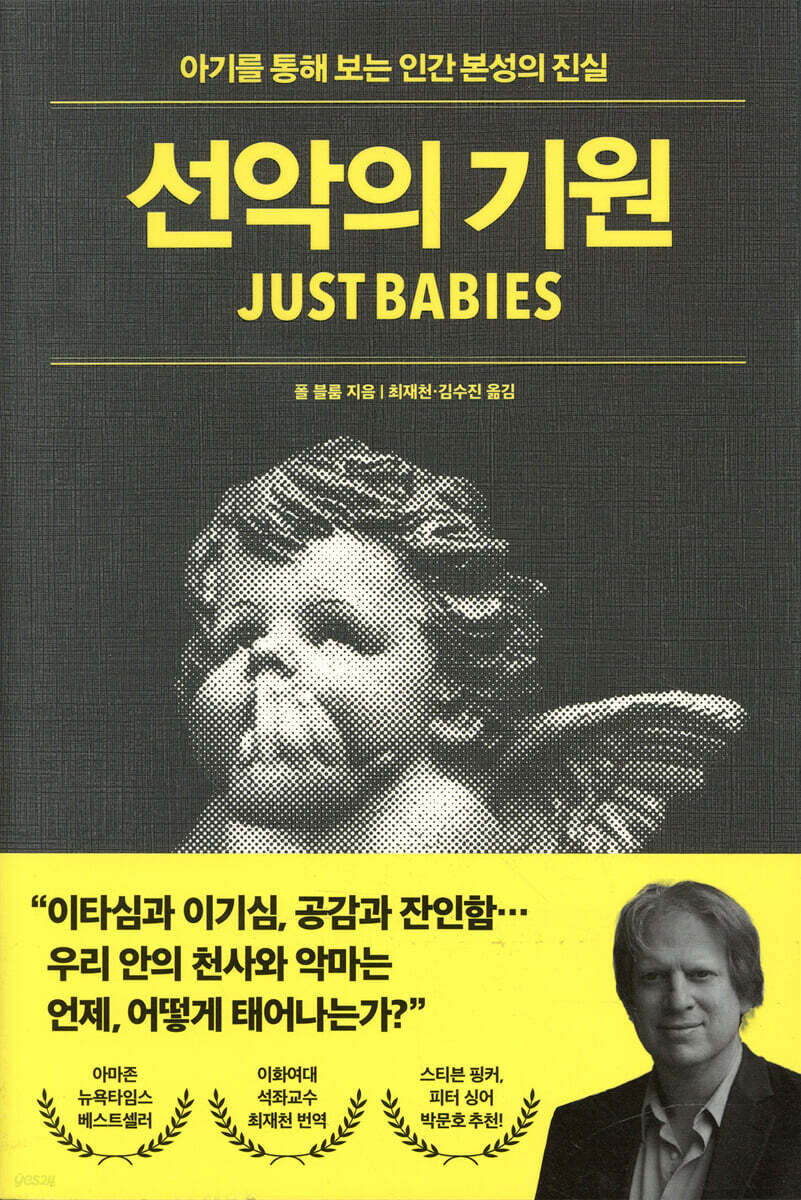
The Origin of Good and Evil
 |
Description
Book Introduction
"Is moral sense innate or made?" World-renowned psychologist Paul Bloom asks babies about good and evil! The evolutionary psychology of good and evil revealed through babies' behavior A groundbreaking book that changed the paradigm of human morality! “Never before has a book so meticulously woven the theory and practice of morality, empathy, and fairness.” (Choi Jae-cheon, Professor Emeritus, Ewha Womans University) Are humans good or evil? This question has been a constant throughout human history, like an unsolvable riddle. Professor Paul Bloom of Yale University embarks on a fascinating journey to solve this mystery. His destination is the baby's heart. "Are babies truly good?" Professor Bloom poses this provocative question, exploring the origins of human morality hidden within the behavior of babies. A baby is a pure being, untainted by the world. Their actions are instinctive and untainted by learning or bias. It was with this very point in mind that he began his research, thinking, "If we look into the minds of babies, might we be able to glimpse the innate morality of humans?" Professor Bloom analyzes infant behavior across a variety of academic fields, including philosophy, developmental psychology, social psychology, behavioral economics, cognitive neuroscience, and evolutionary biology. And it presents a new perspective that challenges our taken-for-granted notions about the origins of human morality. The Origin of Good and Evil is not simply a book that reveals whether or not babies have morality. Ultimately, this book asks us: "How can we transcend our nature and become better human beings?" Professor Bloom's brilliant insights and lucid explanations guide us into the deepest depths of human nature. And it gives us new eyes to understand ourselves and others. Through this book, we will be able to unravel the mysteries of human nature and discover hope for better people and a better world. |
- You can preview some of the book's contents.
Preview
index
Translator's Note: Asking a Baby About Good and Evil
Preface: In Search of Morality
1.
The moral life of a baby
What is morality?
What's happening in a baby's head
We are born with a moral sense
2.
Empathy and compassion
What psychopaths don't have
Empathy and Compassion: The Subtle Difference
Even babies cannot ignore the suffering of others.
The inner thoughts of a baby who is helping
Do babies also self-evaluate?
3.
Fairness, Status, Punishment
We are natural egalitarians
The Two Faces of Humanity Toward Equality
The Ultimatum Game and the Illusion of Egalitarianism
Are children really that greedy?
Punishment, revenge, and the dark side of morality
Children are not pacifists
4.
Other people
Our instincts toward strangers
The Roots of Racial Bias
The social bond created by linguistic homogeneity
How Social Division Begins
The trap of generalization
5.
body
Why and what do humans hate?
The Triangle of Body, Morality, and Disgust
Disgust sensitivity and sexual behavior
Don't take disgust as a moral signal.
6.
Family is important
The special nature of blood relations
The dilemma presented by the runaway tank
An evolutionary interpretation of the origins of morality
Kin, in-group, stranger
7.
How can I become a good person?
The Real Reason Why Humans Act Kindly
Altruism that has become part of custom
Literature and Media that Expand Moral Categories
Can Religion Be a Standard of Morality?
Between reason and emotion
Innate nature, learned fairness
Acknowledgements
References
Preface: In Search of Morality
1.
The moral life of a baby
What is morality?
What's happening in a baby's head
We are born with a moral sense
2.
Empathy and compassion
What psychopaths don't have
Empathy and Compassion: The Subtle Difference
Even babies cannot ignore the suffering of others.
The inner thoughts of a baby who is helping
Do babies also self-evaluate?
3.
Fairness, Status, Punishment
We are natural egalitarians
The Two Faces of Humanity Toward Equality
The Ultimatum Game and the Illusion of Egalitarianism
Are children really that greedy?
Punishment, revenge, and the dark side of morality
Children are not pacifists
4.
Other people
Our instincts toward strangers
The Roots of Racial Bias
The social bond created by linguistic homogeneity
How Social Division Begins
The trap of generalization
5.
body
Why and what do humans hate?
The Triangle of Body, Morality, and Disgust
Disgust sensitivity and sexual behavior
Don't take disgust as a moral signal.
6.
Family is important
The special nature of blood relations
The dilemma presented by the runaway tank
An evolutionary interpretation of the origins of morality
Kin, in-group, stranger
7.
How can I become a good person?
The Real Reason Why Humans Act Kindly
Altruism that has become part of custom
Literature and Media that Expand Moral Categories
Can Religion Be a Standard of Morality?
Between reason and emotion
Innate nature, learned fairness
Acknowledgements
References
Detailed image

Into the book
Moral nature can be explored using the same methods as we study other aspects of our mental lives, such as language, perception, and memory.
We can examine moral reasoning across societies, or explore how people differ within a single society—for example, comparing liberals and conservatives in the United States.
We may also investigate unusual cases, such as cold-blooded psychopaths.
Or, perhaps we wonder whether creatures like chimpanzees possess something we might call morality, and turn to evolutionary biology to explore how a moral sense might have evolved.
Social psychologists could study how environmental characteristics encourage kindness or cruelty, and neuroscientists could study brain regions involved in moral reasoning.
This book briefly covers all of these.
But as a developmental psychologist, I have other main interests.
It is a way to explore morality by looking into the origins of morality that infants and toddlers possess.
I would argue that modern developmental research has revealed some shocking facts about our moral lives.
--- From "Introduction_In Search of Morality"
A one-year-old baby decides to take justice into his own hands.
He had just watched a puppet show featuring three characters.
In the play, when the middle doll rolled a ball to the doll on the right, the doll returned the ball.
This time I rolled the ball to the doll on the left, but it ran away with the ball.
After the puppet show, the two puppets on the right and left were taken down from the stage and placed in front of the baby.
A piece of candy was placed in front of each doll, and the baby was allowed to take one of the candies.
As expected, like most of the infants in this experiment, this baby took the candy from the doll that ran away with the 'bad' doll ball.
But he wasn't satisfied with this alone.
So he leaned forward and hit the wicked doll on the head.
What I want to suggest through this book is this.
As a result of various experiments like the above, it has been proven that some aspects of our morality are innate and some aspects are not.
We have a moral sense that leads us to judge others, to feel pity and condemnation.
We are naturally kind to others.
At least for a certain moment.
But we also have ugly instincts.
This instinct can be transferred and turn into evil.
“We are born into this world with a nature full of evil tendencies,” said the 19th-century Reverend Thomas Martin, who spoke of the “innate wickedness” of children, and was not entirely wrong.
--- From "Chapter 1: The Moral Life of Babies: What is Morality?"
I think we are born with a moral sense.
So, I will continue to repeat this argument in this book.
But morality involves much more than just a certain ability to discern.
This includes emotions and motivations such as the desire to help others in need, compassion for those who suffer, anger toward those who are cruel, guilt for one's own shameful actions, and pride in one's good deeds.
[64p, Chapter 1: The Moral Life of Babies: We are Born with a Moral Sense]
Let's take a closer look at what separates psychopaths from the rest of us.
Psychopaths exhibit many symptoms, including pathological vanity and a lack of remorse or guilt.
But the core deficiency among them is indifference to the suffering of others.
They lack compassion.
To understand how compassion works in the minds of all of us, not just psychopaths, it's important to distinguish between compassion and empathy.
Although some researchers now use these two terms interchangeably, there is a significant difference between caring for someone (compassion) and putting yourself in their shoes (empathy).
--- From "Chapter 2 Empathy and Compassion: The Subtle Difference Between Empathy and Compassion"
Justice isn't just about finding the best way to distribute positive things.
You also have to decide how to share the negative.
That's where punishment and revenge, the dark side of morality, comes in.
If we were always kind to each other, the question of punishment would never arise.
But as anthropologist Robert Ardrey has pointed out, “We are not born of fallen angels, but of rising apes.” Some of us are tempted to cheat, kill, and give in to selfish impulses.
The rest of us must make these bad behaviors pay dearly in order to survive in the presence of these people.
Indeed, some scholars, including philosopher Jesse Printz, argue that outrage is more important for morality than the relatively sweet emotions of empathy and compassion, which we discussed in the previous chapter.
--- From "Chapter 3 Justice, Status, Punishment: Punishment, Revenge, and the Dark Side of Morality"
Babies can distinguish between familiar and unfamiliar people almost instantly.
Newborn babies prefer to look at their mother's face rather than a stranger's.
I also like my mother's smell and voice better.
The fact that babies prefer their mother's voice was discovered through an excellent experimental method.
(…) Babies not only like familiar people, but also like people of the same type as the familiar people.
This fact can be explored by using the attention time measurement method.
As mentioned earlier, just like adults, babies look longer at surprising things.
However, the tendency to look at something they like for a longer time is the same as that of adults.
So we can use this to explore babies' preferences.
The study found that babies looked longer at women if the caregiver was female, and longer at men if the caregiver was male.
White babies prefer to see white faces rather than African or Chinese faces.
--- From "Chapter 4: Others: The Roots of Racial Bias"
Babies don't know disgust.
Freud puts it this way in Civilization and its Discontents:
“Excrement does not cause disgust in children.
To them, it seems precious because it is a part of their own body.” When adults look away, babies and toddlers touch all kinds of disgusting things and even eat them.
The Rosin research team conducted this experiment while conducting one of the most fascinating studies in the field of developmental psychology.
Children under two years old were given something that was 'made to look like real dog poop, made with peanut butter and strong-smelling cheese', which they called dog poop.
Then most of the children ate it.
Most also ate small dried fish whole, and about a third also ate grasshoppers.
Then, at some point in their childhood, as if a switch were turned on, children begin to hate many things in the world, just like adults.
Psychologists are very curious about what causes these changes.
Many of them follow Freud's theory and point out that toilet training is traumatic.
--- From "Chapter 5 Body: Why and What Do Humans Hate?"
Many of the actions we consider good deeds are so ingrained in our culture that we do them without giving them much thought.
This is similar to learning to speak.
When a two-year-old learns that a dog is called "dog," they usually don't question why it's called that or why everything has a name.
These are good questions that your child may wonder about as he or she grows up.
However, because infants and toddlers have to learn so many words, they simply follow what others do and do not understand the logic behind it.
In fact, much of what we learn is learned unconsciously.
For example, I was raised that way at home, so I prefer to keep some physical distance from other people.
But the only time I'm conscious of this is when I'm around people who were raised differently than I was.
It's like how we only become aware of something we say in English as "things" when we hear speakers of other languages use a word other than "things."
We can examine moral reasoning across societies, or explore how people differ within a single society—for example, comparing liberals and conservatives in the United States.
We may also investigate unusual cases, such as cold-blooded psychopaths.
Or, perhaps we wonder whether creatures like chimpanzees possess something we might call morality, and turn to evolutionary biology to explore how a moral sense might have evolved.
Social psychologists could study how environmental characteristics encourage kindness or cruelty, and neuroscientists could study brain regions involved in moral reasoning.
This book briefly covers all of these.
But as a developmental psychologist, I have other main interests.
It is a way to explore morality by looking into the origins of morality that infants and toddlers possess.
I would argue that modern developmental research has revealed some shocking facts about our moral lives.
--- From "Introduction_In Search of Morality"
A one-year-old baby decides to take justice into his own hands.
He had just watched a puppet show featuring three characters.
In the play, when the middle doll rolled a ball to the doll on the right, the doll returned the ball.
This time I rolled the ball to the doll on the left, but it ran away with the ball.
After the puppet show, the two puppets on the right and left were taken down from the stage and placed in front of the baby.
A piece of candy was placed in front of each doll, and the baby was allowed to take one of the candies.
As expected, like most of the infants in this experiment, this baby took the candy from the doll that ran away with the 'bad' doll ball.
But he wasn't satisfied with this alone.
So he leaned forward and hit the wicked doll on the head.
What I want to suggest through this book is this.
As a result of various experiments like the above, it has been proven that some aspects of our morality are innate and some aspects are not.
We have a moral sense that leads us to judge others, to feel pity and condemnation.
We are naturally kind to others.
At least for a certain moment.
But we also have ugly instincts.
This instinct can be transferred and turn into evil.
“We are born into this world with a nature full of evil tendencies,” said the 19th-century Reverend Thomas Martin, who spoke of the “innate wickedness” of children, and was not entirely wrong.
--- From "Chapter 1: The Moral Life of Babies: What is Morality?"
I think we are born with a moral sense.
So, I will continue to repeat this argument in this book.
But morality involves much more than just a certain ability to discern.
This includes emotions and motivations such as the desire to help others in need, compassion for those who suffer, anger toward those who are cruel, guilt for one's own shameful actions, and pride in one's good deeds.
[64p, Chapter 1: The Moral Life of Babies: We are Born with a Moral Sense]
Let's take a closer look at what separates psychopaths from the rest of us.
Psychopaths exhibit many symptoms, including pathological vanity and a lack of remorse or guilt.
But the core deficiency among them is indifference to the suffering of others.
They lack compassion.
To understand how compassion works in the minds of all of us, not just psychopaths, it's important to distinguish between compassion and empathy.
Although some researchers now use these two terms interchangeably, there is a significant difference between caring for someone (compassion) and putting yourself in their shoes (empathy).
--- From "Chapter 2 Empathy and Compassion: The Subtle Difference Between Empathy and Compassion"
Justice isn't just about finding the best way to distribute positive things.
You also have to decide how to share the negative.
That's where punishment and revenge, the dark side of morality, comes in.
If we were always kind to each other, the question of punishment would never arise.
But as anthropologist Robert Ardrey has pointed out, “We are not born of fallen angels, but of rising apes.” Some of us are tempted to cheat, kill, and give in to selfish impulses.
The rest of us must make these bad behaviors pay dearly in order to survive in the presence of these people.
Indeed, some scholars, including philosopher Jesse Printz, argue that outrage is more important for morality than the relatively sweet emotions of empathy and compassion, which we discussed in the previous chapter.
--- From "Chapter 3 Justice, Status, Punishment: Punishment, Revenge, and the Dark Side of Morality"
Babies can distinguish between familiar and unfamiliar people almost instantly.
Newborn babies prefer to look at their mother's face rather than a stranger's.
I also like my mother's smell and voice better.
The fact that babies prefer their mother's voice was discovered through an excellent experimental method.
(…) Babies not only like familiar people, but also like people of the same type as the familiar people.
This fact can be explored by using the attention time measurement method.
As mentioned earlier, just like adults, babies look longer at surprising things.
However, the tendency to look at something they like for a longer time is the same as that of adults.
So we can use this to explore babies' preferences.
The study found that babies looked longer at women if the caregiver was female, and longer at men if the caregiver was male.
White babies prefer to see white faces rather than African or Chinese faces.
--- From "Chapter 4: Others: The Roots of Racial Bias"
Babies don't know disgust.
Freud puts it this way in Civilization and its Discontents:
“Excrement does not cause disgust in children.
To them, it seems precious because it is a part of their own body.” When adults look away, babies and toddlers touch all kinds of disgusting things and even eat them.
The Rosin research team conducted this experiment while conducting one of the most fascinating studies in the field of developmental psychology.
Children under two years old were given something that was 'made to look like real dog poop, made with peanut butter and strong-smelling cheese', which they called dog poop.
Then most of the children ate it.
Most also ate small dried fish whole, and about a third also ate grasshoppers.
Then, at some point in their childhood, as if a switch were turned on, children begin to hate many things in the world, just like adults.
Psychologists are very curious about what causes these changes.
Many of them follow Freud's theory and point out that toilet training is traumatic.
--- From "Chapter 5 Body: Why and What Do Humans Hate?"
Many of the actions we consider good deeds are so ingrained in our culture that we do them without giving them much thought.
This is similar to learning to speak.
When a two-year-old learns that a dog is called "dog," they usually don't question why it's called that or why everything has a name.
These are good questions that your child may wonder about as he or she grows up.
However, because infants and toddlers have to learn so many words, they simply follow what others do and do not understand the logic behind it.
In fact, much of what we learn is learned unconsciously.
For example, I was raised that way at home, so I prefer to keep some physical distance from other people.
But the only time I'm conscious of this is when I'm around people who were raised differently than I was.
It's like how we only become aware of something we say in English as "things" when we hear speakers of other languages use a word other than "things."
--- From "Chapter 7: How to Become a Good Person: Altruism as a Part of Custom"
Publisher's Review
★ Yale University's most popular psychology lecture
★ Became an Amazon bestseller immediately after publication!
★ That book chosen by the editor of the New York Times
★ Highly recommended by world-renowned scholars Steven Pinker, Peter Singer, Jonathan Haidt, and Dan Ariely!
★ Adding value with the excellent translation by Professor Jae-Cheon Choi of Ewha Womans University!
“Altruism and selfishness, empathy and cruelty…
“When and how are the angels and devils within us born?”
Psychologist Paul Bloom's shocking research shook up Nature and Science.
Scientifically exploring human nature through psychological experiments!
Several times a day, we are captivated by stories of "heroes" who perform righteous deeds, and we frown at news of brutal, atrocious acts that are too painful to bear.
When we repeatedly encounter such extreme news, fundamental questions about human morality naturally arise.
Are we inherently good or evil? Why are we capable of boundless altruism and sometimes cruelty? World-renowned psychologist Paul Bloom sets out to answer these age-old questions.
Bloom dissects the spectrum of human morality, from extreme cases like organ donation, acid attacks, and the Holocaust, to everyday acts of kindness and cruelty.
Drawing on the insights of leading thinkers like Hobbes, Adam Smith, and Jefferson, Bloom explores the roots and evolution of morality.
Quoting Thomas Jefferson, who said, "The moral sense is in every man's possession, like his limbs," Bloom explains that some aspects of morality are innate.
To prove this hypothesis, he observes the behavior of babies.
By tracking the minds of babies and how those minds change, we can understand the complex moral psychology of adults.
This book unfolds the complex landscape of human morality.
Bloom's fascinating and groundbreaking research provides insights needed to understand and develop moral psychology, offering a new perspective on our moral nature.
Are babies 'perfectly' pure beings?
The discovery of the innate morality with which humans are born!
Just like arms and legs, humans are born with a 'moral sense'!
Do newborns have the ability to distinguish between good and evil? Paul Bloom poses this question through fascinating experimental results.
He cites as an example a puppet show experiment with a one-year-old child.
Children appeared to make moral judgments, such as distinguishing between a "good" doll that returned a ball and a "bad" doll that stole a ball, and taking treats from the "bad" doll.
Another study found that three-month-old infants also prefer 'helpers', suggesting that babies are 'attracted to good people and repelled by bad people', and interpreting this as evidence of a moral sense.
But the baby's morality is not perfect.
They may be hostile to strangers or exclusive to those outside their own group.
This makes us uncomfortable because it seems to show the roots of human narrow-mindedness and cruelty.
So where does our morality come from? Bloom argues that the seeds of morality are already planted within us.
Just like our arms and legs, we are born with empathy, compassion, and a sense of justice.
However, he argues that for this seed to grow into a strong tree, 'rational evolution' is necessary, and that through education and socialization, we can grow beyond our innate moral sense into more mature moral beings.
Babies are neither simply 'good' nor 'bad' beings.
They are beings with infinite potential.
We all have a responsibility to steer this possibility in the right direction.
Protecting the pure morality of babies and creating a better world through reason and deliberation - that is what we, as 'humans', must do.
Understanding human nature means
It means 'growing' beyond our limitations into better human beings.
This book delves deeply into the various moral dilemmas that humans face.
From social justice to personal biases, real-world psychological experiments and case studies demonstrate how our moral decisions are shaped and sometimes misguided.
Beginning with the pure morality of a baby, it candidly exposes the dark side of human nature and broadly deals with the influence of society, culture, and religion on morality.
In particular, it overturns conventional wisdom about the moral development of children and adults, arguing that our moral decisions are not simply driven by intuition or prejudice, but can develop to a higher level through reason and deliberation.
Just as we have come to realize the injustice of slavery, we can achieve moral progress through rational thought.
Ultimately, we can grow beyond our innate, primitive moral sense and become better beings through imagination, compassion, and rational thinking.
This book doesn't simply impart knowledge; it instills the belief that if we all work together, we can create a more moral and hopeful future.
Whether you're a parent raising a child or someone with fundamental questions about the human mind, this book will enlighten and inspire you.
★ Became an Amazon bestseller immediately after publication!
★ That book chosen by the editor of the New York Times
★ Highly recommended by world-renowned scholars Steven Pinker, Peter Singer, Jonathan Haidt, and Dan Ariely!
★ Adding value with the excellent translation by Professor Jae-Cheon Choi of Ewha Womans University!
“Altruism and selfishness, empathy and cruelty…
“When and how are the angels and devils within us born?”
Psychologist Paul Bloom's shocking research shook up Nature and Science.
Scientifically exploring human nature through psychological experiments!
Several times a day, we are captivated by stories of "heroes" who perform righteous deeds, and we frown at news of brutal, atrocious acts that are too painful to bear.
When we repeatedly encounter such extreme news, fundamental questions about human morality naturally arise.
Are we inherently good or evil? Why are we capable of boundless altruism and sometimes cruelty? World-renowned psychologist Paul Bloom sets out to answer these age-old questions.
Bloom dissects the spectrum of human morality, from extreme cases like organ donation, acid attacks, and the Holocaust, to everyday acts of kindness and cruelty.
Drawing on the insights of leading thinkers like Hobbes, Adam Smith, and Jefferson, Bloom explores the roots and evolution of morality.
Quoting Thomas Jefferson, who said, "The moral sense is in every man's possession, like his limbs," Bloom explains that some aspects of morality are innate.
To prove this hypothesis, he observes the behavior of babies.
By tracking the minds of babies and how those minds change, we can understand the complex moral psychology of adults.
This book unfolds the complex landscape of human morality.
Bloom's fascinating and groundbreaking research provides insights needed to understand and develop moral psychology, offering a new perspective on our moral nature.
Are babies 'perfectly' pure beings?
The discovery of the innate morality with which humans are born!
Just like arms and legs, humans are born with a 'moral sense'!
Do newborns have the ability to distinguish between good and evil? Paul Bloom poses this question through fascinating experimental results.
He cites as an example a puppet show experiment with a one-year-old child.
Children appeared to make moral judgments, such as distinguishing between a "good" doll that returned a ball and a "bad" doll that stole a ball, and taking treats from the "bad" doll.
Another study found that three-month-old infants also prefer 'helpers', suggesting that babies are 'attracted to good people and repelled by bad people', and interpreting this as evidence of a moral sense.
But the baby's morality is not perfect.
They may be hostile to strangers or exclusive to those outside their own group.
This makes us uncomfortable because it seems to show the roots of human narrow-mindedness and cruelty.
So where does our morality come from? Bloom argues that the seeds of morality are already planted within us.
Just like our arms and legs, we are born with empathy, compassion, and a sense of justice.
However, he argues that for this seed to grow into a strong tree, 'rational evolution' is necessary, and that through education and socialization, we can grow beyond our innate moral sense into more mature moral beings.
Babies are neither simply 'good' nor 'bad' beings.
They are beings with infinite potential.
We all have a responsibility to steer this possibility in the right direction.
Protecting the pure morality of babies and creating a better world through reason and deliberation - that is what we, as 'humans', must do.
Understanding human nature means
It means 'growing' beyond our limitations into better human beings.
This book delves deeply into the various moral dilemmas that humans face.
From social justice to personal biases, real-world psychological experiments and case studies demonstrate how our moral decisions are shaped and sometimes misguided.
Beginning with the pure morality of a baby, it candidly exposes the dark side of human nature and broadly deals with the influence of society, culture, and religion on morality.
In particular, it overturns conventional wisdom about the moral development of children and adults, arguing that our moral decisions are not simply driven by intuition or prejudice, but can develop to a higher level through reason and deliberation.
Just as we have come to realize the injustice of slavery, we can achieve moral progress through rational thought.
Ultimately, we can grow beyond our innate, primitive moral sense and become better beings through imagination, compassion, and rational thinking.
This book doesn't simply impart knowledge; it instills the belief that if we all work together, we can create a more moral and hopeful future.
Whether you're a parent raising a child or someone with fundamental questions about the human mind, this book will enlighten and inspire you.
GOODS SPECIFICS
- Date of issue: September 30, 2024
- Page count, weight, size: 344 pages | 454g | 140*210*20mm
- ISBN13: 9791171177776
- ISBN10: 1171177771
You may also like
카테고리
korean


korean

![GQ KOREA Mark (Monthly): December [2025]](http://librairie.coreenne.fr/cdn/shop/files/8ef265dbbfbf186523ed75ba7319009d.jpg?v=1765340328&width=3840)


