

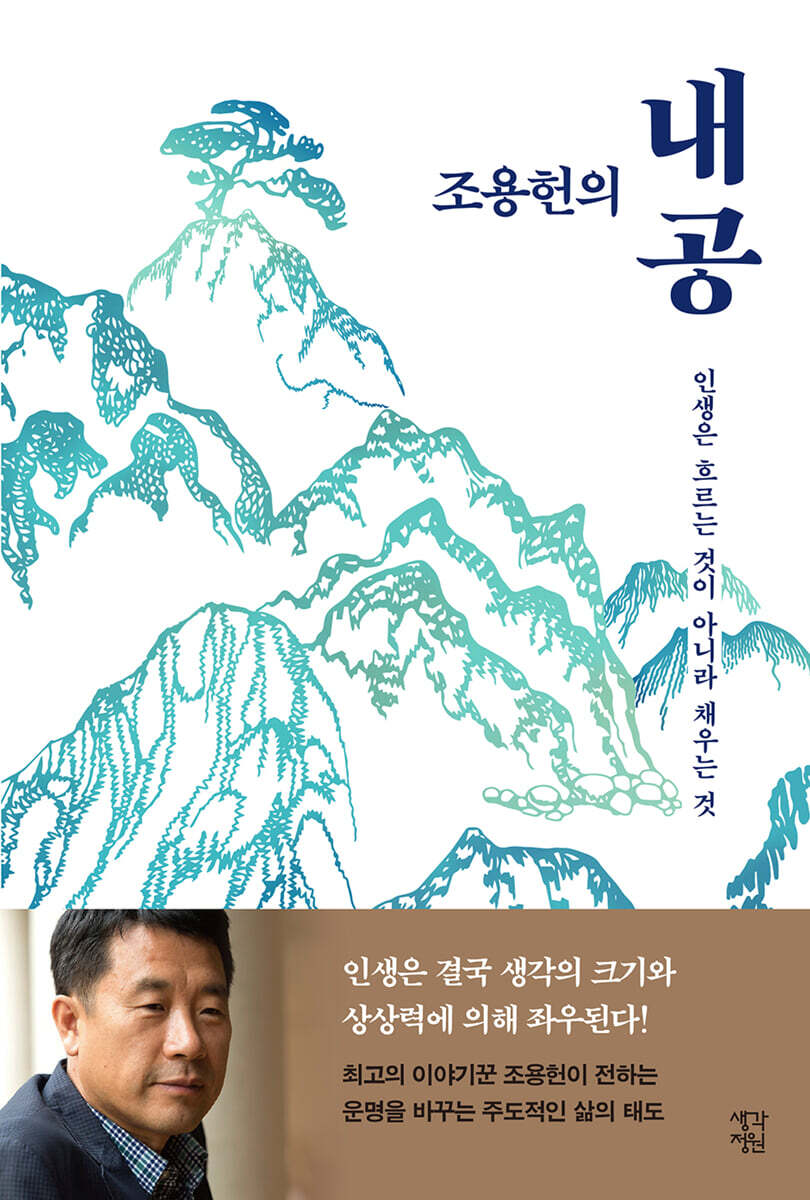
Jo Yong-heon's internal energy
 |
Description
Book Introduction
Where intelligence and reason do not work together
What to do in the face of this bleak reality
The greatest storyteller of our time, Jo Yong-heon, tells
A proactive attitude toward life that changes your destiny
The name of the genre is 'Jo Yong-heon'.
He has interpreted the times, the world, and people through the eyes of Eastern studies such as Confucianism, Buddhism, Taoism, fortune telling, and feng shui, and has pioneered a realm called Gangho Oriental Studies that no one can approach.
'What is existence (humanity) in astronomy (time) and space (geography)?' While reflecting on the functional relationship between these three, what he sought was the answer to the question 'How should we live?'
Rather than pursuing academic achievements, he sought to resolve his inner questions in a realistic manner, so he traveled to famous mountains and rivers, interacted with renowned monks, Taoists, and masters, and collected Eastern and Western humanities classics, history, folk tales, and even small family traditions passed down through his family.
His insight to select and weave meaningful information from a vast amount of information transcending time and space is exceptional.
On that journey, I picked up another book.
Amidst the mainstream Western worldly wisdom and habits, psychology emphasizing positivity, and self-help books, the Eastern perspective on worldly wisdom and wisdom contained in this book stands out.
'Naegong' is an oriental concept that refers to the strength and energy that is built up within oneself through long-term training.
These include patience, concentration, and self-esteem.
All situations and events that cause us hardship are caused by the intertwining of time, space, and relationships.
In other words, if you get through this time without wavering, you will build up your inner strength, and with that strength, you will be able to rebuild your frustrated life.
As we live, there comes a time when we are stuck in a frustrating reality where intellect and reason do not work.
A moment of turmoil sends life into the abyss.
How to control desires, impulses, and the unconscious.
How to maintain composure.
No, isn't there a way to prevent misfortune in the first place?
189 condensed stories provide the warp and weft of the answer.
What to do in the face of this bleak reality
The greatest storyteller of our time, Jo Yong-heon, tells
A proactive attitude toward life that changes your destiny
The name of the genre is 'Jo Yong-heon'.
He has interpreted the times, the world, and people through the eyes of Eastern studies such as Confucianism, Buddhism, Taoism, fortune telling, and feng shui, and has pioneered a realm called Gangho Oriental Studies that no one can approach.
'What is existence (humanity) in astronomy (time) and space (geography)?' While reflecting on the functional relationship between these three, what he sought was the answer to the question 'How should we live?'
Rather than pursuing academic achievements, he sought to resolve his inner questions in a realistic manner, so he traveled to famous mountains and rivers, interacted with renowned monks, Taoists, and masters, and collected Eastern and Western humanities classics, history, folk tales, and even small family traditions passed down through his family.
His insight to select and weave meaningful information from a vast amount of information transcending time and space is exceptional.
On that journey, I picked up another book.
Amidst the mainstream Western worldly wisdom and habits, psychology emphasizing positivity, and self-help books, the Eastern perspective on worldly wisdom and wisdom contained in this book stands out.
'Naegong' is an oriental concept that refers to the strength and energy that is built up within oneself through long-term training.
These include patience, concentration, and self-esteem.
All situations and events that cause us hardship are caused by the intertwining of time, space, and relationships.
In other words, if you get through this time without wavering, you will build up your inner strength, and with that strength, you will be able to rebuild your frustrated life.
As we live, there comes a time when we are stuck in a frustrating reality where intellect and reason do not work.
A moment of turmoil sends life into the abyss.
How to control desires, impulses, and the unconscious.
How to maintain composure.
No, isn't there a way to prevent misfortune in the first place?
189 condensed stories provide the warp and weft of the answer.
- You can preview some of the book's contents.
Preview
index
Chapter 1: Perspective is the Key: One Thought Changes Destiny
A cow floating in a flood | Find your oriole | Master TK | Gyeongjaejam, the cultivation of the mind | The realm of the 8-minute ridge | Heogyo, allowing companionship | Studying with caution and caution when alone | Tao and money are not two different things | Life's bill | An uncomfortable bed saves | Respect and kneeling | About starving to death | Beware of sweet talk | The aesthetics of a 'madman' | When things get tough, it all comes down to it | Which planet am I from? | Water and fire | Binggongyeongsa | 'Money' is empty, and empty is 'money' | Chairman Jeong's light armor | Donating a car | Before all the flowers fall | Playing in the arts | About dying alone | The difference between drugs and samadhi | The taste of money | Cold noodles and the throat | You must change your personality to change your fate | Let's start with the conclusion | Did Prigogine not have a strategist? | Separate observation, self-objectification | Success in your 30s
Chapter 2: Leaning on People: Another Life Brings Blessings to Me
Otani's Mandala | Rebuilt through Fate | Healing of the Grandmothers of Jirisan | A Private First Class Teacher and a Company Commander's Student | Bang Si-hyuk's Roots | Jeong Cheo-sa, Who Enjoyed the Blessing of Death | There's No Time | The Left and the Chaebol | Jindo's "Najeolro" Teacher | A Man Living on the Blessing of His Wife | The 21st Century: People Who Greet | See with Your Eyes and Tread with Your Feet | A Flop, All I Did Today Was Studying | Heo Mok, Who Prescribed an Emergency for Song Si-yeol | Remembering Teacher Lee Eul-ho | Singer Kim Wan-sun and Dance DNA | The Virtue of the Mayor of Gahoe-myeon, Hapcheon-gun | The Rich Who Invest in Education | Bang Woo-san and Shin Jae-hyo of Gochang | A True "Lie" Only When Life is Imbued | Luxury Goods Don't Undercut | Steve Jobs and Yogananda's Autobiography | Plutarch's Heroes | Turtle Hair and Rabbit Horns | Overcoming Duality, Taegeukhwa Style | The Life of Grandmother Kim Byeong-gi
Chapter 3: Go to the Light: Space Changes the Mind
Forgive but never forget | Where two waters meet, Sujongsa Temple in Namyangju | Chicken feet standing | Energy gathers in a bend | Choi Chi-won's Dunsejiji | Jang Sa-chuwa of Paloheon | Tojeong Lee Ji-ham's study place | Where is my deputy's room? | Auspicious sites on the Korean Peninsula | Chickens and tigers | Why were dolmens built? | Gijang, a land of the uninhabited | Preparing for death feels good | Stepping back is also a form of inner strength | Four-gun landscape | The Gate of Clouds, Unmunam Hermitage in Baekyangsa Temple | The Go family satisfied with a B-grade auspicious site | Wolchulsan Mountain and Jang Bogo | Jeongansanseong Fortress in Hadong | Where the 'God who exists without' resides | The waters of Woljeongsa Temple | Dialogue with the Daegaya tombs | Yun Seon-do and Geumswaedong | Fengshui of the wealthy Sim family in Cheongsong | Site of Baekryeonsa Temple in Hwangmaesan Mountain | The day the mountain goat came to Inwangsan Mountain
Chapter 4: Listening to the Accumulated Time: Old Things Have the Power to Endure
Park Gi-hu's family tradition | Every noble family has a story | The chestnut tree at Sambaekdang | The Lord's Prayer at Chiam Mansion | Yi Mun-yeol's burnt house | Onjubeop, welcoming guests | Nongam's fisherman | The only treasure is integrity | Nothing moves without propriety | A place as comfortable as a cow's stomach | Lee Jung-hwan's final settlement | Teacher Myeongje and the paddy field | The Mokapseosa of Hwagae Valley | Respect for scholarship and writers | Am I the only one in the world who is righteous? | The Cheongeum Seowon destruction incident | The first mountain pass over the Baekdudaegan Mountains | Islands, isolation, poverty, and determination | The great men and orders of Hamyang Anui-myeon | Iron Road, the sixty-year-old | The power of Daegu | Anmyeondo Island, open your eyes and necks | Geumganggul Cave and the partisan beat | Samsein | Dokdo is not lonely | Korea's national religion | Toegye's birthplace | Indangsu and stone statues
Chapter 5 Understanding Heaven's Will: God Opens Another Path
We just can't see it
The philosophy of darkness, humility | Epidemics and the White Bone Hall | If you know how to manipulate food and color | The new year begins four times | Youth, middle-aged, and senior years | Study strengthens a weak body | The inner strength of Mujaepalja | A resume is written on one's hand | The voice is mental | What kind of horoscope does a conglomerate chairman have? | Mitterrand's astrologer | 55 years of newspaper writing | Freddie Mercury and Eternal Return | Placing the Big Dipper on the wrist | The Southeast Wind and the I Ching | AI and the Divine | The Taekpungdaegwa hexagram | An era in need of true 'cleansing' | The truth and lies of shamanism | Chungcheong Province, the land of tolerance | Can AI read horoscopes? | Signs of changing fortune | Baekdu Norang and Baekdu Nobu | Cesarean sections are fully booked | Byeonggeop and the Korean medical elite | Black Cleopatra | Being born with a silver spoon in one's mouth | The soul deliveryman | A centipede spell that moves the heart | The symbol of the tiger
Chapter 6: Softening the Heart with Stories: Through Imagination, We Live Further, Higher, and Deeper
From the bow and stern of a ship | The contents of a fallen life | Travelogue and wanderings | On the essence of armor | Pollack and headbutting | Divinity, dominance, and reason | The profession of storytelling | Saigo Takamori and Katsu Kaishu | A fragrance to be reused a thousand years later | Black magic and composure | Clothes are the soul, status, and money | A history dominated by bread | Merchant's scales | A titan who went to the Underworld | The joy of reading calligraphy | The three flavors of Mokpo | Ajabang, the king of the ondol room | Chicken, pheasant, eagle, and owl | 21st-century text emoticons | Gold floating in the sea | Self-pleasure and self-indulgence | Desert religion and the burqa | Sungkyunkwan's butcher shop | Chinese spears, Japanese swords, Korean bows | Exam selection and war heroes | Jinsin sarira and the 'Lee Collection' | Dragon's egg, the moon jar
Chapter 7: Letting Go of the Mountains and Rivers: Nature Shows Us the Shortest Path to a Good Life
The sacred pine tree has dead branches | A bowl of rice and a ladle of water | The history of blood hidden in the scenery | Upo Marsh, which holds 140 million years of water | Water is 1 | Gyeongryujeong's fragrant juniper tree | Let's go for success this weekend | The sound of spring rapids | How many times can I see this scenery? | Hymn to a wood fire | The number of leaves on a wild ginseng | Studying art history and entering the mountain | The six virtues of tea | Cheonwangbong health checkup | Looking at the white flowers of the poplar tree | Putting the blanket covered by the immortals at my feet | Is there a flower in my heart? | The first flower of spring, the red plum blossoms in the first month | Success and hidden heads, the principle of yin and yang | Like a willow tree in May
A cow floating in a flood | Find your oriole | Master TK | Gyeongjaejam, the cultivation of the mind | The realm of the 8-minute ridge | Heogyo, allowing companionship | Studying with caution and caution when alone | Tao and money are not two different things | Life's bill | An uncomfortable bed saves | Respect and kneeling | About starving to death | Beware of sweet talk | The aesthetics of a 'madman' | When things get tough, it all comes down to it | Which planet am I from? | Water and fire | Binggongyeongsa | 'Money' is empty, and empty is 'money' | Chairman Jeong's light armor | Donating a car | Before all the flowers fall | Playing in the arts | About dying alone | The difference between drugs and samadhi | The taste of money | Cold noodles and the throat | You must change your personality to change your fate | Let's start with the conclusion | Did Prigogine not have a strategist? | Separate observation, self-objectification | Success in your 30s
Chapter 2: Leaning on People: Another Life Brings Blessings to Me
Otani's Mandala | Rebuilt through Fate | Healing of the Grandmothers of Jirisan | A Private First Class Teacher and a Company Commander's Student | Bang Si-hyuk's Roots | Jeong Cheo-sa, Who Enjoyed the Blessing of Death | There's No Time | The Left and the Chaebol | Jindo's "Najeolro" Teacher | A Man Living on the Blessing of His Wife | The 21st Century: People Who Greet | See with Your Eyes and Tread with Your Feet | A Flop, All I Did Today Was Studying | Heo Mok, Who Prescribed an Emergency for Song Si-yeol | Remembering Teacher Lee Eul-ho | Singer Kim Wan-sun and Dance DNA | The Virtue of the Mayor of Gahoe-myeon, Hapcheon-gun | The Rich Who Invest in Education | Bang Woo-san and Shin Jae-hyo of Gochang | A True "Lie" Only When Life is Imbued | Luxury Goods Don't Undercut | Steve Jobs and Yogananda's Autobiography | Plutarch's Heroes | Turtle Hair and Rabbit Horns | Overcoming Duality, Taegeukhwa Style | The Life of Grandmother Kim Byeong-gi
Chapter 3: Go to the Light: Space Changes the Mind
Forgive but never forget | Where two waters meet, Sujongsa Temple in Namyangju | Chicken feet standing | Energy gathers in a bend | Choi Chi-won's Dunsejiji | Jang Sa-chuwa of Paloheon | Tojeong Lee Ji-ham's study place | Where is my deputy's room? | Auspicious sites on the Korean Peninsula | Chickens and tigers | Why were dolmens built? | Gijang, a land of the uninhabited | Preparing for death feels good | Stepping back is also a form of inner strength | Four-gun landscape | The Gate of Clouds, Unmunam Hermitage in Baekyangsa Temple | The Go family satisfied with a B-grade auspicious site | Wolchulsan Mountain and Jang Bogo | Jeongansanseong Fortress in Hadong | Where the 'God who exists without' resides | The waters of Woljeongsa Temple | Dialogue with the Daegaya tombs | Yun Seon-do and Geumswaedong | Fengshui of the wealthy Sim family in Cheongsong | Site of Baekryeonsa Temple in Hwangmaesan Mountain | The day the mountain goat came to Inwangsan Mountain
Chapter 4: Listening to the Accumulated Time: Old Things Have the Power to Endure
Park Gi-hu's family tradition | Every noble family has a story | The chestnut tree at Sambaekdang | The Lord's Prayer at Chiam Mansion | Yi Mun-yeol's burnt house | Onjubeop, welcoming guests | Nongam's fisherman | The only treasure is integrity | Nothing moves without propriety | A place as comfortable as a cow's stomach | Lee Jung-hwan's final settlement | Teacher Myeongje and the paddy field | The Mokapseosa of Hwagae Valley | Respect for scholarship and writers | Am I the only one in the world who is righteous? | The Cheongeum Seowon destruction incident | The first mountain pass over the Baekdudaegan Mountains | Islands, isolation, poverty, and determination | The great men and orders of Hamyang Anui-myeon | Iron Road, the sixty-year-old | The power of Daegu | Anmyeondo Island, open your eyes and necks | Geumganggul Cave and the partisan beat | Samsein | Dokdo is not lonely | Korea's national religion | Toegye's birthplace | Indangsu and stone statues
Chapter 5 Understanding Heaven's Will: God Opens Another Path
We just can't see it
The philosophy of darkness, humility | Epidemics and the White Bone Hall | If you know how to manipulate food and color | The new year begins four times | Youth, middle-aged, and senior years | Study strengthens a weak body | The inner strength of Mujaepalja | A resume is written on one's hand | The voice is mental | What kind of horoscope does a conglomerate chairman have? | Mitterrand's astrologer | 55 years of newspaper writing | Freddie Mercury and Eternal Return | Placing the Big Dipper on the wrist | The Southeast Wind and the I Ching | AI and the Divine | The Taekpungdaegwa hexagram | An era in need of true 'cleansing' | The truth and lies of shamanism | Chungcheong Province, the land of tolerance | Can AI read horoscopes? | Signs of changing fortune | Baekdu Norang and Baekdu Nobu | Cesarean sections are fully booked | Byeonggeop and the Korean medical elite | Black Cleopatra | Being born with a silver spoon in one's mouth | The soul deliveryman | A centipede spell that moves the heart | The symbol of the tiger
Chapter 6: Softening the Heart with Stories: Through Imagination, We Live Further, Higher, and Deeper
From the bow and stern of a ship | The contents of a fallen life | Travelogue and wanderings | On the essence of armor | Pollack and headbutting | Divinity, dominance, and reason | The profession of storytelling | Saigo Takamori and Katsu Kaishu | A fragrance to be reused a thousand years later | Black magic and composure | Clothes are the soul, status, and money | A history dominated by bread | Merchant's scales | A titan who went to the Underworld | The joy of reading calligraphy | The three flavors of Mokpo | Ajabang, the king of the ondol room | Chicken, pheasant, eagle, and owl | 21st-century text emoticons | Gold floating in the sea | Self-pleasure and self-indulgence | Desert religion and the burqa | Sungkyunkwan's butcher shop | Chinese spears, Japanese swords, Korean bows | Exam selection and war heroes | Jinsin sarira and the 'Lee Collection' | Dragon's egg, the moon jar
Chapter 7: Letting Go of the Mountains and Rivers: Nature Shows Us the Shortest Path to a Good Life
The sacred pine tree has dead branches | A bowl of rice and a ladle of water | The history of blood hidden in the scenery | Upo Marsh, which holds 140 million years of water | Water is 1 | Gyeongryujeong's fragrant juniper tree | Let's go for success this weekend | The sound of spring rapids | How many times can I see this scenery? | Hymn to a wood fire | The number of leaves on a wild ginseng | Studying art history and entering the mountain | The six virtues of tea | Cheonwangbong health checkup | Looking at the white flowers of the poplar tree | Putting the blanket covered by the immortals at my feet | Is there a flower in my heart? | The first flower of spring, the red plum blossoms in the first month | Success and hidden heads, the principle of yin and yang | Like a willow tree in May
Detailed image
.jpg)
Into the book
The phrase that forms a contrast with the Dokman Book is Haengmanri.
It's like traveling ten thousand miles.
If I have the money and time, I will try traveling abroad a lot.
That's how sparks fly.
You need to have something in your head to spark your spirit when you travel.
If there is nothing inside, you may end up just enjoying the scenery.
As you travel, you are bound to encounter unfamiliar sights and situations.
I wonder, 'Why is this happening?'
The process of resolving that question is the path to building inner strength.
One of the virtues of travel is that it provides an opportunity to meet people.
You meet a person who is different from you.
Differences and differences can be tiring, but acknowledging those differences broadens your perspective, and as your perspective broadens, you become less stressed.
It's easier said than done, but accepting differences is not so easy.
Sometimes it is achieved by colliding violently and breaking.
--- p.5
One of them is the Bul-i-mun Gate.
It literally means 'not two'.
That doesn't mean they're completely one.
It is interpreted to mean, 'They appear to be two separate entities, but upon closer inspection, they are not two separate entities.'
It is connected below.
It is read as birth and death are not two, beauty and ugliness are not two, good and evil are not two.
If life and death are not two separate entities, then why do we have such fear and dread of death?
--- p.30
“What do you think popularity is?”
“When the cloud of popularity comes, there is always a bill attached underneath it.
“Every time I become popular, I get nervous and think, ‘What kind of hardships will happen this time?’”
The bill is indeed complex.
It comes with slander, lawsuits, divorce, violence, fighting, fraud, prison, and death.
Money, popularity, and power are things that all humans desire and envy, so those who possess them are bound to be met with all-out jealousy, envy, and attacks.
Do you think people in their 20s and 30s have the internal strength to handle this attack?
The core of this internal energy is the 'independence and fearlessness' mentioned in the Book of Changes.
--- p.33
Later, recalling his time in Mokpo Prison, the teacher wrote, “The worst conditions can sometimes bring the greatest joy.”
He also said that he met a 'naked person' in prison.
The hardships and adverse conditions of reality are like clothes; they can be taken off. The teacher's teaching is, "Do not be obsessed with external appearances, but live with your true self."
--- p.115
A step above history is gourd! If history is like dried fish with the moisture removed, gourd can be likened to the fresh, blue-backed Jeju Island yellowtail.
Dried fish is hard to chew, but raw fish is easy to chew and melts in your mouth.
The characteristic of the story is that it is open.
I can participate in that story, or conversely, that story can enter my life and be transformed into energy, or my experiences can be added to that story and branch out into another story.
Of course, history can be like that, but in that format, the gura is much more absorbent.
To transition to the stage of Gura, one must have one's own life experiences and body odor.
If you lack the flavor of life, your communication will be weak.
Just reading a lot of books doesn't make you a charlatan.
The desk becomes a mess.
There has to be life buried in it for it to shine.
--- p.123
Mandela was imprisoned as a political prisoner for 27 years, 18 of which were spent in Robben Island prison.
It is said that when looking from the prison, Table Mountain can be seen right in front of you.
As soon as you open your eyes, you can see Table Mountain.
“If you look ahead a few days or weeks, things are pessimistic, but if you look ahead a few decades, things are hopeful,” said Mandela.
Mandela believes that he received the fair and impartial spirit of Geomuntosung from the harsh environment of the prison.
After 342 years of white rule, blacks took power for the first time, but they did not retaliate against the white perpetrators.
We pursued a politics of coexistence.
'Forgive without forgetting' is that.
--- p.141
Hide your head and seek respite, which Deng Xiaoping established as China's diplomatic policy in the 1980s.
'The light must be hidden and the darkness must be increased', 晦 refers to the last day of the month.
The moonlight has almost disappeared.
Generally, we should defeat darkness and reveal light, so why should we cultivate darkness? This darkness has long been the philosophy the Chinese people have embraced as the foundation of their life and conduct.
If you are in the dark, it is difficult for others to recognize you.
It must be difficult to recognize to be safe.
The moment you start showing off and thinking you're great, delusion begins.
When you are exposed, you are bound to be attacked.
--- p.256
Even though the date of birth is not a lucky one, there are about 10% of cases where people actually have a lot of money.
What is this? When I meet people with no fortune but a lot of money, I find a common thread.
The point was, 'I don't spend money.'
Don't carry money in your pocket.
So I have no money to spend.
Although it was over 100 billion won on paper, the average amount I could afford to buy food was around 10,000 won.
There are no people around Mujaepalja.
But since he looks like he has a lot of money, only people who don't know anything approach him.
When a storm hits someone with no fortune, they become isolated and helpless.
Even when holding a press conference, there is no one to set up a screen.
In the end, it is a waste of money to give back to society without being able to use the money properly.
--- p.268
About 20 years ago, there was a famous fortune teller called the 'Photo Fortune Teller' at the foot of Mt. Umyeon. If you went there to have your fortune told, the unique thing about this place was that it would cram about 15 customers into one room and give fortunes in an open manner.
It was also embarrassing to sit in the same room as him and hear his fortune, that is, all the intimate matters of his private life.
'Your husband needs to cheat to make his business prosper, even ten women aren't enough.
So don't be so impatient! You stink.
Are you in the septic tank business?' 'My son is unemployed now, but when he's in his mid-40s, he'll be making a lot of money by handling documents.
'Please wait a moment!' etc.
Sitting in a fortune teller's shop and listening to these fortune telling stories can be a form of psychological therapy.
It's a realization that other people's worries are similar to mine!
--- p.292
If you are born to good parents, they dominate the first half of your life.
50% of your life is influenced by the parents you have.
The more wealthy you are, the more you are influenced.
If you are subject to too much control, you cannot have independence of perspective.
From an injected perspective, you cannot create.
Material and status abundance makes it easy to live in a state of pretense.
So, the second or third generation who inherited the property often have a suspicious nature and are suspicious of others.
Because I have experienced a lot of hypocrisy.
If you become disillusioned with humanity, you will get tuberculosis.
Don't be too jealous of those born with a silver spoon in their mouth.
--- p.309
This beautiful bubble created by human desire called 'screw'.
Why do I find this bubble beautiful?
From the stern of the ship, I learned that human desires, sticky and not dirty, can be beautiful.
But in the end, the traces of those desires merge back into the ocean and disappear without a trace, as if they had never existed.
Is it the law of life that we must disappear without a trace?
Human beings who hate that principle but have no choice but to accept it.
--- p.321
After the mid-fifties, the voice, body, and beauty are important. Don't expect others to please you, but please yourself.
You must reside in Dokrakdang.
For that, music, sports, and art are needed.
Among the arts, folk paintings seem to be the best.
If literati paintings are paintings of the noble class, folk paintings are paintings of the common people.
Simple wishes, prayers, and desires are contained in natural objects such as trees, flowers, animals, and stones. (…) The energy of the mountain is gathered in the stones.
The educated class in the Chinese character cultural sphere could not go to the mountains, so instead they liked strange rocks to receive the energy of the stones in the gardens of their homes.
It was believed that a famous mountain was condensed into a single rock.
The point of appreciating the strange rock is its 'thin and ugly see-through'.
Dry, ugly, porous, and full of holes are the best.
It's like traveling ten thousand miles.
If I have the money and time, I will try traveling abroad a lot.
That's how sparks fly.
You need to have something in your head to spark your spirit when you travel.
If there is nothing inside, you may end up just enjoying the scenery.
As you travel, you are bound to encounter unfamiliar sights and situations.
I wonder, 'Why is this happening?'
The process of resolving that question is the path to building inner strength.
One of the virtues of travel is that it provides an opportunity to meet people.
You meet a person who is different from you.
Differences and differences can be tiring, but acknowledging those differences broadens your perspective, and as your perspective broadens, you become less stressed.
It's easier said than done, but accepting differences is not so easy.
Sometimes it is achieved by colliding violently and breaking.
--- p.5
One of them is the Bul-i-mun Gate.
It literally means 'not two'.
That doesn't mean they're completely one.
It is interpreted to mean, 'They appear to be two separate entities, but upon closer inspection, they are not two separate entities.'
It is connected below.
It is read as birth and death are not two, beauty and ugliness are not two, good and evil are not two.
If life and death are not two separate entities, then why do we have such fear and dread of death?
--- p.30
“What do you think popularity is?”
“When the cloud of popularity comes, there is always a bill attached underneath it.
“Every time I become popular, I get nervous and think, ‘What kind of hardships will happen this time?’”
The bill is indeed complex.
It comes with slander, lawsuits, divorce, violence, fighting, fraud, prison, and death.
Money, popularity, and power are things that all humans desire and envy, so those who possess them are bound to be met with all-out jealousy, envy, and attacks.
Do you think people in their 20s and 30s have the internal strength to handle this attack?
The core of this internal energy is the 'independence and fearlessness' mentioned in the Book of Changes.
--- p.33
Later, recalling his time in Mokpo Prison, the teacher wrote, “The worst conditions can sometimes bring the greatest joy.”
He also said that he met a 'naked person' in prison.
The hardships and adverse conditions of reality are like clothes; they can be taken off. The teacher's teaching is, "Do not be obsessed with external appearances, but live with your true self."
--- p.115
A step above history is gourd! If history is like dried fish with the moisture removed, gourd can be likened to the fresh, blue-backed Jeju Island yellowtail.
Dried fish is hard to chew, but raw fish is easy to chew and melts in your mouth.
The characteristic of the story is that it is open.
I can participate in that story, or conversely, that story can enter my life and be transformed into energy, or my experiences can be added to that story and branch out into another story.
Of course, history can be like that, but in that format, the gura is much more absorbent.
To transition to the stage of Gura, one must have one's own life experiences and body odor.
If you lack the flavor of life, your communication will be weak.
Just reading a lot of books doesn't make you a charlatan.
The desk becomes a mess.
There has to be life buried in it for it to shine.
--- p.123
Mandela was imprisoned as a political prisoner for 27 years, 18 of which were spent in Robben Island prison.
It is said that when looking from the prison, Table Mountain can be seen right in front of you.
As soon as you open your eyes, you can see Table Mountain.
“If you look ahead a few days or weeks, things are pessimistic, but if you look ahead a few decades, things are hopeful,” said Mandela.
Mandela believes that he received the fair and impartial spirit of Geomuntosung from the harsh environment of the prison.
After 342 years of white rule, blacks took power for the first time, but they did not retaliate against the white perpetrators.
We pursued a politics of coexistence.
'Forgive without forgetting' is that.
--- p.141
Hide your head and seek respite, which Deng Xiaoping established as China's diplomatic policy in the 1980s.
'The light must be hidden and the darkness must be increased', 晦 refers to the last day of the month.
The moonlight has almost disappeared.
Generally, we should defeat darkness and reveal light, so why should we cultivate darkness? This darkness has long been the philosophy the Chinese people have embraced as the foundation of their life and conduct.
If you are in the dark, it is difficult for others to recognize you.
It must be difficult to recognize to be safe.
The moment you start showing off and thinking you're great, delusion begins.
When you are exposed, you are bound to be attacked.
--- p.256
Even though the date of birth is not a lucky one, there are about 10% of cases where people actually have a lot of money.
What is this? When I meet people with no fortune but a lot of money, I find a common thread.
The point was, 'I don't spend money.'
Don't carry money in your pocket.
So I have no money to spend.
Although it was over 100 billion won on paper, the average amount I could afford to buy food was around 10,000 won.
There are no people around Mujaepalja.
But since he looks like he has a lot of money, only people who don't know anything approach him.
When a storm hits someone with no fortune, they become isolated and helpless.
Even when holding a press conference, there is no one to set up a screen.
In the end, it is a waste of money to give back to society without being able to use the money properly.
--- p.268
About 20 years ago, there was a famous fortune teller called the 'Photo Fortune Teller' at the foot of Mt. Umyeon. If you went there to have your fortune told, the unique thing about this place was that it would cram about 15 customers into one room and give fortunes in an open manner.
It was also embarrassing to sit in the same room as him and hear his fortune, that is, all the intimate matters of his private life.
'Your husband needs to cheat to make his business prosper, even ten women aren't enough.
So don't be so impatient! You stink.
Are you in the septic tank business?' 'My son is unemployed now, but when he's in his mid-40s, he'll be making a lot of money by handling documents.
'Please wait a moment!' etc.
Sitting in a fortune teller's shop and listening to these fortune telling stories can be a form of psychological therapy.
It's a realization that other people's worries are similar to mine!
--- p.292
If you are born to good parents, they dominate the first half of your life.
50% of your life is influenced by the parents you have.
The more wealthy you are, the more you are influenced.
If you are subject to too much control, you cannot have independence of perspective.
From an injected perspective, you cannot create.
Material and status abundance makes it easy to live in a state of pretense.
So, the second or third generation who inherited the property often have a suspicious nature and are suspicious of others.
Because I have experienced a lot of hypocrisy.
If you become disillusioned with humanity, you will get tuberculosis.
Don't be too jealous of those born with a silver spoon in their mouth.
--- p.309
This beautiful bubble created by human desire called 'screw'.
Why do I find this bubble beautiful?
From the stern of the ship, I learned that human desires, sticky and not dirty, can be beautiful.
But in the end, the traces of those desires merge back into the ocean and disappear without a trace, as if they had never existed.
Is it the law of life that we must disappear without a trace?
Human beings who hate that principle but have no choice but to accept it.
--- p.321
After the mid-fifties, the voice, body, and beauty are important. Don't expect others to please you, but please yourself.
You must reside in Dokrakdang.
For that, music, sports, and art are needed.
Among the arts, folk paintings seem to be the best.
If literati paintings are paintings of the noble class, folk paintings are paintings of the common people.
Simple wishes, prayers, and desires are contained in natural objects such as trees, flowers, animals, and stones. (…) The energy of the mountain is gathered in the stones.
The educated class in the Chinese character cultural sphere could not go to the mountains, so instead they liked strange rocks to receive the energy of the stones in the gardens of their homes.
It was believed that a famous mountain was condensed into a single rock.
The point of appreciating the strange rock is its 'thin and ugly see-through'.
Dry, ugly, porous, and full of holes are the best.
--- p.360
Publisher's Review
The principle of eugenics: cows live and horses die
Buoyancy is my inner strength!
Horses die when there is a flood.
It is to die of exhaustion after struggling to survive.
The cow does not die.
It floats without any hesitation.
It is buoyancy.
The same goes for human history.
How can I be buoyant?
The author says that when you reach a desperate situation and realize that life doesn't go as you want it to, you gain buoyancy.
If you realize this providence, you can advance to the next stage of life without being swept away by any hardship or crisis.
In other words, paradoxically, life's big and small crises are opportunities to strengthen one's inner strength.
There is no life without worries and hardships. Isn't it the ultimate reason we were born that we all become masters of our own lives?
Perhaps that is why the author's advice to be wary of things that seem good, such as "Don't be jealous of those born with a silver spoon in their mouth," "One good thing brings three bad luck," "Money, fame, and power come with bills," "Money makes you weak," and "Be careful of sweet words," comes across as unusual.
As you wander through the famous mountains and rivers, you will find yourself lost in the stories that blend the laws of nature, Eastern and Western classics, history, folk tales, anecdotes, and scriptures. Before you know it, you will discover that the natural order of the world and the way of humanity have entered into you.
Life is determined by the size of your thoughts and imagination.
What story will I leave behind?
This book contains 189 stories.
'One thought per sentence', author Jo Yong-heon's characteristic short sentences stand out in this book as well.
There is no exaggeration or exaggeration.
It's short.
be easy.
It's clear.
Even without going into detail, a knee-slapping realization comes between the lines.
It resembles the speech of a high-powered practitioner.
The reason people like his writing is because they see that it is the result of long reflection and insight.
It is for the same reason that we are open to stories that cannot be clearly explained by the standards of modern science, such as feng shui, fortune telling, and geomancy.
The author calls himself a 'chatologist' and a 'storyteller', which is an invitation to embrace stories that cannot be explained by science and logic.
Stories are connected to imagination.
If humans had no imagination, neither philosophical logic nor scientific theories would exist.
By imagining, stories are created, thoughts are expanded, and perspectives are changed.
When that story enters my life, it can be transformed into energy, and my story can be added to and branch out into another story, which can be a source of strength for someone else.
This is the way of the world.
Where do I stand now?
What kind of 'life story' are you writing?
Are you going back or forward?
The more I read this book, the more I cannot help but ponder the story I will leave behind in this world.
This book will serve as a stepping stone for those who are not in a hurry to find a quick way in life, but rather want to cultivate a solid inner strength through mental study, even if it takes a slow pace.
Is my bowl a paper or a basin?
Or is it the great freedom that even breaks the bowl?
Internal energy classes that expand my mind
1. Perspective is inner strength: One thought changes destiny.
Don't miss out on serious reflection on your origins (essence).
Regularly check your self-reflection and your perception of the world.
In independence of perspective, life is created anew and matures.
Leaning on two people: It is another life that brings me blessings.
Learn from people who are different from you.
Differences and differences can be tiring, but if you acknowledge those differences, your perspective will broaden, and when your perspective broadens, you will experience less stress.
I see my true self through others and learn from their wisdom.
One must become a peaceful person by one's very existence.
If I am happy, the person next to me is happy too.
3 Go to a bright place: Space changes the mind.
Time, space, and humans.
Living in this world is a process of passing through these three stages.
Of these three, the one that humans can choose is space.
Time, humans are difficult to change.
When space changes, the flow of time also changes.
The flow of time spent in prison and the flow of time spent in the movie theater are different.
The types of people you meet in that space also change.
4 Listen to the accumulated time: Old things have the power to endure.
A long time has accumulated in prestigious families and old houses.
There is a reason (internal energy) for surviving until now.
From old trees, old houses, old books, etiquette, and other hidden behind-the-scenes stories of history, we explore 'how to live' with an unwavering spirit.
5 Understanding Heaven's Will: God Always Opens Another Path, We Just Can't See It
Nothing remains unchanged.
Good things and bad things come in turns, and after every uphill there is a downhill.
The four pillars of destiny and destiny are stories about how to face and maturely accept the times of change.
It is about understanding your strengths and weaknesses and developing an inner strength that will not waver in the face of change.
Learn the will of heaven and be humble.
6. Softening the Heart with Stories: Through Imagination, We Live Further, Higher, and Deeper
The world is made of stories.
Stories give life a new lease of life.
The story expands the perspective.
Makes you look at the other side.
Life becomes tiring when I think my perspective is right.
Always keep duality in mind.
What death cannot take away is stories.
7. Putting it down in the mountains and rivers: Nature shows us the shortest path to a good life.
Nature consoles the fear of 'absolute nothingness', that humans are nothing.
Modern people's stress and depression are due to excessive heat.
Because I can't observe it.
Just as our ancestors sought out scenic spots to soothe their worries and receive vital energy, go out into nature often.
The stuffy life is getting better.
Author's Note
“Life depends on how you manage your momentary desires, impulses, and unconsciousness.
What is inner strength? I think it's humility and composure.
I hope this book will be a stepping stone that will help alleviate the dizziness, fear, and heartbreak of life, and provide a little peace of mind.”
Buoyancy is my inner strength!
Horses die when there is a flood.
It is to die of exhaustion after struggling to survive.
The cow does not die.
It floats without any hesitation.
It is buoyancy.
The same goes for human history.
How can I be buoyant?
The author says that when you reach a desperate situation and realize that life doesn't go as you want it to, you gain buoyancy.
If you realize this providence, you can advance to the next stage of life without being swept away by any hardship or crisis.
In other words, paradoxically, life's big and small crises are opportunities to strengthen one's inner strength.
There is no life without worries and hardships. Isn't it the ultimate reason we were born that we all become masters of our own lives?
Perhaps that is why the author's advice to be wary of things that seem good, such as "Don't be jealous of those born with a silver spoon in their mouth," "One good thing brings three bad luck," "Money, fame, and power come with bills," "Money makes you weak," and "Be careful of sweet words," comes across as unusual.
As you wander through the famous mountains and rivers, you will find yourself lost in the stories that blend the laws of nature, Eastern and Western classics, history, folk tales, anecdotes, and scriptures. Before you know it, you will discover that the natural order of the world and the way of humanity have entered into you.
Life is determined by the size of your thoughts and imagination.
What story will I leave behind?
This book contains 189 stories.
'One thought per sentence', author Jo Yong-heon's characteristic short sentences stand out in this book as well.
There is no exaggeration or exaggeration.
It's short.
be easy.
It's clear.
Even without going into detail, a knee-slapping realization comes between the lines.
It resembles the speech of a high-powered practitioner.
The reason people like his writing is because they see that it is the result of long reflection and insight.
It is for the same reason that we are open to stories that cannot be clearly explained by the standards of modern science, such as feng shui, fortune telling, and geomancy.
The author calls himself a 'chatologist' and a 'storyteller', which is an invitation to embrace stories that cannot be explained by science and logic.
Stories are connected to imagination.
If humans had no imagination, neither philosophical logic nor scientific theories would exist.
By imagining, stories are created, thoughts are expanded, and perspectives are changed.
When that story enters my life, it can be transformed into energy, and my story can be added to and branch out into another story, which can be a source of strength for someone else.
This is the way of the world.
Where do I stand now?
What kind of 'life story' are you writing?
Are you going back or forward?
The more I read this book, the more I cannot help but ponder the story I will leave behind in this world.
This book will serve as a stepping stone for those who are not in a hurry to find a quick way in life, but rather want to cultivate a solid inner strength through mental study, even if it takes a slow pace.
Is my bowl a paper or a basin?
Or is it the great freedom that even breaks the bowl?
Internal energy classes that expand my mind
1. Perspective is inner strength: One thought changes destiny.
Don't miss out on serious reflection on your origins (essence).
Regularly check your self-reflection and your perception of the world.
In independence of perspective, life is created anew and matures.
Leaning on two people: It is another life that brings me blessings.
Learn from people who are different from you.
Differences and differences can be tiring, but if you acknowledge those differences, your perspective will broaden, and when your perspective broadens, you will experience less stress.
I see my true self through others and learn from their wisdom.
One must become a peaceful person by one's very existence.
If I am happy, the person next to me is happy too.
3 Go to a bright place: Space changes the mind.
Time, space, and humans.
Living in this world is a process of passing through these three stages.
Of these three, the one that humans can choose is space.
Time, humans are difficult to change.
When space changes, the flow of time also changes.
The flow of time spent in prison and the flow of time spent in the movie theater are different.
The types of people you meet in that space also change.
4 Listen to the accumulated time: Old things have the power to endure.
A long time has accumulated in prestigious families and old houses.
There is a reason (internal energy) for surviving until now.
From old trees, old houses, old books, etiquette, and other hidden behind-the-scenes stories of history, we explore 'how to live' with an unwavering spirit.
5 Understanding Heaven's Will: God Always Opens Another Path, We Just Can't See It
Nothing remains unchanged.
Good things and bad things come in turns, and after every uphill there is a downhill.
The four pillars of destiny and destiny are stories about how to face and maturely accept the times of change.
It is about understanding your strengths and weaknesses and developing an inner strength that will not waver in the face of change.
Learn the will of heaven and be humble.
6. Softening the Heart with Stories: Through Imagination, We Live Further, Higher, and Deeper
The world is made of stories.
Stories give life a new lease of life.
The story expands the perspective.
Makes you look at the other side.
Life becomes tiring when I think my perspective is right.
Always keep duality in mind.
What death cannot take away is stories.
7. Putting it down in the mountains and rivers: Nature shows us the shortest path to a good life.
Nature consoles the fear of 'absolute nothingness', that humans are nothing.
Modern people's stress and depression are due to excessive heat.
Because I can't observe it.
Just as our ancestors sought out scenic spots to soothe their worries and receive vital energy, go out into nature often.
The stuffy life is getting better.
Author's Note
“Life depends on how you manage your momentary desires, impulses, and unconsciousness.
What is inner strength? I think it's humility and composure.
I hope this book will be a stepping stone that will help alleviate the dizziness, fear, and heartbreak of life, and provide a little peace of mind.”
GOODS SPECIFICS
- Date of issue: February 2, 2024
- Page count, weight, size: 420 pages | 720g | 152*225*24mm
- ISBN13: 9791193811009
- ISBN10: 1193811007
You may also like
카테고리
korean


korean

![GQ KOREA Mark (Monthly): December [2025]](http://librairie.coreenne.fr/cdn/shop/files/8ef265dbbfbf186523ed75ba7319009d.jpg?v=1765340328&width=3840)


