

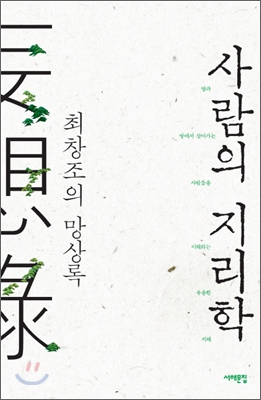
Geography of people
 |
Description
Book Introduction
The earth is our mother,
Self-generated feng shui is the geography of people!
In Korea, feng shui has long been a term that refers to today's geography.
However, 'geography' as a general academic discipline and 'geography' as defined by feng shui are different.
While general geography is a science that studies surface phenomena, feng shui is considered to be an indigenous discipline that was formed as a system by accumulating the wisdom of residents about the land and its climate.
The author argues that urgent land-related issues, such as the Four Major Rivers Project and the relocation of the administrative capital, can also be resolved through the perspective of self-generated feng shui, which regards the land as a mother.
The land is not a material object to be owned and used, but a mother to be cherished and cared for. He asserts that our current land is a sick mother and that it needs proper treatment.
Choi Chang-jo's indigenous feng shui theory, which embodies over 30 years of research on feng shui and a lifetime of practical knowledge accumulated while traveling across our country, will serve as a new guide, imparting useful wisdom to all those in this age who cannot live without the land.
Self-generated feng shui is the geography of people!
In Korea, feng shui has long been a term that refers to today's geography.
However, 'geography' as a general academic discipline and 'geography' as defined by feng shui are different.
While general geography is a science that studies surface phenomena, feng shui is considered to be an indigenous discipline that was formed as a system by accumulating the wisdom of residents about the land and its climate.
The author argues that urgent land-related issues, such as the Four Major Rivers Project and the relocation of the administrative capital, can also be resolved through the perspective of self-generated feng shui, which regards the land as a mother.
The land is not a material object to be owned and used, but a mother to be cherished and cared for. He asserts that our current land is a sick mother and that it needs proper treatment.
Choi Chang-jo's indigenous feng shui theory, which embodies over 30 years of research on feng shui and a lifetime of practical knowledge accumulated while traveling across our country, will serve as a new guide, imparting useful wisdom to all those in this age who cannot live without the land.
- You can preview some of the book's contents.
Preview
index
one.
preface
Why am I writing this book?
two.
What is human geography, natural feng shui?
1.
The fundamental principles of self-generated feng shui
(1) Symbiotic harmony between people and the land
(2) What is the method of selecting a site in self-generated feng shui?
2.
The modern significance of studying feng shui
3.
Self-grown feng shui boron
(1) Meaning
(2) The reason for the emergence of the term
(3) Three cases
1) Seongbulsa Temple, Jeongbangsan Mountain, Gwangseong-ri, Sariwon-si, Hwanghaebuk-do
2) Comparison of the tombs of King Taejo Wang Geon and King Gongmin of Goryeo
3) Abundance of sad cases
4.
Ultimately, how do you judge the land in Feng Shui?
5.
What should I do?
6.
finish
three.
All about human geography and natural feng shui
1.
Subjectivity: The mind is important.
2.
Bibo-seong (裨補性): Geography of healing
3.
Political nature: Aiming for a new world and opening up
4.
Presence: Adapt to the here and now.
5.
Obscurity: the logic of illogicality.
Beyond logic
6.
Convenience: Be faithful to reality rather than ideals.
7.
Plausibility: Seems plausible
8.
Adaptability: Connects to all areas of life
9.
Self-love: I am the center
10.
Complementarity: Humans are both masters, and nature is also a master.
four.
Conclusion
In lieu of a conclusion: the examples of Seoul and Gaeseong
Appendix: The Origin and History of Feng Shui
1.
A study on the research trends and origins of feng shui
2.
History of Feng Shui
(1) Feng Shui philosophy of the late Silla and early Goryeo periods
(2) Feng Shui Thought of the Goryeo Dynasty and National Feng Shui
(3) Feng Shui philosophy of the late Goryeo and early Joseon periods
(4) Feng Shui ideas of Silhak scholars
(5) Feng Shui thought after the end of the Joseon Dynasty
3.
Traditional theoretical structure of viewing the land
(1) Logical structure of traditional feng shui
(2) Basic structure of feng shui
References
preface
Why am I writing this book?
two.
What is human geography, natural feng shui?
1.
The fundamental principles of self-generated feng shui
(1) Symbiotic harmony between people and the land
(2) What is the method of selecting a site in self-generated feng shui?
2.
The modern significance of studying feng shui
3.
Self-grown feng shui boron
(1) Meaning
(2) The reason for the emergence of the term
(3) Three cases
1) Seongbulsa Temple, Jeongbangsan Mountain, Gwangseong-ri, Sariwon-si, Hwanghaebuk-do
2) Comparison of the tombs of King Taejo Wang Geon and King Gongmin of Goryeo
3) Abundance of sad cases
4.
Ultimately, how do you judge the land in Feng Shui?
5.
What should I do?
6.
finish
three.
All about human geography and natural feng shui
1.
Subjectivity: The mind is important.
2.
Bibo-seong (裨補性): Geography of healing
3.
Political nature: Aiming for a new world and opening up
4.
Presence: Adapt to the here and now.
5.
Obscurity: the logic of illogicality.
Beyond logic
6.
Convenience: Be faithful to reality rather than ideals.
7.
Plausibility: Seems plausible
8.
Adaptability: Connects to all areas of life
9.
Self-love: I am the center
10.
Complementarity: Humans are both masters, and nature is also a master.
four.
Conclusion
In lieu of a conclusion: the examples of Seoul and Gaeseong
Appendix: The Origin and History of Feng Shui
1.
A study on the research trends and origins of feng shui
2.
History of Feng Shui
(1) Feng Shui philosophy of the late Silla and early Goryeo periods
(2) Feng Shui Thought of the Goryeo Dynasty and National Feng Shui
(3) Feng Shui philosophy of the late Goryeo and early Joseon periods
(4) Feng Shui ideas of Silhak scholars
(5) Feng Shui thought after the end of the Joseon Dynasty
3.
Traditional theoretical structure of viewing the land
(1) Logical structure of traditional feng shui
(2) Basic structure of feng shui
References
Into the book
The reason why feng shui can be involved in modern territorial issues today is because of its sound view of geography, land, and nature.
Feng Shui regards the earth as a mother or a living being, so it cannot be thought of as a simple material.
Therefore, land cannot be an object of ownership or use.
Who would dare to exploit Mother (Earth) and who would commit the unfilial act of owning Mother (Nature)?
---From “The Fundamental Principles of Self-Generating Feng Shui”
The indigenous feng shui I am talking about is the geographical wisdom that our people possessed, so I do not place much meaning on the term.
Doseon feng shui is good, our feng shui is good, and Joseon feng shui is good.
You just have to accept things as they are.
If we cannot accept indigenous feng shui because there is no precedent for it, then it is the same as claiming that we do not have concepts like science, ecology, or environment because they were created in modern times.
---From "The Natural Feng Shui Boron"
“The baby living in the shack next to the railroad tracks, the baby sleeps so well.
“Cheek, cheek, cheek, cheek… Even though the train is noisy, our baby sleeps soundly.” There is a nursery rhyme that goes like this.
Because it's next to the railroad tracks.
So to speak, it is the worst residential location.
Besides, it's a shack.
This is the worst living environment.
But the baby sleeps well.
In other words, it is a good place for the baby.
---From "In the end, how does one judge the land in terms of feng shui?"
The mother, the country, is in the emergency room or intensive care unit and we have to treat her.
The problem is deciding whether or not to have surgery, and that is really difficult.
Some argue for euthanasia, some argue for surgery, and some argue for neglect.
It takes wisdom to figure out what the appropriate course of action is.
It is worrying that the reality is that wisdom is being claimed as one's own.
Feng Shui regards the earth as a mother or a living being, so it cannot be thought of as a simple material.
Therefore, land cannot be an object of ownership or use.
Who would dare to exploit Mother (Earth) and who would commit the unfilial act of owning Mother (Nature)?
---From “The Fundamental Principles of Self-Generating Feng Shui”
The indigenous feng shui I am talking about is the geographical wisdom that our people possessed, so I do not place much meaning on the term.
Doseon feng shui is good, our feng shui is good, and Joseon feng shui is good.
You just have to accept things as they are.
If we cannot accept indigenous feng shui because there is no precedent for it, then it is the same as claiming that we do not have concepts like science, ecology, or environment because they were created in modern times.
---From "The Natural Feng Shui Boron"
“The baby living in the shack next to the railroad tracks, the baby sleeps so well.
“Cheek, cheek, cheek, cheek… Even though the train is noisy, our baby sleeps soundly.” There is a nursery rhyme that goes like this.
Because it's next to the railroad tracks.
So to speak, it is the worst residential location.
Besides, it's a shack.
This is the worst living environment.
But the baby sleeps well.
In other words, it is a good place for the baby.
---From "In the end, how does one judge the land in terms of feng shui?"
The mother, the country, is in the emergency room or intensive care unit and we have to treat her.
The problem is deciding whether or not to have surgery, and that is really difficult.
Some argue for euthanasia, some argue for surgery, and some argue for neglect.
It takes wisdom to figure out what the appropriate course of action is.
It is worrying that the reality is that wisdom is being claimed as one's own.
---From "Convenience: Be faithful to reality rather than ideals"
Publisher's Review
Korea's leading feng shui expert, former professor of geography at Seoul National University
The wisdom of the earth and the wisdom of people conveyed by Choi Chang-jo!
The object of study of geography is, of course, surface phenomena.
Villages, cities, population, industry, society, economy, climate, etc. - it is truly a mishmash of academic subjects.
If you look closely, they are all related to human life, that is, life itself.
Yet, geography proceeds by separating people from the surface phenomena as its object.
weird.
Shouldn't it be human geography?
_“Why am I writing this book?”
《Human Geography》 is a book that compiles the wisdom about land and people that Choi Chang-jo, a leading feng shui expert in Korea who served as a professor of geography at Seoul National University, has studied and experienced for decades into a new academic system called “self-generated feng shui.”
The author, who is recognized as the country's top expert in the field of Feng Shui and confesses to having developed the habit of viewing people as the land and the land as the people, has been continuously researching new Feng Shui that can be applied to modern times.
And while publishing books containing his research results from time to time (such as “Choi Chang-jo’s New Feng Shui Theory,” “Urban Feng Shui,” and “The Logic of the Land, the Logic of Humans”), he compiled his theories into this book under the name “The Geography of Humans.”
Why of all things, a fantasy novel?
"The Geography of Books," a fascinating look into the author's lifelong reading history.
What's particularly interesting about this book is that the author, an avid bibliophile, begins the preface by saying, "Others have already thought about my ideas," and then develops his theories by quoting from the vast amount of books he has already read.
The approximately 350 quotes from novels, poetry, essays, history books, humanities books, economics books, dictionaries, newspapers, and magazines provide a unique enjoyment in and of themselves when reading this book.
Because of this technical method, the author humbly gave it the subtitle “Record of Delusions.”
I didn't plan to do that from the beginning, but as I did it, I realized that I could convey my thoughts just by quoting other people's stories.
I was surprised myself.
My thoughts are that others have already done it before, so I feel ashamed of myself and wonder what I have been doing until now.
(Omitted) The basis for any claim can be found in ancient and modern literature.
The same applies to conflicting cases.
This is the feeling I have felt to my bones while reading so far.
_“Why am I writing this book?”
Reading only these key quotes, selected from the author's extensive reading history, can be considered another way to enjoy this book in a different way.
In some ways, I think it could be called “geography of books” rather than “geography of people.”
Useful wisdom for understanding the land and the people who live on it
The earth is the mother, and the natural geomancy is the geography of man!
In the end, there is no such thing as good land.
If so, the only question that remains is whether the land and people have achieved symbiotic harmony or not.
This means that Feng Shui is not about distinguishing between good and bad land, but rather the wisdom of our ancestors that determines which land is suitable for a person and which is not.
_From “The Fundamental Principles of Self-Growing Feng Shui”
In Korea, feng shui has long been a term that refers to today's geography.
However, 'geography' as a general academic discipline and 'geography' as defined by feng shui are different.
While general geography is a science that studies surface phenomena, feng shui is considered to be an indigenous discipline that was formed as a system by accumulating the wisdom of residents about the land and its climate.
However, in modern times, feng shui has been transformed into a means of selfish fortune or a means of showing off wealth.
In this book, the author strongly criticizes the practice of shady geomancy, which has been reduced to a mere means of finding a good grave site, and compiles a new geomancy theory called 'self-generated geomancy', which functions as useful wisdom for solving various problems facing modern society.
The author argues that urgent land-related issues, such as the Four Major Rivers Project and the relocation of the administrative capital, can also be resolved through the perspective of self-generated feng shui, which regards the land as a mother.
The land is not a material object to be owned and used, but a mother to be cherished and cared for. He asserts that our current land is a sick mother and that it needs proper treatment.
Choi Chang-jo's indigenous feng shui theory, which embodies over 30 years of research on feng shui and a lifetime of practical knowledge accumulated while traveling across our country, will serve as a new guide, imparting useful wisdom to all those in this age who cannot live without the land.
The wisdom of the earth and the wisdom of people conveyed by Choi Chang-jo!
The object of study of geography is, of course, surface phenomena.
Villages, cities, population, industry, society, economy, climate, etc. - it is truly a mishmash of academic subjects.
If you look closely, they are all related to human life, that is, life itself.
Yet, geography proceeds by separating people from the surface phenomena as its object.
weird.
Shouldn't it be human geography?
_“Why am I writing this book?”
《Human Geography》 is a book that compiles the wisdom about land and people that Choi Chang-jo, a leading feng shui expert in Korea who served as a professor of geography at Seoul National University, has studied and experienced for decades into a new academic system called “self-generated feng shui.”
The author, who is recognized as the country's top expert in the field of Feng Shui and confesses to having developed the habit of viewing people as the land and the land as the people, has been continuously researching new Feng Shui that can be applied to modern times.
And while publishing books containing his research results from time to time (such as “Choi Chang-jo’s New Feng Shui Theory,” “Urban Feng Shui,” and “The Logic of the Land, the Logic of Humans”), he compiled his theories into this book under the name “The Geography of Humans.”
Why of all things, a fantasy novel?
"The Geography of Books," a fascinating look into the author's lifelong reading history.
What's particularly interesting about this book is that the author, an avid bibliophile, begins the preface by saying, "Others have already thought about my ideas," and then develops his theories by quoting from the vast amount of books he has already read.
The approximately 350 quotes from novels, poetry, essays, history books, humanities books, economics books, dictionaries, newspapers, and magazines provide a unique enjoyment in and of themselves when reading this book.
Because of this technical method, the author humbly gave it the subtitle “Record of Delusions.”
I didn't plan to do that from the beginning, but as I did it, I realized that I could convey my thoughts just by quoting other people's stories.
I was surprised myself.
My thoughts are that others have already done it before, so I feel ashamed of myself and wonder what I have been doing until now.
(Omitted) The basis for any claim can be found in ancient and modern literature.
The same applies to conflicting cases.
This is the feeling I have felt to my bones while reading so far.
_“Why am I writing this book?”
Reading only these key quotes, selected from the author's extensive reading history, can be considered another way to enjoy this book in a different way.
In some ways, I think it could be called “geography of books” rather than “geography of people.”
Useful wisdom for understanding the land and the people who live on it
The earth is the mother, and the natural geomancy is the geography of man!
In the end, there is no such thing as good land.
If so, the only question that remains is whether the land and people have achieved symbiotic harmony or not.
This means that Feng Shui is not about distinguishing between good and bad land, but rather the wisdom of our ancestors that determines which land is suitable for a person and which is not.
_From “The Fundamental Principles of Self-Growing Feng Shui”
In Korea, feng shui has long been a term that refers to today's geography.
However, 'geography' as a general academic discipline and 'geography' as defined by feng shui are different.
While general geography is a science that studies surface phenomena, feng shui is considered to be an indigenous discipline that was formed as a system by accumulating the wisdom of residents about the land and its climate.
However, in modern times, feng shui has been transformed into a means of selfish fortune or a means of showing off wealth.
In this book, the author strongly criticizes the practice of shady geomancy, which has been reduced to a mere means of finding a good grave site, and compiles a new geomancy theory called 'self-generated geomancy', which functions as useful wisdom for solving various problems facing modern society.
The author argues that urgent land-related issues, such as the Four Major Rivers Project and the relocation of the administrative capital, can also be resolved through the perspective of self-generated feng shui, which regards the land as a mother.
The land is not a material object to be owned and used, but a mother to be cherished and cared for. He asserts that our current land is a sick mother and that it needs proper treatment.
Choi Chang-jo's indigenous feng shui theory, which embodies over 30 years of research on feng shui and a lifetime of practical knowledge accumulated while traveling across our country, will serve as a new guide, imparting useful wisdom to all those in this age who cannot live without the land.
GOODS SPECIFICS
- Date of issue: May 10, 2011
- Page count, weight, size: 288 pages | 442g | 153*224*20mm
- ISBN13: 9788974834708
- ISBN10: 8974834707
You may also like
카테고리
korean


korean

![GQ KOREA Mark (Monthly): December [2025]](http://librairie.coreenne.fr/cdn/shop/files/8ef265dbbfbf186523ed75ba7319009d.jpg?v=1765340328&width=3840)


