

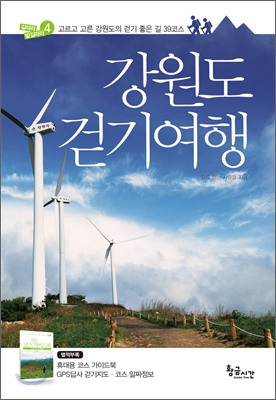
Gangwon-do walking tour
 |
Description
Book Introduction
This is the fifth work in the series “Follow the Road, Follow the Footsteps”, which introduces “good walking paths” where you can enjoy the natural scenery with your five senses and also take care of your health.
The walking team, 'People Finding the Way', and walking enthusiasts selected and included the courses through field surveys.
The 39 courses were carefully selected from around 100 candidates recommended by local people familiar with the geography, such as local mountaineers, hikers and mountain bikers, and local government officials in charge of culture, tourism, and forestry, as well as a database of walking courses by 'People Seeking the Way'.
In particular, in this Gangwon-do edition, an altitude chart was inserted, which is a diagram of digital information stored in a GPS, which was an essential item to carry during field trips, to make it easy for even the most ignorant of routes to find their way.
It also includes detailed additional information to help you enjoy your walking journey.
Restaurants near the starting or ending point of the course, famous places and landmarks around the course, and background information that would be good to know beforehand are introduced in separate box articles.
The walking team, 'People Finding the Way', and walking enthusiasts selected and included the courses through field surveys.
The 39 courses were carefully selected from around 100 candidates recommended by local people familiar with the geography, such as local mountaineers, hikers and mountain bikers, and local government officials in charge of culture, tourism, and forestry, as well as a database of walking courses by 'People Seeking the Way'.
In particular, in this Gangwon-do edition, an altitude chart was inserted, which is a diagram of digital information stored in a GPS, which was an essential item to carry during field trips, to make it easy for even the most ignorant of routes to find their way.
It also includes detailed additional information to help you enjoy your walking journey.
Restaurants near the starting or ending point of the course, famous places and landmarks around the course, and background information that would be good to know beforehand are introduced in separate box articles.
- You can preview some of the book's contents.
Preview
index
1 Gangneung City Police Station and Sacheon Port
2. Gangneung Namdaecheon and Anmok Beach
3. Goseong-gun Geojinhaemajibong Forest Bathing Area
4. Goseong-gun Goseongsan Suseongsaemteo Forest Bathing Area
5 Donghae Simulung Valley
6 Donghae City Green Peak Forest Trail
7 Samcheok City Gwangjin Beacon Mound Trail
8 Samcheok City Deokpung Valley Trekking
9 Samcheok City Junkyungmyo Geumgangsong Forest Road
10 Sokcho City Sokcho Beach, Cheongdaesan Mountain, Cheongcho Lake
11. Sokcho Siheungaksan Mountain Biseondae and Gyejoam Trail
12 Yanggu County Dutayeon Trekking
13 Yanggu-gun Bibongsan Forest Bathing Area
14 Yangyang-gun Guryongryeong Old Road
15 Yeongwol-gun Donggang Eorayeon Trekking
16 Yeongwol-gun Moun-dong (暮雲洞) walking trail
17 Wonju-si Chiaksan Guryongsa Temple ~ Seryeom Falls
18. On the way to Inje-gun Gombaeryeong
19 Inje-gun Baekdamsa Temple~Yeongsiam
20 Inje-gunwon-daeri Forest Road (Forest of Forest Sports)
21 Jeongseon-gun Gariwangsan Forest Road and Forest Trail
22 Jeongseon County Mindongsan Trekking
23 Jeongseon-gun Hwajeolryeong (花折嶺) and Sky Road Trekking
24. Cheorwon County Damteo Valley and the Labor Party Headquarters
25. Sambuyeon Falls and Yonghwa-dong Forest Road in Cheorwon-gun
26 Cheorwon-gun Hantangang Riverside Road
27 Chuncheon City Gangchon Munbae Village Forest Road and Gukgok Falls
28 Chuncheon Kim Yu-jeong Literary Trail (Sille Story Trail)
29 Chuncheon-si Dangnim-ri~Deokduwon-ri Forest Road
30 Chuncheon City Bukhan River ~ Uiamho Lakeside Promenade
31 Taebaek City Geomryongso and Daedeoksan Trekking
32 Taebaek City, Taebaeksan Mountain, Cheonjedan and Munsubong
33 Pyeongchang-gun Seonjaryeong Trekking and Daegwallyeong Old Road
34 Pyeongchang-gun Odaesan Woljeongsa Fir Forest Road and Unpaved Provincial Road No. 446
35 Hongcheon-gun Gongjaksan Ecological Forest and Suta Valley
36 Hongcheon-gun Myeoneuri Pass Forest Road
37 Hongcheon County Military Base Valley Trekking
38 Hwacheon-gun Nangcheon Forest Bathing Area ~ Bungeoseom Island
39 Hoengseong-gun Cheongtaesan Natural Recreation Forest Trail
Appendix & Special Appendix
01 Tourist information for 18 cities and counties in Gangwon-do
02 Main Index
03 Special Appendix Maps in Book - Gangwon-do Walking Tour Handbook
2. Gangneung Namdaecheon and Anmok Beach
3. Goseong-gun Geojinhaemajibong Forest Bathing Area
4. Goseong-gun Goseongsan Suseongsaemteo Forest Bathing Area
5 Donghae Simulung Valley
6 Donghae City Green Peak Forest Trail
7 Samcheok City Gwangjin Beacon Mound Trail
8 Samcheok City Deokpung Valley Trekking
9 Samcheok City Junkyungmyo Geumgangsong Forest Road
10 Sokcho City Sokcho Beach, Cheongdaesan Mountain, Cheongcho Lake
11. Sokcho Siheungaksan Mountain Biseondae and Gyejoam Trail
12 Yanggu County Dutayeon Trekking
13 Yanggu-gun Bibongsan Forest Bathing Area
14 Yangyang-gun Guryongryeong Old Road
15 Yeongwol-gun Donggang Eorayeon Trekking
16 Yeongwol-gun Moun-dong (暮雲洞) walking trail
17 Wonju-si Chiaksan Guryongsa Temple ~ Seryeom Falls
18. On the way to Inje-gun Gombaeryeong
19 Inje-gun Baekdamsa Temple~Yeongsiam
20 Inje-gunwon-daeri Forest Road (Forest of Forest Sports)
21 Jeongseon-gun Gariwangsan Forest Road and Forest Trail
22 Jeongseon County Mindongsan Trekking
23 Jeongseon-gun Hwajeolryeong (花折嶺) and Sky Road Trekking
24. Cheorwon County Damteo Valley and the Labor Party Headquarters
25. Sambuyeon Falls and Yonghwa-dong Forest Road in Cheorwon-gun
26 Cheorwon-gun Hantangang Riverside Road
27 Chuncheon City Gangchon Munbae Village Forest Road and Gukgok Falls
28 Chuncheon Kim Yu-jeong Literary Trail (Sille Story Trail)
29 Chuncheon-si Dangnim-ri~Deokduwon-ri Forest Road
30 Chuncheon City Bukhan River ~ Uiamho Lakeside Promenade
31 Taebaek City Geomryongso and Daedeoksan Trekking
32 Taebaek City, Taebaeksan Mountain, Cheonjedan and Munsubong
33 Pyeongchang-gun Seonjaryeong Trekking and Daegwallyeong Old Road
34 Pyeongchang-gun Odaesan Woljeongsa Fir Forest Road and Unpaved Provincial Road No. 446
35 Hongcheon-gun Gongjaksan Ecological Forest and Suta Valley
36 Hongcheon-gun Myeoneuri Pass Forest Road
37 Hongcheon County Military Base Valley Trekking
38 Hwacheon-gun Nangcheon Forest Bathing Area ~ Bungeoseom Island
39 Hoengseong-gun Cheongtaesan Natural Recreation Forest Trail
Appendix & Special Appendix
01 Tourist information for 18 cities and counties in Gangwon-do
02 Main Index
03 Special Appendix Maps in Book - Gangwon-do Walking Tour Handbook
Publisher's Review
Now is the era of walking!
“For someone who feels unhappy despite being healthy, a brisk five-mile walk a day is better than any medication or psychotherapy.”
This is according to Paul Dudley White, a cardiologist and founder of the American Heart Association who served as President Eisenhower's personal physician.
Walking is the best medicine for your health.
Even Master Heo Jun said in Donguibogam, “Food is better than medicine, and actions are better than food.”
However, walking is now developing not only as a means of exercise for health, but also as a means of travel that combines exercise and is even appearing as a travel product both domestically and internationally.
“There is nothing better than walking to feel the spirit of nature.
A beautiful landscape is like music, so it should be enjoyed at a moderate pace.
Even the bicycle is too fast.”
These are the words of Paul Scott Mowrer, a reporter who won the Pulitzer Prize while working for the Chicago Daily News.
The series "Follow the Road, Follow the Footsteps" is the first long-term project to introduce "good walking paths" by metropolitan city and province across the country, allowing you to enjoy the beauty of nature with all five senses while also taking care of your health.
The fifth work, Gangwon-do, features 39 beautiful green paths in an unspoiled natural environment.
A walking course guidebook that can help you find your way to Gilchido
What sets Golden Time's "Follow the Road, Follow the Footsteps" series apart from other walking guides is its meticulous guidance.
In the case of the routes introduced in existing walking travel books, I listened to the complaints of fellow hikers who said, "I should go there too," but "it was just so hard to find the route."
However, even if we try to guide everyone to a good walking path in an easy-to-find way, the method is not as simple as it sounds.
Unlike roads that are full of various signs and landmarks, there are no cars, so it is good for walking, and the quieter the place is, the less people there are, so there are no signs needed to guide the way.
Even if there are noticeable landmarks here and there, it is impossible to describe in words a route that is 5km, 10km, or 20km long.
The solution is to express it on a map.
However, the dirt paths and trails that are good for walking are not shown on any map data.
So, the method chosen by the 'path seekers' who wrote this book was to utilize GPS (Global Positioning System), which can store the route walked on foot as data.
So, whenever I came across a fork in the road, I took pictures of the surrounding terrain and landmarks, saved the location with GPS, and recorded and hand-drawn the shape and characteristics of the fork in the road.
As a result, we have completed a unique 'walking course map' that can be found anywhere else, even if you are not familiar with the 'Gilchi'.
The 'walking map' in this book, which was completed 100% through field research, is composed of two parts.
Each course includes two maps. The first map you open is the "Course Concept Map," which allows you to see the location of the course and the walking direction at a glance. It also includes detailed markings of surrounding terrain features, so you can use it as a key clue for finding your way.
The second 〈Course Guide〉 you see shows the direction of travel at each of the numerous forks in the road, and by listing the distance between sections and the accumulated distance, you can predict the location of the next fork in the road and estimate the distance between the path you have taken and the path you will take.
Just take out the special appendix and carry it with you, and you won't have to worry about finding your way!
The series “Follow the Road, Follow the Footsteps” published by Golden Time presents a plan that is different from other walking travel books.
Compared to existing walking travel books that are written in the form of emotionally focused travelogues, the Golden Hour walking travel book series, 'Follow the Road, Follow the Footsteps', introduces the scenery, famous places, and landmarks around the walking course, but places a lot of emphasis on route guidance.
The further away from the city center a path is, the less likely it is to have signposts, and the more secluded the path is, the more difficult it is to find your way as it often reaches forks in the road.
High-precision GPS (Global Positioning System) was used for on-site reporting.
Three reporters walked the site repeatedly and created two walking maps using digital information stored on GPS.
One is a 'course concept map' that transfers the reporter's own path along the original course onto a standard-scale map, and the other is a 'fork in the road guide map' that expresses this path in curves in an easy-to-understand way according to the walking order.
As the name suggests, this 'Fork in the Road Guide' focuses on explaining easily confusing forks in the road, and even includes photos of surrounding terrain features, making it more realistic.
With this, hikers only need to carry this 'course map' and 'fork in the road map' so they don't have to worry about getting lost.
The 40 'course trajectory maps' and 'crossroads guide maps' are specially designed as a separate appendix, making them convenient to carry around.
This special appendix, in the form of a 'Book in Book' containing key information about the walking course, including a map, was designed to be conveniently placed in the main book and pulled out whenever you set out on a journey.
Background information that adds depth to your trip, as well as introductions to delicious restaurants, cool places, famous landmarks, and attractions!
The joy of walking is freedom.
It is the freedom to walk when you want to walk, rest when you want to rest, see when you want to see, and eat when you want to eat.
Another unique feature of this book is that it is filled with detailed supplementary information to help you enjoy your walking journey.
Restaurants near the course's starting or ending points are always introduced, and there are separate box articles filled with information on famous places, attractions, and scenic spots around the course, as well as background information that would be helpful to know beforehand.
“For someone who feels unhappy despite being healthy, a brisk five-mile walk a day is better than any medication or psychotherapy.”
This is according to Paul Dudley White, a cardiologist and founder of the American Heart Association who served as President Eisenhower's personal physician.
Walking is the best medicine for your health.
Even Master Heo Jun said in Donguibogam, “Food is better than medicine, and actions are better than food.”
However, walking is now developing not only as a means of exercise for health, but also as a means of travel that combines exercise and is even appearing as a travel product both domestically and internationally.
“There is nothing better than walking to feel the spirit of nature.
A beautiful landscape is like music, so it should be enjoyed at a moderate pace.
Even the bicycle is too fast.”
These are the words of Paul Scott Mowrer, a reporter who won the Pulitzer Prize while working for the Chicago Daily News.
The series "Follow the Road, Follow the Footsteps" is the first long-term project to introduce "good walking paths" by metropolitan city and province across the country, allowing you to enjoy the beauty of nature with all five senses while also taking care of your health.
The fifth work, Gangwon-do, features 39 beautiful green paths in an unspoiled natural environment.
A walking course guidebook that can help you find your way to Gilchido
What sets Golden Time's "Follow the Road, Follow the Footsteps" series apart from other walking guides is its meticulous guidance.
In the case of the routes introduced in existing walking travel books, I listened to the complaints of fellow hikers who said, "I should go there too," but "it was just so hard to find the route."
However, even if we try to guide everyone to a good walking path in an easy-to-find way, the method is not as simple as it sounds.
Unlike roads that are full of various signs and landmarks, there are no cars, so it is good for walking, and the quieter the place is, the less people there are, so there are no signs needed to guide the way.
Even if there are noticeable landmarks here and there, it is impossible to describe in words a route that is 5km, 10km, or 20km long.
The solution is to express it on a map.
However, the dirt paths and trails that are good for walking are not shown on any map data.
So, the method chosen by the 'path seekers' who wrote this book was to utilize GPS (Global Positioning System), which can store the route walked on foot as data.
So, whenever I came across a fork in the road, I took pictures of the surrounding terrain and landmarks, saved the location with GPS, and recorded and hand-drawn the shape and characteristics of the fork in the road.
As a result, we have completed a unique 'walking course map' that can be found anywhere else, even if you are not familiar with the 'Gilchi'.
The 'walking map' in this book, which was completed 100% through field research, is composed of two parts.
Each course includes two maps. The first map you open is the "Course Concept Map," which allows you to see the location of the course and the walking direction at a glance. It also includes detailed markings of surrounding terrain features, so you can use it as a key clue for finding your way.
The second 〈Course Guide〉 you see shows the direction of travel at each of the numerous forks in the road, and by listing the distance between sections and the accumulated distance, you can predict the location of the next fork in the road and estimate the distance between the path you have taken and the path you will take.
Just take out the special appendix and carry it with you, and you won't have to worry about finding your way!
The series “Follow the Road, Follow the Footsteps” published by Golden Time presents a plan that is different from other walking travel books.
Compared to existing walking travel books that are written in the form of emotionally focused travelogues, the Golden Hour walking travel book series, 'Follow the Road, Follow the Footsteps', introduces the scenery, famous places, and landmarks around the walking course, but places a lot of emphasis on route guidance.
The further away from the city center a path is, the less likely it is to have signposts, and the more secluded the path is, the more difficult it is to find your way as it often reaches forks in the road.
High-precision GPS (Global Positioning System) was used for on-site reporting.
Three reporters walked the site repeatedly and created two walking maps using digital information stored on GPS.
One is a 'course concept map' that transfers the reporter's own path along the original course onto a standard-scale map, and the other is a 'fork in the road guide map' that expresses this path in curves in an easy-to-understand way according to the walking order.
As the name suggests, this 'Fork in the Road Guide' focuses on explaining easily confusing forks in the road, and even includes photos of surrounding terrain features, making it more realistic.
With this, hikers only need to carry this 'course map' and 'fork in the road map' so they don't have to worry about getting lost.
The 40 'course trajectory maps' and 'crossroads guide maps' are specially designed as a separate appendix, making them convenient to carry around.
This special appendix, in the form of a 'Book in Book' containing key information about the walking course, including a map, was designed to be conveniently placed in the main book and pulled out whenever you set out on a journey.
Background information that adds depth to your trip, as well as introductions to delicious restaurants, cool places, famous landmarks, and attractions!
The joy of walking is freedom.
It is the freedom to walk when you want to walk, rest when you want to rest, see when you want to see, and eat when you want to eat.
Another unique feature of this book is that it is filled with detailed supplementary information to help you enjoy your walking journey.
Restaurants near the course's starting or ending points are always introduced, and there are separate box articles filled with information on famous places, attractions, and scenic spots around the course, as well as background information that would be helpful to know beforehand.
GOODS SPECIFICS
- Date of issue: March 5, 2010
- Page count, weight, size: 416 pages | 712g | 148*210*30mm
- ISBN13: 9788992533287
- ISBN10: 8992533284
You may also like
카테고리
korean


korean

![GQ KOREA Mark (Monthly): December [2025]](http://librairie.coreenne.fr/cdn/shop/files/8ef265dbbfbf186523ed75ba7319009d.jpg?v=1765340328&width=3840)


