

The Road to Lhasa, the City of the Soul
 |
Description
Book Introduction
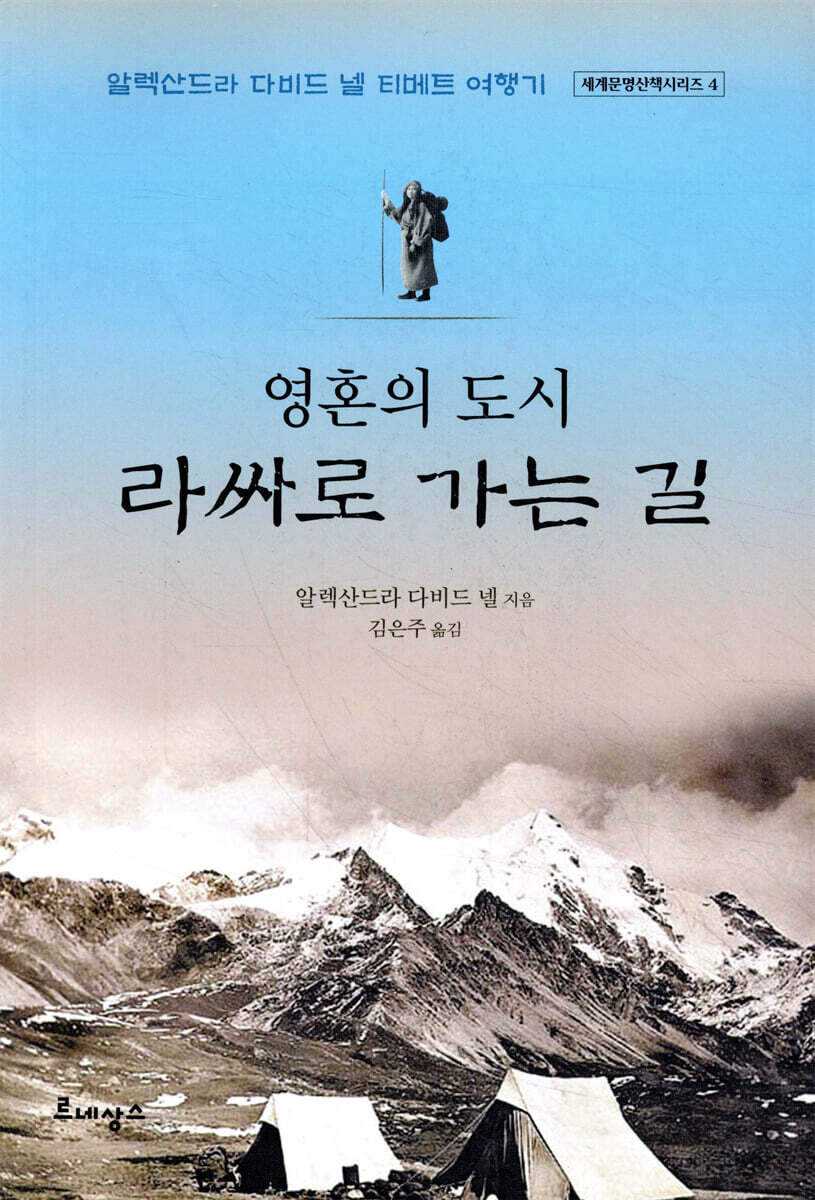
Alexandra David Nel's 1927 travelogue, "The Road to Lhasa, the City of the Spirit."
The author, the first Western woman to successfully enter Lhasa, the capital of Tibet, vividly describes her journey from Yunnan Province, China, to Lhasa, and her two-month stay there before heading to Gangtse, the site of the British Trade Office, over eight months of adventure.
At that time, Tibet had no contact with the outside world at all, and the ruling British government was pursuing a strict isolationist policy. So, David Nell pretended to be an illiterate old Tibetan woman on a pilgrimage and traveled the 3,000-kilometer journey on foot.
And rather, thanks to this setting, I had the opportunity to observe in detail the lifestyle, customs, and beliefs of various regions of Tibet.
This book caused a huge stir in Western society as soon as it was published, and was translated into languages around the world, and is still being reprinted to this day.
The author, the first Western woman to successfully enter Lhasa, the capital of Tibet, vividly describes her journey from Yunnan Province, China, to Lhasa, and her two-month stay there before heading to Gangtse, the site of the British Trade Office, over eight months of adventure.
At that time, Tibet had no contact with the outside world at all, and the ruling British government was pursuing a strict isolationist policy. So, David Nell pretended to be an illiterate old Tibetan woman on a pilgrimage and traveled the 3,000-kilometer journey on foot.
And rather, thanks to this setting, I had the opportunity to observe in detail the lifestyle, customs, and beliefs of various regions of Tibet.
This book caused a huge stir in Western society as soon as it was published, and was translated into languages around the world, and is still being reprinted to this day.
index
Recommendation
The Life of Alexandra David Nell, the Eternal Seeker
Before we begin
introduction
Chapter 1: Crossing the Tibetan Border
Chapter 2: Leaving Mount Ka Kalpo and Meeting the Pilgrims
Chapter 3: Traveling through the Beautiful Nu Valley
Chapter 4 Villages Along the Salween River
Chapter 5: Crossing the Great Glacier and Deo Pass
Chapter 6: Exploring the Source of the Polung Changpo
Chapter 7: People of the Po Province
Chapter 8: Seven Thieves and Two Lamas
Chapter 9: Celebrating the New Year in Lhasa
Chapter 10 Leaving Lhasa and heading south
Translator's Note
The Life of Alexandra David Nell, the Eternal Seeker
Before we begin
introduction
Chapter 1: Crossing the Tibetan Border
Chapter 2: Leaving Mount Ka Kalpo and Meeting the Pilgrims
Chapter 3: Traveling through the Beautiful Nu Valley
Chapter 4 Villages Along the Salween River
Chapter 5: Crossing the Great Glacier and Deo Pass
Chapter 6: Exploring the Source of the Polung Changpo
Chapter 7: People of the Po Province
Chapter 8: Seven Thieves and Two Lamas
Chapter 9: Celebrating the New Year in Lhasa
Chapter 10 Leaving Lhasa and heading south
Translator's Note
Into the book
Perhaps because I was precocious from a young age, I was plagued by a desire to escape the confines of the space given to other children my age, even when I was only five years old.
I used to climb over walls and go down the road in search of the unknown world, but strangely enough, the 'unknown world' I dreamed of was always a remote place where I could sit alone with no one around.
--- p.29, from the 'Preface'
What a thrill that was! That unique natural landscape was forever etched in my memory, and I felt like I'd never forget it.
It was as if I had finally found the quiet wilderness I had dreamed of since childhood, and as if I had returned to my long-awaited hometown after a arduous pilgrimage.
--- p.32, from the 'Preface'
So, you might have wondered where we were going without any luggage, attendants, or transportation, but you would never have imagined that it would be Tibet.
…May his wish come true! May his warm heart, which prayed for my fifth journey toward the forbidden land of the Snowy Land, be filled with the light of glory, be blessed! … The adventure has truly begun.
This trip was my fifth attempt to enter the closed 'Land of Snow', Tibet.
--- p.44, from Chapter 1, 'Crossing the Tibetan Border'
I told the old man to think back to the faith he had believed in since he was a child.
He also advised that rather than dwelling on the rest of this life, they should think about the happy rebirth they will enjoy in the land of Chenreji (Nub Dewa Chen, a paradise located 100 billion lands west of the human world) where the dead can go on their pilgrimage.
There, they will repeat the cycle of peaceful and happy reincarnation for thousands of years, and when their spirit reaches the highest state of enlightenment, they will attain freedom where there is no more life or death.
--- p.101, from Chapter 2, ‘Leaving Mount Ka Kalpo and Meeting the Pilgrimage Group’
As a side note, in Tibet, the act of showing directions to a traveler or guiding a lost person to the right path is considered a religiously praiseworthy act.
However, if one commits the sin of deliberately giving wrong directions to pilgrims or lamas or turning a blind eye to them as they wander lost, he or she will wander in the miserable and dark bardo (between death and rebirth) after death and will not be reborn in any world.
--- p.164, from Chapter 3, 'Traveling through the Beautiful Nu Valley'
It occurred to me that if I were an artist, I could paint a beautiful landscape painting using the wonderful scenery of this Tibetan farmhouse as a subject.
The sight of the golden-leaved trees and farmhouses harmoniously blending with the backdrop of a large, gray rock was as beautiful as a painting.
In front of the house, the clear and transparent Salween River flowed peacefully, and the lightly frozen ice at the edge seemed to decorate the river.
No Westerner has ever come this far and seen the river flowing beneath my feet.
This is the Salween River, winding between vast cliffs towering high against a backdrop of barren wasteland and blue skies.
--- pp.181-182, from Chapter 4, 'Villages Along the Salween River'
Ah! How can I describe my feelings at that moment… .
It was an intense feeling, a mixture of emotion and disappointment, that was indescribable.
We trembled with admiration, wonder, and fear.
Because while walking along the path surrounded by valleys, an incredible sight that we had never seen before suddenly appeared before us.
To the left, a vast snowfield stretched out, and at the far end of the plateau, turquoise glaciers and peaks covered in pure white snow were visible.
To the right, a wide valley with gently sloping slopes stretched straight toward the peaks that towered on the horizon.
A vast plateau rose slowly in front of us, extending far into the distance, but it was impossible to tell whether it ended at the summit of the pass or connected to another endless plateau.
--- p.222, from Chapter 5, 'Crossing the Great Glacier and Deo Pass'
Buried in the quiet, pure white snowfield, a small, barely visible dark spot was moving slowly in the distance.
It was as if a small insect was crawling with all its might on a huge plank.
Up until now, I have been captivated by the majestic and awe-inspiring sights of Tibet, the 'Land of Snows', more than once.
But compared to this vast space surrounded by high peaks and glaciers, the two travelers who came here alone to explore this fantastical space, like a mirage, looked so small and weak.
A deep sorrow that could not be expressed in words welled up from the depths of my heart.
--- p.224, from Chapter 5, 'Crossing the Great Glacier and Deo Pass'
I melted the snow and boiled it.
This time too, I had no choice but to drink it instead of lunch.
If I had only a little butter and two or three handfuls of champas, I could have boiled them in water and eaten them to invigorate myself, but the plain water, which was hot and had no flavor, only irritated my stomach.
I uttered the thought in my head, a prayer half-joking: "Gods of the mountains! Have mercy on us and send us butter or bacon the size of a walnut!"
Yongden stared at me quietly with that unique gaze he often had.
“Why? Why are you looking at me like that?”
I asked him.
"If you really want bacon, I can be your 'mountain spirit' for you."
Yongden spoke hesitantly.
"What do you mean?"
Yongden started to laugh.
"Je-tsun-ma, Mother, you look like a Tibetan woman in every way, but I guess you don't know what Tibetan women do in situations like this."
"Tell me.
Are you saying there's still food left in the bundle?"
"sure.
"I have a piece of bacon that I rubbed on the soles of my shoes to waterproof them, and a piece of leather that was left over from yesterday."
He said it as if he was joking.
"Then put it all in a pot, add some salt if there's any left, and boil it."
I ordered in a cheerful voice.
The true Tibetan spirit came alive within me.
About half an hour later, we were savoring a cloudy broth that, while not particularly appetizing, at least somewhat satisfied our empty stomachs.
The Christmas celebration continued like that.
I used to climb over walls and go down the road in search of the unknown world, but strangely enough, the 'unknown world' I dreamed of was always a remote place where I could sit alone with no one around.
--- p.29, from the 'Preface'
What a thrill that was! That unique natural landscape was forever etched in my memory, and I felt like I'd never forget it.
It was as if I had finally found the quiet wilderness I had dreamed of since childhood, and as if I had returned to my long-awaited hometown after a arduous pilgrimage.
--- p.32, from the 'Preface'
So, you might have wondered where we were going without any luggage, attendants, or transportation, but you would never have imagined that it would be Tibet.
…May his wish come true! May his warm heart, which prayed for my fifth journey toward the forbidden land of the Snowy Land, be filled with the light of glory, be blessed! … The adventure has truly begun.
This trip was my fifth attempt to enter the closed 'Land of Snow', Tibet.
--- p.44, from Chapter 1, 'Crossing the Tibetan Border'
I told the old man to think back to the faith he had believed in since he was a child.
He also advised that rather than dwelling on the rest of this life, they should think about the happy rebirth they will enjoy in the land of Chenreji (Nub Dewa Chen, a paradise located 100 billion lands west of the human world) where the dead can go on their pilgrimage.
There, they will repeat the cycle of peaceful and happy reincarnation for thousands of years, and when their spirit reaches the highest state of enlightenment, they will attain freedom where there is no more life or death.
--- p.101, from Chapter 2, ‘Leaving Mount Ka Kalpo and Meeting the Pilgrimage Group’
As a side note, in Tibet, the act of showing directions to a traveler or guiding a lost person to the right path is considered a religiously praiseworthy act.
However, if one commits the sin of deliberately giving wrong directions to pilgrims or lamas or turning a blind eye to them as they wander lost, he or she will wander in the miserable and dark bardo (between death and rebirth) after death and will not be reborn in any world.
--- p.164, from Chapter 3, 'Traveling through the Beautiful Nu Valley'
It occurred to me that if I were an artist, I could paint a beautiful landscape painting using the wonderful scenery of this Tibetan farmhouse as a subject.
The sight of the golden-leaved trees and farmhouses harmoniously blending with the backdrop of a large, gray rock was as beautiful as a painting.
In front of the house, the clear and transparent Salween River flowed peacefully, and the lightly frozen ice at the edge seemed to decorate the river.
No Westerner has ever come this far and seen the river flowing beneath my feet.
This is the Salween River, winding between vast cliffs towering high against a backdrop of barren wasteland and blue skies.
--- pp.181-182, from Chapter 4, 'Villages Along the Salween River'
Ah! How can I describe my feelings at that moment… .
It was an intense feeling, a mixture of emotion and disappointment, that was indescribable.
We trembled with admiration, wonder, and fear.
Because while walking along the path surrounded by valleys, an incredible sight that we had never seen before suddenly appeared before us.
To the left, a vast snowfield stretched out, and at the far end of the plateau, turquoise glaciers and peaks covered in pure white snow were visible.
To the right, a wide valley with gently sloping slopes stretched straight toward the peaks that towered on the horizon.
A vast plateau rose slowly in front of us, extending far into the distance, but it was impossible to tell whether it ended at the summit of the pass or connected to another endless plateau.
--- p.222, from Chapter 5, 'Crossing the Great Glacier and Deo Pass'
Buried in the quiet, pure white snowfield, a small, barely visible dark spot was moving slowly in the distance.
It was as if a small insect was crawling with all its might on a huge plank.
Up until now, I have been captivated by the majestic and awe-inspiring sights of Tibet, the 'Land of Snows', more than once.
But compared to this vast space surrounded by high peaks and glaciers, the two travelers who came here alone to explore this fantastical space, like a mirage, looked so small and weak.
A deep sorrow that could not be expressed in words welled up from the depths of my heart.
--- p.224, from Chapter 5, 'Crossing the Great Glacier and Deo Pass'
I melted the snow and boiled it.
This time too, I had no choice but to drink it instead of lunch.
If I had only a little butter and two or three handfuls of champas, I could have boiled them in water and eaten them to invigorate myself, but the plain water, which was hot and had no flavor, only irritated my stomach.
I uttered the thought in my head, a prayer half-joking: "Gods of the mountains! Have mercy on us and send us butter or bacon the size of a walnut!"
Yongden stared at me quietly with that unique gaze he often had.
“Why? Why are you looking at me like that?”
I asked him.
"If you really want bacon, I can be your 'mountain spirit' for you."
Yongden spoke hesitantly.
"What do you mean?"
Yongden started to laugh.
"Je-tsun-ma, Mother, you look like a Tibetan woman in every way, but I guess you don't know what Tibetan women do in situations like this."
"Tell me.
Are you saying there's still food left in the bundle?"
"sure.
"I have a piece of bacon that I rubbed on the soles of my shoes to waterproof them, and a piece of leather that was left over from yesterday."
He said it as if he was joking.
"Then put it all in a pot, add some salt if there's any left, and boil it."
I ordered in a cheerful voice.
The true Tibetan spirit came alive within me.
About half an hour later, we were savoring a cloudy broth that, while not particularly appetizing, at least somewhat satisfied our empty stomachs.
The Christmas celebration continued like that.
--- pp.281-282, from Chapter 6, 'Exploring the Source of the Polon Changpo'
Publisher's Review
This book is a travelogue of Tibet published by Alexandra David Nell in 1927.
Davide Nel, the first Western woman to successfully enter Lhasa, the capital of Tibet, vividly describes her journey from Yunnan Province, China, to Lhasa, and after a two-month stay there, to Gangtse, where the British Trade Office was based, and her eight-month adventure.
Until then, Tibet had no contact with the outside world, and the ruling British Empire had been pursuing a strict isolationist policy. So, when the world learned that she had finally succeeded in traveling to Tibet after five attempts over ten years, people at the time were astonished.
To successfully complete this journey, despite strict security, David Nell pretended to be an illiterate Tibetan woman on a begging pilgrimage and walked the 3,000-kilometer journey.
It was a journey that David Nell set out on alone with Apul Yongden, a lama he had adopted as his son since meeting him at a temple in the Sikkim region, without any proper equipment. However, thanks to this setting, David Nell had the opportunity to observe in detail the lifestyle, customs, and beliefs of various regions of Tibet.
It is also quite interesting to examine the differing perspectives of David Nel, who sought to interpret the mystical and superstitious atmosphere deeply ingrained in Tibetan culture through a critical Western lens, and Yongden, who was born the grandson of a shaman and was educated and raised in a Tibetan monastery.
It is said that David Nell originally intended to publish only research data and geographical discoveries on Tibetan culture.
However, after returning home, he found it difficult to disappoint the expectations of the many people who were interested in his travel stories, so he wrote this book. As soon as it was published, the book caused a great stir in Western society, and was translated into many languages around the world, and even new editions continue to be published to this day.
David Nell visited Joseon in 1917 and traveled to places such as Haeinsa Temple in Hapcheon and Yujeomsa Temple in Geumgangsan (see p. 21 and plates 336-337).
You can learn more about her by visiting the Alexandra David Neel Foundation website at http://www.alexandra-david-neel.org.
Davide Nel, the first Western woman to successfully enter Lhasa, the capital of Tibet, vividly describes her journey from Yunnan Province, China, to Lhasa, and after a two-month stay there, to Gangtse, where the British Trade Office was based, and her eight-month adventure.
Until then, Tibet had no contact with the outside world, and the ruling British Empire had been pursuing a strict isolationist policy. So, when the world learned that she had finally succeeded in traveling to Tibet after five attempts over ten years, people at the time were astonished.
To successfully complete this journey, despite strict security, David Nell pretended to be an illiterate Tibetan woman on a begging pilgrimage and walked the 3,000-kilometer journey.
It was a journey that David Nell set out on alone with Apul Yongden, a lama he had adopted as his son since meeting him at a temple in the Sikkim region, without any proper equipment. However, thanks to this setting, David Nell had the opportunity to observe in detail the lifestyle, customs, and beliefs of various regions of Tibet.
It is also quite interesting to examine the differing perspectives of David Nel, who sought to interpret the mystical and superstitious atmosphere deeply ingrained in Tibetan culture through a critical Western lens, and Yongden, who was born the grandson of a shaman and was educated and raised in a Tibetan monastery.
It is said that David Nell originally intended to publish only research data and geographical discoveries on Tibetan culture.
However, after returning home, he found it difficult to disappoint the expectations of the many people who were interested in his travel stories, so he wrote this book. As soon as it was published, the book caused a great stir in Western society, and was translated into many languages around the world, and even new editions continue to be published to this day.
David Nell visited Joseon in 1917 and traveled to places such as Haeinsa Temple in Hapcheon and Yujeomsa Temple in Geumgangsan (see p. 21 and plates 336-337).
You can learn more about her by visiting the Alexandra David Neel Foundation website at http://www.alexandra-david-neel.org.
GOODS SPECIFICS
- Date of issue: October 20, 2008
- Page count, weight, size: 460 pages | 145*215*30mm
- ISBN13: 9788990828491
- ISBN10: 899082849X
You may also like
카테고리
korean


korean

![GQ KOREA Mark (Monthly): December [2025]](http://librairie.coreenne.fr/cdn/shop/files/8ef265dbbfbf186523ed75ba7319009d.jpg?v=1765340328&width=3840)


