

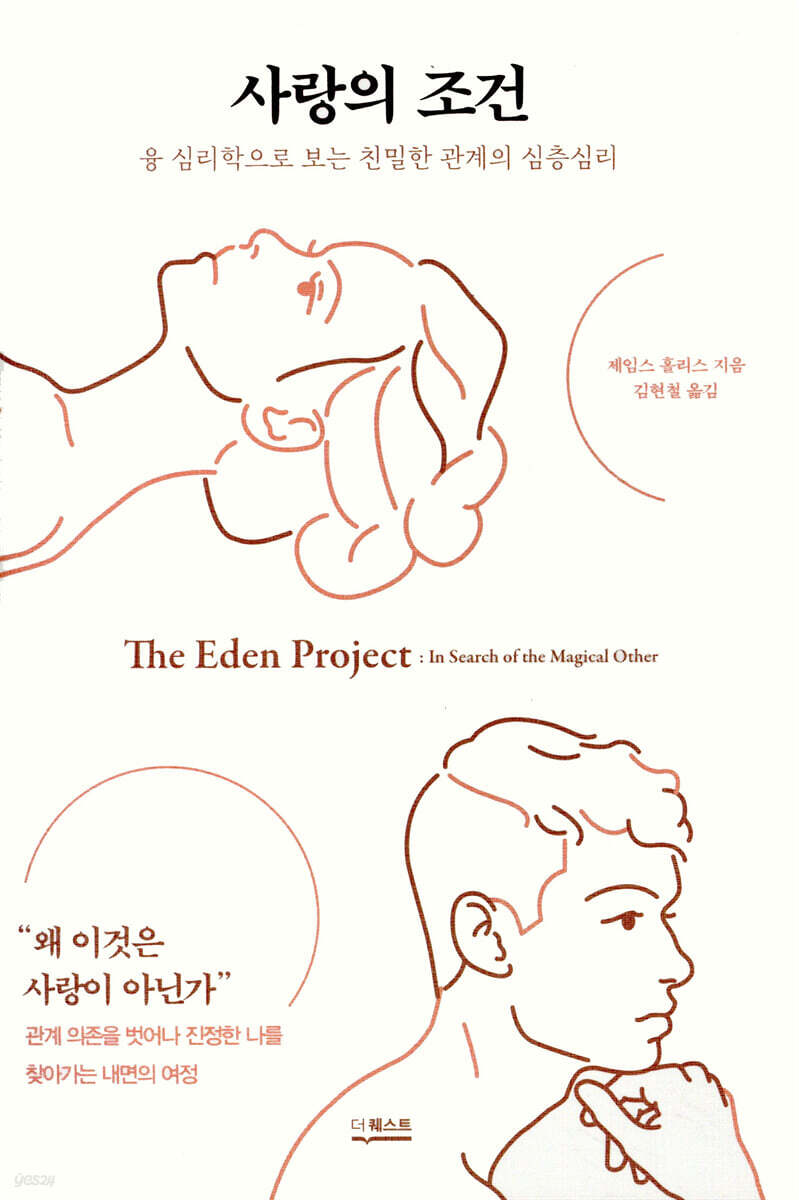
Conditions of Love
 |
Description
Book Introduction
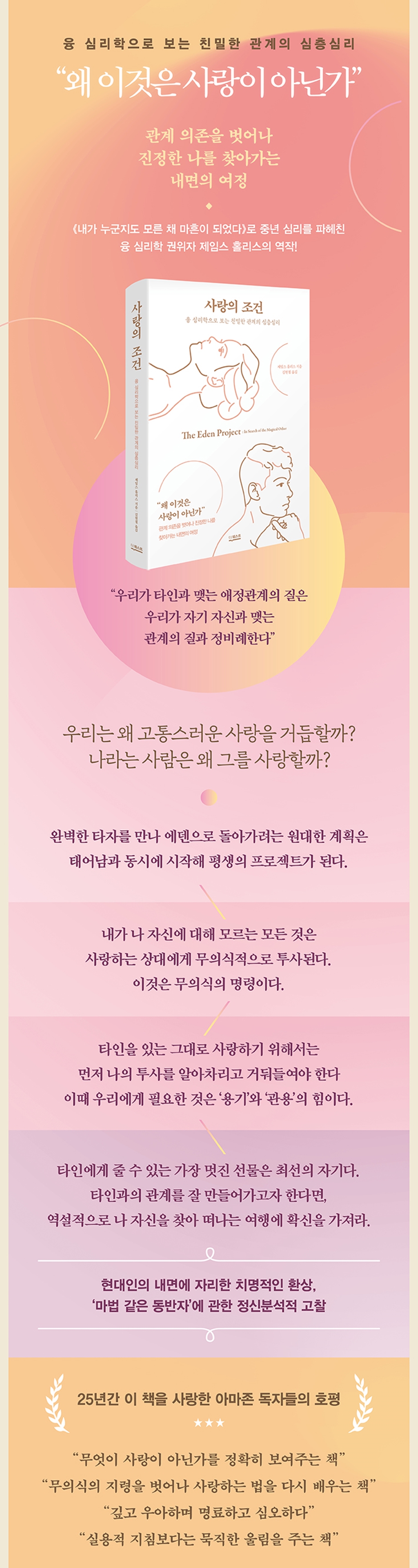
“Why isn’t this love?”
An inner journey to break free from dependence on relationships and find your true self.
James Hollis, an authority on Jungian psychology, has examined the midlife crisis and encounters with one's true self in "Turning Forty Without Knowing Who I Was," and the life and depth of men's psychology in "Being a Man."
The new book, “Conditions of Love,” delves into the causes of psychological pain that arise in intimate relationships, such as between spouses and lovers.
James Hollis, a long-time lecturer on Jungian psychology, was asked the question he received most frequently in the field about 'relationships.'
People were bombarded with questions about romantic relationships, regardless of the title of the lecture or presentation.
《Conditions of Love》 focuses on the psychological dynamics of romantic relationships as a ubiquitous, important, and (sometimes overrated) urgent issue.
But this book isn't a practical guide to solving relationship problems.
Rather, it subtly shatters the "illusions" that people of our time have about relationships, urging us to reflect on the nature of relationships, to discover the goals that become our personal responsibilities within them, and to yearn for our own growth itself, rather than for our own desires to be realized through others.
An inner journey to break free from dependence on relationships and find your true self.
James Hollis, an authority on Jungian psychology, has examined the midlife crisis and encounters with one's true self in "Turning Forty Without Knowing Who I Was," and the life and depth of men's psychology in "Being a Man."
The new book, “Conditions of Love,” delves into the causes of psychological pain that arise in intimate relationships, such as between spouses and lovers.
James Hollis, a long-time lecturer on Jungian psychology, was asked the question he received most frequently in the field about 'relationships.'
People were bombarded with questions about romantic relationships, regardless of the title of the lecture or presentation.
《Conditions of Love》 focuses on the psychological dynamics of romantic relationships as a ubiquitous, important, and (sometimes overrated) urgent issue.
But this book isn't a practical guide to solving relationship problems.
Rather, it subtly shatters the "illusions" that people of our time have about relationships, urging us to reflect on the nature of relationships, to discover the goals that become our personal responsibilities within them, and to yearn for our own growth itself, rather than for our own desires to be realized through others.
- You can preview some of the book's contents.
Preview
index
Bird hitting the window
Entering
Chapter 1: Lost Paradise
In search of 'Self'
Chapter 2: The Eden Project
Can we become one again?
Eros, the fighter, the magical type
This crazy thing called love
How Projection Works From the Inside
How to get out of a projection
Love, Relationships, Soul
Chapter 3 Couple
Meeting and parting
How to Control Fear
Four Principles of Relationships
Chapter 4: Wounded Eros
Five Stories of Finding Wounds
A son who betrayed his mother's expectations
God of the dark river stained with blood
Abilene's Paradox
Who will take care of the caregiver?
Lonely Warrior
Questions for the Wounded Eros
Chapter 5: Expanding Relationships
An organization with a vital soul
Chapter 6 The God Within You
Eyes like spray of water turn toward paradise
Spirituality and Soul
Three Poets Who Walked with God
Two people who can't sleep while coming out
Jungian Psychology Terminology / Annotations / References
Entering
Chapter 1: Lost Paradise
In search of 'Self'
Chapter 2: The Eden Project
Can we become one again?
Eros, the fighter, the magical type
This crazy thing called love
How Projection Works From the Inside
How to get out of a projection
Love, Relationships, Soul
Chapter 3 Couple
Meeting and parting
How to Control Fear
Four Principles of Relationships
Chapter 4: Wounded Eros
Five Stories of Finding Wounds
A son who betrayed his mother's expectations
God of the dark river stained with blood
Abilene's Paradox
Who will take care of the caregiver?
Lonely Warrior
Questions for the Wounded Eros
Chapter 5: Expanding Relationships
An organization with a vital soul
Chapter 6 The God Within You
Eyes like spray of water turn toward paradise
Spirituality and Soul
Three Poets Who Walked with God
Two people who can't sleep while coming out
Jungian Psychology Terminology / Annotations / References
Detailed image
Into the book
If there's one idea that runs through this book, it's that the quality of our relationships with others is directly proportional to the relationship we have with ourselves.
Because our relationships with ourselves operate at an unconscious level, the drama and dynamics that arise in our relationships with others and transcendent beings largely express our own psychology.
So the best we can do in our relationships with others and with the transcendent is to make our relationship with ourselves more conscious.
(Omitted) Being our best selves is the greatest gift we can give to others.
---From "Entering"
There are two strategies for dealing with the experience of being abandoned by others, or the fear of being abandoned.
How to avoid repeating the pain by minimizing yourself, and how to desperately try to connect with someone else, but most of the time, you 'choose' someone who will repeat the previous experience.
As I said before, behind these two strategies lies a huge unconscious force that was programmed into our minds when we were young.
---「Chapter 1.
Lost Paradise
I now intend to impart to my lover and companion everything I know about myself, my secret plan to heal the wounds I have received from my family and culture.
Then, the other person will also experience all the complexes I have accumulated in life.
How could I do this to someone I love? How could he do this to me, when he says he loves me?
---「Chapter 1.
From "Lost Paradise"
How healthy and hopeful an intimate relationship between two people will be depends on the willingness of each person to take responsibility for the relationship between their conscious and unconscious selves.
It makes sense and seems simple, but nothing is more difficult than this.
The reason any relationship carries a burden is because there is a grand plan hidden behind it to reclaim paradise through the other person, and because we are unwilling to take responsibility for the relationship between our conscious and unconscious minds.
---「Chapter 2.
From the Eden Project
Honi calls these strategies for coping with fear submissiveness, power, and distancing, and interestingly, he sees love as one way to cope with fear.
As depth psychologists and theologians often say, the opposite of love is not hate, but fear.
To develop the ability to affirm others, we must broaden our souls and rise up against our inherent fears.
To be able to love others despite their power to hurt us requires a large soul and a broad sense of self, so as not to expose ourselves to unpredictable dangers.
---「Chapter 3.
Among the "couples"
The power of fear, which binds us to the past and prevents us from growing, is actually very powerful.
Sociopaths are unable to love anyone and therefore cannot grow because their entire personality is shaped by a defense mechanism against fear.
The most common way we discover the power of love is when we overcome fear.
Where fear reigns, there is no love.
Fear is everywhere, so moving from fear to love is a formidable challenge.
Only those who can face their own fears and live with ambiguity and ambivalence can find the strength to love others.
As mentioned earlier, couples who come to therapy are already in a state of tremendous hurt.
The projections that covered each other were already worn out.
A plan to return to paradise is revealed, but the two wake up from their daydreams, disillusioned and angry, and bleeding from the thorns of love.
Both believe they are right and just, and are confident that an impartial third party will confirm this.
---「Chapter 3.
Among the "couples"
There are three basic experiences that can change our egocentrism.
It's about experiencing pain, realizing that there are forces at work in your life greater than your own will, and loving and caring for yourself and others.
---「Chapter 3.
Among the "couples"
All life is relationship.
As we have seen, the quality of our relationships with others is proportional to the extent to which our relationship with ourselves has developed, and our relationship with ourselves is usually established within us as a result of our relationship with the primal Other.
In other words, we constantly transfer dynamics that correspond to different times and places to the present and to the present relationships.
Likewise, others transfer their psychological history to us.
Therefore, even when we are alone, we can never be free from the dynamics of relationships.
We spend most of our waking hours interacting with group structures such as family, work, and social institutions.
Therefore, it is important to consider not only the nature of the romantic relationship you form, but also the dynamics of living as a member of a group.
---「Chapter 5.
From “Expansion of Relationships”
We have goals as individuals, and we invest and manage our energy toward them.
We feel well-being when our energy is directed toward the goals our soul desires.
On the other hand, when libido is directed in a direction that does not match the soul's purpose, it becomes neurotic.
Similarly, organizations where employee energy management fails to serve the true goals of each individual employee suffer from fragmentation.
You could say that it's like the company is suffering from neurosis.
---「Chapter 5.
From “Expansion of Relationships”
Jung understood that behind these childlike, universal desires lies a deeper meaning: the need to make our brief earthly lives meaningful.
In the works cited above, the three poets, instead of trying to make the universe our parent, dared to remain thoroughly other.
Their vision did not offer comfort or stability, but instead it gave dignity and meaning.
Because our relationships with ourselves operate at an unconscious level, the drama and dynamics that arise in our relationships with others and transcendent beings largely express our own psychology.
So the best we can do in our relationships with others and with the transcendent is to make our relationship with ourselves more conscious.
(Omitted) Being our best selves is the greatest gift we can give to others.
---From "Entering"
There are two strategies for dealing with the experience of being abandoned by others, or the fear of being abandoned.
How to avoid repeating the pain by minimizing yourself, and how to desperately try to connect with someone else, but most of the time, you 'choose' someone who will repeat the previous experience.
As I said before, behind these two strategies lies a huge unconscious force that was programmed into our minds when we were young.
---「Chapter 1.
Lost Paradise
I now intend to impart to my lover and companion everything I know about myself, my secret plan to heal the wounds I have received from my family and culture.
Then, the other person will also experience all the complexes I have accumulated in life.
How could I do this to someone I love? How could he do this to me, when he says he loves me?
---「Chapter 1.
From "Lost Paradise"
How healthy and hopeful an intimate relationship between two people will be depends on the willingness of each person to take responsibility for the relationship between their conscious and unconscious selves.
It makes sense and seems simple, but nothing is more difficult than this.
The reason any relationship carries a burden is because there is a grand plan hidden behind it to reclaim paradise through the other person, and because we are unwilling to take responsibility for the relationship between our conscious and unconscious minds.
---「Chapter 2.
From the Eden Project
Honi calls these strategies for coping with fear submissiveness, power, and distancing, and interestingly, he sees love as one way to cope with fear.
As depth psychologists and theologians often say, the opposite of love is not hate, but fear.
To develop the ability to affirm others, we must broaden our souls and rise up against our inherent fears.
To be able to love others despite their power to hurt us requires a large soul and a broad sense of self, so as not to expose ourselves to unpredictable dangers.
---「Chapter 3.
Among the "couples"
The power of fear, which binds us to the past and prevents us from growing, is actually very powerful.
Sociopaths are unable to love anyone and therefore cannot grow because their entire personality is shaped by a defense mechanism against fear.
The most common way we discover the power of love is when we overcome fear.
Where fear reigns, there is no love.
Fear is everywhere, so moving from fear to love is a formidable challenge.
Only those who can face their own fears and live with ambiguity and ambivalence can find the strength to love others.
As mentioned earlier, couples who come to therapy are already in a state of tremendous hurt.
The projections that covered each other were already worn out.
A plan to return to paradise is revealed, but the two wake up from their daydreams, disillusioned and angry, and bleeding from the thorns of love.
Both believe they are right and just, and are confident that an impartial third party will confirm this.
---「Chapter 3.
Among the "couples"
There are three basic experiences that can change our egocentrism.
It's about experiencing pain, realizing that there are forces at work in your life greater than your own will, and loving and caring for yourself and others.
---「Chapter 3.
Among the "couples"
All life is relationship.
As we have seen, the quality of our relationships with others is proportional to the extent to which our relationship with ourselves has developed, and our relationship with ourselves is usually established within us as a result of our relationship with the primal Other.
In other words, we constantly transfer dynamics that correspond to different times and places to the present and to the present relationships.
Likewise, others transfer their psychological history to us.
Therefore, even when we are alone, we can never be free from the dynamics of relationships.
We spend most of our waking hours interacting with group structures such as family, work, and social institutions.
Therefore, it is important to consider not only the nature of the romantic relationship you form, but also the dynamics of living as a member of a group.
---「Chapter 5.
From “Expansion of Relationships”
We have goals as individuals, and we invest and manage our energy toward them.
We feel well-being when our energy is directed toward the goals our soul desires.
On the other hand, when libido is directed in a direction that does not match the soul's purpose, it becomes neurotic.
Similarly, organizations where employee energy management fails to serve the true goals of each individual employee suffer from fragmentation.
You could say that it's like the company is suffering from neurosis.
---「Chapter 5.
From “Expansion of Relationships”
Jung understood that behind these childlike, universal desires lies a deeper meaning: the need to make our brief earthly lives meaningful.
In the works cited above, the three poets, instead of trying to make the universe our parent, dared to remain thoroughly other.
Their vision did not offer comfort or stability, but instead it gave dignity and meaning.
---「Chapter 6.
From "The God Within You"
From "The God Within You"
Publisher's Review
'My magical other half'
A Psychological Examination of Unattainable Longing
In the hearts of modern people, there is a fatal illusion of ‘someone who is just right for me.’
The journey to find the so-called 'magic other', the 'perfect companion', begins from the moment of birth, and the author calls it the 'Eden Project'.
This project, born from the primal longing to find our other half and return to the lost paradise, the Garden of Eden, becomes a lifelong task that takes root in our subconscious.
If there's one idea that runs through this book, it's that the quality of our relationships with others is directly proportional to the quality of our relationships with ourselves.
The depth, direction, and key elements of the love we experience all come from our first relationship experience.
And this becomes internalized and becomes our unconscious, phenomenal relationship with ourselves.
Once we acknowledge this fact, it becomes clear why we must explore the origins of our sense of self, the source of our way of interacting with ourselves, others, and ultimately with a transcendent being.
Why I Love Him: Find Your True Self
Even though we think we know ourselves completely, in reality we only know a part of ourselves.
The concept of 'Self', which Jung used to refer to the entire direction of human beings, is in itself a completely unknowable entity, and 'reading' its intentions becomes the core of psychotherapy based on Jungian psychology.
So this book starts with the question of 'relationships', delves into 'myself', and then returns to 'relationships' (or broader relationships).
Everything I don't know about myself is unconsciously 'projected' onto the person I love.
We cry over the pain of love, but we do not know that its origin lies within ourselves.
To love others as others themselves, we must be able to encounter the wounded Eros within ourselves, recognize our projections, and accept them.
What we need at this time is ‘heroic courage.’
Four Principles of Relationships
1.
What I do not know about myself (unconscious plans) or what is not revealed within me (shadow) is projected onto others.
2.
I project onto others the traumas I experienced as a child (my personal pathology), my infantile longings (my narcissistic drive to return to paradise), and my responsibility to achieve individuation.
3.
The other person cannot and should not be responsible for my wounds, my narcissism, or my individuation.
The position of a fighter is ultimately filled with regret and issues of power.
4.
The only cure for a failing relationship is to bring my "Return to Paradise" project to a conscious level and take responsibility for the individuation process myself.
To break free from the dictates of the unconscious and learn to love again
As we have seen so far, the nature of all my relationships with others is derived from my relationship with myself.
Love for a companion or lover, friendship between colleagues, views and beliefs about God—the psychological dynamics of all these relationships are unconsciously expressed from our relationship with ourselves.
So, to maintain the best possible relationship with others, we must first raise our relationship with ourselves to a conscious level.
If you're tired of the pain from relationships, if you've been discouraged and cried over time because of a bad love, you need to start by believing in and loving yourself.
The greatest gift you can give your loved one is your best self.
It takes 'courage' to face your inner self and continue to be humble.
Therefore, in order to accept and love the other as they are, the power of ‘tolerance’ is needed.
If you want to develop good relationships with others, paradoxically, you must have confidence in the journey of finding yourself.
The word that describes this attitude of respect for others is 'reverence'.
The word that describes the attitude of being positive and accepting while being full of ambiguity is 'courage.'
And the word that describes the experience of respecting the differences of others is 'love'.
_Chapter 6.
God within you
★★★★★ Reviews from Amazon readers who have loved this book for 25 years ★★★★★
“A book that shows exactly what love is not.”
A Guide to Love for Growth
“A book that will help you break free from the dictates of the unconscious and learn to love again.”
If you really want to solve your relationship problems, read this book.
“Deep, elegant, clear, and profound.”
"A book that resonates deeply, not just a practical guide."
A Psychological Examination of Unattainable Longing
In the hearts of modern people, there is a fatal illusion of ‘someone who is just right for me.’
The journey to find the so-called 'magic other', the 'perfect companion', begins from the moment of birth, and the author calls it the 'Eden Project'.
This project, born from the primal longing to find our other half and return to the lost paradise, the Garden of Eden, becomes a lifelong task that takes root in our subconscious.
If there's one idea that runs through this book, it's that the quality of our relationships with others is directly proportional to the quality of our relationships with ourselves.
The depth, direction, and key elements of the love we experience all come from our first relationship experience.
And this becomes internalized and becomes our unconscious, phenomenal relationship with ourselves.
Once we acknowledge this fact, it becomes clear why we must explore the origins of our sense of self, the source of our way of interacting with ourselves, others, and ultimately with a transcendent being.
Why I Love Him: Find Your True Self
Even though we think we know ourselves completely, in reality we only know a part of ourselves.
The concept of 'Self', which Jung used to refer to the entire direction of human beings, is in itself a completely unknowable entity, and 'reading' its intentions becomes the core of psychotherapy based on Jungian psychology.
So this book starts with the question of 'relationships', delves into 'myself', and then returns to 'relationships' (or broader relationships).
Everything I don't know about myself is unconsciously 'projected' onto the person I love.
We cry over the pain of love, but we do not know that its origin lies within ourselves.
To love others as others themselves, we must be able to encounter the wounded Eros within ourselves, recognize our projections, and accept them.
What we need at this time is ‘heroic courage.’
Four Principles of Relationships
1.
What I do not know about myself (unconscious plans) or what is not revealed within me (shadow) is projected onto others.
2.
I project onto others the traumas I experienced as a child (my personal pathology), my infantile longings (my narcissistic drive to return to paradise), and my responsibility to achieve individuation.
3.
The other person cannot and should not be responsible for my wounds, my narcissism, or my individuation.
The position of a fighter is ultimately filled with regret and issues of power.
4.
The only cure for a failing relationship is to bring my "Return to Paradise" project to a conscious level and take responsibility for the individuation process myself.
To break free from the dictates of the unconscious and learn to love again
As we have seen so far, the nature of all my relationships with others is derived from my relationship with myself.
Love for a companion or lover, friendship between colleagues, views and beliefs about God—the psychological dynamics of all these relationships are unconsciously expressed from our relationship with ourselves.
So, to maintain the best possible relationship with others, we must first raise our relationship with ourselves to a conscious level.
If you're tired of the pain from relationships, if you've been discouraged and cried over time because of a bad love, you need to start by believing in and loving yourself.
The greatest gift you can give your loved one is your best self.
It takes 'courage' to face your inner self and continue to be humble.
Therefore, in order to accept and love the other as they are, the power of ‘tolerance’ is needed.
If you want to develop good relationships with others, paradoxically, you must have confidence in the journey of finding yourself.
The word that describes this attitude of respect for others is 'reverence'.
The word that describes the attitude of being positive and accepting while being full of ambiguity is 'courage.'
And the word that describes the experience of respecting the differences of others is 'love'.
_Chapter 6.
God within you
★★★★★ Reviews from Amazon readers who have loved this book for 25 years ★★★★★
“A book that shows exactly what love is not.”
A Guide to Love for Growth
“A book that will help you break free from the dictates of the unconscious and learn to love again.”
If you really want to solve your relationship problems, read this book.
“Deep, elegant, clear, and profound.”
"A book that resonates deeply, not just a practical guide."
GOODS SPECIFICS
- Publication date: July 20, 2022
- Page count, weight, size: 292 pages | 342g | 128*188*18mm
- ISBN13: 9791140700509
- ISBN10: 1140700502
You may also like
카테고리
korean


korean

![GQ KOREA Mark (Monthly): December [2025]](http://librairie.coreenne.fr/cdn/shop/files/8ef265dbbfbf186523ed75ba7319009d.jpg?v=1765340328&width=3840)


