

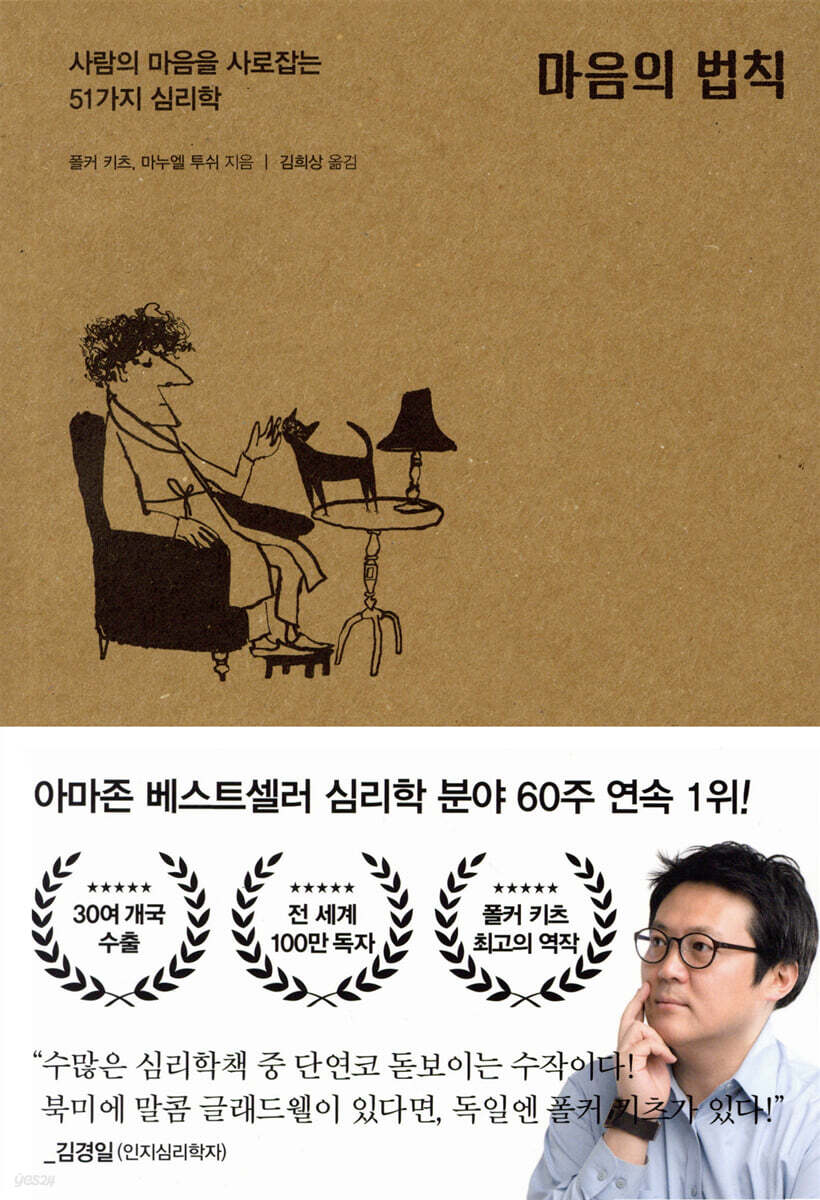
Law of the Mind
 |
Description
Book Introduction
“How does the mind work?”
#1 Amazon Bestseller in Psychology for 60 Consecutive Weeks! The core of psychology is the question, 'How does the human mind work?' We spend our precious time on so many different things, yet we rarely address this question. Even though it is a question that is more urgent to us than any other problem. In this book, Germany's most trusted psychologist duo offers psychological solutions to 51 of the most common problems people face, drawn from tens of thousands of counseling cases over the past several decades. Rather than providing obvious advice, 『The Laws of the Mind』, which explains experimentally proven psychological laws with concrete examples in an easy and fun way, has been the #1 bestseller in the psychology category on Amazon for 60 consecutive weeks and has sold over 1 million copies worldwide. Psychology also teaches us how the people around us operate. This knowledge is very practical for us. Those who know this law of the mind are at a far greater advantage in every respect than those who do not. Because psychology is ultimately the laws of the mind discovered from the lives of millions of people who have been in similar situations to me. As one of Germany's most prominent psychologist duos, the authors avoid difficult or outdated stories and instead focus on the problems and solutions that are happening in our lives right now. In interviews, we use the 'recency effect' of the 'primacy effect' in psychology, and when interpersonal relationships are difficult, we use the 'principle of reciprocity' to solve problems in work, love, and relationships that we find burdensome through psychology. Readers of this book will gain the world's most powerful tool for getting what they want. |
- You can preview some of the book's contents.
Preview
index
How does the mind work?
PART 1
1.
For those of you who have a habit of hiding your emotions (How to Use Emotions)
2.
When you feel like nothing you do is working out (Reframing)
3.
Exciting things are short, boring things are done all at once (habit)
4.
Why When Others Do It, It's Adultery, But When I Do It, It's Romance (The Fundamental Attribution Error)
5.
How to Get Along with a Coworker You Hate (The Ignition Effect)
6.
Why You Shouldn't Compare Yourself to Successful Friends (The Comparison Trap)
7.
Do you want people to welcome you? (Facial Feedback Theory)
8.
The only way to change others to your will (self-fulfilling prophecy)
9.
Things that happy couples always keep in mind (perceptual categorization)
10.
Disagreeing doesn't mean you're being attacked (active listening)
PART 2
11.
The mind that persists even when it knows it is the wrong choice (cognitive dissonance)
12.
Imagery Experiments That Might Save Your Life (Imagery Training)
13.
The other person also has the right to be respected.
Just like you (the trap of egocentrism)
14.
The psychology of incompetent people constantly running for elections (illusion of superiority)
15.
It's Dangerous to Accept Other People's Emotions as Your Own (Sympathy vs. Empathy)
16.
The egocentric perspective underlying advice (projection)
17.
The Secret to Getting the Salary You Want (The Anchoring Effect)
18.
The psychology of people who trust their memories instead of statistics (representativeness heuristic)
19.
How to Use Psychology in Interviews: The First-Time Effect vs. the Recency Effect
20.
If you want to be an attractive person (halo effect)
PART 3
21.
How to Best Manage Everyday Stress (Adaptation)
22.
Why You're Not Happy Right Now (Self-Efficacy)
23.
How to Achieve What You Want Through Your Subconscious Mind (Subconscious Mind)
24.
Why Do Religious People Live Longer? (The Religious Effect)
25.
Why Ridiculous Conspiracy Theories Spread So Widely (The Illusion Fallacy)
26.
What You Need to Know if You're Single (Artificial Scarcity Strategy)
27.
How can I win his heart? (Mere Exposure Effect)
28.
One Word to Impress Your Interviewer in 10 Seconds (The Principle of Similarity)
29.
If your wife and sister are not on good terms (POX model)
30.
If you have coworkers who are uncomfortable with each other at work (principle of reciprocity)
PART 4
31.
Why do we like baby bears more than spiders? (Inter-rater reliability)
32.
How to Resolve Conflicts Without Fighting (Intervention)
33.
Asking for something that the other person cannot refuse
(Negative State Reduction Hypothesis vs. Empathic Altruism)
34.
Irregular rewards increase expectations (conditioned response)
35.
Neglecting your emotions can have fatal consequences (mind cleansing)
36.
Why can't I just say no when I don't like something? (Conformity phenomenon)
37.
The psychology of following the command to "stay still" in an emergency situation (the bystander effect)
38.
How to Get People to Do What You Want (The Reactance Effect)
39.
People who pay their taxes in advance do not commit tax evasion (endowment effect)
40.
What Makes Creative People Different? (Mental Blocking)
PART 5
41.
Do Extrinsic Rewards Motivate People? (The Overjustification Effect)
42.
Why You Can't Find Things Even When They're Right in Front of You (Change Blindness)
43.
Why did George W. Bush say he saw buildings collapse? (Flashback)
44.
How Prejudices Form (Preconceptions)
45.
Why Men and Women Don't Communicate (Communication Square)
46.
How to Overcome Boredom in Long-Term Couples (Sex Therapy)
47.
To avoid conflict with others (animal behavior)
48.
How to Quickly Escape Embarrassing Situations (Lighting Effects)
49.
What You Must Know If You Want to Succeed (Impulse Control)
50.
How to do several things well at the same time (multitasking)
51.
Skills for Winning Debate Arguments (Subconscious)
INDEX
References
PART 1
1.
For those of you who have a habit of hiding your emotions (How to Use Emotions)
2.
When you feel like nothing you do is working out (Reframing)
3.
Exciting things are short, boring things are done all at once (habit)
4.
Why When Others Do It, It's Adultery, But When I Do It, It's Romance (The Fundamental Attribution Error)
5.
How to Get Along with a Coworker You Hate (The Ignition Effect)
6.
Why You Shouldn't Compare Yourself to Successful Friends (The Comparison Trap)
7.
Do you want people to welcome you? (Facial Feedback Theory)
8.
The only way to change others to your will (self-fulfilling prophecy)
9.
Things that happy couples always keep in mind (perceptual categorization)
10.
Disagreeing doesn't mean you're being attacked (active listening)
PART 2
11.
The mind that persists even when it knows it is the wrong choice (cognitive dissonance)
12.
Imagery Experiments That Might Save Your Life (Imagery Training)
13.
The other person also has the right to be respected.
Just like you (the trap of egocentrism)
14.
The psychology of incompetent people constantly running for elections (illusion of superiority)
15.
It's Dangerous to Accept Other People's Emotions as Your Own (Sympathy vs. Empathy)
16.
The egocentric perspective underlying advice (projection)
17.
The Secret to Getting the Salary You Want (The Anchoring Effect)
18.
The psychology of people who trust their memories instead of statistics (representativeness heuristic)
19.
How to Use Psychology in Interviews: The First-Time Effect vs. the Recency Effect
20.
If you want to be an attractive person (halo effect)
PART 3
21.
How to Best Manage Everyday Stress (Adaptation)
22.
Why You're Not Happy Right Now (Self-Efficacy)
23.
How to Achieve What You Want Through Your Subconscious Mind (Subconscious Mind)
24.
Why Do Religious People Live Longer? (The Religious Effect)
25.
Why Ridiculous Conspiracy Theories Spread So Widely (The Illusion Fallacy)
26.
What You Need to Know if You're Single (Artificial Scarcity Strategy)
27.
How can I win his heart? (Mere Exposure Effect)
28.
One Word to Impress Your Interviewer in 10 Seconds (The Principle of Similarity)
29.
If your wife and sister are not on good terms (POX model)
30.
If you have coworkers who are uncomfortable with each other at work (principle of reciprocity)
PART 4
31.
Why do we like baby bears more than spiders? (Inter-rater reliability)
32.
How to Resolve Conflicts Without Fighting (Intervention)
33.
Asking for something that the other person cannot refuse
(Negative State Reduction Hypothesis vs. Empathic Altruism)
34.
Irregular rewards increase expectations (conditioned response)
35.
Neglecting your emotions can have fatal consequences (mind cleansing)
36.
Why can't I just say no when I don't like something? (Conformity phenomenon)
37.
The psychology of following the command to "stay still" in an emergency situation (the bystander effect)
38.
How to Get People to Do What You Want (The Reactance Effect)
39.
People who pay their taxes in advance do not commit tax evasion (endowment effect)
40.
What Makes Creative People Different? (Mental Blocking)
PART 5
41.
Do Extrinsic Rewards Motivate People? (The Overjustification Effect)
42.
Why You Can't Find Things Even When They're Right in Front of You (Change Blindness)
43.
Why did George W. Bush say he saw buildings collapse? (Flashback)
44.
How Prejudices Form (Preconceptions)
45.
Why Men and Women Don't Communicate (Communication Square)
46.
How to Overcome Boredom in Long-Term Couples (Sex Therapy)
47.
To avoid conflict with others (animal behavior)
48.
How to Quickly Escape Embarrassing Situations (Lighting Effects)
49.
What You Must Know If You Want to Succeed (Impulse Control)
50.
How to do several things well at the same time (multitasking)
51.
Skills for Winning Debate Arguments (Subconscious)
INDEX
References
Detailed image

Into the book
The word 'feel' that we use is actually nothing more than a mask.
In reality, we are not expressing our own feelings, but rather our 'thoughts' about others, that is, our 'judgments' about the people around us.
For example, the statement, "I feel like you don't love me," is actually a thought (judgment) in my head that says, "You don't love me."
--- p.12
Empathy becomes difficult because we think that listening to others means giving up our own position.
That's why we find it difficult to listen to what others say.
Because of the fear that you might have to agree with the other person's opinion.
Giving up your own position by agreeing with others' opinions is no different from defeat.
But this thinking is completely wrong!
--- p.64
The sunk cost fallacy is a phenomenon that can be easily observed even at home.
This is a typical phenomenon of 'cognitive dissonance', which involves distorting and embellishing one's own thoughts or expectations that conflict with reality.
Mrs. Schneider can no longer tolerate her husband, but instead of divorcing him, she changes her mind after thinking about the investments she has made.
“But wouldn’t it be better to at least have a shoulder to lean on?” With this, Mrs. Schneider’s world regains peace.
--- p.73
Jumping into a hole after seeing a child is out of pity.
The reason we sympathize is because we feel the pain of the suffering person as our own.
The problem is that sympathizers can't come up with meaningful solutions.
So we need to distinguish between empathy and sympathy.
--- p.92
Superstitions can be seen as the result of our brain's constant attempts to explain things because it feels powerless.
Conspiracy theories also arise from our desire for control.
An example of extreme helplessness occurred after the terrorist attacks on the World Trade Center in New York on September 11, 2001.
Western society, extremely shocked, started to spew out conspiracy theories indiscriminately.
There are countless conspiracy theories floating around the internet, and even a movie about it.
A good example is the absurd conspiracy theory that the US intelligence agency blew up the building itself.
--- p.144
When we feel our own judgment is uncertain, we try to fill it by trusting and relying on the information of others.
For this reason, people often exhibit consistent behavior.
Just like in the meeting example I mentioned earlier, when everyone praises their colleagues' plans, you suddenly feel anxious about whether they are really as bad as you thought.
And once you start feeling anxious, you start borrowing information from other people.
Don't we all agree that it's over? Ultimately, we become convinced that others have the right information.
In other words, they adapt and conform to others' beliefs.
--- p.208
Preconceptions make us do things we never thought possible without any hindrance.
There are countless experiments that have proven this.
Suddenly, white students start attacking their black classmates, men start swearing at their female classmates, and heterosexuals start insulting homosexuals without hesitation.
The brain tries to reduce effort by avoiding conscious thought as much as possible and creating schemas that allow it to respond automatically.
--- p.252
The spotlight effect doesn't just happen in embarrassing situations like the one above.
Even in good times, we tend to believe people are paying more attention to us than they actually are.
When we boast about saying something smart in a discussion or making a big contribution to a company project, we perceive ourselves in a brighter light than we actually are.
In reality, we are not expressing our own feelings, but rather our 'thoughts' about others, that is, our 'judgments' about the people around us.
For example, the statement, "I feel like you don't love me," is actually a thought (judgment) in my head that says, "You don't love me."
--- p.12
Empathy becomes difficult because we think that listening to others means giving up our own position.
That's why we find it difficult to listen to what others say.
Because of the fear that you might have to agree with the other person's opinion.
Giving up your own position by agreeing with others' opinions is no different from defeat.
But this thinking is completely wrong!
--- p.64
The sunk cost fallacy is a phenomenon that can be easily observed even at home.
This is a typical phenomenon of 'cognitive dissonance', which involves distorting and embellishing one's own thoughts or expectations that conflict with reality.
Mrs. Schneider can no longer tolerate her husband, but instead of divorcing him, she changes her mind after thinking about the investments she has made.
“But wouldn’t it be better to at least have a shoulder to lean on?” With this, Mrs. Schneider’s world regains peace.
--- p.73
Jumping into a hole after seeing a child is out of pity.
The reason we sympathize is because we feel the pain of the suffering person as our own.
The problem is that sympathizers can't come up with meaningful solutions.
So we need to distinguish between empathy and sympathy.
--- p.92
Superstitions can be seen as the result of our brain's constant attempts to explain things because it feels powerless.
Conspiracy theories also arise from our desire for control.
An example of extreme helplessness occurred after the terrorist attacks on the World Trade Center in New York on September 11, 2001.
Western society, extremely shocked, started to spew out conspiracy theories indiscriminately.
There are countless conspiracy theories floating around the internet, and even a movie about it.
A good example is the absurd conspiracy theory that the US intelligence agency blew up the building itself.
--- p.144
When we feel our own judgment is uncertain, we try to fill it by trusting and relying on the information of others.
For this reason, people often exhibit consistent behavior.
Just like in the meeting example I mentioned earlier, when everyone praises their colleagues' plans, you suddenly feel anxious about whether they are really as bad as you thought.
And once you start feeling anxious, you start borrowing information from other people.
Don't we all agree that it's over? Ultimately, we become convinced that others have the right information.
In other words, they adapt and conform to others' beliefs.
--- p.208
Preconceptions make us do things we never thought possible without any hindrance.
There are countless experiments that have proven this.
Suddenly, white students start attacking their black classmates, men start swearing at their female classmates, and heterosexuals start insulting homosexuals without hesitation.
The brain tries to reduce effort by avoiding conscious thought as much as possible and creating schemas that allow it to respond automatically.
--- p.252
The spotlight effect doesn't just happen in embarrassing situations like the one above.
Even in good times, we tend to believe people are paying more attention to us than they actually are.
When we boast about saying something smart in a discussion or making a big contribution to a company project, we perceive ourselves in a brighter light than we actually are.
--- p.269
Publisher's Review
“The power to elicit the desired response from the other person.”
Psychology classes for those who are burdened by work, love, and relationships.
* Exported to over 30 countries
* 1 million readers worldwide
* Volker Kitz's greatest masterpiece
There's an internal notice posted at your workplace announcing a promotion opportunity.
You and a few of your colleagues rushed to apply.
Which of the following interview schedules would you choose? Option 1: "The first interview will be the most challenging and difficult.
So, lunch or dinner is better.” 2. “At lunchtime, everyone will only think about eating.
So, morning or evening is better.” 3. “In the evening, everyone may be tired or have already made up their minds.
“Breakfast or lunch would be good.”
I'll tell you the answer.
If you want the interviewers to remember you well, choose the first thing in the order, that is, the morning.
Psychology focuses on an interesting phenomenon called the 'primacy effect'.
Our brain remembers information we receive early on much better than information we catch up on later.
The reason why first impressions and preconceptions have such a powerful effect is because of the 'first impression effect'.
The opposite of the 'first effect' is the 'recency effect'.
We value the most recent information, and this information remains in our memory longer because it cannot be overwritten by anything else.
The two effects complement each other excellently.
So you can get the most out of someone if you make a good first impression, as well as a good last impression.
How about trying this? Let's create a situation where you're the first person to interview, and then, after the marathon-like interview, you "accidentally" run into the committee members in the hallway.
With a bright smile, thank them for the comfortable interview and politely wish them a pleasant evening.
When presenting, you will be able to get the most out of it if you prepare to say something 'cool' at the beginning and end.
When we look at the political world, we often see cases where people without any particular qualifications try their best to become representatives of the people.
Behind this lies the illusion of superiority.
Psychologist Tom Gilovich called this phenomenon the "Lake Wobegon Effect."
Most people mistakenly believe that they are more capable, creative, and attractive than others.
In fact, a significant number of office workers consider themselves above average and believe they deserve to earn more than their colleagues.
We often see people losing huge amounts of money due to absurd decisions in the financial markets.
The media often says that greed has devastated the market, but the real problem is unrealistic confidence.
The best way to avoid falling prey to the illusion of superiority is to remember that it is always targeting us.
The principle of similarity is that people who have many similarities feel affection for each other.
Of course, we all crave that 'exhilarating difference'.
But let's think about it seriously.
Have you ever seen a couple divorce because they said, "We're too similar"? "Personality differences" is the most common reason for divorce.
Couples often argue over leaving the toothpaste cap open.
The problem is that couples have different cleanliness preferences.
One side doesn't mind the lid being open, but the other side can't stand it.
Conversely, if these tastes are the same, no one will bother with the toothpaste cap.
I don't even care if it's open or closed.
The conclusions of countless studies are clear.
The more a couple resembles each other, the better! If you're looking for a long-term partner, I recommend finding someone with many similarities rather than those with striking differences.
The 'principle of similarity' doesn't just apply to romantic relationships.
For example, when looking for a new job, the more you have in common with your interviewer, the better your chances of getting hired.
So, when you interview, try to meet interviewers who are as similar to you as possible.
Do thorough research in advance on age, origin, education, family situation, hobbies, etc.
And let's use these commonalities without fail in real-world situations.
"If I'm correct, you liked soccer when you were a teenager? I'm a huge soccer fan myself..." This one sentence will be far more helpful than any supporting evidence.
I guarantee it.
This book consists of 51 psychological laws proven through various experiments.
We live our lives meeting countless people.
There are various purposes in relationships, such as family, friends, lovers, and colleagues.
This book will help you lead yourself and others in the direction you want.
Psychological thinking, which penetrates the essence and finds the optimal solution, is useful in any era.
The duo of Volker Kitz and Manuel Tusch have clearly answered many of our questions about the 'human mind'.
As we follow this book, we will soon find ourselves holding the psychological tools to overcome the uncertainty of life.
51 Psychological Experiments That Could Save Your Life
Just before the first passenger plane hit the World Trade Center in New York on September 11, an announcement was quickly made throughout the building.
The instructions were to remain calm and remain in the office to await rescue.
This was the building's emergency preparedness manual, and the "expert" stressed that it was best to follow it in critical moments.
The workers who had instinctively run down the stairs had to go back up to the office under the expert's instructions.
And not a single person left in the office survived.
The only survivors were those who trusted their instincts and senses.
When we feel our own judgment is uncertain, we try to fill it by trusting and relying on the information of others.
In an emergency, there is little time to think.
In such cases, we do not have to think long and just watch the reactions of those around us and act accordingly.
'Acting Experiment' shows this psychology well.
Smoke was suddenly poured into the room where the experimental participants were waiting through cracks in the door or window.
If I was alone in the experimental space, I would usually leave the space quickly.
In another room, an actor was placed to sit calmly while smoke rose.
Then the participants remained calm.
Even when the smoke became so thick that they could no longer see each other.
When we smell something burning on a plane, we quickly look around to see how other people are reacting.
And when people are quiet, we automatically think, 'No big deal.'
We call this effect 'mass ignorance'.
If no one gets excited, we don't get excited.
What can we learn from this? When a situation is uncertain, before it escalates into a full-blown emergency, let's ask ourselves:
'If there's no one else here, what will I do?'
Psychology classes for those who are burdened by work, love, and relationships.
* Exported to over 30 countries
* 1 million readers worldwide
* Volker Kitz's greatest masterpiece
There's an internal notice posted at your workplace announcing a promotion opportunity.
You and a few of your colleagues rushed to apply.
Which of the following interview schedules would you choose? Option 1: "The first interview will be the most challenging and difficult.
So, lunch or dinner is better.” 2. “At lunchtime, everyone will only think about eating.
So, morning or evening is better.” 3. “In the evening, everyone may be tired or have already made up their minds.
“Breakfast or lunch would be good.”
I'll tell you the answer.
If you want the interviewers to remember you well, choose the first thing in the order, that is, the morning.
Psychology focuses on an interesting phenomenon called the 'primacy effect'.
Our brain remembers information we receive early on much better than information we catch up on later.
The reason why first impressions and preconceptions have such a powerful effect is because of the 'first impression effect'.
The opposite of the 'first effect' is the 'recency effect'.
We value the most recent information, and this information remains in our memory longer because it cannot be overwritten by anything else.
The two effects complement each other excellently.
So you can get the most out of someone if you make a good first impression, as well as a good last impression.
How about trying this? Let's create a situation where you're the first person to interview, and then, after the marathon-like interview, you "accidentally" run into the committee members in the hallway.
With a bright smile, thank them for the comfortable interview and politely wish them a pleasant evening.
When presenting, you will be able to get the most out of it if you prepare to say something 'cool' at the beginning and end.
When we look at the political world, we often see cases where people without any particular qualifications try their best to become representatives of the people.
Behind this lies the illusion of superiority.
Psychologist Tom Gilovich called this phenomenon the "Lake Wobegon Effect."
Most people mistakenly believe that they are more capable, creative, and attractive than others.
In fact, a significant number of office workers consider themselves above average and believe they deserve to earn more than their colleagues.
We often see people losing huge amounts of money due to absurd decisions in the financial markets.
The media often says that greed has devastated the market, but the real problem is unrealistic confidence.
The best way to avoid falling prey to the illusion of superiority is to remember that it is always targeting us.
The principle of similarity is that people who have many similarities feel affection for each other.
Of course, we all crave that 'exhilarating difference'.
But let's think about it seriously.
Have you ever seen a couple divorce because they said, "We're too similar"? "Personality differences" is the most common reason for divorce.
Couples often argue over leaving the toothpaste cap open.
The problem is that couples have different cleanliness preferences.
One side doesn't mind the lid being open, but the other side can't stand it.
Conversely, if these tastes are the same, no one will bother with the toothpaste cap.
I don't even care if it's open or closed.
The conclusions of countless studies are clear.
The more a couple resembles each other, the better! If you're looking for a long-term partner, I recommend finding someone with many similarities rather than those with striking differences.
The 'principle of similarity' doesn't just apply to romantic relationships.
For example, when looking for a new job, the more you have in common with your interviewer, the better your chances of getting hired.
So, when you interview, try to meet interviewers who are as similar to you as possible.
Do thorough research in advance on age, origin, education, family situation, hobbies, etc.
And let's use these commonalities without fail in real-world situations.
"If I'm correct, you liked soccer when you were a teenager? I'm a huge soccer fan myself..." This one sentence will be far more helpful than any supporting evidence.
I guarantee it.
This book consists of 51 psychological laws proven through various experiments.
We live our lives meeting countless people.
There are various purposes in relationships, such as family, friends, lovers, and colleagues.
This book will help you lead yourself and others in the direction you want.
Psychological thinking, which penetrates the essence and finds the optimal solution, is useful in any era.
The duo of Volker Kitz and Manuel Tusch have clearly answered many of our questions about the 'human mind'.
As we follow this book, we will soon find ourselves holding the psychological tools to overcome the uncertainty of life.
51 Psychological Experiments That Could Save Your Life
Just before the first passenger plane hit the World Trade Center in New York on September 11, an announcement was quickly made throughout the building.
The instructions were to remain calm and remain in the office to await rescue.
This was the building's emergency preparedness manual, and the "expert" stressed that it was best to follow it in critical moments.
The workers who had instinctively run down the stairs had to go back up to the office under the expert's instructions.
And not a single person left in the office survived.
The only survivors were those who trusted their instincts and senses.
When we feel our own judgment is uncertain, we try to fill it by trusting and relying on the information of others.
In an emergency, there is little time to think.
In such cases, we do not have to think long and just watch the reactions of those around us and act accordingly.
'Acting Experiment' shows this psychology well.
Smoke was suddenly poured into the room where the experimental participants were waiting through cracks in the door or window.
If I was alone in the experimental space, I would usually leave the space quickly.
In another room, an actor was placed to sit calmly while smoke rose.
Then the participants remained calm.
Even when the smoke became so thick that they could no longer see each other.
When we smell something burning on a plane, we quickly look around to see how other people are reacting.
And when people are quiet, we automatically think, 'No big deal.'
We call this effect 'mass ignorance'.
If no one gets excited, we don't get excited.
What can we learn from this? When a situation is uncertain, before it escalates into a full-blown emergency, let's ask ourselves:
'If there's no one else here, what will I do?'
GOODS SPECIFICS
- Publication date: February 10, 2022
- Page count, weight, size: 301 pages | 442g | 140*205*30mm
- ISBN13: 9791191347685
- ISBN10: 1191347680
You may also like
카테고리
korean


korean

![GQ KOREA Mark (Monthly): December [2025]](http://librairie.coreenne.fr/cdn/shop/files/8ef265dbbfbf186523ed75ba7319009d.jpg?v=1765340328&width=3840)


