

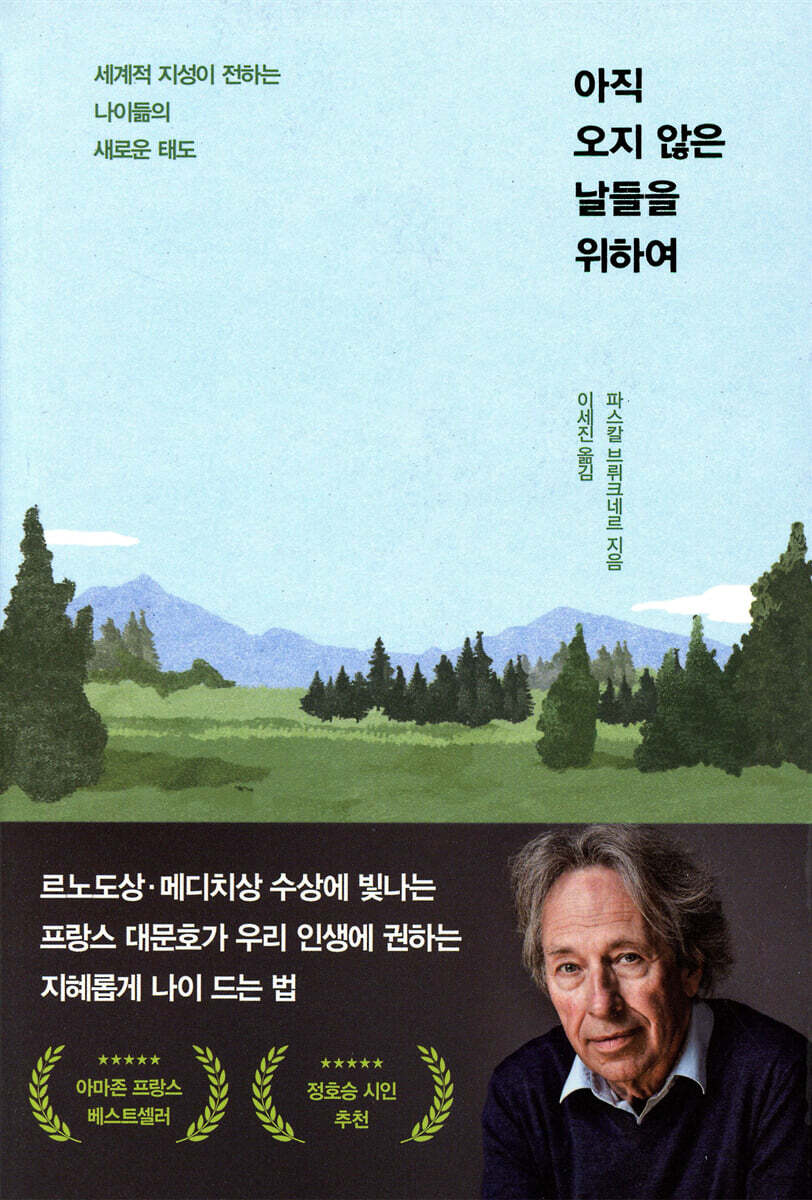
For days yet to come
 |
Description
Book Introduction
- A word from MD
-
To live the rest of your life meaningfullyThe increase in life expectancy is not entirely good news, considering the reality of Korean society, where poverty among the elderly is severe.
Along with material poverty, psychological anxiety, emptiness, and helplessness also make old age difficult.
This book, written by the great French author Pascal Bruckner, is a must-read guide to living the second half of your life meaningfully.
November 23, 2021. Humanities PD Son Min-gyu
Winner of the Medici Prize, Renault Prize, Montaigne Prize, and Duménil Prize
A new work by the great French author Pascal Bruckner
“Is twilight a time of perfection or another adolescence?”
A new philosophy of twilight that makes you dream of a new spring in the autumn of life.
Today's 50-somethings resemble Renaissance newborns.
About 300 years ago, the average life expectancy of Europeans was around 30 years, so both are similar in that they have about 30 years left on average.
In 1922, the day after Marcel Proust won the Prix Goncourt, the newspapers ran an article titled "A Place for the Old!", and he was only 48 years old at the time.
Who would consider 48 old these days? People used to say, "At 50, you know your destiny," but these days, "at 50, you're in the prime of your life."
For modern people, who live longer lives and are much healthier than anyone in human history, 'age' is less of an absolute number than before.
Yet, aren't we repeating outdated coming-of-age narratives, saying, "This is what you should do when you get to a certain age?" As the life guidelines passed down from generation to generation gradually lose their force, Pascal Bruckner, a world-renowned French intellectual, proposes a new approach to "aging" by writing a narrative of post-growth instead of the stale coming-of-age novel.
Why do we feel like we're stealing bread from the next generation as we age? What enables us to continue living meaningful lives? "For Days Yet to Come" explores ten themes: "renunciation, place, routine, time, desire, love, opportunity, limitations, death, and eternity." Through a wealth of quotations from Pascal, Montaigne, Freud, and Nietzsche, it presents readers with a eloquent, world-renowned thought process.
It is full of brilliant stories that will help you train yourself to make the latter half of your life a shining opportunity, such as, ‘Give up on giving up,’ ‘Build a solid framework for your life with routines,’ ‘Spend time as if you will die right now, but never die,’ ‘Love until the day you die,’ and ‘Know your limits clearly and do what you can.’
The saying, 'When you get old, give up' is now an old saying.
For those of you still in the prime of your life, listen to this story of possibility that will push you to test your strength until the very end.
A new work by the great French author Pascal Bruckner
“Is twilight a time of perfection or another adolescence?”
A new philosophy of twilight that makes you dream of a new spring in the autumn of life.
Today's 50-somethings resemble Renaissance newborns.
About 300 years ago, the average life expectancy of Europeans was around 30 years, so both are similar in that they have about 30 years left on average.
In 1922, the day after Marcel Proust won the Prix Goncourt, the newspapers ran an article titled "A Place for the Old!", and he was only 48 years old at the time.
Who would consider 48 old these days? People used to say, "At 50, you know your destiny," but these days, "at 50, you're in the prime of your life."
For modern people, who live longer lives and are much healthier than anyone in human history, 'age' is less of an absolute number than before.
Yet, aren't we repeating outdated coming-of-age narratives, saying, "This is what you should do when you get to a certain age?" As the life guidelines passed down from generation to generation gradually lose their force, Pascal Bruckner, a world-renowned French intellectual, proposes a new approach to "aging" by writing a narrative of post-growth instead of the stale coming-of-age novel.
Why do we feel like we're stealing bread from the next generation as we age? What enables us to continue living meaningful lives? "For Days Yet to Come" explores ten themes: "renunciation, place, routine, time, desire, love, opportunity, limitations, death, and eternity." Through a wealth of quotations from Pascal, Montaigne, Freud, and Nietzsche, it presents readers with a eloquent, world-renowned thought process.
It is full of brilliant stories that will help you train yourself to make the latter half of your life a shining opportunity, such as, ‘Give up on giving up,’ ‘Build a solid framework for your life with routines,’ ‘Spend time as if you will die right now, but never die,’ ‘Love until the day you die,’ and ‘Know your limits clearly and do what you can.’
The saying, 'When you get old, give up' is now an old saying.
For those of you still in the prime of your life, listen to this story of possibility that will push you to test your strength until the very end.
- You can preview some of the book's contents.
Preview
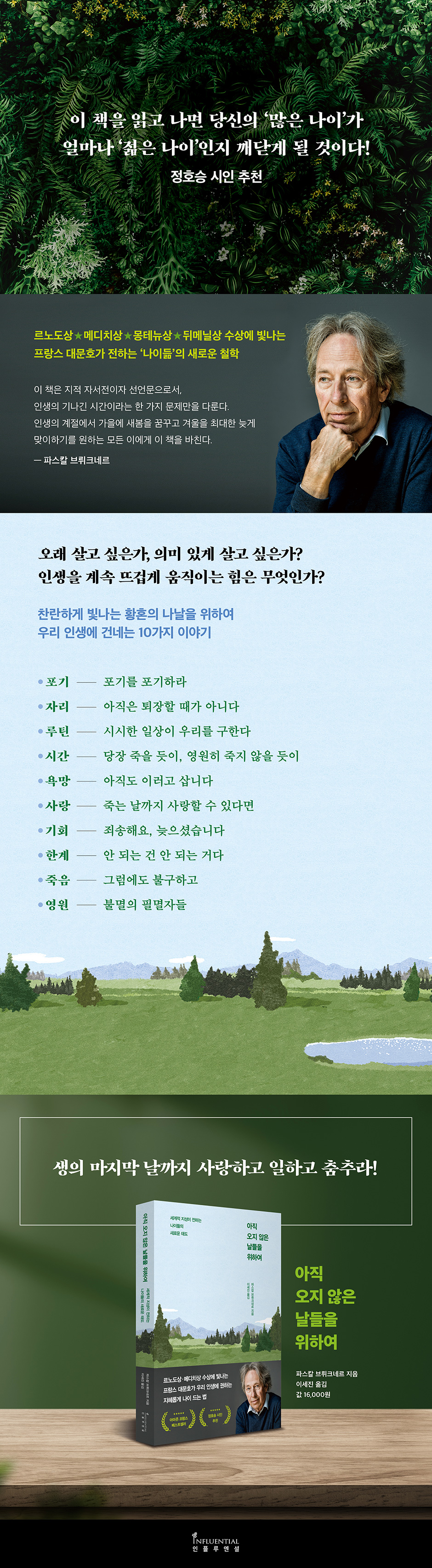
index
Prologue - Being Old Doesn't Mean You're Always That Age
Give up - give up giving up
Life started to feel short
cold water shower
To challenge until the last day of my life
*Desire more than you need*
Seat - It's not time to leave yet
I didn't want to retire
The age of philosophy
The last adolescence of life
*“You haven’t changed at all!”*
Routine - The Simple Daily Life Saves Us
I'm tired of living
The splendor of the trivial
We die and are reborn every day.
Repetition, newness wearing the mask of deja vu
Dusk should resemble dawn.
Is it a swan song or a morning glow?
*Life is an absurd and wonderful gift*
*Those who still have blood on their heads*
Time - as if I'm going to die right now, as if I'll never die
Live every moment as if you were going to die.
The past is not over yet
Life is a moving mosaic
Back to the mind of a child
You are not mature enough for your fruit.
*Do you think grandparents are open 24 hours a day?*
*Can't go down the ladder*
Desire - I still live like this
Good age to date
Escape from the Venus Empire
Even Casanova grows old
*Life is still full of possibilities*
*The windbag and the whiner*
Love - If I could love until the day I die
Love with a white crown
The embers turned to ashes
If I could love you until the day I die
*The old couple's breakup formula*
Opportunity - Sorry, you're late.
Opportunities we didn't take
Mortal Time
I still want to dance
On the blank page of the afterlife
*If you look at the obituary column in the newspaper*
*Family photo of three generations*
Limits - What can't be done can't be done
What can I do if this is me?
The Three Faces of Freedom
The door opens to the unknown
Don't be completely successful
What can't be done is what can't be done
*Who uses words like that these days*
Death - Nevertheless
The scoundrels who gnaw at us and break us down
Death of death
You're lucky you can die
Love what you will never see again
I'm afraid I might die
The zombie within us
*Old child and young old man*
Eternity - Immortal Mortals
What illness teaches us
Hierarchy of Pain
Poor comfort
Mr. Mangnani, please wait a little longer.
Eternity is here now
*Comforting Techniques to Avoid Logical Bullshit*
Epilogue - Love, Praise, Serve
main
Give up - give up giving up
Life started to feel short
cold water shower
To challenge until the last day of my life
*Desire more than you need*
Seat - It's not time to leave yet
I didn't want to retire
The age of philosophy
The last adolescence of life
*“You haven’t changed at all!”*
Routine - The Simple Daily Life Saves Us
I'm tired of living
The splendor of the trivial
We die and are reborn every day.
Repetition, newness wearing the mask of deja vu
Dusk should resemble dawn.
Is it a swan song or a morning glow?
*Life is an absurd and wonderful gift*
*Those who still have blood on their heads*
Time - as if I'm going to die right now, as if I'll never die
Live every moment as if you were going to die.
The past is not over yet
Life is a moving mosaic
Back to the mind of a child
You are not mature enough for your fruit.
*Do you think grandparents are open 24 hours a day?*
*Can't go down the ladder*
Desire - I still live like this
Good age to date
Escape from the Venus Empire
Even Casanova grows old
*Life is still full of possibilities*
*The windbag and the whiner*
Love - If I could love until the day I die
Love with a white crown
The embers turned to ashes
If I could love you until the day I die
*The old couple's breakup formula*
Opportunity - Sorry, you're late.
Opportunities we didn't take
Mortal Time
I still want to dance
On the blank page of the afterlife
*If you look at the obituary column in the newspaper*
*Family photo of three generations*
Limits - What can't be done can't be done
What can I do if this is me?
The Three Faces of Freedom
The door opens to the unknown
Don't be completely successful
What can't be done is what can't be done
*Who uses words like that these days*
Death - Nevertheless
The scoundrels who gnaw at us and break us down
Death of death
You're lucky you can die
Love what you will never see again
I'm afraid I might die
The zombie within us
*Old child and young old man*
Eternity - Immortal Mortals
What illness teaches us
Hierarchy of Pain
Poor comfort
Mr. Mangnani, please wait a little longer.
Eternity is here now
*Comforting Techniques to Avoid Logical Bullshit*
Epilogue - Love, Praise, Serve
main
Detailed image
Into the book
Humans, as animals, feel like they will never age and will live for thousands of years until they are 30.
For him, birthdays are just a fun formality, a harmless sign.
From then on, the 30s, 40s, and 50s follow in 10-year increments.
Growing old means being incorporated into the calendar, becoming a person of a bygone era.
Age makes us sympathize with the passage of time, but it also makes it tragic.
It is sad to be bound together by common conditions and to be swayed by them.
Just because I'm older doesn't mean I'm that age.
I'm talking about the gap between my age on paper and my perceived age.
In this day and age, this gap is too big.
--- p.14~15
Now a new demographic has emerged between the mature and old ages.
A generation that is physically healthy and has more resources than the rest of the population, which can be called 'senior' after the Latin word.
At this time, many people have raised their children, have finished their marital duties, and choose to divorce or remarry.
These changes are not limited to Western societies.
In Asia, Africa, and South America, declining birth rates and aging populations are also progressing, but the material conditions for this situation are not being sufficiently considered.
--- p.22
If the population becomes over 100 years old, people in their 70s might be treated like spoiled children.
Ha, these days young people don't know what respect is or what not!
--- p.26
The fact that entire age groups in our society have stopped working since World War II—that is, they only consume and not produce—is a disaster brought about by the best of intentions.
Experience and insight usually grow with age.
As older adults continue to do their old jobs or find new ones, they will regain relationships, volunteer, and become fully active participants.
Then, the prejudice that views the elderly as parasites that need to be quickly eliminated will disappear.
--- p.47
Samuel Butler said, “Life is like learning the violin by playing the violin concerto.”
We will still be practicing until the last day, playing each note awkwardly.
--- p.119
Life is a very long letter written in small letters.
The journey of life is sometimes incredibly dangerous, but it is truly wonderful.
Pierre Weil, a French thinker who thought about tolerance before Voltaire, argued for “the right of consciousness to wander.”
Rather than being forced to accept a certain truth or belief, we need the right to make mistakes and reflect on our own judgment.
In that sense, we are all wandering souls, living day to day on the spur of the moment.
We take our time, sidestepping and taking scenic detours as we head towards the finish.
The downhill slope of life must be taken like the uphill slope.
--- p.123~124
Love is rejoicing in the existence of the other and telling the other person that fact every day by being alive.
If you want to experience the joys of life, rescue each day from the futility of life, and change the stagnation of everyday life, these two are perfect.
What did you do today? Even if you didn't do anything in particular, there's a huge difference between recounting the day's events in detail with a loved one by your side and mulling them over alone.
At any time, we need someone who will warmly listen to our sorrows and miseries.
At any time, we can be the ones who listen to others and offer comfort and advice.
--- p.170
The diversity of destiny is always related to encounters with people.
Without encounters, we would not gain any depth.
Growing old means acknowledging and cherishing this infinite debt.
The others we met made us who we are today.
Each and every one of us is a collective work called 'me'.
--- p.219
When we are young, our bodies are more like our friends, or rather, our servants.
It recovers on its own without us having to take care of it separately and moves as we want.
Sometimes our bodies surprise us with capabilities and capacities beyond our expectations.
At times like that, we feel invincible.
Things change after the age of 30, and your body demands constant attention.
The servant becomes a demanding master, nagging us day after day, leaving us confused as to whether this is a fuss or a worry.
Should I be on guard now, or am I just too scared?
For him, birthdays are just a fun formality, a harmless sign.
From then on, the 30s, 40s, and 50s follow in 10-year increments.
Growing old means being incorporated into the calendar, becoming a person of a bygone era.
Age makes us sympathize with the passage of time, but it also makes it tragic.
It is sad to be bound together by common conditions and to be swayed by them.
Just because I'm older doesn't mean I'm that age.
I'm talking about the gap between my age on paper and my perceived age.
In this day and age, this gap is too big.
--- p.14~15
Now a new demographic has emerged between the mature and old ages.
A generation that is physically healthy and has more resources than the rest of the population, which can be called 'senior' after the Latin word.
At this time, many people have raised their children, have finished their marital duties, and choose to divorce or remarry.
These changes are not limited to Western societies.
In Asia, Africa, and South America, declining birth rates and aging populations are also progressing, but the material conditions for this situation are not being sufficiently considered.
--- p.22
If the population becomes over 100 years old, people in their 70s might be treated like spoiled children.
Ha, these days young people don't know what respect is or what not!
--- p.26
The fact that entire age groups in our society have stopped working since World War II—that is, they only consume and not produce—is a disaster brought about by the best of intentions.
Experience and insight usually grow with age.
As older adults continue to do their old jobs or find new ones, they will regain relationships, volunteer, and become fully active participants.
Then, the prejudice that views the elderly as parasites that need to be quickly eliminated will disappear.
--- p.47
Samuel Butler said, “Life is like learning the violin by playing the violin concerto.”
We will still be practicing until the last day, playing each note awkwardly.
--- p.119
Life is a very long letter written in small letters.
The journey of life is sometimes incredibly dangerous, but it is truly wonderful.
Pierre Weil, a French thinker who thought about tolerance before Voltaire, argued for “the right of consciousness to wander.”
Rather than being forced to accept a certain truth or belief, we need the right to make mistakes and reflect on our own judgment.
In that sense, we are all wandering souls, living day to day on the spur of the moment.
We take our time, sidestepping and taking scenic detours as we head towards the finish.
The downhill slope of life must be taken like the uphill slope.
--- p.123~124
Love is rejoicing in the existence of the other and telling the other person that fact every day by being alive.
If you want to experience the joys of life, rescue each day from the futility of life, and change the stagnation of everyday life, these two are perfect.
What did you do today? Even if you didn't do anything in particular, there's a huge difference between recounting the day's events in detail with a loved one by your side and mulling them over alone.
At any time, we need someone who will warmly listen to our sorrows and miseries.
At any time, we can be the ones who listen to others and offer comfort and advice.
--- p.170
The diversity of destiny is always related to encounters with people.
Without encounters, we would not gain any depth.
Growing old means acknowledging and cherishing this infinite debt.
The others we met made us who we are today.
Each and every one of us is a collective work called 'me'.
--- p.219
When we are young, our bodies are more like our friends, or rather, our servants.
It recovers on its own without us having to take care of it separately and moves as we want.
Sometimes our bodies surprise us with capabilities and capacities beyond our expectations.
At times like that, we feel invincible.
Things change after the age of 30, and your body demands constant attention.
The servant becomes a demanding master, nagging us day after day, leaving us confused as to whether this is a fuss or a worry.
Should I be on guard now, or am I just too scared?
--- p.276
Publisher's Review
Amazon France Bestseller
Rave reviews from major French media outlets including [Le Monde], [Le Figaro], and [Le Point]
After reading this book, you'll realize just how "young" your "old age" really is! - Poet Jeong Ho-seung
“How will I age?”
- From Montaigne to Sartre, the most eloquent answers to life's uncertainties.
Pascal Bruckner, a novelist and philosopher who has won numerous prestigious French literary awards and is recognized for his outstanding literary talent, presents a splendid world of reflection on the potentially lonely topic of "aging."
The author's sophisticated writing style, which freely moves between literature, philosophy, and popular culture while expressing his thoughts in a flowing style, makes the book quite enjoyable to read.
The author weaves together a variety of references, including Maupassant, Frost, Sartre, Montaigne, and Seneca, to mature into a brilliant insight into 'aging.'
No matter how much medicine and technology advance, the uncertainty of the future has not improved since the 17th century, and the transience of each day has not been reduced in the slightest.
As life gets longer, the paradox arises that we have to endure longer periods of anxiety.
It is the role of philosophy to provide a compass for this very uncertainty of life.
Montaigne said, “Philosophy is learning to die,” and in the same context, the author says, “Philosophy is learning to live, and especially learning how to live again in the horizon of the finite.”
If life has spring and hot summer, fall and winter, which season are we living in now? In "For the Days Yet to Come," we encounter a philosophy of twilight that allows us to live a life filled with the energy of a new spring, even as life's fall and winter come.
“Love, work and dance until the last day of your life!”
The problematic novelist of "Bitter Moon" returns to the philosophy of desire.
The author of this book, Pascal Brückner, is well known in Korea as the novelist of Bitter Moon.
The novel "Bitter Moon," which was also made into a film of the same name, was a controversial work that boldly depicted the destructiveness of desire and was a sensation that shook the French literary world in the 1990s.
The characters in the novel boldly rush toward destruction in pursuit of their own desires, and this attitude remains in the life view of the author, who is now in his seventies.
Returning to being a philosopher, he says:
“We must understand that only desire can rejuvenate the soul and mind.
“Desire constantly re-invents us.” (p. 165) “As we age, we must keep our hearts young, maintaining our desire for the world, our joy, and our curiosity about the next generation.” (p. 95) According to him, the way to slow down the clock of life is to remain within the “dynamism of desire.”
If the world has so far denied the very existence of desires in old age, this book urges us to cultivate our lives by striving to preserve our physical and mental desires, lest our lives become barren in old age.
Do you dream of a life where passion sparkles and your soul and heart burn brightly even as you age? Follow this new philosophy of aging, reconcile "romance" with "wrinkles," willingly surrender to the storm of emotions, and live with "love crowned with white hair."
“My summer isn’t over yet!”
- How to spend the second half of your life brilliantly
How much does "my age" describe me as a person? The average human lifespan was 30-35 years in the 1800s, but by the 1900s, it had risen to 45-50 years, and now lifespans are increasing by about three months per year.
As life expectancy increases, we don't just live longer; our relationship with life fundamentally changes.
Aren't the values regarding education, career, family, and love already significantly different from those of previous generations?
As our paper age becomes less and less accurate in describing who we are, we must find our own way to live the days ahead.
Haven't you ever heard someone say, "Why does someone of your age act like that?"
There was a time when age was another name for limitations and restrictions, and not being worthy of your age was shameful.
As I got older, the list of things I shouldn't do and things I should give up on only got longer.
Against this conventional wisdom, this book offers a new perspective on 'aging' and boldly says, "Give up on giving up."
Why should we live by organizing, compromising, and giving up when life is still in full swing? Let's ask ourselves this question as we follow the author's ten stories on topics like position, desire, love, and death.
Do you want to live long or intensely? How will you endure the fatigue of existence and the gloom of twilight? What is the driving force that keeps life moving with such fervor? Ultimately, it's up to us to make the days yet to come a time of anticipation and excitement.
Rave reviews from major French media outlets including [Le Monde], [Le Figaro], and [Le Point]
After reading this book, you'll realize just how "young" your "old age" really is! - Poet Jeong Ho-seung
“How will I age?”
- From Montaigne to Sartre, the most eloquent answers to life's uncertainties.
Pascal Bruckner, a novelist and philosopher who has won numerous prestigious French literary awards and is recognized for his outstanding literary talent, presents a splendid world of reflection on the potentially lonely topic of "aging."
The author's sophisticated writing style, which freely moves between literature, philosophy, and popular culture while expressing his thoughts in a flowing style, makes the book quite enjoyable to read.
The author weaves together a variety of references, including Maupassant, Frost, Sartre, Montaigne, and Seneca, to mature into a brilliant insight into 'aging.'
No matter how much medicine and technology advance, the uncertainty of the future has not improved since the 17th century, and the transience of each day has not been reduced in the slightest.
As life gets longer, the paradox arises that we have to endure longer periods of anxiety.
It is the role of philosophy to provide a compass for this very uncertainty of life.
Montaigne said, “Philosophy is learning to die,” and in the same context, the author says, “Philosophy is learning to live, and especially learning how to live again in the horizon of the finite.”
If life has spring and hot summer, fall and winter, which season are we living in now? In "For the Days Yet to Come," we encounter a philosophy of twilight that allows us to live a life filled with the energy of a new spring, even as life's fall and winter come.
“Love, work and dance until the last day of your life!”
The problematic novelist of "Bitter Moon" returns to the philosophy of desire.
The author of this book, Pascal Brückner, is well known in Korea as the novelist of Bitter Moon.
The novel "Bitter Moon," which was also made into a film of the same name, was a controversial work that boldly depicted the destructiveness of desire and was a sensation that shook the French literary world in the 1990s.
The characters in the novel boldly rush toward destruction in pursuit of their own desires, and this attitude remains in the life view of the author, who is now in his seventies.
Returning to being a philosopher, he says:
“We must understand that only desire can rejuvenate the soul and mind.
“Desire constantly re-invents us.” (p. 165) “As we age, we must keep our hearts young, maintaining our desire for the world, our joy, and our curiosity about the next generation.” (p. 95) According to him, the way to slow down the clock of life is to remain within the “dynamism of desire.”
If the world has so far denied the very existence of desires in old age, this book urges us to cultivate our lives by striving to preserve our physical and mental desires, lest our lives become barren in old age.
Do you dream of a life where passion sparkles and your soul and heart burn brightly even as you age? Follow this new philosophy of aging, reconcile "romance" with "wrinkles," willingly surrender to the storm of emotions, and live with "love crowned with white hair."
“My summer isn’t over yet!”
- How to spend the second half of your life brilliantly
How much does "my age" describe me as a person? The average human lifespan was 30-35 years in the 1800s, but by the 1900s, it had risen to 45-50 years, and now lifespans are increasing by about three months per year.
As life expectancy increases, we don't just live longer; our relationship with life fundamentally changes.
Aren't the values regarding education, career, family, and love already significantly different from those of previous generations?
As our paper age becomes less and less accurate in describing who we are, we must find our own way to live the days ahead.
Haven't you ever heard someone say, "Why does someone of your age act like that?"
There was a time when age was another name for limitations and restrictions, and not being worthy of your age was shameful.
As I got older, the list of things I shouldn't do and things I should give up on only got longer.
Against this conventional wisdom, this book offers a new perspective on 'aging' and boldly says, "Give up on giving up."
Why should we live by organizing, compromising, and giving up when life is still in full swing? Let's ask ourselves this question as we follow the author's ten stories on topics like position, desire, love, and death.
Do you want to live long or intensely? How will you endure the fatigue of existence and the gloom of twilight? What is the driving force that keeps life moving with such fervor? Ultimately, it's up to us to make the days yet to come a time of anticipation and excitement.
GOODS SPECIFICS
- Publication date: November 12, 2021
- Page count, weight, size: 320 pages | 476g | 138*205*30mm
- ISBN13: 9791168340039
- ISBN10: 1168340039
You may also like
카테고리
korean


korean

![GQ KOREA Mark (Monthly): December [2025]](http://librairie.coreenne.fr/cdn/shop/files/8ef265dbbfbf186523ed75ba7319009d.jpg?v=1765340328&width=3840)


