

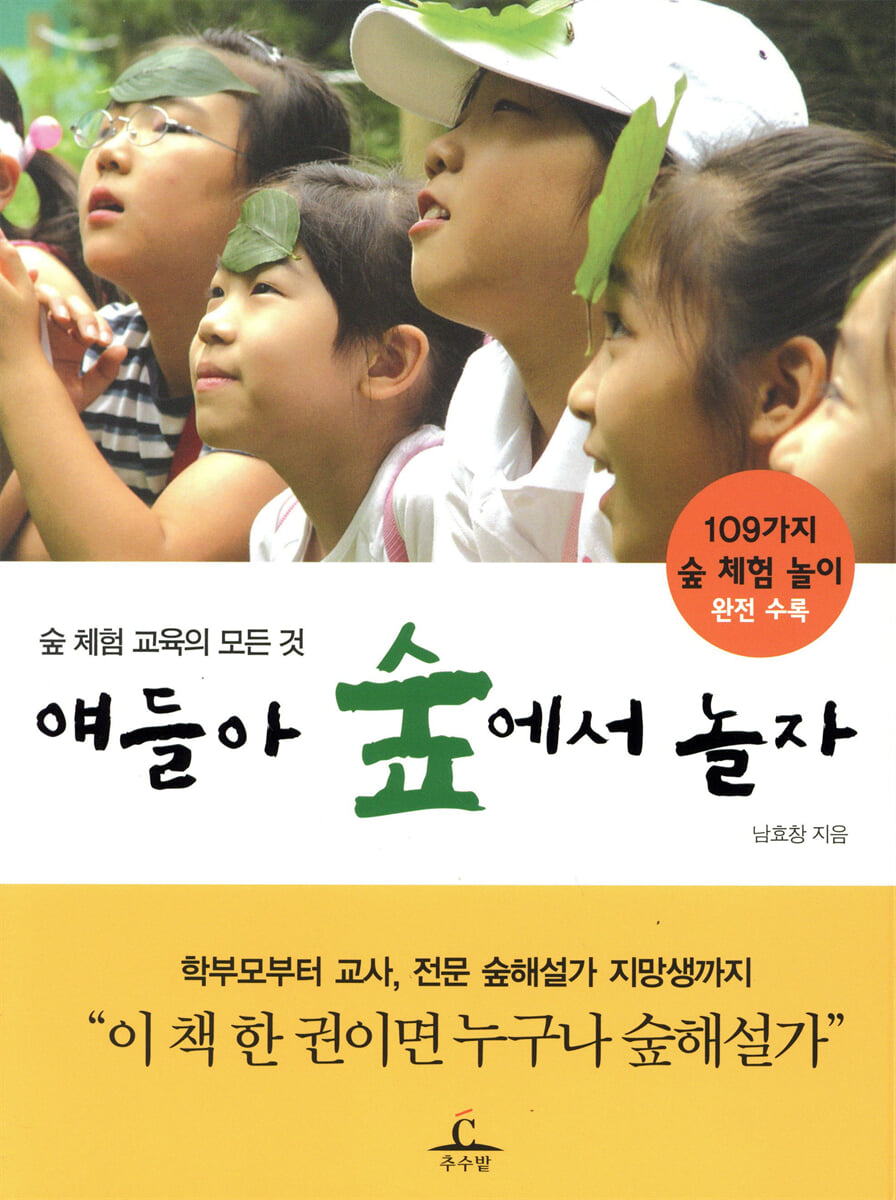
Kids, let's play in the forest
 |
Description
Book Introduction
The importance of forest experience education is increasing day by day because forest experiences are a source of emotion that can awaken children's five senses.
This book is a compilation of all the know-how on forest experience play that Dr. Nam Hyo-chang, director of the Forest Research Institute, has accumulated over 20 years of research on forests and years of conducting forest ecology experience education.
The author provides a detailed and friendly guide to forest experience education from start to finish, based on the philosophical background that nature and humans must coexist, making it a perfect forest experience education textbook for experts in the field.
It also includes 109 forest experience activities, making it a helpful forest experience guide for parents, kindergarten, and elementary, middle, and high school teachers.
This book is a compilation of all the know-how on forest experience play that Dr. Nam Hyo-chang, director of the Forest Research Institute, has accumulated over 20 years of research on forests and years of conducting forest ecology experience education.
The author provides a detailed and friendly guide to forest experience education from start to finish, based on the philosophical background that nature and humans must coexist, making it a perfect forest experience education textbook for experts in the field.
It also includes 109 forest experience activities, making it a helpful forest experience guide for parents, kindergarten, and elementary, middle, and high school teachers.
index
Prologue: Dreaming of a happy encounter between nature and humanity
Part 1: Ecological Experience Education for Forest Interpreters
1.
Ecological experiential education that connects nature and humans
2.
Future-oriented education that nurtures true human beings
Living in harmony with nature | Developing a sound character and personality | Insurance for a bright future | Experiential education seven times more effective than theoretical education | The birth of ecological experiential education
3.
Ecological experience education according to age and target audience
Fairytale Forest | Magic Forest | Discovery of Nature | Forest of Existence | Forest of Togetherness
4.
5 Nature-Themed Educational Activities
Ecological Education | Nature Education | Environmental Education | Experiential Education | Forest Ecology Education
Part 2: Practical Strategies for Ecological Play in the Forest
1.
7 Fun, Eco-Friendly Ways to Play in the Forest
Play activities | Homework activities | Commentary activities | Discussion activities | Exploration activities | Role-play activities | Example activities
2.
Veteran Forest Interpreter's Ecological Experience Education Charter
Creating an Ecological Experiential Learning Center | Qualities of a Veteran Ecological Experiential Educator
3.
Drawing the blueprint for ecological experiential education
Flow of the ecological experience education course
4.
Basic Design of Ecological Experiential Education
Gathering Ideas | Developing Key Topics | Organizing Content | Developing a Budget | Receiving Training Applications | Gathering Participant Information | Advertising and Recruitment
5.
11 Practical Steps for Successful Ecological Experiential Education
Ecological Experience Teacher Structure | Field Trips | Ecological Experience Education | Preparation of Materials and Materials | Demonstrations and Rehearsals | Meeting with Trainees | Progression in Chronological Order | Ecological Experience Education Evaluation | Organizing Tools and Supplies | Organizing Records and Photos | Organizing Evaluation Content
6.
Ecological experiential education through group activities
Setting Group Rules | Role-Playing | Effective Education through Group Conflict Resolution | The Laws of Communication
Part 3 Kids, Let's Play in the Forest
109 Forest Ecology Experience Activities
Author's Note: The forest is a source of emotion and intellect.
Recommended References
Part 1: Ecological Experience Education for Forest Interpreters
1.
Ecological experiential education that connects nature and humans
2.
Future-oriented education that nurtures true human beings
Living in harmony with nature | Developing a sound character and personality | Insurance for a bright future | Experiential education seven times more effective than theoretical education | The birth of ecological experiential education
3.
Ecological experience education according to age and target audience
Fairytale Forest | Magic Forest | Discovery of Nature | Forest of Existence | Forest of Togetherness
4.
5 Nature-Themed Educational Activities
Ecological Education | Nature Education | Environmental Education | Experiential Education | Forest Ecology Education
Part 2: Practical Strategies for Ecological Play in the Forest
1.
7 Fun, Eco-Friendly Ways to Play in the Forest
Play activities | Homework activities | Commentary activities | Discussion activities | Exploration activities | Role-play activities | Example activities
2.
Veteran Forest Interpreter's Ecological Experience Education Charter
Creating an Ecological Experiential Learning Center | Qualities of a Veteran Ecological Experiential Educator
3.
Drawing the blueprint for ecological experiential education
Flow of the ecological experience education course
4.
Basic Design of Ecological Experiential Education
Gathering Ideas | Developing Key Topics | Organizing Content | Developing a Budget | Receiving Training Applications | Gathering Participant Information | Advertising and Recruitment
5.
11 Practical Steps for Successful Ecological Experiential Education
Ecological Experience Teacher Structure | Field Trips | Ecological Experience Education | Preparation of Materials and Materials | Demonstrations and Rehearsals | Meeting with Trainees | Progression in Chronological Order | Ecological Experience Education Evaluation | Organizing Tools and Supplies | Organizing Records and Photos | Organizing Evaluation Content
6.
Ecological experiential education through group activities
Setting Group Rules | Role-Playing | Effective Education through Group Conflict Resolution | The Laws of Communication
Part 3 Kids, Let's Play in the Forest
109 Forest Ecology Experience Activities
Author's Note: The forest is a source of emotion and intellect.
Recommended References
Into the book
If you ask people what and how insects smell, very few will be able to answer.
But we know insects well and even know their structures and internal organs.
I have no idea how it affects our lives.
Wouldn't it be more important to understand the numerous relationships that exist within nature and live in harmony with it?
I believe that the process of trying to find answers is more important than finding the perfect answer to a question, and that this is one way of achieving true ecological education. --- p.11
Direct experience with nature will cultivate the ability to see nature in its true form, and this will be the spark that fosters creativity.
--- p.24
Let's go to the forest with the kids.
They don't ask for much.
Just lying down in the forest and feeling the forest is enough.
It all starts with becoming acquainted with the forest, but children gain and give much more than meets the eye.
You can learn it little by little, slowly.
Isn't it easier to see something once than to hear it ten times? Is there any education more effective than this? --- p.57
Play in nature sharpens perception (sensory play), increases knowledge (observation and exploration), helps recognize connections (role play), and encourages creativity (making shapes and models).
It also helps you relax and feel your body in a good way (movement play).
--- p.88
Many people don't realize that the forest is a more organized space than a classroom or lecture hall.
It is clear that the teaching method of ecological experiential education has many advantages over events held in a walled environment.
But we know insects well and even know their structures and internal organs.
I have no idea how it affects our lives.
Wouldn't it be more important to understand the numerous relationships that exist within nature and live in harmony with it?
I believe that the process of trying to find answers is more important than finding the perfect answer to a question, and that this is one way of achieving true ecological education. --- p.11
Direct experience with nature will cultivate the ability to see nature in its true form, and this will be the spark that fosters creativity.
--- p.24
Let's go to the forest with the kids.
They don't ask for much.
Just lying down in the forest and feeling the forest is enough.
It all starts with becoming acquainted with the forest, but children gain and give much more than meets the eye.
You can learn it little by little, slowly.
Isn't it easier to see something once than to hear it ten times? Is there any education more effective than this? --- p.57
Play in nature sharpens perception (sensory play), increases knowledge (observation and exploration), helps recognize connections (role play), and encourages creativity (making shapes and models).
It also helps you relax and feel your body in a good way (movement play).
--- p.88
Many people don't realize that the forest is a more organized space than a classroom or lecture hall.
It is clear that the teaching method of ecological experiential education has many advantages over events held in a walled environment.
--- p.108
Publisher's Review
Playing in the forest is also a strategy - Everything you need to know about forest play
It has been over 20 years since the author moved to Germany and majored in forest ecology at the University of Freiburg, and it has been just six years since he returned to Korea and opened a forest research institute and began operating a forest ecology experience program.
This is the ultimate forest ecology experience education program that encapsulates the know-how that Dr. Nam Hyo-chang has accumulated over the past several decades.
Therefore, it can be used as an essential textbook for educators who lead forest ecology experience programs in the field.
It is also a great guidebook for parents who visit the forest holding their children's hands to experience becoming one with nature.
A friendly and complete guide for forest ecology educators
As the importance of ecological experiential education grows, all kinds of experiential programs are flourishing in mountains, fields, and tidal flats across the country.
In particular, forest ecology experiences are more popular than any other program because they take place ‘inside’ nature.
However, there are not many teaching materials that educators can refer to in the field.
The author has been directly operating a forest experience program through the Forest Research Institute for several years and has meticulously observed the entire process of forest ecology education and organized it into a book.
What does it mean to play in the forest? While traditional education primarily relied on one-sided commentary, forest ecology experiential education is gradually incorporating active activities.
The author introduces 'How to Play in the Forest' as the cornerstone of forest ecology experience education in seven ways: play activities, assignment activities, explanation activities, discussion activities, exploration activities, role-playing activities, and example activities.
If these seven activities are organically combined according to location, time, age, and target, a forest ecology experience education program is formed.
So how does a program actually proceed? Drawing on his own experience and expertise, the author guides the entire process, from deciding on a program theme and recruiting trainees, budgeting, and advertising, to recruiting instructors, field trips, conducting the actual training, and finally, evaluating the program.
The essence of eco-edutainment: 109 forest eco-experience activities
The 109 forest experience play programs introduced in Part 3 are what makes this book stand out the most.
The author has organized the forest experience play programs he researched and conducted at the Forest Research Institute by age, target audience, location, time required, and season, and can be said to have pioneered a new genre called eco-edutainment.
Above all, it not only organizes the games that can be played at each stage, such as the beginning stage where you first encounter the forest, the development/climax stage where you actively progress in the forest, and the final stage where you clean up after leaving the forest, but also includes various activities that can help you experience the forest and develop your senses for each game, and since it is described in detail from the beginning to the end of the game, it has the advantage of allowing anyone to easily create their own forest experience play program.
It has been over 20 years since the author moved to Germany and majored in forest ecology at the University of Freiburg, and it has been just six years since he returned to Korea and opened a forest research institute and began operating a forest ecology experience program.
This is the ultimate forest ecology experience education program that encapsulates the know-how that Dr. Nam Hyo-chang has accumulated over the past several decades.
Therefore, it can be used as an essential textbook for educators who lead forest ecology experience programs in the field.
It is also a great guidebook for parents who visit the forest holding their children's hands to experience becoming one with nature.
A friendly and complete guide for forest ecology educators
As the importance of ecological experiential education grows, all kinds of experiential programs are flourishing in mountains, fields, and tidal flats across the country.
In particular, forest ecology experiences are more popular than any other program because they take place ‘inside’ nature.
However, there are not many teaching materials that educators can refer to in the field.
The author has been directly operating a forest experience program through the Forest Research Institute for several years and has meticulously observed the entire process of forest ecology education and organized it into a book.
What does it mean to play in the forest? While traditional education primarily relied on one-sided commentary, forest ecology experiential education is gradually incorporating active activities.
The author introduces 'How to Play in the Forest' as the cornerstone of forest ecology experience education in seven ways: play activities, assignment activities, explanation activities, discussion activities, exploration activities, role-playing activities, and example activities.
If these seven activities are organically combined according to location, time, age, and target, a forest ecology experience education program is formed.
So how does a program actually proceed? Drawing on his own experience and expertise, the author guides the entire process, from deciding on a program theme and recruiting trainees, budgeting, and advertising, to recruiting instructors, field trips, conducting the actual training, and finally, evaluating the program.
The essence of eco-edutainment: 109 forest eco-experience activities
The 109 forest experience play programs introduced in Part 3 are what makes this book stand out the most.
The author has organized the forest experience play programs he researched and conducted at the Forest Research Institute by age, target audience, location, time required, and season, and can be said to have pioneered a new genre called eco-edutainment.
Above all, it not only organizes the games that can be played at each stage, such as the beginning stage where you first encounter the forest, the development/climax stage where you actively progress in the forest, and the final stage where you clean up after leaving the forest, but also includes various activities that can help you experience the forest and develop your senses for each game, and since it is described in detail from the beginning to the end of the game, it has the advantage of allowing anyone to easily create their own forest experience play program.
GOODS SPECIFICS
- Date of issue: April 20, 2006
- Page count, weight, size: 343 pages | 748g | 153*224*30mm
- ISBN13: 9788995768723
You may also like
카테고리
korean


korean

![GQ KOREA Mark (Monthly): December [2025]](http://librairie.coreenne.fr/cdn/shop/files/8ef265dbbfbf186523ed75ba7319009d.jpg?v=1765340328&width=3840)


