

History of Philosophy
 |
Description
Book Introduction
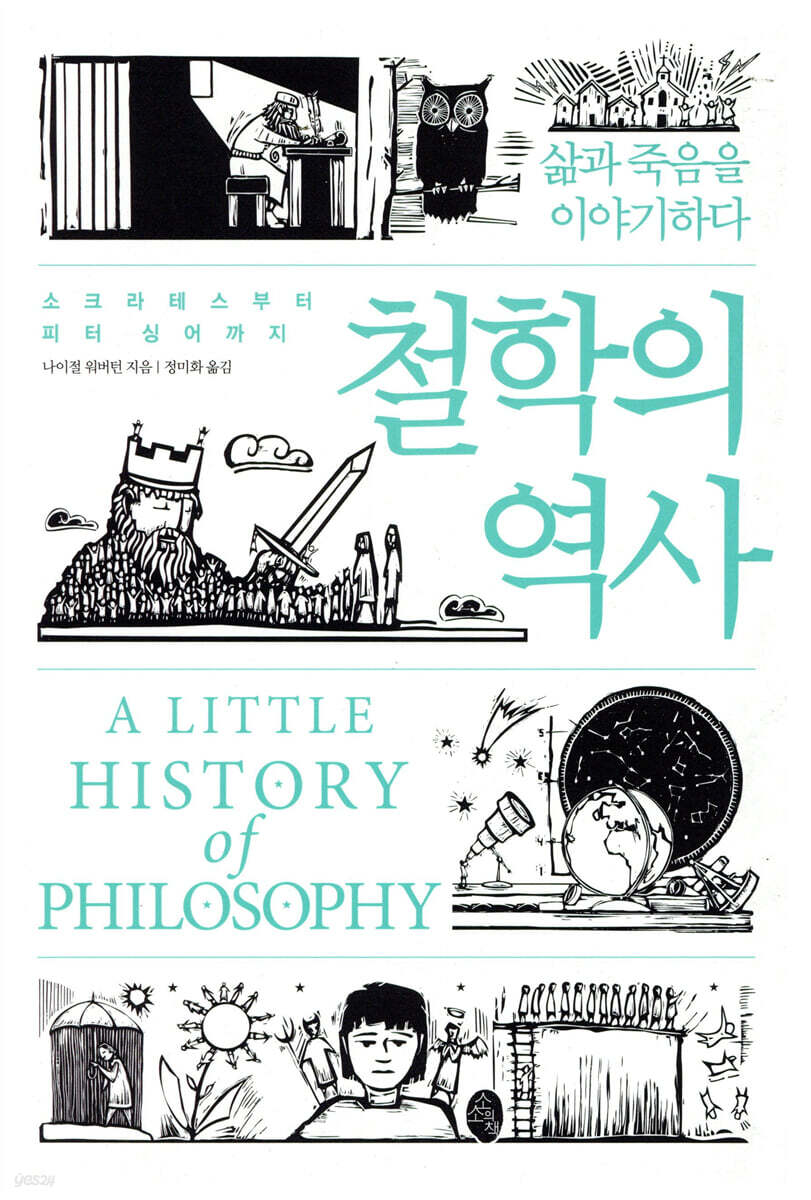
A journey of knowledge that delves into the essence of various topics surrounding humanity.
Questions such as 'How should we live?', 'Does God exist?', and 'What is the nature of the real world?' are topics that philosophers have continuously explored since the time of Socrates to this day.
Philosophers who ask difficult questions, speculate about how objects exist, and debate fiercely with one another in search of truth… … The process of uncovering the essence of countless topics can never end, but thanks to their passion and courage, we have gained a yardstick for looking more clearly into the world of knowledge and the real problems of humanity.
This book uses short, easy-to-understand examples to explain philosophical concepts and discuss what it means to live a truly meaningful life.
Questions such as 'How should we live?', 'Does God exist?', and 'What is the nature of the real world?' are topics that philosophers have continuously explored since the time of Socrates to this day.
Philosophers who ask difficult questions, speculate about how objects exist, and debate fiercely with one another in search of truth… … The process of uncovering the essence of countless topics can never end, but thanks to their passion and courage, we have gained a yardstick for looking more clearly into the world of knowledge and the real problems of humanity.
This book uses short, easy-to-understand examples to explain philosophical concepts and discuss what it means to live a truly meaningful life.
- You can preview some of the book's contents.
Preview
index
1 The Questioning Man _ Socrates and Plato
2 True Happiness _ Aristotle
3 We know nothing _Pyrrhon
4 Garden Walks _Epicurus
5 Learning Not to Worry _ Epictetus, Cicero, Seneca
6 Who Controls Us? _Augustine
7 The Consolation of Philosophy _ Boethius
8 Perfect Islands _ Anselm and Aquinas
9 The Fox and the Lion _Niccolò Machiavelli
10 Horrible, Savage, and Short _Thomas Hobbes
11 Were We Dreaming? _René Descartes
12 Place Your Bet _Blaise Pascal
13 The Lens Grinder _Baruch Spinoza
14 The Prince and the Shoemaker _ John Locke and Thomas Read
The Elephant in the Room _ George Berkeley (and John Locke)
16 Is This the Best Possible World? _Voltaire and Gottfried Leibniz
17 The Virtual Watchmaker _David Hume
18 Born Free _Jean-Jacques Rousseau
19 Rosy Reality _ Immanuel Kant 1
20 What if everyone did that? _Immanuel Kant 2
21 Practical Happiness _ Jeremy Bentham
22 The Owl of Minerva _ Georg Wilhelm Friedrich Hegel
23 A Glimpse of Reality _Arthur Schopenhauer
24. Room to Grow _ John Stuart Mill
25 Unintelligent Design _ Charles Darwin
26 The Sacrifice of Life _Søren Kierkegaard
Workers of the world, unite _Karl Marx
28 So What? _Charles Sanders Peirce and William James
29 The Death of God _Friedrich Nietzsche
30 Disguised Thoughts _ Sigmund Freud
31 Is the current King of France bald? _Bertrand Russell
32 Whoa! / Whoa! _Alfred Jules Ayer
33 The Pain of Freedom _Jean-Paul Sartre, Simone de Beauvoir, Albert Camus
34 The Magic of Language _Ludwig Wittgenstein
35 The Man Who Asks No Questions _ Hannah Arendt
36 Learning from Mistakes _Karl Popper and Thomas Kuhn
37 Runaway Train and the Unwanted Violinist _Philippa Foot and Judith Jarvis Thompson
38 Justice by Ignorance _ John Rawls
39 Can Computers Think? _Alan Turing and John Searle
40 Modern Backs _ Peter Singer
Translator's Note
Search
2 True Happiness _ Aristotle
3 We know nothing _Pyrrhon
4 Garden Walks _Epicurus
5 Learning Not to Worry _ Epictetus, Cicero, Seneca
6 Who Controls Us? _Augustine
7 The Consolation of Philosophy _ Boethius
8 Perfect Islands _ Anselm and Aquinas
9 The Fox and the Lion _Niccolò Machiavelli
10 Horrible, Savage, and Short _Thomas Hobbes
11 Were We Dreaming? _René Descartes
12 Place Your Bet _Blaise Pascal
13 The Lens Grinder _Baruch Spinoza
14 The Prince and the Shoemaker _ John Locke and Thomas Read
The Elephant in the Room _ George Berkeley (and John Locke)
16 Is This the Best Possible World? _Voltaire and Gottfried Leibniz
17 The Virtual Watchmaker _David Hume
18 Born Free _Jean-Jacques Rousseau
19 Rosy Reality _ Immanuel Kant 1
20 What if everyone did that? _Immanuel Kant 2
21 Practical Happiness _ Jeremy Bentham
22 The Owl of Minerva _ Georg Wilhelm Friedrich Hegel
23 A Glimpse of Reality _Arthur Schopenhauer
24. Room to Grow _ John Stuart Mill
25 Unintelligent Design _ Charles Darwin
26 The Sacrifice of Life _Søren Kierkegaard
Workers of the world, unite _Karl Marx
28 So What? _Charles Sanders Peirce and William James
29 The Death of God _Friedrich Nietzsche
30 Disguised Thoughts _ Sigmund Freud
31 Is the current King of France bald? _Bertrand Russell
32 Whoa! / Whoa! _Alfred Jules Ayer
33 The Pain of Freedom _Jean-Paul Sartre, Simone de Beauvoir, Albert Camus
34 The Magic of Language _Ludwig Wittgenstein
35 The Man Who Asks No Questions _ Hannah Arendt
36 Learning from Mistakes _Karl Popper and Thomas Kuhn
37 Runaway Train and the Unwanted Violinist _Philippa Foot and Judith Jarvis Thompson
38 Justice by Ignorance _ John Rawls
39 Can Computers Think? _Alan Turing and John Searle
40 Modern Backs _ Peter Singer
Translator's Note
Search
Detailed image
Into the book
What does it mean to "pursue happiness"? When most people today hear the phrase "pursue happiness," they probably think of ways to enjoy life.
Perhaps happiness involves going on an exotic vacation, going to a music festival or party, or hanging out with friends.
It could mean reading your favorite book in a comfortable position or going to an art museum.
But even though these may be elements of a good life, Aristotle clearly did not think that pursuing pleasure in this way was the best way to live.
For Aristotle, that alone was not a good life.
The Greek word Aristotle used was eudaimonia (which could be pronounced in English as 'you-die-moania, you groaning people, you die', but the meaning is the opposite).
This word is sometimes translated as 'prosperity' or 'success' rather than 'happiness'.
It's more than just the feel-good feeling you get from eating mango ice cream or watching your favorite team win a game.
Eudaimonia is not a fleeting moment of joy or a feeling, but something more objective.
This is very difficult to understand because we are so used to thinking that happiness is something we 'feel' and nothing more.
--- From "2 True Happiness _ Aristotle"
Descartes' next step led to one of the most famous quotes in philosophy.
Although there are probably more people who just know it than who understand its meaning.
Descartes believed that even if the devil exists and is deceiving him, there must be something the devil is deceiving.
As long as Descartes is thinking, he must exist.
The devil cannot make Descartes believe that he exists if he does not exist.
Because we cannot think of something that does not exist.
Descartes' conclusion is 'I think.
'I think, therefore I am' (Latin: 'cogito ergo sum').
I am thinking, therefore I must exist.
Think about it for yourself.
As long as you have any thoughts or sensations, it is impossible to doubt that you exist.
What kind of being you are is a separate issue.
You may doubt whether you have a body, or a body that you can see and touch.
But there is no doubt that you exist as a kind of thinking being.
Such thinking would be self-denial.
The moment you begin to doubt your own existence, the act of doubting proves that you exist as the being you think you are.
--- From "11 Were We Dreaming? _René Descartes"
Think of all of history as a long piece of paper rolled up into a roll.
We don't know what's there until the paper is fully unfolded.
Also, you can't tell what's written on the very last page of the paper until it's unfolded to the end.
There is a structure underlying the way the paper unfolds.
For Hegel, reality is constantly moving toward the goal of understanding itself.
In a sense, history is not random; it is going somewhere.
When we look back at history, we see that it had to unfold this way.
It's a view that sounds strange at first hearing.
I think most people who read this book will not agree with Hegel's views.
For us, the way Henry Ford (founder of the American automobile company Ford - translator) evaluated history is closer to how he said, "History is just a series of weary events."
History is a series of events that occur without any overall plan.
We can study history, uncover probable causes of events, and predict future events.
But this does not mean that history has an inevitable pattern, as Hegel thought.
That doesn't mean history is going anywhere.
Moreover, it does not mean that history gradually becomes aware of itself.
--- From "22 The Owl of Minerva _ Georg Wilhelm Friedrich Hegel"
For Freud, dreams were a 'shortcut to the unconscious', one of the best ways to uncover hidden thoughts.
What we see and experience in our dreams is not what it seems.
There is the superficial content, the content that appears to be what is happening.
But the real meaning of a dream is its potential content.
This is exactly what psychoanalysts are trying to understand.
What we encounter in our dreams are symbols.
This symbol represents a desire hidden in our unconscious mind.
For example, dreams involving snakes, umbrellas, or swords are usually disguised sexual dreams.
Snakes, umbrellas, and swords are typical 'Freudian symbols' representing the male genitalia.
Likewise, in dreams, images of a purse or a cave represent a woman's vagina.
If you find this idea shocking and absurd, Freud would probably say that it is because your mind is preventing you from recognizing that such sexual thoughts exist within you.
--- From "30 Disguised Thoughts _ Sigmund Freud"
Like Socrates long before him, Singer takes a risk when he makes public statements about how we should live.
Some of his lectures were protested against, and he himself received death threats.
Nevertheless, Singer is a figure who embodies the finest traditions of philosophy.
He constantly challenges existing assumptions.
His philosophy also influences the way he lives.
When Singer disagrees with someone else's opinion, he is always willing to challenge the opinions of those around him and engage in open debate.
Perhaps happiness involves going on an exotic vacation, going to a music festival or party, or hanging out with friends.
It could mean reading your favorite book in a comfortable position or going to an art museum.
But even though these may be elements of a good life, Aristotle clearly did not think that pursuing pleasure in this way was the best way to live.
For Aristotle, that alone was not a good life.
The Greek word Aristotle used was eudaimonia (which could be pronounced in English as 'you-die-moania, you groaning people, you die', but the meaning is the opposite).
This word is sometimes translated as 'prosperity' or 'success' rather than 'happiness'.
It's more than just the feel-good feeling you get from eating mango ice cream or watching your favorite team win a game.
Eudaimonia is not a fleeting moment of joy or a feeling, but something more objective.
This is very difficult to understand because we are so used to thinking that happiness is something we 'feel' and nothing more.
--- From "2 True Happiness _ Aristotle"
Descartes' next step led to one of the most famous quotes in philosophy.
Although there are probably more people who just know it than who understand its meaning.
Descartes believed that even if the devil exists and is deceiving him, there must be something the devil is deceiving.
As long as Descartes is thinking, he must exist.
The devil cannot make Descartes believe that he exists if he does not exist.
Because we cannot think of something that does not exist.
Descartes' conclusion is 'I think.
'I think, therefore I am' (Latin: 'cogito ergo sum').
I am thinking, therefore I must exist.
Think about it for yourself.
As long as you have any thoughts or sensations, it is impossible to doubt that you exist.
What kind of being you are is a separate issue.
You may doubt whether you have a body, or a body that you can see and touch.
But there is no doubt that you exist as a kind of thinking being.
Such thinking would be self-denial.
The moment you begin to doubt your own existence, the act of doubting proves that you exist as the being you think you are.
--- From "11 Were We Dreaming? _René Descartes"
Think of all of history as a long piece of paper rolled up into a roll.
We don't know what's there until the paper is fully unfolded.
Also, you can't tell what's written on the very last page of the paper until it's unfolded to the end.
There is a structure underlying the way the paper unfolds.
For Hegel, reality is constantly moving toward the goal of understanding itself.
In a sense, history is not random; it is going somewhere.
When we look back at history, we see that it had to unfold this way.
It's a view that sounds strange at first hearing.
I think most people who read this book will not agree with Hegel's views.
For us, the way Henry Ford (founder of the American automobile company Ford - translator) evaluated history is closer to how he said, "History is just a series of weary events."
History is a series of events that occur without any overall plan.
We can study history, uncover probable causes of events, and predict future events.
But this does not mean that history has an inevitable pattern, as Hegel thought.
That doesn't mean history is going anywhere.
Moreover, it does not mean that history gradually becomes aware of itself.
--- From "22 The Owl of Minerva _ Georg Wilhelm Friedrich Hegel"
For Freud, dreams were a 'shortcut to the unconscious', one of the best ways to uncover hidden thoughts.
What we see and experience in our dreams is not what it seems.
There is the superficial content, the content that appears to be what is happening.
But the real meaning of a dream is its potential content.
This is exactly what psychoanalysts are trying to understand.
What we encounter in our dreams are symbols.
This symbol represents a desire hidden in our unconscious mind.
For example, dreams involving snakes, umbrellas, or swords are usually disguised sexual dreams.
Snakes, umbrellas, and swords are typical 'Freudian symbols' representing the male genitalia.
Likewise, in dreams, images of a purse or a cave represent a woman's vagina.
If you find this idea shocking and absurd, Freud would probably say that it is because your mind is preventing you from recognizing that such sexual thoughts exist within you.
--- From "30 Disguised Thoughts _ Sigmund Freud"
Like Socrates long before him, Singer takes a risk when he makes public statements about how we should live.
Some of his lectures were protested against, and he himself received death threats.
Nevertheless, Singer is a figure who embodies the finest traditions of philosophy.
He constantly challenges existing assumptions.
His philosophy also influences the way he lives.
When Singer disagrees with someone else's opinion, he is always willing to challenge the opinions of those around him and engage in open debate.
--- From "40 Modern Backs _ Peter Singer"
Publisher's Review
What is the nature of human life and death, God, and the world?
Constantly arguing, reasoning, and asking!
The questions and arguments that formed the foundation of human culture and thought, as well as the intense thinking and insights of major philosophers!
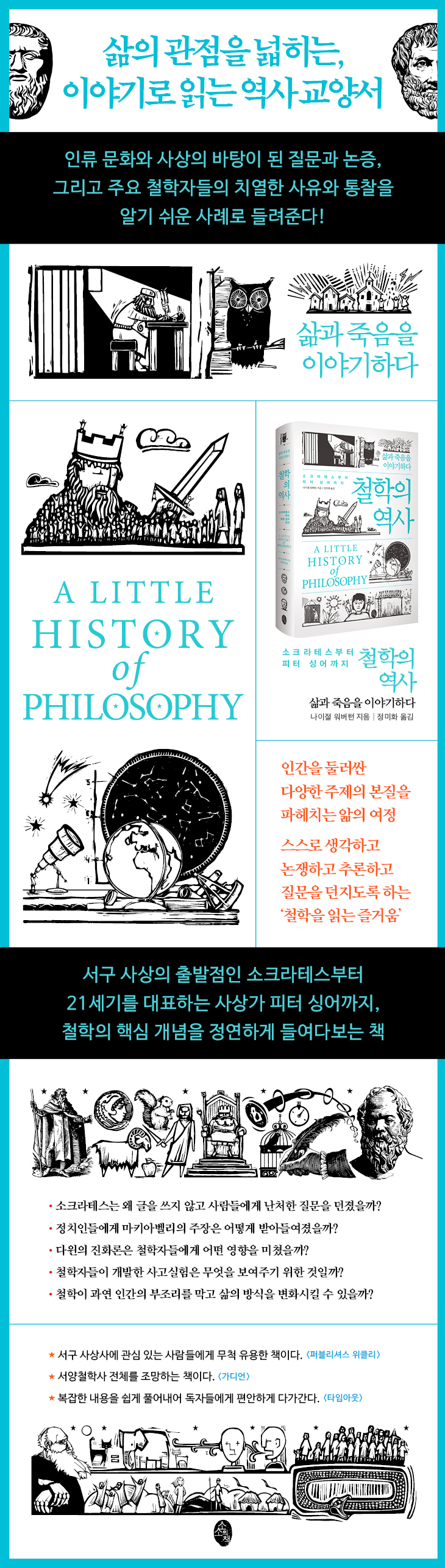
This book examines the views of leading thinkers who have guided Western thought from ancient times to the present day, divided into 40 chapters. It explains the broad, quintessential areas of human exploration through a variety of case studies in a way that anyone can easily understand.
In fact, the world of philosophy is not only inscrutable in its depth, but the deeper you delve into it, the broader and more complex its scope becomes. Therefore, it is by no means easy for those who are just beginning to take an interest in philosophy or wish to study it to knock on its door.
We also cannot help but question the usefulness of philosophy.
Does understanding the nature of humanity and the world really help us live? What value does philosophy have in the real world? How meaningful is the life of a philosopher who devotes his or her life to a single topic and then dies?
This book addresses these practical and fundamental questions, using everyday situations as examples to bring readers one step closer to philosophy, in a conversational and comfortable manner.
Having previously written several introductory books on philosophy and recognized as "the greatest popular philosopher of our time," the author's insight and style of expression serve as the driving force behind his ability to explain, argue, and reflect on the claims of each philosopher in an accessible and engaging way.
For Socrates, who is considered the starting point of Western philosophy, the wisdom valued in the Western philosophical tradition did not mean knowing numerous facts or knowing how to do something, but rather understanding the true nature of our existence, such as the limits of what we can know.
That tradition continues to this day, with modern philosophers still asking difficult questions, examining reasons and grounds, and striving to answer the most difficult questions we can ask ourselves, such as the nature of reality and how we should live.
The most important thing in any field of history is the eye (wisdom) to read the overall flow.
This book also connects these trends and provides insight into the times.
Early philosophy interpreted the world in various ways, but what is important in philosophy today is finding practical ways to transform the world.
Of course, this is thanks to previous theoretical arguments and the philosophical legacy left behind by numerous thinkers.
Blindly relying on or following someone's authority or claims is against the spirit of philosophy.
Philosophy thrives on argument, the possibility of error, the challenge of established views and the search for alternatives.
It was because we were willing to take a critical, doubtful, and skeptical stance that we were able to continue the tradition of philosophy that involved thinking and arguing.
If a good and omnipotent God designed humanity and the world, why did he create evil?
What impact did Darwin's theory of evolution have on the history of philosophy?
Views that became turning points in the history of philosophy and endless debates
If you're looking to delve into the subject matter of a famous philosopher or a particular school of thought through this book, you might be sorely disappointed.
This book is faithfully written as an introductory text to philosophy that anyone can easily read.
In fact, it takes more than a few books to properly understand a single philosophical concept.
Hegel, who is considered the greatest German philosopher of the 19th century, has many parts in his writings that no one, perhaps not even Hegel himself, could understand.
Because, like Kant's writings, it is expressed in very abstract language and often uses terms of his own creation.
While reading this book, it is also very interesting to examine not only the history of philosophy, but also the relationships between science and philosophy, philosophy and religion, and the positions philosophers have taken on science and religion.
Many philosophers were also interested in science, mathematics, geometry, etc.
At first glance, philosophy and science may seem similar in their processes of hypothesis, inference, and argument.
The essence of scientific inquiry is that it is testable, that is, it is possible to make observations that can be proven false.
Science advances when it realizes that certain ways of thinking are false.
Scientists learn from their mistakes, starting with bold guesses or guesses and then trying to dismantle them through experimentation or observation.
But science, while a creative and exciting activity, cannot prove that anything is true.
The arguments of philosophers for religions that believe in the existence of God are also closely related to philosophy.
During the Western Middle Ages, from the 5th to the 15th centuries, philosophy and religion were very closely linked.
Medieval philosophers learned from the ideas of ancient Greek philosophers such as Plato and Aristotle.
But they modified their ideas and applied them to their own religion.
Most of these philosophers were Christians.
Proving the existence of God has been a constant challenge for philosophers.
Augustine, who tried to explain and defend how a good and omnipotent God could allow suffering; Anselm and Aquinas, who devoted themselves to a religious way of life focusing on belief in God; Descartes, who believed that the existence of God could be proven logically; Pascal, who viewed belief in God as a matter of the heart and faith; Hume, who refuted the design argument used by religious believers with cause and effect; Nietzsche, who intentionally exploited the death of God; and Russell, who was outspoken and provocative about religion. Attempts to prove the existence of God formed another major stream in the history of philosophy and continue to this day.
On the other hand, you may be wondering why Darwin, a biologist and geologist, appears in this book.
This is because Darwin's theory of evolution by natural selection and its modern interpretations have had a great influence on the thinking of not only scientists but also philosophers.
The modern American philosopher Daniel Dennett called evolution "the single best view man has ever had."
The theory of evolution explains how humans and the plants and animals around them came to be what they are today and how they are still changing.
One of the consequences of the rise of evolution is that it has become easier than ever to believe that there is no God.
Zoologist Richard Dawkins has written that 'before the publication of Darwin's 'Origin of Species' in 1859, it was inconceivable to be an atheist.'
Of course, there were atheists before 1859, but there were far more of them after that.
You don't have to be an atheist to believe that evolution is true.
Many religious believers are Darwinists.
But you can't be a Darwinist and also believe that God created all species exactly as they are today.
Philosophers' thought experiments and broadening their perspectives on the world
A book full of the pleasure of reading philosophy without being too rigid.
Scientists use real experiments, but philosophers devise thought experiments to rationalize their arguments.
A thought experiment is a hypothetical situation designed to reveal our feelings about a particular problem, what philosophers call "intuitions."
These thought experiments force us to focus more closely on the heart of the problem.
The thought experiment of the 'evil demon' (René Descartes) that pushes doubt to its limits, the 'prince and the cobbler' thought experiment to prove the identity of persons (John Locke), the 'squirrel and the hunter' thought experiment to demonstrate the pragmatist theory of truth (William James), the 'runaway train' thought experiment to illustrate the law of double effect (Philippa Foot and Judith Jarvis Thompson), and the 'Chinese room' thought experiment to show that computers cannot actually think (John Searle) - these thought experiments not only give us a concrete idea of how we think and accept things in various situations, but also show us that we can see different things if we change our perspective.
This book not only provides easy-to-understand examples of concepts in each chapter, but also briefly introduces the biographies of philosophers.
Each chapter concludes with a link to the next philosopher, while mentioning the author's background and the circumstances of the times and capturing the unique aspects of the characters. Furthermore, the inclusion of a "chronological history of philosophy" at the beginning of the book allows readers to follow the naturally changing flow of philosophy.
Through this book, we will meet leading philosophers, from ancient thinkers who debated freedom and the spirit to modern philosophers who soberly address the issues of our time. This will provide an opportunity to ask ourselves and discuss with others how we should live, what wise methods we can use to solve the problems arising in our society, and what is right and wrong.
[Recommendation]
· This lively introduction is a useful resource for anyone interested in the history of Western thought.
[Publisher's Weekly]
· It is by no means easy to cover the entire history of Western philosophy with a brief intellectual biography of about 40 philosophers from Socrates to Peter Singer.
But the author of this book did it very successfully.
[Guardian]
· This book compiles the vast history of philosophy into just the right amount of material.
It is neither too long nor too brief, and the explanation is neither too sparse nor too excessive nor too vague.
This little history of philosophy can be enjoyed as a nutritious snack on its own, or it will serve as a hearty meal for those who wish to journey into the world of philosophy.
[Observer]
· Nigel Warburton has the concise charm of art historian Gongbrich's writings, making complex material accessible to readers.
[Timeout]
· The journey through the major ideas and thinkers in the history of philosophy is well-constructed into 40 short chapters.
[Bookseller]
· This book, written in the style of an everyday conversation, presents useful and clear guidance from leading Western philosophers in 40 short chapters.
[Sunday Telegraph]
· An invaluable book for those interested in philosophy, it shows that philosophy is not as difficult and unreadable as some fools think, and that it is a very enjoyable way to broaden the mind.
[Oxford Times]
· If you're looking for a philosophy book, use this book as a starting point.
It's easy to read, fun, and informative.
Sacramento News & Review
· In this wide-ranging and enjoyable book, the author asserts that it is still worthwhile to think deeply about reality and question how we can best live.
[Pop Matters]
· It's an engaging read.
[Christian Century]
· This book provides intellectual enjoyment for all generations.
Lisa Appignanesi, bestselling author of Cabaret
· Philosophy has rarely seemed so clear, so important, so valuable, and so accessible.
It is refreshing to look at the topic presented from the perspective of the history of ideas rather than a timeless concept.
A wonderful book for anyone who has ever been curious about almost anything.
Sarah Bakewell (author of How to Live)
· This book is not only lively and eye-catching, but is also written in an easy-to-understand style, making it appealing to young people.
Peter Cave (author of Can Robots Become Human?)
Constantly arguing, reasoning, and asking!
The questions and arguments that formed the foundation of human culture and thought, as well as the intense thinking and insights of major philosophers!
This book examines the views of leading thinkers who have guided Western thought from ancient times to the present day, divided into 40 chapters. It explains the broad, quintessential areas of human exploration through a variety of case studies in a way that anyone can easily understand.
In fact, the world of philosophy is not only inscrutable in its depth, but the deeper you delve into it, the broader and more complex its scope becomes. Therefore, it is by no means easy for those who are just beginning to take an interest in philosophy or wish to study it to knock on its door.
We also cannot help but question the usefulness of philosophy.
Does understanding the nature of humanity and the world really help us live? What value does philosophy have in the real world? How meaningful is the life of a philosopher who devotes his or her life to a single topic and then dies?
This book addresses these practical and fundamental questions, using everyday situations as examples to bring readers one step closer to philosophy, in a conversational and comfortable manner.
Having previously written several introductory books on philosophy and recognized as "the greatest popular philosopher of our time," the author's insight and style of expression serve as the driving force behind his ability to explain, argue, and reflect on the claims of each philosopher in an accessible and engaging way.
For Socrates, who is considered the starting point of Western philosophy, the wisdom valued in the Western philosophical tradition did not mean knowing numerous facts or knowing how to do something, but rather understanding the true nature of our existence, such as the limits of what we can know.
That tradition continues to this day, with modern philosophers still asking difficult questions, examining reasons and grounds, and striving to answer the most difficult questions we can ask ourselves, such as the nature of reality and how we should live.
The most important thing in any field of history is the eye (wisdom) to read the overall flow.
This book also connects these trends and provides insight into the times.
Early philosophy interpreted the world in various ways, but what is important in philosophy today is finding practical ways to transform the world.
Of course, this is thanks to previous theoretical arguments and the philosophical legacy left behind by numerous thinkers.
Blindly relying on or following someone's authority or claims is against the spirit of philosophy.
Philosophy thrives on argument, the possibility of error, the challenge of established views and the search for alternatives.
It was because we were willing to take a critical, doubtful, and skeptical stance that we were able to continue the tradition of philosophy that involved thinking and arguing.
If a good and omnipotent God designed humanity and the world, why did he create evil?
What impact did Darwin's theory of evolution have on the history of philosophy?
Views that became turning points in the history of philosophy and endless debates
If you're looking to delve into the subject matter of a famous philosopher or a particular school of thought through this book, you might be sorely disappointed.
This book is faithfully written as an introductory text to philosophy that anyone can easily read.
In fact, it takes more than a few books to properly understand a single philosophical concept.
Hegel, who is considered the greatest German philosopher of the 19th century, has many parts in his writings that no one, perhaps not even Hegel himself, could understand.
Because, like Kant's writings, it is expressed in very abstract language and often uses terms of his own creation.
While reading this book, it is also very interesting to examine not only the history of philosophy, but also the relationships between science and philosophy, philosophy and religion, and the positions philosophers have taken on science and religion.
Many philosophers were also interested in science, mathematics, geometry, etc.
At first glance, philosophy and science may seem similar in their processes of hypothesis, inference, and argument.
The essence of scientific inquiry is that it is testable, that is, it is possible to make observations that can be proven false.
Science advances when it realizes that certain ways of thinking are false.
Scientists learn from their mistakes, starting with bold guesses or guesses and then trying to dismantle them through experimentation or observation.
But science, while a creative and exciting activity, cannot prove that anything is true.
The arguments of philosophers for religions that believe in the existence of God are also closely related to philosophy.
During the Western Middle Ages, from the 5th to the 15th centuries, philosophy and religion were very closely linked.
Medieval philosophers learned from the ideas of ancient Greek philosophers such as Plato and Aristotle.
But they modified their ideas and applied them to their own religion.
Most of these philosophers were Christians.
Proving the existence of God has been a constant challenge for philosophers.
Augustine, who tried to explain and defend how a good and omnipotent God could allow suffering; Anselm and Aquinas, who devoted themselves to a religious way of life focusing on belief in God; Descartes, who believed that the existence of God could be proven logically; Pascal, who viewed belief in God as a matter of the heart and faith; Hume, who refuted the design argument used by religious believers with cause and effect; Nietzsche, who intentionally exploited the death of God; and Russell, who was outspoken and provocative about religion. Attempts to prove the existence of God formed another major stream in the history of philosophy and continue to this day.
On the other hand, you may be wondering why Darwin, a biologist and geologist, appears in this book.
This is because Darwin's theory of evolution by natural selection and its modern interpretations have had a great influence on the thinking of not only scientists but also philosophers.
The modern American philosopher Daniel Dennett called evolution "the single best view man has ever had."
The theory of evolution explains how humans and the plants and animals around them came to be what they are today and how they are still changing.
One of the consequences of the rise of evolution is that it has become easier than ever to believe that there is no God.
Zoologist Richard Dawkins has written that 'before the publication of Darwin's 'Origin of Species' in 1859, it was inconceivable to be an atheist.'
Of course, there were atheists before 1859, but there were far more of them after that.
You don't have to be an atheist to believe that evolution is true.
Many religious believers are Darwinists.
But you can't be a Darwinist and also believe that God created all species exactly as they are today.
Philosophers' thought experiments and broadening their perspectives on the world
A book full of the pleasure of reading philosophy without being too rigid.
Scientists use real experiments, but philosophers devise thought experiments to rationalize their arguments.
A thought experiment is a hypothetical situation designed to reveal our feelings about a particular problem, what philosophers call "intuitions."
These thought experiments force us to focus more closely on the heart of the problem.
The thought experiment of the 'evil demon' (René Descartes) that pushes doubt to its limits, the 'prince and the cobbler' thought experiment to prove the identity of persons (John Locke), the 'squirrel and the hunter' thought experiment to demonstrate the pragmatist theory of truth (William James), the 'runaway train' thought experiment to illustrate the law of double effect (Philippa Foot and Judith Jarvis Thompson), and the 'Chinese room' thought experiment to show that computers cannot actually think (John Searle) - these thought experiments not only give us a concrete idea of how we think and accept things in various situations, but also show us that we can see different things if we change our perspective.
This book not only provides easy-to-understand examples of concepts in each chapter, but also briefly introduces the biographies of philosophers.
Each chapter concludes with a link to the next philosopher, while mentioning the author's background and the circumstances of the times and capturing the unique aspects of the characters. Furthermore, the inclusion of a "chronological history of philosophy" at the beginning of the book allows readers to follow the naturally changing flow of philosophy.
Through this book, we will meet leading philosophers, from ancient thinkers who debated freedom and the spirit to modern philosophers who soberly address the issues of our time. This will provide an opportunity to ask ourselves and discuss with others how we should live, what wise methods we can use to solve the problems arising in our society, and what is right and wrong.
[Recommendation]
· This lively introduction is a useful resource for anyone interested in the history of Western thought.
[Publisher's Weekly]
· It is by no means easy to cover the entire history of Western philosophy with a brief intellectual biography of about 40 philosophers from Socrates to Peter Singer.
But the author of this book did it very successfully.
[Guardian]
· This book compiles the vast history of philosophy into just the right amount of material.
It is neither too long nor too brief, and the explanation is neither too sparse nor too excessive nor too vague.
This little history of philosophy can be enjoyed as a nutritious snack on its own, or it will serve as a hearty meal for those who wish to journey into the world of philosophy.
[Observer]
· Nigel Warburton has the concise charm of art historian Gongbrich's writings, making complex material accessible to readers.
[Timeout]
· The journey through the major ideas and thinkers in the history of philosophy is well-constructed into 40 short chapters.
[Bookseller]
· This book, written in the style of an everyday conversation, presents useful and clear guidance from leading Western philosophers in 40 short chapters.
[Sunday Telegraph]
· An invaluable book for those interested in philosophy, it shows that philosophy is not as difficult and unreadable as some fools think, and that it is a very enjoyable way to broaden the mind.
[Oxford Times]
· If you're looking for a philosophy book, use this book as a starting point.
It's easy to read, fun, and informative.
Sacramento News & Review
· In this wide-ranging and enjoyable book, the author asserts that it is still worthwhile to think deeply about reality and question how we can best live.
[Pop Matters]
· It's an engaging read.
[Christian Century]
· This book provides intellectual enjoyment for all generations.
Lisa Appignanesi, bestselling author of Cabaret
· Philosophy has rarely seemed so clear, so important, so valuable, and so accessible.
It is refreshing to look at the topic presented from the perspective of the history of ideas rather than a timeless concept.
A wonderful book for anyone who has ever been curious about almost anything.
Sarah Bakewell (author of How to Live)
· This book is not only lively and eye-catching, but is also written in an easy-to-understand style, making it appealing to young people.
Peter Cave (author of Can Robots Become Human?)
GOODS SPECIFICS
- Date of issue: July 30, 2019
- Format: Hardcover book binding method guide
- Page count, weight, size: 340 pages | 582g | 145*218*30mm
- ISBN13: 9791188941285
- ISBN10: 1188941283
You may also like
카테고리
korean


korean

![GQ KOREA Mark (Monthly): December [2025]](http://librairie.coreenne.fr/cdn/shop/files/8ef265dbbfbf186523ed75ba7319009d.jpg?v=1765340328&width=3840)


