

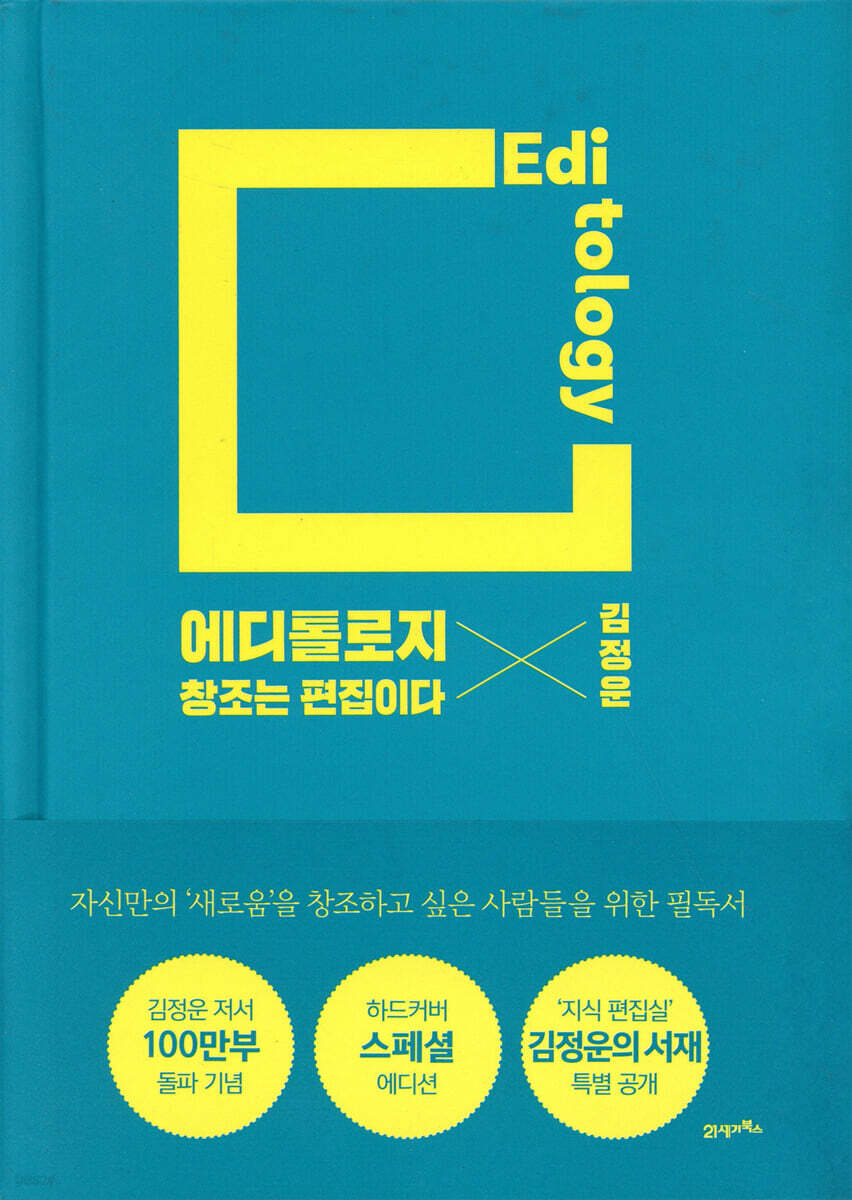
Editology (Special Edition)
 |
Description
Book Introduction
This is Kim Jong-un's humanities class! A must-read for those who want to create their own innovation. What is "creativity"? Is it possible to create something completely new? Author Kim Jeong-un explains in "Editology: Creation is Editing": “Creation is not about making something out of nothing, but rather about ‘reconstructing existing things into something new.’” This means that editing with your own perspective is the core of editorology. In this book, the author introduces various editorial methods that can be applied to our lives, such as how to develop a unique perspective through "seeing things differently" and how to create one's own theories and philosophies through proactive study rather than memorization. In addition, this special edition will feature a special exhibition of 'Kim Jeong-un's Study', providing readers with key know-how, including practical reading methods and differentiated writing methods. |
- You can preview some of the book's contents.
Preview
index
Introducing the revised edition_ It's not an 'industrial revolution', it's an 'editing revolution' of knowledge!
Prologue: Reading the Edited World through Editology
1.
Editology of Knowledge and Culture
01.
Why Editology?
02.
The essence of creation is to make strange.
03.
Knowledge power no longer resides in universities.
04.
Anyone can be a genius, because of the rat!
05.
Kim Yong-ok's Crosstext and Lee Eo-ryeong's Hypertext
06.
The difference between notes and cards is huge.
07.
Good knowledge is knowledge that can be edited.
08.
Entertainment programs are completed with subtitles.
09.
Why Even Actors with Terrible Acting Skills Can Appear in Movies
10.
If you like classical music, you should never diss Karajan.
2.
Editorials of perspective and place
11.
The Discovery of Perspective and the Myth of Western Rationality
12.
We believe that we can see the world objectively through the window.
13.
Perspective is a controlling obsession
14.
Power wears sunglasses
15.
An objective(?) world map that changes with time and region
16.
Human psychology changes depending on spatial editing.
17.
The Germans' sense of space deprivation was the cause of World War II.
18.
The 19th-century Prussian Army and the Space of Football
19.
Military training and uniform fetish
20.
The Evolution of Classification and Editing: Department Stores and Select Shops
3.
Editology of Mind and Psychology
21.
'Individual' is an edited concept
22.
'I' am the result of my edited memories.
23.
Why are we kind to white people and rude to Southeast Asians?
24.
Geniuses aren't born, they're edited.
25.
The United States is a nation whose national anthem is edited.
26.
Psychology failed to thrive in Germany, the birthplace of psychology.
27.
Freud was a total fraud!
28.
Nevertheless, Freud was a great editor.
29.
Japanese with anal fixation and Korean with oral fixation
30.
A book is not meant to be read from beginning to end.
Epilogue: Everyone must experience intense loneliness at least once in their lives.
Special Appendix_ My study is an 'editing room'!
Search
Prologue: Reading the Edited World through Editology
1.
Editology of Knowledge and Culture
01.
Why Editology?
02.
The essence of creation is to make strange.
03.
Knowledge power no longer resides in universities.
04.
Anyone can be a genius, because of the rat!
05.
Kim Yong-ok's Crosstext and Lee Eo-ryeong's Hypertext
06.
The difference between notes and cards is huge.
07.
Good knowledge is knowledge that can be edited.
08.
Entertainment programs are completed with subtitles.
09.
Why Even Actors with Terrible Acting Skills Can Appear in Movies
10.
If you like classical music, you should never diss Karajan.
2.
Editorials of perspective and place
11.
The Discovery of Perspective and the Myth of Western Rationality
12.
We believe that we can see the world objectively through the window.
13.
Perspective is a controlling obsession
14.
Power wears sunglasses
15.
An objective(?) world map that changes with time and region
16.
Human psychology changes depending on spatial editing.
17.
The Germans' sense of space deprivation was the cause of World War II.
18.
The 19th-century Prussian Army and the Space of Football
19.
Military training and uniform fetish
20.
The Evolution of Classification and Editing: Department Stores and Select Shops
3.
Editology of Mind and Psychology
21.
'Individual' is an edited concept
22.
'I' am the result of my edited memories.
23.
Why are we kind to white people and rude to Southeast Asians?
24.
Geniuses aren't born, they're edited.
25.
The United States is a nation whose national anthem is edited.
26.
Psychology failed to thrive in Germany, the birthplace of psychology.
27.
Freud was a total fraud!
28.
Nevertheless, Freud was a great editor.
29.
Japanese with anal fixation and Korean with oral fixation
30.
A book is not meant to be read from beginning to end.
Epilogue: Everyone must experience intense loneliness at least once in their lives.
Special Appendix_ My study is an 'editing room'!
Search
Detailed image

Into the book
Humans are most creative when they are just sitting there blankly.
That doesn't mean I have no thoughts.
Rather, it's the opposite.
When you are in a daze, your thoughts fly around very freely.
Sometimes I just sit there blankly and think, 'Why am I thinking this?'
And then we've all probably had the experience of going back and tracing where that thought started.
When you find your train of thought, you will be amazed at the range of thoughts that have flown through you in that short period of time.
Today, with the availability of computers, even ordinary people can think like geniuses.
This means that the ability to think on the fly, which God had granted only to some geniuses, is now available to ordinary people as well.
It's because of the 'rat'.
That's the computer's 'mouse'.
For the first time in history, humans have a tool that can make their thoughts fly.
When you look at your computer screen and click on something that interests you, your thoughts immediately fly elsewhere.
This is a place that has nothing to do with the previous context.
This is a huge revolution.
- '04.
Anyone can be a genius, because of the rats!'
Everyone experiences intellectual shock at least once while growing up.
This is when you think, 'Ah, I want to write and speak like that person too!'
The thirst for knowledge is also a kind of vanity.
I just want to show off for once.
People grow when they want to show off to others.
When we are young, we try to show off to our close friends, and as we get older, we try to show off to the public.
And Anna, adults and men always want to look good in front of women.
The core of Hegel's 'struggle for recognition' is the psychological 'motivation' of wanting to show off.
Kim Yong-ok was the first person to use the subject 'I' in an academic text.
Until then, there had been no case of using the subject 'I' in humanities and social science texts.
As far as I remember, Kim Yong-ok is the first.
It was the same abroad.
After natural science was considered the epitome of learning, the subject of knowledge, ‘I,’ disappeared from academic writing.
This is because the core of natural scientific knowledge is ‘objectivity that excludes the subject.’
- '05.
From Kim Yong-ok's Crosstext and Lee Eo-ryeong's Hypertext
As the direction of study that had been forced upon us in the Korean context was lost, we began to think about the content and methodology of independent learning.
It was also a belated question of why one should study.
I was particularly interested in the discussion on the conceptual difference between 'society Gesellschaft' and 'culture Kultur'.
In the end, I decided to focus my studies on ‘cultural psychology.’
I started studying anew.
I worked really hard.
“What is your theory?” asked my advisor, whom I had finally met after months of waiting after requesting an interview.
You didn't even read the thesis proposal I laid out.
'My theory?' Until then, I had never thought about my own theory, nor had I ever thought of creating one.
But my advisor is asking me, who has just settled in Germany, what my theory is.
He said there wasn't any.
He said he came to learn your theory.
Then he tells me to get out.
How can a student who wants to write a master's or doctoral thesis not have his or her own thoughts?
He said that summarizing other people's theories is not worth even half a penny.
He told me to come back and think about the direction of the theory I wanted to present.
The question was whether I was studying with a subjective perspective.
It was also a question of whether there was an academic awareness of the problem.
The point is that if you have a clear subjective viewpoint, you won't be imitating other people's theories.
I had to change the way I studied.
As I have done so far, it was impossible to construct my own theory by simply understanding and memorizing the theories of the masters.
- '06.
The difference between notes and cards is huge.
That doesn't mean I have no thoughts.
Rather, it's the opposite.
When you are in a daze, your thoughts fly around very freely.
Sometimes I just sit there blankly and think, 'Why am I thinking this?'
And then we've all probably had the experience of going back and tracing where that thought started.
When you find your train of thought, you will be amazed at the range of thoughts that have flown through you in that short period of time.
Today, with the availability of computers, even ordinary people can think like geniuses.
This means that the ability to think on the fly, which God had granted only to some geniuses, is now available to ordinary people as well.
It's because of the 'rat'.
That's the computer's 'mouse'.
For the first time in history, humans have a tool that can make their thoughts fly.
When you look at your computer screen and click on something that interests you, your thoughts immediately fly elsewhere.
This is a place that has nothing to do with the previous context.
This is a huge revolution.
- '04.
Anyone can be a genius, because of the rats!'
Everyone experiences intellectual shock at least once while growing up.
This is when you think, 'Ah, I want to write and speak like that person too!'
The thirst for knowledge is also a kind of vanity.
I just want to show off for once.
People grow when they want to show off to others.
When we are young, we try to show off to our close friends, and as we get older, we try to show off to the public.
And Anna, adults and men always want to look good in front of women.
The core of Hegel's 'struggle for recognition' is the psychological 'motivation' of wanting to show off.
Kim Yong-ok was the first person to use the subject 'I' in an academic text.
Until then, there had been no case of using the subject 'I' in humanities and social science texts.
As far as I remember, Kim Yong-ok is the first.
It was the same abroad.
After natural science was considered the epitome of learning, the subject of knowledge, ‘I,’ disappeared from academic writing.
This is because the core of natural scientific knowledge is ‘objectivity that excludes the subject.’
- '05.
From Kim Yong-ok's Crosstext and Lee Eo-ryeong's Hypertext
As the direction of study that had been forced upon us in the Korean context was lost, we began to think about the content and methodology of independent learning.
It was also a belated question of why one should study.
I was particularly interested in the discussion on the conceptual difference between 'society Gesellschaft' and 'culture Kultur'.
In the end, I decided to focus my studies on ‘cultural psychology.’
I started studying anew.
I worked really hard.
“What is your theory?” asked my advisor, whom I had finally met after months of waiting after requesting an interview.
You didn't even read the thesis proposal I laid out.
'My theory?' Until then, I had never thought about my own theory, nor had I ever thought of creating one.
But my advisor is asking me, who has just settled in Germany, what my theory is.
He said there wasn't any.
He said he came to learn your theory.
Then he tells me to get out.
How can a student who wants to write a master's or doctoral thesis not have his or her own thoughts?
He said that summarizing other people's theories is not worth even half a penny.
He told me to come back and think about the direction of the theory I wanted to present.
The question was whether I was studying with a subjective perspective.
It was also a question of whether there was an academic awareness of the problem.
The point is that if you have a clear subjective viewpoint, you won't be imitating other people's theories.
I had to change the way I studied.
As I have done so far, it was impossible to construct my own theory by simply understanding and memorizing the theories of the masters.
- '06.
The difference between notes and cards is huge.
--- From the text
Publisher's Review
Commemorating the sale of Kim Jong-un's books exceeding one million copies
Hardcover Special Edition
Kim Jong-un's study, "Knowledge Editing Room," is on display for a special viewing.
How is newness born?
In the era of the Fourth Industrial Revolution, a creative methodology perfected through "Editology"
Author Kim Jeong-un's masterpiece, "Editorology," is now available in a new hardcover special edition.
Published in 2014, 『Editology』 presented a new concept called ‘editology,’ a compound word of ‘edit’ and ‘ology,’ and raised a major topic in the intellectual community of South Korea.
How can we cultivate our own perspectives and compile knowledge amidst the endless stream of information connected through online networks? How can we cultivate creativity that sets us apart from others in the process? "We don't live in a world without information.
Information is overflowing.
“It is a world where the key is to be able to compile information and compile it into some kind of knowledge.”
As of 2018, South Korea is facing a huge change of the times called the 'Fourth Industrial Revolution'.
At a time when everyone is excited about the transition to a world of a completely different dimension, the author points out this from a completely different perspective.
“The reason the Fourth Industrial Revolution is receiving such a huge response in Korean society is, ironically, closely related to the decline of the ‘industrialization generation’ that led the industrial revolution in Korean society over the past half-century.
The term "4th Industrial Revolution" emerged as a new alternative after the collapse of the Park Geun-hye administration, a symbol of the industrialization generation that had been calling for a "creative economy."
'Creation' remains an important concept, and the concept of 'industrial revolution' can never explain today's changes.
It's not an industrial revolution.
“It is a ‘knowledge revolution’ and a ‘revolution of awareness’!” This is why we need to pay attention to the ‘editorial revolution of knowledge’ called editorology at this point in time.
Hardcover Special Edition
Kim Jong-un's study, "Knowledge Editing Room," is on display for a special viewing.
How is newness born?
In the era of the Fourth Industrial Revolution, a creative methodology perfected through "Editology"
Author Kim Jeong-un's masterpiece, "Editorology," is now available in a new hardcover special edition.
Published in 2014, 『Editology』 presented a new concept called ‘editology,’ a compound word of ‘edit’ and ‘ology,’ and raised a major topic in the intellectual community of South Korea.
How can we cultivate our own perspectives and compile knowledge amidst the endless stream of information connected through online networks? How can we cultivate creativity that sets us apart from others in the process? "We don't live in a world without information.
Information is overflowing.
“It is a world where the key is to be able to compile information and compile it into some kind of knowledge.”
As of 2018, South Korea is facing a huge change of the times called the 'Fourth Industrial Revolution'.
At a time when everyone is excited about the transition to a world of a completely different dimension, the author points out this from a completely different perspective.
“The reason the Fourth Industrial Revolution is receiving such a huge response in Korean society is, ironically, closely related to the decline of the ‘industrialization generation’ that led the industrial revolution in Korean society over the past half-century.
The term "4th Industrial Revolution" emerged as a new alternative after the collapse of the Park Geun-hye administration, a symbol of the industrialization generation that had been calling for a "creative economy."
'Creation' remains an important concept, and the concept of 'industrial revolution' can never explain today's changes.
It's not an industrial revolution.
“It is a ‘knowledge revolution’ and a ‘revolution of awareness’!” This is why we need to pay attention to the ‘editorial revolution of knowledge’ called editorology at this point in time.
GOODS SPECIFICS
- Date of issue: August 14, 2018
- Format: Hardcover book binding method guide
- Page count, weight, size: 372 pages | 598g | 148*210*30mm
- ISBN13: 9788950976446
- ISBN10: 8950976447
You may also like
카테고리
korean


korean

![GQ KOREA Mark (Monthly): December [2025]](http://librairie.coreenne.fr/cdn/shop/files/8ef265dbbfbf186523ed75ba7319009d.jpg?v=1765340328&width=3840)


