

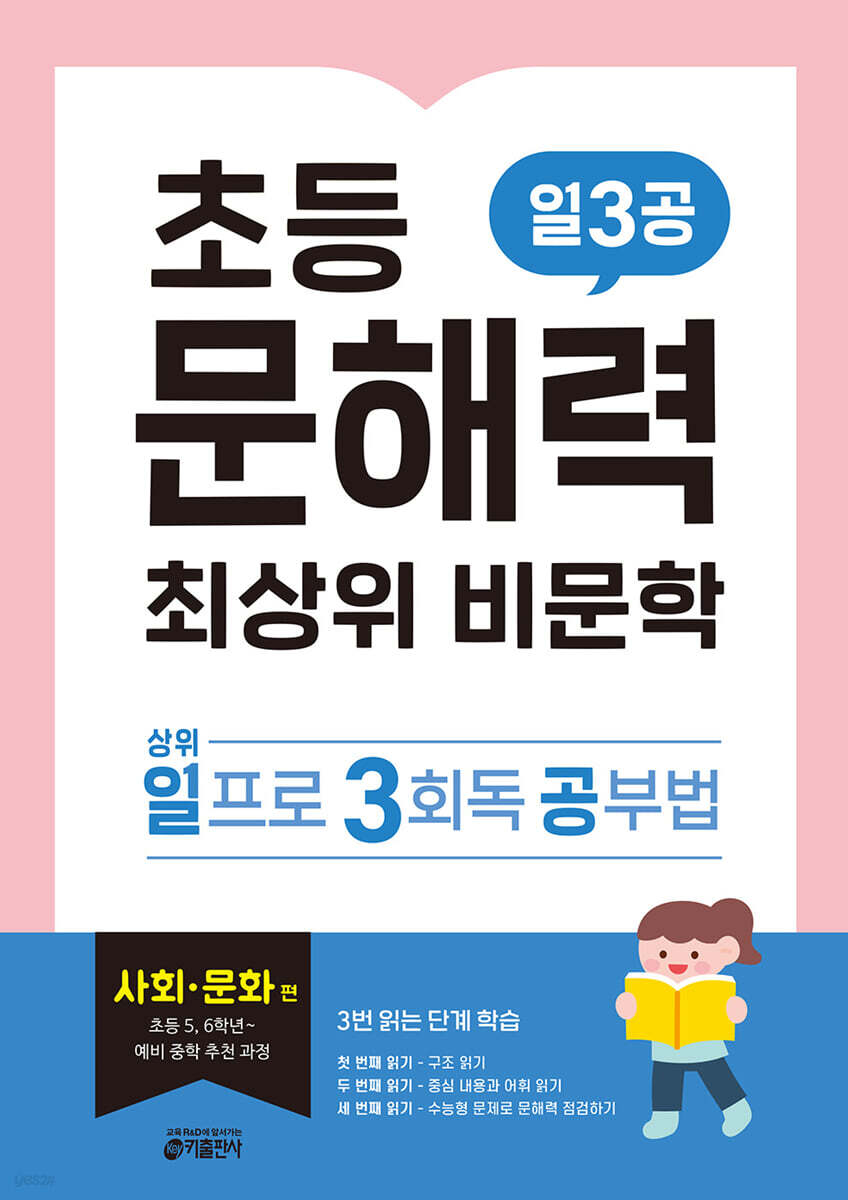
Elementary Literacy Top Non-Fiction 13th Public Social Studies and Culture
 |
Description
Book Introduction
Develop literacy skills through a step-by-step 3-time reading study method
Develop the ability to understand text deeply and build confidence
The 〈Elementary Literacy Top Non-Fiction 13th Publication〉 series!
The habit of reading carefully creates the top 1%.
The 3-time study method of Ilpro, Il3gong!
One feature.
Introduction to Non-Literature Korean Language for the College Scholastic Ability Test
〈Elementary Literacy Top Non-Literature 13th Public Social Studies and Culture Edition〉 is designed to help students learn the concepts of the ‘College Scholastic Ability Test Korean Non-Literature Social Studies and Culture Section’ and to practice with CSAT-style problems.
The text was composed by selecting topics related to middle school curriculum and current topics that have recently been receiving attention.
Through this, students can gradually prepare for the Korean language section of the CSAT starting from elementary school.
Feature two.
3rd reading stage learning
〈Elementary Literacy Top-tier Non-literature 13-stage Social Studies and Culture Edition〉 is designed to systematically develop literacy skills through the ‘3-reading study method’ consisting of ‘1st reading: reading the structure → 2nd reading: reading the main content and vocabulary → 3rd reading: checking literacy skills with CSAT-style questions.’
This allows you to read non-fiction texts containing a large amount of information carefully and understand them deeply.
Feature three.
Learning the Structure of Five Types of Writing
〈Elementary Literacy Top Non-Fiction 13th Public Social Studies and Culture Edition〉 teaches the ‘five text structures’ of ‘list structure, comparison and contrast structure, case structure, process structure, and problem-solving structure’, and helps students understand the representative text structures that appear in Korean language test passages or long texts from other subjects.
This will help students develop the ability to read persistently until the end.
Develop the ability to understand text deeply and build confidence
The 〈Elementary Literacy Top Non-Fiction 13th Publication〉 series!
The habit of reading carefully creates the top 1%.
The 3-time study method of Ilpro, Il3gong!
One feature.
Introduction to Non-Literature Korean Language for the College Scholastic Ability Test
〈Elementary Literacy Top Non-Literature 13th Public Social Studies and Culture Edition〉 is designed to help students learn the concepts of the ‘College Scholastic Ability Test Korean Non-Literature Social Studies and Culture Section’ and to practice with CSAT-style problems.
The text was composed by selecting topics related to middle school curriculum and current topics that have recently been receiving attention.
Through this, students can gradually prepare for the Korean language section of the CSAT starting from elementary school.
Feature two.
3rd reading stage learning
〈Elementary Literacy Top-tier Non-literature 13-stage Social Studies and Culture Edition〉 is designed to systematically develop literacy skills through the ‘3-reading study method’ consisting of ‘1st reading: reading the structure → 2nd reading: reading the main content and vocabulary → 3rd reading: checking literacy skills with CSAT-style questions.’
This allows you to read non-fiction texts containing a large amount of information carefully and understand them deeply.
Feature three.
Learning the Structure of Five Types of Writing
〈Elementary Literacy Top Non-Fiction 13th Public Social Studies and Culture Edition〉 teaches the ‘five text structures’ of ‘list structure, comparison and contrast structure, case structure, process structure, and problem-solving structure’, and helps students understand the representative text structures that appear in Korean language test passages or long texts from other subjects.
This will help students develop the ability to read persistently until the end.
- You can preview some of the book's contents.
Preview
index
Ⅰ List structure
01 Systems and Institutions for Fair Elections (Politics)
02 Asset Management Methods (Economy)
03 Characteristics and Problems of Cyberspace (Culture)
04 Basic Rights Guaranteed by the Constitution (Law)
- Take a break: A dictionary of knowledge in your hand
Ⅱ Comparison and contrast structure
01 Rational Consumption and Ethical Consumption (Economy)
02 Groupthink and Collective Intelligence (Society)
03 Copyright and Copyleft (Law)
04 Price Determination Based on Supply and Demand (Economics)
- Take a break: A dictionary of knowledge in your hand
Ⅲ Case Structure
01 Transformation into a Livable City (Geography)
02 Sales Strategy Considering Cultural Differences (Management)
03 Understanding the Trial (Law)
04 The Impact of New Media on Popular Culture (Culture)
- Take a break: A dictionary of knowledge in your hand
Ⅳ Course Structure
01 Growth into a multinational corporation (management)
02 The Path of Democratic Politics (Politics)
03 The process for youth to find part-time jobs (law)
04 The Development Process of E-Sports (Culture)
- Take a break: A dictionary of knowledge in your hand
V Problem-solving structure
01 Population Problems Due to Low Birth Rates (Society)
02 Pivoting to Solve a Corporate Crisis (Management)
03 Problems and Solutions of Inflation (Economy)
04 Microplastics and ESG Management (Environment)
- Take a break: A dictionary of knowledge in your hand
[Special Appendix] Special Lecture on "How to Use the Korean Dictionary"
* Correct answer and explanation
Special Lecture on "Conceptual Words" for the 3rd Industrial Revolution
01 Systems and Institutions for Fair Elections (Politics)
02 Asset Management Methods (Economy)
03 Characteristics and Problems of Cyberspace (Culture)
04 Basic Rights Guaranteed by the Constitution (Law)
- Take a break: A dictionary of knowledge in your hand
Ⅱ Comparison and contrast structure
01 Rational Consumption and Ethical Consumption (Economy)
02 Groupthink and Collective Intelligence (Society)
03 Copyright and Copyleft (Law)
04 Price Determination Based on Supply and Demand (Economics)
- Take a break: A dictionary of knowledge in your hand
Ⅲ Case Structure
01 Transformation into a Livable City (Geography)
02 Sales Strategy Considering Cultural Differences (Management)
03 Understanding the Trial (Law)
04 The Impact of New Media on Popular Culture (Culture)
- Take a break: A dictionary of knowledge in your hand
Ⅳ Course Structure
01 Growth into a multinational corporation (management)
02 The Path of Democratic Politics (Politics)
03 The process for youth to find part-time jobs (law)
04 The Development Process of E-Sports (Culture)
- Take a break: A dictionary of knowledge in your hand
V Problem-solving structure
01 Population Problems Due to Low Birth Rates (Society)
02 Pivoting to Solve a Corporate Crisis (Management)
03 Problems and Solutions of Inflation (Economy)
04 Microplastics and ESG Management (Environment)
- Take a break: A dictionary of knowledge in your hand
[Special Appendix] Special Lecture on "How to Use the Korean Dictionary"
* Correct answer and explanation
Special Lecture on "Conceptual Words" for the 3rd Industrial Revolution
Detailed image

Publisher's Review
Students who want to prepare for the Korean language and non-literature section of the CSAT step by step starting from elementary school.
Students who want to develop the ability to deeply understand non-fiction texts that contain a large amount of information.
Students who want to develop literacy skills and build background knowledge while learning key concepts of middle school social studies.
It is prepared for students like this.
◆ The “Elementary Literacy Top-tier Non-literature 13-gong Series” is an elementary literacy improvement program aimed at the top 1%.
◆ 〈Elementary Literacy Top-tier Non-fiction 13th Public Social Studies and Culture Edition〉 is designed to enable introductory learning of non-fiction for the College Scholastic Ability Test, learning at the 3rd reading level, and learning the structure of 5 types of texts.
◆ Through “Elementary Literacy Top-Level Non-Fiction 13th Public Social Studies and Culture Edition,” students can develop the ability to read accurately and gain confidence in being able to read a text to the end.
● Introduction to Non-Literature for the College Scholastic Ability Test
- What are the benefits of preparing for the Korean language non-literature section of the CSAT in advance?
It is very important to develop the ability to read and understand information-based texts.
These skills are necessary not only for learning Korean but also for learning other subjects such as social studies and science.
Among the Korean language sections of the College Scholastic Ability Test, the non-literature (reading) section is intended to measure these Korean language skills.
It's about reading a balanced, information-focused piece of writing with a certain amount of perspective to make sure you've read it accurately.
Additionally, CSAT-style questions are a good way to check literacy skills because they allow you to efficiently check whether you have accurately grasped the information given in the text.
In “Elementary Literacy Top-Level Non-Fiction 13th Public Social Studies and Culture Edition,” we present CSAT-style passages and CSAT-style questions to help students develop literacy while simultaneously preparing for the CSAT Korean non-fiction (reading) section.
Among the materials in the social and cultural fields, the text was composed primarily of materials related to middle school curriculum.
We have also included texts on topical topics that have recently been gaining attention, to ensure that you can learn in an interesting way.
● 3-step reading learning
- Why should I read it over and over again?
To read a text accurately, you must read it carefully.
Can students read texts thoroughly from the beginning? Elementary school students lack the experience of reading long texts, so they may lack the ability to understand and connect multiple pieces of information.
Therefore, in order for students to read carefully, they need to learn how to read while understanding the content of the text and practice developing the ability to read the text to the end.
You need to read the text over and over again, figure out what you know and what you don't know, and then repeat the experience of moving on from what you don't know.
Even if it takes a little more time, you must experience the process of reading the text repeatedly and digesting it completely as your own.
〈Elementary Literacy Top-Level Non-Fiction 13th Public Social Studies and Culture Edition〉 is designed to help students develop literacy skills through the ‘three-time reading study method’ of reading the same text three times.
We have developed the ability to understand the text more deeply through systematic learning consisting of '1st reading: read the structure → 2nd reading: read the main content and vocabulary → 3rd reading: check literacy with CSAT-style questions.'
● Learning the structure of five types of writing
- What is the structure of the five articles?
When reading, it is important to know the meaning of words and sentences, but it is also important to read while understanding the structure of the text.
This is because you can read while thinking about the overall structure or framework of the text, distinguishing between more important and less important content, and reading while thinking about the content that follows.
Learning the structure of writing also helps you write more systematically.
〈Elementary Literacy Top-Level Non-Fiction 13th Public Social Studies and Culture Edition〉 is designed to enable learning of five writing structures: list structure, comparison and contrast structure, case structure, process structure, and problem-solving structure.
We have made it easier to understand texts by studying the structure of representative texts found in various Korean language tests.
Students who want to develop the ability to deeply understand non-fiction texts that contain a large amount of information.
Students who want to develop literacy skills and build background knowledge while learning key concepts of middle school social studies.
It is prepared for students like this.
◆ The “Elementary Literacy Top-tier Non-literature 13-gong Series” is an elementary literacy improvement program aimed at the top 1%.
◆ 〈Elementary Literacy Top-tier Non-fiction 13th Public Social Studies and Culture Edition〉 is designed to enable introductory learning of non-fiction for the College Scholastic Ability Test, learning at the 3rd reading level, and learning the structure of 5 types of texts.
◆ Through “Elementary Literacy Top-Level Non-Fiction 13th Public Social Studies and Culture Edition,” students can develop the ability to read accurately and gain confidence in being able to read a text to the end.
● Introduction to Non-Literature for the College Scholastic Ability Test
- What are the benefits of preparing for the Korean language non-literature section of the CSAT in advance?
It is very important to develop the ability to read and understand information-based texts.
These skills are necessary not only for learning Korean but also for learning other subjects such as social studies and science.
Among the Korean language sections of the College Scholastic Ability Test, the non-literature (reading) section is intended to measure these Korean language skills.
It's about reading a balanced, information-focused piece of writing with a certain amount of perspective to make sure you've read it accurately.
Additionally, CSAT-style questions are a good way to check literacy skills because they allow you to efficiently check whether you have accurately grasped the information given in the text.
In “Elementary Literacy Top-Level Non-Fiction 13th Public Social Studies and Culture Edition,” we present CSAT-style passages and CSAT-style questions to help students develop literacy while simultaneously preparing for the CSAT Korean non-fiction (reading) section.
Among the materials in the social and cultural fields, the text was composed primarily of materials related to middle school curriculum.
We have also included texts on topical topics that have recently been gaining attention, to ensure that you can learn in an interesting way.
● 3-step reading learning
- Why should I read it over and over again?
To read a text accurately, you must read it carefully.
Can students read texts thoroughly from the beginning? Elementary school students lack the experience of reading long texts, so they may lack the ability to understand and connect multiple pieces of information.
Therefore, in order for students to read carefully, they need to learn how to read while understanding the content of the text and practice developing the ability to read the text to the end.
You need to read the text over and over again, figure out what you know and what you don't know, and then repeat the experience of moving on from what you don't know.
Even if it takes a little more time, you must experience the process of reading the text repeatedly and digesting it completely as your own.
〈Elementary Literacy Top-Level Non-Fiction 13th Public Social Studies and Culture Edition〉 is designed to help students develop literacy skills through the ‘three-time reading study method’ of reading the same text three times.
We have developed the ability to understand the text more deeply through systematic learning consisting of '1st reading: read the structure → 2nd reading: read the main content and vocabulary → 3rd reading: check literacy with CSAT-style questions.'
● Learning the structure of five types of writing
- What is the structure of the five articles?
When reading, it is important to know the meaning of words and sentences, but it is also important to read while understanding the structure of the text.
This is because you can read while thinking about the overall structure or framework of the text, distinguishing between more important and less important content, and reading while thinking about the content that follows.
Learning the structure of writing also helps you write more systematically.
〈Elementary Literacy Top-Level Non-Fiction 13th Public Social Studies and Culture Edition〉 is designed to enable learning of five writing structures: list structure, comparison and contrast structure, case structure, process structure, and problem-solving structure.
We have made it easier to understand texts by studying the structure of representative texts found in various Korean language tests.
GOODS SPECIFICS
- Publication date: May 26, 2022
- Page count, weight, size: 248 pages | 706g | 210*277*13mm
- ISBN13: 9791165261498
- ISBN10: 1165261499
- Reference book usage semester: Common semester
- Reference Difficulty: Very Difficult Reference Difficulty Guide
- KC Certification: Certification Type: Conformity Confirmation
You may also like
카테고리
korean


korean

![GQ KOREA Mark (Monthly): December [2025]](http://librairie.coreenne.fr/cdn/shop/files/8ef265dbbfbf186523ed75ba7319009d.jpg?v=1765340328&width=3840)


