

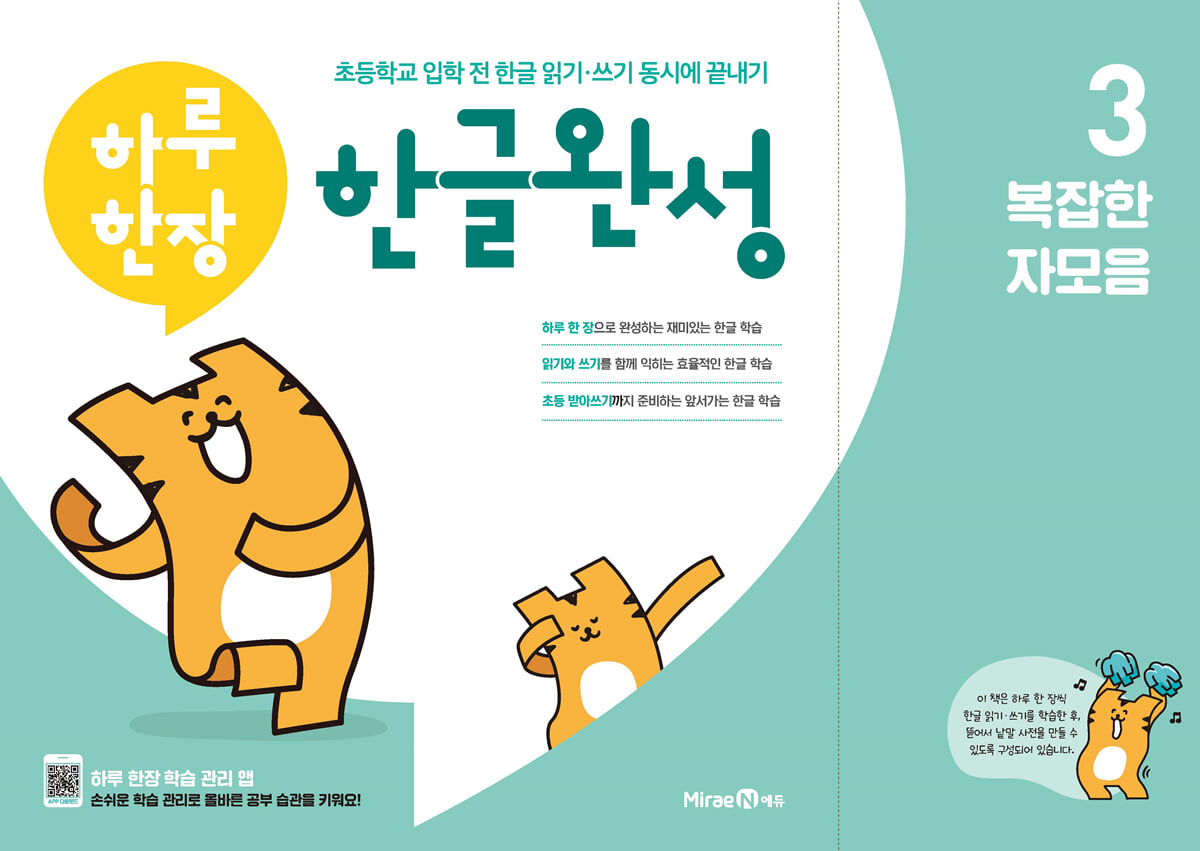
Complete one page of Korean a day: 3 complex consonants and vowels
 |
Description
Book Introduction
I can read Korean, but I have trouble writing it. On average, children begin learning Korean at the age of 4-5, and are exposed to reading more than writing. This is because we become familiar with letters through various reading materials such as storybooks and signs around us. To actually be able to use the Korean language you have learned, you need to practice. Only when the writing process is well done can we say that we have completed learning Korean. I started learning Korean, but my child is bored with the same repetitive patterns. Children aged 6-7 cannot sit still and concentrate for more than 10 minutes. So, it is necessary to set a daily study volume and provide elements of interest. If children can learn while playing, they will not get bored and will want to study on their own. I don't know how much Korean I should study to get my child into elementary school. The current curriculum includes learning Hangul in the first grade of elementary school. However, it is a level that needs to be organized and checked again for children who can read and write Korean to some extent. So, children who are well-versed in Korean before entering school will be able to attend school classes with confidence. |
- You can preview some of the book's contents.
Preview
index
[Volume 3] Complex Consonants and Vowels
Day 1 Letters containing ㄲ
Letters with ㄸ on the 2nd day
Day 3 Review
4th day letters with ㅃ
5th day letters with ㅆ in them
Day 6: Letters with ㅉ
Day 7 Review
Day 8: Letters containing ㅐ
Day 9 Letters containing ㅔ
10th day Letters containing ㅚ
Day 11 Review
12th day Letters containing ㅟ
13th day Letters containing ㅘ
14th day Letters containing ㅝ
Day 15 Review
16th day Letters containing ㅢ
Day 17: Letters containing ㅙ and ㅞ
Day 18 Letters containing ㅒ and ㅖ
Day 19 Review
Day 1 Letters containing ㄲ
Letters with ㄸ on the 2nd day
Day 3 Review
4th day letters with ㅃ
5th day letters with ㅆ in them
Day 6: Letters with ㅉ
Day 7 Review
Day 8: Letters containing ㅐ
Day 9 Letters containing ㅔ
10th day Letters containing ㅚ
Day 11 Review
12th day Letters containing ㅟ
13th day Letters containing ㅘ
14th day Letters containing ㅝ
Day 15 Review
16th day Letters containing ㅢ
Day 17: Letters containing ㅙ and ㅞ
Day 18 Letters containing ㅒ and ㅖ
Day 19 Review
Detailed image

Publisher's Review
Completing one Korean page a day
First, you can learn in a fun way by tearing off one flashcard a day and creating flashcards! Second, you can learn effectively by practicing reading and writing simultaneously.
Third, you can learn ahead of time to prepare for elementary school dictation.
Complete reading and writing in Korean before entering elementary school with one page a day!
[Learning by focusing on whole letters, not individual letters]
Children who can read basic Korean should learn whole letters rather than individual letters to increase their vocabulary and improve their comprehension.
We have designed the entire text so that it can be learned within sentences, taking into account the situations in which the letters are used.
[Tear off one sheet a day and make a flashcard]
You can write down the words you learned each day and then tear them apart to create a Korean dictionary.
You can naturally memorize the shapes of letters and learn their meanings by playing with your own dictionary.
Voice support is available for realistic learning.
It stimulates children's interest by guiding them through what they are studying and what situations are unfolding each day.
It supports voice recognition, allowing you to read the sentences you learned that day in their entirety and take dictation.
First, you can learn in a fun way by tearing off one flashcard a day and creating flashcards! Second, you can learn effectively by practicing reading and writing simultaneously.
Third, you can learn ahead of time to prepare for elementary school dictation.
Complete reading and writing in Korean before entering elementary school with one page a day!
[Learning by focusing on whole letters, not individual letters]
Children who can read basic Korean should learn whole letters rather than individual letters to increase their vocabulary and improve their comprehension.
We have designed the entire text so that it can be learned within sentences, taking into account the situations in which the letters are used.
[Tear off one sheet a day and make a flashcard]
You can write down the words you learned each day and then tear them apart to create a Korean dictionary.
You can naturally memorize the shapes of letters and learn their meanings by playing with your own dictionary.
Voice support is available for realistic learning.
It stimulates children's interest by guiding them through what they are studying and what situations are unfolding each day.
It supports voice recognition, allowing you to read the sentences you learned that day in their entirety and take dictation.
GOODS SPECIFICS
- Publication date: November 1, 2021
- Page count, weight, size: 44 pages | 398g | 364*257*6mm
- ISBN13: 9791164139590
- ISBN10: 1164139592
- Reference book for use: Preschool
- Reference book difficulty level: Easy Reference book difficulty level guide
You may also like
카테고리
korean


korean

![GQ KOREA Mark (Monthly): December [2025]](http://librairie.coreenne.fr/cdn/shop/files/8ef265dbbfbf186523ed75ba7319009d.jpg?v=1765340328&width=3840)


