

How Wise Interventions Can Change Lives
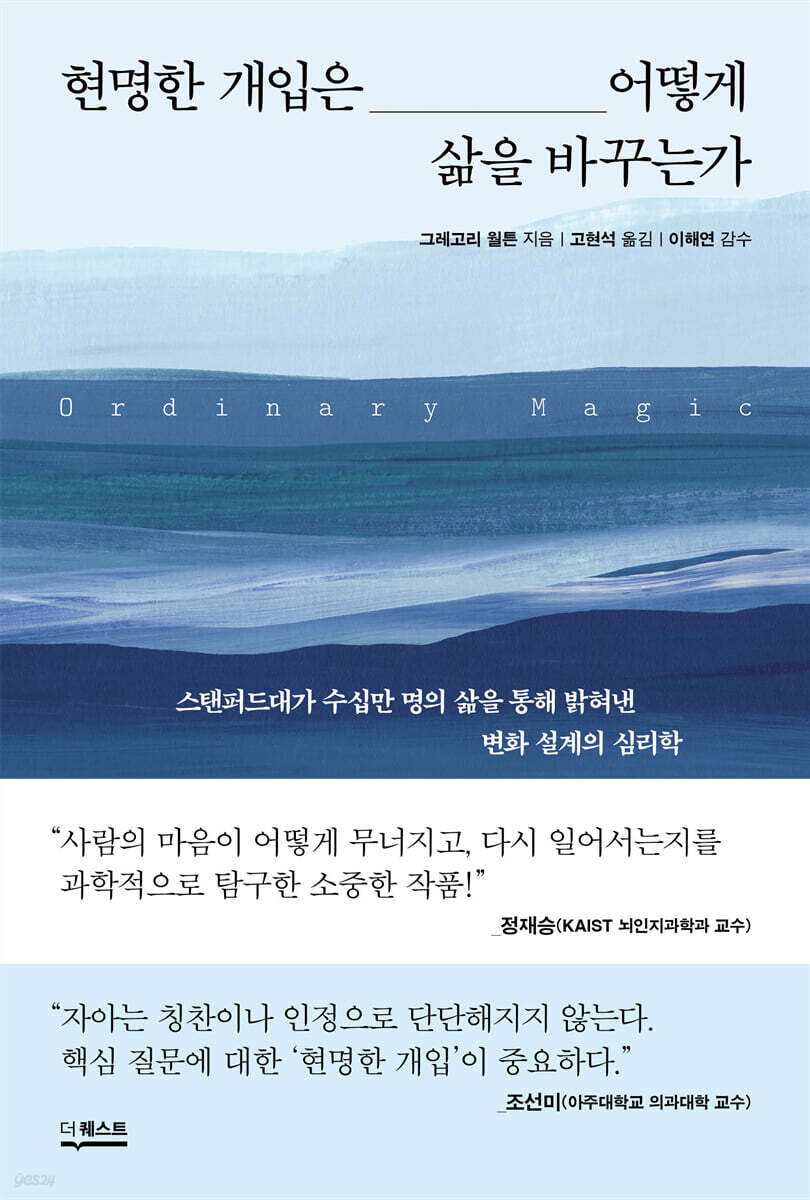 |
Description
Book Introduction
How does "wise intervention" transform myself, others, and society? It stops negative triggers and creates a virtuous cycle in life.
The Secret of Small but Powerful Psychological Intervention
There are many important 'transitional moments' in our lives.
The moment when you become a child, a teenager, and an adult, the moment you first step into society, the moment you start a serious relationship with someone, the moment you become a parent for the first time, etc.
And in those times of turmoil, everyone makes mistakes and experiences failure.
The problem starts here.
After a failure, a little voice inside us begins to doubt ourselves.
"Can I really grow beyond what I am now?", "Can I truly belong here?", "Am I loved enough by them?" As we face the challenges of a new life, these "small voices" quietly seek us out, growing our self-doubt and ultimately causing us to give up.
"How Wise Interventions Change Your Life" is a passionate exploration of these inner "little voices" and a surprisingly practical guide to psychology.
The author, a professor of psychology at Stanford University and a world-renowned authority on growth research, says that only by properly understanding this fundamental question can we escape the downward spiral of negativity and open the door to new possibilities.
And he emphasizes that you can change the direction of your life through 'Wise Intervention', a psychological tool that helps you answer that question constructively.
This book introduces five questions that shake us at every turning point in life: belonging, achievement, identity, relationships, and trust and respect within the community. It also provides specific guidance on how to respond to the negative currents these questions bring and how to transform them into opportunities for growth.
The Secret of Small but Powerful Psychological Intervention
There are many important 'transitional moments' in our lives.
The moment when you become a child, a teenager, and an adult, the moment you first step into society, the moment you start a serious relationship with someone, the moment you become a parent for the first time, etc.
And in those times of turmoil, everyone makes mistakes and experiences failure.
The problem starts here.
After a failure, a little voice inside us begins to doubt ourselves.
"Can I really grow beyond what I am now?", "Can I truly belong here?", "Am I loved enough by them?" As we face the challenges of a new life, these "small voices" quietly seek us out, growing our self-doubt and ultimately causing us to give up.
"How Wise Interventions Change Your Life" is a passionate exploration of these inner "little voices" and a surprisingly practical guide to psychology.
The author, a professor of psychology at Stanford University and a world-renowned authority on growth research, says that only by properly understanding this fundamental question can we escape the downward spiral of negativity and open the door to new possibilities.
And he emphasizes that you can change the direction of your life through 'Wise Intervention', a psychological tool that helps you answer that question constructively.
This book introduces five questions that shake us at every turning point in life: belonging, achievement, identity, relationships, and trust and respect within the community. It also provides specific guidance on how to respond to the negative currents these questions bring and how to transform them into opportunities for growth.
- You can preview some of the book's contents.
Preview
index
Recommendation
Reviewer's note
prolog
Part 1.
swirl
Chapter 1.
descending vortex
How do vortices begin and develop?
Chapter 2.
rising vortex
Step 1: Listen to the question. Step 2: Reveal the question and develop an answer. Step 3: Provide a wise and elegant answer.
Part 2.
Three questions for me
Chapter 3.
Do I belong here?
The threat of stereotypes created by a history of separation and exclusion┃The sense of belonging: The moment when a small incident becomes a 'signal'┃Is this the problem, or am I the problem?┃Don't give a difficult day more meaning┃How to get on the 'upward escalator' of life┃The upward spiral created by the thought, "I am not alone"┃Wise intervention can rewrite the story of reality
Chapter 4.
Can I do it?
Why Do We Fail to Achieve Our Goals? ┃The Devil's Whispers: When Doubts Are Planted in Our Heads ┃The Illusion of Tiredness: What Drives Willpower ┃How to Find and Pursue the Goals That Matter to You
Chapter 5.
Who am I?
Who is telling your story? ┃Tell your own story, breaking free from the old, hackneyed narratives. ┃How to acknowledge the existence of others as they are. ┃Guide and safeguards: nouns and verbs.
spotlight.
How can we solve the problem of global poverty?
Is it okay to feel pity for someone who is poor?┃What kind of people can we become and what can we do?
Part 3.
Two Questions That Will Change Your Relationship
Chapter 6.
Do you love me?
Relationship Intervention #1: What You Need for a Happy Marriage | Relationship Intervention #2: How to Be a Good Parent | Relationship Intervention #3: Friendships That Show You 'Just Who You Are'
Chapter 7.
Are you a trustworthy person?
Why Do Some Interactions Start Negatively? ┃How Mentors and Mentees Can Grow Together
spotlight.
How can we improve vulnerable educational environments?
One Letter That Changed My Life┃Raising the Bar: “I’m a Good Kid.”
Part 4.
Questions that change the world
Chapter 8.
Towards a better world
For Wise Interventions to Work Properly┃The Power of Leadership to Improve Others' Experiences┃How to Motivate Individuals and Organizations
Floodlight.
What can we do to make schools smarter?
How to avoid uncomfortable questions feeling uncomfortable┃The motivation needed to create a smart classroom
Acknowledgements
annotation
Reviewer's note
prolog
Part 1.
swirl
Chapter 1.
descending vortex
How do vortices begin and develop?
Chapter 2.
rising vortex
Step 1: Listen to the question. Step 2: Reveal the question and develop an answer. Step 3: Provide a wise and elegant answer.
Part 2.
Three questions for me
Chapter 3.
Do I belong here?
The threat of stereotypes created by a history of separation and exclusion┃The sense of belonging: The moment when a small incident becomes a 'signal'┃Is this the problem, or am I the problem?┃Don't give a difficult day more meaning┃How to get on the 'upward escalator' of life┃The upward spiral created by the thought, "I am not alone"┃Wise intervention can rewrite the story of reality
Chapter 4.
Can I do it?
Why Do We Fail to Achieve Our Goals? ┃The Devil's Whispers: When Doubts Are Planted in Our Heads ┃The Illusion of Tiredness: What Drives Willpower ┃How to Find and Pursue the Goals That Matter to You
Chapter 5.
Who am I?
Who is telling your story? ┃Tell your own story, breaking free from the old, hackneyed narratives. ┃How to acknowledge the existence of others as they are. ┃Guide and safeguards: nouns and verbs.
spotlight.
How can we solve the problem of global poverty?
Is it okay to feel pity for someone who is poor?┃What kind of people can we become and what can we do?
Part 3.
Two Questions That Will Change Your Relationship
Chapter 6.
Do you love me?
Relationship Intervention #1: What You Need for a Happy Marriage | Relationship Intervention #2: How to Be a Good Parent | Relationship Intervention #3: Friendships That Show You 'Just Who You Are'
Chapter 7.
Are you a trustworthy person?
Why Do Some Interactions Start Negatively? ┃How Mentors and Mentees Can Grow Together
spotlight.
How can we improve vulnerable educational environments?
One Letter That Changed My Life┃Raising the Bar: “I’m a Good Kid.”
Part 4.
Questions that change the world
Chapter 8.
Towards a better world
For Wise Interventions to Work Properly┃The Power of Leadership to Improve Others' Experiences┃How to Motivate Individuals and Organizations
Floodlight.
What can we do to make schools smarter?
How to avoid uncomfortable questions feeling uncomfortable┃The motivation needed to create a smart classroom
Acknowledgements
annotation
Detailed image

Into the book
Have you heard of the "White Bear Experiment"? Researchers long ago demonstrated that when people were told not to think about something ("Don't think of a white bear!"), they were actually more likely to remain stuck in that thought (didn't you just picture a white bear in your head?).
This effect is even more powerful if the thing you don't want to think about is a mental bugaboo.
For example, once a question like, "Do I look like a bad kid?" arises, it immediately tries to occupy our minds.
No matter how much you try to deny or push away the questions, they keep coming back, eventually becoming so intense that they consume your entire sanity.
That's why this question is so important to us.
Because it is a question about my own perception of who I am and a question about the relationships I cherish.
That is why we are trying to find an answer to this question.
These questions take over your mind and soon threaten to consume your life.
It acts as a leading question, leading us to a negative conclusion, and the negative conclusion quickly becomes self-fulfilling.
--- 「Chapter 1.
From "Descending Vortex"
One of the best things we can do for someone facing personal challenges is to provide a kind of model to show how others have overcome the same challenges.
It tells the story of the hardships and worries they experienced, and how they ultimately persevered and grew.
Stories like these help us see our experiences from a new perspective.
It also gives people a chance to reflect on how their own experiences resemble that model, or how they might resemble it in the future, how their own thinking is evolving, and whether they are currently on that model's growth curve.
The best way to do this is to give people the opportunity to give advice to younger people or those who are less experienced.
This gives them the opportunity to demonstrate leadership on their own.
--- 「Chapter 2.
From "Rising Vortex"
This story is very meaningful.
Let's think about it carefully.
In 2014, Michelle Obama had already had a successful career spanning decades.
She first worked as a lawyer and later held various public sector roles in Chicago.
At the time she told this story, she was the First Lady of the United States and one of the most respected people in the world.
The incident she recalled happened decades ago.
And there was no villain in this story.
There is no mention of an overt racist like George Wallace, or even of anyone who directly influenced her.
This might have seemed like just an uncomfortable experience, a minor mistake.
But why did this event remain so vivid in her memory?
That's because this was a trigger for her.
Also, this situation was a tip-bit situation for her.
It's a situation that makes me ask myself, "Can I truly be accepted and respected at Princeton, and truly enjoy the opportunities it offers, when I can't even prepare a single sheet for my dorm bed?"
--- Chapter 3.
From "Do I belong here?"
One reason has to do with a process that Finkel calls “negative-affect reciprocity.”
Simply put, this process is a vortex flowing in the wrong direction.
In the complex reality of living together, small problems that start out as problems with work, money, childcare, etc. gradually solidify into a negative cycle.
For example, Lisa says I'm spending too much time writing this book.
I feel offended by that comment and respond to her bluntly.
Then Lisa gets angry, and I kick the door and run out.
So we are sucked into a downward spiral, and our affection for each other is gradually consumed.
And if you're feeling anxious, it's easy to solidify a more negative interpretation of these situations.
--- 「Chapter 6.
From "Do you love me?"
The only times when the feedback was effective was when Dr. Lindsay explained precisely why she was giving critical feedback.
Dr. Lindsay said she gives feedback because she has high standards and "believes" that her students are capable of meeting them.
“The feedback on the next page is quite critical, but I hope it helps.
“I am giving you this detailed feedback because I believe you are capable of reaching the high standards I mentioned earlier.” This was a clear statement of intent.
(…) When Black students received wise feedback notes, the percentage of students who revised their essays increased to 64 percent.
The figure for white students also increased from 64 percent to 82 percent.
(…) an intervention that delivered a memo of just 17 words at the right time and place increased college enrollment rates six years later.
This effect is even more powerful if the thing you don't want to think about is a mental bugaboo.
For example, once a question like, "Do I look like a bad kid?" arises, it immediately tries to occupy our minds.
No matter how much you try to deny or push away the questions, they keep coming back, eventually becoming so intense that they consume your entire sanity.
That's why this question is so important to us.
Because it is a question about my own perception of who I am and a question about the relationships I cherish.
That is why we are trying to find an answer to this question.
These questions take over your mind and soon threaten to consume your life.
It acts as a leading question, leading us to a negative conclusion, and the negative conclusion quickly becomes self-fulfilling.
--- 「Chapter 1.
From "Descending Vortex"
One of the best things we can do for someone facing personal challenges is to provide a kind of model to show how others have overcome the same challenges.
It tells the story of the hardships and worries they experienced, and how they ultimately persevered and grew.
Stories like these help us see our experiences from a new perspective.
It also gives people a chance to reflect on how their own experiences resemble that model, or how they might resemble it in the future, how their own thinking is evolving, and whether they are currently on that model's growth curve.
The best way to do this is to give people the opportunity to give advice to younger people or those who are less experienced.
This gives them the opportunity to demonstrate leadership on their own.
--- 「Chapter 2.
From "Rising Vortex"
This story is very meaningful.
Let's think about it carefully.
In 2014, Michelle Obama had already had a successful career spanning decades.
She first worked as a lawyer and later held various public sector roles in Chicago.
At the time she told this story, she was the First Lady of the United States and one of the most respected people in the world.
The incident she recalled happened decades ago.
And there was no villain in this story.
There is no mention of an overt racist like George Wallace, or even of anyone who directly influenced her.
This might have seemed like just an uncomfortable experience, a minor mistake.
But why did this event remain so vivid in her memory?
That's because this was a trigger for her.
Also, this situation was a tip-bit situation for her.
It's a situation that makes me ask myself, "Can I truly be accepted and respected at Princeton, and truly enjoy the opportunities it offers, when I can't even prepare a single sheet for my dorm bed?"
--- Chapter 3.
From "Do I belong here?"
One reason has to do with a process that Finkel calls “negative-affect reciprocity.”
Simply put, this process is a vortex flowing in the wrong direction.
In the complex reality of living together, small problems that start out as problems with work, money, childcare, etc. gradually solidify into a negative cycle.
For example, Lisa says I'm spending too much time writing this book.
I feel offended by that comment and respond to her bluntly.
Then Lisa gets angry, and I kick the door and run out.
So we are sucked into a downward spiral, and our affection for each other is gradually consumed.
And if you're feeling anxious, it's easy to solidify a more negative interpretation of these situations.
--- 「Chapter 6.
From "Do you love me?"
The only times when the feedback was effective was when Dr. Lindsay explained precisely why she was giving critical feedback.
Dr. Lindsay said she gives feedback because she has high standards and "believes" that her students are capable of meeting them.
“The feedback on the next page is quite critical, but I hope it helps.
“I am giving you this detailed feedback because I believe you are capable of reaching the high standards I mentioned earlier.” This was a clear statement of intent.
(…) When Black students received wise feedback notes, the percentage of students who revised their essays increased to 64 percent.
The figure for white students also increased from 64 percent to 82 percent.
(…) an intervention that delivered a memo of just 17 words at the right time and place increased college enrollment rates six years later.
--- Chapter 7.
Are you a trustworthy person?
Are you a trustworthy person?
Publisher's Review
How do the whirlpools that change the course of life begin and unfold?
In 2014, then-First Lady of the United States Michelle Obama gave a speech in which she recalled her experience as a freshman at Princeton University.
“As the first college student in my family, the only person I knew on campus was my older brother (*her older brother had been accepted to Princeton on a basketball scholarship two years before her).
I didn't know which lectures to take, and it was difficult to find my way to the lecture hall.
Even the bed sheets I had prepared didn't fit the dorm bed.
I didn't know dorm beds were that long.
“Because of this, I felt depressed and a little left out.”
She vividly remembered one day 33 years ago when she was embarrassed because her bed sheets were the wrong size.
Why did something that might have seemed like a minor mistake, not even a case of racist insult, etch itself so strongly in her memory? Because it was a "trigger" for her.
I was faced with a question that was working inside me without me realizing it: 'Can I really be accepted as a human being and move forward in this place where I don't know a single person and where there are only white people and I can't even prepare a single sheet for my dorm bed?'
There are countless little things in our lives that trigger these 'negative triggers'.
A single thoughtless word from someone, a small mistake that can be laughed off, a minor misunderstanding can create a butterfly effect that makes you doubt that you are not good enough, and that doubt can quickly lead to a downward spiral that changes the direction of your life.
"Ordinaty Magic" examines these questions we ask ourselves at crucial crossroads that determine the direction of our lives and shows us how to find the right answers to these questions using a psychological tool called "Wise Intervention."
The author, a professor of psychology at Stanford University and a world-renowned expert in growth research, emphasizes that only when you can avoid the negative flow caused by these questions and come up with a "different interpretation," can you truly design your life in the direction you want.
Just one question, just one letter,
Just 21 minutes of conversation can completely change the direction of your life!
The psychology of change design, as revealed by Stanford University through decades of research and experimentation.
All dramatic changes happen quietly, just below the surface of consciousness.
Just as the slightest flap of a butterfly's wings can, over time, bring about a huge storm.
And those wings are made up of very ordinary words and actions.
Through the metaphor of the "spiral," the author meticulously traces how the small emotions and perceptions we encounter in our daily lives can be amplified and completely change our identity and the trajectory of our lives.
Part 1 covers the core questions we ask when faced with a triggering event, when and under what circumstances these questions arise, how they escalate into a downward spiral, and how we can reverse this process and turn it into an upward spiral.
In the following parts 2 and 3, we address five of the most fundamental questions we face in life.
We explore how answering these questions can help you calm your inner anxieties, believe in your own potential, build strong relationships, and build trust with others.
The five questions are about belonging ('Do I belong here?'), about goal achievement and competence ('Can I do it?'), about identity ('Who am I?'), about my closest relationships ('Do you love me?'), and about trust and respect within the community ('Are you trustworthy?').
The author says that when doubts about this arise in our subconscious, we can use a simple but powerful psychological tool called 'wise intervention' to prevent our minds from falling into the downward spiral and ride the upward spiral.
Sometimes these interventions are so trivial and so 'routine' that they seem almost magical.
How can a one-hour survey improve GPA three years later, a 21-minute conversation save a marriage, a postcard save someone's life, and a 17-word note increase a middle school student's chances of going to college? But the direction of our lives can change 180 degrees depending on the questions we ask in a given situation and how we interpret them.
Because when your interpretation of a situation changes, your thinking changes, and that leads to changes in behavior.
Wise intervention is not a mathematical formula with a set answer.
It is not a technology that requires complex specialized knowledge.
It manifests itself in various everyday language and behaviors depending on the situation, time, cultural context, past experiences, and the relationship between the intervener and the intervened.
What matters is how naturally this intervention occurs, in the ‘right way’ and at the ‘right time’.
When this carefully designed intervention, taking into account the individual's psychological situation, is applied appropriately, we can break free from the self-imposed label of "failure," believe in the possibility of recovery, and feel trust and a sense of belonging within the community.
That way, you can find the right answer for yourself and move forward.
Don't let minor misfortunes consume your life.
There is a better way to live every life.
The effectiveness of 'wise interventions' has already been proven through rigorous research and experiments conducted by numerous researchers, as well as through follow-up and longitudinal studies spanning over a decade.
This is why leading American psychology scholars, including Carol Dweck and Angela Duckworth, evaluate author Gregory Walton as “the most noteworthy psychologist of our time.”
His research has been widely used as a practical and effective intervention strategy in various areas of life, including education, organizations, and interpersonal relationships, and this research is also leading to actual changes in the field.
The psychological intervention program designed and distributed by the author's research team was delivered online to middle and high school students and college freshmen across the United States, and it increased students' sense of belonging, improved student-teacher interaction, and improved academic performance.
If you are at a crossroads in life, if you are shaken by inner doubts and anxieties, or if you want to change the direction of your life even a little, this book will be of great help.
This book demonstrates how small but powerful psychological interventions can lead to sustained growth, deeper relationships, and healthier communities. It will be the beginning of a new vision for ourselves, others, and society.
In 2014, then-First Lady of the United States Michelle Obama gave a speech in which she recalled her experience as a freshman at Princeton University.
“As the first college student in my family, the only person I knew on campus was my older brother (*her older brother had been accepted to Princeton on a basketball scholarship two years before her).
I didn't know which lectures to take, and it was difficult to find my way to the lecture hall.
Even the bed sheets I had prepared didn't fit the dorm bed.
I didn't know dorm beds were that long.
“Because of this, I felt depressed and a little left out.”
She vividly remembered one day 33 years ago when she was embarrassed because her bed sheets were the wrong size.
Why did something that might have seemed like a minor mistake, not even a case of racist insult, etch itself so strongly in her memory? Because it was a "trigger" for her.
I was faced with a question that was working inside me without me realizing it: 'Can I really be accepted as a human being and move forward in this place where I don't know a single person and where there are only white people and I can't even prepare a single sheet for my dorm bed?'
There are countless little things in our lives that trigger these 'negative triggers'.
A single thoughtless word from someone, a small mistake that can be laughed off, a minor misunderstanding can create a butterfly effect that makes you doubt that you are not good enough, and that doubt can quickly lead to a downward spiral that changes the direction of your life.
"Ordinaty Magic" examines these questions we ask ourselves at crucial crossroads that determine the direction of our lives and shows us how to find the right answers to these questions using a psychological tool called "Wise Intervention."
The author, a professor of psychology at Stanford University and a world-renowned expert in growth research, emphasizes that only when you can avoid the negative flow caused by these questions and come up with a "different interpretation," can you truly design your life in the direction you want.
Just one question, just one letter,
Just 21 minutes of conversation can completely change the direction of your life!
The psychology of change design, as revealed by Stanford University through decades of research and experimentation.
All dramatic changes happen quietly, just below the surface of consciousness.
Just as the slightest flap of a butterfly's wings can, over time, bring about a huge storm.
And those wings are made up of very ordinary words and actions.
Through the metaphor of the "spiral," the author meticulously traces how the small emotions and perceptions we encounter in our daily lives can be amplified and completely change our identity and the trajectory of our lives.
Part 1 covers the core questions we ask when faced with a triggering event, when and under what circumstances these questions arise, how they escalate into a downward spiral, and how we can reverse this process and turn it into an upward spiral.
In the following parts 2 and 3, we address five of the most fundamental questions we face in life.
We explore how answering these questions can help you calm your inner anxieties, believe in your own potential, build strong relationships, and build trust with others.
The five questions are about belonging ('Do I belong here?'), about goal achievement and competence ('Can I do it?'), about identity ('Who am I?'), about my closest relationships ('Do you love me?'), and about trust and respect within the community ('Are you trustworthy?').
The author says that when doubts about this arise in our subconscious, we can use a simple but powerful psychological tool called 'wise intervention' to prevent our minds from falling into the downward spiral and ride the upward spiral.
Sometimes these interventions are so trivial and so 'routine' that they seem almost magical.
How can a one-hour survey improve GPA three years later, a 21-minute conversation save a marriage, a postcard save someone's life, and a 17-word note increase a middle school student's chances of going to college? But the direction of our lives can change 180 degrees depending on the questions we ask in a given situation and how we interpret them.
Because when your interpretation of a situation changes, your thinking changes, and that leads to changes in behavior.
Wise intervention is not a mathematical formula with a set answer.
It is not a technology that requires complex specialized knowledge.
It manifests itself in various everyday language and behaviors depending on the situation, time, cultural context, past experiences, and the relationship between the intervener and the intervened.
What matters is how naturally this intervention occurs, in the ‘right way’ and at the ‘right time’.
When this carefully designed intervention, taking into account the individual's psychological situation, is applied appropriately, we can break free from the self-imposed label of "failure," believe in the possibility of recovery, and feel trust and a sense of belonging within the community.
That way, you can find the right answer for yourself and move forward.
Don't let minor misfortunes consume your life.
There is a better way to live every life.
The effectiveness of 'wise interventions' has already been proven through rigorous research and experiments conducted by numerous researchers, as well as through follow-up and longitudinal studies spanning over a decade.
This is why leading American psychology scholars, including Carol Dweck and Angela Duckworth, evaluate author Gregory Walton as “the most noteworthy psychologist of our time.”
His research has been widely used as a practical and effective intervention strategy in various areas of life, including education, organizations, and interpersonal relationships, and this research is also leading to actual changes in the field.
The psychological intervention program designed and distributed by the author's research team was delivered online to middle and high school students and college freshmen across the United States, and it increased students' sense of belonging, improved student-teacher interaction, and improved academic performance.
If you are at a crossroads in life, if you are shaken by inner doubts and anxieties, or if you want to change the direction of your life even a little, this book will be of great help.
This book demonstrates how small but powerful psychological interventions can lead to sustained growth, deeper relationships, and healthier communities. It will be the beginning of a new vision for ourselves, others, and society.
GOODS SPECIFICS
- Date of issue: July 31, 2025
- Page count, weight, size: 604 pages | 900g | 152*225*36mm
- ISBN13: 9791140714872
You may also like
카테고리
korean


korean

![GQ KOREA Mark (Monthly): December [2025]](http://librairie.coreenne.fr/cdn/shop/files/8ef265dbbfbf186523ed75ba7319009d.jpg?v=1765340328&width=3840)


