

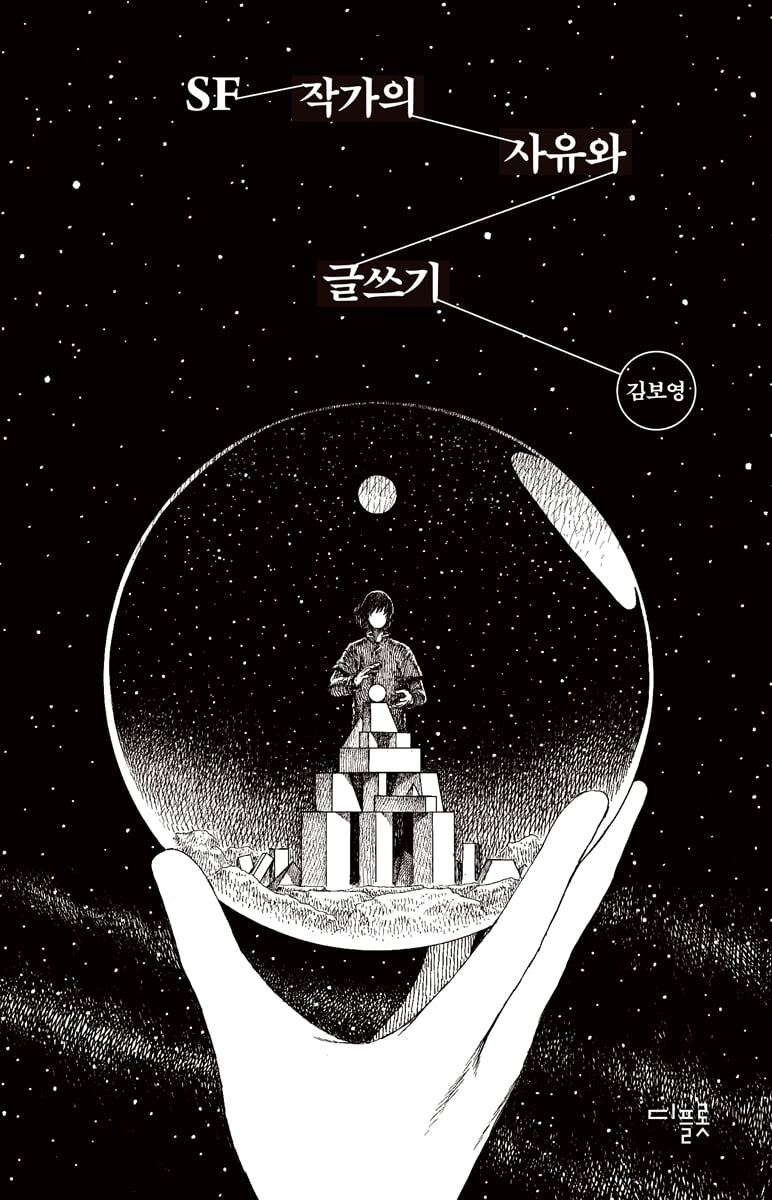
The Thoughts and Writings of Science Fiction Writers
 |
Description
Book Introduction
The first Korean SF writer to be nominated for the National Book Award, the author of SF writers
Kim Bo-young's first creative theory!
A story that begins with a core mistake, from "The Origin of Species" to "Quarantine",
From "Between 0 and 1" to "Interstellar," which never loses readers with their dual storylines.
Hear the secrets of a science fiction narrative that captivated the world, told through the vivid voice of author Kim Bo-young!
“I just wanted to talk about the way I embodied myself while writing.”
A must-read for any modern writer who needs the imagination of science fiction.
The author, who began writing in his teens when there was no such thing as a science fiction publishing market in Korea, conceived the robot story conceived in the early 2000s and is nominated for the 2021 National Book Award.
Meanwhile, the author has won two grand prizes at the SF Awards, and a novel he wrote at the request of a reader to write for a marriage proposal is being made into a film in Hollywood. He also served as an advisor on the screenplay for director Bong Joon-ho's film "Snowpiercer."
In short, Kim Bo-young is a writer who embodies both the origins and achievements of Korean science fiction.
《The Thoughts and Writing of a SF Writer》 is a book that compiles only the creative methodologies that the author, known as the "writer of SF writers," has personally embodied since his debut.
The author, who had been pondering during his rookie days, “How can I get my writing read by people who have no intention of reading?”, sought a way through writing.
He began to study writing books, and as a faithful reader of this field, he wanted to include in this book what he had not seen in the books he had read so far.
With a wide range of examples, including the dual storyline of the film "Interstellar" that draws you in even if you don't know science, and Greg Egan's "Quarantine," which is called a "model work" of hard SF but turns out to be wrong at its core, the author clearly explains the principles he has learned while looking back on his writing process in powerful language without relying on any literary theory.
Amidst the challenges and essence of creation, and the ironic landscapes encountered at the end, we encounter sharp quotes and the humor of masters, and ultimately realize that the origins of this practical advice lie in the very essence of literature.
As the author's declaration that "the author exists before the genre" reveals, science fiction should be viewed as a branch of literature that thinks about and represents the world in a different way before judging it by the categories of form.
In this narrative, the world is as important as the characters. Kim Bo-young's "writing essay" is a must-read for all contemporary writers, who increasingly demand science fiction imagination, as well as for fans of the genre, to deepen their enjoyment.
Kim Bo-young's first creative theory!
A story that begins with a core mistake, from "The Origin of Species" to "Quarantine",
From "Between 0 and 1" to "Interstellar," which never loses readers with their dual storylines.
Hear the secrets of a science fiction narrative that captivated the world, told through the vivid voice of author Kim Bo-young!
“I just wanted to talk about the way I embodied myself while writing.”
A must-read for any modern writer who needs the imagination of science fiction.
The author, who began writing in his teens when there was no such thing as a science fiction publishing market in Korea, conceived the robot story conceived in the early 2000s and is nominated for the 2021 National Book Award.
Meanwhile, the author has won two grand prizes at the SF Awards, and a novel he wrote at the request of a reader to write for a marriage proposal is being made into a film in Hollywood. He also served as an advisor on the screenplay for director Bong Joon-ho's film "Snowpiercer."
In short, Kim Bo-young is a writer who embodies both the origins and achievements of Korean science fiction.
《The Thoughts and Writing of a SF Writer》 is a book that compiles only the creative methodologies that the author, known as the "writer of SF writers," has personally embodied since his debut.
The author, who had been pondering during his rookie days, “How can I get my writing read by people who have no intention of reading?”, sought a way through writing.
He began to study writing books, and as a faithful reader of this field, he wanted to include in this book what he had not seen in the books he had read so far.
With a wide range of examples, including the dual storyline of the film "Interstellar" that draws you in even if you don't know science, and Greg Egan's "Quarantine," which is called a "model work" of hard SF but turns out to be wrong at its core, the author clearly explains the principles he has learned while looking back on his writing process in powerful language without relying on any literary theory.
Amidst the challenges and essence of creation, and the ironic landscapes encountered at the end, we encounter sharp quotes and the humor of masters, and ultimately realize that the origins of this practical advice lie in the very essence of literature.
As the author's declaration that "the author exists before the genre" reveals, science fiction should be viewed as a branch of literature that thinks about and represents the world in a different way before judging it by the categories of form.
In this narrative, the world is as important as the characters. Kim Bo-young's "writing essay" is a must-read for all contemporary writers, who increasingly demand science fiction imagination, as well as for fans of the genre, to deepen their enjoyment.
- You can preview some of the book's contents.
Preview
index
To begin with
Before writing
You come first, then the genre.
Why do I feel like my writing is well written?
What on earth is an idea?
Study like a child
write
There are two main characters in a science fiction narrative: characters and settings.
Other people have their own opinions
The world is connected
Get the point wrong—and get the pointless right.
Time flows relatively
Transmitting in a double structure
Considering the reader's memory and concentration
After writing
The art of listening for reflection and evaluation
How to avoid being hurt by malicious comments
What is essential is invisible to the eye.
By the way
Is there a separate way to read science fiction?
Why isn't 'Ashibalkum' loved?
'It was a visual depiction'
routine
finally
source
annotation
Before writing
You come first, then the genre.
Why do I feel like my writing is well written?
What on earth is an idea?
Study like a child
write
There are two main characters in a science fiction narrative: characters and settings.
Other people have their own opinions
The world is connected
Get the point wrong—and get the pointless right.
Time flows relatively
Transmitting in a double structure
Considering the reader's memory and concentration
After writing
The art of listening for reflection and evaluation
How to avoid being hurt by malicious comments
What is essential is invisible to the eye.
By the way
Is there a separate way to read science fiction?
Why isn't 'Ashibalkum' loved?
'It was a visual depiction'
routine
finally
source
annotation
Detailed image

Into the book
One idea is nothing.
Please also put aside the thought, ‘Then I just need to provide a lot of ideas!’
The reason your idea seems novel is because of the context of your life.
Other people don't have that context.
--- From "What on Earth is an Idea?"
Isn't science fiction a genre that can portray unique and diverse human figures instead of the boring, common, and dull characters of modern society?
Among the contest entries, there are surprisingly many protagonists who start their first line with “Fuck!”
I think it's believed that those words make the protagonist stand out and give him personality.
Every time I see the protagonist announcing his first appearance by roaring, “Fuck!”, I wonder if this is some kind of primal line engraved in the Korean spirit.
Individuality does not come from the protagonist's striking gestures, howling screams, rough thoughts, anxious eyes, threatening fists, or dangerous human appearance.
Individuality comes from contrast (to some extent).
--- From "Others Have Subjectivity"
When I'm often asked, "How do you create a science fiction world?", I often answer, "Just change one thing from reality."
I was later surprised to learn that this answer was taken to mean that it would hardly change the world.
The reason I change just one thing in a novel is to change the whole world.
That is also to change it organically and probabilistically.
There is only one central factor that creates another world.
So to speak, this is the 'main setting' mentioned above.
If a robot with a sense of self were to emerge into the world, it would not be real unless its technology changed the world as we know it.
It's just a metaphor.
A metaphor is an idea.
It's a daydream and an illusion.
When I read such novels, I end up feeling that they are realistic literature that uses science fiction as a poetic metaphor.
Good science fiction creates a real world based on a real world.
--- From "The World is Connected"
The most crucial thing in science fiction is to be wrong.
If this isn't wrong, science fiction doesn't even begin.
This 'must be wrong' is the main setting I mentioned earlier.
It is the single factor that affects the entire world, and it is the most important setting that changes the world in the novel from the world we live in.
It must be done openly, boldly, without hesitation, without reservation, shamelessly, blatantly, blatantly, and blatantly.
As for other minor things, everything that is useless and unimportant in the novel, do your best to be strict.
What if the Falcon was useless for storytelling? The Falcon shouldn't fly at superluminal speeds.
I'm saying this twice because it's important.
If the Falcon doesn't play a significant role in the story, scientific rigor must be maintained.
Otherwise, the audience will get angry and ask how a spaceship can fly at superluminal speeds.
It would be a problem if the writer grumbled at that time, saying, “No, why should SF make sense...”
The reason the spaceship was problematic was not because it was unscientific.
Because it doesn't play a role.
I don't like using robots for trivial purposes like having no emotions, no minds, or being discriminated against in society.
There are countless heartless people in the world, and there are also mountains of people who are discriminated against.
Why use robots if they only play a role no different from humans and then leave?
How blatantly wrong it is gives the reader a thrill, and how rigorously that wrong world is unfolded gives a second thrill.
The two are complementary, and neither alone makes science fiction beautiful enough.
--- From "Get the point wrong ─ and be accurate about the useless"
For something to feel wonderful, it must not be too familiar or too unfamiliar.
It is a feeling that can only be experienced by those who are somewhat familiar with it and ready to open their minds to the point of being touched, but who, coincidentally, are not yet open.
The number of such people is bound to be small.
--- From "Transmitting with a Double Structure"
Perfectionism is the belief that creativity deserves a perfect score, like a test or school assignment.
But there is no such thing in creation.
There is only infinity.
Creativity is not a path or a ladder, but an open field.
Creativity is not a world of scoring.
It is a world that has reached its peak.
In this realm, there are no scores, no rankings, no comparisons.
Mastery is not about being ahead of others.
It is somewhere isolated in the boundless field.
--- From "The Art of Listening to Reflections and Evaluation"
Even after you've established yourself in a relatively stable career, writing may never bring home as much money as a full-time job.
It's extremely difficult to make your family understand this.
So don't try to make them understand, just get it.
You will live in ignorance, but you will be happy.
Writing is like that.
Please also put aside the thought, ‘Then I just need to provide a lot of ideas!’
The reason your idea seems novel is because of the context of your life.
Other people don't have that context.
--- From "What on Earth is an Idea?"
Isn't science fiction a genre that can portray unique and diverse human figures instead of the boring, common, and dull characters of modern society?
Among the contest entries, there are surprisingly many protagonists who start their first line with “Fuck!”
I think it's believed that those words make the protagonist stand out and give him personality.
Every time I see the protagonist announcing his first appearance by roaring, “Fuck!”, I wonder if this is some kind of primal line engraved in the Korean spirit.
Individuality does not come from the protagonist's striking gestures, howling screams, rough thoughts, anxious eyes, threatening fists, or dangerous human appearance.
Individuality comes from contrast (to some extent).
--- From "Others Have Subjectivity"
When I'm often asked, "How do you create a science fiction world?", I often answer, "Just change one thing from reality."
I was later surprised to learn that this answer was taken to mean that it would hardly change the world.
The reason I change just one thing in a novel is to change the whole world.
That is also to change it organically and probabilistically.
There is only one central factor that creates another world.
So to speak, this is the 'main setting' mentioned above.
If a robot with a sense of self were to emerge into the world, it would not be real unless its technology changed the world as we know it.
It's just a metaphor.
A metaphor is an idea.
It's a daydream and an illusion.
When I read such novels, I end up feeling that they are realistic literature that uses science fiction as a poetic metaphor.
Good science fiction creates a real world based on a real world.
--- From "The World is Connected"
The most crucial thing in science fiction is to be wrong.
If this isn't wrong, science fiction doesn't even begin.
This 'must be wrong' is the main setting I mentioned earlier.
It is the single factor that affects the entire world, and it is the most important setting that changes the world in the novel from the world we live in.
It must be done openly, boldly, without hesitation, without reservation, shamelessly, blatantly, blatantly, and blatantly.
As for other minor things, everything that is useless and unimportant in the novel, do your best to be strict.
What if the Falcon was useless for storytelling? The Falcon shouldn't fly at superluminal speeds.
I'm saying this twice because it's important.
If the Falcon doesn't play a significant role in the story, scientific rigor must be maintained.
Otherwise, the audience will get angry and ask how a spaceship can fly at superluminal speeds.
It would be a problem if the writer grumbled at that time, saying, “No, why should SF make sense...”
The reason the spaceship was problematic was not because it was unscientific.
Because it doesn't play a role.
I don't like using robots for trivial purposes like having no emotions, no minds, or being discriminated against in society.
There are countless heartless people in the world, and there are also mountains of people who are discriminated against.
Why use robots if they only play a role no different from humans and then leave?
How blatantly wrong it is gives the reader a thrill, and how rigorously that wrong world is unfolded gives a second thrill.
The two are complementary, and neither alone makes science fiction beautiful enough.
--- From "Get the point wrong ─ and be accurate about the useless"
For something to feel wonderful, it must not be too familiar or too unfamiliar.
It is a feeling that can only be experienced by those who are somewhat familiar with it and ready to open their minds to the point of being touched, but who, coincidentally, are not yet open.
The number of such people is bound to be small.
--- From "Transmitting with a Double Structure"
Perfectionism is the belief that creativity deserves a perfect score, like a test or school assignment.
But there is no such thing in creation.
There is only infinity.
Creativity is not a path or a ladder, but an open field.
Creativity is not a world of scoring.
It is a world that has reached its peak.
In this realm, there are no scores, no rankings, no comparisons.
Mastery is not about being ahead of others.
It is somewhere isolated in the boundless field.
--- From "The Art of Listening to Reflections and Evaluation"
Even after you've established yourself in a relatively stable career, writing may never bring home as much money as a full-time job.
It's extremely difficult to make your family understand this.
So don't try to make them understand, just get it.
You will live in ignorance, but you will be happy.
Writing is like that.
--- From "Routine"
Publisher's Review
SF? Write your story first.
“If you were completely free,
“That writing might be closer to science fiction.”
“It portrays human and non-human characters side by side and reflects on contemporary social and environmental issues.”
_The National Book Award Jury's Comments on "The Origin of Species"
“Kim Bo-young’s novel is a breathtaking work of cinematic art in itself.
It brings to mind the worlds we experienced in The Matrix, Inception, and Dark City, but it also takes us into a completely new structure, providing a groundbreaking and mysterious literary and cinematic experience.
“It’s really intense yet elegant.”
_Bong Joon-ho's review of "I'm Waiting For You and Other Stories"
“Kim Bo-young’s books will be placed next to those of Ray Bradbury, Ursula Le Guin, and Haruki Murakami.”
Publisher's Weekly review of Whale Snow Down
Although he is a writer who has written such monumental science fiction works, he also had to study and answer every time he was asked what science fiction was when he was a rookie.
It's like a Korean who went abroad for the first time being asked, "What kind of country is Korea?" or "Please describe the characteristics of Koreans."
What about now? We live in an era where science fiction novels are a common sight at the top of bestsellers, and works with distinct and compelling "(science fiction) worldviews" captivate Netflix audiences worldwide. Yet, science fiction remains, perhaps even more so, an elusive concept.
To aspiring novelists venturing into the elusive world of science fiction, the author advises, "I hope you don't begin writing simply because you want to write science fiction." Science fiction, like other fiction, must begin with a specific, tangible personal interest.
The author, who felt a sense of crisis about competitive education, wrote “Between 0 and 1” with the clear purpose of recreating his school days.
Ursula K.
Le Guin wrote The Dispossessed as a thought experiment in an anarchist communal society, and Doris Lessing wrote The Fifth Child, a work that depicts the horrors of childbirth through a woman who becomes pregnant with a monster.
The most important thing is to 'write freely about what interests you, what makes you laugh, cry, and get excited.'
“What is your immediate concern?
What makes you laugh, cry, and get excited?
If the appropriate way to express it is in science fiction, then use science fiction.
Otherwise, just write freely.
Perhaps the broad and generous genre of science fiction can embrace your freedom.
If you are completely free, the writing might become closer to science fiction.” (From the text)
The author encourages those who wish to write science fiction to break free from the confines of its concepts, while also emphasizing that science fiction has its own unique charm, and clearly presents the methodology he has embodied for writing science fiction.
Yes. Regardless of how you define science fiction, one thing is clear: some amazing works of science fiction broaden our horizons and even provide experiences bordering on ecstasy.
Those who have fallen for its charm become avid readers and even dream of becoming writers.
So how can we write good science fiction?
Secrets to Writing Good Science Fiction 1
─ There are two main characters in the SF narrative.
The first key point is that among the three elements of a novel (character/incident/background), in science fiction, the background is as important as the characters.
To be more precise, it is a 'setting'.
The author defines the setting as 'main setting' because, like the main character, it is universally one.
This main setting drives the narrative along with the protagonist, and must also be at the center of the conflict along with the protagonist, and ultimately, the resolution must be done together with the protagonist.
The main setting of the 'Captain America' movie series is the 'shield'.
The story begins with the fragile protagonist opening a trash can lid, a fragile shield.
The main setting of the 'Avengers' series is 'gathering', and the ending where so many heroes gather is a more important moment than the scene where they defeat the enemy.
A bad example is Joss Whedon's version of Justice League.
The film loses its narrative power midway through when Batman decides to revive the dead Superman.
This work also has a 'gathering' as its main setting, and since one strong character doesn't solve everything, such a decision would make the story lose interest as if the main character had died.
What about the author's case?
In "The Prophet of This World," the author begins with the imagination that "the afterlife is actually a world where all living things are one living thing," and derives the main premise that "the world is one living thing, and we are fragments of it."
Therefore, the conflict of the narrative is between 'unity' and 'division', and the main characters are those who represent each of these two.
And so the story begins.
'The protagonist, Naban, wants to unite with Aman, who is trying to divide.'
Secrets to Writing Good Science Fiction 2
─ Be blatantly, shamelessly, and blatantly wrong about the most crucial things.
'Should good science fiction be scientifically rigorous?' The author offers a clear answer to this debate:
ㆍThe most important thing in a novel is to be wrong
ㆍOther useless things should be scientifically rigorous.
"Quarantine," which is called the essence of hard SF, is a novel based on quantum mechanics.
It starts from the imagination that the uncertain possibilities that occur in the microscopic world at the particle level can also occur in the macroscopic world.
It is based on a scientifically incorrect assumption.
But what if that part isn't right? The novel can't even begin.
Likewise, the world-renowned science fiction writer Ted Chiang's "The Tower of Babylon" begins with the premise that the universe is cylindrical.
Of course, that's not true.
In the author's "The Origin of Species," robots with consciousness and self appear.
It is currently in the realm of imagination, but without this premise, this novel could not have been born.
The key here is that all the things that are wrong play an important role in the story.
In the 'Star Wars' series, the Falcon, a super-fast spaceship loved by all fans, plays a crucial role in escaping the protagonist when he is in danger.
But what if the Falcon is one of those useless backgrounds? It shouldn't be flying at superluminal speeds.
It must be scientifically rigorous.
The author explains this in the context of the principle of 'Chekhov's gun'.
If a gun appears in a story, it must be used.
But this principle must be complemented by another principle.
The point is that everything that is not important outside of the core must be strict.
In Quarantine, everything other than the core is done with the utmost scientific basis.
In "The Tower of Babylon," all the unimportant parts of building a tower, such as breaking through walls and building, are very realistic until the discovery of a cylindrical universe.
In all other aspects, except the essential ones, the plot must be plausible enough to keep readers engaged while reading the novel.
The higher the resolution of probability, the greater the immersion.
“It will be shamelessly wrong.
Then you know you were wrong.
If you don't know that, there is another problem.
There will be problems in daily life.
After that, truly believe in that wrong world.
Believe with all your heart and unfold the world in that truth. (...)
How blatantly wrong it is gives the reader a thrill, and how rigorously that wrong world is unfolded gives a second thrill.
“The two are complementary, and neither alone makes science fiction beautiful enough.” (From the text)
3 Secrets to Writing Good Science Fiction
─ Don't lose your readers with dual storylines.
Why do people find science fiction difficult? The author ponders this question deeply, but also explains that if science fiction, which contains more information than other genres, demands simplicity, then it too has lost sight of its essence. While science fiction is perceived as difficult, fans tend to delve deeply into the genre.
So, does this mean that science fiction fans are more likely to become fans simply because they understand science better? A look at recent domestic best-selling science fiction books suggests otherwise.
The fact that the overall market size has not grown suggests that general literature readers have become more interested, rather than readers with a good understanding of science creating a new science fiction market.
The author heard from a university lecturer who used his short story "Under the Ground" as a lecture material that 90 percent of his students did not notice the final twist.
It's surprising that this is so despite not using difficult science, but on the other hand, it's also surprising that people understand "Between 0 and 1," a work that throws in science as it is and even incorporates the theory of time travel into quantum mechanics.
The author also finds the reason in the success of Interstellar.
In this film, like in Between 0 and 1, there are two storylines that flow.
Interstellar is a story of wonder about going into a black hole, transcending time and space to save humanity, and at the same time, it is a story about a father longing to see his daughter.
Even if you don't know science, the story of heartbreaking fatherly love is worth paying for.
Creativity isn't a test where you have to aim for perfect scores in every aspect.
It's a world that has reached a new level
The core of writing is clearly presented, and the writer's preparation process before and after writing and his attitude toward the work are also covered extensively.
In the chapters “Before Writing” and “After Writing,” you can also delve deeper into the author’s unique creative theory.
For example, the author warns that 'perfectionism is doing everything in moderation.'
Creative writing isn't a world where you get perfect marks like on tests or school assignments.
'It's not a world of scoring, it's a world of achieving a level.'
If you strive for perfect writing in every way, you're likely to end up with a bland piece of writing.
A masterpiece is completed by having some parts that are strangely lacking, while others are surprisingly outstanding.
The author clearly states in response to the age-old debate of 'Should I think about the message when writing a novel?' that 'You need to intend the message before you write, but you shouldn't intend it while you're writing.'
In a novel, it is more difficult and important to experience and embody the message or ethics itself than to emphasize them.
Good creations make us truly experience their message, and the world in which they take place feels real, which is a miracle.
The only way to make the world come alive is through the details of every single novel, and that is why the creator says this.
“I don’t think about the message.
“I only think about the details.”
The method is also like this.
The author finally urges us to embody the writing style, but to forget it when writing.
Because masterpieces are ultimately created when you do things that the rules tell you not to do.
The protrusions and anomalies that create masterpieces simply come from the midst of pure immersion, from a state of utmost confirmation and selflessness.
Listen to the author's willingness to share his wisdom with those who truly want to write science fiction.
“If you were completely free,
“That writing might be closer to science fiction.”
“It portrays human and non-human characters side by side and reflects on contemporary social and environmental issues.”
_The National Book Award Jury's Comments on "The Origin of Species"
“Kim Bo-young’s novel is a breathtaking work of cinematic art in itself.
It brings to mind the worlds we experienced in The Matrix, Inception, and Dark City, but it also takes us into a completely new structure, providing a groundbreaking and mysterious literary and cinematic experience.
“It’s really intense yet elegant.”
_Bong Joon-ho's review of "I'm Waiting For You and Other Stories"
“Kim Bo-young’s books will be placed next to those of Ray Bradbury, Ursula Le Guin, and Haruki Murakami.”
Publisher's Weekly review of Whale Snow Down
Although he is a writer who has written such monumental science fiction works, he also had to study and answer every time he was asked what science fiction was when he was a rookie.
It's like a Korean who went abroad for the first time being asked, "What kind of country is Korea?" or "Please describe the characteristics of Koreans."
What about now? We live in an era where science fiction novels are a common sight at the top of bestsellers, and works with distinct and compelling "(science fiction) worldviews" captivate Netflix audiences worldwide. Yet, science fiction remains, perhaps even more so, an elusive concept.
To aspiring novelists venturing into the elusive world of science fiction, the author advises, "I hope you don't begin writing simply because you want to write science fiction." Science fiction, like other fiction, must begin with a specific, tangible personal interest.
The author, who felt a sense of crisis about competitive education, wrote “Between 0 and 1” with the clear purpose of recreating his school days.
Ursula K.
Le Guin wrote The Dispossessed as a thought experiment in an anarchist communal society, and Doris Lessing wrote The Fifth Child, a work that depicts the horrors of childbirth through a woman who becomes pregnant with a monster.
The most important thing is to 'write freely about what interests you, what makes you laugh, cry, and get excited.'
“What is your immediate concern?
What makes you laugh, cry, and get excited?
If the appropriate way to express it is in science fiction, then use science fiction.
Otherwise, just write freely.
Perhaps the broad and generous genre of science fiction can embrace your freedom.
If you are completely free, the writing might become closer to science fiction.” (From the text)
The author encourages those who wish to write science fiction to break free from the confines of its concepts, while also emphasizing that science fiction has its own unique charm, and clearly presents the methodology he has embodied for writing science fiction.
Yes. Regardless of how you define science fiction, one thing is clear: some amazing works of science fiction broaden our horizons and even provide experiences bordering on ecstasy.
Those who have fallen for its charm become avid readers and even dream of becoming writers.
So how can we write good science fiction?
Secrets to Writing Good Science Fiction 1
─ There are two main characters in the SF narrative.
The first key point is that among the three elements of a novel (character/incident/background), in science fiction, the background is as important as the characters.
To be more precise, it is a 'setting'.
The author defines the setting as 'main setting' because, like the main character, it is universally one.
This main setting drives the narrative along with the protagonist, and must also be at the center of the conflict along with the protagonist, and ultimately, the resolution must be done together with the protagonist.
The main setting of the 'Captain America' movie series is the 'shield'.
The story begins with the fragile protagonist opening a trash can lid, a fragile shield.
The main setting of the 'Avengers' series is 'gathering', and the ending where so many heroes gather is a more important moment than the scene where they defeat the enemy.
A bad example is Joss Whedon's version of Justice League.
The film loses its narrative power midway through when Batman decides to revive the dead Superman.
This work also has a 'gathering' as its main setting, and since one strong character doesn't solve everything, such a decision would make the story lose interest as if the main character had died.
What about the author's case?
In "The Prophet of This World," the author begins with the imagination that "the afterlife is actually a world where all living things are one living thing," and derives the main premise that "the world is one living thing, and we are fragments of it."
Therefore, the conflict of the narrative is between 'unity' and 'division', and the main characters are those who represent each of these two.
And so the story begins.
'The protagonist, Naban, wants to unite with Aman, who is trying to divide.'
Secrets to Writing Good Science Fiction 2
─ Be blatantly, shamelessly, and blatantly wrong about the most crucial things.
'Should good science fiction be scientifically rigorous?' The author offers a clear answer to this debate:
ㆍThe most important thing in a novel is to be wrong
ㆍOther useless things should be scientifically rigorous.
"Quarantine," which is called the essence of hard SF, is a novel based on quantum mechanics.
It starts from the imagination that the uncertain possibilities that occur in the microscopic world at the particle level can also occur in the macroscopic world.
It is based on a scientifically incorrect assumption.
But what if that part isn't right? The novel can't even begin.
Likewise, the world-renowned science fiction writer Ted Chiang's "The Tower of Babylon" begins with the premise that the universe is cylindrical.
Of course, that's not true.
In the author's "The Origin of Species," robots with consciousness and self appear.
It is currently in the realm of imagination, but without this premise, this novel could not have been born.
The key here is that all the things that are wrong play an important role in the story.
In the 'Star Wars' series, the Falcon, a super-fast spaceship loved by all fans, plays a crucial role in escaping the protagonist when he is in danger.
But what if the Falcon is one of those useless backgrounds? It shouldn't be flying at superluminal speeds.
It must be scientifically rigorous.
The author explains this in the context of the principle of 'Chekhov's gun'.
If a gun appears in a story, it must be used.
But this principle must be complemented by another principle.
The point is that everything that is not important outside of the core must be strict.
In Quarantine, everything other than the core is done with the utmost scientific basis.
In "The Tower of Babylon," all the unimportant parts of building a tower, such as breaking through walls and building, are very realistic until the discovery of a cylindrical universe.
In all other aspects, except the essential ones, the plot must be plausible enough to keep readers engaged while reading the novel.
The higher the resolution of probability, the greater the immersion.
“It will be shamelessly wrong.
Then you know you were wrong.
If you don't know that, there is another problem.
There will be problems in daily life.
After that, truly believe in that wrong world.
Believe with all your heart and unfold the world in that truth. (...)
How blatantly wrong it is gives the reader a thrill, and how rigorously that wrong world is unfolded gives a second thrill.
“The two are complementary, and neither alone makes science fiction beautiful enough.” (From the text)
3 Secrets to Writing Good Science Fiction
─ Don't lose your readers with dual storylines.
Why do people find science fiction difficult? The author ponders this question deeply, but also explains that if science fiction, which contains more information than other genres, demands simplicity, then it too has lost sight of its essence. While science fiction is perceived as difficult, fans tend to delve deeply into the genre.
So, does this mean that science fiction fans are more likely to become fans simply because they understand science better? A look at recent domestic best-selling science fiction books suggests otherwise.
The fact that the overall market size has not grown suggests that general literature readers have become more interested, rather than readers with a good understanding of science creating a new science fiction market.
The author heard from a university lecturer who used his short story "Under the Ground" as a lecture material that 90 percent of his students did not notice the final twist.
It's surprising that this is so despite not using difficult science, but on the other hand, it's also surprising that people understand "Between 0 and 1," a work that throws in science as it is and even incorporates the theory of time travel into quantum mechanics.
The author also finds the reason in the success of Interstellar.
In this film, like in Between 0 and 1, there are two storylines that flow.
Interstellar is a story of wonder about going into a black hole, transcending time and space to save humanity, and at the same time, it is a story about a father longing to see his daughter.
Even if you don't know science, the story of heartbreaking fatherly love is worth paying for.
Creativity isn't a test where you have to aim for perfect scores in every aspect.
It's a world that has reached a new level
The core of writing is clearly presented, and the writer's preparation process before and after writing and his attitude toward the work are also covered extensively.
In the chapters “Before Writing” and “After Writing,” you can also delve deeper into the author’s unique creative theory.
For example, the author warns that 'perfectionism is doing everything in moderation.'
Creative writing isn't a world where you get perfect marks like on tests or school assignments.
'It's not a world of scoring, it's a world of achieving a level.'
If you strive for perfect writing in every way, you're likely to end up with a bland piece of writing.
A masterpiece is completed by having some parts that are strangely lacking, while others are surprisingly outstanding.
The author clearly states in response to the age-old debate of 'Should I think about the message when writing a novel?' that 'You need to intend the message before you write, but you shouldn't intend it while you're writing.'
In a novel, it is more difficult and important to experience and embody the message or ethics itself than to emphasize them.
Good creations make us truly experience their message, and the world in which they take place feels real, which is a miracle.
The only way to make the world come alive is through the details of every single novel, and that is why the creator says this.
“I don’t think about the message.
“I only think about the details.”
The method is also like this.
The author finally urges us to embody the writing style, but to forget it when writing.
Because masterpieces are ultimately created when you do things that the rules tell you not to do.
The protrusions and anomalies that create masterpieces simply come from the midst of pure immersion, from a state of utmost confirmation and selflessness.
Listen to the author's willingness to share his wisdom with those who truly want to write science fiction.
GOODS SPECIFICS
- Date of issue: November 20, 2025
- Page count, weight, size: 232 pages | 334g | 128*198*15mm
- ISBN13: 9791193591468
- ISBN10: 1193591465
You may also like
카테고리
korean


korean

![GQ KOREA Mark (Monthly): December [2025]](http://librairie.coreenne.fr/cdn/shop/files/8ef265dbbfbf186523ed75ba7319009d.jpg?v=1765340328&width=3840)


