

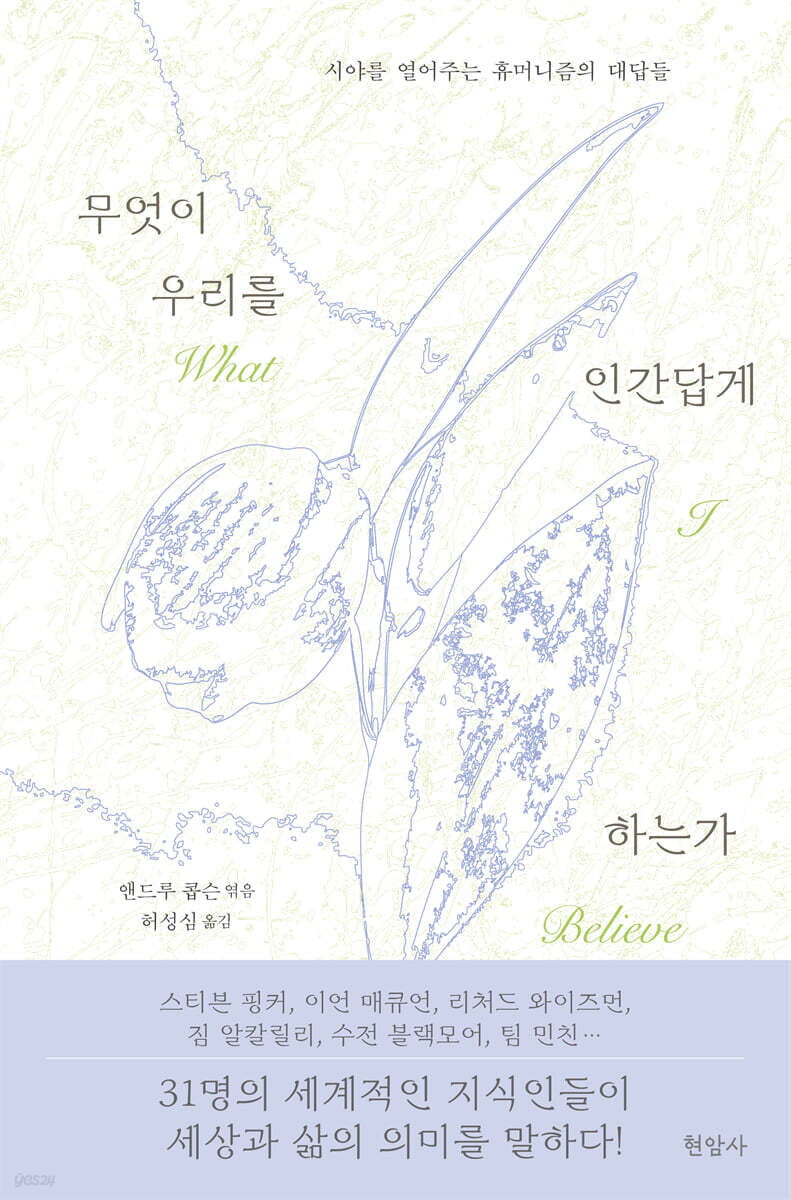
What Makes Us Human
 |
Description
Book Introduction
How will you live?
Steven Pinker, Ian McEwan, Richard Wiseman, Jim Al-Khalili, Susan Blackmore…
The world's greatest historians, writers, scientists, philosophers, and journalists
Talk about the meaning of the world and life!
Life is sometimes overwhelming.
I don't know how to live or what to believe in while living.
We each establish our own values and navigate the uncertainties of life.
Some people value reason and rationality and pursue truth, some care for others with love, and some are determined to establish justice.
When you don't know how to live, listening to other people's stories can make the path more clear.
Andrew Copson, president of the British Humanist Association, met with 31 world-renowned intellectuals and asked them questions.
How should we live? What kind of being are humans? Why do we create art? Why should we learn? What role can history play for us? Scientists, psychologists, writers, historians, philosophers, journalists, artists—these people with diverse professions have one thing in common: they are all humanists.
Leading figures in their fields, including Steven Pinker, Richard Wiseman, Jim Al-Khalili, and Ian McEwan, reveal their perspectives on the world.
Their answers are all different, and that makes them fascinating and enterprising.
"What Makes Us Human" will be able to answer the questions we endlessly ask ourselves as we go about our lives, about the meaning of life and the world.
Steven Pinker, Ian McEwan, Richard Wiseman, Jim Al-Khalili, Susan Blackmore…
The world's greatest historians, writers, scientists, philosophers, and journalists
Talk about the meaning of the world and life!
Life is sometimes overwhelming.
I don't know how to live or what to believe in while living.
We each establish our own values and navigate the uncertainties of life.
Some people value reason and rationality and pursue truth, some care for others with love, and some are determined to establish justice.
When you don't know how to live, listening to other people's stories can make the path more clear.
Andrew Copson, president of the British Humanist Association, met with 31 world-renowned intellectuals and asked them questions.
How should we live? What kind of being are humans? Why do we create art? Why should we learn? What role can history play for us? Scientists, psychologists, writers, historians, philosophers, journalists, artists—these people with diverse professions have one thing in common: they are all humanists.
Leading figures in their fields, including Steven Pinker, Richard Wiseman, Jim Al-Khalili, and Ian McEwan, reveal their perspectives on the world.
Their answers are all different, and that makes them fascinating and enterprising.
"What Makes Us Human" will be able to answer the questions we endlessly ask ourselves as we go about our lives, about the meaning of life and the world.
- You can preview some of the book's contents.
Preview
index
Introduction
Acknowledgements
Part 1: On Reason, Science, and Truth
Jim Al-Khalili - Reality and Storytelling
Susan Blackmore - False Beliefs and Drug Experiences
Richard Wiseman - How to Understand Ourselves
Rebecca Goldstein - Knowledge and the Things That Matter
Steven Pinker - Science and Human Nature
Helen Chersky - When We Were All in the Same Boat
Tim Minchin - How to Be Skeptical and Avoid Controversy
Paul Sina - Family and the Joy of Knowing
Hannah Peel - Music and Meaning
Joan Bakewell - Curiosity and Being Interested in the World
Stephen Fry - Uncertainty
Part 2: On Love, Respect, and Empathy
Eddie Marsan - Character and the Immigrant Spirit
Janet Ellis - Creativity and Resilience
Ian McEwan - On Being a Novelist
Diane Monday - Efforts for Change
Anthony Grayling - The Good Life and the Good Society
Nigel Warburton - Clarity and Freedom of Thought
Nicola Raihani - Collaboration
Frank Turner - Creativity and Connection
Christina Patterson - Loss and Pain
Sarah Bakewell - The Biography of a Human Being
Part 3: On Liberty, Equality and Justice
Alice Roberts - Culture and Equality
S.
I. Martin - History and Diversity
Natalie Haynes - A Classic for Everyone and a Woman's Perspective
Dan Snow - History, Progress, and the Power of Chance
Sandi Totzvig - Thoughtfulness and Equality
Kate Pickett - Society and Equality
Leo Igwe - Optimism and the Fight Against Superstition
Sian Berry - The Green Party's Human Perspective
Mike Little - The World of Open Source
Elf Dubs - Human Rights
Acknowledgements
Part 1: On Reason, Science, and Truth
Jim Al-Khalili - Reality and Storytelling
Susan Blackmore - False Beliefs and Drug Experiences
Richard Wiseman - How to Understand Ourselves
Rebecca Goldstein - Knowledge and the Things That Matter
Steven Pinker - Science and Human Nature
Helen Chersky - When We Were All in the Same Boat
Tim Minchin - How to Be Skeptical and Avoid Controversy
Paul Sina - Family and the Joy of Knowing
Hannah Peel - Music and Meaning
Joan Bakewell - Curiosity and Being Interested in the World
Stephen Fry - Uncertainty
Part 2: On Love, Respect, and Empathy
Eddie Marsan - Character and the Immigrant Spirit
Janet Ellis - Creativity and Resilience
Ian McEwan - On Being a Novelist
Diane Monday - Efforts for Change
Anthony Grayling - The Good Life and the Good Society
Nigel Warburton - Clarity and Freedom of Thought
Nicola Raihani - Collaboration
Frank Turner - Creativity and Connection
Christina Patterson - Loss and Pain
Sarah Bakewell - The Biography of a Human Being
Part 3: On Liberty, Equality and Justice
Alice Roberts - Culture and Equality
S.
I. Martin - History and Diversity
Natalie Haynes - A Classic for Everyone and a Woman's Perspective
Dan Snow - History, Progress, and the Power of Chance
Sandi Totzvig - Thoughtfulness and Equality
Kate Pickett - Society and Equality
Leo Igwe - Optimism and the Fight Against Superstition
Sian Berry - The Green Party's Human Perspective
Mike Little - The World of Open Source
Elf Dubs - Human Rights
Detailed image
Into the book
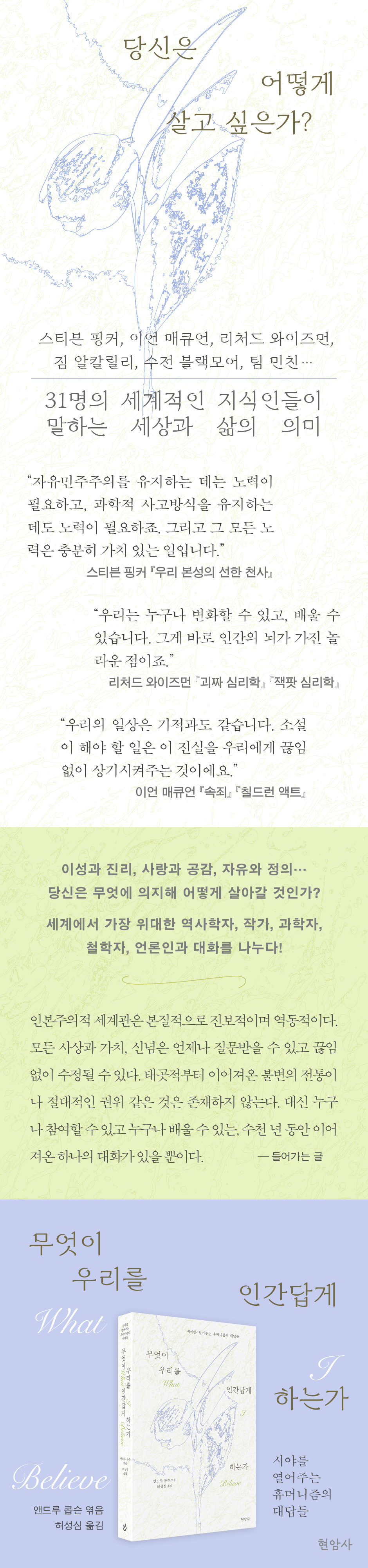
We can all change and learn.
That's the amazing thing about the human brain.
--- From "Richard Wiseman - Understanding Ourselves"
I think we are beings who have a tendency to continue to regress.
That's clearly evident when you look at the threats to democracy, the threats to human rights, the threats to scientific understanding.
Democracy, human rights, scientific understanding—these things don't just happen on their own.
We tend to fall into 'magical thinking' where we believe what we want to believe instead of thinking scientifically.
Instead of thinking universally and human-centered, we think tribal-centered.
So we must continually remind ourselves that we must resist the temptation to revert to tribalism, magical thinking, or authoritarianism.
Maintaining liberal democracy takes effort, and maintaining a scientific mindset also takes effort.
And all that effort is well worth it.
--- From "Steven Pinker - Science and Human Nature"
Life is a story.
But in many ways, it's not a story we can write ourselves.
All we know for sure is the beginning and the end of the story, and sometimes we can't even pinpoint the beginning.
--- From "Janet Ellis - Creativity and Resilience"
Our daily lives are like miracles.
The job of the novel is to constantly remind us of this truth.
Or, as novelist John Updike puts it, the novel's task is "to give the ordinary its due beauty."
--- From "Ian McEwan - Becoming a Novelist"
You can't brainwash yourself into feeling emotions you don't feel.
If you feel unhappy, you just feel unhappy.
But it's difficult to say this simply.
Only after we become wiser, gain more life experience, and endure a few trials do we begin to realize that happiness is, to some extent, a choice.
We can either continue to focus on what is making us miserable, or we can turn away from it.
The choice is yours.
--- From "Christina Patterson - Loss and Pain"
History is a question of how we tell our stories.
It's a process of finding answers to the questions, "What kind of beings are we? Why do we think we are that way, and why do we believe that?"
Questions like these lead to endless discussion.
The more controversial and controversial something is, the more desirable it is.
I really enjoy talking to people.
I especially enjoy talking to people who have different perspectives than I do.
That's also why I think history is important.
Throughout history, we are constantly challenged and given the opportunity to challenge others.
That's the amazing thing about the human brain.
--- From "Richard Wiseman - Understanding Ourselves"
I think we are beings who have a tendency to continue to regress.
That's clearly evident when you look at the threats to democracy, the threats to human rights, the threats to scientific understanding.
Democracy, human rights, scientific understanding—these things don't just happen on their own.
We tend to fall into 'magical thinking' where we believe what we want to believe instead of thinking scientifically.
Instead of thinking universally and human-centered, we think tribal-centered.
So we must continually remind ourselves that we must resist the temptation to revert to tribalism, magical thinking, or authoritarianism.
Maintaining liberal democracy takes effort, and maintaining a scientific mindset also takes effort.
And all that effort is well worth it.
--- From "Steven Pinker - Science and Human Nature"
Life is a story.
But in many ways, it's not a story we can write ourselves.
All we know for sure is the beginning and the end of the story, and sometimes we can't even pinpoint the beginning.
--- From "Janet Ellis - Creativity and Resilience"
Our daily lives are like miracles.
The job of the novel is to constantly remind us of this truth.
Or, as novelist John Updike puts it, the novel's task is "to give the ordinary its due beauty."
--- From "Ian McEwan - Becoming a Novelist"
You can't brainwash yourself into feeling emotions you don't feel.
If you feel unhappy, you just feel unhappy.
But it's difficult to say this simply.
Only after we become wiser, gain more life experience, and endure a few trials do we begin to realize that happiness is, to some extent, a choice.
We can either continue to focus on what is making us miserable, or we can turn away from it.
The choice is yours.
--- From "Christina Patterson - Loss and Pain"
History is a question of how we tell our stories.
It's a process of finding answers to the questions, "What kind of beings are we? Why do we think we are that way, and why do we believe that?"
Questions like these lead to endless discussion.
The more controversial and controversial something is, the more desirable it is.
I really enjoy talking to people.
I especially enjoy talking to people who have different perspectives than I do.
That's also why I think history is important.
Throughout history, we are constantly challenged and given the opportunity to challenge others.
--- 「S.
I. Martin? From “History and Diversity”
I. Martin? From “History and Diversity”
Publisher's Review
What is a human life?
We often talk about how we should live like human beings.
But what exactly does it mean to be human? What constitutes a humane life? The philosophical thought that answers these questions is humanism.
Humanism pursues humanity, believes in human capabilities, values human dignity, and talks about human development and the future.
Today, humanism has gone beyond the exclusive domain of a specific school of thought or philosopher and has become widespread as common sense in modern society.
Many people believe that humans are rational beings, that morality is a human creation, and that the world can be explained by scientific reason.
However, despite the widespread adoption of this humanistic perspective, there are few opportunities to directly encounter humanists' opinions.
The British Humanist Association is a diverse organization with a history of over 120 years, and its members include scientists, philosophers, historians, writers, musicians, politicians, and many others.
Andrew Copson, the president of the association, introduced the stories of humanists to the public through the podcast “What I Believe.” Global intellectuals who are active in their fields, such as Steven Pinker, well-known in Korea for “The Better Angels of Our Nature,” Richard Wiseman, author of “Freaky Psychology,” Ian McEwan, Man From the Star Award-winning author, Stephen Fry, television writer and actor, marine physicist Heln Czersky, and Green Party politician Sian Berry, shared their views on this podcast.
"What Makes Us Human" is a collection of these interviews.
The humanistic worldview is inherently progressive and dynamic.
All ideas, values, and beliefs are always subject to questioning and constant revision.
There is no such thing as an immutable tradition or absolute authority that has been passed down from time immemorial.
Instead, there is a single conversation that has been going on for thousands of years, one that anyone can participate in and learn from.
I hope this book will serve as a guide to help you embark on that journey of meaningful conversation.
- From the introductory text
Each worldview of reason, emotion, and justice
31 humanists reveal their worldviews in conversation with Andrew Copson.
How do you see the world, what do you consider important, and how do you think you should live?
Although they are united by their commonality as humanists, the values they hold are all different.
Some people value reason and knowledge, some value emotion and love, and some value freedom and equality.
The paths they took to their humanistic beliefs were different for each person, and their professional worlds had a significant influence.
Andrew Copson, who conducted the interview, delves deep into the interviewees' worldviews and asks them questions.
Physicist Jim Al-Khalili talks about the importance of the scientific method, and actress and writer Janet Ellis understands life as a story.
Cognitive psychologist Steven Pinker believes that humans have a tendency to regress, while psychologist Richard Wiseman sees humans as beings capable of change.
For composer Hannah Peel, music is a means of expression that conveys meaning, while singer-songwriter Frank Turner sees music as a conversation with others.
The diverse perspectives on life presented by humanists are fascinating.
By understanding the values and beliefs of others, we can learn something and see the world from a new perspective.
Through these numerous conversations, readers will gain valuable insights and deep reflections, and will be able to establish their own worldview and gain the strength to live their lives.
We often talk about how we should live like human beings.
But what exactly does it mean to be human? What constitutes a humane life? The philosophical thought that answers these questions is humanism.
Humanism pursues humanity, believes in human capabilities, values human dignity, and talks about human development and the future.
Today, humanism has gone beyond the exclusive domain of a specific school of thought or philosopher and has become widespread as common sense in modern society.
Many people believe that humans are rational beings, that morality is a human creation, and that the world can be explained by scientific reason.
However, despite the widespread adoption of this humanistic perspective, there are few opportunities to directly encounter humanists' opinions.
The British Humanist Association is a diverse organization with a history of over 120 years, and its members include scientists, philosophers, historians, writers, musicians, politicians, and many others.
Andrew Copson, the president of the association, introduced the stories of humanists to the public through the podcast “What I Believe.” Global intellectuals who are active in their fields, such as Steven Pinker, well-known in Korea for “The Better Angels of Our Nature,” Richard Wiseman, author of “Freaky Psychology,” Ian McEwan, Man From the Star Award-winning author, Stephen Fry, television writer and actor, marine physicist Heln Czersky, and Green Party politician Sian Berry, shared their views on this podcast.
"What Makes Us Human" is a collection of these interviews.
The humanistic worldview is inherently progressive and dynamic.
All ideas, values, and beliefs are always subject to questioning and constant revision.
There is no such thing as an immutable tradition or absolute authority that has been passed down from time immemorial.
Instead, there is a single conversation that has been going on for thousands of years, one that anyone can participate in and learn from.
I hope this book will serve as a guide to help you embark on that journey of meaningful conversation.
- From the introductory text
Each worldview of reason, emotion, and justice
31 humanists reveal their worldviews in conversation with Andrew Copson.
How do you see the world, what do you consider important, and how do you think you should live?
Although they are united by their commonality as humanists, the values they hold are all different.
Some people value reason and knowledge, some value emotion and love, and some value freedom and equality.
The paths they took to their humanistic beliefs were different for each person, and their professional worlds had a significant influence.
Andrew Copson, who conducted the interview, delves deep into the interviewees' worldviews and asks them questions.
Physicist Jim Al-Khalili talks about the importance of the scientific method, and actress and writer Janet Ellis understands life as a story.
Cognitive psychologist Steven Pinker believes that humans have a tendency to regress, while psychologist Richard Wiseman sees humans as beings capable of change.
For composer Hannah Peel, music is a means of expression that conveys meaning, while singer-songwriter Frank Turner sees music as a conversation with others.
The diverse perspectives on life presented by humanists are fascinating.
By understanding the values and beliefs of others, we can learn something and see the world from a new perspective.
Through these numerous conversations, readers will gain valuable insights and deep reflections, and will be able to establish their own worldview and gain the strength to live their lives.
GOODS SPECIFICS
- Date of issue: November 20, 2025
- Page count, weight, size: 448 pages | 534g | 145*220*22mm
- ISBN13: 9788932324579
You may also like
카테고리
korean


korean

![GQ KOREA Mark (Monthly): December [2025]](http://librairie.coreenne.fr/cdn/shop/files/8ef265dbbfbf186523ed75ba7319009d.jpg?v=1765340328&width=3840)


