

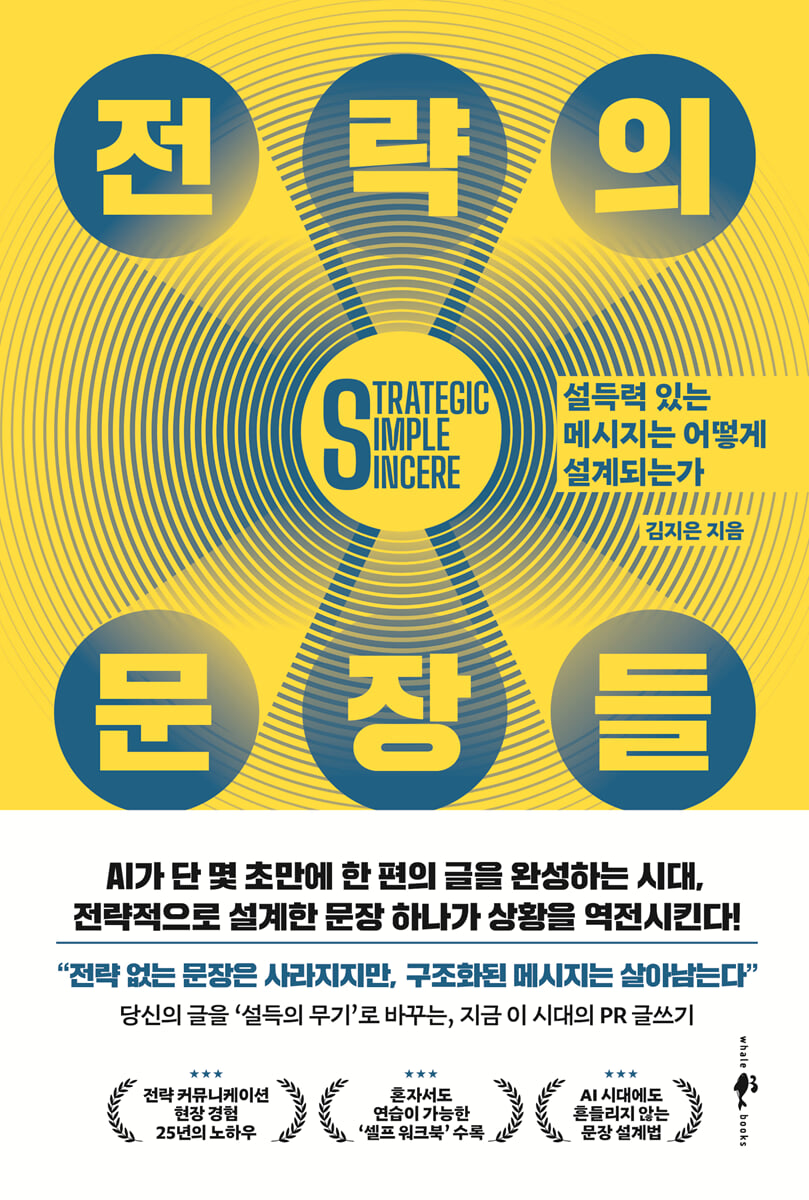
Sentences of Strategy
 |
Description
Book Introduction
★★★ 25 years of strategic communications experience ★★★
★★★ Sentence Design Methods That Won't Fade Even in the AI Era ★★★
★★★ Includes a 'self-workbook' for practicing on your own ★★★
In an era where AI can complete a piece of writing in just a few seconds,
One strategically designed sentence can turn the tables!
“A sentence without strategy disappears,
“Structured messages survive”
Transforming Your Writing into a Weapon of Persuasion: PR Writing for Today's Times
The emergence of generative AI like ChatGPT has also changed the landscape of writing.
Now, we live in an era where generative AI can churn out a piece of writing in seconds by inputting the genre, subject matter, core argument, target audience, tone, and desired expression into a prompt.
So, in these days when speed and fluency seem to be the only virtues, does this mean "human writing" no longer holds any utility or meaning? The answer is "absolutely not." In fact, it's in moments of change and crisis that the values we truly need to focus on shine brightly.
It is the ‘structuring ability to design messages of persuasion and empathy.’
"Sentences of Strategy" is a compilation of PR writing expertise, drawn from the author's 25 years of experience as a corporate communications leader, developing brand strategies, managing crises, and communicating organizationally. Drawing on his extensive experience and expertise, PR writing goes beyond simply crafting press releases. Beyond press releases, PR writing encompasses a diverse range of content, including feature articles, interviews, crisis response messages, internal communications, and digital content, all of which embody the organization's direction and aspirations. Therefore, authentic and persuasive writing skills are essential.
The author argues that the core of PR writing is to write with all three elements: Strategic, Simple, and Sincere, and provides detailed writing know-how for each type of PR writing.
In recent years, the communication environment for companies and brands has rapidly changed due to the development of AI and digital technology.
Actively reflecting this trend, the text covers not only traditional PR writing, but also includes tips on ethically creating high-quality content through collaboration with AI tools, and content production know-how suited to diverse digital platforms.
In addition, rather than remaining a theoretical explanation, it is composed to be of practical help in the field of PR work by including specific examples of actual success/failure cases and texts to help readers intuitively understand.
Meanwhile, to help readers self-assess their understanding of the text, a checklist and a section summarizing key principles ("Quick Tips") are included at the end of each chapter. A "Self-Workbook" is also included as an appendix, allowing readers to practice PR writing independently. This book is a must-read for PR practitioners seeking to develop compelling messages and anyone seeking to craft persuasive writing.
★★★ Sentence Design Methods That Won't Fade Even in the AI Era ★★★
★★★ Includes a 'self-workbook' for practicing on your own ★★★
In an era where AI can complete a piece of writing in just a few seconds,
One strategically designed sentence can turn the tables!
“A sentence without strategy disappears,
“Structured messages survive”
Transforming Your Writing into a Weapon of Persuasion: PR Writing for Today's Times
The emergence of generative AI like ChatGPT has also changed the landscape of writing.
Now, we live in an era where generative AI can churn out a piece of writing in seconds by inputting the genre, subject matter, core argument, target audience, tone, and desired expression into a prompt.
So, in these days when speed and fluency seem to be the only virtues, does this mean "human writing" no longer holds any utility or meaning? The answer is "absolutely not." In fact, it's in moments of change and crisis that the values we truly need to focus on shine brightly.
It is the ‘structuring ability to design messages of persuasion and empathy.’
"Sentences of Strategy" is a compilation of PR writing expertise, drawn from the author's 25 years of experience as a corporate communications leader, developing brand strategies, managing crises, and communicating organizationally. Drawing on his extensive experience and expertise, PR writing goes beyond simply crafting press releases. Beyond press releases, PR writing encompasses a diverse range of content, including feature articles, interviews, crisis response messages, internal communications, and digital content, all of which embody the organization's direction and aspirations. Therefore, authentic and persuasive writing skills are essential.
The author argues that the core of PR writing is to write with all three elements: Strategic, Simple, and Sincere, and provides detailed writing know-how for each type of PR writing.
In recent years, the communication environment for companies and brands has rapidly changed due to the development of AI and digital technology.
Actively reflecting this trend, the text covers not only traditional PR writing, but also includes tips on ethically creating high-quality content through collaboration with AI tools, and content production know-how suited to diverse digital platforms.
In addition, rather than remaining a theoretical explanation, it is composed to be of practical help in the field of PR work by including specific examples of actual success/failure cases and texts to help readers intuitively understand.
Meanwhile, to help readers self-assess their understanding of the text, a checklist and a section summarizing key principles ("Quick Tips") are included at the end of each chapter. A "Self-Workbook" is also included as an appendix, allowing readers to practice PR writing independently. This book is a must-read for PR practitioners seeking to develop compelling messages and anyone seeking to craft persuasive writing.
- You can preview some of the book's contents.
Preview
index
Prologue: One Strategically Written Sentence Changes Everything
Chapter 1: PR Writing: Clear Goals
“PR writing is about strategically designing your message.”
· PR writing is about writing "strategic sentences."
· PR writing is neither advertising nor news.
· The Golden Rule of PR Writing: The '3S' Principle
· 4 Steps to Successful PR Writing
[Quick Tips] Effective PR Writing: Just Remember This
Chapter 2: Brand Language Strategy: Designing Context
“A great brand language always embodies the organization’s philosophy.”
· What makes the brand language remembered around the world different?
· Two ways to build a brand language:
· 'Planned' and 'Responsive' Writing
· Brand language is the organizational culture itself.
· Influential brand language reads 'context'
[Quick Tips] Brand Language Design: Just Remember This
Chapter 3: Communication Strategies for Overcoming Crisis
“In a moment of crisis, the structure of words determines whether trust is restored.”
· Even though the onset of a crisis may be different, the initial message is created based on the same principles.
A well-written apology is a stepping stone to building trust.
· Crisis response messages also require a "tailored" strategy.
In the age of social media, attitude is more important than quick crisis response.
Recovery begins with words that convey change, not with promises.
[Quick Tips] Crisis Response Messages: Just Remember These
Chapter 4: Structuring Strategies for Creating Writing That Makes Readers Want to Read
“Information is just material; news is completed through structure.”
· Conditions for a message to become news
· Headlines drive clicks, and leads drive storytelling.
· Master the structure with a 'journalist's eye'
· A good quote speaks volumes about your brand's attitude.
[Quick Tips] Press Releases That Receive News Coverage: Just Remember This
Chapter 5: Practical Strategies for Producing Different Versions of News
“Behind every newsworthy article are distribution strategies and contextual design.”
· Carefully design distribution timing and diffusion routes.
· How to expand your message beyond feature articles and press releases
· The art of making a persuasive interview proposal
· Interview composition strategy that conveys the brand's attitude
[Quick Tips] Feature Articles and Interviews: Just Remember These Things
Chapter 6: Message Design Strategies Optimized for the Digital Environment
“Only messages that are discovered and searched survive.”
· The same message must change depending on the container it is contained in.
· A practical SEO guide to creating searchable content.
· Data-driven storytelling, a strategy that turns numbers into messages.
· If you can't avoid it, do it strategically! How to coexist and collaborate with AI.
[Quick Tips] PR Writing in the Digital Age: Just Remember This
Chapter 7: Internal Messaging Strategies to Unite Members
“One well-designed message can change the atmosphere of an organization.”
· From messages that 'only send information' to messages that 'design actions'
· Message strategies that break the silence and lead to participation
· A leader's message builds trust in the organization.
· Employees are the first recipients of crisis response messages.
[Quick Tips] Internal Messages: Just Remember This
Chapter 8: Ethics and Responsibilities in Public Relations Writing
“A message that is not true is not remembered.”
· Escape the temptation of exaggerated expressions immediately.
· Authenticity and transparency: principles that brand language must adhere to.
· AI writes, humans take responsibility
· A list of facts does not necessarily mean the truth.
[Quick Tips] Ethical PR Writing: Just Remember This
References
Chapter 1: PR Writing: Clear Goals
“PR writing is about strategically designing your message.”
· PR writing is about writing "strategic sentences."
· PR writing is neither advertising nor news.
· The Golden Rule of PR Writing: The '3S' Principle
· 4 Steps to Successful PR Writing
[Quick Tips] Effective PR Writing: Just Remember This
Chapter 2: Brand Language Strategy: Designing Context
“A great brand language always embodies the organization’s philosophy.”
· What makes the brand language remembered around the world different?
· Two ways to build a brand language:
· 'Planned' and 'Responsive' Writing
· Brand language is the organizational culture itself.
· Influential brand language reads 'context'
[Quick Tips] Brand Language Design: Just Remember This
Chapter 3: Communication Strategies for Overcoming Crisis
“In a moment of crisis, the structure of words determines whether trust is restored.”
· Even though the onset of a crisis may be different, the initial message is created based on the same principles.
A well-written apology is a stepping stone to building trust.
· Crisis response messages also require a "tailored" strategy.
In the age of social media, attitude is more important than quick crisis response.
Recovery begins with words that convey change, not with promises.
[Quick Tips] Crisis Response Messages: Just Remember These
Chapter 4: Structuring Strategies for Creating Writing That Makes Readers Want to Read
“Information is just material; news is completed through structure.”
· Conditions for a message to become news
· Headlines drive clicks, and leads drive storytelling.
· Master the structure with a 'journalist's eye'
· A good quote speaks volumes about your brand's attitude.
[Quick Tips] Press Releases That Receive News Coverage: Just Remember This
Chapter 5: Practical Strategies for Producing Different Versions of News
“Behind every newsworthy article are distribution strategies and contextual design.”
· Carefully design distribution timing and diffusion routes.
· How to expand your message beyond feature articles and press releases
· The art of making a persuasive interview proposal
· Interview composition strategy that conveys the brand's attitude
[Quick Tips] Feature Articles and Interviews: Just Remember These Things
Chapter 6: Message Design Strategies Optimized for the Digital Environment
“Only messages that are discovered and searched survive.”
· The same message must change depending on the container it is contained in.
· A practical SEO guide to creating searchable content.
· Data-driven storytelling, a strategy that turns numbers into messages.
· If you can't avoid it, do it strategically! How to coexist and collaborate with AI.
[Quick Tips] PR Writing in the Digital Age: Just Remember This
Chapter 7: Internal Messaging Strategies to Unite Members
“One well-designed message can change the atmosphere of an organization.”
· From messages that 'only send information' to messages that 'design actions'
· Message strategies that break the silence and lead to participation
· A leader's message builds trust in the organization.
· Employees are the first recipients of crisis response messages.
[Quick Tips] Internal Messages: Just Remember This
Chapter 8: Ethics and Responsibilities in Public Relations Writing
“A message that is not true is not remembered.”
· Escape the temptation of exaggerated expressions immediately.
· Authenticity and transparency: principles that brand language must adhere to.
· AI writes, humans take responsibility
· A list of facts does not necessarily mean the truth.
[Quick Tips] Ethical PR Writing: Just Remember This
References
Detailed image

Into the book
The starting point for strategic PR writing is simple.
We must begin by examining whether we can clearly answer the question, 'Why does this text exist?'
Many articles only focus on ‘information delivery.’
But information has no meaning without context.
When a message connects to a brand's reason for being, it goes beyond simple explanation to empathy and persuasion.
--- pp.17~18
Many PR practitioners have the same concerns.
"It's clearly good content, so why isn't there a response?", "What kind of message really resonates with people?" Analyzing successful PR messages reveals interesting commonalities.
The message is delivered strategically, clearly, and sincerely.
The reason these three are so important is clear. Most PR writing failures stem from missing one of them.
No matter how sincere you are, if you don't have a strategy, you'll lose direction. No matter how strategic you are, if it's complicated, it won't be communicated. No matter how clear you are, if you don't have sincerity, you won't be trusted.
--- p.29
Brand language is not an abstract philosophy, but is revealed in actual sentences.
All elements, such as tone of voice, expression, tone of voice, and words emphasized, reveal the attitude of the brand.
Therefore, before looking into the sentences, practitioners must first determine what the intention and purpose of the brand language is.
--- p.58
Depending on the situation, the target, and the weight of responsibility, the sentences an organization sends out in a moment of crisis should vary.
In a crisis, an organization cannot remain silent.
Even if the facts have not been fully revealed.
At that point, what the organization needs to show first is its ‘attitude’ rather than its ‘explanation.’
Yet, there is only one reason why many messages fail to gain trust.
Because I didn't say anything important.
If so, it's more likely that the organization failed to realize what should have been at the heart of its message, rather than that the message failed.
--- p.98
A press release is not a document that conveys information, but a document that designs a message that becomes news.
No matter how many sentences there are, if a reporter misses even one sentence that interests him, the news will not be made.
So, the first question a practitioner should ask when writing a press release is this:
“Can you summarize the key sentence in this press release in one sentence?”
--- p.145
Interviews are remembered not for their sentences but for their 'attitudes'.
A single word reveals a brand's worldview, and its stance is interpreted through the words it uses.
A good interview isn't judged by how well you answer the questions.
What's important is your attitude when asking questions.
Readers remember what language a brand speaks, especially when faced with challenging questions or ambiguous situations.
--- p.211
Numbers by themselves do not persuade people.
But the moment numbers turn into stories, people move.
Emotions and arguments have their limits in persuading people. What PR writing should focus on isn't the sheer size of the numbers, but the context and message contained within those numbers.
For example, the phrase "95% customer satisfaction" and the sentence "95 out of 100 customers chose our product again" are numerically identical data, but they carry completely different meanings. The role of a PR practitioner is to understand this difference and translate the numbers into "tangible language."
--- p.249
So what's the most effective way to collaborate with AI? The answer is for each person to do what they excel at. AI excels at "writing," while humans excel at "design."
However, let us remember one thing.
The truth is that while you can divide up work for efficiency, you can't delegate responsibility.
The final judgment and direction of the message must always be determined by humans.
--- p.262
Participation begins in a responsive environment rather than from spontaneous enthusiasm.
When employees don't speak up, organizations should ask:
"Why is it so quiet right now?" Engaging writing isn't simply a request; it's about identifying the reasons for the silence and creating a message that allows employees to speak up safely.
One sentence can't change everything at once.
But a structured piece that consistently sends the message that "it's okay to talk" ultimately moves the organization in a better direction.
We must begin by examining whether we can clearly answer the question, 'Why does this text exist?'
Many articles only focus on ‘information delivery.’
But information has no meaning without context.
When a message connects to a brand's reason for being, it goes beyond simple explanation to empathy and persuasion.
--- pp.17~18
Many PR practitioners have the same concerns.
"It's clearly good content, so why isn't there a response?", "What kind of message really resonates with people?" Analyzing successful PR messages reveals interesting commonalities.
The message is delivered strategically, clearly, and sincerely.
The reason these three are so important is clear. Most PR writing failures stem from missing one of them.
No matter how sincere you are, if you don't have a strategy, you'll lose direction. No matter how strategic you are, if it's complicated, it won't be communicated. No matter how clear you are, if you don't have sincerity, you won't be trusted.
--- p.29
Brand language is not an abstract philosophy, but is revealed in actual sentences.
All elements, such as tone of voice, expression, tone of voice, and words emphasized, reveal the attitude of the brand.
Therefore, before looking into the sentences, practitioners must first determine what the intention and purpose of the brand language is.
--- p.58
Depending on the situation, the target, and the weight of responsibility, the sentences an organization sends out in a moment of crisis should vary.
In a crisis, an organization cannot remain silent.
Even if the facts have not been fully revealed.
At that point, what the organization needs to show first is its ‘attitude’ rather than its ‘explanation.’
Yet, there is only one reason why many messages fail to gain trust.
Because I didn't say anything important.
If so, it's more likely that the organization failed to realize what should have been at the heart of its message, rather than that the message failed.
--- p.98
A press release is not a document that conveys information, but a document that designs a message that becomes news.
No matter how many sentences there are, if a reporter misses even one sentence that interests him, the news will not be made.
So, the first question a practitioner should ask when writing a press release is this:
“Can you summarize the key sentence in this press release in one sentence?”
--- p.145
Interviews are remembered not for their sentences but for their 'attitudes'.
A single word reveals a brand's worldview, and its stance is interpreted through the words it uses.
A good interview isn't judged by how well you answer the questions.
What's important is your attitude when asking questions.
Readers remember what language a brand speaks, especially when faced with challenging questions or ambiguous situations.
--- p.211
Numbers by themselves do not persuade people.
But the moment numbers turn into stories, people move.
Emotions and arguments have their limits in persuading people. What PR writing should focus on isn't the sheer size of the numbers, but the context and message contained within those numbers.
For example, the phrase "95% customer satisfaction" and the sentence "95 out of 100 customers chose our product again" are numerically identical data, but they carry completely different meanings. The role of a PR practitioner is to understand this difference and translate the numbers into "tangible language."
--- p.249
So what's the most effective way to collaborate with AI? The answer is for each person to do what they excel at. AI excels at "writing," while humans excel at "design."
However, let us remember one thing.
The truth is that while you can divide up work for efficiency, you can't delegate responsibility.
The final judgment and direction of the message must always be determined by humans.
--- p.262
Participation begins in a responsive environment rather than from spontaneous enthusiasm.
When employees don't speak up, organizations should ask:
"Why is it so quiet right now?" Engaging writing isn't simply a request; it's about identifying the reasons for the silence and creating a message that allows employees to speak up safely.
One sentence can't change everything at once.
But a structured piece that consistently sends the message that "it's okay to talk" ultimately moves the organization in a better direction.
--- p.302
Publisher's Review
In an era where one sentence is the deciding factor,
Persuasion skills gained from 25 years of communication experience
"Everyone can write, but not everyone can persuade.
Move people's hearts with 'meticulous design'!
With the advancement of AI technology, we have entered an era where anyone can write plausible texts.
Regardless of genre, drafting a piece using the power of generative AI is increasingly considered a natural part of writing.
These changes are particularly concerning to those who write for a living.
“Will AI replace the work we do?”, “Will human writing become meaningless?”
It is undeniable that AI can quickly create complete sentences.
But this should not be viewed solely as a crisis.
As technology advances, the ‘unique human capabilities’ that AI cannot imitate become more important.
These include empathy, understanding of context, motivation, ethics, and a sense of responsibility.
This is the secret to writing a message that captures the reader's heart.
A persuasive and authentic message isn't created with smooth writing.
The persuasiveness and authenticity of a piece of writing are only secured when the structure of the piece is strategically designed, keeping in mind "why this message should be delivered now, to whom, and in what context."
"Strategy Sentences" is a book written by a strategic communications expert with 25 years of experience, focusing on PR writing among various areas of writing, and condensing his know-how and details.
All writing aims to persuade and empathize with readers, but PR (Public Relations) writing, in particular, requires more skill in persuading and empathizing than any other writing because its ultimate goal is to build a friendly and mutually trusting relationship (Relations) with the public (Public).
What the author considers the core of the trick is the ‘structure of the text.’
And a piece of writing that is strategically structured well means a piece that is ‘alive in context.’
Here, context is a concept that encompasses who is reading (target audience), when it should be read (timing), in what situation the writing is written (purpose), on which channel it will be posted (platform), whether it reflects local social and cultural differences (global sense), and whether it meets ethical standards (ethics).
A text with a lively context is one in which the aforementioned contents are clearly expressed within a solid structural format.
If you are a PR practitioner, you must now possess qualities that are more important than the ability to write well-written articles or have good sentence structure.
It is the ability to appeal to authenticity and gain trust from readers through 'text that is alive with context.'
You can't write an article that captures the reader's attention by simply listing information.
Only writing that always keeps in mind, "Why am I writing this now?" and "What is the ultimate goal of this writing?"—writing that uses "strategic sentences"—will truly move the reader's heart.
There is a point that 'pokes' the heart
3S Practical Strategies for Messages
“Sentences may disappear, but strategies will last!”
So, what do messages that successfully persuade and resonate have in common? We've all probably had moments where we confidently posted something on social media, believing it was packed with information and good content, only to be shocked or dismayed by the lack of response.
Why did my message fail? According to the author, messages that successfully persuaded readers had an interesting commonality.
The message is delivered strategically, clearly, and sincerely.
The Golden Rule of PR Writing: The "3S" Principle
① Strategy: An article that unilaterally summarizes what I want to say without any purpose or direction will not reach the reader.
Strategy is reframing the message from the recipient's perspective.
Messages should be written with the recipient and context in mind.
Even the same information must be delivered in completely different ways depending on the recipient's current situation, interests, priorities, and work context.
For example, even when sending messages in the same crisis situation, the strategic emphasis on what to focus on should vary depending on the target audience (external customers, stakeholders, internal employees, etc.).
② Clarity: ‘Simple’ does not simply mean that the writing should be ‘easy’.
Rather, it means 'clearly' structuring it to fit the recipient's information processing method and the grammar of the channel on which the text will be posted.
That is, information must be arranged in an order and manner that the receiver of the channel can understand most quickly.
A single, consistent format cannot effectively communicate a position to different recipients.
The same message must be effectively reconstructed according to the ‘container.’
At this time, you need to know how to ‘write something new to fit a different context’ rather than ‘show the same text differently.’
③ Sincerity: An apology in name only and an expression of gratitude in name only do not resonate with the reader's heart.
Authenticity does not come from eloquent rhetoric; it comes from concrete actions that actually help the recipient.
In other words, if you want to build trust with the recipient of your message, you need to provide them with actions they can personally verify and experience.
Sincerity must be proven by action.
People don't read messages as sentences themselves.
Read the flow of attitudes, perspectives, priorities, and responsibilities contained within it.
These three principles aren't just ideals; they're the foundation for message design that works in practice. PR writing is strategic communication that cultivates relationships and builds trust.
Therefore, PR practitioners and anyone who wants to write persuasively and empathetically should use these 3S principles as a compass for strategic message structuring.
No matter how much content creation technology advances, no matter how much AI generates flawless sentences, there is no content that moves our hearts as powerfully as human writing.
‘Writing’ is the most powerful weapon to create persuasion and trust.
"Sentences of Strategy" is filled with the ingenuity of "message structuring strategies" that capture the minds and hearts of readers and ultimately lead them to action.
This is an excellent writing guidebook that should be read by not only public relations, PR, and marketing practitioners who are concerned about how to properly convey a message beyond how to write good sentences, how to write articles that will be reported in the media and other media, how to write articles that will receive support and interest from readers and spread widely, and how to write articles that build trust with readers, but also solo entrepreneurs, individuals interested in personal branding, and anyone who needs to do their own brand promotion and marketing work on their own, and anyone who wants to write persuasive articles regardless of the field.
Persuasion skills gained from 25 years of communication experience
"Everyone can write, but not everyone can persuade.
Move people's hearts with 'meticulous design'!
With the advancement of AI technology, we have entered an era where anyone can write plausible texts.
Regardless of genre, drafting a piece using the power of generative AI is increasingly considered a natural part of writing.
These changes are particularly concerning to those who write for a living.
“Will AI replace the work we do?”, “Will human writing become meaningless?”
It is undeniable that AI can quickly create complete sentences.
But this should not be viewed solely as a crisis.
As technology advances, the ‘unique human capabilities’ that AI cannot imitate become more important.
These include empathy, understanding of context, motivation, ethics, and a sense of responsibility.
This is the secret to writing a message that captures the reader's heart.
A persuasive and authentic message isn't created with smooth writing.
The persuasiveness and authenticity of a piece of writing are only secured when the structure of the piece is strategically designed, keeping in mind "why this message should be delivered now, to whom, and in what context."
"Strategy Sentences" is a book written by a strategic communications expert with 25 years of experience, focusing on PR writing among various areas of writing, and condensing his know-how and details.
All writing aims to persuade and empathize with readers, but PR (Public Relations) writing, in particular, requires more skill in persuading and empathizing than any other writing because its ultimate goal is to build a friendly and mutually trusting relationship (Relations) with the public (Public).
What the author considers the core of the trick is the ‘structure of the text.’
And a piece of writing that is strategically structured well means a piece that is ‘alive in context.’
Here, context is a concept that encompasses who is reading (target audience), when it should be read (timing), in what situation the writing is written (purpose), on which channel it will be posted (platform), whether it reflects local social and cultural differences (global sense), and whether it meets ethical standards (ethics).
A text with a lively context is one in which the aforementioned contents are clearly expressed within a solid structural format.
If you are a PR practitioner, you must now possess qualities that are more important than the ability to write well-written articles or have good sentence structure.
It is the ability to appeal to authenticity and gain trust from readers through 'text that is alive with context.'
You can't write an article that captures the reader's attention by simply listing information.
Only writing that always keeps in mind, "Why am I writing this now?" and "What is the ultimate goal of this writing?"—writing that uses "strategic sentences"—will truly move the reader's heart.
There is a point that 'pokes' the heart
3S Practical Strategies for Messages
“Sentences may disappear, but strategies will last!”
So, what do messages that successfully persuade and resonate have in common? We've all probably had moments where we confidently posted something on social media, believing it was packed with information and good content, only to be shocked or dismayed by the lack of response.
Why did my message fail? According to the author, messages that successfully persuaded readers had an interesting commonality.
The message is delivered strategically, clearly, and sincerely.
The Golden Rule of PR Writing: The "3S" Principle
① Strategy: An article that unilaterally summarizes what I want to say without any purpose or direction will not reach the reader.
Strategy is reframing the message from the recipient's perspective.
Messages should be written with the recipient and context in mind.
Even the same information must be delivered in completely different ways depending on the recipient's current situation, interests, priorities, and work context.
For example, even when sending messages in the same crisis situation, the strategic emphasis on what to focus on should vary depending on the target audience (external customers, stakeholders, internal employees, etc.).
② Clarity: ‘Simple’ does not simply mean that the writing should be ‘easy’.
Rather, it means 'clearly' structuring it to fit the recipient's information processing method and the grammar of the channel on which the text will be posted.
That is, information must be arranged in an order and manner that the receiver of the channel can understand most quickly.
A single, consistent format cannot effectively communicate a position to different recipients.
The same message must be effectively reconstructed according to the ‘container.’
At this time, you need to know how to ‘write something new to fit a different context’ rather than ‘show the same text differently.’
③ Sincerity: An apology in name only and an expression of gratitude in name only do not resonate with the reader's heart.
Authenticity does not come from eloquent rhetoric; it comes from concrete actions that actually help the recipient.
In other words, if you want to build trust with the recipient of your message, you need to provide them with actions they can personally verify and experience.
Sincerity must be proven by action.
People don't read messages as sentences themselves.
Read the flow of attitudes, perspectives, priorities, and responsibilities contained within it.
These three principles aren't just ideals; they're the foundation for message design that works in practice. PR writing is strategic communication that cultivates relationships and builds trust.
Therefore, PR practitioners and anyone who wants to write persuasively and empathetically should use these 3S principles as a compass for strategic message structuring.
No matter how much content creation technology advances, no matter how much AI generates flawless sentences, there is no content that moves our hearts as powerfully as human writing.
‘Writing’ is the most powerful weapon to create persuasion and trust.
"Sentences of Strategy" is filled with the ingenuity of "message structuring strategies" that capture the minds and hearts of readers and ultimately lead them to action.
This is an excellent writing guidebook that should be read by not only public relations, PR, and marketing practitioners who are concerned about how to properly convey a message beyond how to write good sentences, how to write articles that will be reported in the media and other media, how to write articles that will receive support and interest from readers and spread widely, and how to write articles that build trust with readers, but also solo entrepreneurs, individuals interested in personal branding, and anyone who needs to do their own brand promotion and marketing work on their own, and anyone who wants to write persuasive articles regardless of the field.
GOODS SPECIFICS
- Date of issue: September 10, 2025
- Page count, weight, size: 384 pages | 642g | 145*215*23mm
- ISBN13: 9791194627135
- ISBN10: 1194627137
You may also like
카테고리
korean


korean

![GQ KOREA Mark (Monthly): December [2025]](http://librairie.coreenne.fr/cdn/shop/files/8ef265dbbfbf186523ed75ba7319009d.jpg?v=1765340328&width=3840)


