

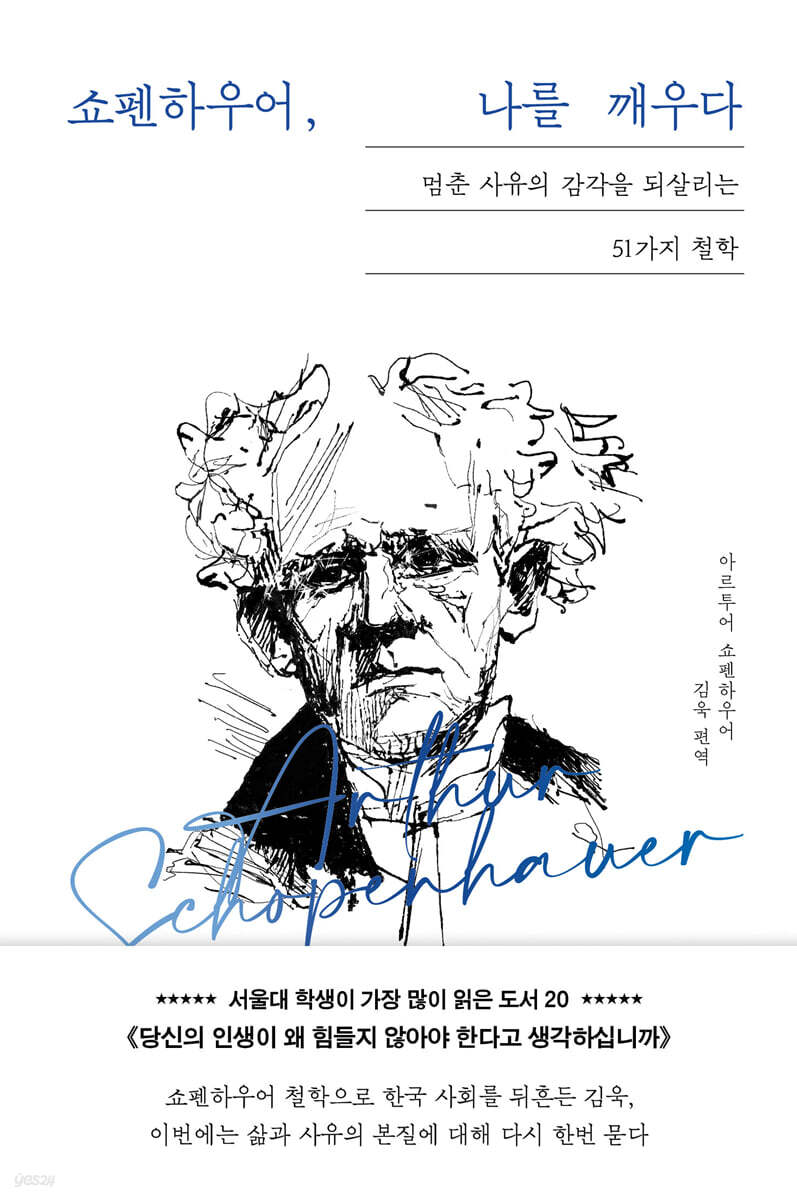
Schopenhauer, wake me up
 |
Description
Book Introduction
“If you don’t break your own thoughts,
Life doesn't move forward even one step from where it is now.”
Between happiness and unhappiness,
Schopenhauer Essentials 51: Sharply Penetrating the Darkest Cracks
★★★★★ The 20 most read books by Seoul National University students
The longest-running bestseller in the humanities
The sequel to "Why Do You Think Your Life Shouldn't Be Hard?"
Schopenhauer, a philosopher admired by Nietzsche, engrossed by Freud, and revered by Tolstoy, and called the intellect of intellects, remains a symbolic figure in the history of Western philosophy.
This time, a book titled "Schopenhauer, Awaken Me," which compiles his deep thoughts on life and excerpts from his representative works written in his later years, has been published.
Schopenhauer is known as a pessimist, but he is not a philosopher who simply justifies the misery of life.
Rather, he persistently pondered 'how to live' in the existential condition of suffering until the end of his life.
Perhaps that is why, in this age where reason is shrinking and, paradoxically, material abundance is increasing while the mind is becoming more impoverished, it is receiving attention again, even after hundreds of years.
Often, when life is difficult or things are not going well, we tend to chew on or offer words of encouragement and support like, "It will be okay," or "It will be okay." However, there comes a time when such comfort is no help to everyone.
The world is changing so quickly, and it feels like I've been working hard, but I feel like I'm just standing still, and I'm too afraid to make new choices.
Because now I have reached a point where I can clearly feel the weight of my own life that I must take responsibility for.
What is needed at such times is not warm comfort or encouragement, but rather a sharp sentence that makes us face reality head on.
Schopenhauer's sentences pierce the darkest gap between happiness and unhappiness.
Each and every one of those sharp lines will completely awaken you to who you are now.
For those who wish to confront the essence of life head-on and live without turning a blind eye to suffering, this book will serve as a strong voice in the loneliest moments.
Life doesn't move forward even one step from where it is now.”
Between happiness and unhappiness,
Schopenhauer Essentials 51: Sharply Penetrating the Darkest Cracks
★★★★★ The 20 most read books by Seoul National University students
The longest-running bestseller in the humanities
The sequel to "Why Do You Think Your Life Shouldn't Be Hard?"
Schopenhauer, a philosopher admired by Nietzsche, engrossed by Freud, and revered by Tolstoy, and called the intellect of intellects, remains a symbolic figure in the history of Western philosophy.
This time, a book titled "Schopenhauer, Awaken Me," which compiles his deep thoughts on life and excerpts from his representative works written in his later years, has been published.
Schopenhauer is known as a pessimist, but he is not a philosopher who simply justifies the misery of life.
Rather, he persistently pondered 'how to live' in the existential condition of suffering until the end of his life.
Perhaps that is why, in this age where reason is shrinking and, paradoxically, material abundance is increasing while the mind is becoming more impoverished, it is receiving attention again, even after hundreds of years.
Often, when life is difficult or things are not going well, we tend to chew on or offer words of encouragement and support like, "It will be okay," or "It will be okay." However, there comes a time when such comfort is no help to everyone.
The world is changing so quickly, and it feels like I've been working hard, but I feel like I'm just standing still, and I'm too afraid to make new choices.
Because now I have reached a point where I can clearly feel the weight of my own life that I must take responsibility for.
What is needed at such times is not warm comfort or encouragement, but rather a sharp sentence that makes us face reality head on.
Schopenhauer's sentences pierce the darkest gap between happiness and unhappiness.
Each and every one of those sharp lines will completely awaken you to who you are now.
For those who wish to confront the essence of life head-on and live without turning a blind eye to suffering, this book will serve as a strong voice in the loneliest moments.
- You can preview some of the book's contents.
Preview
index
Translator's Note
Part 1: What is Life? - Being born is the first misfortune in life.
Don't tie your self-worth to the opinions of others.
The illusion of seeing others, and the illusion of knowing oneself
Only when you empty your mind can what you want come to mind.
What You Get When You Let Go of Your Will to Be Happy
Has the world changed, or has it been my heart?
Because life is a construction that is done without a blueprint.
Humans do not forgive others
Why You Shouldn't Rely on People Even When Times Are Hard
About the emptiness that cannot be filled no matter how hard you live
The fact that we were born is the first misfortune in life.
Being one year older means becoming deeper
What you are saying now may be a sentence written by someone else.
Why do we keep making the same mistakes and not correct them?
Do not seek wisdom outside yourself.
Why You Should Listen to Fools
Don't trust your head just because you're smart.
Why Art is Born in the Cracks of Pain
Part 2 What is Truth? - Even while life is being torn apart, its fruit is ripening.
Geniuses are born with two minds.
Even while life is being torn apart like this, the fruit is ripening.
They are only allowed to exist after death.
The only joy we can expect in life is the effort, not the result.
A society where Goethe's spirit is erased and only Goethe's birthplace is displayed.
Nevertheless, for those who choose solitude
Can we really see things 'as they are'?
Why do we only wander around representations?
Nature is answering, we're just asking the wrong questions.
Things that exist even if they are invisible
Why are deep thinkers so vulnerable to reality?
I ask people who are now 'philosophers'
The public accepts the name of a thinker as authority.
The only thing you can fully understand is yourself.
If you don't see it with your own power, it's meaningless.
To the philosophy that has only a head and no heart
Part 3: What is Philosophy? - If I just follow the flow, my river won't be created.
When you confess that you don't know what you don't know
It's not perfect, but it's true nonetheless.
What you should say before refuting someone
Something more dangerous and persistent than a lie
If I just follow the flowing water, my river will not be created.
The voice of intelligence born from will
All beings exist only when I perceive them.
Things you can only see when you rest
No one can shine all the time
Learning is a mix of interest
True reason is born in the gaps of silence.
Can the senses contain truth?
Time doesn't flow, it's just a concept we created.
All space is a projection of the subject.
Lighting the shadow of will, intellect
If you look into yourself, you might lose your way.
It is desire, not the brain, that creates the world.
The best philosophers do not pay attention to any other field.
Part 1: What is Life? - Being born is the first misfortune in life.
Don't tie your self-worth to the opinions of others.
The illusion of seeing others, and the illusion of knowing oneself
Only when you empty your mind can what you want come to mind.
What You Get When You Let Go of Your Will to Be Happy
Has the world changed, or has it been my heart?
Because life is a construction that is done without a blueprint.
Humans do not forgive others
Why You Shouldn't Rely on People Even When Times Are Hard
About the emptiness that cannot be filled no matter how hard you live
The fact that we were born is the first misfortune in life.
Being one year older means becoming deeper
What you are saying now may be a sentence written by someone else.
Why do we keep making the same mistakes and not correct them?
Do not seek wisdom outside yourself.
Why You Should Listen to Fools
Don't trust your head just because you're smart.
Why Art is Born in the Cracks of Pain
Part 2 What is Truth? - Even while life is being torn apart, its fruit is ripening.
Geniuses are born with two minds.
Even while life is being torn apart like this, the fruit is ripening.
They are only allowed to exist after death.
The only joy we can expect in life is the effort, not the result.
A society where Goethe's spirit is erased and only Goethe's birthplace is displayed.
Nevertheless, for those who choose solitude
Can we really see things 'as they are'?
Why do we only wander around representations?
Nature is answering, we're just asking the wrong questions.
Things that exist even if they are invisible
Why are deep thinkers so vulnerable to reality?
I ask people who are now 'philosophers'
The public accepts the name of a thinker as authority.
The only thing you can fully understand is yourself.
If you don't see it with your own power, it's meaningless.
To the philosophy that has only a head and no heart
Part 3: What is Philosophy? - If I just follow the flow, my river won't be created.
When you confess that you don't know what you don't know
It's not perfect, but it's true nonetheless.
What you should say before refuting someone
Something more dangerous and persistent than a lie
If I just follow the flowing water, my river will not be created.
The voice of intelligence born from will
All beings exist only when I perceive them.
Things you can only see when you rest
No one can shine all the time
Learning is a mix of interest
True reason is born in the gaps of silence.
Can the senses contain truth?
Time doesn't flow, it's just a concept we created.
All space is a projection of the subject.
Lighting the shadow of will, intellect
If you look into yourself, you might lose your way.
It is desire, not the brain, that creates the world.
The best philosophers do not pay attention to any other field.
Detailed image

Into the book
I found solace in classical figures, not in others.
Thinkers like Pythagoras and Epictetus were all people who listened to their inner selves.
I consoled myself with the words they left behind.
I have always considered myself sufficiently knowledgeable, even if the world does not recognize me.
In fact, it took me a long time to believe that truth does not exist in the applause of others.
People often feel that their dignity has been damaged when they lose their honor.
But protecting one's honor is only about protecting the eyes of others, and has nothing to do with one's true self.
Fame is sometimes not achieved in one's lifetime.
They can be forgotten at any time depending on the flow of time, and sometimes they are evaluated only after death.
The writers I admired, those who spoke the truth through their writing, transcended their time and survived through all ages.
But most of them were poor and neglected during their lifetime.
So I started talking about 'nothingness'.
The fullness of nothingness.
A state of having nothing but not feeling lacking, and a state of wanting nothing but not feeling hungry.
To get there, inner independence and spiritual richness are essential.
I truly wanted to become someone who could endure without receiving anything from outside, someone who could live without external recognition.
I've tried to live like that so far.
Actually, I turned down a lot of things.
He turned his back on fame, wealth, social standing, and academic standing.
I had a room to write in, a path to walk on, and a reason to keep silent, and that alone was enough for me.
I didn't consider that kind of life miserable.
Rather, I believed that there was true nobility in it.
I didn't get public acclaim, but that didn't make me miserable.
This is the true life I am talking about.
A life that denies happiness, yet finds deep peace through that denial.
I have no doubt that this is the ultimate life.
--- p.18~19
A brilliant mind can never mingle with the majority.
It's like clear water refusing to mix with muddy water.
Rather than finding solace in worldly relationships, they choose to fortify themselves through suffering alone.
The world judges them as cold and rude, but the truth is quite the opposite.
This is because they are people who have chosen to carefully reject even the intimacy of others so as not to tarnish the nobility they possess.
Sometimes people ask:
Why do some people willingly accept pain, and endure it as if it were their natural tendency?
But this is not instinct.
It is simply a way of life chosen by those who have already realized the absurdity of life in order to endure that insight.
In other words, suffering is the only relationship a superior spirit has with the world, and it is the proof that he is moving towards truth.
--- p.52
Those who have seen through the lens of the truth that the essence of life is suffering will choose suffering over pleasure at every moment of choice.
For him, pain cannot be avoided.
Because it is a passage to reach the truth of existence and a mirror that most sharply reveals the true nature of the human creature.
Such people endure the conflicts of their youth as they grow older.
And as time passes, their inner selves become stronger with the wisdom of silence.
The body deteriorates, desires wear out, and conflicts with others become increasingly meaningless.
After the age of 60, people become increasingly insensitive to external stimuli, but their inner calm becomes more solid.
This hardness is perhaps the true form of wisdom that a person can acquire as he ages.
Only when we realize that the anger and conflict, the longing and excitement of youth were nothing more than biological noise, are we finally ready to face the true nature of life.
--- p.54
An intellectual life is not hindered by any inherent destiny, such as economic circumstances, freedom of occupation, or social status.
Thus, through an intelligent life, man can be liberated from the changes that determine his destiny.
This intellectual life is sustained through thinking, learning, exploration, and training, and as this life gradually becomes established as the most important foundation of life, physical life becomes subordinated to the intellectual life as a tool for achieving a purpose.
We can see in Goethe an example of how intellectual life is a completely separate life from physical life.
Despite the turmoil and chaos of the war, he continued to study color theory, a field he had always been interested in.
At the time, Goethe was staying in a small town in Luxembourg to escape the chaos, and he later confessed that the only friend who comforted him there was a notebook of color theory spread out on a small desk.
In this way, Goethe showed an example of life that everyone should follow.
As the salt of the earth, humans need a mental state that can always maintain an intellectual life even if their physical life is subject to the storms of the world.
We must also always keep in mind that we are not the product of the handmaiden called the body, but of the free spirit.
We are a lonely tree, quietly fluttering its leaves and fruit on a storm-swept hill.
I would like to add a line to this lonely pattern.
“While I was torn like this, they ripened” or “We suffered terribly, yet we bore fruit.”
Thinkers like Pythagoras and Epictetus were all people who listened to their inner selves.
I consoled myself with the words they left behind.
I have always considered myself sufficiently knowledgeable, even if the world does not recognize me.
In fact, it took me a long time to believe that truth does not exist in the applause of others.
People often feel that their dignity has been damaged when they lose their honor.
But protecting one's honor is only about protecting the eyes of others, and has nothing to do with one's true self.
Fame is sometimes not achieved in one's lifetime.
They can be forgotten at any time depending on the flow of time, and sometimes they are evaluated only after death.
The writers I admired, those who spoke the truth through their writing, transcended their time and survived through all ages.
But most of them were poor and neglected during their lifetime.
So I started talking about 'nothingness'.
The fullness of nothingness.
A state of having nothing but not feeling lacking, and a state of wanting nothing but not feeling hungry.
To get there, inner independence and spiritual richness are essential.
I truly wanted to become someone who could endure without receiving anything from outside, someone who could live without external recognition.
I've tried to live like that so far.
Actually, I turned down a lot of things.
He turned his back on fame, wealth, social standing, and academic standing.
I had a room to write in, a path to walk on, and a reason to keep silent, and that alone was enough for me.
I didn't consider that kind of life miserable.
Rather, I believed that there was true nobility in it.
I didn't get public acclaim, but that didn't make me miserable.
This is the true life I am talking about.
A life that denies happiness, yet finds deep peace through that denial.
I have no doubt that this is the ultimate life.
--- p.18~19
A brilliant mind can never mingle with the majority.
It's like clear water refusing to mix with muddy water.
Rather than finding solace in worldly relationships, they choose to fortify themselves through suffering alone.
The world judges them as cold and rude, but the truth is quite the opposite.
This is because they are people who have chosen to carefully reject even the intimacy of others so as not to tarnish the nobility they possess.
Sometimes people ask:
Why do some people willingly accept pain, and endure it as if it were their natural tendency?
But this is not instinct.
It is simply a way of life chosen by those who have already realized the absurdity of life in order to endure that insight.
In other words, suffering is the only relationship a superior spirit has with the world, and it is the proof that he is moving towards truth.
--- p.52
Those who have seen through the lens of the truth that the essence of life is suffering will choose suffering over pleasure at every moment of choice.
For him, pain cannot be avoided.
Because it is a passage to reach the truth of existence and a mirror that most sharply reveals the true nature of the human creature.
Such people endure the conflicts of their youth as they grow older.
And as time passes, their inner selves become stronger with the wisdom of silence.
The body deteriorates, desires wear out, and conflicts with others become increasingly meaningless.
After the age of 60, people become increasingly insensitive to external stimuli, but their inner calm becomes more solid.
This hardness is perhaps the true form of wisdom that a person can acquire as he ages.
Only when we realize that the anger and conflict, the longing and excitement of youth were nothing more than biological noise, are we finally ready to face the true nature of life.
--- p.54
An intellectual life is not hindered by any inherent destiny, such as economic circumstances, freedom of occupation, or social status.
Thus, through an intelligent life, man can be liberated from the changes that determine his destiny.
This intellectual life is sustained through thinking, learning, exploration, and training, and as this life gradually becomes established as the most important foundation of life, physical life becomes subordinated to the intellectual life as a tool for achieving a purpose.
We can see in Goethe an example of how intellectual life is a completely separate life from physical life.
Despite the turmoil and chaos of the war, he continued to study color theory, a field he had always been interested in.
At the time, Goethe was staying in a small town in Luxembourg to escape the chaos, and he later confessed that the only friend who comforted him there was a notebook of color theory spread out on a small desk.
In this way, Goethe showed an example of life that everyone should follow.
As the salt of the earth, humans need a mental state that can always maintain an intellectual life even if their physical life is subject to the storms of the world.
We must also always keep in mind that we are not the product of the handmaiden called the body, but of the free spirit.
We are a lonely tree, quietly fluttering its leaves and fruit on a storm-swept hill.
I would like to add a line to this lonely pattern.
“While I was torn like this, they ripened” or “We suffered terribly, yet we bore fruit.”
--- p.97~98
Publisher's Review
“One thing you should keep in mind if you feel bored and tedious every day.”
Laying bricks one day at a time on a life that has no blueprint
Schopenhauer talks about life by comparing it to ‘architecture’.
Life is like a construction project that is carried out without a blueprint.
Like a worker on a construction site, he has no idea where the bricks he is laying will end up in the building.
We have never seen a blueprint, and no one has told us the overall outline.
But every day we have to lift stones, apply cement, and rebuild what has fallen.
So our days are spent perfecting some structure.
And within that structure, we live, bearing some meaning that we ourselves are unaware of.
Therefore, the most essential knowledge in life is not omniscient insight that overlooks the entire blueprint, but the answer to the question, 'Where should I put the brick I'm holding now?'
Therefore, the question, “What do I live for?” must ultimately be changed to “What will I do with my life today?”
The truth of life depends on what we are focusing on now.
Perhaps a great life means not a complete thought that penetrates the whole, but the tenacity to hold on to a single piece of truth and stay there.
Perhaps our smooth daily lives are maintained not because we are working toward a grand goal, but because we are building one brick at a time.
Sometimes life goes by so absurdly, and expectations are always betrayed.
But in the process of gradually and steadily piling up the small tasks that need to be done, something is being accomplished.
Because life isn't something that just happens, it's something that builds up little by little every day.
When we feel bored with the repetitive days and the scenery around us, when we wonder why our lives lack grand goals or accomplishments, we must remember that even in the midst of these accumulations of days, we are all creating our own meaning.
Even in moments when no one notices.
And even in times that seem meaningless.
The more painful life becomes, the more we need philosophy.
From suffering to insight, from desire to liberation,
The essence of life as conveyed by Schopenhauer, a pessimistic philosopher ahead of his time.
Schopenhauer is one of the most problematic philosophers recorded in history.
Rather than asking what he should pursue in life, he pondered how he could 'disappear from the shackles of this absurd reality' as quickly and without leaving any trace.
Although his philosophy was neglected and coldly received during his lifetime, paradoxically, today he is considered one of the most popular philosophers.
This is because, while philosophy at the time was stuck in wasteful debates that only recognized ideas, such as law, ethics, and religion, Schopenhauer took ‘human existence’ itself as the purpose and ultimate truth of philosophy.
When contemporary philosophers insisted on philosophy for philosophy's sake, he paid deep attention to the inner existential problems of human 'will' and 'representation'.
This book is a compilation of some of Schopenhauer's representative works, "Parerga und Paralipomena" (Travels and Possessions), written in his later years, along with his philosophical reflections.
Of course, his philosophy is not easy to fully understand or accept.
But through pessimism, he illuminates life and the world more truthfully.
In the first place, it does not say that unhappiness or suffering can disappear or be eliminated, but rather that peace can be achieved only when happiness is denied.
It also offers the cold but clear insight that humans are inherently self-centered, unable to forgive others, unable to understand ourselves, and that we are all doomed to live in the suffering created by our relationships.
Thus, Schopenhauer asserts that 'being born itself is already the first misfortune' and that there is no such thing as a technique for a pain-free life.
But instead, it opens up the depth of our perspective to look philosophically at a life filled with such tragedy, and gives us time to stop and think.
Philosophy cannot eliminate suffering, but it can change the way we look at it.
Few people knew this fact as keenly as Schopenhauer.
Laying bricks one day at a time on a life that has no blueprint
Schopenhauer talks about life by comparing it to ‘architecture’.
Life is like a construction project that is carried out without a blueprint.
Like a worker on a construction site, he has no idea where the bricks he is laying will end up in the building.
We have never seen a blueprint, and no one has told us the overall outline.
But every day we have to lift stones, apply cement, and rebuild what has fallen.
So our days are spent perfecting some structure.
And within that structure, we live, bearing some meaning that we ourselves are unaware of.
Therefore, the most essential knowledge in life is not omniscient insight that overlooks the entire blueprint, but the answer to the question, 'Where should I put the brick I'm holding now?'
Therefore, the question, “What do I live for?” must ultimately be changed to “What will I do with my life today?”
The truth of life depends on what we are focusing on now.
Perhaps a great life means not a complete thought that penetrates the whole, but the tenacity to hold on to a single piece of truth and stay there.
Perhaps our smooth daily lives are maintained not because we are working toward a grand goal, but because we are building one brick at a time.
Sometimes life goes by so absurdly, and expectations are always betrayed.
But in the process of gradually and steadily piling up the small tasks that need to be done, something is being accomplished.
Because life isn't something that just happens, it's something that builds up little by little every day.
When we feel bored with the repetitive days and the scenery around us, when we wonder why our lives lack grand goals or accomplishments, we must remember that even in the midst of these accumulations of days, we are all creating our own meaning.
Even in moments when no one notices.
And even in times that seem meaningless.
The more painful life becomes, the more we need philosophy.
From suffering to insight, from desire to liberation,
The essence of life as conveyed by Schopenhauer, a pessimistic philosopher ahead of his time.
Schopenhauer is one of the most problematic philosophers recorded in history.
Rather than asking what he should pursue in life, he pondered how he could 'disappear from the shackles of this absurd reality' as quickly and without leaving any trace.
Although his philosophy was neglected and coldly received during his lifetime, paradoxically, today he is considered one of the most popular philosophers.
This is because, while philosophy at the time was stuck in wasteful debates that only recognized ideas, such as law, ethics, and religion, Schopenhauer took ‘human existence’ itself as the purpose and ultimate truth of philosophy.
When contemporary philosophers insisted on philosophy for philosophy's sake, he paid deep attention to the inner existential problems of human 'will' and 'representation'.
This book is a compilation of some of Schopenhauer's representative works, "Parerga und Paralipomena" (Travels and Possessions), written in his later years, along with his philosophical reflections.
Of course, his philosophy is not easy to fully understand or accept.
But through pessimism, he illuminates life and the world more truthfully.
In the first place, it does not say that unhappiness or suffering can disappear or be eliminated, but rather that peace can be achieved only when happiness is denied.
It also offers the cold but clear insight that humans are inherently self-centered, unable to forgive others, unable to understand ourselves, and that we are all doomed to live in the suffering created by our relationships.
Thus, Schopenhauer asserts that 'being born itself is already the first misfortune' and that there is no such thing as a technique for a pain-free life.
But instead, it opens up the depth of our perspective to look philosophically at a life filled with such tragedy, and gives us time to stop and think.
Philosophy cannot eliminate suffering, but it can change the way we look at it.
Few people knew this fact as keenly as Schopenhauer.
GOODS SPECIFICS
- Date of issue: August 1, 2025
- Page count, weight, size: 244 pages | 302g | 125*188*16mm
- ISBN13: 9791198999191
- ISBN10: 1198999195
You may also like
카테고리
korean


korean

![GQ KOREA Mark (Monthly): December [2025]](http://librairie.coreenne.fr/cdn/shop/files/8ef265dbbfbf186523ed75ba7319009d.jpg?v=1765340328&width=3840)


