

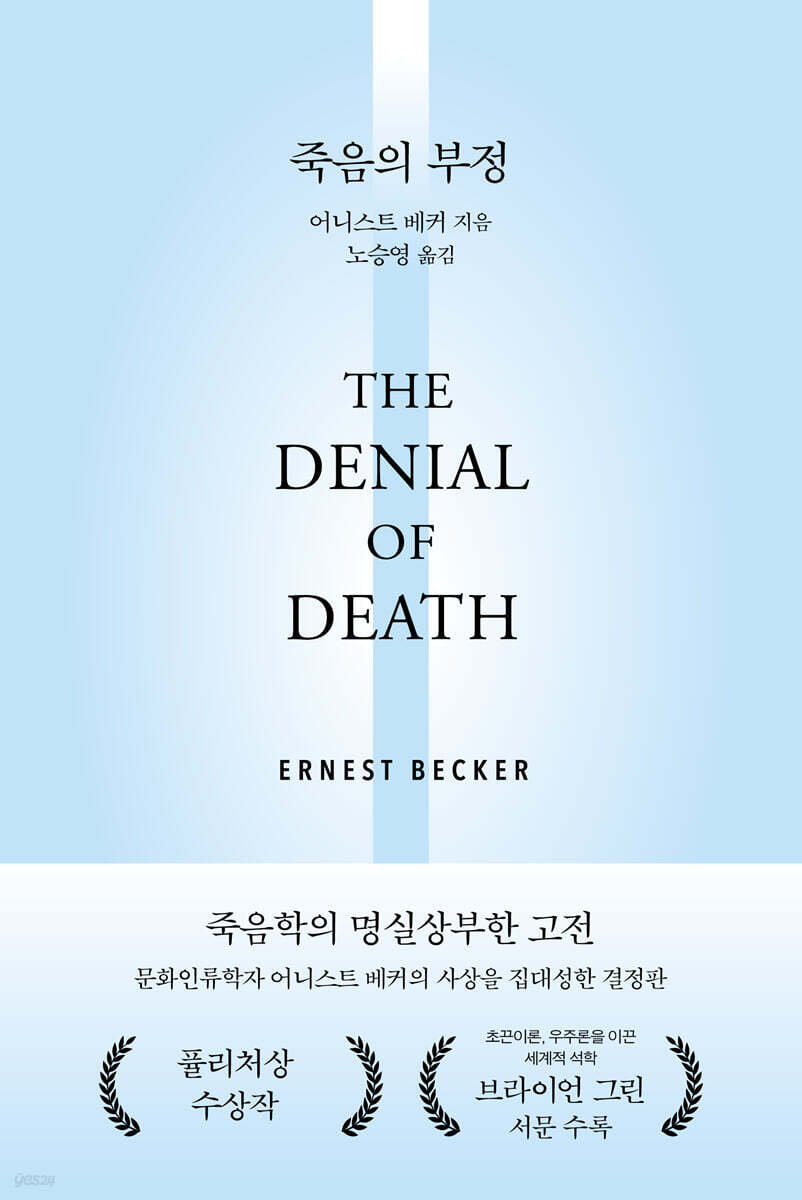
denial of death
 |
Description
Book Introduction
◆ Pulitzer Prize Winner in Nonfiction
◆ Includes a preface by Brian Greene, a physicist who led the development of string theory and cosmology.
A true classic in thanatology
A monumental work by world-renowned cultural anthropologist Ernest Becker
“This book is an attempt at peace for my scholarly soul and a petition for intellectual pardon.
“I think it’s the first mature work I’ve ever written.” _Ernest Becker
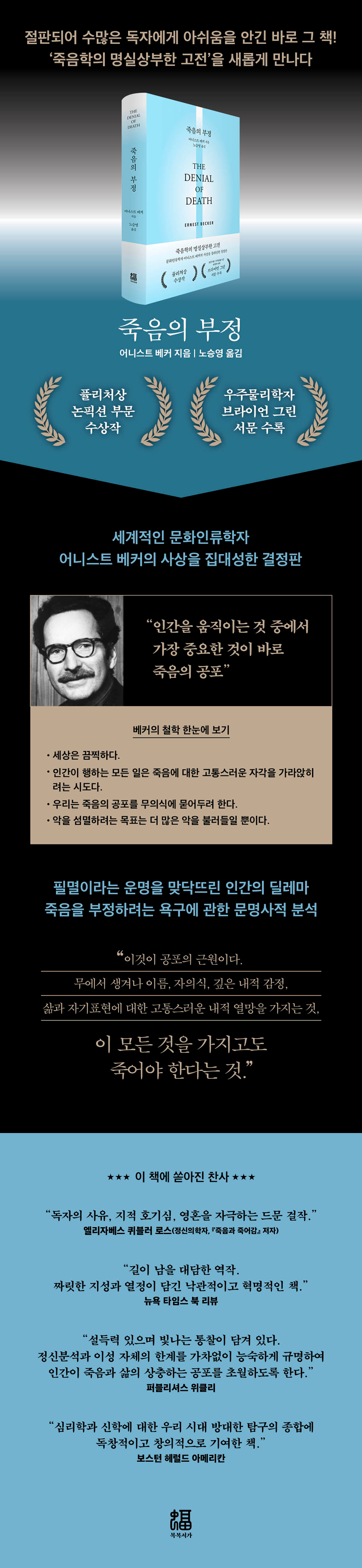
More than 50 years after its publication, 『The Denial of Death』, which has been a major topic in philosophy, sociology, psychology, and theology and has established itself as a true classic in the field of thanatology, is being presented in a new light.
This book has been cited in numerous works and has stimulated readers' intellectual curiosity and interest, but it has been out of print in Korea, which has caused great regret.
In this edition published by Bokbokseoga, translator Noh Seung-young personally refined the existing translation and added a foreword by Brian Greene, a world-renowned physicist who has led the field of string theory and cosmology.
Brian Greene says that reading Becker's book put his own curiosity into perspective.
This book, which makes the provocative claim that “the most important thing that moves humans is the fear of death,” is a masterpiece that compiles the thoughts of Ernest Becker, who spent his entire life exploring human nature and death.
For Becker, the fear of death was “the key to understanding human behavior with remarkable clarity.”
Even when he was facing death from colon cancer, he never gave up on writing this book.
When philosopher Sam Kean, who wrote the preface to The Denial of Death, visited Becker in his hospital room, he said:
“You came to me at the last moment.
It's finally time to test everything I've written about death.
The opportunity has come to show how people die and what attitude they take.
“I will show you how I face death with dignity and humanity, what I think about death, and how I accept death.” His unwavering determination is condensed into clear and sharp insight and is contained in a single book.
The book was published after Becker's death and won the 1974 Pulitzer Prize for Nonfiction.
A bold masterpiece that will be remembered for a long time.
An optimistic and revolutionary book filled with thrilling intelligence and passion.
_The New York Times Book Review
It is a rare masterpiece that stimulates the reader's thoughts, intellectual curiosity, and soul.
Elisabeth Kübler-Ross (psychiatrist, author of Death and Dying)
◆ Includes a preface by Brian Greene, a physicist who led the development of string theory and cosmology.
A true classic in thanatology
A monumental work by world-renowned cultural anthropologist Ernest Becker
“This book is an attempt at peace for my scholarly soul and a petition for intellectual pardon.
“I think it’s the first mature work I’ve ever written.” _Ernest Becker
More than 50 years after its publication, 『The Denial of Death』, which has been a major topic in philosophy, sociology, psychology, and theology and has established itself as a true classic in the field of thanatology, is being presented in a new light.
This book has been cited in numerous works and has stimulated readers' intellectual curiosity and interest, but it has been out of print in Korea, which has caused great regret.
In this edition published by Bokbokseoga, translator Noh Seung-young personally refined the existing translation and added a foreword by Brian Greene, a world-renowned physicist who has led the field of string theory and cosmology.
Brian Greene says that reading Becker's book put his own curiosity into perspective.
This book, which makes the provocative claim that “the most important thing that moves humans is the fear of death,” is a masterpiece that compiles the thoughts of Ernest Becker, who spent his entire life exploring human nature and death.
For Becker, the fear of death was “the key to understanding human behavior with remarkable clarity.”
Even when he was facing death from colon cancer, he never gave up on writing this book.
When philosopher Sam Kean, who wrote the preface to The Denial of Death, visited Becker in his hospital room, he said:
“You came to me at the last moment.
It's finally time to test everything I've written about death.
The opportunity has come to show how people die and what attitude they take.
“I will show you how I face death with dignity and humanity, what I think about death, and how I accept death.” His unwavering determination is condensed into clear and sharp insight and is contained in a single book.
The book was published after Becker's death and won the 1974 Pulitzer Prize for Nonfiction.
A bold masterpiece that will be remembered for a long time.
An optimistic and revolutionary book filled with thrilling intelligence and passion.
_The New York Times Book Review
It is a rare masterpiece that stimulates the reader's thoughts, intellectual curiosity, and soul.
Elisabeth Kübler-Ross (psychiatrist, author of Death and Dying)
- You can preview some of the book's contents.
Preview
index
Foreword to the 2023 Edition | Brian Greene (physicist)
Foreword | Sam Keen (philosopher)
Author's Preface
Chapter 1.
Preface: Human Nature and the Heroic
Part 1.
The Deep Psychology of Heroism
Chapter 2.
fear of death
Chapter 3.
Reestablishing the basic concepts of psychoanalysis
Chapter 4.
Human Character as a Necessary Falsehood
Chapter 5.
Psychoanalyst Kierkegaard
Chapter 6.
Reexamining Freud's personality issues
Part 2.
The failure of heroism
Chapter 7.
The Magic of Personality? The Core of Wealth
Chapter 8.
Otto Rank? The Completeness of Kierkegaardian Psychoanalysis
Chapter 9.
Current results of psychoanalysis
Chapter 10.
Causes of mental illness
Part 3.
Reflection and Conclusion: The Dilemma of Heroism
Chapter 11.
Psychoanalysis and Religion: What is a Heroic Individual?
main
Foreword | Sam Keen (philosopher)
Author's Preface
Chapter 1.
Preface: Human Nature and the Heroic
Part 1.
The Deep Psychology of Heroism
Chapter 2.
fear of death
Chapter 3.
Reestablishing the basic concepts of psychoanalysis
Chapter 4.
Human Character as a Necessary Falsehood
Chapter 5.
Psychoanalyst Kierkegaard
Chapter 6.
Reexamining Freud's personality issues
Part 2.
The failure of heroism
Chapter 7.
The Magic of Personality? The Core of Wealth
Chapter 8.
Otto Rank? The Completeness of Kierkegaardian Psychoanalysis
Chapter 9.
Current results of psychoanalysis
Chapter 10.
Causes of mental illness
Part 3.
Reflection and Conclusion: The Dilemma of Heroism
Chapter 11.
Psychoanalysis and Religion: What is a Heroic Individual?
main
Detailed image
Into the book
While Kübler-Ross taught us how to die with dignity, Becker reminded us that contemplating death inevitably brings with it fear, dread, and existential anxiety.
--- p.21
We achieve a false immortality by sacrificing ourselves to conquer empires, build temples, write books, raise families, amass wealth, contribute to progress and prosperity, and create the information society and the global free market.
Since the primary task of human life is to become a hero and transcend death, every culture must provide its members with an ingenious system of symbols imbued with a secret religiosity.
This means that ideological conflicts between cultures are essentially battles between immortal projects, that is, holy wars.
--- p.22
Death is the main driving force of human activity.
The goal of this activity is largely to overcome death by avoiding its fate and denying that death is the ultimate destination for humans.
--- p.29
Heroism is, above all, a reflex to the fear of death.
We admire above all else the courage to face death.
To such courage I offer the highest and most constant worship.
The reason the courage to face death moves us so deeply is because we are unsure of how brave we ourselves will be in the face of death.
--- p.54
Most people believe that there is no fear of death because death rarely shows its true face, but beneath all appearances, the fear of death is universal.
--- p.60
The irony of the human condition is that our deepest desire is to escape the anxiety of death and extinction.
But since it is life itself that awakens anxiety, we must avoid living fully.
--- p.135
The drive for immortality is not a simple reflex to the fear of death, but rather a drive toward life with one's whole being.
--- p.265
We live our lives completely unaware of who we are and why we are here, but we know that life must have meaning.
--- p.269
It is perhaps a paradoxical truth that there is no way for living creatures to escape life and death, and that trying too hard to do so would destroy them.
--- p.308
When do people struggle most with self-esteem? It's when the heroic transcendence of destiny is most questioned, when the enduring value of life, one's own immortality, is questioned.
That is, when you are not sure that your past life has made even the slightest cosmic difference.
--- p.350
If you fear life, you will become overly afraid of death.
--- p.351
From time immemorial, the unique problem of humankind has been the need to give spiritual meaning to life, to elevate it to a special, immortal dimension, beyond the cycle of life and death that characterizes all other organisms.
--- p.21
We achieve a false immortality by sacrificing ourselves to conquer empires, build temples, write books, raise families, amass wealth, contribute to progress and prosperity, and create the information society and the global free market.
Since the primary task of human life is to become a hero and transcend death, every culture must provide its members with an ingenious system of symbols imbued with a secret religiosity.
This means that ideological conflicts between cultures are essentially battles between immortal projects, that is, holy wars.
--- p.22
Death is the main driving force of human activity.
The goal of this activity is largely to overcome death by avoiding its fate and denying that death is the ultimate destination for humans.
--- p.29
Heroism is, above all, a reflex to the fear of death.
We admire above all else the courage to face death.
To such courage I offer the highest and most constant worship.
The reason the courage to face death moves us so deeply is because we are unsure of how brave we ourselves will be in the face of death.
--- p.54
Most people believe that there is no fear of death because death rarely shows its true face, but beneath all appearances, the fear of death is universal.
--- p.60
The irony of the human condition is that our deepest desire is to escape the anxiety of death and extinction.
But since it is life itself that awakens anxiety, we must avoid living fully.
--- p.135
The drive for immortality is not a simple reflex to the fear of death, but rather a drive toward life with one's whole being.
--- p.265
We live our lives completely unaware of who we are and why we are here, but we know that life must have meaning.
--- p.269
It is perhaps a paradoxical truth that there is no way for living creatures to escape life and death, and that trying too hard to do so would destroy them.
--- p.308
When do people struggle most with self-esteem? It's when the heroic transcendence of destiny is most questioned, when the enduring value of life, one's own immortality, is questioned.
That is, when you are not sure that your past life has made even the slightest cosmic difference.
--- p.350
If you fear life, you will become overly afraid of death.
--- p.351
From time immemorial, the unique problem of humankind has been the need to give spiritual meaning to life, to elevate it to a special, immortal dimension, beyond the cycle of life and death that characterizes all other organisms.
--- p.382~383
Publisher's Review
The dilemma of humans facing mortality
A Civilization-Historical Analysis of the Universal Desire to Deny Death
Unlike other living beings, humans can think beyond the present moment.
We are not only preoccupied with the present moment, but also look back on the past and imagine the future.
This unique ability of humans has enabled them to achieve remarkable feats that no other life in the natural world can.
Through broad and deep thinking, it was possible to invent things that had never existed before, create beautiful works of art, and build societies and nations to pursue a better life.
However, there comes a time when this unique ability of humans loses its power, and that is the moment of death, the end of life that all humans must face in the end.
Even exceptional abilities and meticulous strategies are powerless in the face of death, and no one can escape it.
Without exception, the future that awaits all of humanity is the territory of death.
The irony and dilemma of the human condition is that even the most superior of living beings has no way to escape mortality.
So, it is inevitable that humans feel an instinctive aversion and fear towards death.
While they are aware that they are unique in that they stand tall and majestic, they return blindly and speechless to the ground a meter below, where they rot away forever.
This is the terrible dilemma we face and have to live with.
Page 77
Becker argues that the fear of death is universally present in all humans.
To overcome this, he says he struggles throughout his life to leave behind something of lasting value and meaning even after he is gone from this world.
According to Becker, everything we do is an attempt to alleviate the painful awareness of death.
While there are relatively benign ways of finding hope in faith or procreating, sometimes it manifests itself in violent ways, such as killing other life forms, starting wars, and destroying nature.
But no matter what you do, you can never achieve true immortality.
In this book, Becker argues that this struggle for 'false' immortality brings evil into the world.
It synthesizes research from various fields, including psychology, psychoanalysis, and theology, and delves deeply into death, a subject he has devoted his life to, based on philosophical and sociocultural analyses of major thinkers such as Sigmund Freud, Søren Kierkegaard, Erich Fromm, and Otto Rank.
This is the source of fear.
To be born from nothing, to have a name, a self-consciousness, deep inner feelings, a painful inner yearning for life and self-expression, and yet to die with all this.
It's like a joke.
Page 168
The fear of death that pursues us fiercely
The desperately fragile and surprisingly powerful hope Becker left behind
To say that the fear of death is the motivation behind all human actions would mean, in other words, that death is also what gives meaning to our lives.
Facing the human condition as it is, which is destined to “return to the ground and rot away forever,” may paradoxically lead us to a more fulfilling life.
Being aware of our mortality will sharpen our ability to discern what is important and what is not in this life, and this will become a stepping stone to a more worthwhile life.
We may not be able to eliminate the primal anxiety, but by facing the truth at the core of that anxiety, we can develop our own unique thoughts from it, or grow by branching out into another dimension of thought.
Beyond the pessimistic and resigned declaration that only death awaits us, Becker makes us consider the best we can do in this life.
So, it would be fair to say that 『The Denial of Death』 is a book that opens up a new perspective not only on death but also on life.
We can choose to increase the reign of evil or we can choose to decrease it.
Tomorrow's script hasn't been written yet.
Ultimately, the hope Becker leaves us with is both terribly fragile and surprisingly powerful.
_「Introduction」, Sam Keen
A Civilization-Historical Analysis of the Universal Desire to Deny Death
Unlike other living beings, humans can think beyond the present moment.
We are not only preoccupied with the present moment, but also look back on the past and imagine the future.
This unique ability of humans has enabled them to achieve remarkable feats that no other life in the natural world can.
Through broad and deep thinking, it was possible to invent things that had never existed before, create beautiful works of art, and build societies and nations to pursue a better life.
However, there comes a time when this unique ability of humans loses its power, and that is the moment of death, the end of life that all humans must face in the end.
Even exceptional abilities and meticulous strategies are powerless in the face of death, and no one can escape it.
Without exception, the future that awaits all of humanity is the territory of death.
The irony and dilemma of the human condition is that even the most superior of living beings has no way to escape mortality.
So, it is inevitable that humans feel an instinctive aversion and fear towards death.
While they are aware that they are unique in that they stand tall and majestic, they return blindly and speechless to the ground a meter below, where they rot away forever.
This is the terrible dilemma we face and have to live with.
Page 77
Becker argues that the fear of death is universally present in all humans.
To overcome this, he says he struggles throughout his life to leave behind something of lasting value and meaning even after he is gone from this world.
According to Becker, everything we do is an attempt to alleviate the painful awareness of death.
While there are relatively benign ways of finding hope in faith or procreating, sometimes it manifests itself in violent ways, such as killing other life forms, starting wars, and destroying nature.
But no matter what you do, you can never achieve true immortality.
In this book, Becker argues that this struggle for 'false' immortality brings evil into the world.
It synthesizes research from various fields, including psychology, psychoanalysis, and theology, and delves deeply into death, a subject he has devoted his life to, based on philosophical and sociocultural analyses of major thinkers such as Sigmund Freud, Søren Kierkegaard, Erich Fromm, and Otto Rank.
This is the source of fear.
To be born from nothing, to have a name, a self-consciousness, deep inner feelings, a painful inner yearning for life and self-expression, and yet to die with all this.
It's like a joke.
Page 168
The fear of death that pursues us fiercely
The desperately fragile and surprisingly powerful hope Becker left behind
To say that the fear of death is the motivation behind all human actions would mean, in other words, that death is also what gives meaning to our lives.
Facing the human condition as it is, which is destined to “return to the ground and rot away forever,” may paradoxically lead us to a more fulfilling life.
Being aware of our mortality will sharpen our ability to discern what is important and what is not in this life, and this will become a stepping stone to a more worthwhile life.
We may not be able to eliminate the primal anxiety, but by facing the truth at the core of that anxiety, we can develop our own unique thoughts from it, or grow by branching out into another dimension of thought.
Beyond the pessimistic and resigned declaration that only death awaits us, Becker makes us consider the best we can do in this life.
So, it would be fair to say that 『The Denial of Death』 is a book that opens up a new perspective not only on death but also on life.
We can choose to increase the reign of evil or we can choose to decrease it.
Tomorrow's script hasn't been written yet.
Ultimately, the hope Becker leaves us with is both terribly fragile and surprisingly powerful.
_「Introduction」, Sam Keen
GOODS SPECIFICS
- Date of issue: May 30, 2025
- Format: Hardcover book binding method guide
- Page count, weight, size: 484 pages | 704g | 140*210*30mm
- ISBN13: 9791191114874
- ISBN10: 1191114872
You may also like
카테고리
korean


korean

![GQ KOREA Mark (Monthly): December [2025]](http://librairie.coreenne.fr/cdn/shop/files/8ef265dbbfbf186523ed75ba7319009d.jpg?v=1765340328&width=3840)


