

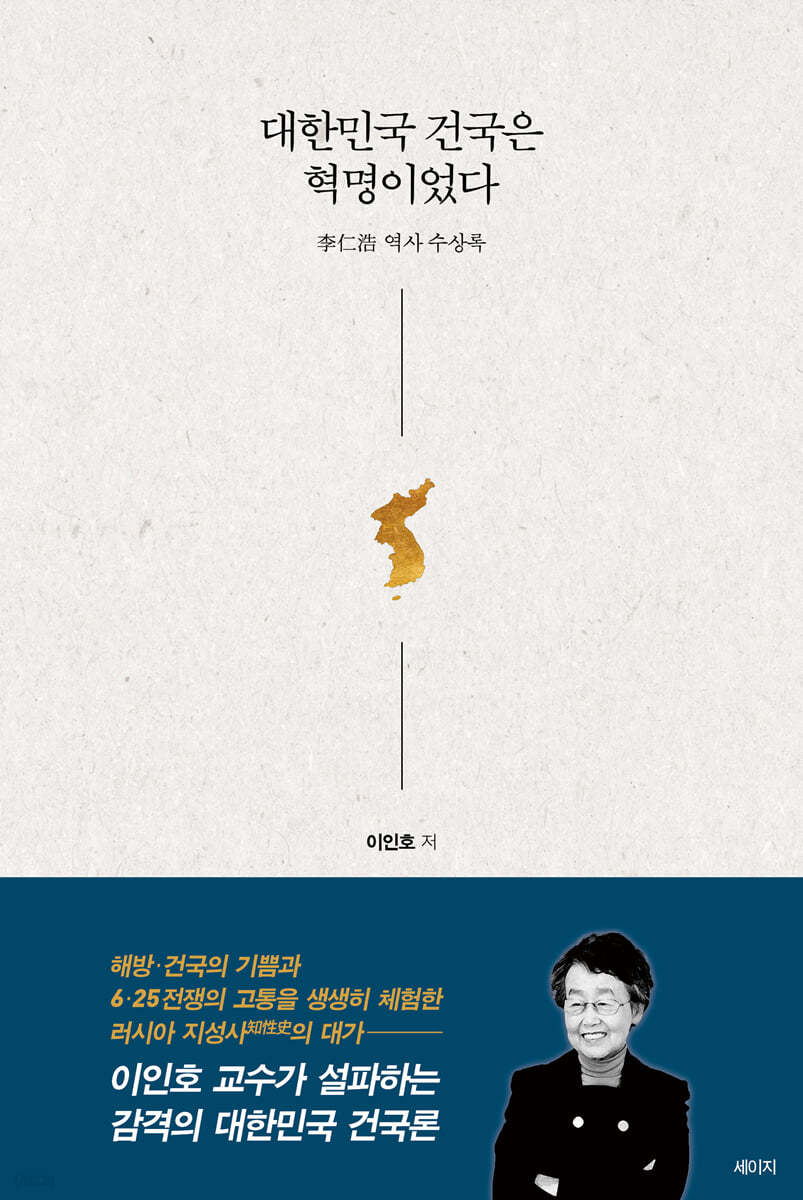
The founding of the Republic of Korea was a revolution
 |
Description
Book Introduction
A master of Russian intellectual history who vividly experienced the joy of liberation and the founding of the nation and the pain of the Korean War.
Professor Lee In-ho's moving theory of the founding of the Republic of Korea
Now, in Korean society, forces that deny or denigrate the glorious history of the founding of the Republic of Korea on August 15, 1948, which was completed with the free general elections in May 1948, the opening of the first National Assembly and the enactment of the Constitution in July, and the establishment of the government, are exerting their influence in all areas, including politics, the legal profession, the media, education, and academia.
In a situation where even the Korean Liberation Association has joined in this controversy, it is believed that readers have listened to the author's theory of founding the Republic of Korea through various channels such as the media and public lectures, with sincerity and passion, to refute, persuade, and correct misleading and heretical views on the founding of the Republic of Korea.
This book is a compilation of unpublished papers, newspaper columns, lecture notes, and internet broadcasts written by the author while serving as a professor of history at Korea University and Seoul National University, and while carrying out public duties as Ambassador to Finland and Ambassador to Russia. By making these widely available as a publication, the author has selected and compiled those that will help future generations develop a correct view of history.
Based on theses that illuminate the founding of the Republic of Korea as a 'revolution' from a comparative historical perspective, it includes essays that diagnose today's reality in reverse chronological order, followed by articles on the meaning of history in chronological order. Finally, it includes a compilation of recent special interviews with VON News regarding the founding of the Republic of Korea and President Syngman Rhee.
The writings in this book range from those written decades ago to relatively recent compilations of speeches, spanning the author's entire life and thoughts.
Therefore, we would like to point out that terms that are no longer in use (e.g., elementary school) or years calculated from the year of writing (e.g., 60 years of liberation) have been left in the original text without any changes to the expressions used at the time of writing, as much as possible.
Professor Lee In-ho's moving theory of the founding of the Republic of Korea
Now, in Korean society, forces that deny or denigrate the glorious history of the founding of the Republic of Korea on August 15, 1948, which was completed with the free general elections in May 1948, the opening of the first National Assembly and the enactment of the Constitution in July, and the establishment of the government, are exerting their influence in all areas, including politics, the legal profession, the media, education, and academia.
In a situation where even the Korean Liberation Association has joined in this controversy, it is believed that readers have listened to the author's theory of founding the Republic of Korea through various channels such as the media and public lectures, with sincerity and passion, to refute, persuade, and correct misleading and heretical views on the founding of the Republic of Korea.
This book is a compilation of unpublished papers, newspaper columns, lecture notes, and internet broadcasts written by the author while serving as a professor of history at Korea University and Seoul National University, and while carrying out public duties as Ambassador to Finland and Ambassador to Russia. By making these widely available as a publication, the author has selected and compiled those that will help future generations develop a correct view of history.
Based on theses that illuminate the founding of the Republic of Korea as a 'revolution' from a comparative historical perspective, it includes essays that diagnose today's reality in reverse chronological order, followed by articles on the meaning of history in chronological order. Finally, it includes a compilation of recent special interviews with VON News regarding the founding of the Republic of Korea and President Syngman Rhee.
The writings in this book range from those written decades ago to relatively recent compilations of speeches, spanning the author's entire life and thoughts.
Therefore, we would like to point out that terms that are no longer in use (e.g., elementary school) or years calculated from the year of writing (e.g., 60 years of liberation) have been left in the original text without any changes to the expressions used at the time of writing, as much as possible.
- You can preview some of the book's contents.
Preview
index
Author's Preface… 006
Prologue: Where are we going?… 014
The founding of the Republic of Korea was a revolution
The Founding of the Republic of Korea Through Revolution - Rethinking Our Modern History Through Macro-Historical Comparison… 030
History and reality
Why Syngman Rhee again… 068
The Historical Significance of the ROK-US Military Alliance… 099
A Story for a New Generation - Ignorance or Rebellion? 107
History and Historiography
Methodological Issues in Korean Historical Studies… 122
Should history be taught? 158
The Correlation Between History and Politics: Focusing on the Problems of Interpreting Our Modern History… 171
Intellectuals and Historical Consciousness - Video: The Harmful Effects of the Hundred Years' War... 194
History as the Centerpiece of the Humanities and Today's Reality… 201
Dialogue: Exploring the Future Through History
Founded in 1948, the Republic of Korea is a revolutionary nation that recognizes basic individual rights… 240
A historic event of global significance: the founding of the anti-communist, liberal, democratic Republic of Korea… 260
How the Left and the Right Can Coexist While Preserving the Legitimacy of the Republic of Korea's Founding... 285
The construction of the President Syngman Rhee Memorial Hall lays the ideological foundation for the nation… 313
Prologue: Where are we going?… 014
The founding of the Republic of Korea was a revolution
The Founding of the Republic of Korea Through Revolution - Rethinking Our Modern History Through Macro-Historical Comparison… 030
History and reality
Why Syngman Rhee again… 068
The Historical Significance of the ROK-US Military Alliance… 099
A Story for a New Generation - Ignorance or Rebellion? 107
History and Historiography
Methodological Issues in Korean Historical Studies… 122
Should history be taught? 158
The Correlation Between History and Politics: Focusing on the Problems of Interpreting Our Modern History… 171
Intellectuals and Historical Consciousness - Video: The Harmful Effects of the Hundred Years' War... 194
History as the Centerpiece of the Humanities and Today's Reality… 201
Dialogue: Exploring the Future Through History
Founded in 1948, the Republic of Korea is a revolutionary nation that recognizes basic individual rights… 240
A historic event of global significance: the founding of the anti-communist, liberal, democratic Republic of Korea… 260
How the Left and the Right Can Coexist While Preserving the Legitimacy of the Republic of Korea's Founding... 285
The construction of the President Syngman Rhee Memorial Hall lays the ideological foundation for the nation… 313
Into the book
Growing up in elementary school, I was tired of hearing the sorrows of a weak nation. After experiencing liberation, division of Korea, the founding of the Republic of Korea, and the Korean War, when I first took my steps as a history student, my dream was to study world history and, with that knowledge as a background, to properly write our country's history.
But before he knew it, he was caught up in the turbulent waves of history and was pulled down from the high ground of historical studies.
However, the flame of interest in history and historical awareness never completely died out, so I sometimes accepted requests to give lectures or broadcasts, and even contributed to newspapers.
However, as time has passed and I have become a member of a bygone generation, and furthermore, after the so-called 'Candlelight Revolution', I have been classified as an 'old evil' that needs to be liquidated, so even if I really want to say something, I am ignored by the major mass media.
However, sometimes, when I see the basic principles of liberal democracy and the foundation of the national system being destroyed under the pretext of democratization, I feel an unbearable frustration and anger, so I write a few words on my own, share them with a few comrades, and bury them, or, if I am lucky, publish them through foreign media.
(......)
In fact, if we look at the historical controversies that have been taking place in our country over the past few years, they are not 'debates' but 'wars', and not 'academic conferences' but nothing more than 'political propaganda'.
The direct cause, of course, was the persistent propaganda offensive of the former communist forces and enemies of the Republic of Korea, centered around North Korea. However, we cannot help but conclude that the reason this kind of historical war could continue and the very spiritual and ideological foundation on which the Republic of Korea stands began to crumble was because the people in general were indifferent and ignorant about history, and thus lacked the ability to sense that the foundation of the country they were living in was being destroyed, that is, they did not even have a historical consciousness.
How could it be that not only politicians of the pro-North Korea faction but also university professors and editorial writers of major media outlets make such absurd claims that the Republic of Korea was established in 1919, not 1948, and that even during the Japanese colonial period, Koreans had Korean citizenship?
What's even more outrageous is that when the National Assembly members who make such absurd claims kick out the minister who points out that at the time there was no way to live without being subject to Japanese law, acting like the dictator Stalin, those who call themselves editorial writers for major newspapers not only do not condemn this unconstitutional outrage that tramples on freedom of conscience, but instead insult the minister who refuses to bend his convictions on historical facts that he knows well, calling him a "stubborn person who tires out the people" and displaying such apocalyptic moral and intellectual insensitivity.
(......)
I once again ask for your understanding as I have to publish these old articles without having time to update them.
I just hope that this will be of some help in saving the Republic of Korea from a crisis of consciousness.
And I would like to express my deepest gratitude to the editorial staff and readers who have put in all their effort, both materially and spiritually, to publish this book, which was clearly not going to sell well.
---From the author's preface
The revolutionary significance of the founding of the Republic of Korea was at least threefold.
First, we were liberated from Japanese colonial rule and the US military government, reborn as an independent nation, and became a sovereign nation recognized by the international community.
The entire nation's wish for independence was fulfilled.
Second, we have been elevated from the status of subjects of the dynasty era, discriminated against colonial subjects under Japanese colonial rule, and former citizens of a defeated enemy country's colonies under the US military government to the status of citizens, the masters of the country, and have established a democratic republic that recognizes these citizens as free and equal masters.
Third, the national ideals and ideologies adopted by such republics were not communism or militaristic collectivism, but liberal democracy, which held individual freedom and dignity as the highest values and respected property rights.
These three were all groundbreaking transformations that completely transcended the political, social, and cultural realities that had existed up to that point, and although there were many twists and turns, they were clear revolutionary dividing lines that could never be returned to their former state.
---From "Republic of Korea as Seen Through Revolution"
The April 19 Uprising was a loyal uprising sparked by the motive of correcting the constitutional order of the Republic of Korea, which was originally led by Syngman Rhee, and was by no means a revolution aimed at overthrowing the Republic of Korea.
However, rather than demonstrating a patriotic spirit to succeed the tasks of building, protecting, and developing a democratic nation that the Syngman Rhee government failed to accomplish on the basis of the Constitution of the Republic of Korea, the subsequent regimes mistakenly believed that politically criticizing Syngman Rhee and the Liberal Party government was the only way to highlight their own value.
Falling into such shallow political calculations, they began to neglect or even denigrate not only Syngman Rhee as an anti-communist political leader who laid the foundation for the Republic of Korea's national foundation, but also his historical achievements as an independence activist.
---From "Why Syngman Rhee Again"
On August 15, 2008, in our Republic of Korea, opposition leaders openly refused to attend the 60th anniversary celebrations and even filed a constitutional petition opposing the 60th anniversary celebrations. This led to the unfortunate incident where the National Foundation Association, which was planning to hold the National Festival at the Sangam World Cup Stadium in Seoul, was disrupted by the Liberation Association.
Without independent independence through nation-building, can the meaning of liberation truly be realized through liberation from Japanese colonial rule alone? How can commemorating the founding of the Republic of Korea, which inherited the legitimacy of the Provisional Government, be considered an insult to the members of the Provisional Government and other individuals who dedicated themselves to the independence movement? Things are happening that defy common sense.
---From "The Correlation Between History and Politics"
The Republic of Korea was established as an independent nation with the fundamental values of liberal democracy as its ideology and was the only legitimate nation on the Korean Peninsula recognized by the United Nations.
However, because we have been faced with the communist bloc's persistent internal and external sabotage from birth, we could not allow political freedom indefinitely, which meant living in a vicious cycle that undermined the fundamental values of liberal democracy.
---From "Intellectuals and Historical Consciousness"
The fight against those who seek to exploit history as a political tool must also be waged on another, more direct level: the political level.
Because the direction of the crossroads between freedom and totalitarianism will be determined by the outcome of that fight.
However, I believe that what is more urgent than anything else now is to instill in the new generation of the Republic of Korea a correct understanding of history and to instill in them the strength to live as unified individuals even amidst the turbulent waves of historical change.
But before he knew it, he was caught up in the turbulent waves of history and was pulled down from the high ground of historical studies.
However, the flame of interest in history and historical awareness never completely died out, so I sometimes accepted requests to give lectures or broadcasts, and even contributed to newspapers.
However, as time has passed and I have become a member of a bygone generation, and furthermore, after the so-called 'Candlelight Revolution', I have been classified as an 'old evil' that needs to be liquidated, so even if I really want to say something, I am ignored by the major mass media.
However, sometimes, when I see the basic principles of liberal democracy and the foundation of the national system being destroyed under the pretext of democratization, I feel an unbearable frustration and anger, so I write a few words on my own, share them with a few comrades, and bury them, or, if I am lucky, publish them through foreign media.
(......)
In fact, if we look at the historical controversies that have been taking place in our country over the past few years, they are not 'debates' but 'wars', and not 'academic conferences' but nothing more than 'political propaganda'.
The direct cause, of course, was the persistent propaganda offensive of the former communist forces and enemies of the Republic of Korea, centered around North Korea. However, we cannot help but conclude that the reason this kind of historical war could continue and the very spiritual and ideological foundation on which the Republic of Korea stands began to crumble was because the people in general were indifferent and ignorant about history, and thus lacked the ability to sense that the foundation of the country they were living in was being destroyed, that is, they did not even have a historical consciousness.
How could it be that not only politicians of the pro-North Korea faction but also university professors and editorial writers of major media outlets make such absurd claims that the Republic of Korea was established in 1919, not 1948, and that even during the Japanese colonial period, Koreans had Korean citizenship?
What's even more outrageous is that when the National Assembly members who make such absurd claims kick out the minister who points out that at the time there was no way to live without being subject to Japanese law, acting like the dictator Stalin, those who call themselves editorial writers for major newspapers not only do not condemn this unconstitutional outrage that tramples on freedom of conscience, but instead insult the minister who refuses to bend his convictions on historical facts that he knows well, calling him a "stubborn person who tires out the people" and displaying such apocalyptic moral and intellectual insensitivity.
(......)
I once again ask for your understanding as I have to publish these old articles without having time to update them.
I just hope that this will be of some help in saving the Republic of Korea from a crisis of consciousness.
And I would like to express my deepest gratitude to the editorial staff and readers who have put in all their effort, both materially and spiritually, to publish this book, which was clearly not going to sell well.
---From the author's preface
The revolutionary significance of the founding of the Republic of Korea was at least threefold.
First, we were liberated from Japanese colonial rule and the US military government, reborn as an independent nation, and became a sovereign nation recognized by the international community.
The entire nation's wish for independence was fulfilled.
Second, we have been elevated from the status of subjects of the dynasty era, discriminated against colonial subjects under Japanese colonial rule, and former citizens of a defeated enemy country's colonies under the US military government to the status of citizens, the masters of the country, and have established a democratic republic that recognizes these citizens as free and equal masters.
Third, the national ideals and ideologies adopted by such republics were not communism or militaristic collectivism, but liberal democracy, which held individual freedom and dignity as the highest values and respected property rights.
These three were all groundbreaking transformations that completely transcended the political, social, and cultural realities that had existed up to that point, and although there were many twists and turns, they were clear revolutionary dividing lines that could never be returned to their former state.
---From "Republic of Korea as Seen Through Revolution"
The April 19 Uprising was a loyal uprising sparked by the motive of correcting the constitutional order of the Republic of Korea, which was originally led by Syngman Rhee, and was by no means a revolution aimed at overthrowing the Republic of Korea.
However, rather than demonstrating a patriotic spirit to succeed the tasks of building, protecting, and developing a democratic nation that the Syngman Rhee government failed to accomplish on the basis of the Constitution of the Republic of Korea, the subsequent regimes mistakenly believed that politically criticizing Syngman Rhee and the Liberal Party government was the only way to highlight their own value.
Falling into such shallow political calculations, they began to neglect or even denigrate not only Syngman Rhee as an anti-communist political leader who laid the foundation for the Republic of Korea's national foundation, but also his historical achievements as an independence activist.
---From "Why Syngman Rhee Again"
On August 15, 2008, in our Republic of Korea, opposition leaders openly refused to attend the 60th anniversary celebrations and even filed a constitutional petition opposing the 60th anniversary celebrations. This led to the unfortunate incident where the National Foundation Association, which was planning to hold the National Festival at the Sangam World Cup Stadium in Seoul, was disrupted by the Liberation Association.
Without independent independence through nation-building, can the meaning of liberation truly be realized through liberation from Japanese colonial rule alone? How can commemorating the founding of the Republic of Korea, which inherited the legitimacy of the Provisional Government, be considered an insult to the members of the Provisional Government and other individuals who dedicated themselves to the independence movement? Things are happening that defy common sense.
---From "The Correlation Between History and Politics"
The Republic of Korea was established as an independent nation with the fundamental values of liberal democracy as its ideology and was the only legitimate nation on the Korean Peninsula recognized by the United Nations.
However, because we have been faced with the communist bloc's persistent internal and external sabotage from birth, we could not allow political freedom indefinitely, which meant living in a vicious cycle that undermined the fundamental values of liberal democracy.
---From "Intellectuals and Historical Consciousness"
The fight against those who seek to exploit history as a political tool must also be waged on another, more direct level: the political level.
Because the direction of the crossroads between freedom and totalitarianism will be determined by the outcome of that fight.
However, I believe that what is more urgent than anything else now is to instill in the new generation of the Republic of Korea a correct understanding of history and to instill in them the strength to live as unified individuals even amidst the turbulent waves of historical change.
---From "History as the Center of the Humanities and Today's Reality"
Publisher's Review
Editor's Review
While conducting a conversation with Professor Lee In-ho and publishing his new book, “Lee In-ho’s Award - The Founding of the Republic of Korea Was a Revolution,” the thought that kept coming to mind was, in one word, “master.”
I am thrilled to have been able to create a book by the master, Lee In-ho, with my own hands.
As I was leaving for my trip, the editor suggested that I add an epilogue myself, so I gave up on writing the preface.
I was afraid that it would be a distraction from the grand discourse.
When I first started writing the introduction, I outlined it with the following three propositions:
First, the anti-communism of Professor Lee In-ho, a leading figure in the history of Russian thought and a progressive intellectual, is different.
Second, Professor Lee In-ho's theory of national foundation, which remembers the joy of liberation and independence through experience, is different.
Third, Professor Lee In-ho's theory of defending liberal democracy, which vividly remembers the suffering of the Korean War, is different.
I believe that the three propositions above will resonate with readers even without further explanation.
Professor Lee In-ho, born in 1936, still walks faster than young people and preaches loudly for future generations that the founding of the Republic of Korea was a great revolution.
The 'Revolution for the Founding of the Republic of Korea' that this person speaks of is greater than the Russian Revolution, which was the theme of his life, and even greater than the French Revolution, which stands as a landmark in Western history.
The revolutionary Syngman Rhee and the revolutionary nation of the Republic of Korea are enemies of communism and totalitarianism, and enemies of all elite politics.
Professor Lee In-ho's theory of national foundation shines simply.
"Granting inviolable fundamental rights to each and every person is a true revolution!" This was the first time since the heavens opened on the Korean Peninsula.
How can the president who created that constitution not be a revolutionary and not a founding president?
Professor Lee In-ho, the author, recognizes all the slander against President Syngman Rhee, who did not have a single memorial hall, as a "failure of historians."
Although he said he permitted the publication of a book of shortcomings to compensate for this failure, readers will easily discover that the author's profound thoughts and historical methodology contained in this book represent a high-level philosophy of history rarely encountered in Korea.
While conducting a conversation with Professor Lee In-ho and publishing his new book, “Lee In-ho’s Award - The Founding of the Republic of Korea Was a Revolution,” the thought that kept coming to mind was, in one word, “master.”
I am thrilled to have been able to create a book by the master, Lee In-ho, with my own hands.
As I was leaving for my trip, the editor suggested that I add an epilogue myself, so I gave up on writing the preface.
I was afraid that it would be a distraction from the grand discourse.
When I first started writing the introduction, I outlined it with the following three propositions:
First, the anti-communism of Professor Lee In-ho, a leading figure in the history of Russian thought and a progressive intellectual, is different.
Second, Professor Lee In-ho's theory of national foundation, which remembers the joy of liberation and independence through experience, is different.
Third, Professor Lee In-ho's theory of defending liberal democracy, which vividly remembers the suffering of the Korean War, is different.
I believe that the three propositions above will resonate with readers even without further explanation.
Professor Lee In-ho, born in 1936, still walks faster than young people and preaches loudly for future generations that the founding of the Republic of Korea was a great revolution.
The 'Revolution for the Founding of the Republic of Korea' that this person speaks of is greater than the Russian Revolution, which was the theme of his life, and even greater than the French Revolution, which stands as a landmark in Western history.
The revolutionary Syngman Rhee and the revolutionary nation of the Republic of Korea are enemies of communism and totalitarianism, and enemies of all elite politics.
Professor Lee In-ho's theory of national foundation shines simply.
"Granting inviolable fundamental rights to each and every person is a true revolution!" This was the first time since the heavens opened on the Korean Peninsula.
How can the president who created that constitution not be a revolutionary and not a founding president?
Professor Lee In-ho, the author, recognizes all the slander against President Syngman Rhee, who did not have a single memorial hall, as a "failure of historians."
Although he said he permitted the publication of a book of shortcomings to compensate for this failure, readers will easily discover that the author's profound thoughts and historical methodology contained in this book represent a high-level philosophy of history rarely encountered in Korea.
GOODS SPECIFICS
- Date of issue: December 2, 2024
- Page count, weight, size: 332 pages | 144*215*30mm
- ISBN13: 9791198064325
- ISBN10: 1198064323
You may also like
카테고리
korean


korean

![GQ KOREA Mark (Monthly): December [2025]](http://librairie.coreenne.fr/cdn/shop/files/8ef265dbbfbf186523ed75ba7319009d.jpg?v=1765340328&width=3840)


