

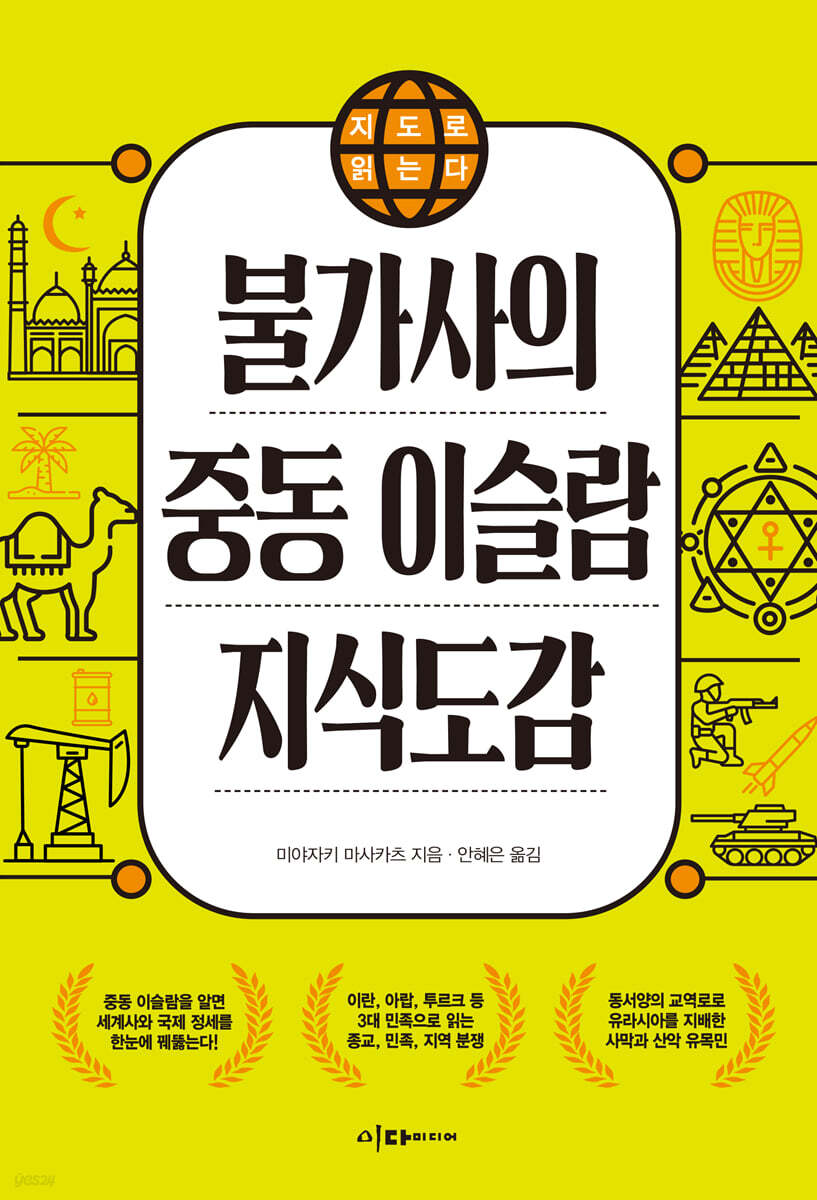
Reading the Map: A Guide to the Mysteries of the Middle East and Islam
 |
Description
Book Introduction
Divides the Middle East and the Islamic world into six eras for easy understanding.
The Iranians, who founded the Achaemenid and Sassanid dynasties in the 6th century BC, maintained hegemony for 1,000 years and created order in the Middle East.
After the 7th century, Arabs, who took the lead in Islamizing the Middle East and spreading the Arabic language through a great conquest movement, took the lead in the Middle East.
Also, the Ottoman Empire, founded by the Turks of the Anatolian Plateau in the late 13th century, became a major player in world history as a great empire that ruled over Asia, Eastern Europe, and North Africa.
This book divides the Middle East and the Islamic world into six eras, explaining them in a way that is easy for anyone to understand.
The Iranians, who founded the Achaemenid and Sassanid dynasties in the 6th century BC, maintained hegemony for 1,000 years and created order in the Middle East.
After the 7th century, Arabs, who took the lead in Islamizing the Middle East and spreading the Arabic language through a great conquest movement, took the lead in the Middle East.
Also, the Ottoman Empire, founded by the Turks of the Anatolian Plateau in the late 13th century, became a major player in world history as a great empire that ruled over Asia, Eastern Europe, and North Africa.
This book divides the Middle East and the Islamic world into six eras, explaining them in a way that is easy for anyone to understand.
- You can preview some of the book's contents.
Preview
index
Introduction - Understanding the Middle East and Islam Understanding World History and International Relations!
Introduction - A glimpse into the tangled world of the Middle East and Islam!
Chapter 1: The Middle East and Islam: The Crossroads of East and West
A Guide to the Middle East: Understanding Its Mysterious Culture and History
The Middle East, the birthplace of human civilization - the Middle East, connecting East and West, laid the foundation for world history.
The Expansion of the Islamic World: A World of 2 Billion Muslims Expands in Three Stages
The Origin of the Term Middle East - Why is it Called the Middle East, and Where Is It?
The climate and landscape of the Middle East—deserts and mountainous arid regions—are the life stages of nomads.
The Islamic World and the Western Roman Empire - Did the Islamic conquests give birth to the Western Roman Empire?
The Birth of Islam and the Ummah—The Islamic Ummah that Achieved Secularization Beyond the Fences of Religion
Who are the Arabs of the Middle East? - Arabs in the Middle East make up only 20% of Muslims.
Muslim Religion and Life - Five Daily Prayers are the Center of Muslim Religious Life
Ramadan and pilgrimage in the Islamic calendar - Ramadan in September, pilgrimage to Mecca in December
The Quran and Islamic Doctrine: Why Do Muslims Forbid Eating Pork and Drinking Alcohol?
Muslim veils and beards - What does a burqa mean for Muslim women and a beard for men?
Column: Islamic Democracy: Choosing Leaders
Chapter 2: The Middle East: The Origin of Civilization
Reading the complex history of the Middle East through geography
Mesopotamian Civilization - Humanity's First Civilization Born in the Wetlands of the River
Egyptian Civilization - Born from the 'Black Soil' of the Nile River
Syria's Desert Trade - Damascus, Syria, the World's Oldest City
Lebanon's Mediterranean trade - a maritime power that pioneered Mediterranean shipping routes and connected the Middle East
The three major religions of Palestine - Jerusalem, Palestine, is a holy place for the three major religions of the world.
The deserts of the Middle East—a vast corridor for trade: the Syrian and Arabian deserts
The outskirts of the Middle East - Anatolia, Afghanistan and the Iranian Plateau are the outskirts of the Middle East.
Column: Roman Baths: The Origin of Turkish Hamams
Chapter 3: 1,000 Years of Iranian Hegemony
Iranian dynasties ruled the Middle East for 1,000 years.
Assyria and Neo-Babylonia - Northern Iraq Assyria first unified the Middle East
Achaemenid Dynasty - Persian Empire in the Middle East unified by the Achaemenid Dynasty
Zoroastrianism - Zoroastrianism in the Middle East was the state religion of the Achaemenid Empire.
The Hellenistic and Parthian Era - The advent of the Hellenistic era and the rise of the Parthian Empire
Sassanid Dynasty - The last great Iranian empire that succeeded the Achaemenid Dynasty
Column - What is the truth behind 'The Quran in the right hand, the sword in the left'?
Chapter 4: The Birth of Islam in the Arabian Peninsula
The Prophet Muhammad's founding and spread of Islam
Mecca, the holy city of Islam - Mecca, a commercial city in the desert, transformed into a holy city of Islam.
The Birth of Muhammad - Muhammad in the Desert Caravan Receives Revelation at Age 40
After the Hegira migration to Medina, the number of Muslims increased rapidly.
The Death of Muhammad - The Caliphs Who Launched a Movement of Conquest After Muhammad's Death
The Quran, the Islamic scripture, is a guide to Muslim life, documenting the five elements of Islam.
The Islamic Ummah System—Dismantling Tribes and Clans and Forming Faith-Centered Communities
Islamic society and jihad - Islamic military activity led by the caliph, 'jihad'
Column: Umar, the Arab nomadic hero who led the era of great conquests
Chapter 5: The Arab Islamic Empire
The Great Islamic Empire Created by the Great Conquest
Desert Trade Networks: How the Desert, a "Sea of Land," Transformed World History Through Trade
The Islamic Conquest Movement - The Islamic Conquest Movement is the Arab missionary and conquest movement.
Islamic Mosques - Mosques spread throughout the Middle East through conquest and missionary work.
The conflict between the early caliphs - the caliphs of Muhammad's lineage and the hereditary succession of the Umayyad lineage
Separation of Shia Islam - Shia recognize only Muhammad's lineage as caliphs
Umayyad Dynasty - The Umayyad dynasty succeeded the caliphs of the Islamic Empire
Abbasid Dynasty - an Islamic empire where diverse ethnic groups were equally integrated
Column: The Harem of the Palace and the Caliph's Debauchery
Chapter 6: The Eurasian Network of Islamic Merchants
World history was born from the trade networks of Muslim merchants!
Expansion of the Islamic Network - The Mongols built a great empire based on the Islamic commercial network.
The construction of Baghdad - Baghdad, with a population of 1.5 million, was a center of world trade!
Four arterial roads in Abas - Four arterial roads in Abas that connect the Eurasian commercial zone
The expansion of the Great Conquest Movement - a major offensive by Islamic forces that seized control of the Mediterranean Sea.
The Sahara Salt Trade: The Salt Trade That Linked the Sahara Desert North and South
Completion of the Oasis Route: A Desert Oasis Route Connecting the Mediterranean and China
Viking and Islamic Economic Spheres - Vikings Traded Furs with Islam via the Volga River
The spread of Islam in Southeast Asia - Islamic merchants pioneered Indian Ocean routes using dhows.
Trade between China and Islam: The Sea Routes of Islamic Merchants Linking the Middle East and China
The Arabian Renaissance: The Advent of the Arabian Renaissance, a Fusion of Eurasian Civilization
Column - The Trade Secrets of Islamic Banks Where Interest Is Banned?
Chapter 7: Turks and Mongols Rule the Middle East
Nomads, Turks and Mongols who advanced into the Middle East
The decline of the Abbasid dynasty - The rise of the Shia led to the downfall of the Abbasid dynasty.
The beginning of the Seljuk dynasty - the Turkic Seljuk dynasty that destroyed the Abbasid dynasty
The Crusades - Europe launched the Crusades in response to the invasion of the Seljuk dynasty.
The Mongol Empire's Fall of Baghdad - The Mongol Empire, which conquered Baghdad and ruled the Middle East
Mamluk Dynasty of Egypt - The Mamluk Dynasty of Egypt founded by Turkic slave soldiers
Timur, the Turkic "conqueror" who dreamed of rebuilding the Timurid Empire and the Mongol Empire
Islamic Mughal Empire - The Mughal Empire, which succeeded Timur, ruled Hindu India.
The birth of the Ottoman dynasty - the Turk Osman I seizes hegemony over the Anatolian Peninsula
The Expansion of the Ottoman Empire - The Ottoman Sultans Who Ruled Three Continents
Devshirme Islands - The Ottoman Empire's recruitment of Slavs from the Balkan Peninsula as talent
The Spread of Coffee to Europe - Coffee in Europe became an Islamic alcoholic beverage.
Safavid Dynasty of Iran - Shia mystic sect established the Safavid Dynasty in Iran
Column: Saladin, the Kurdish Hero Who Defeated the Crusaders
Chapter 8: European Modernization and the Fall of the Ottoman Empire
The dazzling rise of Europe and the decline of the Ottoman Empire
The decline of the Ottoman Empire - The power balance between the Ottoman Empire and Europe begins to reverse.
Greek War of Independence - The Greek War of Independence marked the beginning of the collapse of the Ottoman Empire.
The Partition of the Ottoman Empire - The Ottoman Empire Divided by the Conflict Between Europe and Russia
Construction of the Suez Canal - The French-built Suez Canal was sold by Egypt to the UK for a pittance.
Britain and the Persian Gulf - Britain, the 'Master of the Seas,' Dominates the Persian Gulf's Commercial Areas
The collapse of the Iranian monarchy - the collapse of the Safavid dynasty led to full-scale invasion by Britain and Russia.
3B and 3C policies - Germany approaches the Ottoman Empire to counter Britain
The Middle East's Oil Age: The Great Powers' Struggle for Oil That Hastened the Collapse of the Ottoman Empire
Young Turk Revolution - The Young Turks' military revolution that brought down the Ottoman Empire
Column - Are the royal families of Jordan and Morocco direct descendants of Muhammad?
Chapter 9 · The Partition of the Middle East between Britain and France
The skeleton of the Middle East was formed after World War I.
The reorganization of the Middle East following World War I and the defeat of the Ottoman Empire
Kemal Pasha's Turkish Revolution - Kemal Pasha's revolution led to the establishment of the Turkish Republic.
Britain's Palestine Policy - Britain's Double Diplomacy: The Beginning of the Palestinian Problem
The division of the Ottoman Empire's territory - the partition and colonial rule of the Middle East led by Britain and France
Border Demarcation in the Middle East - Straight Borders in the Middle East Determined by Britain and France
The Kurdish Problem in the Middle East - Why Don't Iranian Kurds Have a State?
British Middle East Policy: British Rule in Egypt and Saudi Arabia's Independence
Column - Why Has Saudi Arabia Emerged as a Power in the Middle East?
Chapter 10: Oil Disputes and Democratization in the Middle East
The oil disputes between the great powers and the growing pains of a modern nation
Understanding the turbulent modern history of the Middle East since World War II, divided into six periods.
The Palestinian War - Israel's Declaration of Independence and the Arab Invasion of Palestine
The Rise of Arab Nationalism - The Rise of Arab Nationalism Caused Unrest in British and French Colonies
Pan-Arabism and the Iranian White Revolution: US support for Pahlavi, establishment of a pro-American regime in Iran
The Suez War: Nasser's rise to power as a leader in the Arab world, despite his opposition to the West.
Third Middle East War - Egypt loses the Six-Day War to Israeli airstrikes
The Fourth Middle East War and the Oil Shock: The Arab oil-producing countries emerged victorious from the global oil shock.
The Lebanese Civil War: Religious conflict and intervention from neighboring countries devastated Lebanon.
Establishment of the Palestinian Authority - The Oslo Accords between Israel and the PLO also became meaningless.
Khomeini's Iranian Revolution - Khomeini's religious revolution that championed Islamic fundamentalism
Iran-Iraq War - The United States supported Saddam Hussein in the Iran-Iraq War.
Gulf War - The Gulf War in which the United States intervened to defend Kuwait
Al Qaeda's 9/11 attacks - Al Qaeda's attack on the World Trade Center in New York with a passenger plane
The Iraq War: A Vicious Cycle of Endless Division Due to Iraq's Ethnic and Religious Strife
The Arab Spring in the Middle East - A duet between dictatorship and monarchy: When will the Arab Spring come?
The Syrian Civil War: A religious war between Shiites and Sunnis that overthrew a 50-year dictatorship.
The Islamic State (IS)—the three major sectarian, ethnic, and regional sparks that turned the Middle East into a powder keg.
Introduction - A glimpse into the tangled world of the Middle East and Islam!
Chapter 1: The Middle East and Islam: The Crossroads of East and West
A Guide to the Middle East: Understanding Its Mysterious Culture and History
The Middle East, the birthplace of human civilization - the Middle East, connecting East and West, laid the foundation for world history.
The Expansion of the Islamic World: A World of 2 Billion Muslims Expands in Three Stages
The Origin of the Term Middle East - Why is it Called the Middle East, and Where Is It?
The climate and landscape of the Middle East—deserts and mountainous arid regions—are the life stages of nomads.
The Islamic World and the Western Roman Empire - Did the Islamic conquests give birth to the Western Roman Empire?
The Birth of Islam and the Ummah—The Islamic Ummah that Achieved Secularization Beyond the Fences of Religion
Who are the Arabs of the Middle East? - Arabs in the Middle East make up only 20% of Muslims.
Muslim Religion and Life - Five Daily Prayers are the Center of Muslim Religious Life
Ramadan and pilgrimage in the Islamic calendar - Ramadan in September, pilgrimage to Mecca in December
The Quran and Islamic Doctrine: Why Do Muslims Forbid Eating Pork and Drinking Alcohol?
Muslim veils and beards - What does a burqa mean for Muslim women and a beard for men?
Column: Islamic Democracy: Choosing Leaders
Chapter 2: The Middle East: The Origin of Civilization
Reading the complex history of the Middle East through geography
Mesopotamian Civilization - Humanity's First Civilization Born in the Wetlands of the River
Egyptian Civilization - Born from the 'Black Soil' of the Nile River
Syria's Desert Trade - Damascus, Syria, the World's Oldest City
Lebanon's Mediterranean trade - a maritime power that pioneered Mediterranean shipping routes and connected the Middle East
The three major religions of Palestine - Jerusalem, Palestine, is a holy place for the three major religions of the world.
The deserts of the Middle East—a vast corridor for trade: the Syrian and Arabian deserts
The outskirts of the Middle East - Anatolia, Afghanistan and the Iranian Plateau are the outskirts of the Middle East.
Column: Roman Baths: The Origin of Turkish Hamams
Chapter 3: 1,000 Years of Iranian Hegemony
Iranian dynasties ruled the Middle East for 1,000 years.
Assyria and Neo-Babylonia - Northern Iraq Assyria first unified the Middle East
Achaemenid Dynasty - Persian Empire in the Middle East unified by the Achaemenid Dynasty
Zoroastrianism - Zoroastrianism in the Middle East was the state religion of the Achaemenid Empire.
The Hellenistic and Parthian Era - The advent of the Hellenistic era and the rise of the Parthian Empire
Sassanid Dynasty - The last great Iranian empire that succeeded the Achaemenid Dynasty
Column - What is the truth behind 'The Quran in the right hand, the sword in the left'?
Chapter 4: The Birth of Islam in the Arabian Peninsula
The Prophet Muhammad's founding and spread of Islam
Mecca, the holy city of Islam - Mecca, a commercial city in the desert, transformed into a holy city of Islam.
The Birth of Muhammad - Muhammad in the Desert Caravan Receives Revelation at Age 40
After the Hegira migration to Medina, the number of Muslims increased rapidly.
The Death of Muhammad - The Caliphs Who Launched a Movement of Conquest After Muhammad's Death
The Quran, the Islamic scripture, is a guide to Muslim life, documenting the five elements of Islam.
The Islamic Ummah System—Dismantling Tribes and Clans and Forming Faith-Centered Communities
Islamic society and jihad - Islamic military activity led by the caliph, 'jihad'
Column: Umar, the Arab nomadic hero who led the era of great conquests
Chapter 5: The Arab Islamic Empire
The Great Islamic Empire Created by the Great Conquest
Desert Trade Networks: How the Desert, a "Sea of Land," Transformed World History Through Trade
The Islamic Conquest Movement - The Islamic Conquest Movement is the Arab missionary and conquest movement.
Islamic Mosques - Mosques spread throughout the Middle East through conquest and missionary work.
The conflict between the early caliphs - the caliphs of Muhammad's lineage and the hereditary succession of the Umayyad lineage
Separation of Shia Islam - Shia recognize only Muhammad's lineage as caliphs
Umayyad Dynasty - The Umayyad dynasty succeeded the caliphs of the Islamic Empire
Abbasid Dynasty - an Islamic empire where diverse ethnic groups were equally integrated
Column: The Harem of the Palace and the Caliph's Debauchery
Chapter 6: The Eurasian Network of Islamic Merchants
World history was born from the trade networks of Muslim merchants!
Expansion of the Islamic Network - The Mongols built a great empire based on the Islamic commercial network.
The construction of Baghdad - Baghdad, with a population of 1.5 million, was a center of world trade!
Four arterial roads in Abas - Four arterial roads in Abas that connect the Eurasian commercial zone
The expansion of the Great Conquest Movement - a major offensive by Islamic forces that seized control of the Mediterranean Sea.
The Sahara Salt Trade: The Salt Trade That Linked the Sahara Desert North and South
Completion of the Oasis Route: A Desert Oasis Route Connecting the Mediterranean and China
Viking and Islamic Economic Spheres - Vikings Traded Furs with Islam via the Volga River
The spread of Islam in Southeast Asia - Islamic merchants pioneered Indian Ocean routes using dhows.
Trade between China and Islam: The Sea Routes of Islamic Merchants Linking the Middle East and China
The Arabian Renaissance: The Advent of the Arabian Renaissance, a Fusion of Eurasian Civilization
Column - The Trade Secrets of Islamic Banks Where Interest Is Banned?
Chapter 7: Turks and Mongols Rule the Middle East
Nomads, Turks and Mongols who advanced into the Middle East
The decline of the Abbasid dynasty - The rise of the Shia led to the downfall of the Abbasid dynasty.
The beginning of the Seljuk dynasty - the Turkic Seljuk dynasty that destroyed the Abbasid dynasty
The Crusades - Europe launched the Crusades in response to the invasion of the Seljuk dynasty.
The Mongol Empire's Fall of Baghdad - The Mongol Empire, which conquered Baghdad and ruled the Middle East
Mamluk Dynasty of Egypt - The Mamluk Dynasty of Egypt founded by Turkic slave soldiers
Timur, the Turkic "conqueror" who dreamed of rebuilding the Timurid Empire and the Mongol Empire
Islamic Mughal Empire - The Mughal Empire, which succeeded Timur, ruled Hindu India.
The birth of the Ottoman dynasty - the Turk Osman I seizes hegemony over the Anatolian Peninsula
The Expansion of the Ottoman Empire - The Ottoman Sultans Who Ruled Three Continents
Devshirme Islands - The Ottoman Empire's recruitment of Slavs from the Balkan Peninsula as talent
The Spread of Coffee to Europe - Coffee in Europe became an Islamic alcoholic beverage.
Safavid Dynasty of Iran - Shia mystic sect established the Safavid Dynasty in Iran
Column: Saladin, the Kurdish Hero Who Defeated the Crusaders
Chapter 8: European Modernization and the Fall of the Ottoman Empire
The dazzling rise of Europe and the decline of the Ottoman Empire
The decline of the Ottoman Empire - The power balance between the Ottoman Empire and Europe begins to reverse.
Greek War of Independence - The Greek War of Independence marked the beginning of the collapse of the Ottoman Empire.
The Partition of the Ottoman Empire - The Ottoman Empire Divided by the Conflict Between Europe and Russia
Construction of the Suez Canal - The French-built Suez Canal was sold by Egypt to the UK for a pittance.
Britain and the Persian Gulf - Britain, the 'Master of the Seas,' Dominates the Persian Gulf's Commercial Areas
The collapse of the Iranian monarchy - the collapse of the Safavid dynasty led to full-scale invasion by Britain and Russia.
3B and 3C policies - Germany approaches the Ottoman Empire to counter Britain
The Middle East's Oil Age: The Great Powers' Struggle for Oil That Hastened the Collapse of the Ottoman Empire
Young Turk Revolution - The Young Turks' military revolution that brought down the Ottoman Empire
Column - Are the royal families of Jordan and Morocco direct descendants of Muhammad?
Chapter 9 · The Partition of the Middle East between Britain and France
The skeleton of the Middle East was formed after World War I.
The reorganization of the Middle East following World War I and the defeat of the Ottoman Empire
Kemal Pasha's Turkish Revolution - Kemal Pasha's revolution led to the establishment of the Turkish Republic.
Britain's Palestine Policy - Britain's Double Diplomacy: The Beginning of the Palestinian Problem
The division of the Ottoman Empire's territory - the partition and colonial rule of the Middle East led by Britain and France
Border Demarcation in the Middle East - Straight Borders in the Middle East Determined by Britain and France
The Kurdish Problem in the Middle East - Why Don't Iranian Kurds Have a State?
British Middle East Policy: British Rule in Egypt and Saudi Arabia's Independence
Column - Why Has Saudi Arabia Emerged as a Power in the Middle East?
Chapter 10: Oil Disputes and Democratization in the Middle East
The oil disputes between the great powers and the growing pains of a modern nation
Understanding the turbulent modern history of the Middle East since World War II, divided into six periods.
The Palestinian War - Israel's Declaration of Independence and the Arab Invasion of Palestine
The Rise of Arab Nationalism - The Rise of Arab Nationalism Caused Unrest in British and French Colonies
Pan-Arabism and the Iranian White Revolution: US support for Pahlavi, establishment of a pro-American regime in Iran
The Suez War: Nasser's rise to power as a leader in the Arab world, despite his opposition to the West.
Third Middle East War - Egypt loses the Six-Day War to Israeli airstrikes
The Fourth Middle East War and the Oil Shock: The Arab oil-producing countries emerged victorious from the global oil shock.
The Lebanese Civil War: Religious conflict and intervention from neighboring countries devastated Lebanon.
Establishment of the Palestinian Authority - The Oslo Accords between Israel and the PLO also became meaningless.
Khomeini's Iranian Revolution - Khomeini's religious revolution that championed Islamic fundamentalism
Iran-Iraq War - The United States supported Saddam Hussein in the Iran-Iraq War.
Gulf War - The Gulf War in which the United States intervened to defend Kuwait
Al Qaeda's 9/11 attacks - Al Qaeda's attack on the World Trade Center in New York with a passenger plane
The Iraq War: A Vicious Cycle of Endless Division Due to Iraq's Ethnic and Religious Strife
The Arab Spring in the Middle East - A duet between dictatorship and monarchy: When will the Arab Spring come?
The Syrian Civil War: A religious war between Shiites and Sunnis that overthrew a 50-year dictatorship.
The Islamic State (IS)—the three major sectarian, ethnic, and regional sparks that turned the Middle East into a powder keg.
Detailed image

Publisher's Review
The First Civilization Period of Egypt and Mesopotamia (3,000–500 BC)
The Middle East was the birthplace of early human civilization, with farmers in the Nile, Tigris, and Euphrates river basins and various nomadic peoples in the surrounding deserts, grasslands, and mountains engaging in repeated trade and conflict.
And the Iranians (Persians), based in the Central Asian region, emerged as a power in the Middle East.
The Second Iranian Hegemony (550 BC–AD 651)
The Iranians united the Middle East and established the Achaemenid Empire, which lasted for 200 years, and then maintained hegemony in the Middle East for 1,000 years.
After the 4th century BC, Alexander the Great's eastern expeditions and the Hellenistic era began, and for 600 years AD, the history of conflict and coexistence was repeated as it clashed with the Roman Empire.
The Third Arab Hegemony Period (632–11th century)
The nomadic Arabs of the Arabian Peninsula emerged as rulers of the Middle East by promoting Islam, founded by Muhammad.
As Muslims conquered and expanded the territories of the Iranian and Roman empires through a campaign of conquest, they created a new order centered on Islam for 500 years.
The Fourth Period of Turkic Hegemony (11th century–late 19th century)
For 800 years after the Arab era, the Middle East was ruled by nomadic Turks who advanced from Central Asia.
During the 13th and 14th centuries, the Mongols of the Mongolian Plateau briefly disrupted the order of the Middle East, but later the Ottoman dynasty of the Turks rebuilt a powerful theocratic Islamic empire and became the de facto rulers.
Fifth Period: European Invasion and Colonialism (Late 19th Century - Early 20th Century)
This was the period when Britain and France, emerging as world powers, completely destroyed the Ottoman Empire and advanced into the Middle East.
Through World Wars I and II, the Middle East was reduced to a colony of Western powers, and the unilateral division of territory by Britain and France after the war is now the spark that fuels the conflict in the Middle East.
The Sixth Period of Self-Reliance and Turmoil in the Middle East (After World War II)
The approximately 60 years following World War II were a period in which the British and French ruling systems collapsed and Arab countries gained independence.
The ongoing conflict between Arab states over control of oil and the intervention of major powers are proving that the Middle East is a geopolitical hub with significant influence on international politics and economics.
All about the Middle East and Islam, the birthplace of human civilization and the crossroads of East and West.
The regional issues of the Middle East and the religious issues of Islam are still ongoing and attract the attention of people around the world in relation to international affairs.
Just looking at the war between Hamas in Palestine and Israel, countless casualties have occurred through repeated local wars and ceasefires.
Additionally, the Syrian civil war, which had been going on for over 10 years due to conflict between Sunnis and Shiites since the Arab Spring, ended with the victory of the Sunni rebels, putting an end to the 50-year dictatorship of the Assad family.
It is true that for us living in a global era, the Middle East and the Islamic world are imprinted with negative images of terrorism, war, and oil.
In the past, when there was little exchange, differences in geographical and religious environments also influenced heterogeneous relationships.
Moreover, international news from the Middle East, reported from a Western perspective, was mostly negative.
If the history of the Middle East before the 20th century was accepted and understood through a European perspective, it is no exaggeration to say that the politics, economy, and religion of the Middle East after the 20th century were judged based on an American perspective.
Meanwhile, with the explosive increase in exchanges between Europe and Asia following globalization, the geopolitical value of the Middle East, the crossroads of East and West, is receiving new attention.
Dubai Airport, a hub airport connecting the Suez Canal, which connects the Mediterranean Sea and the Indian Ocean, and the Eurasian air route, symbolically demonstrates the geopolitical value of the Middle East.
Moreover, Islam, with over 2 billion Muslims, is spreading throughout the world and increasing its religious influence.
Meanwhile, oil-producing countries in the Middle East, which have been marred by the vested interests of major powers and regional conflicts surrounding oil resources, are increasing their presence on the world stage by combining the advantages of petrodollars and geopolitical strategic locations.
Shiite Iran and Sunni Saudi Arabia, traditional rivals in the Middle East, have joined hands for reconciliation, and Israel, at the behest of the United States, is reaching out to improve relations with oil-producing countries, excluding Iran.
While Iran, which is developing nuclear weapons, is being held back by sanctions from the United States and the United Nations, Saudi Arabia is emerging as a new power in the Middle East.
The outbreak of the Ukraine-Russia war has proven that the Middle East remains a strategic chokepoint, and has drawn global attention, particularly to Turkey and Saudi Arabia, which have stepped in as mediators.
Organizing Middle Eastern history around three major ethnic groups: Iranians, Arabs, and Turks.
This book attempts to provide an integrated understanding of world history by treating the Middle East, a region with a complex history that has served as a strategic point of exchange and conflict between the East and the West for thousands of years since the dawn of time, as a single, unified entity called the "Middle Eastern Civilization."
The Middle East is no longer a periphery of European or Asian civilization, but is emerging as the birthplace of human civilization and the central stage of world history connecting the East and the West.
In other words, the history of the Middle East is a crucial puzzle piece that links Western and Eastern history together to complete world history.
This book is a unique history of the Middle East and the world, explaining the Middle East, a world unfamiliar to us, from ancient history to modern history in an easy-to-understand manner.
It is not easy to understand Eastern and Western history without considering the history of the Middle East, and world history is nothing more than a patchwork of disconnected histories.
The Middle East, which has lasted for 6,000 years, is a region with a long history as the starting point of Egyptian and Mesopotamian civilizations.
Agricultural culture, which began in the wetlands of large rivers, gave rise to highly mature civilizations in Mesopotamia and Egypt.
And from around 3000 BC, ancient nations such as Sumer, Babylonia, Phoenicia, Egypt, and Israel appeared one after another.
Then, around the 7th century BC, a unified nation called Assyria emerged and developed into a great empire.
The constant conflict and exchange between farmers settled along the great rivers and nomads moving through the deserts and mountainous regions is also one of the most significant characteristics of the history of the Middle East.
And it is difficult to explain or understand Middle Eastern history through general chronological historical narratives, such as the extensive commercial sphere connecting three continents, the strong solidarity, and the spread of Islam, which has taken root as a world religion.
In the ancient Middle East, Judaism and Zoroastrianism, the roots of Christianity and Islam, were born, and the Greek and Roman civilizations, the roots of Western civilization, also sprouted and blossomed in the soil of Oriental culture.
Afterwards, the Byzantine Empire of Eastern Europe advanced into the Middle East and contributed to the development of European commerce by taking the lead in trade connecting the Silk Road of Eurasia and the Mediterranean commercial area.
And the Crusades, which lasted for 200 years from the end of the 11th century, served as a driving force for the fall of the Byzantine Empire and the Renaissance movement in Europe.
The greatest strength of this book is that it establishes the Middle East and the Islamic world as a single civilization and systematically organizes its historical flow.
The complex ethnic composition of the Middle East was simplified by organizing it into three main groups: Iranians, Arabs, and Turks.
The Middle East was the birthplace of early human civilization, with farmers in the Nile, Tigris, and Euphrates river basins and various nomadic peoples in the surrounding deserts, grasslands, and mountains engaging in repeated trade and conflict.
And the Iranians (Persians), based in the Central Asian region, emerged as a power in the Middle East.
The Second Iranian Hegemony (550 BC–AD 651)
The Iranians united the Middle East and established the Achaemenid Empire, which lasted for 200 years, and then maintained hegemony in the Middle East for 1,000 years.
After the 4th century BC, Alexander the Great's eastern expeditions and the Hellenistic era began, and for 600 years AD, the history of conflict and coexistence was repeated as it clashed with the Roman Empire.
The Third Arab Hegemony Period (632–11th century)
The nomadic Arabs of the Arabian Peninsula emerged as rulers of the Middle East by promoting Islam, founded by Muhammad.
As Muslims conquered and expanded the territories of the Iranian and Roman empires through a campaign of conquest, they created a new order centered on Islam for 500 years.
The Fourth Period of Turkic Hegemony (11th century–late 19th century)
For 800 years after the Arab era, the Middle East was ruled by nomadic Turks who advanced from Central Asia.
During the 13th and 14th centuries, the Mongols of the Mongolian Plateau briefly disrupted the order of the Middle East, but later the Ottoman dynasty of the Turks rebuilt a powerful theocratic Islamic empire and became the de facto rulers.
Fifth Period: European Invasion and Colonialism (Late 19th Century - Early 20th Century)
This was the period when Britain and France, emerging as world powers, completely destroyed the Ottoman Empire and advanced into the Middle East.
Through World Wars I and II, the Middle East was reduced to a colony of Western powers, and the unilateral division of territory by Britain and France after the war is now the spark that fuels the conflict in the Middle East.
The Sixth Period of Self-Reliance and Turmoil in the Middle East (After World War II)
The approximately 60 years following World War II were a period in which the British and French ruling systems collapsed and Arab countries gained independence.
The ongoing conflict between Arab states over control of oil and the intervention of major powers are proving that the Middle East is a geopolitical hub with significant influence on international politics and economics.
All about the Middle East and Islam, the birthplace of human civilization and the crossroads of East and West.
The regional issues of the Middle East and the religious issues of Islam are still ongoing and attract the attention of people around the world in relation to international affairs.
Just looking at the war between Hamas in Palestine and Israel, countless casualties have occurred through repeated local wars and ceasefires.
Additionally, the Syrian civil war, which had been going on for over 10 years due to conflict between Sunnis and Shiites since the Arab Spring, ended with the victory of the Sunni rebels, putting an end to the 50-year dictatorship of the Assad family.
It is true that for us living in a global era, the Middle East and the Islamic world are imprinted with negative images of terrorism, war, and oil.
In the past, when there was little exchange, differences in geographical and religious environments also influenced heterogeneous relationships.
Moreover, international news from the Middle East, reported from a Western perspective, was mostly negative.
If the history of the Middle East before the 20th century was accepted and understood through a European perspective, it is no exaggeration to say that the politics, economy, and religion of the Middle East after the 20th century were judged based on an American perspective.
Meanwhile, with the explosive increase in exchanges between Europe and Asia following globalization, the geopolitical value of the Middle East, the crossroads of East and West, is receiving new attention.
Dubai Airport, a hub airport connecting the Suez Canal, which connects the Mediterranean Sea and the Indian Ocean, and the Eurasian air route, symbolically demonstrates the geopolitical value of the Middle East.
Moreover, Islam, with over 2 billion Muslims, is spreading throughout the world and increasing its religious influence.
Meanwhile, oil-producing countries in the Middle East, which have been marred by the vested interests of major powers and regional conflicts surrounding oil resources, are increasing their presence on the world stage by combining the advantages of petrodollars and geopolitical strategic locations.
Shiite Iran and Sunni Saudi Arabia, traditional rivals in the Middle East, have joined hands for reconciliation, and Israel, at the behest of the United States, is reaching out to improve relations with oil-producing countries, excluding Iran.
While Iran, which is developing nuclear weapons, is being held back by sanctions from the United States and the United Nations, Saudi Arabia is emerging as a new power in the Middle East.
The outbreak of the Ukraine-Russia war has proven that the Middle East remains a strategic chokepoint, and has drawn global attention, particularly to Turkey and Saudi Arabia, which have stepped in as mediators.
Organizing Middle Eastern history around three major ethnic groups: Iranians, Arabs, and Turks.
This book attempts to provide an integrated understanding of world history by treating the Middle East, a region with a complex history that has served as a strategic point of exchange and conflict between the East and the West for thousands of years since the dawn of time, as a single, unified entity called the "Middle Eastern Civilization."
The Middle East is no longer a periphery of European or Asian civilization, but is emerging as the birthplace of human civilization and the central stage of world history connecting the East and the West.
In other words, the history of the Middle East is a crucial puzzle piece that links Western and Eastern history together to complete world history.
This book is a unique history of the Middle East and the world, explaining the Middle East, a world unfamiliar to us, from ancient history to modern history in an easy-to-understand manner.
It is not easy to understand Eastern and Western history without considering the history of the Middle East, and world history is nothing more than a patchwork of disconnected histories.
The Middle East, which has lasted for 6,000 years, is a region with a long history as the starting point of Egyptian and Mesopotamian civilizations.
Agricultural culture, which began in the wetlands of large rivers, gave rise to highly mature civilizations in Mesopotamia and Egypt.
And from around 3000 BC, ancient nations such as Sumer, Babylonia, Phoenicia, Egypt, and Israel appeared one after another.
Then, around the 7th century BC, a unified nation called Assyria emerged and developed into a great empire.
The constant conflict and exchange between farmers settled along the great rivers and nomads moving through the deserts and mountainous regions is also one of the most significant characteristics of the history of the Middle East.
And it is difficult to explain or understand Middle Eastern history through general chronological historical narratives, such as the extensive commercial sphere connecting three continents, the strong solidarity, and the spread of Islam, which has taken root as a world religion.
In the ancient Middle East, Judaism and Zoroastrianism, the roots of Christianity and Islam, were born, and the Greek and Roman civilizations, the roots of Western civilization, also sprouted and blossomed in the soil of Oriental culture.
Afterwards, the Byzantine Empire of Eastern Europe advanced into the Middle East and contributed to the development of European commerce by taking the lead in trade connecting the Silk Road of Eurasia and the Mediterranean commercial area.
And the Crusades, which lasted for 200 years from the end of the 11th century, served as a driving force for the fall of the Byzantine Empire and the Renaissance movement in Europe.
The greatest strength of this book is that it establishes the Middle East and the Islamic world as a single civilization and systematically organizes its historical flow.
The complex ethnic composition of the Middle East was simplified by organizing it into three main groups: Iranians, Arabs, and Turks.
GOODS SPECIFICS
- Date of issue: November 29, 2025
- Page count, weight, size: 396 pages | 648g | 145*212*23mm
- ISBN13: 9791163940821
- ISBN10: 1163940828
You may also like
카테고리
korean


korean

![GQ KOREA Mark (Monthly): December [2025]](http://librairie.coreenne.fr/cdn/shop/files/8ef265dbbfbf186523ed75ba7319009d.jpg?v=1765340328&width=3840)


