

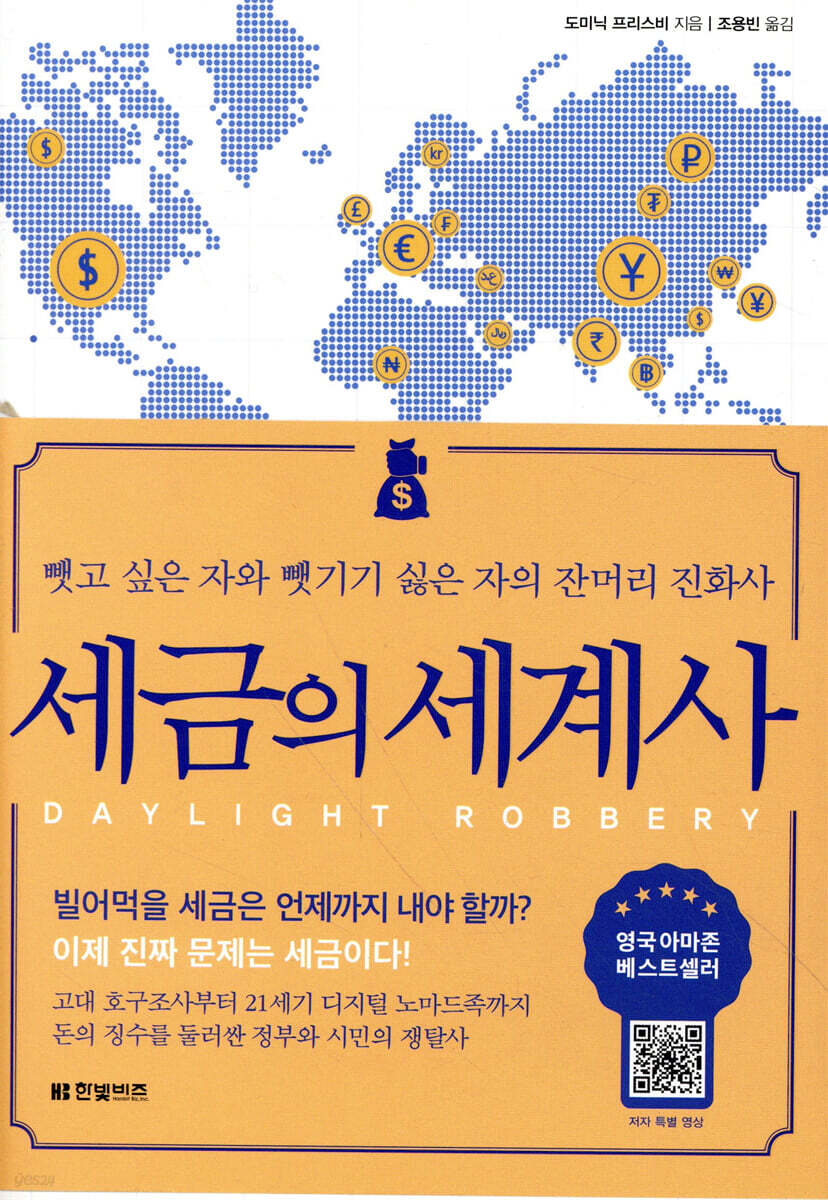
The World History of Taxes
 |
Description
Book Introduction
From ancient Mesopotamia to Lincoln, Hitler, and the present government. The History of Money from a Taxation Perspective Genghis Khan, the greatest conqueror of mankind who built a great empire spanning the East and West, attempted to exterminate all the inhabitants of the Jin Dynasty after conquering it, just as he had done in other conquered territories. At this time, the staff member next to him advised, “Dead farmers cannot pay taxes,” and it is said that this saved the lives of many Chinese people. Thus, taxes have been a major business of all conquerors around the world, then and now. The story of Genghis Khan is just one example of how important taxes are to state power. Taxes have always been involved in every important event in human history. Jesus was born in Bethlehem because Mary and Joseph went there to file their taxes, and a new tax-paying working class emerged because the Black Death effectively destroyed the medieval feudal system. Women's suffrage was also granted during World War I because women were brought into factories and could pay income tax. From the Pyramids to the White House, many of humanity's most important structures could not have been built without taxes. The Great Wall of China was built to prevent invasion by foreign enemies, but it also served the purpose of imposing taxes on goods traveling into and out of China along the Silk Road. Taxes always appear in the process of rebuilding after war, disaster, and calamity. Without taxes, humans would never have set foot on the moon. Dominic Frisby, a British financial expert and author of this book, asserts that taxes are the first reason that has influenced human history, and emphasizes looking at the world through the eyes of taxes. Because taxes determine the character of civilization. In short, the tax system determines the fate of a nation: its people's prosperity and poverty, freedom and oppression, satisfaction and dissatisfaction. The author demonstrates this through numerous historical examples, from ancient Mesopotamian civilization to today's digital economy. From world-historical events that shifted the paradigm of our times to the smallest changes we haven't even noticed, we will clearly see that all of human history moves within the tax system. |
- You can preview some of the book's contents.
Preview
index
Chapter 1: The Sunshine Thief
Chapter 2: The Secret of Hong Kong's Growth
Chapter 3: Why the sudden tax?
Chapter 4: The Origin of Taxes
Chapter 5: Religion and Taxes
Chapter 6: The Magna Carta Born from Tax Resistance
Chapter 7: The Black Death That Changed the Tax Structure
Chapter 8: Taxation and the Formation of the Modern State
Chapter 9: The Napoleonic Wars and the Income Tax
Chapter 10: The Real Reason for the Civil War
Chapter 11: The Rise of Big Government and the Early 20th Century
Chapter 12: World War II and Taxes
Chapter 13: 20th Century Taxes: More and Easier to Collect
Chapter 14: Debt and Inflation Are Hidden Taxes
Chapter 15: The Future of Jobs and Taxes
Chapter 16: Cryptocurrencies Are the IRS's Nightmare
Chapter 17: Escape from Digital
Chapter 18: Data: The Tax Authority's New Friend
Chapter 19: The System Collapses
Chapter 20: Changing Taxes Changes the World
Acknowledgements
References
main
Chapter 2: The Secret of Hong Kong's Growth
Chapter 3: Why the sudden tax?
Chapter 4: The Origin of Taxes
Chapter 5: Religion and Taxes
Chapter 6: The Magna Carta Born from Tax Resistance
Chapter 7: The Black Death That Changed the Tax Structure
Chapter 8: Taxation and the Formation of the Modern State
Chapter 9: The Napoleonic Wars and the Income Tax
Chapter 10: The Real Reason for the Civil War
Chapter 11: The Rise of Big Government and the Early 20th Century
Chapter 12: World War II and Taxes
Chapter 13: 20th Century Taxes: More and Easier to Collect
Chapter 14: Debt and Inflation Are Hidden Taxes
Chapter 15: The Future of Jobs and Taxes
Chapter 16: Cryptocurrencies Are the IRS's Nightmare
Chapter 17: Escape from Digital
Chapter 18: Data: The Tax Authority's New Friend
Chapter 19: The System Collapses
Chapter 20: Changing Taxes Changes the World
Acknowledgements
References
main
Detailed image

Into the book
By the 19th century, opposition to window taxes had erupted everywhere.
“The expression ‘free as air’ is no longer true.
“Since the window tax was imposed, neither air nor light is free,” Charles Dickens fumed.
The protests continued for decades.
Leaflets were distributed, songs were made and sung, and speeches against the movement were given.
In 1845, income tax was reintroduced, and soon after, Prime Minister Robert Peel abolished the glass tax.
But the window tax was left behind.
It was not until 1850 that a bill to repeal the window tax was introduced in Parliament.
According to legend, lawmakers called the window tax a "daylight robbery" during the debate.
---From "Chapter 1: The Thief of Sunlight"
Today, taxes are withheld at source and collected forcibly without our knowledge.
Some people say that when I say this, I am not forcing them to take it.
But when I say forced, I mean that if you don't pay your taxes, you become a criminal.
But in many cases, there is no chance of even going to prison.
Because taxes are withheld at source.
So comedian Chris Rock quipped:
“You don’t pay taxes, the government takes them.
As soon as I get my paycheck, it disappears the next moment.
“This is not extortion, this is robbery.”
---From "Chapter 3: Why the sudden tax?"
John Hampden's creed against Charles I became the rallying cry of the American Revolution.
Their slogans still resonate today.
“No taxation without representation.” Thirteen states rose up against taxes imposed by the British monarch.
Their victory gave birth to the United States of America, the world's most powerful nation today.
---From “Chapter 8: Taxation and the Formation of the Modern State”
When William Forster of the Liberal Party said in the House of Commons that slavery was the cause of the Civil War, he said, "No.
Opposition poured in, saying, “It’s because of the tariffs!”
Lincoln did not fight the Civil War to abolish slavery.
As late as August 1862, Lincoln was saying, “The supreme object of the Civil War is to save the Union.”
“The object of this war is not the preservation or abolition of slavery.
If I could save the Union without freeing a single slave, I would do it.
If the Union could be saved only by freeing all the slaves, then so be it.
If I had to free some and leave others alone, I would do it.” The Emancipation Proclamation, which freed the slaves in the South, was issued belatedly in January 1863, a move Lincoln made “when he was desperate and felt he had run out of cards to play and would lose unless he changed his strategy.”
---From "Chapter 10: The Real Reason for the Civil War"
The bigger the war, the bigger the tax burden.
World War II left the world burdened with more taxes.
As U.S. President Franklin Roosevelt said, “War costs money.” The United States covered 22 percent of the costs of World War I through taxes.
The rest was filled by borrowing and issuing currency.
After the war, most Americans were still exempt from income tax.
That was changed to the Income Tax Act of 1942.
The number of people affected increased from 13 million to over 50 million.
Suddenly, 75 percent of the population found themselves having to pay income tax.
Time lamented that this tax “would take more money from more people than any other taxpayer in American history.”
---From Chapter 12, World War II and Taxes
After World War II, government spending decreased, but taxes never returned to pre-war levels.
No, it didn't even come close to a similar level.
Rather, it was stuck at a high level.
Income tax has now become a part of the 20th century for everyone.
The war broke the tax genie out of the bottle and no one put it back.
The British Institute for Fiscal Policy calls this the ratchet effect.
In peacetime, politicians are reluctant to raise taxes for fear of affecting their re-election chances, but when war breaks out, the situation changes, and once new taxes and high rates are introduced, they are unlikely to be removed.
---From "Chapter 13: 20th Century Taxes: Collecting More and Easier"
The repayment of the debts incurred now will fall on future generations who have not yet been born.
Even as their debts pile up, they have no say through voting.
They must repay the debts they incurred today with their own taxes.
If they cannot repay their debt, they will have to bear the price.
Debt is a tax carried forward to the future, or, to borrow a phrase from the American Revolutionary War, taxation without representation.
---From "Chapter 14: Debt and Inflation Are Hidden Taxes"
Among the new technologies that threaten government revenue, cryptocurrency technology has the greatest impact.
The realization of a large government in the 20th century was largely due to the existence of fiat currency.
By being able to control the amount of money at will, the government gains immense power.
If the government needs money, it just prints it.
But non-governmental currencies cannot do this.
Since there is no control, there is no way to impose an inflation tax by lowering the value of the currency.
Cryptocurrencies are not only difficult to report on taxes, but withholding taxes, value-added tax, sales tax, and transaction taxes will become increasingly difficult to collect and monitor.
Tax collection will become more difficult, especially as alternative currencies become more widespread online and overseas.
---From "Chapter 16: Cryptocurrency is the IRS's Nightmare"
Taxing technology will only become more complex.
Because tax laws have not kept pace with changes in the value chain, there are many cases where people cannot pay their taxes even if they want to.
If servers are located in multiple locations and data is transmitted to distant locations, where should profits be attributed? Where should costs be accounted for? Where should IP be located? Where should added value be considered created? To which country should value-added tax be paid? Is there a possibility of double taxation?
---From "Chapter 17: Escape from Digital"
The ideological conflict between big government and small government, authoritarianism and liberalism, smokestack industries and IT industries, high taxes and low taxes will persist.
There is no way that either side will fall out first.
However, countries that choose fair and simple tax systems with low tax rates will prosper.
Where taxes are low and citizens are most free, the greatest inventions, reforms, and resulting wealth will be generated.
History has proven this, and the future will be no different.
“The expression ‘free as air’ is no longer true.
“Since the window tax was imposed, neither air nor light is free,” Charles Dickens fumed.
The protests continued for decades.
Leaflets were distributed, songs were made and sung, and speeches against the movement were given.
In 1845, income tax was reintroduced, and soon after, Prime Minister Robert Peel abolished the glass tax.
But the window tax was left behind.
It was not until 1850 that a bill to repeal the window tax was introduced in Parliament.
According to legend, lawmakers called the window tax a "daylight robbery" during the debate.
---From "Chapter 1: The Thief of Sunlight"
Today, taxes are withheld at source and collected forcibly without our knowledge.
Some people say that when I say this, I am not forcing them to take it.
But when I say forced, I mean that if you don't pay your taxes, you become a criminal.
But in many cases, there is no chance of even going to prison.
Because taxes are withheld at source.
So comedian Chris Rock quipped:
“You don’t pay taxes, the government takes them.
As soon as I get my paycheck, it disappears the next moment.
“This is not extortion, this is robbery.”
---From "Chapter 3: Why the sudden tax?"
John Hampden's creed against Charles I became the rallying cry of the American Revolution.
Their slogans still resonate today.
“No taxation without representation.” Thirteen states rose up against taxes imposed by the British monarch.
Their victory gave birth to the United States of America, the world's most powerful nation today.
---From “Chapter 8: Taxation and the Formation of the Modern State”
When William Forster of the Liberal Party said in the House of Commons that slavery was the cause of the Civil War, he said, "No.
Opposition poured in, saying, “It’s because of the tariffs!”
Lincoln did not fight the Civil War to abolish slavery.
As late as August 1862, Lincoln was saying, “The supreme object of the Civil War is to save the Union.”
“The object of this war is not the preservation or abolition of slavery.
If I could save the Union without freeing a single slave, I would do it.
If the Union could be saved only by freeing all the slaves, then so be it.
If I had to free some and leave others alone, I would do it.” The Emancipation Proclamation, which freed the slaves in the South, was issued belatedly in January 1863, a move Lincoln made “when he was desperate and felt he had run out of cards to play and would lose unless he changed his strategy.”
---From "Chapter 10: The Real Reason for the Civil War"
The bigger the war, the bigger the tax burden.
World War II left the world burdened with more taxes.
As U.S. President Franklin Roosevelt said, “War costs money.” The United States covered 22 percent of the costs of World War I through taxes.
The rest was filled by borrowing and issuing currency.
After the war, most Americans were still exempt from income tax.
That was changed to the Income Tax Act of 1942.
The number of people affected increased from 13 million to over 50 million.
Suddenly, 75 percent of the population found themselves having to pay income tax.
Time lamented that this tax “would take more money from more people than any other taxpayer in American history.”
---From Chapter 12, World War II and Taxes
After World War II, government spending decreased, but taxes never returned to pre-war levels.
No, it didn't even come close to a similar level.
Rather, it was stuck at a high level.
Income tax has now become a part of the 20th century for everyone.
The war broke the tax genie out of the bottle and no one put it back.
The British Institute for Fiscal Policy calls this the ratchet effect.
In peacetime, politicians are reluctant to raise taxes for fear of affecting their re-election chances, but when war breaks out, the situation changes, and once new taxes and high rates are introduced, they are unlikely to be removed.
---From "Chapter 13: 20th Century Taxes: Collecting More and Easier"
The repayment of the debts incurred now will fall on future generations who have not yet been born.
Even as their debts pile up, they have no say through voting.
They must repay the debts they incurred today with their own taxes.
If they cannot repay their debt, they will have to bear the price.
Debt is a tax carried forward to the future, or, to borrow a phrase from the American Revolutionary War, taxation without representation.
---From "Chapter 14: Debt and Inflation Are Hidden Taxes"
Among the new technologies that threaten government revenue, cryptocurrency technology has the greatest impact.
The realization of a large government in the 20th century was largely due to the existence of fiat currency.
By being able to control the amount of money at will, the government gains immense power.
If the government needs money, it just prints it.
But non-governmental currencies cannot do this.
Since there is no control, there is no way to impose an inflation tax by lowering the value of the currency.
Cryptocurrencies are not only difficult to report on taxes, but withholding taxes, value-added tax, sales tax, and transaction taxes will become increasingly difficult to collect and monitor.
Tax collection will become more difficult, especially as alternative currencies become more widespread online and overseas.
---From "Chapter 16: Cryptocurrency is the IRS's Nightmare"
Taxing technology will only become more complex.
Because tax laws have not kept pace with changes in the value chain, there are many cases where people cannot pay their taxes even if they want to.
If servers are located in multiple locations and data is transmitted to distant locations, where should profits be attributed? Where should costs be accounted for? Where should IP be located? Where should added value be considered created? To which country should value-added tax be paid? Is there a possibility of double taxation?
---From "Chapter 17: Escape from Digital"
The ideological conflict between big government and small government, authoritarianism and liberalism, smokestack industries and IT industries, high taxes and low taxes will persist.
There is no way that either side will fall out first.
However, countries that choose fair and simple tax systems with low tax rates will prosper.
Where taxes are low and citizens are most free, the greatest inventions, reforms, and resulting wealth will be generated.
History has proven this, and the future will be no different.
---From "Chapter 19: The System Collapses"
Publisher's Review
The history of human civilization is the history of taxes.
War, religion, revolution… Taxes were at the heart of every event.
Fort Sumter on the east coast of the United States, April 1861.
This was a key point for collecting customs duties.
Colonel Baldwin makes a final plea to the President.
“Your Majesty, for the sake of peace, please withdraw your troops from the fortress.
"Then you'll have more support than anyone in American history." "What about tariff revenue?" "How much do you think tariff revenue will be? You need to decide quickly."
“Will you be the savior of this country, or will you leave a stain on history…?”
But the president ignores the colonel's pleas and chooses war to raise tariff revenue.
That's Abraham Lincoln.
Lincoln sent supply ships to Fort Sumter, drawing Confederate artillery fire, and as we know, America was plunged into bloodshed for the next four years.
The emancipation of slaves was just one of the differing opinions between the North and the South, and the American Civil War was no different from civil wars or large-scale rebellions in other countries.
This happened because of the unequal taxes between the South and the North.
As such, the issue of taxes always exists at the heart of every war.
From the ancient Mesopotamian wars to the Iraq wars, the costs of all wars have been financed by taxes.
The goal of every conqueror, from Alexander the Great to Napoleon and the conquerors who followed, was to seize the land, labor, products, and profits that became the source of revenue.
All revolutions are the same.
At the heart of it all has always been unequal taxation.
The slogan of the American Revolution was “No taxes without representation,” and the Russian Revolution was a revolution started by peasants who could not stand the unfair taxes imposed by the emperor.
Religion is also like that.
The Hebrews, who escaped to the Sinai Peninsula to escape the bondage of punitive taxes and forced labor, are recorded as the first refugees in history to escape from taxes, and the tithe is a part of the history of Christianity.
The rapid spread of Islam in the 7th and 8th centuries can also be explained by the Islamic tax system.
Because he had to choose between death, taxes, and Islam.
In addition, this book shows how taxes are intertwined with history and have always been a part of human civilization, including the secret story of the birth of the Magna Carta, the foundation of the British Constitution; the income tax that determined the outcome of World War II; the Nazis' discriminatory tax policy against Jews; and Britain's collapse due to debt after World War II.
The 21st Century Digital Age: The Collapse of National Power
The future is determined by taxes!
Taxes are power.
So the moment tax revenue disappears, the king, the emperor, or the government loses power.
From the kings of the ancient Sumerian Empire to today's democratic welfare states, this law has always been applied.
Since World War II, many countries have promoted the welfare state model by increasing tax revenue and expanding the government's role beyond traditional areas such as security, order maintenance, and social infrastructure to include education and public health.
In short, taxes are like the fuel that runs a country.
However, in the 21st century, which is characterized by the digital economy, this fuel system is collapsing.
This is because the traditional employer-employee relationship, which was relatively easy to tax, is disappearing and the gig economy is emerging.
With the rise of digital nomads and the gig economy, withholding taxes has become more difficult and the potential for tax evasion has increased.
Opportunities to collect income taxes are disappearing, and artificial intelligence, machine learning, and robots are making this bad news even worse.
There is a huge hole in the government's finances.
Furthermore, the emergence of cryptocurrencies, which make it difficult to impose and monitor tax reporting, withholding taxes, value-added tax, and transaction taxes, is further fueling this trend.
As the author says, cryptocurrencies have now become a nightmare for the IRS.
Moreover, as seen in the tax war between the EU and US IT giants such as Amazon and Apple, online platform companies are dealing a decisive blow to the government's declining revenue.
Many countries around the world are currently experiencing financial difficulties.
As national debt exceeds GDP and globalization and digitalization increasingly erase the meaning of borders, tax collection will become increasingly difficult.
In particular, technological advancements are making the government's role obsolete in many sectors.
The model of governments providing services like welfare, education, and healthcare is at risk, and the state as we know it could disappear.
At the heart of all these changes is tax.
What happens next will also be determined by taxes.
See the world through the eyes of taxes
Changing taxes changes the world.
The IRS building in Washington, D.C., has the phrase “We live in a civilized society thanks to taxes.”
But do we truly live in a civilized society thanks to taxes? How much do we think about and discuss taxes? Most people likely simply pay the amount listed on their bills, assuming the taxes withheld without their knowledge are used for welfare programs like education and healthcare. Few would question the legitimacy of taxes.
Author Dominic Frisbee emphasizes that as everything shifts from the 20th century to the 21st century, from the analog to the digital economy, the issue of taxation must be brought to the forefront again.
“Taxes are how we create the world our children will live in.
History repeatedly shows the dire consequences of out-of-date taxes, born of foolish and flawed thinking.
Now we need a new and better tax system fit for the 21st century.
Tax reform is one of the few ways politicians can truly change the world.
If you change taxes, the world will change.
“Taxes are the starting point.”
When we look at the world of the present, past, and future through the lens of taxes, a clear picture emerges.
Why things are like this now, why things happened in the past, what the future will be like, and even how we can change it.
If you read “A World History of Taxes,” the world will look completely different.
War, religion, revolution… Taxes were at the heart of every event.
Fort Sumter on the east coast of the United States, April 1861.
This was a key point for collecting customs duties.
Colonel Baldwin makes a final plea to the President.
“Your Majesty, for the sake of peace, please withdraw your troops from the fortress.
"Then you'll have more support than anyone in American history." "What about tariff revenue?" "How much do you think tariff revenue will be? You need to decide quickly."
“Will you be the savior of this country, or will you leave a stain on history…?”
But the president ignores the colonel's pleas and chooses war to raise tariff revenue.
That's Abraham Lincoln.
Lincoln sent supply ships to Fort Sumter, drawing Confederate artillery fire, and as we know, America was plunged into bloodshed for the next four years.
The emancipation of slaves was just one of the differing opinions between the North and the South, and the American Civil War was no different from civil wars or large-scale rebellions in other countries.
This happened because of the unequal taxes between the South and the North.
As such, the issue of taxes always exists at the heart of every war.
From the ancient Mesopotamian wars to the Iraq wars, the costs of all wars have been financed by taxes.
The goal of every conqueror, from Alexander the Great to Napoleon and the conquerors who followed, was to seize the land, labor, products, and profits that became the source of revenue.
All revolutions are the same.
At the heart of it all has always been unequal taxation.
The slogan of the American Revolution was “No taxes without representation,” and the Russian Revolution was a revolution started by peasants who could not stand the unfair taxes imposed by the emperor.
Religion is also like that.
The Hebrews, who escaped to the Sinai Peninsula to escape the bondage of punitive taxes and forced labor, are recorded as the first refugees in history to escape from taxes, and the tithe is a part of the history of Christianity.
The rapid spread of Islam in the 7th and 8th centuries can also be explained by the Islamic tax system.
Because he had to choose between death, taxes, and Islam.
In addition, this book shows how taxes are intertwined with history and have always been a part of human civilization, including the secret story of the birth of the Magna Carta, the foundation of the British Constitution; the income tax that determined the outcome of World War II; the Nazis' discriminatory tax policy against Jews; and Britain's collapse due to debt after World War II.
The 21st Century Digital Age: The Collapse of National Power
The future is determined by taxes!
Taxes are power.
So the moment tax revenue disappears, the king, the emperor, or the government loses power.
From the kings of the ancient Sumerian Empire to today's democratic welfare states, this law has always been applied.
Since World War II, many countries have promoted the welfare state model by increasing tax revenue and expanding the government's role beyond traditional areas such as security, order maintenance, and social infrastructure to include education and public health.
In short, taxes are like the fuel that runs a country.
However, in the 21st century, which is characterized by the digital economy, this fuel system is collapsing.
This is because the traditional employer-employee relationship, which was relatively easy to tax, is disappearing and the gig economy is emerging.
With the rise of digital nomads and the gig economy, withholding taxes has become more difficult and the potential for tax evasion has increased.
Opportunities to collect income taxes are disappearing, and artificial intelligence, machine learning, and robots are making this bad news even worse.
There is a huge hole in the government's finances.
Furthermore, the emergence of cryptocurrencies, which make it difficult to impose and monitor tax reporting, withholding taxes, value-added tax, and transaction taxes, is further fueling this trend.
As the author says, cryptocurrencies have now become a nightmare for the IRS.
Moreover, as seen in the tax war between the EU and US IT giants such as Amazon and Apple, online platform companies are dealing a decisive blow to the government's declining revenue.
Many countries around the world are currently experiencing financial difficulties.
As national debt exceeds GDP and globalization and digitalization increasingly erase the meaning of borders, tax collection will become increasingly difficult.
In particular, technological advancements are making the government's role obsolete in many sectors.
The model of governments providing services like welfare, education, and healthcare is at risk, and the state as we know it could disappear.
At the heart of all these changes is tax.
What happens next will also be determined by taxes.
See the world through the eyes of taxes
Changing taxes changes the world.
The IRS building in Washington, D.C., has the phrase “We live in a civilized society thanks to taxes.”
But do we truly live in a civilized society thanks to taxes? How much do we think about and discuss taxes? Most people likely simply pay the amount listed on their bills, assuming the taxes withheld without their knowledge are used for welfare programs like education and healthcare. Few would question the legitimacy of taxes.
Author Dominic Frisbee emphasizes that as everything shifts from the 20th century to the 21st century, from the analog to the digital economy, the issue of taxation must be brought to the forefront again.
“Taxes are how we create the world our children will live in.
History repeatedly shows the dire consequences of out-of-date taxes, born of foolish and flawed thinking.
Now we need a new and better tax system fit for the 21st century.
Tax reform is one of the few ways politicians can truly change the world.
If you change taxes, the world will change.
“Taxes are the starting point.”
When we look at the world of the present, past, and future through the lens of taxes, a clear picture emerges.
Why things are like this now, why things happened in the past, what the future will be like, and even how we can change it.
If you read “A World History of Taxes,” the world will look completely different.
GOODS SPECIFICS
- Publication date: March 15, 2022
- Page count, weight, size: 360 pages | 540g | 148*215*30mm
- ISBN13: 9791157845651
- ISBN10: 1157845657
You may also like
카테고리
korean


korean

![GQ KOREA Mark (Monthly): December [2025]](http://librairie.coreenne.fr/cdn/shop/files/8ef265dbbfbf186523ed75ba7319009d.jpg?v=1765340328&width=3840)


