

Genius Report
 |
Description
Book Introduction
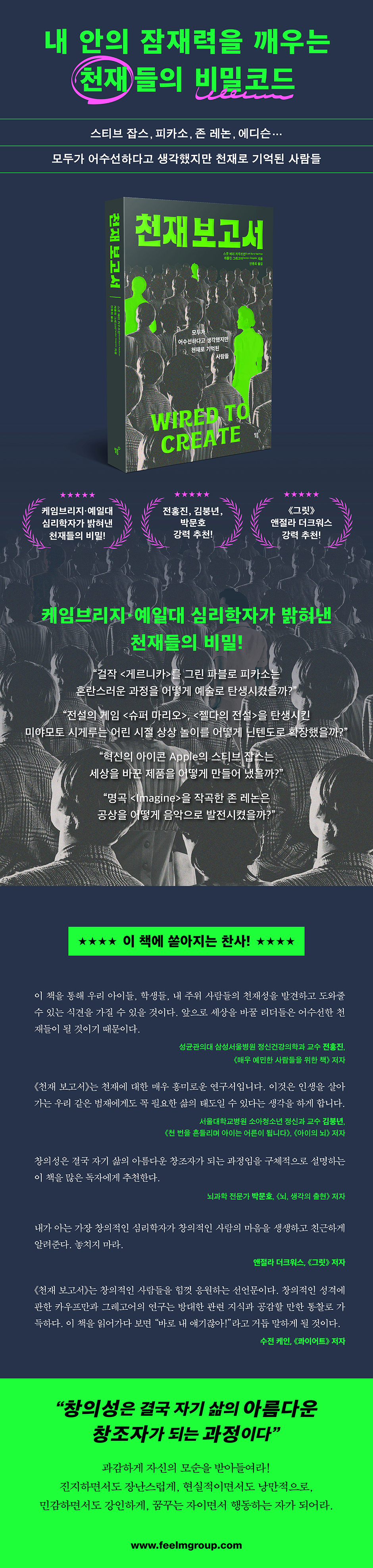
★★★ Highly recommended by Professor Jeon Hong-jin, Professor Kim Boong-nyeon, and brain science expert Park Moon-ho!
★★★ 『Grit』 by Angela Duckworth, 『Quiet』 by Susan Cain, 『The Laws of Power』 by Robert Greene, etc.
Bestselling authors continue to praise "Genius Report"!
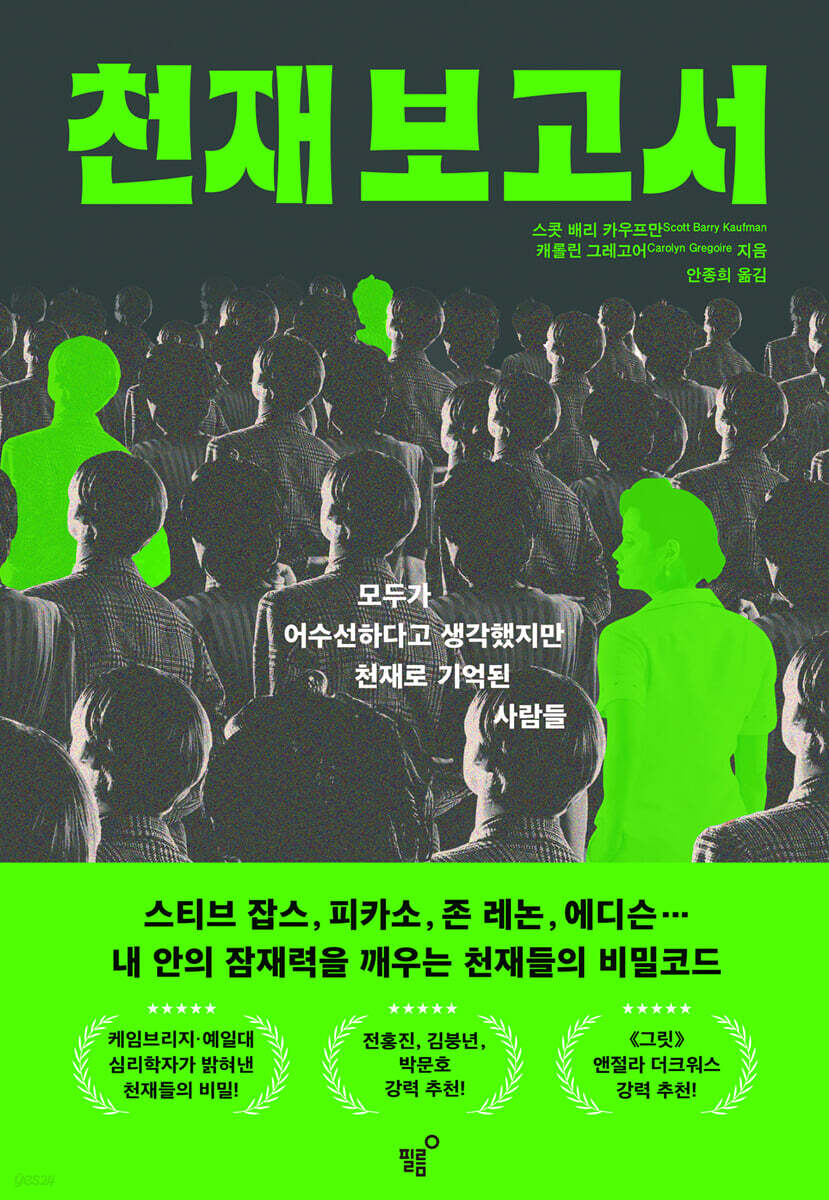
People who everyone thought were messy but were remembered as geniuses
The secrets of geniuses revealed by Cambridge and Yale psychologists!
The Genius Report is based on groundbreaking research by Cambridge and Yale psychologist Scott Barry Kaufman and a critically acclaimed article by journalist Carolyn Gregoire in the Huffington Post.
This book talks about the '10 Secret Codes of Genius' that helped awaken their potential in the midst of complex and chaotic minds through numerous examples of historically famous geniuses such as Pablo Picasso, Frida Kahlo, Marcel Proust, David Foster Wallace, Thomas Edison, Josephine Baker, John Lennon, Michael Jackson, Thom Yorke, Josh Waitzkin, and Shigeru Miyamoto.
Professor Jeon Hong-jin of the Department of Psychiatry said, “True geniuses are creative people who think differently from others and solve difficult problems.
He recommended this book, saying, “The leaders who will change the world in the future will be the messy geniuses,” and Professor Kim Boong-nyeon of Child and Adolescent Psychiatry said, “The elements introduced here are the keys to understanding the detailed mind of a genius.
At the same time, this book was recommended as “an attitude toward life that is essential for ordinary people like us who live our lives,” and it emphasized that the direction we should take in the future is not simple and uniform thinking and education, but rather focusing on awakening and developing the unique potential within ourselves.
As Dr. Park Moon-ho recommends, “Creativity is ultimately the process of becoming a beautiful creator of your own life.” Through the 10 keywords of geniuses that awaken potential contained in this book, we will discover not only the secrets of geniuses’ creativity, but also the meaning of life, humanity, and humanistic insights, and at the same time, we will be able to face the true self that lies deep within and be reborn as a beautiful creator of our own life.
★★★ 『Grit』 by Angela Duckworth, 『Quiet』 by Susan Cain, 『The Laws of Power』 by Robert Greene, etc.
Bestselling authors continue to praise "Genius Report"!
People who everyone thought were messy but were remembered as geniuses
The secrets of geniuses revealed by Cambridge and Yale psychologists!
The Genius Report is based on groundbreaking research by Cambridge and Yale psychologist Scott Barry Kaufman and a critically acclaimed article by journalist Carolyn Gregoire in the Huffington Post.
This book talks about the '10 Secret Codes of Genius' that helped awaken their potential in the midst of complex and chaotic minds through numerous examples of historically famous geniuses such as Pablo Picasso, Frida Kahlo, Marcel Proust, David Foster Wallace, Thomas Edison, Josephine Baker, John Lennon, Michael Jackson, Thom Yorke, Josh Waitzkin, and Shigeru Miyamoto.
Professor Jeon Hong-jin of the Department of Psychiatry said, “True geniuses are creative people who think differently from others and solve difficult problems.
He recommended this book, saying, “The leaders who will change the world in the future will be the messy geniuses,” and Professor Kim Boong-nyeon of Child and Adolescent Psychiatry said, “The elements introduced here are the keys to understanding the detailed mind of a genius.
At the same time, this book was recommended as “an attitude toward life that is essential for ordinary people like us who live our lives,” and it emphasized that the direction we should take in the future is not simple and uniform thinking and education, but rather focusing on awakening and developing the unique potential within ourselves.
As Dr. Park Moon-ho recommends, “Creativity is ultimately the process of becoming a beautiful creator of your own life.” Through the 10 keywords of geniuses that awaken potential contained in this book, we will discover not only the secrets of geniuses’ creativity, but also the meaning of life, humanity, and humanistic insights, and at the same time, we will be able to face the true self that lies deep within and be reborn as a beautiful creator of our own life.
- You can preview some of the book's contents.
Preview
index
Recommendation
Praise for this book
introduction
Entering: A Disturbed Mind
10 Distinctive Characteristics of Highly Creative People
Chapter 1: Imaginary Play
Chapter 2 Passion
Chapter 3 Fantasy
Chapter 4: Solitude
Chapter 5: Intuition
Chapter 6 Openness to Experience
Chapter 7 Mindfulness
Chapter 8 Sensitivity
Chapter 9: Turning Adversity into Beneficial Opportunity
Chapter 10: Thinking Differently
Acknowledgements
References
Praise for this book
introduction
Entering: A Disturbed Mind
10 Distinctive Characteristics of Highly Creative People
Chapter 1: Imaginary Play
Chapter 2 Passion
Chapter 3 Fantasy
Chapter 4: Solitude
Chapter 5: Intuition
Chapter 6 Openness to Experience
Chapter 7 Mindfulness
Chapter 8 Sensitivity
Chapter 9: Turning Adversity into Beneficial Opportunity
Chapter 10: Thinking Differently
Acknowledgements
References
Detailed image
Into the book
In creative work, there are moments when it should be serious and moments when it should be enjoyed like play.
In many cases, the best results come from a combination of serious effort and relaxed ease.
The false dichotomy of play and work is not only misleading but also destructive.
--- From "Chapter 1: Imagination Play"
According to Winner, talent involves a "fierce passion to become a master" of an individual's chosen activity or medium—a focused and sustained drive toward exceptional achievement.
While this kind of drive is important, it doesn't replace ordinary, everyday diligence.
The geniuses Winner studied worked with incredible diligence, and it was this inner drive that fueled their relentless efforts.
--- From "Chapter 2: Passion"
Although intelligence, especially in the scientific field, is often thought of as a capacity for careful reasoning and analysis (capabilities that can be measured using IQ tests), Hoffman's findings highlight a very different and often underappreciated intellectual power: the power of the subconscious mind.
Years of experience synthesizing chemicals had built up a deep storehouse of knowledge in Hoffmann's mind, and his consciousness had become intimately familiar with the subtle properties and variations of chemicals.
Rational and conventional thinking told me the new compound was completely useless, but another voice in my heart told me to look further, and it turned out to be right.
--- From "Chapter 5 Intuition"
Dopamine, which is important for extraversion, is also released through neurites in brain regions strongly associated with numerous other cognitive aspects.
People high in openness to experience are energized by the possibility of discovering new information, not by the possibility of having their needs rewarded.
What excites them most is the thrill they feel when exploring knowledge.
--- From “Chapter 6: Openness to Experience”
Creative people are willing to accept not only the rejection of others, but also the risk of their own failure.
The conventional wisdom that creative geniuses will consistently produce great works is completely wrong.
In reality, that is not the case.
If we systematically analyze the careers of so-called geniuses, we find that the quality of their output is not very consistent, that many of their outputs are flawed from the outset, and that some of their outputs contain good ideas.
In many cases, the best results come from a combination of serious effort and relaxed ease.
The false dichotomy of play and work is not only misleading but also destructive.
--- From "Chapter 1: Imagination Play"
According to Winner, talent involves a "fierce passion to become a master" of an individual's chosen activity or medium—a focused and sustained drive toward exceptional achievement.
While this kind of drive is important, it doesn't replace ordinary, everyday diligence.
The geniuses Winner studied worked with incredible diligence, and it was this inner drive that fueled their relentless efforts.
--- From "Chapter 2: Passion"
Although intelligence, especially in the scientific field, is often thought of as a capacity for careful reasoning and analysis (capabilities that can be measured using IQ tests), Hoffman's findings highlight a very different and often underappreciated intellectual power: the power of the subconscious mind.
Years of experience synthesizing chemicals had built up a deep storehouse of knowledge in Hoffmann's mind, and his consciousness had become intimately familiar with the subtle properties and variations of chemicals.
Rational and conventional thinking told me the new compound was completely useless, but another voice in my heart told me to look further, and it turned out to be right.
--- From "Chapter 5 Intuition"
Dopamine, which is important for extraversion, is also released through neurites in brain regions strongly associated with numerous other cognitive aspects.
People high in openness to experience are energized by the possibility of discovering new information, not by the possibility of having their needs rewarded.
What excites them most is the thrill they feel when exploring knowledge.
--- From “Chapter 6: Openness to Experience”
Creative people are willing to accept not only the rejection of others, but also the risk of their own failure.
The conventional wisdom that creative geniuses will consistently produce great works is completely wrong.
In reality, that is not the case.
If we systematically analyze the careers of so-called geniuses, we find that the quality of their output is not very consistent, that many of their outputs are flawed from the outset, and that some of their outputs contain good ideas.
--- From "Chapter 10 Thinking Differently"
Publisher's Review
“Is genius born?”
Steve Jobs, Picasso, John Lennon, Edison...
The Secret Code of Geniuses that Unlocks Your Potential
Are the extraordinary abilities of creative people innate, or do they stem from life experiences and inner habits? Co-authored by psychologist Scott Barry Kaufman and journalist Carolyn Gregoire, "The Genius Report" explores a wide range of case studies and research findings from historically renowned geniuses, including Pablo Picasso, Frida Kahlo, Marcel Proust, David Foster Wallace, Thomas Edison, Josephine Baker, John Lennon, Michael Jackson, Thom Yorke, Josh Waitzkin, and Shigeru Miyamoto. This book reveals the secrets of creative thinking through ten key words they possess, and furthermore, offers guidance on how to discover and develop your own latent creative talent.
“How did Pablo Picasso transform a chaotic process into a masterpiece?” Picasso’s creative process was a typical example of the “contradictory thinking” emphasized in this book.
Picasso created dozens of sketches to complete his most famous work, Guernica.
Each sketch was a process of exploring countless ideas and finding their essence.
This process can be seen as an example of what the book calls 'immersion'.
Picasso did not simply rely on momentary inspiration, but completed his masterpieces through continuous exploration.
“How did Shigeru Miyamoto expand his childhood imaginative play into Nintendo?” Shigeru Miyamoto, who built Nintendo into a global brand, drew on his childhood curiosity for nature and cave exploration to create some of his most iconic games, The Legend of Zelda and Super Mario.
As this book explains, creativity often begins with play and curiosity.
Shigeru Miyamoto's case shows that creativity comes not from mere technical ability, but from play, curiosity, exploration, and immersion.
Play and curiosity are not just fun, they are also sources of creativity.
“How did Steve Jobs create products that changed the world?” Steve Jobs’ work offers important lessons about creativity.
He transformed complex technologies into simple and beautiful designs, revolutionizing people's lives.
This process is deeply connected to several key elements of creativity discussed in the Genius Report, particularly flow and intuition.
Jobs emphasized intuition as “a force more powerful than intellect.”
The one book that will turn your distraction into a weapon!
“Creativity is ultimately about one’s own life.
“It is the process of becoming a beautiful creator.”
"Genius Report" provides a wealth of in-depth knowledge about creativity, while also offering insights into the mechanisms of brain functions like dopamine and practical applications for our lives.
This book is not just about creativity.
Spanning ancient and modern times, science and philosophy, art and psychology, it presents detailed case studies and research findings on how the latent creativity of geniuses was unleashed, constantly posing questions to us.
Creative people, often called geniuses, are not afraid to apply a wide range of skills, behaviors, and mindsets to a given situation, combining them in new and unusual ways to produce amazing ideas and results.
This book illuminates the bewildering yet fascinating side of the creative mind, ultimately encouraging us to look deeper, understand ourselves, and express ourselves.
Ultimately, creativity is the process of awakening the potential within oneself and becoming a beautiful creator of life, and the key to creative achievement and creative satisfaction comes from the ability to accurately understand one's own multifaceted and complex characteristics.
I hope that through this book, you will be able to fill your intellectual and inspirational void, while also awakening the creativity and potential hidden within you, transforming them into your own unique weapon.
The secret codes of geniuses contained in this book will be the key to that.
"Embrace your own contradictions boldly! Be serious yet playful, realistic yet romantic, sensitive yet strong, a dreamer yet a doer."
Steve Jobs, Picasso, John Lennon, Edison...
The Secret Code of Geniuses that Unlocks Your Potential
Are the extraordinary abilities of creative people innate, or do they stem from life experiences and inner habits? Co-authored by psychologist Scott Barry Kaufman and journalist Carolyn Gregoire, "The Genius Report" explores a wide range of case studies and research findings from historically renowned geniuses, including Pablo Picasso, Frida Kahlo, Marcel Proust, David Foster Wallace, Thomas Edison, Josephine Baker, John Lennon, Michael Jackson, Thom Yorke, Josh Waitzkin, and Shigeru Miyamoto. This book reveals the secrets of creative thinking through ten key words they possess, and furthermore, offers guidance on how to discover and develop your own latent creative talent.
“How did Pablo Picasso transform a chaotic process into a masterpiece?” Picasso’s creative process was a typical example of the “contradictory thinking” emphasized in this book.
Picasso created dozens of sketches to complete his most famous work, Guernica.
Each sketch was a process of exploring countless ideas and finding their essence.
This process can be seen as an example of what the book calls 'immersion'.
Picasso did not simply rely on momentary inspiration, but completed his masterpieces through continuous exploration.
“How did Shigeru Miyamoto expand his childhood imaginative play into Nintendo?” Shigeru Miyamoto, who built Nintendo into a global brand, drew on his childhood curiosity for nature and cave exploration to create some of his most iconic games, The Legend of Zelda and Super Mario.
As this book explains, creativity often begins with play and curiosity.
Shigeru Miyamoto's case shows that creativity comes not from mere technical ability, but from play, curiosity, exploration, and immersion.
Play and curiosity are not just fun, they are also sources of creativity.
“How did Steve Jobs create products that changed the world?” Steve Jobs’ work offers important lessons about creativity.
He transformed complex technologies into simple and beautiful designs, revolutionizing people's lives.
This process is deeply connected to several key elements of creativity discussed in the Genius Report, particularly flow and intuition.
Jobs emphasized intuition as “a force more powerful than intellect.”
The one book that will turn your distraction into a weapon!
“Creativity is ultimately about one’s own life.
“It is the process of becoming a beautiful creator.”
"Genius Report" provides a wealth of in-depth knowledge about creativity, while also offering insights into the mechanisms of brain functions like dopamine and practical applications for our lives.
This book is not just about creativity.
Spanning ancient and modern times, science and philosophy, art and psychology, it presents detailed case studies and research findings on how the latent creativity of geniuses was unleashed, constantly posing questions to us.
Creative people, often called geniuses, are not afraid to apply a wide range of skills, behaviors, and mindsets to a given situation, combining them in new and unusual ways to produce amazing ideas and results.
This book illuminates the bewildering yet fascinating side of the creative mind, ultimately encouraging us to look deeper, understand ourselves, and express ourselves.
Ultimately, creativity is the process of awakening the potential within oneself and becoming a beautiful creator of life, and the key to creative achievement and creative satisfaction comes from the ability to accurately understand one's own multifaceted and complex characteristics.
I hope that through this book, you will be able to fill your intellectual and inspirational void, while also awakening the creativity and potential hidden within you, transforming them into your own unique weapon.
The secret codes of geniuses contained in this book will be the key to that.
"Embrace your own contradictions boldly! Be serious yet playful, realistic yet romantic, sensitive yet strong, a dreamer yet a doer."
GOODS SPECIFICS
- Date of issue: January 22, 2025
- Page count, weight, size: 376 pages | 404g | 130*188*25mm
- ISBN13: 9791193262368
- ISBN10: 1193262364
You may also like
카테고리
korean


korean

![GQ KOREA Mark (Monthly): December [2025]](http://librairie.coreenne.fr/cdn/shop/files/8ef265dbbfbf186523ed75ba7319009d.jpg?v=1765340328&width=3840)


