

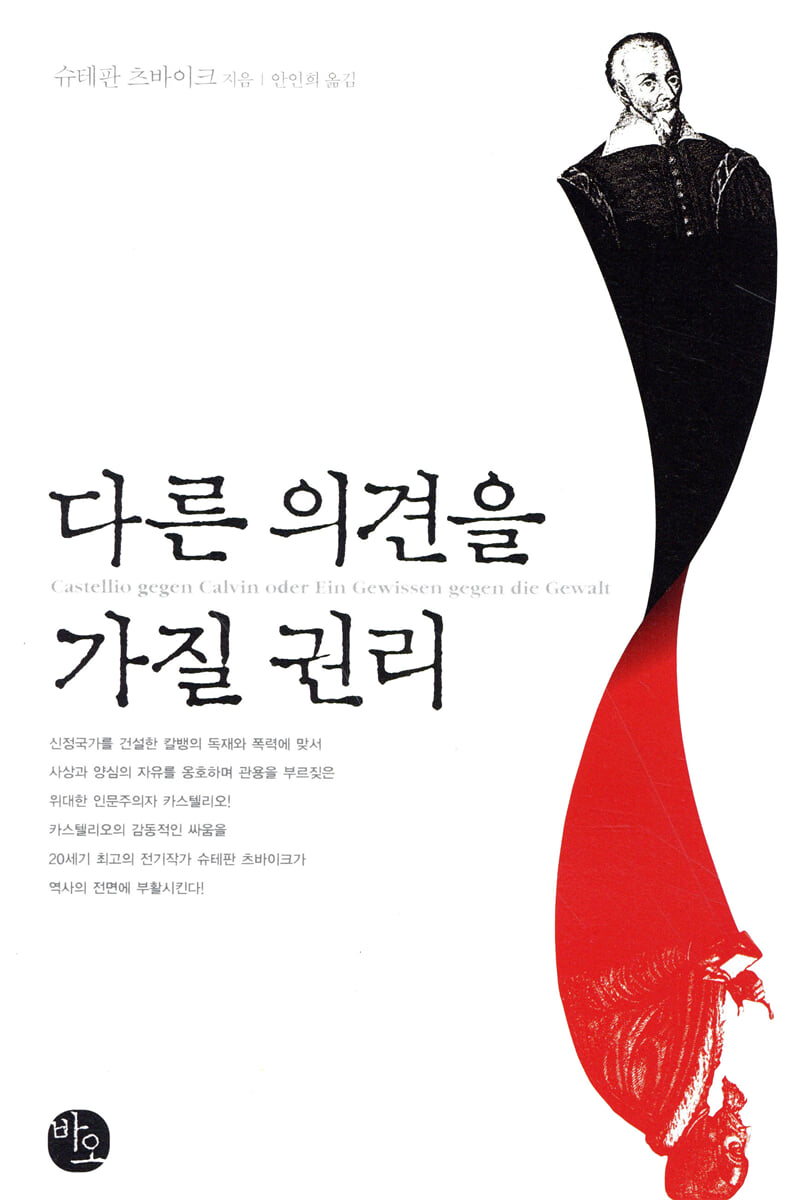
The right to have different opinions
 |
Description
Book Introduction
In an age of religious fanaticism and dictatorial violence, for the persecuted 'other opinions'
Castellio, the great humanist who faced his fate with determination!
This book allows readers to objectively evaluate two figures by contrasting Calvin, who was a “spiritual dictator and fanatical intellectualist,” with Castellio, who risked his life to “call for tolerance and freedom of conscience.”
From Chapter 1, “Calvin’s Seizure of Power,” to Chapter 5, this book describes Calvin’s religious self-righteousness, fanaticism, inhumanity, and cruelty, and denounces Geneva under his rule as a dictatorship comparable to Hitler’s dictatorship.
Then, from Chapter 5 to the last Chapter 9, the lonely and fierce fight of the “free spirit” Castellio against the “narrow-minded fanatic” Calvin and his followers is vividly and movingly described.
Castellio, the great humanist who faced his fate with determination!
This book allows readers to objectively evaluate two figures by contrasting Calvin, who was a “spiritual dictator and fanatical intellectualist,” with Castellio, who risked his life to “call for tolerance and freedom of conscience.”
From Chapter 1, “Calvin’s Seizure of Power,” to Chapter 5, this book describes Calvin’s religious self-righteousness, fanaticism, inhumanity, and cruelty, and denounces Geneva under his rule as a dictatorship comparable to Hitler’s dictatorship.
Then, from Chapter 5 to the last Chapter 9, the lonely and fierce fight of the “free spirit” Castellio against the “narrow-minded fanatic” Calvin and his followers is vividly and movingly described.
- You can preview some of the book's contents.
Preview
index
Translator's Note
preface
Chapter 1: Calvin's Seizure of Power
A new order built by violence/Young Calvin, who saw through the demands of the times/Freedom is now over in Geneva/Humanity bows only to the great paranoia/Calvin the Conqueror
Chapter 2: Only One Will Left in Geneva
Biblical Politics / Portrait of the Fanatic Intellectualist Calvin / Judge of All / Church Discipline and the Morality Police / Prohibition, Prohibition, Prohibition! / Terrorism is the Eternal Law of Dictatorship / City of Gray Shadows
Chapter 3: The Guardians of Freedom and Conscience: The Plague Unmasks the Dictator / Castellio, a Free Conscience / Conscience Clashes with Dictatorship / Castellio Leaves Geneva
Chapter 4: The Unlucky Scapegoat
Don Quixote of Theology, Servetus / Passion and Courage / Hatred That Knows No Forgetting / A Cunning Murderous Plot / Servetus Escapes from Prison
Chapter 5: The Tragic End of "Different Opinions"
The cruel tragedy begins / The sacrifice of hypocrisy / Servetus's maddening rage / The flames of the stake cannot burn the spirit / The last scream
Chapter 6: Declaration of Tolerance
Against violence/Flimsy excuses/No more silence/Fighting fanaticism/The voice of the free spirit always lives on
Chapter 7: Conscience Rises Against Violence
Censorship, Oppression, and Conspiracy/Accusing the Murderer Calvin/Once-Time Liberal, Why Did You Kill 'Different Opinions'?/Calvin is Guilty! Guilty! Guilty!
Chapter 8: Violence Eliminates Conscience
The Terror of Power/The Nature of Dictatorship/Set a Trap!/The Honorable One Is Not Addicted to Extreme Hatred/A Fanatic Who Does Not Know Reconciliation and Tolerance/The Incarnation of Defeated Tolerance/Only Death Will Save Him
Chapter 9: Castellio's Resurrection
The Legacy of Calvinism / In the Spirit of Tolerance and Liberation / Castellio, Resurrected! / A Castellio Against All Calvins
*Bringing Castellio into the world
-Knut Beck
preface
Chapter 1: Calvin's Seizure of Power
A new order built by violence/Young Calvin, who saw through the demands of the times/Freedom is now over in Geneva/Humanity bows only to the great paranoia/Calvin the Conqueror
Chapter 2: Only One Will Left in Geneva
Biblical Politics / Portrait of the Fanatic Intellectualist Calvin / Judge of All / Church Discipline and the Morality Police / Prohibition, Prohibition, Prohibition! / Terrorism is the Eternal Law of Dictatorship / City of Gray Shadows
Chapter 3: The Guardians of Freedom and Conscience: The Plague Unmasks the Dictator / Castellio, a Free Conscience / Conscience Clashes with Dictatorship / Castellio Leaves Geneva
Chapter 4: The Unlucky Scapegoat
Don Quixote of Theology, Servetus / Passion and Courage / Hatred That Knows No Forgetting / A Cunning Murderous Plot / Servetus Escapes from Prison
Chapter 5: The Tragic End of "Different Opinions"
The cruel tragedy begins / The sacrifice of hypocrisy / Servetus's maddening rage / The flames of the stake cannot burn the spirit / The last scream
Chapter 6: Declaration of Tolerance
Against violence/Flimsy excuses/No more silence/Fighting fanaticism/The voice of the free spirit always lives on
Chapter 7: Conscience Rises Against Violence
Censorship, Oppression, and Conspiracy/Accusing the Murderer Calvin/Once-Time Liberal, Why Did You Kill 'Different Opinions'?/Calvin is Guilty! Guilty! Guilty!
Chapter 8: Violence Eliminates Conscience
The Terror of Power/The Nature of Dictatorship/Set a Trap!/The Honorable One Is Not Addicted to Extreme Hatred/A Fanatic Who Does Not Know Reconciliation and Tolerance/The Incarnation of Defeated Tolerance/Only Death Will Save Him
Chapter 9: Castellio's Resurrection
The Legacy of Calvinism / In the Spirit of Tolerance and Liberation / Castellio, Resurrected! / A Castellio Against All Calvins
*Bringing Castellio into the world
-Knut Beck
Detailed image

Into the book
For the state to interfere with the inner world of moral, religious, and artistic beliefs is an infringement on the inviolable right of individuality and an overreach of authority. … … State power has no authority over matters of opinion.
So why should we froth and go wild just because someone has a different opinion or a different worldview?
Why do they constantly call the police and hate each other to the point of murder? … … From the arrogance of thinking that only they are right comes cruelty and persecution. … … Such oppression and persecution occur simply because they hold opinions that are not pleasing to the higher powers, and sometimes for no particular reason at all. … … Castellio believed that only one thing could save humanity from barbarism.
That is, tolerance.
Our world has room for not just one truth, but many.
People can live side by side if they want to.
'If we accept each other's differences and do not judge others' beliefs.'
So why should we froth and go wild just because someone has a different opinion or a different worldview?
Why do they constantly call the police and hate each other to the point of murder? … … From the arrogance of thinking that only they are right comes cruelty and persecution. … … Such oppression and persecution occur simply because they hold opinions that are not pleasing to the higher powers, and sometimes for no particular reason at all. … … Castellio believed that only one thing could save humanity from barbarism.
That is, tolerance.
Our world has room for not just one truth, but many.
People can live side by side if they want to.
'If we accept each other's differences and do not judge others' beliefs.'
--- From the text
Publisher's Review
Freedom of thought and conscience against the tyranny and violence of Calvin, who established a theocratic state.
Castellio, the great humanist who advocated for tolerance and advocacy!
The moving fight of Castellio, forgotten in history, is brought to life by the greatest biographer of the 20th century.
Stefan Zweig brings history back to the forefront!
In an age of religious fanaticism and dictatorial violence, for the persecuted 'other opinions'
Castellio, the great humanist who faced his fate with determination!
Today, his conscience and courage walk through history through the pen of Stefan Zweig!
The Resurrection of Castellio, a Forgotten Figure in History
It is often said that “history is written by the victors.”
In reality, history is never just.
History is a dispassionate chronicler, measuring only the consequences and rarely using moral measures.
History only sees the victors and leaves the losers in the dark.
Castellio, the protagonist of this book, is also a thoroughly forgotten figure, a loser of history.
His rival, Calvin (whose birth celebrates its 500th anniversary this year), is widely revered today as the figure who led the Reformation and the father of Protestantism, but Castellio, who defended freedom of conscience and called for tolerance, is barely remembered.
In fact, there are countless records, materials, and books about the victorious Calvin, but almost none about Castellio (only one portrait of him remains).
However, biographer Zweig resurrects Castellio, a 16th-century humanist and conscientious intellectual who had been forgotten for hundreds of years, and introduces him to us today.
_Biography of Castellio, a conscientious intellectual
This book is a biography of the 16th-century humanist Castellio, discovered through the dedicated efforts of the great biographer Zweig, who wandered in exile to escape Nazi oppression.
The original title was "Conscience Against Violence - Castellio Against Calvin" and it was first published in German in 1935.
Rather than chronicling the protagonist's life like other biographies, this book contrasts Calvin, a "spiritual dictator and fanatical intellectualist," with Castellio, who risked his life to "preach tolerance and freedom of conscience," allowing readers to objectively evaluate the two figures.
From Chapter 1, “Calvin’s Seizure of Power,” to Chapter 5, this book describes Calvin’s religious self-righteousness, fanaticism, inhumanity, and cruelty, and denounces Geneva under his rule as a dictatorship comparable to Hitler’s dictatorship.
Then, from Chapter 5 to the last Chapter 9, the lonely and fierce fight of the “free spirit” Castellio against the “narrow-minded fanatic” Calvin and his followers is vividly and movingly described.
_The embodiment of tolerance
There is a famous saying about 'tolerance'.
It's Voltaire's.
“I disagree with your view.
But if you are persecuted for your views, I will stand by you and fight to the end.” Castellio was the man who put this maxim into practice before Voltaire.
He was a courageous man who chose to be persecuted himself when the young theologian Servetus was burned at the stake as a heretic for differing from Calvin in his interpretation of the Bible, by defending the right of everyone to have a different opinion, even though he did not agree with Servetus's theological views.
So Zweig said, “Don’t dare to compare Castellio with people like Voltaire, Émile Zola, Locke, or Hume.
“Such comparisons fall nowhere near the moral height of what Castellio did,” he says.
Unlike Voltaire or Émile Zola, who lived in a much later humanistic era, Castellio fought single-handedly against Calvin's brutal power, despite having no supporters or patrons.
As revealed in his work On Heretics, Castellio's cry for tolerance was pioneering in Europe.
_Record of a fierce debate
This book is also a record of the debate between Calvin and Castellio.
The most moving passage in this book is the one where Castellio confronts enemies who swarm him like bees, yet he refutes the logic of Calvin's group with impeccable and persuasive logic.
Castellio counters Calvin, who insists that only his own views are the truth and considers all other opinions heretical.
“State power has no authority over matters of opinion.
So why should we froth and go wild just because someone has a different opinion or a different worldview?
Why do they constantly call the police and hate others to the point of murder? … … From the arrogance of thinking that only they are right comes cruelty and persecution. … … Such oppression and persecution occur simply because they hold opinions that are not pleasing to the higher-ups, and sometimes for no particular reason.”
_Denouncing violence and dictatorship!
This book has the character of an accusation against the absurd times in which the author, Zweig, lived.
Zweig wrote this book while he was in exile abroad to escape Nazi persecution.
In fact, in the book, the author does not simply speak of religious violence and madness.
Rather, it clearly shows how a society structured, manipulated, and dominated by a single belief or ideology can lead to a reign of terror.
Through the fight between Calvin and Castellio, the author sharply points out the problems of a totalitarian system in which a leader obsessed with self-righteousness and madness and the power and discipline he exercises do not tolerate any different opinions or individuality. At the same time, he portrays Castellio as a person who unwaveringly maintained his conscience until the end in the face of the tyranny of such a system.
In that sense, this book can be said to have a largely 'political' theme, even though it wears a 'religious' cloak.
Indeed, Castellio's life is a worthy model of a true and upright intellectual who heroically fought against countless dictatorships that have appeared throughout history.
Contents of this book
|Dictator Calvin and the Theocracy|
Calvin was a reformist young leader who enjoyed widespread support at the time, leading the religious reformation against the corrupt Catholic Church and advocating for “religious freedom.”
However, after taking control of Geneva, which had accepted a new faith, Protestantism, he asserted that his will was God's will and that anything that went against his will was an act of rebellion against God, and he carried out a "Biblical politics."
Calvin, who established a theocratic state in Geneva, thoroughly rejected opinions that differed from his own and ruled the state through violence and oppression.
Calvin uses the law and public power to monitor the citizens' every move, and Geneva is engulfed in a wave of reporting due to mutual surveillance and fear.
Of course, gatherings were also banned, and criticism of Calvin was treated as a grave sin (one intellectual was beheaded for describing Calvin as a “hypocrite”!).
Police officers raided citizens' homes to search for prohibited items, and all entertainment, including art, was banned.
Even clothing and hairstyles were subject to surveillance by the authorities.
So, during the first five years of his reign, 13 people were hanged, 10 were beheaded, 35 were burned at the stake, and 76 were banished.
The prison cells were so full of prisoners that the warden informed the city authorities that he could not accept a single more prisoner.
Calvin forced everyone to remain silent, plunging Geneva, once a free city, into a reign of terror.
|Castelio defends the right to have different opinions|
The decisive point of conflict between Calvin and Castellio was the burning of Servetus.
When Servetus was burned at the stake, Castellio was exiled from Geneva and was staying in Basel due to a disagreement with Calvin over Bible translation.
Servetus, a young theologian from Spain, was sentenced to death by Calvin's control of the Geneva city council and burned at the stake because his interpretation of the Bible, including the doctrine of the Trinity, differed from Calvin's.
This incident, which Voltaire described as “the first Protestant religious trial,” marked the beginning of Castellio’s full-scale fight to defend freedom of conscience, freedom of thought, and the spirit of tolerance against Calvin’s dogmatism, fanaticism, and oppressive power.
Servetus never defended or agreed with Servetus's position in biblical interpretation.
Nevertheless, the reason Castellio criticized Servetus's burning at the stake and fought against Calvin was simple and clear.
“Killing a human being is never a defense of a doctrine.
“It was just the murder of one human being after another.”
What Zweig reveals through the confrontation between Calvin and Castellio is the “narrow-minded fanaticism that seeks to suppress all opinions except its own” and the tyranny of a dictatorship that suppresses freedom of conscience and thought.
Calvin's attack on Castellio, who challenged his authority, was truly all-out.
Publication of Castellio's books was difficult, and he was forbidden from writing, lecturing at universities, or preaching.
Moreover, with even his means of livelihood blocked, he was barely able to make a living by working as a tutor and proofreading for a publishing company.
The watertight surveillance net of a brutal dictatorship surrounded him from all sides.
Until his last moment, Castellio was subjected to fatal attacks from his enemies, but it was his sudden death that saved him from the flames of trial and burning.
By dying a natural death, he did not allow his persecutors to gain victory in the end.
But Calvin's hatred for Castellio, his fear of tyranny and self-righteousness over freedom and tolerance, was persistent.
So, the gang of punks burned all records, including his books, to prevent Castellio's name from being remembered in future history.
Nevertheless, his spirit of tolerance was realized in later history and led to the birth of numerous other castellios.
Castellio, the great humanist who advocated for tolerance and advocacy!
The moving fight of Castellio, forgotten in history, is brought to life by the greatest biographer of the 20th century.
Stefan Zweig brings history back to the forefront!
In an age of religious fanaticism and dictatorial violence, for the persecuted 'other opinions'
Castellio, the great humanist who faced his fate with determination!
Today, his conscience and courage walk through history through the pen of Stefan Zweig!
The Resurrection of Castellio, a Forgotten Figure in History
It is often said that “history is written by the victors.”
In reality, history is never just.
History is a dispassionate chronicler, measuring only the consequences and rarely using moral measures.
History only sees the victors and leaves the losers in the dark.
Castellio, the protagonist of this book, is also a thoroughly forgotten figure, a loser of history.
His rival, Calvin (whose birth celebrates its 500th anniversary this year), is widely revered today as the figure who led the Reformation and the father of Protestantism, but Castellio, who defended freedom of conscience and called for tolerance, is barely remembered.
In fact, there are countless records, materials, and books about the victorious Calvin, but almost none about Castellio (only one portrait of him remains).
However, biographer Zweig resurrects Castellio, a 16th-century humanist and conscientious intellectual who had been forgotten for hundreds of years, and introduces him to us today.
_Biography of Castellio, a conscientious intellectual
This book is a biography of the 16th-century humanist Castellio, discovered through the dedicated efforts of the great biographer Zweig, who wandered in exile to escape Nazi oppression.
The original title was "Conscience Against Violence - Castellio Against Calvin" and it was first published in German in 1935.
Rather than chronicling the protagonist's life like other biographies, this book contrasts Calvin, a "spiritual dictator and fanatical intellectualist," with Castellio, who risked his life to "preach tolerance and freedom of conscience," allowing readers to objectively evaluate the two figures.
From Chapter 1, “Calvin’s Seizure of Power,” to Chapter 5, this book describes Calvin’s religious self-righteousness, fanaticism, inhumanity, and cruelty, and denounces Geneva under his rule as a dictatorship comparable to Hitler’s dictatorship.
Then, from Chapter 5 to the last Chapter 9, the lonely and fierce fight of the “free spirit” Castellio against the “narrow-minded fanatic” Calvin and his followers is vividly and movingly described.
_The embodiment of tolerance
There is a famous saying about 'tolerance'.
It's Voltaire's.
“I disagree with your view.
But if you are persecuted for your views, I will stand by you and fight to the end.” Castellio was the man who put this maxim into practice before Voltaire.
He was a courageous man who chose to be persecuted himself when the young theologian Servetus was burned at the stake as a heretic for differing from Calvin in his interpretation of the Bible, by defending the right of everyone to have a different opinion, even though he did not agree with Servetus's theological views.
So Zweig said, “Don’t dare to compare Castellio with people like Voltaire, Émile Zola, Locke, or Hume.
“Such comparisons fall nowhere near the moral height of what Castellio did,” he says.
Unlike Voltaire or Émile Zola, who lived in a much later humanistic era, Castellio fought single-handedly against Calvin's brutal power, despite having no supporters or patrons.
As revealed in his work On Heretics, Castellio's cry for tolerance was pioneering in Europe.
_Record of a fierce debate
This book is also a record of the debate between Calvin and Castellio.
The most moving passage in this book is the one where Castellio confronts enemies who swarm him like bees, yet he refutes the logic of Calvin's group with impeccable and persuasive logic.
Castellio counters Calvin, who insists that only his own views are the truth and considers all other opinions heretical.
“State power has no authority over matters of opinion.
So why should we froth and go wild just because someone has a different opinion or a different worldview?
Why do they constantly call the police and hate others to the point of murder? … … From the arrogance of thinking that only they are right comes cruelty and persecution. … … Such oppression and persecution occur simply because they hold opinions that are not pleasing to the higher-ups, and sometimes for no particular reason.”
_Denouncing violence and dictatorship!
This book has the character of an accusation against the absurd times in which the author, Zweig, lived.
Zweig wrote this book while he was in exile abroad to escape Nazi persecution.
In fact, in the book, the author does not simply speak of religious violence and madness.
Rather, it clearly shows how a society structured, manipulated, and dominated by a single belief or ideology can lead to a reign of terror.
Through the fight between Calvin and Castellio, the author sharply points out the problems of a totalitarian system in which a leader obsessed with self-righteousness and madness and the power and discipline he exercises do not tolerate any different opinions or individuality. At the same time, he portrays Castellio as a person who unwaveringly maintained his conscience until the end in the face of the tyranny of such a system.
In that sense, this book can be said to have a largely 'political' theme, even though it wears a 'religious' cloak.
Indeed, Castellio's life is a worthy model of a true and upright intellectual who heroically fought against countless dictatorships that have appeared throughout history.
Contents of this book
|Dictator Calvin and the Theocracy|
Calvin was a reformist young leader who enjoyed widespread support at the time, leading the religious reformation against the corrupt Catholic Church and advocating for “religious freedom.”
However, after taking control of Geneva, which had accepted a new faith, Protestantism, he asserted that his will was God's will and that anything that went against his will was an act of rebellion against God, and he carried out a "Biblical politics."
Calvin, who established a theocratic state in Geneva, thoroughly rejected opinions that differed from his own and ruled the state through violence and oppression.
Calvin uses the law and public power to monitor the citizens' every move, and Geneva is engulfed in a wave of reporting due to mutual surveillance and fear.
Of course, gatherings were also banned, and criticism of Calvin was treated as a grave sin (one intellectual was beheaded for describing Calvin as a “hypocrite”!).
Police officers raided citizens' homes to search for prohibited items, and all entertainment, including art, was banned.
Even clothing and hairstyles were subject to surveillance by the authorities.
So, during the first five years of his reign, 13 people were hanged, 10 were beheaded, 35 were burned at the stake, and 76 were banished.
The prison cells were so full of prisoners that the warden informed the city authorities that he could not accept a single more prisoner.
Calvin forced everyone to remain silent, plunging Geneva, once a free city, into a reign of terror.
|Castelio defends the right to have different opinions|
The decisive point of conflict between Calvin and Castellio was the burning of Servetus.
When Servetus was burned at the stake, Castellio was exiled from Geneva and was staying in Basel due to a disagreement with Calvin over Bible translation.
Servetus, a young theologian from Spain, was sentenced to death by Calvin's control of the Geneva city council and burned at the stake because his interpretation of the Bible, including the doctrine of the Trinity, differed from Calvin's.
This incident, which Voltaire described as “the first Protestant religious trial,” marked the beginning of Castellio’s full-scale fight to defend freedom of conscience, freedom of thought, and the spirit of tolerance against Calvin’s dogmatism, fanaticism, and oppressive power.
Servetus never defended or agreed with Servetus's position in biblical interpretation.
Nevertheless, the reason Castellio criticized Servetus's burning at the stake and fought against Calvin was simple and clear.
“Killing a human being is never a defense of a doctrine.
“It was just the murder of one human being after another.”
What Zweig reveals through the confrontation between Calvin and Castellio is the “narrow-minded fanaticism that seeks to suppress all opinions except its own” and the tyranny of a dictatorship that suppresses freedom of conscience and thought.
Calvin's attack on Castellio, who challenged his authority, was truly all-out.
Publication of Castellio's books was difficult, and he was forbidden from writing, lecturing at universities, or preaching.
Moreover, with even his means of livelihood blocked, he was barely able to make a living by working as a tutor and proofreading for a publishing company.
The watertight surveillance net of a brutal dictatorship surrounded him from all sides.
Until his last moment, Castellio was subjected to fatal attacks from his enemies, but it was his sudden death that saved him from the flames of trial and burning.
By dying a natural death, he did not allow his persecutors to gain victory in the end.
But Calvin's hatred for Castellio, his fear of tyranny and self-righteousness over freedom and tolerance, was persistent.
So, the gang of punks burned all records, including his books, to prevent Castellio's name from being remembered in future history.
Nevertheless, his spirit of tolerance was realized in later history and led to the birth of numerous other castellios.
GOODS SPECIFICS
- Date of issue: May 3, 2009
- Page count, weight, size: 304 pages | 441g | 153*224*30mm
- ISBN13: 9788991428072
- ISBN10: 899142807X
You may also like
카테고리
korean


korean

![ELLE 엘르 스페셜 에디션 A형 : 12월 [2025]](http://librairie.coreenne.fr/cdn/shop/files/b8e27a3de6c9538896439686c6b0e8fb.jpg?v=1766436872&width=3840)


