

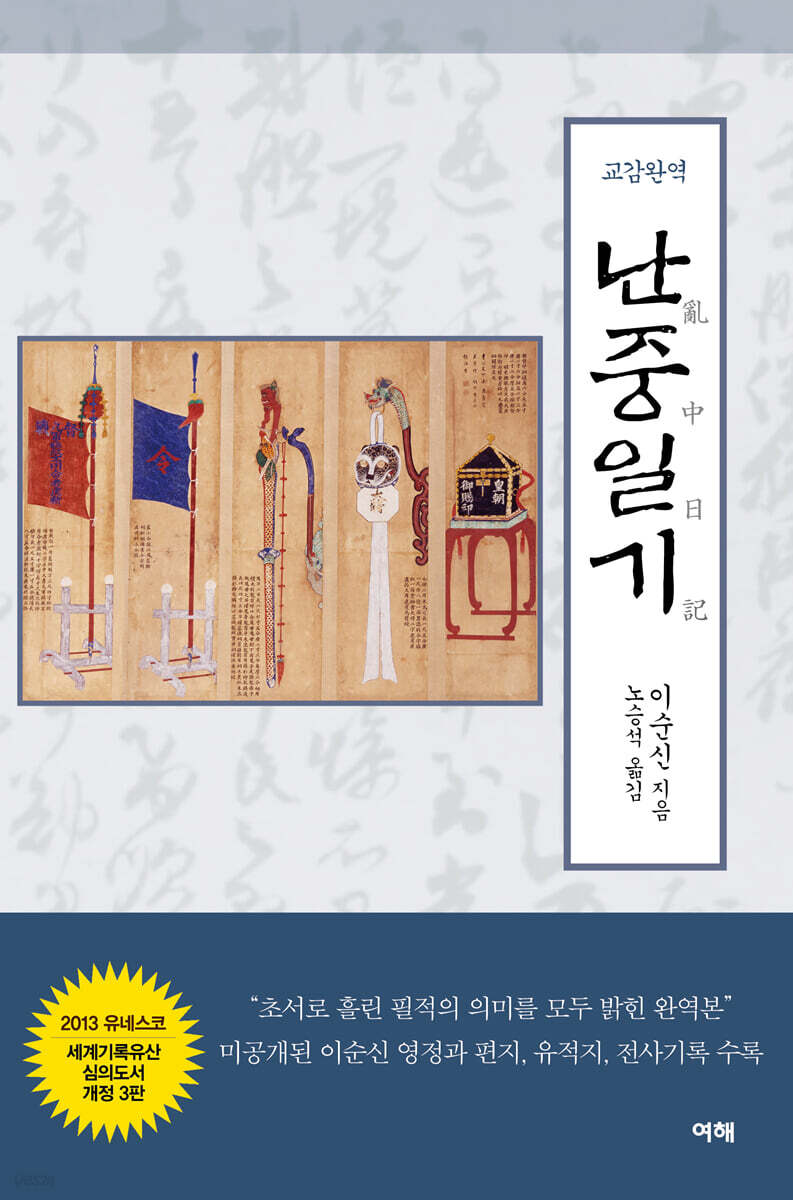
The Complete Translation of Nanjung Ilgi
 |
Description
Book Introduction
The first complete translation of the Nanjung Ilgi, National Treasure No. 76, in Korea.
Books considered for registration as UNESCO Memory of the World in 2013 (3rd revised edition)
Includes 36 new diary entries and corrects over 200 errors.
Includes an unpublished portrait of Yi Sun-sin, a collection of his sayings, a letter, and a record of his military career.
During the Imjin War, the greatest war in Joseon history, Yi Sun-sin turned a crisis into an opportunity and achieved a victorious record by displaying the strategies and improvisational skills of his predecessors. He also never gave up and fulfilled his duty despite being unjustly imprisoned, his mother's death, and the vicious cycle of serving in the military. He is a role model that transcends the times and always serves as a role model.
The lessons of his seven-year diary, Nanjung Ilgi, will always provide life wisdom to modern people in the 21st century.
The 《Gyogamwanyeok Nanjung Ilgi》 published by Minumsa in 2010 was selected as a book for consideration when the Nanjung Ilgi was registered as a UNESCO Memory of the World Register in 2013, and the subsequent revised edition was evaluated as a masterpiece by the public as it became the script for the films Myeongryang, Hansan, and Noryang.
This revised third edition is based on the comprehensive edition of the 《Shin Wan-yak Nanjung Ilgi Gyojubon》(2021), but has improved readability by translating Chinese terms into Korean and making it as easy for the general public to read as possible.
The author is a classical scholar who has studied Chinese characters and cursive script for over 40 years. Along with translating classics, he has also studied the calligraphy of Wang Xizhi and Sun Qiao, who influenced Yi Sun-sin's calligraphy. In this unique field, he has deciphered all the cursive script of the Nanjung Ilgi, created a canonical edition, and translated it completely.
In the process, various materials were discovered and supplemented.
This book, which continues the tradition of providing complete translations for 15 years, includes 36 new days of diary entries and corrects over 200 errors to further enhance the accuracy of the content.
In particular, it includes a portrait of Yi Sun-sin, which has never been introduced before, the records of his life in Mulyeongmangdongjeongjungyeosan, a letter, the historical site of Danseong, and the record of Yi Sun-sin's death written by Yu Seong-ryong.
Books considered for registration as UNESCO Memory of the World in 2013 (3rd revised edition)
Includes 36 new diary entries and corrects over 200 errors.
Includes an unpublished portrait of Yi Sun-sin, a collection of his sayings, a letter, and a record of his military career.
During the Imjin War, the greatest war in Joseon history, Yi Sun-sin turned a crisis into an opportunity and achieved a victorious record by displaying the strategies and improvisational skills of his predecessors. He also never gave up and fulfilled his duty despite being unjustly imprisoned, his mother's death, and the vicious cycle of serving in the military. He is a role model that transcends the times and always serves as a role model.
The lessons of his seven-year diary, Nanjung Ilgi, will always provide life wisdom to modern people in the 21st century.
The 《Gyogamwanyeok Nanjung Ilgi》 published by Minumsa in 2010 was selected as a book for consideration when the Nanjung Ilgi was registered as a UNESCO Memory of the World Register in 2013, and the subsequent revised edition was evaluated as a masterpiece by the public as it became the script for the films Myeongryang, Hansan, and Noryang.
This revised third edition is based on the comprehensive edition of the 《Shin Wan-yak Nanjung Ilgi Gyojubon》(2021), but has improved readability by translating Chinese terms into Korean and making it as easy for the general public to read as possible.
The author is a classical scholar who has studied Chinese characters and cursive script for over 40 years. Along with translating classics, he has also studied the calligraphy of Wang Xizhi and Sun Qiao, who influenced Yi Sun-sin's calligraphy. In this unique field, he has deciphered all the cursive script of the Nanjung Ilgi, created a canonical edition, and translated it completely.
In the process, various materials were discovered and supplemented.
This book, which continues the tradition of providing complete translations for 15 years, includes 36 new days of diary entries and corrects over 200 errors to further enhance the accuracy of the content.
In particular, it includes a portrait of Yi Sun-sin, which has never been introduced before, the records of his life in Mulyeongmangdongjeongjungyeosan, a letter, the historical site of Danseong, and the record of Yi Sun-sin's death written by Yu Seong-ryong.
- You can preview some of the book's contents.
Preview
index
Translator's Preface
commentary
Imjin Year (1592)
January, taking up the brush to prepare for war
February, the first sunrise of the year
March, Turtle Ship Operation Test
April, the Imjin War broke out
Departure to Okpo in May
June, Battle of Dangpo
August, departure to Gadeok, Busan
Year of Gyesa (1593)
February, Battle of Ungpo
March, annihilation of the Japanese army at Ungcheon
In May, the Ming Dynasty fell.
June, Exploring Endurance
July, moving to Hansando
August, commanding the Samdo naval forces
September, Reporting Abuses
Gap-o year (1594)
January, I visited my mother.
February, strengthening reconnaissance activities
March, receive the Golden Topaemun
April: The special civil service examination center opens.
May, interrogating captured Japanese soldiers
In June, Zhang Hongyou of the Ming Dynasty arrives.
July, news of Ryu Seong-ryong's death was mistakenly reported.
In August, my wife's illness became critical.
September, dispatched to Jangmunpo
In October, the Japanese pirates are hiding and not coming out.
In November, a report was submitted to reward and discipline the officers.
Year of the Goat (1595)
January, I met my father in a dream.
February, dividing the rice of Doyang into ports
March, building an archery practice range on Hansando Island
April, criticizing Kwon Yul's false report
In May, the soldiers of Samdo practice archery.
June, worrying about my mother's illness
July, Concerns About the Country's Lack of Talent
August, mourning the fall of Chokseokru
September, a farewell poem to the election
In October, construction began on the main hall of Suru.
November, Criticizing Won Gyun's Letter
December, meeting Lee Won-ik in Samcheonjin
Year of the Monkey (1596)
January, hearing about the situation in Ming and Japan
February, reaping the rice in the fields
March, I've been feeling unwell every day.
April, receiving a report on Japanese intelligence
In May, the Fengshenshu Road decides to make peace.
In June, generals from the four provinces gathered to practice archery.
July: The Ming envoy's entourage is appointed.
August, departing from Hansando and inspecting
In August, I climbed Nammangsan Mountain, a strategic point in Wando.
September, a peaceful time in the Jeolla region
October, seeing my mother for the last time
Jeongyu Year I (1597)
In April, after being released from prison, he embarked on a military career.
May, wandering from one shabby house to another
June, arrival at Gwon Yul's camp in Hapcheon
In July, upon hearing of Won Gyun's defeat, he ascended Dongsan Mountain Fortress.
August, receiving a royal decree reinstating the commander of the three provinces' naval forces.
In September, the navy was rebuilt and the Battle of Myeongnyang was achieved.
October, after a break, we went to Beopseongpo.
Year of the Dog II (1597)
August, receiving a royal decree reinstating the commander of the three provinces' naval forces.
In September, the navy was rebuilt and the Battle of Myeongnyang was achieved.
In October, the third son, Myeon(?), died in battle.
In November, he received 20 nyang of silver for his military service.
December, King Seonjo orders meat consumption during mourning
Year of the Dog (1598)
January, completion of construction of the Panokseon
September: The Battle of Yegyo Castle begins
In October, the army retreats, but Yi Sun-sin continues his challenge.
November: Yi Sun-sin dies in the Battle of Noryang
Letter spy
photo album
References
Nanjung Ilgi Comparison Table
Chronology of Admiral Yi Sun-sin
commentary
Imjin Year (1592)
January, taking up the brush to prepare for war
February, the first sunrise of the year
March, Turtle Ship Operation Test
April, the Imjin War broke out
Departure to Okpo in May
June, Battle of Dangpo
August, departure to Gadeok, Busan
Year of Gyesa (1593)
February, Battle of Ungpo
March, annihilation of the Japanese army at Ungcheon
In May, the Ming Dynasty fell.
June, Exploring Endurance
July, moving to Hansando
August, commanding the Samdo naval forces
September, Reporting Abuses
Gap-o year (1594)
January, I visited my mother.
February, strengthening reconnaissance activities
March, receive the Golden Topaemun
April: The special civil service examination center opens.
May, interrogating captured Japanese soldiers
In June, Zhang Hongyou of the Ming Dynasty arrives.
July, news of Ryu Seong-ryong's death was mistakenly reported.
In August, my wife's illness became critical.
September, dispatched to Jangmunpo
In October, the Japanese pirates are hiding and not coming out.
In November, a report was submitted to reward and discipline the officers.
Year of the Goat (1595)
January, I met my father in a dream.
February, dividing the rice of Doyang into ports
March, building an archery practice range on Hansando Island
April, criticizing Kwon Yul's false report
In May, the soldiers of Samdo practice archery.
June, worrying about my mother's illness
July, Concerns About the Country's Lack of Talent
August, mourning the fall of Chokseokru
September, a farewell poem to the election
In October, construction began on the main hall of Suru.
November, Criticizing Won Gyun's Letter
December, meeting Lee Won-ik in Samcheonjin
Year of the Monkey (1596)
January, hearing about the situation in Ming and Japan
February, reaping the rice in the fields
March, I've been feeling unwell every day.
April, receiving a report on Japanese intelligence
In May, the Fengshenshu Road decides to make peace.
In June, generals from the four provinces gathered to practice archery.
July: The Ming envoy's entourage is appointed.
August, departing from Hansando and inspecting
In August, I climbed Nammangsan Mountain, a strategic point in Wando.
September, a peaceful time in the Jeolla region
October, seeing my mother for the last time
Jeongyu Year I (1597)
In April, after being released from prison, he embarked on a military career.
May, wandering from one shabby house to another
June, arrival at Gwon Yul's camp in Hapcheon
In July, upon hearing of Won Gyun's defeat, he ascended Dongsan Mountain Fortress.
August, receiving a royal decree reinstating the commander of the three provinces' naval forces.
In September, the navy was rebuilt and the Battle of Myeongnyang was achieved.
October, after a break, we went to Beopseongpo.
Year of the Dog II (1597)
August, receiving a royal decree reinstating the commander of the three provinces' naval forces.
In September, the navy was rebuilt and the Battle of Myeongnyang was achieved.
In October, the third son, Myeon(?), died in battle.
In November, he received 20 nyang of silver for his military service.
December, King Seonjo orders meat consumption during mourning
Year of the Dog (1598)
January, completion of construction of the Panokseon
September: The Battle of Yegyo Castle begins
In October, the army retreats, but Yi Sun-sin continues his challenge.
November: Yi Sun-sin dies in the Battle of Noryang
Letter spy
photo album
References
Nanjung Ilgi Comparison Table
Chronology of Admiral Yi Sun-sin
Into the book
“I thought about writing it down, but I was so busy traveling between land and sea and had no time to rest that I forgot about it for a long time.
“I will continue writing from here.”
---From the “Diary entry for May of the year of Gyesa”
“I will devote my loyalty and strength to the work of bringing peace to the country and stabilizing the country. Whether I live or die, I will follow this.”
“I will continue writing from here.”
---From the “Diary entry for May of the year of Gyesa”
“I will devote my loyalty and strength to the work of bringing peace to the country and stabilizing the country. Whether I live or die, I will follow this.”
---From “Records after September 15, Year of Gyesa”
Publisher's Review
▶ 2013 UNESCO World Heritage Review Materials Adoption
▶ 2015 Vietnamese Translation Support from the Literature Translation Institute of Korea under the Ministry of Culture, Sports and Tourism
▶ 2016 Korea Publication Industry Promotion Agency Recommended Books for Incoming College Students (Abridged Edition)
▶ Includes 27 middle and high school textbooks
▶ Sungkyunkwan University's 100 Sungkyunkwan Classics Selection
▶ Selected as a 2020 Daegu National University of Education DNUE 50 Greatbooks Liberal Arts Book
Unraveling the full meaning of Yi Sun-sin's cryptic cursive handwriting from over 400 years ago.
A complete translation of the original manuscript of the Nanjung Ilgi, perfectly deciphered.
Contains recently excavated literature on Yi Sun-sin.
It is said that the Nanjung Ilgi is the only case in world history where a supreme commander directly participated in a war and wrote a diary of what he saw and heard.
In order to thoroughly prepare for war, Yi Sun-sin began writing his war diary on January 1, 1592, and continued writing until November 17, 1598, two days before his death.
《Nanjung Ilgi》 is a war diary written by Yi Sun-sin during the seven-year Imjin War, and it contains detailed accounts of the war situation at the time and various events that occurred in the camp.
It contains many interesting stories that are not even in official history, and is therefore being used as an important tool in historical research.
It also contains a significant amount of content that allows us to learn about the activities and human aspects of great people.
These diaries are very much about the commander's experience and have a strong practical nature, and are clearly different from other diaries written objectively from a third-person perspective.
Yi Sun-sin often wrote about his longing and love for his mother in his Nanjung Ilgi (War Diary). He kept his mother's instructions to "greatly wash away the nation's shame" in mind, and fought in the war without sparing his life with a single-minded desire to overcome the national crisis.
As a result, he achieved a record of 100 victories in 100 battles.
The Nanjung Ilgi, which contains the story of Yi Sun-sin's efforts to lead the crisis to victory without yielding even in the worst of situations, is an immortal masterpiece and the pinnacle of war literature.
The problem of deciphering this 《Nanjung Ilgi》 has very important implications.
《Nanjung Ilgi》 was first deciphered in 1795, the 19th year of King Jeongjo's reign in Joseon, when 《Complete Works of Admiral Yi Sun-sin》 was published, and some of the letters were modified during this process.
This resulted in differences from the original manuscript, but this followed the customary law of using characters with the same pronunciation and meaning.
According to the theory of sympathy, this was written as a different version of the text, not a typo, along with the text of the original version of the Nanjung Ilgi DB in the National Heritage Portal.
In 1935, the Chosun History Compilation Committee published the deciphered “Nanjung Ilgi Cho,” and later, Hong Gi-mun and Lee Eun-sang’s complete translation of the Nanjung Ilgi was published.
As there were errors in interpretation, the need for a consensus was raised in the academic world, so the author conducted a consensus work on the original manuscript of the Nanjung Ilgi, created a new, canonical version of the Nanjung Ilgi, and published the Complete Translation of the Nanjung Ilgi (Minumsa) in 2010.
After that, it went through a second edition, a revised edition, and a textbook version to reach what it is today.
It includes 36 new diary entries, new research on terms, names of people, and place names.
There are a total of about 200 cases reported and communicated to the academic community.
Yi Sun-sin's cursive script is a style that was formed in the middle stage between Wang Xizhi and Sun Qing, and is characterized by powerful and majestic strokes, and the final separate strokes are not blown out with force, but rather the dots are finished in a blunt manner.
The author has studied the calligraphy of Wang Xizhi and Sun Jiaotong for a long time, which was of great help in deciphering the calligraphy in the Nanzhong Diary.
Because I studied Nanjung Ilgi in my own field specializing in classics and cursive script, it is distinct from ordinary translations.
The third revised edition of the "Gyogamwanyeok Nanjung Ilgi" includes new content, including an unpublished portrait of Yi Sun-sin, a handwritten copy of his quotations from the Battle of Okpo, such as "Do not make a fool of yourself, but be still like a heavy mountain", a new letter from Yi Sun-sin requesting silk from the groom's family for his daughter's marriage, Hansando Island, which was handwritten in 2017, the Danseong Historic Site among the Baekui Jonggun-ro, and Yu Seong-ryong's account of Yi Sun-sin's battles written in the "Gyeongja Year Daetongryeok".
On a bright moonlit night on Hansan Island, as I climb up the tower and stroke my large sword, I feel deep worry. A melody of a strong sword rang out from somewhere, adding to my worry.
On the moon at night, on the moon, on the moon, on the moon
In particular, the content of Yi Sun-sin's military records written by Yu Seong-ryong was discovered in 2022 by the author while deciphering the entire Sutaek version of "Gyeongja Daetongryeok" owned by Yu Seong-ryong at the request of the Overseas Korean Cultural Heritage Foundation.
This was written in cursive script on the front cover, and it contained the story of Yi Sun-sin being shot and killed in the Battle of Noryang while fighting alone despite the advice of his subordinates.
The appendix contains seven letters sent by Yi Sun-sin to his nephews and relatives, Hyeon Geon and Hyeon Deok-seung, one letter sent by his son Yi Hoe (李?) to Hyeon Geon, and one piece written by Yi Gyu-dae (李奎大), the 10th generation descendant of Yi Sun-sin.
The photo album contains photos of approximately 50 representative sites of Yi Sun-sin's historical sites.
▶ 2015 Vietnamese Translation Support from the Literature Translation Institute of Korea under the Ministry of Culture, Sports and Tourism
▶ 2016 Korea Publication Industry Promotion Agency Recommended Books for Incoming College Students (Abridged Edition)
▶ Includes 27 middle and high school textbooks
▶ Sungkyunkwan University's 100 Sungkyunkwan Classics Selection
▶ Selected as a 2020 Daegu National University of Education DNUE 50 Greatbooks Liberal Arts Book
Unraveling the full meaning of Yi Sun-sin's cryptic cursive handwriting from over 400 years ago.
A complete translation of the original manuscript of the Nanjung Ilgi, perfectly deciphered.
Contains recently excavated literature on Yi Sun-sin.
It is said that the Nanjung Ilgi is the only case in world history where a supreme commander directly participated in a war and wrote a diary of what he saw and heard.
In order to thoroughly prepare for war, Yi Sun-sin began writing his war diary on January 1, 1592, and continued writing until November 17, 1598, two days before his death.
《Nanjung Ilgi》 is a war diary written by Yi Sun-sin during the seven-year Imjin War, and it contains detailed accounts of the war situation at the time and various events that occurred in the camp.
It contains many interesting stories that are not even in official history, and is therefore being used as an important tool in historical research.
It also contains a significant amount of content that allows us to learn about the activities and human aspects of great people.
These diaries are very much about the commander's experience and have a strong practical nature, and are clearly different from other diaries written objectively from a third-person perspective.
Yi Sun-sin often wrote about his longing and love for his mother in his Nanjung Ilgi (War Diary). He kept his mother's instructions to "greatly wash away the nation's shame" in mind, and fought in the war without sparing his life with a single-minded desire to overcome the national crisis.
As a result, he achieved a record of 100 victories in 100 battles.
The Nanjung Ilgi, which contains the story of Yi Sun-sin's efforts to lead the crisis to victory without yielding even in the worst of situations, is an immortal masterpiece and the pinnacle of war literature.
The problem of deciphering this 《Nanjung Ilgi》 has very important implications.
《Nanjung Ilgi》 was first deciphered in 1795, the 19th year of King Jeongjo's reign in Joseon, when 《Complete Works of Admiral Yi Sun-sin》 was published, and some of the letters were modified during this process.
This resulted in differences from the original manuscript, but this followed the customary law of using characters with the same pronunciation and meaning.
According to the theory of sympathy, this was written as a different version of the text, not a typo, along with the text of the original version of the Nanjung Ilgi DB in the National Heritage Portal.
In 1935, the Chosun History Compilation Committee published the deciphered “Nanjung Ilgi Cho,” and later, Hong Gi-mun and Lee Eun-sang’s complete translation of the Nanjung Ilgi was published.
As there were errors in interpretation, the need for a consensus was raised in the academic world, so the author conducted a consensus work on the original manuscript of the Nanjung Ilgi, created a new, canonical version of the Nanjung Ilgi, and published the Complete Translation of the Nanjung Ilgi (Minumsa) in 2010.
After that, it went through a second edition, a revised edition, and a textbook version to reach what it is today.
It includes 36 new diary entries, new research on terms, names of people, and place names.
There are a total of about 200 cases reported and communicated to the academic community.
Yi Sun-sin's cursive script is a style that was formed in the middle stage between Wang Xizhi and Sun Qing, and is characterized by powerful and majestic strokes, and the final separate strokes are not blown out with force, but rather the dots are finished in a blunt manner.
The author has studied the calligraphy of Wang Xizhi and Sun Jiaotong for a long time, which was of great help in deciphering the calligraphy in the Nanzhong Diary.
Because I studied Nanjung Ilgi in my own field specializing in classics and cursive script, it is distinct from ordinary translations.
The third revised edition of the "Gyogamwanyeok Nanjung Ilgi" includes new content, including an unpublished portrait of Yi Sun-sin, a handwritten copy of his quotations from the Battle of Okpo, such as "Do not make a fool of yourself, but be still like a heavy mountain", a new letter from Yi Sun-sin requesting silk from the groom's family for his daughter's marriage, Hansando Island, which was handwritten in 2017, the Danseong Historic Site among the Baekui Jonggun-ro, and Yu Seong-ryong's account of Yi Sun-sin's battles written in the "Gyeongja Year Daetongryeok".
On a bright moonlit night on Hansan Island, as I climb up the tower and stroke my large sword, I feel deep worry. A melody of a strong sword rang out from somewhere, adding to my worry.
On the moon at night, on the moon, on the moon, on the moon
In particular, the content of Yi Sun-sin's military records written by Yu Seong-ryong was discovered in 2022 by the author while deciphering the entire Sutaek version of "Gyeongja Daetongryeok" owned by Yu Seong-ryong at the request of the Overseas Korean Cultural Heritage Foundation.
This was written in cursive script on the front cover, and it contained the story of Yi Sun-sin being shot and killed in the Battle of Noryang while fighting alone despite the advice of his subordinates.
The appendix contains seven letters sent by Yi Sun-sin to his nephews and relatives, Hyeon Geon and Hyeon Deok-seung, one letter sent by his son Yi Hoe (李?) to Hyeon Geon, and one piece written by Yi Gyu-dae (李奎大), the 10th generation descendant of Yi Sun-sin.
The photo album contains photos of approximately 50 representative sites of Yi Sun-sin's historical sites.
GOODS SPECIFICS
- Date of issue: April 10, 2025
- Format: Hardcover book binding method guide
- Page count, weight, size: 500 pages | 150*225*30mm
- ISBN13: 9791197378270
- ISBN10: 1197378278
You may also like
카테고리
korean


korean

![ELLE 엘르 스페셜 에디션 A형 : 12월 [2025]](http://librairie.coreenne.fr/cdn/shop/files/b8e27a3de6c9538896439686c6b0e8fb.jpg?v=1766436872&width=3840)


