

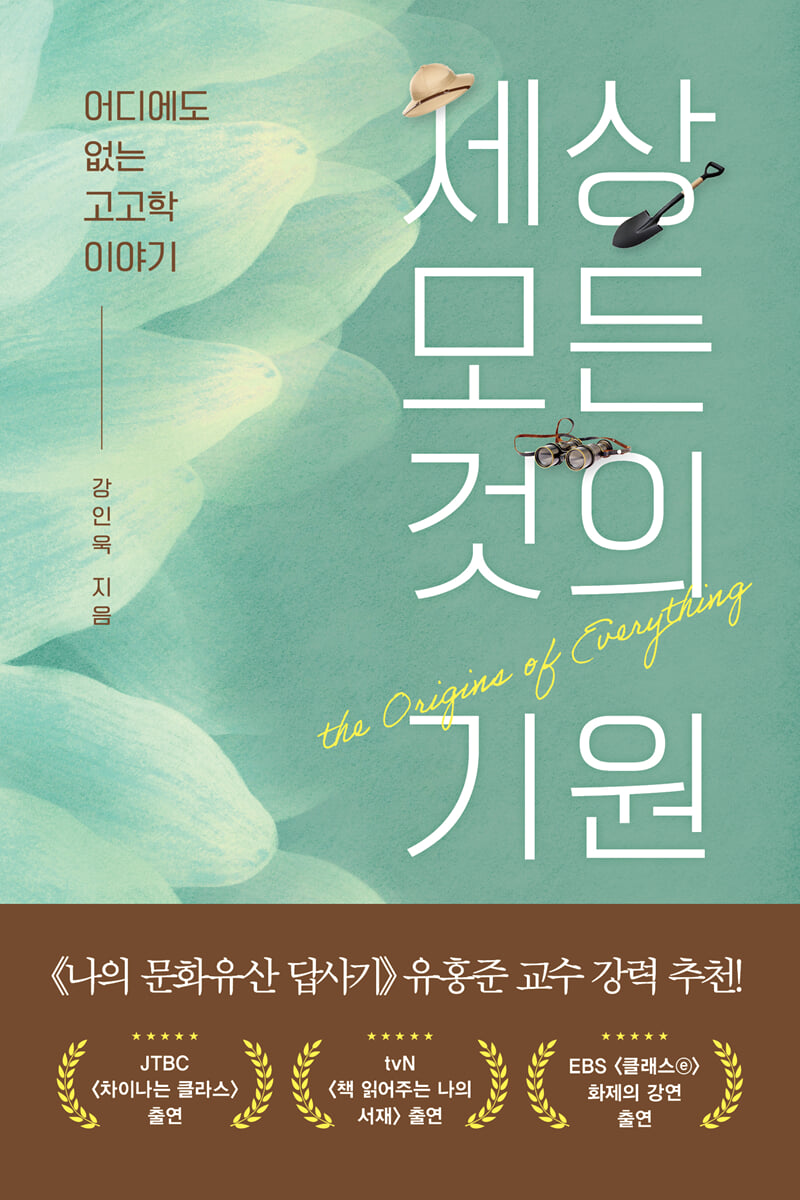
The origin of everything in the world
 |
Description
Book Introduction
Professor Kang In-wook, who has been at the forefront of popularizing Korean archaeology, A journey to discover the various 'origins' of human life. Inviting us on an intellectual journey that transcends time and space! When we talk about archaeology, we often think of thrilling adventure scenes from the movie Indiana Jones. Some people view archaeology as a somewhat detached discipline, studying a time far removed from our present lives. However, both ideas are the result of public misunderstandings and prejudices that are far removed from the essence of archaeology. Archaeology is a discipline that gradually fills in the blanks of human history that have not been recorded by carefully listening to the stories told by artifacts, sometimes incomplete, excavated from the field, and reconstructing the lives and cultures of ancient people. Thanks to the excavations and research of archaeologists like these, the lives of ancient people and our lives here and now are not separate, but rather connected as one flow. Everything we eat, drink, wear, and enjoy today is possible because there was someone who first created or discovered it and used it. As the title, "The Origin of Everything," suggests, this book presents the origins and history of the objects and cultures we encounter and enjoy in our daily lives in an easy and engaging way, from the perspective of an archaeologist who has been at the forefront of excavation sites. It contains various stories about 'origins', ranging from the history of food, clothing, and shelter, such as alcohol and food, to the history of play and travel, to the human desire to covet precious items such as gold and silk and dream of eternal life. Readers who encounter this book will experience the joy of an intellectual journey that crosses the boundaries between past and present, life and death, prosperity and decline, and understands the joys and sorrows of human history. |
- You can preview some of the book's contents.
Preview
index
Prologue: A Living Story Told by a Dead Relic
I.
Party: Cook, eat, and drink
[Makgeolli] Are Makgeolli and Beer Actually the Same Alcohol?
Soju: A gift from nature, evolving into something "clearer."
[Kimchi] The 'Food Road' that stretches across the Northern Hemisphere
[Samgyeopsal] The sorrows of the common people contained in the melted pork fat
[Beef] Our delicacy that has overcome prejudice
[Chicken] Silla was the land of chickens.
Shark Meat: Our Ceremonial Food for 2,000 Years
[Haejangguk] Relieve a hangover and promote harmony
Ⅱ.
Play: To play, have fun, and have fun
[Play] The fun games that led to human evolution
[Dolmen] The Origin of Human Cooperation and Coexistence
[Wrestling] Becoming one through carrying and throwing
[Soccer] From Death Match to Global Festival
[Travel] The wandering instinct engraved in human DNA
[Doodle] If you want to give your brain a rest, doodle.
[Dog] Wild wolves become human companions
[Cats] Small but majestic beasts that captivate humans
Ⅲ.
Prestige: The pursuit of wealth and beauty
[Stone Age] A Barometer Showing Ancient People's Environmental Adaptability
[Silk] The Fatal Temptation That Moved Human History
[Gold] 6,500 years ago, humanity's first flex
[Silla Gold Crown] Half a Millennium of Korean History Hidden Behind the Gorgeous Appearance
[Ginseng] The Miracle Medicine That Changed World History
Climate and Heritage: Global Warming and the Disappearance of Cultural Heritage
[Grave Robbery] A Dark Gamble with Your Life
[Imitation] Creation begins with replication.
Ⅳ.
Permanence: Desiring eternal life
[Mural] The Metaverse Created by the Goguryeo People 1,500 Years Ago
[Memorial] Copper Sparrow Hill and the National Cemetery
[Mummy] The futile wish of humans to live forever
[Excavation Story] The Curse of Tutankhamun's Mummy: What's the Truth?
[Mask] The World History Hidden Behind a Tightly Covered Face
[Tattoo] Eternal Beauty Traded for Pain
[Fortune-telling] Alleviate anxiety and dream of the future.
[Messenger] We are all connected
Epilogue: Archaeology in Search of a New Past
References
I.
Party: Cook, eat, and drink
[Makgeolli] Are Makgeolli and Beer Actually the Same Alcohol?
Soju: A gift from nature, evolving into something "clearer."
[Kimchi] The 'Food Road' that stretches across the Northern Hemisphere
[Samgyeopsal] The sorrows of the common people contained in the melted pork fat
[Beef] Our delicacy that has overcome prejudice
[Chicken] Silla was the land of chickens.
Shark Meat: Our Ceremonial Food for 2,000 Years
[Haejangguk] Relieve a hangover and promote harmony
Ⅱ.
Play: To play, have fun, and have fun
[Play] The fun games that led to human evolution
[Dolmen] The Origin of Human Cooperation and Coexistence
[Wrestling] Becoming one through carrying and throwing
[Soccer] From Death Match to Global Festival
[Travel] The wandering instinct engraved in human DNA
[Doodle] If you want to give your brain a rest, doodle.
[Dog] Wild wolves become human companions
[Cats] Small but majestic beasts that captivate humans
Ⅲ.
Prestige: The pursuit of wealth and beauty
[Stone Age] A Barometer Showing Ancient People's Environmental Adaptability
[Silk] The Fatal Temptation That Moved Human History
[Gold] 6,500 years ago, humanity's first flex
[Silla Gold Crown] Half a Millennium of Korean History Hidden Behind the Gorgeous Appearance
[Ginseng] The Miracle Medicine That Changed World History
Climate and Heritage: Global Warming and the Disappearance of Cultural Heritage
[Grave Robbery] A Dark Gamble with Your Life
[Imitation] Creation begins with replication.
Ⅳ.
Permanence: Desiring eternal life
[Mural] The Metaverse Created by the Goguryeo People 1,500 Years Ago
[Memorial] Copper Sparrow Hill and the National Cemetery
[Mummy] The futile wish of humans to live forever
[Excavation Story] The Curse of Tutankhamun's Mummy: What's the Truth?
[Mask] The World History Hidden Behind a Tightly Covered Face
[Tattoo] Eternal Beauty Traded for Pain
[Fortune-telling] Alleviate anxiety and dream of the future.
[Messenger] We are all connected
Epilogue: Archaeology in Search of a New Past
References
Detailed image

Into the book
In this way, people have been inventing and distributing unique fermented foods suited to the climate and environment of the region where they live for about 10,000 years.
Evidence that humans made and ate fermented foods is being discovered all over the world thanks to the advancement of archaeology.
As archaeological research accumulates, fermented foods like kimchi and their history will become increasingly evident.
When explaining food culture, what is important is not its origins, but how the food has adapted to the changing environment.
In this context, arguing over the origins of fermented foods like kimchi is a meaningless debate.
Just as the fact that the hamburger, America's quintessential food today, originated in Hamburg, Germany, is merely an interesting side note, it doesn't explain the true nature of the hamburger.
---From "Kimchi: A 'Food Road' Along the Northern Hemisphere"
There is nothing that humans fear more than death.
But through death, humans have bound the lives of those who remain.
There is a Latin proverb called 'Memento mori'.
This proverb, meaning 'remember death', paradoxically emphasizes 'doing your best while you live'.
Sacrifice is the oldest way in which humanity practices the teaching of memento mori.
We first mourned the departed and prayed for their eternal rest and happiness, thereby overcoming the fear of death and maintaining community harmony.
The ancestral rites were a ritual to pray for the dead to fulfill the wishes of the living, and a festival to remember the dead.
---From "Shark Meat: Our Ritual Food for 2,000 Years"
For young children, play is a pleasure in itself.
Moreover, through play, children learn the rules of society and adapt to the environment around them.
From the cave paintings of the Paleolithic Age, estimated to be 40,000 to 50,000 years old, to the murals of Goguryeo, the pictures drawn on the murals served as teaching materials for ancient people to imitate and learn from objects.
For example, ancient children would have learned what wild cattle looked like and how to hunt them by looking at paintings of wild cattle being hunted on murals.
Children of ancient nomadic peoples developed their identity as a nomadic people through games such as horse riding, archery, and wrestling.
In Chinese history books that record the Xiongnu people who ruled northern China 2,000 years ago, it is written that Xiongnu children learned horsemanship from a young age by playing games such as riding sheep and hunting small animals.
Nomadic children learned how to ride horses through horseback riding before they could even walk.
---From "Play: The Joyful Play That Driven Human Evolution"
Novgorod is a representative historical city of Russia, like Gyeongju in our country or Nara in Japan.
In particular, in Novgorod, a large number of documents written on birch bark were excavated, which greatly helped in elucidating the origins of the Slavic language.
Among the national treasures that are comparable to Russia's 'Hunminjeongeum', the artifact that received the most love from people was, strangely enough, a bundle of writings written by a child called 'Onfim'.
Judging from the fact that the contents of the writing bundle include Bible verses, it is presumed that Onfim learned to read and write at a local church school. Interesting drawings and doodles remain throughout Onfim's writing bundle.
For example, an exciting scene of riding a horse and shooting arrows at animals has the caption, "I am a beast (let's have a go)," and a drawing of students taking a class together has the graffiti, "Oh, it's already 6 o'clock... (I don't want to study)."
Did Onfim drop this bundle of notes into a sewer on his way home from class? Onfim's entire bundle of notes was discovered 800 years later by later Russians, and it remains a beloved Russian artifact to this day.
---From "Doodle: If you want to rest your brain, doodle"
The word 'flex' has been trending recently.
Originally, it was an English word meaning 'bend over' or 'stretch out the body by doing warm-up exercises, etc.', but in the 1990s, in American hip-hop culture, it was used to refer to rappers showing off their wealth, and the meaning spread to Korea and became widespread as everyday terminology.
When studying archaeology, you often come across traces of the 'flex' of ancient people.
A representative example is a tomb decorated with splendid jewels and gold.
These relics, which still exude their splendor today despite the thick walls of time, vividly demonstrate humanity's innate desire to display and flaunt wealth and fame.
---From "Gold: 6,500 Years Ago, Humanity's First Flex"
The climate crisis manifests itself in various ways, but the most representative and fundamental problem is global warming.
It's not just polar glaciers that are melting due to global warming.
The ancient tombs of Altai, a beautiful mountainous steppe region on the border of Russia, Kazakhstan, China, and Mongolia, and the mummies and golden artifacts they contain, are also quietly disappearing.
(…) When the ice that prevented decay melts, the mummies, felt, and wooden tools in the tomb rot rapidly.
Even golden relics cannot avoid damage.
Gold was mainly used in the form of foil, but when the artifact with the gold foil on it rotted away, the gold foil also lost its original shape, becoming wrinkled or torn.
It is an inevitable reality that archaeologists will argue that measures must be taken to preserve the cultural heritage buried underground in the Altai region.
---From “Climate and Artifacts: Global Warming and Disappearing Cultural Heritage”
The Goguryeo people made the ceilings of ancient tombs three-dimensional and then carved constellations and mythological figures related to those constellations into the spaces between them.
Among the images depicted in Goguryeo tomb murals, the well-known Samjok-o (a crow with three legs that lives in the sun) is also depicted on the ceiling of the Mojulrim.
Usually, the body of a deceased person is laid out with its face towards the sky.
Perhaps the tomb builders hoped the tomb's occupants would lie down, gaze at the sky, admire the constellations, and encounter mythical figures. If so, was the Mojulrim ceiling a Goguryeo invention? No.
The practice of building a three-dimensional, high ceiling like a planetarium originated among the nomadic peoples of the Central Asian steppes.
Anyone who has spent a night on the Mongolian steppe will never forget the star-filled night sky.
For nomads who live under the sky, constellations are their closest friends.
---From "Murals: The Metaverse Created by Goguryeo People 1,500 Years Ago"
So, is there really no curse on archaeological artifacts? One could even say there is.
For example, bacteria (now extinct) remaining on ancient artifacts could attack archaeologists and other people involved in the excavation process.
This is entirely feasible, especially in polar regions.
In the permafrost zone of the Arctic Circle, the bodies of people who died from contagious diseases such as anthrax and plague, or who died while exploring the polar regions, lie buried in shallow soil, completely intact.
In polar regions, deep graves cannot be dug because ice appears even when the ground is dug just a little.
Therefore, the burial is done by lightly covering the body with soil and then covering it with stones.
Because it is such a cold region, even a corpse buried like that can be preserved intact.
Excavating these tombs could expose us to ancient bacteria.
Evidence that humans made and ate fermented foods is being discovered all over the world thanks to the advancement of archaeology.
As archaeological research accumulates, fermented foods like kimchi and their history will become increasingly evident.
When explaining food culture, what is important is not its origins, but how the food has adapted to the changing environment.
In this context, arguing over the origins of fermented foods like kimchi is a meaningless debate.
Just as the fact that the hamburger, America's quintessential food today, originated in Hamburg, Germany, is merely an interesting side note, it doesn't explain the true nature of the hamburger.
---From "Kimchi: A 'Food Road' Along the Northern Hemisphere"
There is nothing that humans fear more than death.
But through death, humans have bound the lives of those who remain.
There is a Latin proverb called 'Memento mori'.
This proverb, meaning 'remember death', paradoxically emphasizes 'doing your best while you live'.
Sacrifice is the oldest way in which humanity practices the teaching of memento mori.
We first mourned the departed and prayed for their eternal rest and happiness, thereby overcoming the fear of death and maintaining community harmony.
The ancestral rites were a ritual to pray for the dead to fulfill the wishes of the living, and a festival to remember the dead.
---From "Shark Meat: Our Ritual Food for 2,000 Years"
For young children, play is a pleasure in itself.
Moreover, through play, children learn the rules of society and adapt to the environment around them.
From the cave paintings of the Paleolithic Age, estimated to be 40,000 to 50,000 years old, to the murals of Goguryeo, the pictures drawn on the murals served as teaching materials for ancient people to imitate and learn from objects.
For example, ancient children would have learned what wild cattle looked like and how to hunt them by looking at paintings of wild cattle being hunted on murals.
Children of ancient nomadic peoples developed their identity as a nomadic people through games such as horse riding, archery, and wrestling.
In Chinese history books that record the Xiongnu people who ruled northern China 2,000 years ago, it is written that Xiongnu children learned horsemanship from a young age by playing games such as riding sheep and hunting small animals.
Nomadic children learned how to ride horses through horseback riding before they could even walk.
---From "Play: The Joyful Play That Driven Human Evolution"
Novgorod is a representative historical city of Russia, like Gyeongju in our country or Nara in Japan.
In particular, in Novgorod, a large number of documents written on birch bark were excavated, which greatly helped in elucidating the origins of the Slavic language.
Among the national treasures that are comparable to Russia's 'Hunminjeongeum', the artifact that received the most love from people was, strangely enough, a bundle of writings written by a child called 'Onfim'.
Judging from the fact that the contents of the writing bundle include Bible verses, it is presumed that Onfim learned to read and write at a local church school. Interesting drawings and doodles remain throughout Onfim's writing bundle.
For example, an exciting scene of riding a horse and shooting arrows at animals has the caption, "I am a beast (let's have a go)," and a drawing of students taking a class together has the graffiti, "Oh, it's already 6 o'clock... (I don't want to study)."
Did Onfim drop this bundle of notes into a sewer on his way home from class? Onfim's entire bundle of notes was discovered 800 years later by later Russians, and it remains a beloved Russian artifact to this day.
---From "Doodle: If you want to rest your brain, doodle"
The word 'flex' has been trending recently.
Originally, it was an English word meaning 'bend over' or 'stretch out the body by doing warm-up exercises, etc.', but in the 1990s, in American hip-hop culture, it was used to refer to rappers showing off their wealth, and the meaning spread to Korea and became widespread as everyday terminology.
When studying archaeology, you often come across traces of the 'flex' of ancient people.
A representative example is a tomb decorated with splendid jewels and gold.
These relics, which still exude their splendor today despite the thick walls of time, vividly demonstrate humanity's innate desire to display and flaunt wealth and fame.
---From "Gold: 6,500 Years Ago, Humanity's First Flex"
The climate crisis manifests itself in various ways, but the most representative and fundamental problem is global warming.
It's not just polar glaciers that are melting due to global warming.
The ancient tombs of Altai, a beautiful mountainous steppe region on the border of Russia, Kazakhstan, China, and Mongolia, and the mummies and golden artifacts they contain, are also quietly disappearing.
(…) When the ice that prevented decay melts, the mummies, felt, and wooden tools in the tomb rot rapidly.
Even golden relics cannot avoid damage.
Gold was mainly used in the form of foil, but when the artifact with the gold foil on it rotted away, the gold foil also lost its original shape, becoming wrinkled or torn.
It is an inevitable reality that archaeologists will argue that measures must be taken to preserve the cultural heritage buried underground in the Altai region.
---From “Climate and Artifacts: Global Warming and Disappearing Cultural Heritage”
The Goguryeo people made the ceilings of ancient tombs three-dimensional and then carved constellations and mythological figures related to those constellations into the spaces between them.
Among the images depicted in Goguryeo tomb murals, the well-known Samjok-o (a crow with three legs that lives in the sun) is also depicted on the ceiling of the Mojulrim.
Usually, the body of a deceased person is laid out with its face towards the sky.
Perhaps the tomb builders hoped the tomb's occupants would lie down, gaze at the sky, admire the constellations, and encounter mythical figures. If so, was the Mojulrim ceiling a Goguryeo invention? No.
The practice of building a three-dimensional, high ceiling like a planetarium originated among the nomadic peoples of the Central Asian steppes.
Anyone who has spent a night on the Mongolian steppe will never forget the star-filled night sky.
For nomads who live under the sky, constellations are their closest friends.
---From "Murals: The Metaverse Created by Goguryeo People 1,500 Years Ago"
So, is there really no curse on archaeological artifacts? One could even say there is.
For example, bacteria (now extinct) remaining on ancient artifacts could attack archaeologists and other people involved in the excavation process.
This is entirely feasible, especially in polar regions.
In the permafrost zone of the Arctic Circle, the bodies of people who died from contagious diseases such as anthrax and plague, or who died while exploring the polar regions, lie buried in shallow soil, completely intact.
In polar regions, deep graves cannot be dug because ice appears even when the ground is dug just a little.
Therefore, the burial is done by lightly covering the body with soil and then covering it with stones.
Because it is such a cold region, even a corpse buried like that can be preserved intact.
Excavating these tombs could expose us to ancient bacteria.
---From "Excavation Ghost Story: The Curse of Tutankhamun's Mummy, What is the Truth?"
Publisher's Review
A piece of artifact meets the knowledge and academic imagination of an archaeologist.
Becoming a living, breathing story of the 'here and now'
Professor Kang In-wook, who has been at the forefront of popularizing Korean archaeology, has explained the origins and history of cultures and objects commonly encountered in our daily lives from an archaeologist's perspective in an easy-to-understand and informative way.
Who first made kimchi, the kind we eat without thinking? When did we start drinking soju, the drink that relieves the fatigue of a hard day's work? When did we first start wearing masks, a common sight during the COVID-19 pandemic?
The search for origins is a common preoccupation across all disciplines.
For example, astrophysicists seek to elucidate the beginning of the universe, biologists the origin of life, and linguists the foundations of human language.
But there is something a little special about archaeologists' research on origins.
Because it draws out living stories that are meaningful to us ‘here and now’ from dead relics.
In other words, archaeology is the process of giving new life to the dead past.
The dead do not speak, but the objects and traces left behind by those who have passed on contain countless stories we may not have known about.
Archaeology reconstructs and traces the lifestyles and cultures of ancient people based on relics from the past that do not exist in written records.
And the archaeologist carefully brushes away the dust of time that has accumulated on the artifact, listens intently to the story it tells, and then breathes life into it with his or her expertise, academic imagination, and storytelling.
“It is virtually impossible for someone without background knowledge of the archaeological artifacts on display in a museum to grasp their true nature.
Consider the pipa-shaped bronze dagger, a relic that proves Gojoseon. The pipa-shaped bronze dagger on display in the exhibition hall doesn't look particularly impressive.
Some people even consider it unsightly because it has a blue-green rust on it.
Just by looking at its appearance, it is impossible to immediately understand how this relic proves Gojoseon, the first nation on the Korean Peninsula.
But with the expert knowledge and storytelling of an archaeologist, this old and rusty bronze dagger takes on new life.
“Relics that have come into the world after breaking through the walls of time like this have new stories created by archaeologists.” (From “Prologue”)
A puzzle piece that fills in the gaping holes in history,
A time capsule that contains the traces of the people of old,
The joys and sorrows of human history contained in faded relics
『The Origin of Everything in the World』 examines the '32 Relic Stories' by dividing them into four keywords: 'Party', 'Play', 'Prestige', and 'Permanence'.
Each keyword encapsulates into a single word the core axes of human life: ‘eating,’ ‘enjoying,’ ‘desiring,’ and ‘facing death.’
Everything we eat, drink, wear, and enjoy today is possible because there was someone who first created or discovered it and used it.
In other words, relics are puzzle pieces that fill in the gaps in history that humanity failed to record, and are time capsules that contain the traces of ancient people.
Archaeologists are like detectives, reconstructing and reconstructing unknown history by finding clues from broken jar fragments, incomplete human bones, and even tiny traces on pottery.
Professor Kang In-wook, based on his knowledge and experience as an archaeologist accumulated over many years traveling to excavation sites around the world, tells the story of human history, full of joys and sorrows, crossing the boundaries of past and present, life and death, prosperity and decline, from the food, clothing, and shelter of ancient people to the history of play and travel, and even the desires of humans to covet precious items such as gold and silk and dream of eternal life.
Part 1, “Feast: Cooking, Eating, and Drinking,” explores the theme of food, an essential element of human life.
Humanity did not stop at gathering and hunting natural products to eat.
Instead, they learned how to preserve food ingredients for longer periods, such as through fermentation and salting, which helped them overcome difficult times when food was hard to obtain and increased their chances of survival.
This type of processing not only increased the chances of survival, but also helped to form a gastronomic culture.
It is quite interesting to imagine what the food and alcohol that people ate and drank long ago tasted like, based on artifacts such as pottery and small bowls discovered around the world, and animal and fish bones excavated from ancient tombs.
Part 2, “Play: Playing, Enjoying, and Having Fun,” explores the origins of humans who know how to cooperate and coexist through traces of play and cooperation left behind by ancient people, such as cave paintings and dolmens.
Through the bones of cats or dogs excavated from ancient ruins, or artifacts bearing their likenesses, we can see the history of humanity's wisdom and response to nature, which was built by worshipping it while also taming it to its advantage and building civilization.
Part 3, "Luxury: Pursuit of Wealth and Beauty," explores the minds of ancient people, who yearned for and indulged in beauty and wealth, not so different from those of today, through mummies adorned with gold artifacts or draped in silk, and gold burial objects excavated from ancient tombs.
Both past and present, valuable and rare artifacts buried in ancient tombs are frequent targets for grave robbers.
The story of the theft of a replica Silla gold crown that occurred twice in Korea after liberation, as well as the discovery of the tomb of Cao Cao, who was famous as the 'king of grave robbers' while he was alive, by grave robbers, is a story of the suffering of relics due to human greed, and is also a fable that shows the transience of life.
The suffering suffered by relics is not only due to grave robbery.
Ancient cultural heritages are also not immune to the impacts of the climate crisis.
For example, as global warming melts the permafrost, Eurasia's well-preserved ancient heritage sites are being damaged and disappearing.
Finally, Part 4, "Eternity: Desiring Eternal Life," examines how ancient people thought about and faced death, and how they saw off and commemorated the dead, based on murals painted on tombs, masks placed on human bones or mummies, and tattoos inscribed on their bodies.
Thus, it traces the origins of mankind, who overcame the fear of death and longed for eternal life.
Archaeology, the oldest yet most forward-looking discipline.
The birth of an 'emotional knowledge textbook' that will add meaning and fun to your daily life!
"The Origin of Everything" is a book that not only encourages us to see the objects we encounter in our daily lives and the cultures we experience from a different perspective, but also awakens our eyes to the charm of the discipline of archaeology itself.
According to the author, 'archaeology is the most forward-looking discipline.'
Every time a new artifact or relic that overturns existing theories is discovered, human history is inevitably rewritten and updated.
For example, until the 1970s, the prevailing theory was that the Paleolithic culture of the East was less developed than that of the West, based on the forms of stone tools excavated up to that time.
However, the discovery of the first Acheulean hand axe in East Asia in Jeongok-ri, near the Hantangang River in Yeoncheon-gun, Gyeonggi-do in the late 1970s shattered the prejudice that had been widely accepted as an established theory in the world of archaeology.
In fact, the past itself does not change.
We today simply do not know the exact circumstances of that time.
But a single newly discovered artifact can completely change our perspective on the past from what we have commonly believed.
This is the true meaning of the saying, 'Archaeology deals with the oldest things, but it is also the most forward-looking discipline.'
Moreover, the relics of the past excavated by archaeologists have greater significance beyond the mere collection and gathering of data, as they enable deeper insight into human nature.
Let's take a grave as an example.
More than half of the world's archaeological material is related to tombs.
For archaeologists, tombs are a treasure trove of valuable data that allows them to reconstruct the lives of ancient people.
However, if we look closely at the human bones and artifacts excavated from the tomb, we can get a glimpse not only of the lives of the people who lived in that era, but also of their innermost thoughts.
For example, among the skeletons of a man and woman discovered in a 14,000-year-old tomb, the bones of a young puppy were also found, and examination of these bones revealed that they had received human care and treatment until just a few weeks before their death.
This discovery allows us to surmise that compassion and love for small non-human creatures have been a part of human hearts since ancient times.
Looking at the world and my surroundings through the lens of an archaeologist opens up a new horizon that allows me to understand the human condition more deeply.
The 32 artifact stories in the book begin with an exploration of the origins of everything we eat, drink, wear, and enjoy, and ultimately conclude with a reflection on our lives here and now.
Moreover, throughout the book, there are not only interesting and entertaining archaeological knowledge, but also many passages containing the unique insights and reflections of an archaeologist that help us realize that the desires and survival instincts inherent in modern people are not so different from those of ancient people.
"The Origin of Everything" is filled with the most fragile yet beautiful aspects of humanity, suffering, grieving, yearning, and hoping for the future amidst the cycle of birth, aging, illness, and death, preserved intact in a single piece of artifact from thousands, even millions of years ago.
As you read through these contents, you will come to understand that the process of archaeology in uncovering the origins of an object is a journey to find our own roots.
“Man is an animal of history.
Because we look to the future through the past.
Securities analysts predict the future based on past stock price fluctuations.
When making a decision, a judge must refer to previous precedents and take the current situation into consideration.
Doctors also base their diagnosis and treatment on previous clinical experience.
In this way, the most certain basis for humans to judge and predict the future is our past.
We often tend to think of the past and the future as disconnected time.
But in reality, time doesn't flow like that.
The past connects to the present, and the present connects to the future.
Also, the future is sometimes just a repetition of the past.
It's like a Möbius strip.
The thirty-two stories of relics told in this book are both ancient tales and stories of our lives today.
“I hope my story will serve as a bridge between the daily lives of the readers of this book and the daily lives of people of the past.” (From the “Prologue”)
Becoming a living, breathing story of the 'here and now'
Professor Kang In-wook, who has been at the forefront of popularizing Korean archaeology, has explained the origins and history of cultures and objects commonly encountered in our daily lives from an archaeologist's perspective in an easy-to-understand and informative way.
Who first made kimchi, the kind we eat without thinking? When did we start drinking soju, the drink that relieves the fatigue of a hard day's work? When did we first start wearing masks, a common sight during the COVID-19 pandemic?
The search for origins is a common preoccupation across all disciplines.
For example, astrophysicists seek to elucidate the beginning of the universe, biologists the origin of life, and linguists the foundations of human language.
But there is something a little special about archaeologists' research on origins.
Because it draws out living stories that are meaningful to us ‘here and now’ from dead relics.
In other words, archaeology is the process of giving new life to the dead past.
The dead do not speak, but the objects and traces left behind by those who have passed on contain countless stories we may not have known about.
Archaeology reconstructs and traces the lifestyles and cultures of ancient people based on relics from the past that do not exist in written records.
And the archaeologist carefully brushes away the dust of time that has accumulated on the artifact, listens intently to the story it tells, and then breathes life into it with his or her expertise, academic imagination, and storytelling.
“It is virtually impossible for someone without background knowledge of the archaeological artifacts on display in a museum to grasp their true nature.
Consider the pipa-shaped bronze dagger, a relic that proves Gojoseon. The pipa-shaped bronze dagger on display in the exhibition hall doesn't look particularly impressive.
Some people even consider it unsightly because it has a blue-green rust on it.
Just by looking at its appearance, it is impossible to immediately understand how this relic proves Gojoseon, the first nation on the Korean Peninsula.
But with the expert knowledge and storytelling of an archaeologist, this old and rusty bronze dagger takes on new life.
“Relics that have come into the world after breaking through the walls of time like this have new stories created by archaeologists.” (From “Prologue”)
A puzzle piece that fills in the gaping holes in history,
A time capsule that contains the traces of the people of old,
The joys and sorrows of human history contained in faded relics
『The Origin of Everything in the World』 examines the '32 Relic Stories' by dividing them into four keywords: 'Party', 'Play', 'Prestige', and 'Permanence'.
Each keyword encapsulates into a single word the core axes of human life: ‘eating,’ ‘enjoying,’ ‘desiring,’ and ‘facing death.’
Everything we eat, drink, wear, and enjoy today is possible because there was someone who first created or discovered it and used it.
In other words, relics are puzzle pieces that fill in the gaps in history that humanity failed to record, and are time capsules that contain the traces of ancient people.
Archaeologists are like detectives, reconstructing and reconstructing unknown history by finding clues from broken jar fragments, incomplete human bones, and even tiny traces on pottery.
Professor Kang In-wook, based on his knowledge and experience as an archaeologist accumulated over many years traveling to excavation sites around the world, tells the story of human history, full of joys and sorrows, crossing the boundaries of past and present, life and death, prosperity and decline, from the food, clothing, and shelter of ancient people to the history of play and travel, and even the desires of humans to covet precious items such as gold and silk and dream of eternal life.
Part 1, “Feast: Cooking, Eating, and Drinking,” explores the theme of food, an essential element of human life.
Humanity did not stop at gathering and hunting natural products to eat.
Instead, they learned how to preserve food ingredients for longer periods, such as through fermentation and salting, which helped them overcome difficult times when food was hard to obtain and increased their chances of survival.
This type of processing not only increased the chances of survival, but also helped to form a gastronomic culture.
It is quite interesting to imagine what the food and alcohol that people ate and drank long ago tasted like, based on artifacts such as pottery and small bowls discovered around the world, and animal and fish bones excavated from ancient tombs.
Part 2, “Play: Playing, Enjoying, and Having Fun,” explores the origins of humans who know how to cooperate and coexist through traces of play and cooperation left behind by ancient people, such as cave paintings and dolmens.
Through the bones of cats or dogs excavated from ancient ruins, or artifacts bearing their likenesses, we can see the history of humanity's wisdom and response to nature, which was built by worshipping it while also taming it to its advantage and building civilization.
Part 3, "Luxury: Pursuit of Wealth and Beauty," explores the minds of ancient people, who yearned for and indulged in beauty and wealth, not so different from those of today, through mummies adorned with gold artifacts or draped in silk, and gold burial objects excavated from ancient tombs.
Both past and present, valuable and rare artifacts buried in ancient tombs are frequent targets for grave robbers.
The story of the theft of a replica Silla gold crown that occurred twice in Korea after liberation, as well as the discovery of the tomb of Cao Cao, who was famous as the 'king of grave robbers' while he was alive, by grave robbers, is a story of the suffering of relics due to human greed, and is also a fable that shows the transience of life.
The suffering suffered by relics is not only due to grave robbery.
Ancient cultural heritages are also not immune to the impacts of the climate crisis.
For example, as global warming melts the permafrost, Eurasia's well-preserved ancient heritage sites are being damaged and disappearing.
Finally, Part 4, "Eternity: Desiring Eternal Life," examines how ancient people thought about and faced death, and how they saw off and commemorated the dead, based on murals painted on tombs, masks placed on human bones or mummies, and tattoos inscribed on their bodies.
Thus, it traces the origins of mankind, who overcame the fear of death and longed for eternal life.
Archaeology, the oldest yet most forward-looking discipline.
The birth of an 'emotional knowledge textbook' that will add meaning and fun to your daily life!
"The Origin of Everything" is a book that not only encourages us to see the objects we encounter in our daily lives and the cultures we experience from a different perspective, but also awakens our eyes to the charm of the discipline of archaeology itself.
According to the author, 'archaeology is the most forward-looking discipline.'
Every time a new artifact or relic that overturns existing theories is discovered, human history is inevitably rewritten and updated.
For example, until the 1970s, the prevailing theory was that the Paleolithic culture of the East was less developed than that of the West, based on the forms of stone tools excavated up to that time.
However, the discovery of the first Acheulean hand axe in East Asia in Jeongok-ri, near the Hantangang River in Yeoncheon-gun, Gyeonggi-do in the late 1970s shattered the prejudice that had been widely accepted as an established theory in the world of archaeology.
In fact, the past itself does not change.
We today simply do not know the exact circumstances of that time.
But a single newly discovered artifact can completely change our perspective on the past from what we have commonly believed.
This is the true meaning of the saying, 'Archaeology deals with the oldest things, but it is also the most forward-looking discipline.'
Moreover, the relics of the past excavated by archaeologists have greater significance beyond the mere collection and gathering of data, as they enable deeper insight into human nature.
Let's take a grave as an example.
More than half of the world's archaeological material is related to tombs.
For archaeologists, tombs are a treasure trove of valuable data that allows them to reconstruct the lives of ancient people.
However, if we look closely at the human bones and artifacts excavated from the tomb, we can get a glimpse not only of the lives of the people who lived in that era, but also of their innermost thoughts.
For example, among the skeletons of a man and woman discovered in a 14,000-year-old tomb, the bones of a young puppy were also found, and examination of these bones revealed that they had received human care and treatment until just a few weeks before their death.
This discovery allows us to surmise that compassion and love for small non-human creatures have been a part of human hearts since ancient times.
Looking at the world and my surroundings through the lens of an archaeologist opens up a new horizon that allows me to understand the human condition more deeply.
The 32 artifact stories in the book begin with an exploration of the origins of everything we eat, drink, wear, and enjoy, and ultimately conclude with a reflection on our lives here and now.
Moreover, throughout the book, there are not only interesting and entertaining archaeological knowledge, but also many passages containing the unique insights and reflections of an archaeologist that help us realize that the desires and survival instincts inherent in modern people are not so different from those of ancient people.
"The Origin of Everything" is filled with the most fragile yet beautiful aspects of humanity, suffering, grieving, yearning, and hoping for the future amidst the cycle of birth, aging, illness, and death, preserved intact in a single piece of artifact from thousands, even millions of years ago.
As you read through these contents, you will come to understand that the process of archaeology in uncovering the origins of an object is a journey to find our own roots.
“Man is an animal of history.
Because we look to the future through the past.
Securities analysts predict the future based on past stock price fluctuations.
When making a decision, a judge must refer to previous precedents and take the current situation into consideration.
Doctors also base their diagnosis and treatment on previous clinical experience.
In this way, the most certain basis for humans to judge and predict the future is our past.
We often tend to think of the past and the future as disconnected time.
But in reality, time doesn't flow like that.
The past connects to the present, and the present connects to the future.
Also, the future is sometimes just a repetition of the past.
It's like a Möbius strip.
The thirty-two stories of relics told in this book are both ancient tales and stories of our lives today.
“I hope my story will serve as a bridge between the daily lives of the readers of this book and the daily lives of people of the past.” (From the “Prologue”)
GOODS SPECIFICS
- Date of issue: October 6, 2023
- Page count, weight, size: 352 pages | 558g | 140*210*21mm
- ISBN13: 9788965965978
- ISBN10: 8965965977
You may also like
카테고리
korean


korean

![ELLE 엘르 스페셜 에디션 A형 : 12월 [2025]](http://librairie.coreenne.fr/cdn/shop/files/b8e27a3de6c9538896439686c6b0e8fb.jpg?v=1766436872&width=3840)


