

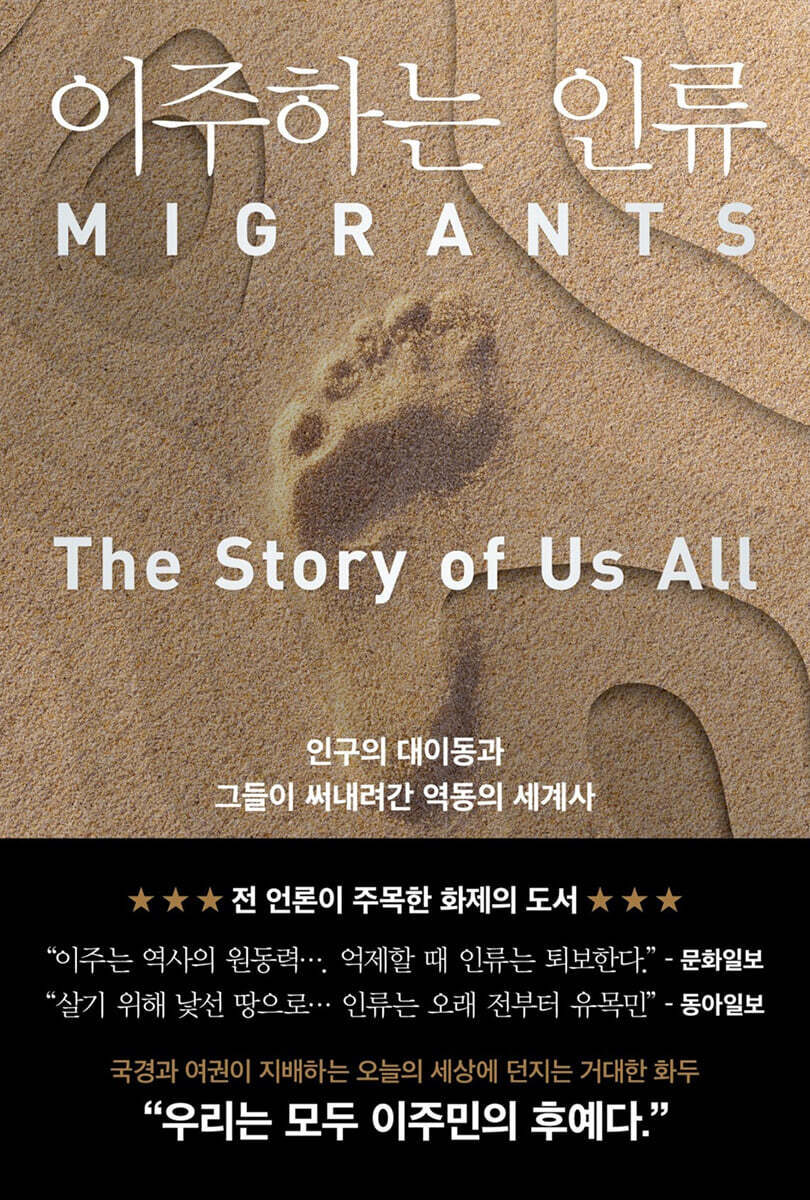
Migrating humanity
 |
Description
Book Introduction
From the Vikings to the Mayflower, from Columbus to Elon Musk
The protagonists of world history have always been immigrants!
Humans are fundamentally migratory animals.
For a long time, all of humanity was nomadic, and some still live as migratory nomads.
It has only been a little over 12,000 years since people began building houses, establishing cities, and settling down.
It was much more recently that borders were drawn and passports were created.
Based on various and interesting stories such as the Garden of Eden, Noah's Ark, the migration of prehistoric Neanderthals and Homo sapiens, the establishment of Greco-Roman settlements, the Vikings of Northern Europe, Columbus's migration to the Americas, the slave trade, the Yellow Menace, Jews, the Civil War, and migrant workers, it suggests how to solve the problems of migration and immigration that we face today.
The protagonists of world history have always been immigrants!
Humans are fundamentally migratory animals.
For a long time, all of humanity was nomadic, and some still live as migratory nomads.
It has only been a little over 12,000 years since people began building houses, establishing cities, and settling down.
It was much more recently that borders were drawn and passports were created.
Based on various and interesting stories such as the Garden of Eden, Noah's Ark, the migration of prehistoric Neanderthals and Homo sapiens, the establishment of Greco-Roman settlements, the Vikings of Northern Europe, Columbus's migration to the Americas, the slave trade, the Yellow Menace, Jews, the Civil War, and migrant workers, it suggests how to solve the problems of migration and immigration that we face today.
- You can preview some of the book's contents.
Preview
index
introduction
Chapter 1: Neanderthals, Sapiens, and the Beagle
- Author's Note, Part 1
Chapter 2 Babylon, the Bible, and Native Americans
- Author's Note, Part 2
Chapter 3: Phoenicians, Greeks, and Aryans
- Author's Note, Third
Chapter 4: The Expulsion, the Romans and the Vandals
- Author's Note, Fourth
Chapter 5: Ancestors of Arabs, Vikings, and the British
- Author's Note, Part 5
Chapter 6 Genoa, Columbus, and Taino
- Author's Note, Sixth
Chapter 7: Virginia, Slavery, and the Mayflower
- Author's Note, Seventh
Chapter 8: Yellow Race, Chinatown, and Fu Manchu
- Author's Note, Eighth
Chapter 9: Zionists, Refugees, and Aunt Polly
- Author's Note, Ninth
Chapter 10: Freedom, Harlem, and the Rainbow Tribe
- Author's Note, Last
Chapter 11: Migrant Workers, the United States, and Mexico
Epilogue
Chapter 1: Neanderthals, Sapiens, and the Beagle
- Author's Note, Part 1
Chapter 2 Babylon, the Bible, and Native Americans
- Author's Note, Part 2
Chapter 3: Phoenicians, Greeks, and Aryans
- Author's Note, Third
Chapter 4: The Expulsion, the Romans and the Vandals
- Author's Note, Fourth
Chapter 5: Ancestors of Arabs, Vikings, and the British
- Author's Note, Part 5
Chapter 6 Genoa, Columbus, and Taino
- Author's Note, Sixth
Chapter 7: Virginia, Slavery, and the Mayflower
- Author's Note, Seventh
Chapter 8: Yellow Race, Chinatown, and Fu Manchu
- Author's Note, Eighth
Chapter 9: Zionists, Refugees, and Aunt Polly
- Author's Note, Ninth
Chapter 10: Freedom, Harlem, and the Rainbow Tribe
- Author's Note, Last
Chapter 11: Migrant Workers, the United States, and Mexico
Epilogue
Into the book
The migration of prehistoric humans was enormous.
The migration of ancient Neanderthals and Sapiens to or within Europe was nothing compared to the migrations from Asia and the Americas.
For Africans to reach Europe, they had to first go to the Middle East, then turn left and follow the coastline of the Mediterranean or North Sea.
The journey to other parts of the world was much more complicated.
Some early settlers followed the coastline into Asia and beyond, stopping off at various islands as far as Australia.
Other migrants went overland to Siberia (or perhaps along the Chinese coast), crossed the Bering Strait, and then traveled down the American continent to the southern tip of what is now Chile.
--- p.29
Before Mesopotamia, about 12,000 years ago, everyone was a migrant.
Since no one had a permanent residence, everyone was an immigrant.
And around that time, a tiny fraction of the world's population began to stop migrating, first in the Middle East and then in other parts of the world.
They stayed in one place and became the first settlers in human history.
It is unclear why this small number of people stopped migrating.
Historians once argued that early humans settled down and began living in villages because they had difficulty finding food by wandering around, so they turned to agriculture to solve the food shortage.
But now it is thought that the opposite is more likely.
Most of these first settlers appear to have lived in areas with abundant food, such as wetlands or areas bordering two climate zones, where enough food was available from nearby nature to sustain a certain population.
--- p.48
There is no need to look hard to find stories about migration in the Bible.
Because immigrants are found everywhere in the Bible, from being driven out of the Garden of Eden, to rebuilding the population after the great flood, to escaping across the Red Sea.
The Bible can be read as a guide to immigration.
Moreover, unlike most immigration-related records, it is no exaggeration to say that the Bible was written by immigrants for immigrants.
Although many of the stories have nothing to do with actual history, they tell us a lot about how people viewed migration when the Old Testament was first written some 2,500 years ago.
--- p.56
The arrival of the new settlers was a significant event because Roman and later records suggest that a new upheaval had begun in Europe.
It was a time of migration for large communities of tens of thousands of people. For example, the Huns moved westward across the center of the map, reaching northern Italy and central France, but never reaching Rome on the Italian peninsula or the Atlantic Ocean.
Pursued by the Huns, the Goths moved to Rome and the Atlantic, and at one time controlled most of the northern Mediterranean coast.
The Vandals appear to have taken the most complex route.
They went west from central Europe through Spain, then south to Morocco, from there they moved east to conquer Carthage, and then north to Sicily and Rome.
Meanwhile, the Angles, who came from the present Danish-German border region, were among the shortest travellers, having crossed the sea to the land that would later bear their name.
--- p.136
Accordingly, various regions were proposed as the supposed homeland of the Aryans, including Germany.
Although these claims were far more flimsy and rife with racism, many scholars in many countries accepted the notion that Aryans were originally blond, blue-eyed, fair-skinned Germans whose physical characteristics were diluted as they migrated and intermarried away from their northern European homelands.
A British-born, German-based writer named Houston Stewart Chamberlain was a key figure in introducing these concepts to Adolf Hitler and the Nazi Party in the 1920s.
Soon the Nazis adopted the ideology that Germans were the original Aryans and the dominant race.
They even adopted the ancient Indian swastika as their party symbol.
--- p.102
The Vikings traveled in three directions, by sea and river, more than 2,000 kilometers from their homeland.
To the northwest, it crossed the Atlantic to Iceland, Greenland, and the coast of Canada; to the southwest to England, France, and the Mediterranean; and to the southeast, through Russia to the Black Sea and Constantinople.
The reasons why the Vikings migrated in this way are not yet clear, but overpopulation in their homeland appears to have been one important reason.
And with their excellent shipbuilding and navigation skills, they had the means to travel longer distances than their contemporaries.
There were numerous other factors at play, including the wealth, power, land, and status that came with expanding into new areas, a desire to escape tyranny, and a deep curiosity.
These factors intertwine to explain the motivations behind the massive Viking migrations that unfolded in three directions and the life choices of the settlers.
--- p.162
Now, let's talk about Joseph Kearney.
He was a middle-aged shoemaker who was born and raised in the small village of Moneygall, County Offaly, Ireland, in the late 18th century.
And like hundreds of thousands of other Irish immigrants, Kearny immigrated to America during the Great Famine, settling in the Midwestern state of Ohio.
He brought his family (wife and three children) from his hometown and they were all able to become American citizens.
Joseph Kearney died as an American citizen, and his descendants later became Presidents of the United States.
Who is that descendant? The answer is Barack Obama.
He was a fifth-generation descendant of Joseph Kearney, a shoemaker in Moneygall.
--- p.233
The story of the American continent cannot be told without mentioning slavery.
There were slaves in New England, Canada, Argentina, and Chile.
There were simply far fewer of them because there were no large-scale farms in those places.
Although some European settlers had ethical reservations about the slave trade, they were a minority, and forcibly brought Africans were sent not only to North America but also to Brazil and the Caribbean.
It was the largest forced migration in history.
The statistics are staggering.
Over a period of about 350 years, approximately 12 million African slaves were brought across the sea.
At least one million Africans who were brought as slaves died on the way from the interior of Africa to the coast, and about two million died crossing the Atlantic Ocean.
This story of the greatest forced migration in history is so full of suffering and death that it is difficult to recall.
--- p.252
Although there has been decades of debate among racial scientists about the number and names of races, the norms surrounding racial classification remained unchanged until the early 19th century.
Linnaeus's successors simply ignored the categories named after continents without any logical reason and replaced them with various variants such as Caucasians, Mongoloid, and Negroid.
By the late 19th century, waves of Chinese immigration had arrived in the United States, Europe, and Australia, and East Asians had become yellow in the public imagination.
While the term "yellow race" was mostly used as a general term with negative connotations, the phrase "yellow peril" became a metaphor for concerns about East Asian immigration that evoked paranoia and extreme anxiety.
--- p.279
Passports and the inequality they symbolize remain central to the immigration narrative.
Today, millions of people in countries at the bottom of the passport index want a better passport, one that gives them the right to live and travel more freely.
If you're rich, it'll be pretty easy.
Because they can benefit from 'investment immigration' worth billions of dollars.
There are plenty of companies willing to guide you through the labyrinthine and complex world of golden visas and "citizenship by investment" for a hefty fee.
For just $500,000, you can 'buy' a passport to one of the Caribbean countries.
If you pay a little more and go through a more complicated process, you can also get a passport from an EU country.
The UK government website lists the eligibility criteria, which state that those who can invest more than 10 million pounds can obtain citizenship quickly.
--- p.315
Immigrants are now people who are either unwanted, unfit to enter the settled world, or both.
And they can be easily blamed for almost anything, becoming enemies or scapegoats.
This could be called a lack of empathy, an inability to understand the lives of people who are not like us.
This lack of empathy is only occasionally compensated for when a child is found dead on a beach while trying to escape a boat, or a group of refugees are found frozen to death, entangled in a refrigerated truck.
For that brief moment, it seems like the whole world is interested in them, but only for a moment.
Because immigrants are not people like us.
This could be said, to put it extremely, to be the oppression of sedentarism.
In a world where staying where you are is the norm, moving is an aberration.
In this world, migration is only permitted in special circumstances, such as when life is at risk or when one's skills are needed in another part of the planet.
--- p.349
The decision by the United States to restrict its borders was partly driven by the sheer number of would-be migrants, but also by concerns among some Americans about what kind of immigrants they would accept.
Americans did not like the "weak and poor" of Lazarus's poem, especially if they were from Southern and Eastern Europe or were Jewish.
The Chinese probably hated it more.
The Chinese were excluded from immigration after 1882, as were other Asian immigrants.
Also, after the passage of the Immigration Act of 1891, those on various lists of "undesirable persons" were excluded.
--- p.354
We do not know exactly how the Earth began to be divided into properties, and we may never know.
Rousseau's words seem very valid, but there is little modern discussion of them, and we do not even try to find a justification for the way the world is divided into property.
So how do we explain to nomads why they can no longer use the land they once used for hunting, gathering, foraging, and grazing their livestock? Is it justifiable for settled people to suddenly restrict their freedom of movement simply by drawing a line down the middle of their land? And why are some people unable to live where they want, while others can freely move anywhere in the world? While some might dismiss these questions, they challenge what sedentary people take for granted, leaving some deeply uncomfortable and even defensive.
--- p.379
In France and Britain, post-war migration became a bigger problem as it became intertwined with the bloody collapse of empires.
Most immigrants came to live legally in France and Britain from the colonies, primarily from the West Indies and South Asia in the British case and North Africa in the French case.
Germany, without an empire, managed to navigate the 1950s and 1960s without race riots or immigrants being murdered on the streets of the capital, aided by a few euphemisms like "Gastarbeiter" and a booming economy.
However, in post-war France and Britain, new myths about immigration were persuasively recreated, mainly by settled white people, and these had a huge impact, completely changing the perspective on immigration.
Various myths that normalized sedentism spread with infectious force throughout the West, and people adopted these new myths as if they had "migration amnesia."
The migration of ancient Neanderthals and Sapiens to or within Europe was nothing compared to the migrations from Asia and the Americas.
For Africans to reach Europe, they had to first go to the Middle East, then turn left and follow the coastline of the Mediterranean or North Sea.
The journey to other parts of the world was much more complicated.
Some early settlers followed the coastline into Asia and beyond, stopping off at various islands as far as Australia.
Other migrants went overland to Siberia (or perhaps along the Chinese coast), crossed the Bering Strait, and then traveled down the American continent to the southern tip of what is now Chile.
--- p.29
Before Mesopotamia, about 12,000 years ago, everyone was a migrant.
Since no one had a permanent residence, everyone was an immigrant.
And around that time, a tiny fraction of the world's population began to stop migrating, first in the Middle East and then in other parts of the world.
They stayed in one place and became the first settlers in human history.
It is unclear why this small number of people stopped migrating.
Historians once argued that early humans settled down and began living in villages because they had difficulty finding food by wandering around, so they turned to agriculture to solve the food shortage.
But now it is thought that the opposite is more likely.
Most of these first settlers appear to have lived in areas with abundant food, such as wetlands or areas bordering two climate zones, where enough food was available from nearby nature to sustain a certain population.
--- p.48
There is no need to look hard to find stories about migration in the Bible.
Because immigrants are found everywhere in the Bible, from being driven out of the Garden of Eden, to rebuilding the population after the great flood, to escaping across the Red Sea.
The Bible can be read as a guide to immigration.
Moreover, unlike most immigration-related records, it is no exaggeration to say that the Bible was written by immigrants for immigrants.
Although many of the stories have nothing to do with actual history, they tell us a lot about how people viewed migration when the Old Testament was first written some 2,500 years ago.
--- p.56
The arrival of the new settlers was a significant event because Roman and later records suggest that a new upheaval had begun in Europe.
It was a time of migration for large communities of tens of thousands of people. For example, the Huns moved westward across the center of the map, reaching northern Italy and central France, but never reaching Rome on the Italian peninsula or the Atlantic Ocean.
Pursued by the Huns, the Goths moved to Rome and the Atlantic, and at one time controlled most of the northern Mediterranean coast.
The Vandals appear to have taken the most complex route.
They went west from central Europe through Spain, then south to Morocco, from there they moved east to conquer Carthage, and then north to Sicily and Rome.
Meanwhile, the Angles, who came from the present Danish-German border region, were among the shortest travellers, having crossed the sea to the land that would later bear their name.
--- p.136
Accordingly, various regions were proposed as the supposed homeland of the Aryans, including Germany.
Although these claims were far more flimsy and rife with racism, many scholars in many countries accepted the notion that Aryans were originally blond, blue-eyed, fair-skinned Germans whose physical characteristics were diluted as they migrated and intermarried away from their northern European homelands.
A British-born, German-based writer named Houston Stewart Chamberlain was a key figure in introducing these concepts to Adolf Hitler and the Nazi Party in the 1920s.
Soon the Nazis adopted the ideology that Germans were the original Aryans and the dominant race.
They even adopted the ancient Indian swastika as their party symbol.
--- p.102
The Vikings traveled in three directions, by sea and river, more than 2,000 kilometers from their homeland.
To the northwest, it crossed the Atlantic to Iceland, Greenland, and the coast of Canada; to the southwest to England, France, and the Mediterranean; and to the southeast, through Russia to the Black Sea and Constantinople.
The reasons why the Vikings migrated in this way are not yet clear, but overpopulation in their homeland appears to have been one important reason.
And with their excellent shipbuilding and navigation skills, they had the means to travel longer distances than their contemporaries.
There were numerous other factors at play, including the wealth, power, land, and status that came with expanding into new areas, a desire to escape tyranny, and a deep curiosity.
These factors intertwine to explain the motivations behind the massive Viking migrations that unfolded in three directions and the life choices of the settlers.
--- p.162
Now, let's talk about Joseph Kearney.
He was a middle-aged shoemaker who was born and raised in the small village of Moneygall, County Offaly, Ireland, in the late 18th century.
And like hundreds of thousands of other Irish immigrants, Kearny immigrated to America during the Great Famine, settling in the Midwestern state of Ohio.
He brought his family (wife and three children) from his hometown and they were all able to become American citizens.
Joseph Kearney died as an American citizen, and his descendants later became Presidents of the United States.
Who is that descendant? The answer is Barack Obama.
He was a fifth-generation descendant of Joseph Kearney, a shoemaker in Moneygall.
--- p.233
The story of the American continent cannot be told without mentioning slavery.
There were slaves in New England, Canada, Argentina, and Chile.
There were simply far fewer of them because there were no large-scale farms in those places.
Although some European settlers had ethical reservations about the slave trade, they were a minority, and forcibly brought Africans were sent not only to North America but also to Brazil and the Caribbean.
It was the largest forced migration in history.
The statistics are staggering.
Over a period of about 350 years, approximately 12 million African slaves were brought across the sea.
At least one million Africans who were brought as slaves died on the way from the interior of Africa to the coast, and about two million died crossing the Atlantic Ocean.
This story of the greatest forced migration in history is so full of suffering and death that it is difficult to recall.
--- p.252
Although there has been decades of debate among racial scientists about the number and names of races, the norms surrounding racial classification remained unchanged until the early 19th century.
Linnaeus's successors simply ignored the categories named after continents without any logical reason and replaced them with various variants such as Caucasians, Mongoloid, and Negroid.
By the late 19th century, waves of Chinese immigration had arrived in the United States, Europe, and Australia, and East Asians had become yellow in the public imagination.
While the term "yellow race" was mostly used as a general term with negative connotations, the phrase "yellow peril" became a metaphor for concerns about East Asian immigration that evoked paranoia and extreme anxiety.
--- p.279
Passports and the inequality they symbolize remain central to the immigration narrative.
Today, millions of people in countries at the bottom of the passport index want a better passport, one that gives them the right to live and travel more freely.
If you're rich, it'll be pretty easy.
Because they can benefit from 'investment immigration' worth billions of dollars.
There are plenty of companies willing to guide you through the labyrinthine and complex world of golden visas and "citizenship by investment" for a hefty fee.
For just $500,000, you can 'buy' a passport to one of the Caribbean countries.
If you pay a little more and go through a more complicated process, you can also get a passport from an EU country.
The UK government website lists the eligibility criteria, which state that those who can invest more than 10 million pounds can obtain citizenship quickly.
--- p.315
Immigrants are now people who are either unwanted, unfit to enter the settled world, or both.
And they can be easily blamed for almost anything, becoming enemies or scapegoats.
This could be called a lack of empathy, an inability to understand the lives of people who are not like us.
This lack of empathy is only occasionally compensated for when a child is found dead on a beach while trying to escape a boat, or a group of refugees are found frozen to death, entangled in a refrigerated truck.
For that brief moment, it seems like the whole world is interested in them, but only for a moment.
Because immigrants are not people like us.
This could be said, to put it extremely, to be the oppression of sedentarism.
In a world where staying where you are is the norm, moving is an aberration.
In this world, migration is only permitted in special circumstances, such as when life is at risk or when one's skills are needed in another part of the planet.
--- p.349
The decision by the United States to restrict its borders was partly driven by the sheer number of would-be migrants, but also by concerns among some Americans about what kind of immigrants they would accept.
Americans did not like the "weak and poor" of Lazarus's poem, especially if they were from Southern and Eastern Europe or were Jewish.
The Chinese probably hated it more.
The Chinese were excluded from immigration after 1882, as were other Asian immigrants.
Also, after the passage of the Immigration Act of 1891, those on various lists of "undesirable persons" were excluded.
--- p.354
We do not know exactly how the Earth began to be divided into properties, and we may never know.
Rousseau's words seem very valid, but there is little modern discussion of them, and we do not even try to find a justification for the way the world is divided into property.
So how do we explain to nomads why they can no longer use the land they once used for hunting, gathering, foraging, and grazing their livestock? Is it justifiable for settled people to suddenly restrict their freedom of movement simply by drawing a line down the middle of their land? And why are some people unable to live where they want, while others can freely move anywhere in the world? While some might dismiss these questions, they challenge what sedentary people take for granted, leaving some deeply uncomfortable and even defensive.
--- p.379
In France and Britain, post-war migration became a bigger problem as it became intertwined with the bloody collapse of empires.
Most immigrants came to live legally in France and Britain from the colonies, primarily from the West Indies and South Asia in the British case and North Africa in the French case.
Germany, without an empire, managed to navigate the 1950s and 1960s without race riots or immigrants being murdered on the streets of the capital, aided by a few euphemisms like "Gastarbeiter" and a booming economy.
However, in post-war France and Britain, new myths about immigration were persuasively recreated, mainly by settled white people, and these had a huge impact, completely changing the perspective on immigration.
Various myths that normalized sedentism spread with infectious force throughout the West, and people adopted these new myths as if they had "migration amnesia."
--- p.393
Publisher's Review
I believe that migration or immigration has become a representative topic that encompasses all the issues that permeate our lives and thoughts: identity, ethnicity, religion, patriotism, nostalgia, integration, multiculturalism, security, terrorism, racism, etc.
Because immigration or migration was a very important factor historically and culturally.
Whether we are immigrants or not, we are all descendants of immigrants.
The role of migration in human history has been underestimated, overlooked, or misunderstood.
There are several plausible reasons for this.
Most people today have a fixed home address and nationality.
Many people also own land and houses.
We stay in one place and belong somewhere.
But all this is only a very short part of the long history of mankind.
Having a fixed residence and nationality is often considered a human condition, but I believe that in some ways the opposite is true.
Humanity has migrated at an almost unprecedented rate and has the ability to thrive wherever it goes.
If we acknowledge this, our view of the world may change.
- From the author's preface
“All things are in flux.” - Heraclitus
We are all descendants of immigrants
Humans are fundamentally a migratory species, with a stronger migratory instinct than any other mammal on earth.
As we go through life, we generally move from place to place, and some even live a nomadic life.
The concept of home and permanent residence is a very recent phenomenon in human history.
Not to mention the emergence of borders and passports.
From Neanderthals to Alexander the Great, Christopher Columbus and Pocahontas, the African slave trade, Fu Manchu and Barack Obama, the author recounts the history of human migration and suggests ways to address the migration and immigration issues we face today.
『Migrating Humanity』 shows that the concept of migration has been at the center of human history.
There are many reasons why humans migrate.
It's not just about escaping war, poverty, or climate change; curiosity and a sense of adventure are what drive people to leave their homes.
Upon arrival in a foreign country, immigrants are faced with a choice: assimilate into the local culture or retain their old identity.
It is not easy to embrace a new culture while preserving one's own heritage.
Immigrants were either despised or revered, banished, feared or romanticized.
In this book, the author says that all these stories are not new.
This is a story that has been repeated throughout history, and if we go back further, it is the story of all of us, whether we are immigrants or not.
Moving rather than stopping is a universal norm, and it can be said that migration is more normal than settling in human behavior.
Although COVID-19 forced a temporary ban on human movement, the migratory instinct deeply embedded in human genes has not disappeared.
This book is an interesting history book that helps us understand, even if only a little, the instinct for migration that has continued from the beginning of humanity to the present day, and recognize the history of immigrants as part of our own history.
We forget that humans migrate because they are bored, curious, adventurous, enjoy a challenge, or want to fulfill their dreams.
For thousands of years, humans have migrated to nearly every corner of the Earth, and despite all attempts to stop it, they continue to do so.
The history of migration is one of the things that clearly distinguishes humans from our closest cousins, the apes.
We must not forget that.
And as immigrants and descendants of immigrants, we must acknowledge that our history is something we all have in common.
- Author's Note, p. 419
Because immigration or migration was a very important factor historically and culturally.
Whether we are immigrants or not, we are all descendants of immigrants.
The role of migration in human history has been underestimated, overlooked, or misunderstood.
There are several plausible reasons for this.
Most people today have a fixed home address and nationality.
Many people also own land and houses.
We stay in one place and belong somewhere.
But all this is only a very short part of the long history of mankind.
Having a fixed residence and nationality is often considered a human condition, but I believe that in some ways the opposite is true.
Humanity has migrated at an almost unprecedented rate and has the ability to thrive wherever it goes.
If we acknowledge this, our view of the world may change.
- From the author's preface
“All things are in flux.” - Heraclitus
We are all descendants of immigrants
Humans are fundamentally a migratory species, with a stronger migratory instinct than any other mammal on earth.
As we go through life, we generally move from place to place, and some even live a nomadic life.
The concept of home and permanent residence is a very recent phenomenon in human history.
Not to mention the emergence of borders and passports.
From Neanderthals to Alexander the Great, Christopher Columbus and Pocahontas, the African slave trade, Fu Manchu and Barack Obama, the author recounts the history of human migration and suggests ways to address the migration and immigration issues we face today.
『Migrating Humanity』 shows that the concept of migration has been at the center of human history.
There are many reasons why humans migrate.
It's not just about escaping war, poverty, or climate change; curiosity and a sense of adventure are what drive people to leave their homes.
Upon arrival in a foreign country, immigrants are faced with a choice: assimilate into the local culture or retain their old identity.
It is not easy to embrace a new culture while preserving one's own heritage.
Immigrants were either despised or revered, banished, feared or romanticized.
In this book, the author says that all these stories are not new.
This is a story that has been repeated throughout history, and if we go back further, it is the story of all of us, whether we are immigrants or not.
Moving rather than stopping is a universal norm, and it can be said that migration is more normal than settling in human behavior.
Although COVID-19 forced a temporary ban on human movement, the migratory instinct deeply embedded in human genes has not disappeared.
This book is an interesting history book that helps us understand, even if only a little, the instinct for migration that has continued from the beginning of humanity to the present day, and recognize the history of immigrants as part of our own history.
We forget that humans migrate because they are bored, curious, adventurous, enjoy a challenge, or want to fulfill their dreams.
For thousands of years, humans have migrated to nearly every corner of the Earth, and despite all attempts to stop it, they continue to do so.
The history of migration is one of the things that clearly distinguishes humans from our closest cousins, the apes.
We must not forget that.
And as immigrants and descendants of immigrants, we must acknowledge that our history is something we all have in common.
- Author's Note, p. 419
GOODS SPECIFICS
- Date of issue: July 20, 2023
- Page count, weight, size: 424 pages | 656g | 153*224*26mm
- ISBN13: 9791192519135
- ISBN10: 1192519132
You may also like
카테고리
korean


korean

![GQ KOREA Mark (Monthly): December [2025]](http://librairie.coreenne.fr/cdn/shop/files/8ef265dbbfbf186523ed75ba7319009d.jpg?v=1765340328&width=3840)


