

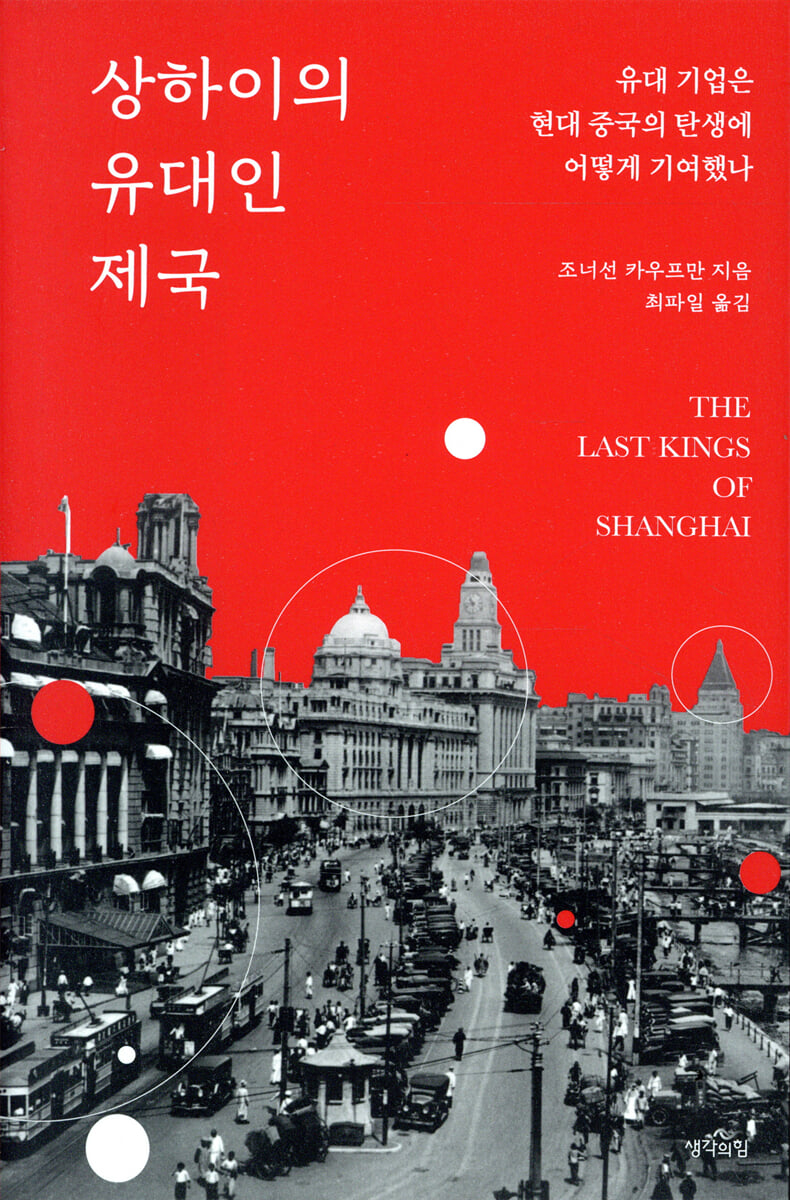
Jewish Empire in Shanghai
 |
Description
Book Introduction
The growth and contradictions surrounding Shanghai in the early 20th century
In search of a mosaic of history buried in the '100 years of shame'
"The Jewish Empire of Shanghai" is a non-fiction book that restores the hidden 100 years of the Xu and Qing families, two rival families who formed a vast corporate empire at the center of modern and contemporary Chinese history.
Jonathan Kaufman, who worked as a China reporter for the Wall Street Journal, Bloomberg, and Boston Globe for nearly 30 years and even won a Pulitzer Prize, used meticulous research, numerous interviews, and a novelist's writing style to reveal to the world the legacy of Xu Sun and Ke Du Li, who amassed enormous wealth during China's modernization process.
This book received enthusiastic attention from influential media outlets from the time of its publication, as it delved into the hidden history that the Chinese government had attempted to conceal, calling it the "100 Years of Humiliation," from the end of the First Opium War in 1842 until the Communist Party came to power in 1949.
The author's persistent pursuit connects not only with modern and contemporary Chinese history but also with the broader context of globalization, guiding readers through the turbulent history of the early 20th century alongside the footsteps of Xu Sun and Ke Du Li.
The choices of the two families also send an important message to us living in the 21st century.
Because military and diplomatic friction between China and the world is still ongoing.
The growth and development, struggles and contradictions they endured a century ago can serve as a useful tool for deciphering the hidden context in today's turbulent international situation.
In search of a mosaic of history buried in the '100 years of shame'
"The Jewish Empire of Shanghai" is a non-fiction book that restores the hidden 100 years of the Xu and Qing families, two rival families who formed a vast corporate empire at the center of modern and contemporary Chinese history.
Jonathan Kaufman, who worked as a China reporter for the Wall Street Journal, Bloomberg, and Boston Globe for nearly 30 years and even won a Pulitzer Prize, used meticulous research, numerous interviews, and a novelist's writing style to reveal to the world the legacy of Xu Sun and Ke Du Li, who amassed enormous wealth during China's modernization process.
This book received enthusiastic attention from influential media outlets from the time of its publication, as it delved into the hidden history that the Chinese government had attempted to conceal, calling it the "100 Years of Humiliation," from the end of the First Opium War in 1842 until the Communist Party came to power in 1949.
The author's persistent pursuit connects not only with modern and contemporary Chinese history but also with the broader context of globalization, guiding readers through the turbulent history of the early 20th century alongside the footsteps of Xu Sun and Ke Du Li.
The choices of the two families also send an important message to us living in the 21st century.
Because military and diplomatic friction between China and the world is still ongoing.
The growth and development, struggles and contradictions they endured a century ago can serve as a useful tool for deciphering the hidden context in today's turbulent international situation.
- You can preview some of the book's contents.
Preview
index
Characters
map
Introduction
Part 1: Shanghai Calls
Chapter 1: Patriarch
Chapter 2: The Empire of Sons and the Empire of Opium
Chapter 3 Laura and Ellie
Part 2: The Big Shots of Shanghai
Chapter 4: Rising Shanghai
Chapter 5: Box Office Stocks
Chapter 6: "I'm Walking a Tightrope"
Chapter 7 War
Chapter 8: "I Abandoned India, and China Abandoned Me"
Part 3: Exile and Return
Chapter 9: Conclusion
Chapter 10, Last Taipan
Chapter 11: Return to Waitan
Acknowledgements
annotation
Search
map
Introduction
Part 1: Shanghai Calls
Chapter 1: Patriarch
Chapter 2: The Empire of Sons and the Empire of Opium
Chapter 3 Laura and Ellie
Part 2: The Big Shots of Shanghai
Chapter 4: Rising Shanghai
Chapter 5: Box Office Stocks
Chapter 6: "I'm Walking a Tightrope"
Chapter 7 War
Chapter 8: "I Abandoned India, and China Abandoned Me"
Part 3: Exile and Return
Chapter 9: Conclusion
Chapter 10, Last Taipan
Chapter 11: Return to Waitan
Acknowledgements
annotation
Search
Detailed image

Into the book
The world this book depicts is very similar to today's, marked by innovation, globalization, growing inequality, and political upheaval.
Long before Mark Zuckerberg, Steve Jobs, Microsoft, and Google were grappling with how to deal with China and American political pressure, the Sasseons and the Kuduri families, with their companies in Shanghai, Hong Kong, Bombay, and London, were wrestling with the political and moral dilemmas of allying with China while controlling the global economy.
---From the "Introductory Note"
In the 19th and 20th centuries, they became accustomed to being called the "Rothschilds of Asia" by their business partners and competitors, as the family's wealth and influence rapidly spread throughout China, India, and Europe.
But deep down, they felt that such a comparison was misleading and somewhat degrading to them.
To the West, the Rothschilds, though magnates and politically influential, were merely a generation of impoverished families from the ghettos of Europe.
The Xu Shuns may not have been known to the Chinese emperors, Indian monarchs, or British royalty, but they were wealthy, prominent, and powerful for centuries.
---From "Chapter 1: The Patriarch"
Looking back now, it's easy to criticize David for his enthusiastic embrace of colonialism and imperialism.
In Europe, Russia, and later the United States, many Jews, faced with similar moral choices posed by colonialism and inhumane capitalism, embraced socialism and revolution.
David was a forerunner of the figures who would emerge as industrialization and modern finance swept the globe.
A type of liberal Jewish businessman who achieves enormous financial success through his exceptional skills and talent, but is also more socially and politically progressive because of his history of personal suffering and commitment to the Jewish value system.
---From "Chapter 1: The Patriarch"
Since the Opium Wars, China's greatest minds have wrestled with how to respond to a West better equipped with far more advanced technology.
Shanghai now offers Chinese entrepreneurs an answer: learn from foreign entrepreneurs.
And take advantage of the city's open borders and foreign competition.
For some Chinese, Shanghai was a daily reminder of China's military defeats and humiliations, while for others it offered a glimpse into the future.
---From "Chapter 4: Rising Shanghai"
Winston Churchill, a rising politician in London, dismissed Gandhi and his civil disobedience movement as a “disturbing and disgusting” endeavor by “a subversive mendicant who is half-naked and strutting down the steps of the Viceroy’s Palace.”
But Victor, who knew Churchill socially, warned a friend in a letter that the name Gandhi was “a magic name in India.”
He believed that Britain could not continue its colonial rule by imprisoning Gandhi.
---From "Chapter 5 Box Office Stocks"
As a journalist, Emily witnessed the imbalance between Chinese poverty and foreign affluence, which fueled support for the Communist Party.
Although she also hung out with millionaires like Victor, her Chinese lover, Xiao Xunmei, introduced her to Chinese leftist thinkers and intellectuals, including Zhou Enlai.
“Even the nobles here, the nobles I know, recognize that communism is the only way out,” Han wrote.
---From "Chapter 5 Box Office Stocks"
Victor contacted Charlie Chaplin to ask for his help in raising funds for Shanghai Jewish refugees in the United States and Europe.
He encouraged other Hollywood stars to follow his example and donate a portion of their earnings from film appearances, just as Chaplin did when he donated a portion of his earnings from the film "The Dictator."
---From Chapter 6, “I’m Walking a Tightrope”
Shanghai has begun its next transformation.
Contrary to Victor's prediction that the Communists would also work with him and other foreign businessmen, Shanghai's new rulers began a slow but relentless takeover of the businesses of the Kuduri and Xu Shun families.
They immediately seized control of companies crucial to the city's operation, such as the Shanghai Gas Company of the Kuduri family.
Instead of immediately confiscating private property and driving out foreigners, the Communists decided to extract as much as possible from foreign companies.
They kept pushing tax bills, regulations, and worker demands.
And until this demand was met, the company's foreign executives were not allowed to leave China.
China suffered “a century of humiliation” at the hands of capitalists like the Kuduri and Xu Shuang.
Now it was the foreigners' turn to be humiliated.
---From Chapter 8, “I Abandoned India, and China Abandoned Me”
For a century, he met with and advised every Chinese leader except Mao Zedong.
Michael now meets occasionally with Deng Xiaoping's successors and China's powerful new president, Xi Jinping.
At a meeting attended by Xi Jinping and some 20 Hong Kong business leaders, Michael was the only Westerner.
The city mayor took a moment to send an aide to shake Michael's hand and convey the message, "Your family has always been a friend of China."
---From "Chapter 11: Return to Waitan"
The Xu Shuns and the Kedu Lis exploited Shanghai, but they also ignited an economic boom that attracted the Long family and millions of others.
As China struggled to shed its rigid feudal society and enter a modern industrial society, they found in the city a place to pursue their bold business dreams.
It was the Chinese who transformed Shanghai and China.
Seosun-ga and Keuduri-ga helped light the fuse.
At a time when China and much of the world are erecting physical, political, and cyber barriers to restrict immigration and the free flow of people, ideas, and information, Shanghai has lessons to teach us.
Long before Mark Zuckerberg, Steve Jobs, Microsoft, and Google were grappling with how to deal with China and American political pressure, the Sasseons and the Kuduri families, with their companies in Shanghai, Hong Kong, Bombay, and London, were wrestling with the political and moral dilemmas of allying with China while controlling the global economy.
---From the "Introductory Note"
In the 19th and 20th centuries, they became accustomed to being called the "Rothschilds of Asia" by their business partners and competitors, as the family's wealth and influence rapidly spread throughout China, India, and Europe.
But deep down, they felt that such a comparison was misleading and somewhat degrading to them.
To the West, the Rothschilds, though magnates and politically influential, were merely a generation of impoverished families from the ghettos of Europe.
The Xu Shuns may not have been known to the Chinese emperors, Indian monarchs, or British royalty, but they were wealthy, prominent, and powerful for centuries.
---From "Chapter 1: The Patriarch"
Looking back now, it's easy to criticize David for his enthusiastic embrace of colonialism and imperialism.
In Europe, Russia, and later the United States, many Jews, faced with similar moral choices posed by colonialism and inhumane capitalism, embraced socialism and revolution.
David was a forerunner of the figures who would emerge as industrialization and modern finance swept the globe.
A type of liberal Jewish businessman who achieves enormous financial success through his exceptional skills and talent, but is also more socially and politically progressive because of his history of personal suffering and commitment to the Jewish value system.
---From "Chapter 1: The Patriarch"
Since the Opium Wars, China's greatest minds have wrestled with how to respond to a West better equipped with far more advanced technology.
Shanghai now offers Chinese entrepreneurs an answer: learn from foreign entrepreneurs.
And take advantage of the city's open borders and foreign competition.
For some Chinese, Shanghai was a daily reminder of China's military defeats and humiliations, while for others it offered a glimpse into the future.
---From "Chapter 4: Rising Shanghai"
Winston Churchill, a rising politician in London, dismissed Gandhi and his civil disobedience movement as a “disturbing and disgusting” endeavor by “a subversive mendicant who is half-naked and strutting down the steps of the Viceroy’s Palace.”
But Victor, who knew Churchill socially, warned a friend in a letter that the name Gandhi was “a magic name in India.”
He believed that Britain could not continue its colonial rule by imprisoning Gandhi.
---From "Chapter 5 Box Office Stocks"
As a journalist, Emily witnessed the imbalance between Chinese poverty and foreign affluence, which fueled support for the Communist Party.
Although she also hung out with millionaires like Victor, her Chinese lover, Xiao Xunmei, introduced her to Chinese leftist thinkers and intellectuals, including Zhou Enlai.
“Even the nobles here, the nobles I know, recognize that communism is the only way out,” Han wrote.
---From "Chapter 5 Box Office Stocks"
Victor contacted Charlie Chaplin to ask for his help in raising funds for Shanghai Jewish refugees in the United States and Europe.
He encouraged other Hollywood stars to follow his example and donate a portion of their earnings from film appearances, just as Chaplin did when he donated a portion of his earnings from the film "The Dictator."
---From Chapter 6, “I’m Walking a Tightrope”
Shanghai has begun its next transformation.
Contrary to Victor's prediction that the Communists would also work with him and other foreign businessmen, Shanghai's new rulers began a slow but relentless takeover of the businesses of the Kuduri and Xu Shun families.
They immediately seized control of companies crucial to the city's operation, such as the Shanghai Gas Company of the Kuduri family.
Instead of immediately confiscating private property and driving out foreigners, the Communists decided to extract as much as possible from foreign companies.
They kept pushing tax bills, regulations, and worker demands.
And until this demand was met, the company's foreign executives were not allowed to leave China.
China suffered “a century of humiliation” at the hands of capitalists like the Kuduri and Xu Shuang.
Now it was the foreigners' turn to be humiliated.
---From Chapter 8, “I Abandoned India, and China Abandoned Me”
For a century, he met with and advised every Chinese leader except Mao Zedong.
Michael now meets occasionally with Deng Xiaoping's successors and China's powerful new president, Xi Jinping.
At a meeting attended by Xi Jinping and some 20 Hong Kong business leaders, Michael was the only Westerner.
The city mayor took a moment to send an aide to shake Michael's hand and convey the message, "Your family has always been a friend of China."
---From "Chapter 11: Return to Waitan"
The Xu Shuns and the Kedu Lis exploited Shanghai, but they also ignited an economic boom that attracted the Long family and millions of others.
As China struggled to shed its rigid feudal society and enter a modern industrial society, they found in the city a place to pursue their bold business dreams.
It was the Chinese who transformed Shanghai and China.
Seosun-ga and Keuduri-ga helped light the fuse.
At a time when China and much of the world are erecting physical, political, and cyber barriers to restrict immigration and the free flow of people, ideas, and information, Shanghai has lessons to teach us.
---From "Chapter 11: Return to Waitan"
Publisher's Review
* tvN [Naked World History] Highly recommended by lecturer Professor Young-Hwi Yoon!
* Recommended by influential international media outlets such as [Financial Times], [Forbes], [Wall Street Journal], and [Economist]!
* “A Vivid History Seen Through the Lens of Jewish Rival Families” by Amy Chua, author of Political Tribalism
* “A captivating story set on a global stage”_Susanna Hessel, Professor Emeritus, Dartmouth College
“This is what once promised another China.
“One memory, one dream about Shanghai.”
A hidden century restored by a Pulitzer Prize-winning author.
The Forgotten History of the Jewish Corporate Empire That Contributed to the Birth of Modern China
"The Jewish Empire of Shanghai" is a non-fiction book that restores the hidden 100 years of the Xu and Qing families, two rival families who formed a vast corporate empire at the center of modern and contemporary Chinese history.
Jonathan Kaufman, who worked as a China reporter for the Wall Street Journal, Bloomberg, and Boston Globe for nearly 30 years and even won a Pulitzer Prize, used meticulous research, numerous interviews, and a novelist's writing style to reveal to the world the legacy of Xu Sun and Ke Du Li, who amassed enormous wealth during China's modernization process.
"The Jewish Empire of Shanghai" received enthusiastic attention from influential media outlets from the time of its publication because it delved into the hidden history that the Chinese government had tried to hide.
For decades, China's Communist rulers have covered up the story of two Jewish families who ruled Shanghai.
Chinese historical narratives record the period from the end of the First Opium War in 1842 to the Communist takeover in 1949 as a "hundred years of humiliation" during which China was trampled by foreign powers.
That is why the story of the Jewish companies Xushun and Kuduri was not specifically mentioned or addressed, but rather appeared as a propaganda narrative about Mao Zedong and his dedicated communist army overthrowing greedy capitalists.
For the Chinese, Shanghai was a reminder of “military defeat and humiliation.”
But the author shows that there was another truth to the '100 Years of Shame'.
For some Chinese, Shanghai “illuminated the future.”
Shanghai was a virtually unknown city until the Treaty of Nanking was signed in 1842.
But in just over 50 years, by 1895, it had a tram system and gas supply network on par with London's, and by the 1930s it had grown into the world's fourth-largest city, with skyscrapers and a skyline rivaling those of Chicago and New York.
At the center of this dramatic change were Jewish companies such as Sessions and Curduri.
They exploited Shanghai, benefiting from imperialism, but also fueled its economic boom and instilled a culture steeped in entrepreneurship.
As China struggled to shed its rigid feudal society and enter a modern industrial society, countless Chinese chose Shanghai as the place to pursue their bold business dreams.
Two Jewish families contributed to the birth of modern China and “transformed the lives of hundreds of millions.”
Their decisions changed the lives of hundreds of millions.
The Xu Shunzai helped stabilize the Chinese economy in the 1930s, when the rest of the world was in recession.
They nurtured a generation of Chinese within global capitalism, paving the way for China's remarkable success today.
The cable car brought electricity to millions of Hong Kong residents and transformed areas where life had been stagnant for centuries.
After 1949, the Kuduri family's decision to join forces with Chinese factory owners from Shanghai who had fled communism opened up global markets, spurred Hong Kong's growth, and set the stage for the export boom that made China the world's factory in the 21st century.
Page 39, [Introduction]
“Everyone knows that name”
Two billionaires who achieved success from contrasting positions
Passing through generations, it finally becomes a part of history.
"The more I got into the work, it really seemed like two stories," Jonathan Kaufman said in an interview.
“One is about two Jewish families, and the other is about modernization and globalization, which was the first way China connected with the world,” he said, revealing that the stories of the two families are connected not only to modern and contemporary Chinese history but also to the larger context of globalization.
The author's meticulous tracing takes readers through the turbulent history of the early 20th century, following in the footsteps of Seo Sun and Keuduri.
The two Jewish families that ruled Shanghai had their roots in Baghdad in the Middle East.
David Sassoon was born into the Jewish ruling class, an economic advisory family under the Ottoman Empire, but fled his hometown amidst power struggles among the rulers.
However, he had the reputation of the Sursoon family, known as the 'Rothschild of Asia', and he expanded his trading business by traveling alone between the Middle East and India.
He was “a descendant of a noble family that had made a successful comeback.”
Ellie Curduri, on the other hand, started from the bottom.
Having lost his father at an early age and entered a vocational school founded by David Sassoon at the age of fifteen, he was “a man struggling to climb the ladder of success” without any tradition, authority, or connections.
After graduation, he worked for Seosun Enterprise, but became independent after an incident in which the company distributed disinfectant to Chinese employees without permission to prevent an infectious disease.
The two contrasting patriarchs established themselves in Shanghai, which was then run like a corporate republic as the International Concession after the Opium Wars, and expanded their businesses over the next several generations.
He invested the money he earned from the opium trade in real estate and infrastructure projects, and won Chiang Kai-shek's favor by supporting the Kuomintang.
Although the Seosunga and Keuduriga survived the Japanese occupation, their fates diverged due to different political decisions made after the Communist Party took power.
The choices of the two families also send an important message to us living in the 21st century.
This is because the so-called 'China Exodus' is currently underway, with Western companies leaving China, unable to withstand various regulations and interferences, including the US-China conflict.
The growth and development, struggles and contradictions they endured a century ago can serve as a useful tool for deciphering the hidden context in today's turbulent international situation.
The challenges facing China today—working with foreigners, inequality and corruption, finding China's place in the world, balancing nationalism and openness, democracy and political control, diversity and change—are the very issues that shaped Shanghai and that Kerduri and Xu Sun face every day.
Shanghai, along with the two families, and its growth and development, struggles and contradictions, are the main characters of this book.
Page 41, [Introduction]
The irony of history in early 20th-century Shanghai:
The spirit of capitalism and socialist revolution that were achieved amidst the humiliation of colonialism,
Political and Moral Dilemmas of Global Corporations
In the early 20th century, Shanghai unabashedly embraced the capitalist perspectives brought by the great business families.
Thousands of Chinese people poured into Shanghai with dreams of working for the foreign companies lining the Bund.
They lived like immigrants in their own country.
Even though they lived in crowded slums, they worked hard and learned innovative entrepreneurship.
The Chinese established cotton, rubber, tobacco, iron, flour, and food processing companies.
More than half of the new factories built in China between the late 19th century and the 1920s were built in Shanghai.
When Joseph Stilwell, an American soldier who would later play a pivotal role in shaping American views of China and relations with China during World War II, first visited Shanghai in the 1920s, he was struck by the city's modernity.
Instead of an Oriental skyline of wooden pagodas and temples with gently sloping roofs, Stillwell saw modern hotels, banks, boulevards, and Western-style parks.
(...) He could not help but admire the energy of the Chinese people.
“If properly guided, the 400 million people with working and manufacturing capabilities will rule the world, and we would do well to be on their side,” he wrote in his diary.
Page 141, Chapter 4 [Rising Shanghai]
But behind the glitzy skyline and skyscrapers, Chinese people were growing increasingly discontented with persistent inequality and poverty.
Ironically, the cosmopolitan atmosphere and free press of the Shanghai International Settlement became a base for the Communist Party, weakened by the suppression of the Kuomintang government, to organize the revolution.
Mao Zedong lived in Shanghai and held the Communist Party's first national congress in 1921, while Zhou Enlai launched an armed uprising in 1927.
The Communist Party finally took power in 1949 and thereafter took complete control of Shanghai and imprisoned capitalists.
Xu Shun and Ke Du Li, who had fostered the growth of Chinese capitalism in the wake of imperialist influence, ultimately deepened and neglected the gap between the rich and the poor, thereby providing the spark for socialist revolution.
He ruined countless Chinese lives through the opium trade, was a beneficiary of imperialism by supporting Britain, and opposed the introduction of democracy in Hong Kong.
But on the other hand, they also joined forces for the first time to protect Jewish refugees who had entered Shanghai to escape the Nazis.
Their efforts saved the lives of 18,000 Jewish refugees.
While the author acknowledges the achievements of following the changing tides of the West and the Curtain, he never loses his objective judgment.
They chose commercial interests over political freedom and morality, and although they were excellent businessmen, they were always caught in political and moral dilemmas.
This is a dilemma that 21st century global companies such as Google, Facebook, and Apple face at every moment, and it is very suggestive.
“What does Shanghai’s past tell us about China’s future?”
Shanghai and Beijing: A Crossroads for 21st-Century China
Modern China has become the global power that its Communist leaders and people have long desired.
China boasts the world's second-largest economy after the United States, and also possesses formidable military power.
But China's approach to engaging with the world still creates frequent friction.
Even recently, diplomatic issues have continued to arise, including the military tensions with the United States, which have been called the "New Cold War," the "One Belt, One Road" project that aims to check this tension while expanding influence in Europe and Africa, and the "operation of illegal overseas police organizations," which has been controversial as an infringement on the sovereignty of other countries.
The author reconstructs the legacy of two Jewish families while also shedding light on a long-standing debate in China.
This is the debate surrounding “two different paths for China’s future,” represented by Shanghai and Beijing.
Shanghai still embraces innovation today.
Beijing, on the other hand, is more inward-looking and nationalistic, once the seat of the emperor and now the Communist Party leadership.
The contrasting histories of the two cities have also changed the emotions of the people who live there.
Chinese in Shanghai ridicule their compatriots in Beijing as being crude, narrow-minded, and suspicious of the outside world.
On the other hand, Chinese people living in Beijing look down on Shanghainese people as being only interested in money and fashion and as being obsessed with foreign culture.
“As China’s power and influence grows, these differences become more important,” the author says.
Because these differences “will shape China’s attitude toward the world” (p. 402).
Embracing conflicting identities and standing at a crossroads in the 21st century, what choice will China make? And how will the world treat China? The answer to this persistent and perilous question may lie in history.
In the 『Jewish Empire of Shanghai』, where the contradictions and ironies that created modern China, untouched by human footsteps, lie quietly dormant.
The Jewish Empire of Shanghai has contemporary relevance.
As is well known, Chinese historical narratives view the period from the First Opium War in 1842 to the rise of the Chinese Communist Party to power in 1949 as a "hundred years of humiliation" during which China suffered under foreign powers.
However, this book raises the possibility of an alternative narrative to this interpretation of history.
In fact, Shanghai built a world-class transportation network and gas supply network during this period.
It boasted a skyline comparable to that of Chicago or New York along the coast, and prospered even during the Great Depression of the 1930s.
And at the heart of this change were, surprisingly, Jewish families who had originated in Baghdad in the Middle East and settled in Shanghai.
The choices made by the Xu Shu and Kedu families, representing Western capitalists, at pivotal moments in Chinese history—the Sino-Japanese War, the Chinese Civil War, and the Communist Party's rise to power—offer a glimpse into how Chinese people today address the challenges they face, and how the world addresses China's problems.
Yoon Young-hwi (Professor of History, Kyungpook National University, lecturer on tvN's "Naked World History")
* Recommended by influential international media outlets such as [Financial Times], [Forbes], [Wall Street Journal], and [Economist]!
* “A Vivid History Seen Through the Lens of Jewish Rival Families” by Amy Chua, author of Political Tribalism
* “A captivating story set on a global stage”_Susanna Hessel, Professor Emeritus, Dartmouth College
“This is what once promised another China.
“One memory, one dream about Shanghai.”
A hidden century restored by a Pulitzer Prize-winning author.
The Forgotten History of the Jewish Corporate Empire That Contributed to the Birth of Modern China
"The Jewish Empire of Shanghai" is a non-fiction book that restores the hidden 100 years of the Xu and Qing families, two rival families who formed a vast corporate empire at the center of modern and contemporary Chinese history.
Jonathan Kaufman, who worked as a China reporter for the Wall Street Journal, Bloomberg, and Boston Globe for nearly 30 years and even won a Pulitzer Prize, used meticulous research, numerous interviews, and a novelist's writing style to reveal to the world the legacy of Xu Sun and Ke Du Li, who amassed enormous wealth during China's modernization process.
"The Jewish Empire of Shanghai" received enthusiastic attention from influential media outlets from the time of its publication because it delved into the hidden history that the Chinese government had tried to hide.
For decades, China's Communist rulers have covered up the story of two Jewish families who ruled Shanghai.
Chinese historical narratives record the period from the end of the First Opium War in 1842 to the Communist takeover in 1949 as a "hundred years of humiliation" during which China was trampled by foreign powers.
That is why the story of the Jewish companies Xushun and Kuduri was not specifically mentioned or addressed, but rather appeared as a propaganda narrative about Mao Zedong and his dedicated communist army overthrowing greedy capitalists.
For the Chinese, Shanghai was a reminder of “military defeat and humiliation.”
But the author shows that there was another truth to the '100 Years of Shame'.
For some Chinese, Shanghai “illuminated the future.”
Shanghai was a virtually unknown city until the Treaty of Nanking was signed in 1842.
But in just over 50 years, by 1895, it had a tram system and gas supply network on par with London's, and by the 1930s it had grown into the world's fourth-largest city, with skyscrapers and a skyline rivaling those of Chicago and New York.
At the center of this dramatic change were Jewish companies such as Sessions and Curduri.
They exploited Shanghai, benefiting from imperialism, but also fueled its economic boom and instilled a culture steeped in entrepreneurship.
As China struggled to shed its rigid feudal society and enter a modern industrial society, countless Chinese chose Shanghai as the place to pursue their bold business dreams.
Two Jewish families contributed to the birth of modern China and “transformed the lives of hundreds of millions.”
Their decisions changed the lives of hundreds of millions.
The Xu Shunzai helped stabilize the Chinese economy in the 1930s, when the rest of the world was in recession.
They nurtured a generation of Chinese within global capitalism, paving the way for China's remarkable success today.
The cable car brought electricity to millions of Hong Kong residents and transformed areas where life had been stagnant for centuries.
After 1949, the Kuduri family's decision to join forces with Chinese factory owners from Shanghai who had fled communism opened up global markets, spurred Hong Kong's growth, and set the stage for the export boom that made China the world's factory in the 21st century.
Page 39, [Introduction]
“Everyone knows that name”
Two billionaires who achieved success from contrasting positions
Passing through generations, it finally becomes a part of history.
"The more I got into the work, it really seemed like two stories," Jonathan Kaufman said in an interview.
“One is about two Jewish families, and the other is about modernization and globalization, which was the first way China connected with the world,” he said, revealing that the stories of the two families are connected not only to modern and contemporary Chinese history but also to the larger context of globalization.
The author's meticulous tracing takes readers through the turbulent history of the early 20th century, following in the footsteps of Seo Sun and Keuduri.
The two Jewish families that ruled Shanghai had their roots in Baghdad in the Middle East.
David Sassoon was born into the Jewish ruling class, an economic advisory family under the Ottoman Empire, but fled his hometown amidst power struggles among the rulers.
However, he had the reputation of the Sursoon family, known as the 'Rothschild of Asia', and he expanded his trading business by traveling alone between the Middle East and India.
He was “a descendant of a noble family that had made a successful comeback.”
Ellie Curduri, on the other hand, started from the bottom.
Having lost his father at an early age and entered a vocational school founded by David Sassoon at the age of fifteen, he was “a man struggling to climb the ladder of success” without any tradition, authority, or connections.
After graduation, he worked for Seosun Enterprise, but became independent after an incident in which the company distributed disinfectant to Chinese employees without permission to prevent an infectious disease.
The two contrasting patriarchs established themselves in Shanghai, which was then run like a corporate republic as the International Concession after the Opium Wars, and expanded their businesses over the next several generations.
He invested the money he earned from the opium trade in real estate and infrastructure projects, and won Chiang Kai-shek's favor by supporting the Kuomintang.
Although the Seosunga and Keuduriga survived the Japanese occupation, their fates diverged due to different political decisions made after the Communist Party took power.
The choices of the two families also send an important message to us living in the 21st century.
This is because the so-called 'China Exodus' is currently underway, with Western companies leaving China, unable to withstand various regulations and interferences, including the US-China conflict.
The growth and development, struggles and contradictions they endured a century ago can serve as a useful tool for deciphering the hidden context in today's turbulent international situation.
The challenges facing China today—working with foreigners, inequality and corruption, finding China's place in the world, balancing nationalism and openness, democracy and political control, diversity and change—are the very issues that shaped Shanghai and that Kerduri and Xu Sun face every day.
Shanghai, along with the two families, and its growth and development, struggles and contradictions, are the main characters of this book.
Page 41, [Introduction]
The irony of history in early 20th-century Shanghai:
The spirit of capitalism and socialist revolution that were achieved amidst the humiliation of colonialism,
Political and Moral Dilemmas of Global Corporations
In the early 20th century, Shanghai unabashedly embraced the capitalist perspectives brought by the great business families.
Thousands of Chinese people poured into Shanghai with dreams of working for the foreign companies lining the Bund.
They lived like immigrants in their own country.
Even though they lived in crowded slums, they worked hard and learned innovative entrepreneurship.
The Chinese established cotton, rubber, tobacco, iron, flour, and food processing companies.
More than half of the new factories built in China between the late 19th century and the 1920s were built in Shanghai.
When Joseph Stilwell, an American soldier who would later play a pivotal role in shaping American views of China and relations with China during World War II, first visited Shanghai in the 1920s, he was struck by the city's modernity.
Instead of an Oriental skyline of wooden pagodas and temples with gently sloping roofs, Stillwell saw modern hotels, banks, boulevards, and Western-style parks.
(...) He could not help but admire the energy of the Chinese people.
“If properly guided, the 400 million people with working and manufacturing capabilities will rule the world, and we would do well to be on their side,” he wrote in his diary.
Page 141, Chapter 4 [Rising Shanghai]
But behind the glitzy skyline and skyscrapers, Chinese people were growing increasingly discontented with persistent inequality and poverty.
Ironically, the cosmopolitan atmosphere and free press of the Shanghai International Settlement became a base for the Communist Party, weakened by the suppression of the Kuomintang government, to organize the revolution.
Mao Zedong lived in Shanghai and held the Communist Party's first national congress in 1921, while Zhou Enlai launched an armed uprising in 1927.
The Communist Party finally took power in 1949 and thereafter took complete control of Shanghai and imprisoned capitalists.
Xu Shun and Ke Du Li, who had fostered the growth of Chinese capitalism in the wake of imperialist influence, ultimately deepened and neglected the gap between the rich and the poor, thereby providing the spark for socialist revolution.
He ruined countless Chinese lives through the opium trade, was a beneficiary of imperialism by supporting Britain, and opposed the introduction of democracy in Hong Kong.
But on the other hand, they also joined forces for the first time to protect Jewish refugees who had entered Shanghai to escape the Nazis.
Their efforts saved the lives of 18,000 Jewish refugees.
While the author acknowledges the achievements of following the changing tides of the West and the Curtain, he never loses his objective judgment.
They chose commercial interests over political freedom and morality, and although they were excellent businessmen, they were always caught in political and moral dilemmas.
This is a dilemma that 21st century global companies such as Google, Facebook, and Apple face at every moment, and it is very suggestive.
“What does Shanghai’s past tell us about China’s future?”
Shanghai and Beijing: A Crossroads for 21st-Century China
Modern China has become the global power that its Communist leaders and people have long desired.
China boasts the world's second-largest economy after the United States, and also possesses formidable military power.
But China's approach to engaging with the world still creates frequent friction.
Even recently, diplomatic issues have continued to arise, including the military tensions with the United States, which have been called the "New Cold War," the "One Belt, One Road" project that aims to check this tension while expanding influence in Europe and Africa, and the "operation of illegal overseas police organizations," which has been controversial as an infringement on the sovereignty of other countries.
The author reconstructs the legacy of two Jewish families while also shedding light on a long-standing debate in China.
This is the debate surrounding “two different paths for China’s future,” represented by Shanghai and Beijing.
Shanghai still embraces innovation today.
Beijing, on the other hand, is more inward-looking and nationalistic, once the seat of the emperor and now the Communist Party leadership.
The contrasting histories of the two cities have also changed the emotions of the people who live there.
Chinese in Shanghai ridicule their compatriots in Beijing as being crude, narrow-minded, and suspicious of the outside world.
On the other hand, Chinese people living in Beijing look down on Shanghainese people as being only interested in money and fashion and as being obsessed with foreign culture.
“As China’s power and influence grows, these differences become more important,” the author says.
Because these differences “will shape China’s attitude toward the world” (p. 402).
Embracing conflicting identities and standing at a crossroads in the 21st century, what choice will China make? And how will the world treat China? The answer to this persistent and perilous question may lie in history.
In the 『Jewish Empire of Shanghai』, where the contradictions and ironies that created modern China, untouched by human footsteps, lie quietly dormant.
The Jewish Empire of Shanghai has contemporary relevance.
As is well known, Chinese historical narratives view the period from the First Opium War in 1842 to the rise of the Chinese Communist Party to power in 1949 as a "hundred years of humiliation" during which China suffered under foreign powers.
However, this book raises the possibility of an alternative narrative to this interpretation of history.
In fact, Shanghai built a world-class transportation network and gas supply network during this period.
It boasted a skyline comparable to that of Chicago or New York along the coast, and prospered even during the Great Depression of the 1930s.
And at the heart of this change were, surprisingly, Jewish families who had originated in Baghdad in the Middle East and settled in Shanghai.
The choices made by the Xu Shu and Kedu families, representing Western capitalists, at pivotal moments in Chinese history—the Sino-Japanese War, the Chinese Civil War, and the Communist Party's rise to power—offer a glimpse into how Chinese people today address the challenges they face, and how the world addresses China's problems.
Yoon Young-hwi (Professor of History, Kyungpook National University, lecturer on tvN's "Naked World History")
GOODS SPECIFICS
- Date of issue: February 1, 2023
- Page count, weight, size: 448 pages | 584g | 143*215*22mm
- ISBN13: 9791190955829
- ISBN10: 1190955822
You may also like
카테고리
korean


korean

![ELLE 엘르 스페셜 에디션 A형 : 12월 [2025]](http://librairie.coreenne.fr/cdn/shop/files/b8e27a3de6c9538896439686c6b0e8fb.jpg?v=1766436872&width=3840)


