

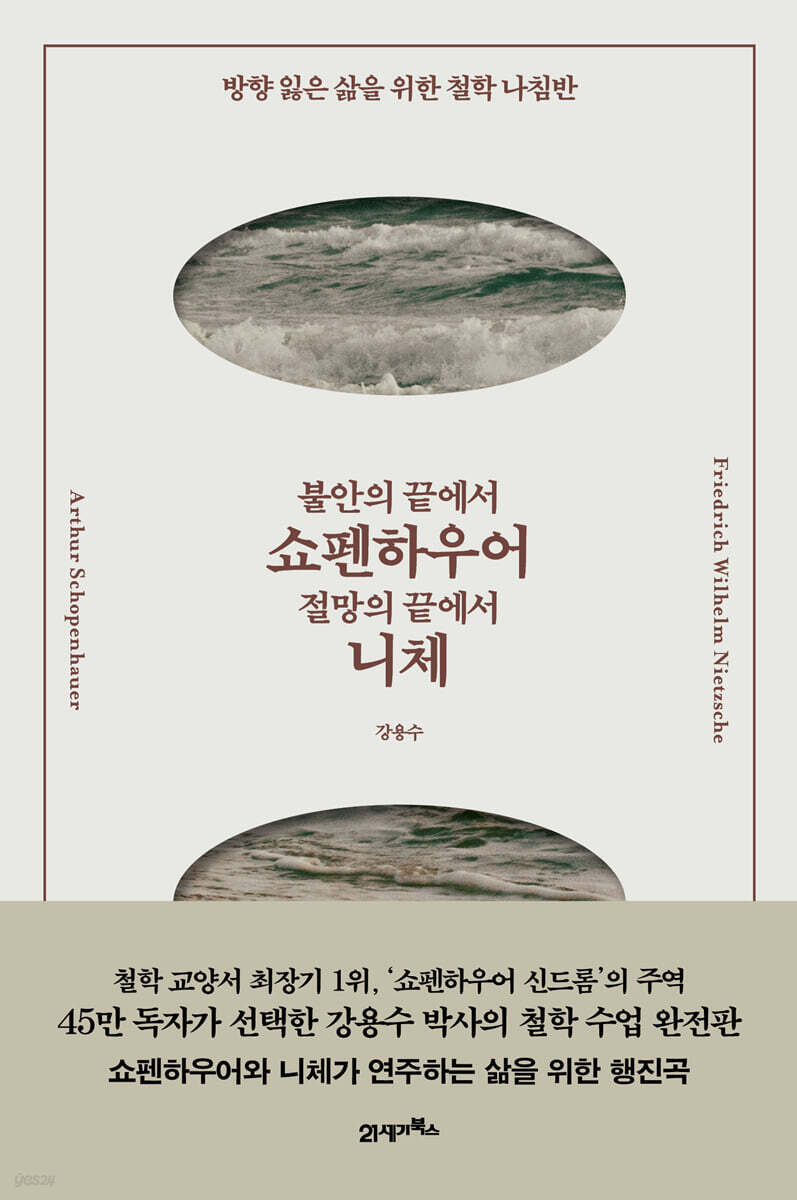
Schopenhauer at the End of Anxiety, Nietzsche at the End of Despair
 |
Description
Book Introduction
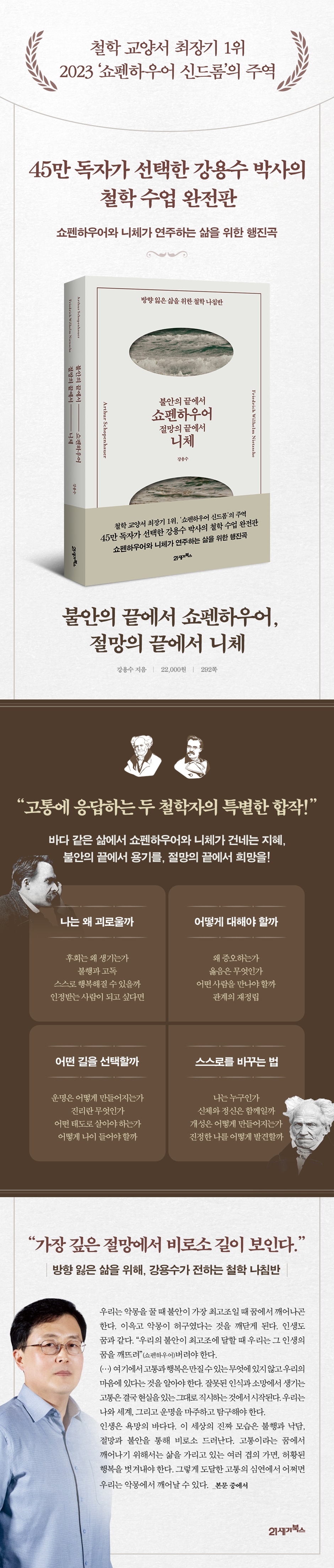
The longest-running number one philosophy textbook, the protagonist of the "Schopenhauer Syndrome" Complete edition of Kang Yong-su's philosophy class, chosen by 450,000 readers A March for Life Played by Schopenhauer and Nietzsche 『Schopenhauer at the End of Anxiety, Nietzsche at the End of Despair』 borrows the main ideas of Schopenhauer and Nietzsche to explore the will and courage to live a meaningful life. Through four themes: regret, relationships, life, and self-identity, Schopenhauer and Nietzsche each respond to various concerns and questions we face in life. The book was written by Kang Yong-su, a writer who caused the 'Schopenhauer Syndrome' in Korean society in 2023 and a doctor of philosophy who has intensively studied Nietzsche. The philosophies of Schopenhauer and Nietzsche, which help us face our true selves in a life filled with vulgar desires and suffering, and affirm life, are reborn as life lessons in this book. |
- You can preview some of the book's contents.
Preview
index
Introduction - How to Face the World and Love It: Meeting Schopenhauer and Nietzsche
Part 1: Why Am I Suffering?
CHAPTER 1 - If I Hadn't Been Born (Regret)
The False Excuse of Pessimism_Schopenhauer
Beyond Pessimism_Nietzsche
CHAPTER 2 - Misery and Solitude (Solitude)
Make loneliness your friend_Schopenhauer
Joy in Solitude_Nietzsche
CHAPTER 3 - I'm so tired (depressed)
Depression may be a good stimulus_Schopenhauer
Can I save myself?_Nietzsche
CHAPTER 4 - If you want to be recognized (greed and vanity)
Is my appearance to others true?_Schopenhauer
To you who pursue something invisible_Nietzsche
How to deal with Part 2
CHAPTER 5 - I Hate You (Hatred and Resentment)
A Philosophical Study of the Sense of Qualification_Schopenhauer
The Origin of Morality_Nietzsche
CHAPTER 6 - Am I Wrong (Truth and Claim)
The art of debate is the sword of the mind_Schopenhauer
Think about what is right - Nietzsche
CHAPTER 7 - Family, Strange and Intimate (Marriage)
Reinterpreting Encounter_Schopenhauer
The Illusion of Marriage_Nietzsche
CHAPTER 8 - On Friendship (Friendship and Social Relationships)
The Illusion of Friendship_Schopenhauer
Every encounter has its bitter taste_Nietzsche
Part 3: Which Path Should I Choose?
CHAPTER 9 - About Fate
Remember that we all die_Schopenhauer
Love your fate_Nietzsche
CHAPTER 10 - How to Accept the World (A Matter of Perception)
Desire comes before knowledge_Schopenhauer
How to Live in a World Without God_Nietzsche
CHAPTER 11 - Can You Live the Way You Want? (Desire)
How to Balance Desires_Schopenhauer
Just laugh it off_Nietzsche
CHAPTER 12 - How Long Should I Live? (Positive)
Live long and see what you can see_Schopenhauer
Things you only realize as you get older_Nietzsche
Part 4 How to Change Myself
CHAPTER 13 - WHO AM I (Nature and Personality)
Fate changes, but character does not._Schopenhauer
Strip off the snake's skin_Nietzsche
CHAPTER 14 - Rediscovering the Body (Body vs. Mind)
A healthy mind resides in a healthy body_Schopenhauer
The health of the body comes first_Nietzsche
CHAPTER 15 - Finding Your Own Color (Individuality)
Find your own individuality_Schopenhauer
Become who you really are_Nietzsche
CHAPTER 16 - How to Create Your True Self (Culture)
Develop the Muscles of Thinking_Schopenhauer
Experience and understand through blood_Nietzsche
Going Out - Only in the Deepest Despair Can the Path Be Seen
Part 1: Why Am I Suffering?
CHAPTER 1 - If I Hadn't Been Born (Regret)
The False Excuse of Pessimism_Schopenhauer
Beyond Pessimism_Nietzsche
CHAPTER 2 - Misery and Solitude (Solitude)
Make loneliness your friend_Schopenhauer
Joy in Solitude_Nietzsche
CHAPTER 3 - I'm so tired (depressed)
Depression may be a good stimulus_Schopenhauer
Can I save myself?_Nietzsche
CHAPTER 4 - If you want to be recognized (greed and vanity)
Is my appearance to others true?_Schopenhauer
To you who pursue something invisible_Nietzsche
How to deal with Part 2
CHAPTER 5 - I Hate You (Hatred and Resentment)
A Philosophical Study of the Sense of Qualification_Schopenhauer
The Origin of Morality_Nietzsche
CHAPTER 6 - Am I Wrong (Truth and Claim)
The art of debate is the sword of the mind_Schopenhauer
Think about what is right - Nietzsche
CHAPTER 7 - Family, Strange and Intimate (Marriage)
Reinterpreting Encounter_Schopenhauer
The Illusion of Marriage_Nietzsche
CHAPTER 8 - On Friendship (Friendship and Social Relationships)
The Illusion of Friendship_Schopenhauer
Every encounter has its bitter taste_Nietzsche
Part 3: Which Path Should I Choose?
CHAPTER 9 - About Fate
Remember that we all die_Schopenhauer
Love your fate_Nietzsche
CHAPTER 10 - How to Accept the World (A Matter of Perception)
Desire comes before knowledge_Schopenhauer
How to Live in a World Without God_Nietzsche
CHAPTER 11 - Can You Live the Way You Want? (Desire)
How to Balance Desires_Schopenhauer
Just laugh it off_Nietzsche
CHAPTER 12 - How Long Should I Live? (Positive)
Live long and see what you can see_Schopenhauer
Things you only realize as you get older_Nietzsche
Part 4 How to Change Myself
CHAPTER 13 - WHO AM I (Nature and Personality)
Fate changes, but character does not._Schopenhauer
Strip off the snake's skin_Nietzsche
CHAPTER 14 - Rediscovering the Body (Body vs. Mind)
A healthy mind resides in a healthy body_Schopenhauer
The health of the body comes first_Nietzsche
CHAPTER 15 - Finding Your Own Color (Individuality)
Find your own individuality_Schopenhauer
Become who you really are_Nietzsche
CHAPTER 16 - How to Create Your True Self (Culture)
Develop the Muscles of Thinking_Schopenhauer
Experience and understand through blood_Nietzsche
Going Out - Only in the Deepest Despair Can the Path Be Seen
Detailed image
Into the book
Regret arises when past choices were wrong.
If you think too much about the past, your regrets will only grow.
Most people are consumed by the heartache of dashed hopes and worries about a future that has not yet arrived, and they let this moment pass them by in vain.
But it is wise to just let go of what has already passed.
There's no need to worry about something that hasn't even happened yet.
If you lose sight of the present because you are caught up in regret and anxiety, you will end up in a vicious cycle of creating more regrets.
Schopenhauer says that no matter how painful it may be, we should let go of what has already happened and calm our upset feelings, and that we should remember the words of Homer (The Iliad) that we should not worry about the future because it is up to the will of God.
--- From "The False Excuse of Pessimism"
If the Dionysian refers to the unity with the 'primordial One' that is the basis of this world, the 'principle of individuation', a term used by Nietzsche, is a concept that appears in Schopenhauer's 'The World as Will and Representation'.
The condition for the will, which is the essence of the world, to be diversified through objects is the principle of individualization, which is time and space.
Therefore, although humans perceive and understand individually according to the conditions of time and space, in reality, only one world exists.
To feel this, you need an artistic experience.
If you've had a tough day, and often feel doubtful about life, what choice would you make?
How about taking a break from life with a glass of wine and some music, as Nietzsche suggested?
--- From "Beyond Pessimism"
Nietzsche said, “Solitude makes us stronger, but it also makes us softer towards others.
“Solitude makes us grow in two ways,” he says.
So, Nietzsche needs ‘solitude.’
Solitude is a return to oneself, a recovery.
The only way he can escape from his vomiting is through free, clear air.
Nietzsche finds a fountain of joy alone in a high realm where all things impure cannot approach, avoiding the smell.
"Here, in the highest place, a fountain of joy gushes forth! And here is life, which refuses to drink from it with any impurity!"
Wisdom is the whisper of a lonely person whispering only to himself, even in a crowded marketplace.
--- From "Is Unhappiness Due to Loneliness?"
In this respect, suicide is foolish.
People with severe depression often believe that the physical pain of suicide will not be that great because their mental pain is so great.
So, there are many cases where decisions are made in a hurry.
But no one knows what suicide is like.
Because the dead cannot speak.
Suicide can be seen as an experiment and a question that humans ask of nature and try to force an answer.
In other words, it is an experiment to find out what changes human survival and perception undergo through death.
But it's a clumsy experiment.
Because this experiment destroys even the identity of consciousness that must ask questions and receive answers.
--- From "Depression may be a good stimulus"
What's more important than the vanity of trying to look good to others is myself.
The principle of 'chivalrous honor' is very foolish in that it seeks to gain external respect and attention even by using physical violence.
The saying, "Honor is more important than life," is a kind of madness that forces us to believe that the opinions of others are more important than our own survival.
The same goes for the expression, 'Fame is essential for success.'
Ultimately, it is nothing more than an exaggeration to say that they want the benefits that honor brings, namely material wealth, rather than the honor itself.
The high status that is sought through career advancement is, strictly speaking, a fictitious value.
Honor, fame, and status based on the reputation of others are delusions and madness that make us unhappy.
If you think too much about the past, your regrets will only grow.
Most people are consumed by the heartache of dashed hopes and worries about a future that has not yet arrived, and they let this moment pass them by in vain.
But it is wise to just let go of what has already passed.
There's no need to worry about something that hasn't even happened yet.
If you lose sight of the present because you are caught up in regret and anxiety, you will end up in a vicious cycle of creating more regrets.
Schopenhauer says that no matter how painful it may be, we should let go of what has already happened and calm our upset feelings, and that we should remember the words of Homer (The Iliad) that we should not worry about the future because it is up to the will of God.
--- From "The False Excuse of Pessimism"
If the Dionysian refers to the unity with the 'primordial One' that is the basis of this world, the 'principle of individuation', a term used by Nietzsche, is a concept that appears in Schopenhauer's 'The World as Will and Representation'.
The condition for the will, which is the essence of the world, to be diversified through objects is the principle of individualization, which is time and space.
Therefore, although humans perceive and understand individually according to the conditions of time and space, in reality, only one world exists.
To feel this, you need an artistic experience.
If you've had a tough day, and often feel doubtful about life, what choice would you make?
How about taking a break from life with a glass of wine and some music, as Nietzsche suggested?
--- From "Beyond Pessimism"
Nietzsche said, “Solitude makes us stronger, but it also makes us softer towards others.
“Solitude makes us grow in two ways,” he says.
So, Nietzsche needs ‘solitude.’
Solitude is a return to oneself, a recovery.
The only way he can escape from his vomiting is through free, clear air.
Nietzsche finds a fountain of joy alone in a high realm where all things impure cannot approach, avoiding the smell.
"Here, in the highest place, a fountain of joy gushes forth! And here is life, which refuses to drink from it with any impurity!"
Wisdom is the whisper of a lonely person whispering only to himself, even in a crowded marketplace.
--- From "Is Unhappiness Due to Loneliness?"
In this respect, suicide is foolish.
People with severe depression often believe that the physical pain of suicide will not be that great because their mental pain is so great.
So, there are many cases where decisions are made in a hurry.
But no one knows what suicide is like.
Because the dead cannot speak.
Suicide can be seen as an experiment and a question that humans ask of nature and try to force an answer.
In other words, it is an experiment to find out what changes human survival and perception undergo through death.
But it's a clumsy experiment.
Because this experiment destroys even the identity of consciousness that must ask questions and receive answers.
--- From "Depression may be a good stimulus"
What's more important than the vanity of trying to look good to others is myself.
The principle of 'chivalrous honor' is very foolish in that it seeks to gain external respect and attention even by using physical violence.
The saying, "Honor is more important than life," is a kind of madness that forces us to believe that the opinions of others are more important than our own survival.
The same goes for the expression, 'Fame is essential for success.'
Ultimately, it is nothing more than an exaggeration to say that they want the benefits that honor brings, namely material wealth, rather than the honor itself.
The high status that is sought through career advancement is, strictly speaking, a fictitious value.
Honor, fame, and status based on the reputation of others are delusions and madness that make us unhappy.
--- From "Is the way I appear to others the truth?"
Publisher's Review
Why is life difficult? How should we treat people? How should we live?
A shining philosophy that will give you strength at every turning point in life.
It is said that Nietzsche found Schopenhauer's book in an old bookstore and read it for several nights.
As if to support this story, Schopenhauer is evaluated to have had a profound influence on many of Nietzsche's works.
The two philosophers also have strangely similar approaches to life.
Schopenhauer is famous for his pessimism, saying, "It might have been better not to have been born," but today he is widely read by readers for his wisdom in accepting suffering.
Meanwhile, Nietzsche emphasized the courage to face the 'true self' through free will and live again.
Both philosophers left behind important wisdom regarding a life-affirming attitude.
"Schopenhauer at the End of Anxiety, Nietzsche at the End of Despair" is a book that philosophically advises on how humans should live in the face of fate, which is anxiety and suffering itself.
Regret, relationships, life, and self-identity are divided into four parts, each with four sub-topics, and a total of 16 issues are raised, including fate, desire, nature, and love. Author Kang Yong-su alternately borrows from the thoughts of Schopenhauer and Nietzsche to explore the two philosophers' reflections on each topic in an interesting way.
A true look at vanity and desire
The will to move forward, stepping on the essence of life
In this book, the philosophies of Schopenhauer and Nietzsche, although at first glance they seem contrasting, can provide readers with peace of mind in a complementary way.
Schopenhauer says about the sense of entitlement, “They harbor a secret hostility towards those who belong to the nobility, and when they think that they have nothing to fear, they show in various ways that ‘you too are no better than we are’”, and that the envy of others is actually evidence that supports my superiority.
Therefore, if you are treated this way by someone, you should respond with indifference and endure it calmly.
Meanwhile, Nietzsche says that Christian morality encourages people to feel ashamed of happiness when they envy the happiness of others, and further emphasizes objective and free thinking that is not limited to a single morality.
In a world where worldly values determine the quality of life, there is great meaning in taking stock of life's concerns, big and small, and contemplating them philosophically.
Just as a person awakens from a nightmare at its worst, the author believes that facing the sea of suffering that is life and finding the true meaning of life creates true happiness and peace.
“To wake up from the dream of suffering, we must strip away the many masks that cover our lives and the false happiness.”
In this way, this book offers the comfort that only philosophy can provide in a world without answers.
A shining philosophy that will give you strength at every turning point in life.
It is said that Nietzsche found Schopenhauer's book in an old bookstore and read it for several nights.
As if to support this story, Schopenhauer is evaluated to have had a profound influence on many of Nietzsche's works.
The two philosophers also have strangely similar approaches to life.
Schopenhauer is famous for his pessimism, saying, "It might have been better not to have been born," but today he is widely read by readers for his wisdom in accepting suffering.
Meanwhile, Nietzsche emphasized the courage to face the 'true self' through free will and live again.
Both philosophers left behind important wisdom regarding a life-affirming attitude.
"Schopenhauer at the End of Anxiety, Nietzsche at the End of Despair" is a book that philosophically advises on how humans should live in the face of fate, which is anxiety and suffering itself.
Regret, relationships, life, and self-identity are divided into four parts, each with four sub-topics, and a total of 16 issues are raised, including fate, desire, nature, and love. Author Kang Yong-su alternately borrows from the thoughts of Schopenhauer and Nietzsche to explore the two philosophers' reflections on each topic in an interesting way.
A true look at vanity and desire
The will to move forward, stepping on the essence of life
In this book, the philosophies of Schopenhauer and Nietzsche, although at first glance they seem contrasting, can provide readers with peace of mind in a complementary way.
Schopenhauer says about the sense of entitlement, “They harbor a secret hostility towards those who belong to the nobility, and when they think that they have nothing to fear, they show in various ways that ‘you too are no better than we are’”, and that the envy of others is actually evidence that supports my superiority.
Therefore, if you are treated this way by someone, you should respond with indifference and endure it calmly.
Meanwhile, Nietzsche says that Christian morality encourages people to feel ashamed of happiness when they envy the happiness of others, and further emphasizes objective and free thinking that is not limited to a single morality.
In a world where worldly values determine the quality of life, there is great meaning in taking stock of life's concerns, big and small, and contemplating them philosophically.
Just as a person awakens from a nightmare at its worst, the author believes that facing the sea of suffering that is life and finding the true meaning of life creates true happiness and peace.
“To wake up from the dream of suffering, we must strip away the many masks that cover our lives and the false happiness.”
In this way, this book offers the comfort that only philosophy can provide in a world without answers.
GOODS SPECIFICS
- Date of issue: October 16, 2024
- Page count, weight, size: 292 pages | 368g | 133*200*20mm
- ISBN13: 9791171178360
- ISBN10: 1171178360
You may also like
카테고리
korean


korean

![GQ KOREA Mark (Monthly): December [2025]](http://librairie.coreenne.fr/cdn/shop/files/8ef265dbbfbf186523ed75ba7319009d.jpg?v=1765340328&width=3840)


