

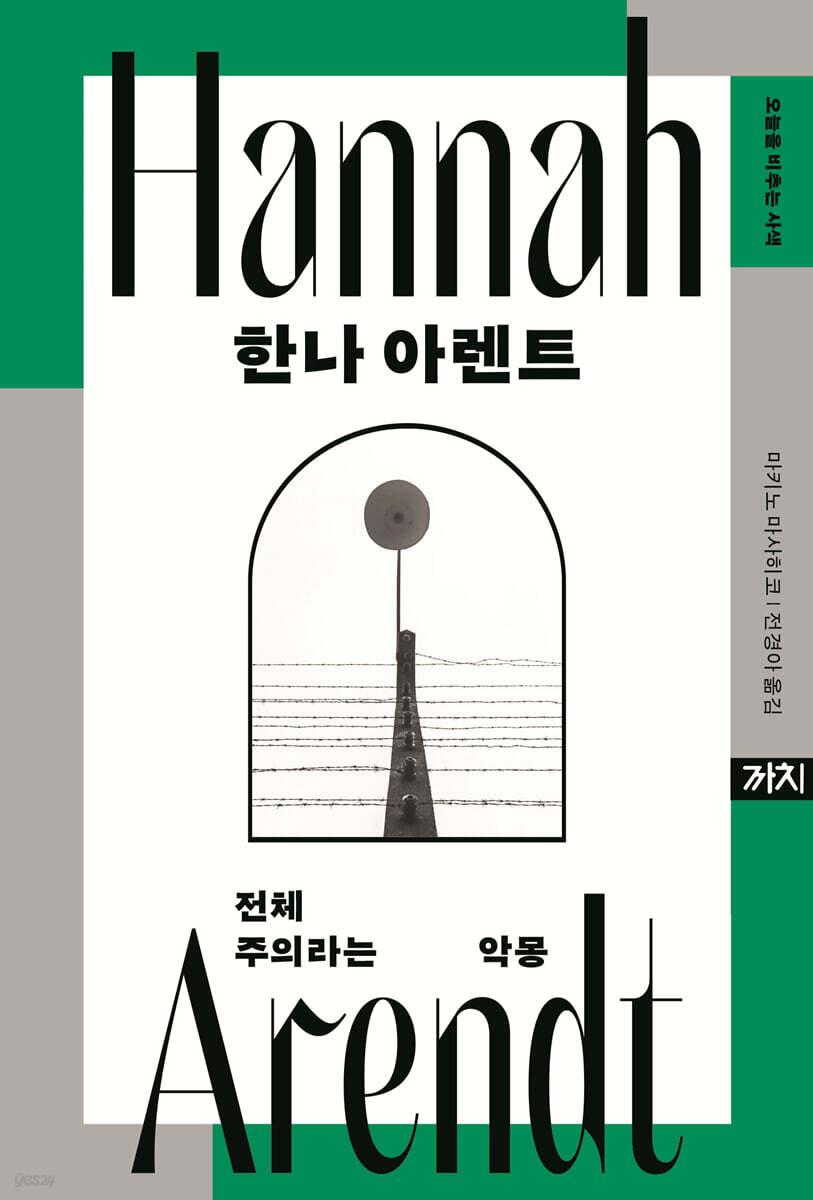
Hannah Arendt
 |
Description
Book Introduction
The destruction brought about by cynicism and indifference,
Reexamining the dangers of a possible return to totalitarianism
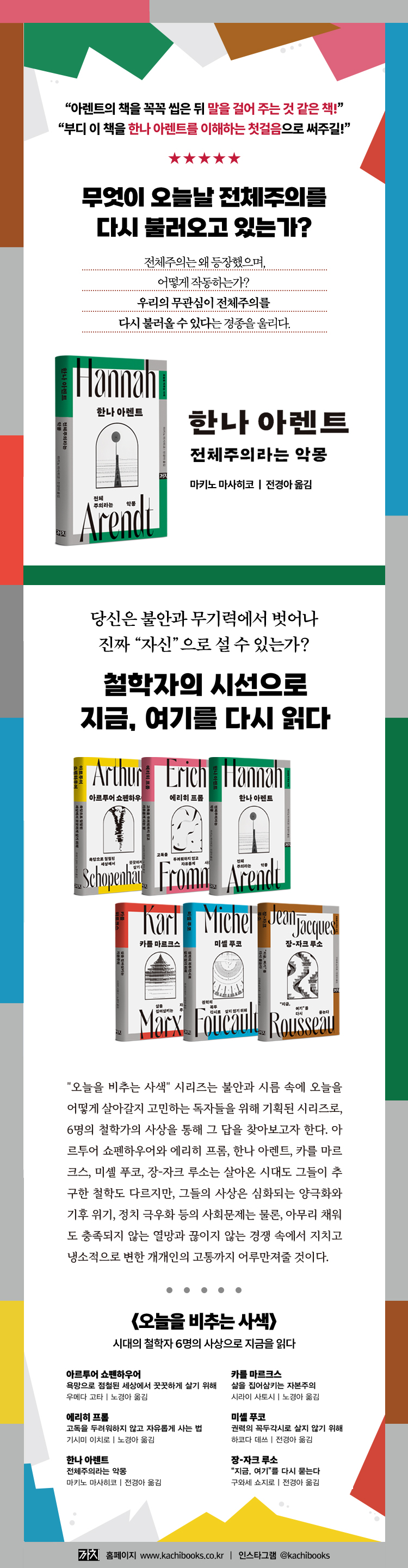
The "Thoughts Illuminating Today" series closely examines the mechanisms of our society through the thoughts of six philosophers of our time, and seeks ways to navigate life without losing oneself amidst the rough waves of everyday life.
Hannah Arendt delves into the background and operating mechanisms of totalitarianism, sounding the alarm that our indifference could bring about the return of totalitarianism.
The collapse of the class structure and social chaos isolate individual people and reduce political subjects to mobs.
The disconnected individual does not believe in himself and follows the “fictional world” advocated by totalitarianism.
The important point is that the public does not follow a fictional world because they “believe” it.
The public believes nothing in a world full of lies, and is simply indifferent.
No matter what they hear, they always respond with cynicism, saying, “None of it is true.”
The author quotes Hannah Arendt's book at appropriate points to clearly show the structure of totalitarianism that Arendt spoke of.
And above all, it emphasizes the need to protect the “facts” and “truth” that Hannah Arendt emphasized, and warns that the present is no different from the time when Arendt’s thoughts were developed.
It also revisits the importance of “facts” emphasized by Hannah Arendt and explains that unchanging “facts” and “testimony” create “opinions” and can lead to reconciliation through them.
Reexamining the dangers of a possible return to totalitarianism
The "Thoughts Illuminating Today" series closely examines the mechanisms of our society through the thoughts of six philosophers of our time, and seeks ways to navigate life without losing oneself amidst the rough waves of everyday life.
Hannah Arendt delves into the background and operating mechanisms of totalitarianism, sounding the alarm that our indifference could bring about the return of totalitarianism.
The collapse of the class structure and social chaos isolate individual people and reduce political subjects to mobs.
The disconnected individual does not believe in himself and follows the “fictional world” advocated by totalitarianism.
The important point is that the public does not follow a fictional world because they “believe” it.
The public believes nothing in a world full of lies, and is simply indifferent.
No matter what they hear, they always respond with cynicism, saying, “None of it is true.”
The author quotes Hannah Arendt's book at appropriate points to clearly show the structure of totalitarianism that Arendt spoke of.
And above all, it emphasizes the need to protect the “facts” and “truth” that Hannah Arendt emphasized, and warns that the present is no different from the time when Arendt’s thoughts were developed.
It also revisits the importance of “facts” emphasized by Hannah Arendt and explains that unchanging “facts” and “testimony” create “opinions” and can lead to reconciliation through them.
- You can preview some of the book's contents.
Preview
index
Introduction: To resist future totalitarianism
Chapter 1: The Origins of Anti-Semitism
Chapter 2: The Emergence of the “Public”
Chapter 3: The Structure of Totalitarianism
Chapter 4: What Totalitarianism Destroys
Chapter 5: “Facts” as a Basis for Resistance
Chapter 6: Upholding the Truth of Facts to the End
The outgoing text constantly speaks of hope
Conclusion
main
More books to read
Chapter 1: The Origins of Anti-Semitism
Chapter 2: The Emergence of the “Public”
Chapter 3: The Structure of Totalitarianism
Chapter 4: What Totalitarianism Destroys
Chapter 5: “Facts” as a Basis for Resistance
Chapter 6: Upholding the Truth of Facts to the End
The outgoing text constantly speaks of hope
Conclusion
main
More books to read
Detailed image
Into the book
Many of the factors that led to totalitarianism still exist today.
In the name of globalization, the movement and exchange of goods, money, and people across borders is widening economic disparity and resulting conflict between nations and races.
Advances in science and technology that have occurred alongside economic development have changed the way humans have lived their lives.
In this situation, the risk of totalitarianism reappearing in a different form has actually increased.
--- From the "Introductory Note"
Within the totalitarian movement that surrounds the fictional world, the more the movement organizes and gains power, the more the “fiction” becomes reality.
Here, the exercise itself—appropriate to each class of those swept up in it—provides a sense of actual recognition.
As science, technology, and medical technology advance and genetic engineering technology attempts to put “life choices” within the hands of humans, humanity is faced with the questions of what constitutes a “life worth living” and what constitutes a “life worthy of humanity.”
Being able to give a different answer to that question than the Nazis will be one key to preventing the resurgence of totalitarianism.
Today, when we look at the “mass”—the agglomeration of human beings who have no connection with anyone and are indifferent to one another—we see ourselves.
Standing in a crowded street, we pay attention to others only enough to avoid unnecessary conflicts. … … The ideology of totalitarianism operates on this accumulation of solitary human beings, disconnected from anyone.
The nature of human behavior is such that calculations and predictions based on such general laws are often wrong.
Historical events are caused by human actions, not uniform behavior.
Politically significant
What exists, what is historically significant, comes from action.
In the name of globalization, the movement and exchange of goods, money, and people across borders is widening economic disparity and resulting conflict between nations and races.
Advances in science and technology that have occurred alongside economic development have changed the way humans have lived their lives.
In this situation, the risk of totalitarianism reappearing in a different form has actually increased.
--- From the "Introductory Note"
Within the totalitarian movement that surrounds the fictional world, the more the movement organizes and gains power, the more the “fiction” becomes reality.
Here, the exercise itself—appropriate to each class of those swept up in it—provides a sense of actual recognition.
As science, technology, and medical technology advance and genetic engineering technology attempts to put “life choices” within the hands of humans, humanity is faced with the questions of what constitutes a “life worth living” and what constitutes a “life worthy of humanity.”
Being able to give a different answer to that question than the Nazis will be one key to preventing the resurgence of totalitarianism.
Today, when we look at the “mass”—the agglomeration of human beings who have no connection with anyone and are indifferent to one another—we see ourselves.
Standing in a crowded street, we pay attention to others only enough to avoid unnecessary conflicts. … … The ideology of totalitarianism operates on this accumulation of solitary human beings, disconnected from anyone.
The nature of human behavior is such that calculations and predictions based on such general laws are often wrong.
Historical events are caused by human actions, not uniform behavior.
Politically significant
What exists, what is historically significant, comes from action.
--- From the text
Publisher's Review
A guide to making Hannah Arendt's thoughts easier to follow.
“A book worth reading”
Hannah Arendt was a thinker who delved into the background and mechanisms of the birth of totalitarianism, while also thoroughly exploring what humans could do after its destruction.
Accordingly, the author introduces Hannah Arendt's work at the end of the book and adds a brief commentary to help readers who are new to Arendt's thought follow along with her book.
“Further Reading” introduces Hannah Arendt’s representative works, such as “The Origins of Totalitarianism” and “Eichmann in Jerusalem,” as well as “On Revolution,” which explores elements of the American republic, and “The Crisis of the Republic,” which examines the political reality of the 1960s, and will serve as a solid compass for readers seeking to understand Arendt’s philosophical world in general.
Can you break free from anxiety and helplessness and stand as your true “self”?
Meet six thinkers who will offer the keys to answering life's questions.
The "Thoughts Illuminating Today" series, part of Kodansha's popular series designed to make timely philosophy accessible, introduces the thoughts of six philosophers who pose profound questions and answers to us today.
Arthur Schopenhauer, Erich Fromm, Hannah Arendt, Karl Marx, Michel Foucault, and Jean-Jacques Rousseau, although they lived in different times and pursued different philosophies, provide clues to the question of “how to live.”
This series features commentaries by authors who delve deeply into each philosophy, introducing the philosopher's life, delving into his or her thoughts, and applying them to the present day.
『Artur Schopenhauer』 begins with the premise that the essence of life is suffering, and examines how his philosophy sought a way to escape suffering.
『Erich Fromm』 explores the philosophical world of Erich Fromm, who viewed society and individuals in a three-dimensional way, through the commentary of Ichiro Kishimi, who is familiar to domestic readers as the author of 『The Courage to be Disliked』.
Hannah Arendt examines the polarized world of today by examining the structure of “totalitarianism” that can be brought about by isolated individuals.
『Karl Marx』 applies Marx's theory to individuals, not society, through the keyword "capitalism that has taken hold of our lives and minds."
Michel Foucault examines the structures of power and governance that force us to whip ourselves today.
Finally, 『Jean-Jacques Rousseau』 looks back at the implications that the life of Jean-Jacques Rousseau, who practiced solitary thinking while rejecting all common sense, gives us.
This book's approach to understanding philosophy and applying it to life will enable readers to understand and reflect on today's world.
A book that seems to speak to you after thoroughly chewing on Arendt's book.
- Reading Meta Reader Reviews
It addresses deep and difficult issues in an easy-to-read tone.
Please use this book as the first step toward understanding Hannah Arendt.
- Reading Meta Reader Reviews
“A book worth reading”
Hannah Arendt was a thinker who delved into the background and mechanisms of the birth of totalitarianism, while also thoroughly exploring what humans could do after its destruction.
Accordingly, the author introduces Hannah Arendt's work at the end of the book and adds a brief commentary to help readers who are new to Arendt's thought follow along with her book.
“Further Reading” introduces Hannah Arendt’s representative works, such as “The Origins of Totalitarianism” and “Eichmann in Jerusalem,” as well as “On Revolution,” which explores elements of the American republic, and “The Crisis of the Republic,” which examines the political reality of the 1960s, and will serve as a solid compass for readers seeking to understand Arendt’s philosophical world in general.
Can you break free from anxiety and helplessness and stand as your true “self”?
Meet six thinkers who will offer the keys to answering life's questions.
The "Thoughts Illuminating Today" series, part of Kodansha's popular series designed to make timely philosophy accessible, introduces the thoughts of six philosophers who pose profound questions and answers to us today.
Arthur Schopenhauer, Erich Fromm, Hannah Arendt, Karl Marx, Michel Foucault, and Jean-Jacques Rousseau, although they lived in different times and pursued different philosophies, provide clues to the question of “how to live.”
This series features commentaries by authors who delve deeply into each philosophy, introducing the philosopher's life, delving into his or her thoughts, and applying them to the present day.
『Artur Schopenhauer』 begins with the premise that the essence of life is suffering, and examines how his philosophy sought a way to escape suffering.
『Erich Fromm』 explores the philosophical world of Erich Fromm, who viewed society and individuals in a three-dimensional way, through the commentary of Ichiro Kishimi, who is familiar to domestic readers as the author of 『The Courage to be Disliked』.
Hannah Arendt examines the polarized world of today by examining the structure of “totalitarianism” that can be brought about by isolated individuals.
『Karl Marx』 applies Marx's theory to individuals, not society, through the keyword "capitalism that has taken hold of our lives and minds."
Michel Foucault examines the structures of power and governance that force us to whip ourselves today.
Finally, 『Jean-Jacques Rousseau』 looks back at the implications that the life of Jean-Jacques Rousseau, who practiced solitary thinking while rejecting all common sense, gives us.
This book's approach to understanding philosophy and applying it to life will enable readers to understand and reflect on today's world.
A book that seems to speak to you after thoroughly chewing on Arendt's book.
- Reading Meta Reader Reviews
It addresses deep and difficult issues in an easy-to-read tone.
Please use this book as the first step toward understanding Hannah Arendt.
- Reading Meta Reader Reviews
GOODS SPECIFICS
- Date of issue: September 5, 2024
- Format: Hardcover book binding method guide
- Page count, weight, size: 166 pages | 272g | 120*183*17mm
- ISBN13: 9788972918509
- ISBN10: 8972918504
You may also like
카테고리
korean


korean

![GQ KOREA Mark (Monthly): December [2025]](http://librairie.coreenne.fr/cdn/shop/files/8ef265dbbfbf186523ed75ba7319009d.jpg?v=1765340328&width=3840)


