

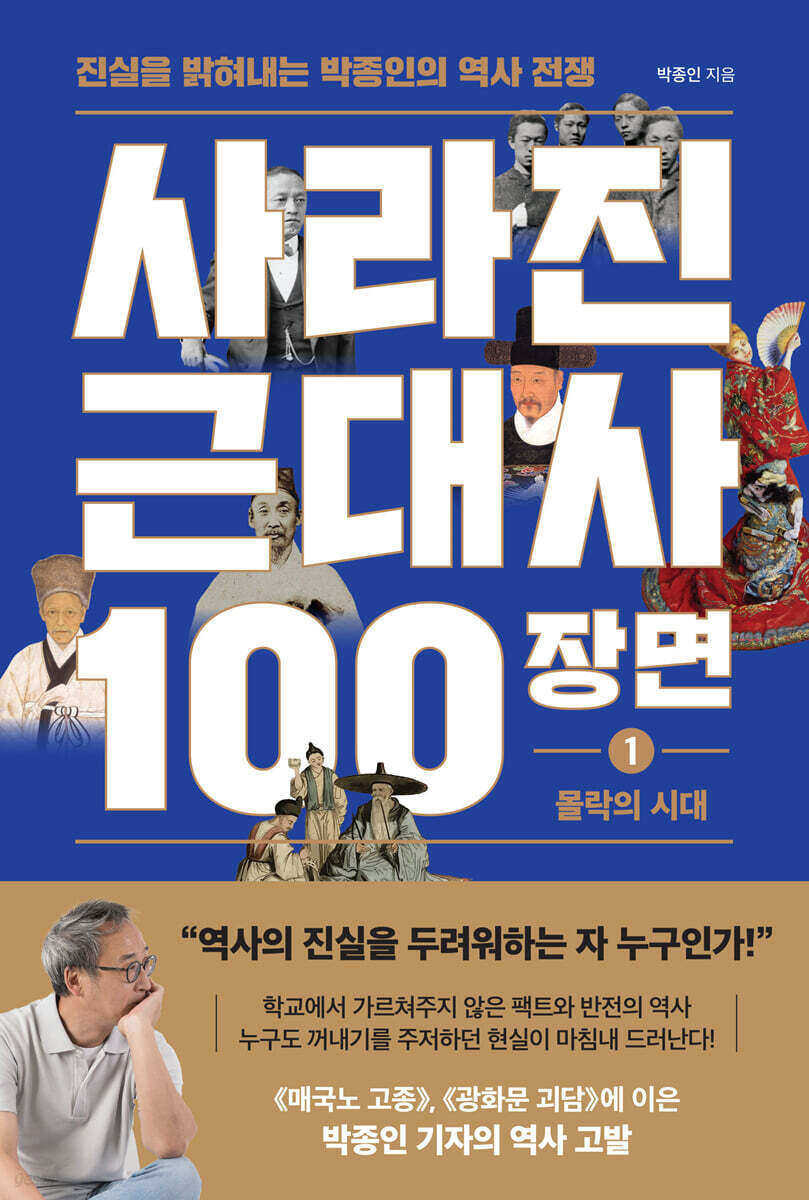
100 Lost Scenes from Modern History ① The Age of Decline
 |
Description
Book Introduction
100 historical puzzles full of twists and shocks
On May 6, 1889, the day the Eiffel Tower, a symbol of modernity, stood tall in Europe, a lowly civil servant in Joseon was appointed as the governor of Gobu County.
The cause of the largest civil uprising in Joseon, the Donghak Peasant Revolution, is Jo Byeong-gap.
The Eiffel Tower changed the world, and so did a single person.
A year before the poor French intellectual Denis Diderot was appointed editor-in-chief of the Encyclopédie, King Yeongjo of Joseon destroyed a telescope that his subjects had obtained with difficulty from the Qing Dynasty.
It is an 'ugly' tool that dares to look straight at the sun.
The 'Encyclopedists' ushered in the Age of Enlightenment in Europe, while the broken telescope brought damp darkness to Joseon, rather than light.
During the majestic 19th century, when the entire world was rushing toward modernity, striving for wealth and a strong military, what was happening in Joseon and the world? When Newton discovered the law of universal gravitation after seeing an apple, and when Edison invented the phonograph, what did Joseon realize and invent during the same era?
At some point, history ceased to be a necessary map for moving forward into the future, but became a tool that was not afraid to be distorted for personal gain.
History exists not just for pride.
Mistakes and failures are also part of our history that we must not forget.
"100 Lost Scenes of Modern History" captures 100 scenes that changed the fate of this land during a time when the world was in turmoil due to explosive "intellect" and intense "exchange."
From the reign of King Yeongjeongjo to liberation and the founding of the nation, all 100 scenes are 'inconvenient' facts that cannot be learned in school.
The moment we properly confront the history that has been 'disappeared' by someone, things that were previously invisible begin to become visible.
On May 6, 1889, the day the Eiffel Tower, a symbol of modernity, stood tall in Europe, a lowly civil servant in Joseon was appointed as the governor of Gobu County.
The cause of the largest civil uprising in Joseon, the Donghak Peasant Revolution, is Jo Byeong-gap.
The Eiffel Tower changed the world, and so did a single person.
A year before the poor French intellectual Denis Diderot was appointed editor-in-chief of the Encyclopédie, King Yeongjo of Joseon destroyed a telescope that his subjects had obtained with difficulty from the Qing Dynasty.
It is an 'ugly' tool that dares to look straight at the sun.
The 'Encyclopedists' ushered in the Age of Enlightenment in Europe, while the broken telescope brought damp darkness to Joseon, rather than light.
During the majestic 19th century, when the entire world was rushing toward modernity, striving for wealth and a strong military, what was happening in Joseon and the world? When Newton discovered the law of universal gravitation after seeing an apple, and when Edison invented the phonograph, what did Joseon realize and invent during the same era?
At some point, history ceased to be a necessary map for moving forward into the future, but became a tool that was not afraid to be distorted for personal gain.
History exists not just for pride.
Mistakes and failures are also part of our history that we must not forget.
"100 Lost Scenes of Modern History" captures 100 scenes that changed the fate of this land during a time when the world was in turmoil due to explosive "intellect" and intense "exchange."
From the reign of King Yeongjeongjo to liberation and the founding of the nation, all 100 scenes are 'inconvenient' facts that cannot be learned in school.
The moment we properly confront the history that has been 'disappeared' by someone, things that were previously invisible begin to become visible.
- You can preview some of the book's contents.
Preview
index
① The Age of Decline
Introduction: Beautiful Fake and Sacred Fact
Chapter 1: Yeongjeongjo's reign, 1724–1800
Scene 01.
King Yeongjo's State Policy and Isaac Newton's Apple in 1726
Scene 02.
1744: The warship of the royal inspector Park Mun-su and the peaceful Qianlong Emperor
Scene 03.
King Yeongjo and Diderot's Encyclopédie, who broke the telescope in 1745
Scene 04.
1749 “We are the sons of the Ming Dynasty”
Scene 05.
The attempted massacre of 1771 and the rise of the "Tree of Knowledge" in Europe
Scene 06.
1777 Collection of Ancient and Modern Books and the Monopoly of Knowledge
Scene 07.
1778 Park Je-ga's "Bukhakui" and Adam Smith's "The Wealth of Nations"
Scene 08.
The 1786 declaration of the destruction of intelligence, the "Byeong-o Sohoe" and the "Kansei Science Criminal Code"
Scene 09.
The 1788 ban on garb and the hidden discrimination
Scene 10.
The Fall of the Bastille in 1789 and the restoration of Crown Prince Sado
Scene 11.
King Jeongjo's planting of trees at Hyeonryungwon in 1790, Mindungsan Mountain, and Arbor Day
Scene 12.
The Shinhae Persecution of 1791 and their own league, Dosanbyeol
Scene 13.
The 1792 Munche Restoration and the death of the bookworm Lee Deok-mu
Scene 14.
The construction of Hwaseong Fortress in 1796 and the disappearance of the cart
Scene 15.
King Jeongjo's iron stake and the disappeared talents of 1797
Scene 16.
Yeongchunheon, Changgyeonggung Palace, 1800, King Jeongjo's death
Scene 17.
Napoleon's coronation in 1804 and the lecture of the boy king Sunjo
Scene 18.
Filipino fishermen and salmon merchant Moon Sun-deok, who were detained in 1809
Scene 19.
The hat of Napoleon and the Chungcheong-do official who were exiled in 1817
Scene 20.
The death of Crown Prince Hyomyeong in 1830 and the fading light
Scene 21.
The Imjin War of 1862 and poor Im Dan
Chapter 2: The Regent Daewongun Era, 1864–1873
Scene 22.
1864: Gojong's accession to the throne and The Origin of Species
Scene 23.
1865: The first reform in 500 years, the Gapyusin Reform of Daewongun
Scene 24.
The reconstruction of Gyeongbokgung Palace in 1865 and the drifting reforms
Scene 25.
The proud Berneux and the closed door of Joseon in 1866
Scene 26.
Min became queen in 1866, and Joseon became the playground of the Min clan.
Scene 27.
1867 Blue Lantern Circulation and the Paris World's Fair
Scene 28.
The Opert Grave Robbery Incident of 1868 and the Meiji Restoration
Scene 29.
The abolition of private academies in 1871 and the Belle Époque in Europe
Scene 30.
The magnificent and tragic Shinmiyangyo of 1871
Scene 31.
Emperor Gojong drinking feces and urine in 1871
Scene 32.
1872 Dongrae Nanchull and the Iwakura Mission
Chapter 3: King Gojong and the Min Dynasty, 1873–1885
Scene 33.
Emperor Gojong's declaration of personal rule in 1873 and the secret war that broke out
Scene 34.
The abolition of the Qing Dynasty in 1874 and the departure of Shim Su-gwan to Vienna
Scene 35.
The establishment of Muwiso and the disappearance of the army in 1874
Scene 36.
Emperor Gojong and the Unyo Incident, in which he was stabbed eighteen times in the head in 1875
Scene 37.
Choi Ik-hyeon, who appeared with an axe in 1876
Scene 38.
Shinheon laughing heartily with the impudent Mori Arinori in 1876
Scene 39.
1876: Envoy Kim Gi-su is baffled by the steam engine.
Scene 40.
1879, the day Joseon's life was saved
Scene 41.
The 1881 Inspection Mission and the Reversed Teachings
Scene 42.
The modern Korea-US Treaty of 1882, which was carried out in a very pre-modern manner
Scene 43.
The Wangsimni Soldiers' Mutiny in 1882
Scene 44.
The kidnapped Daewongun in 1882 and his journey back to Korea, a journey filled with hell.
Scene 45.
Joseon Dynasty, where the queen returned to the palace in 1882 and was tricked by a shaman
Scene 46.
The shock of light and brightness in 1883, Bobingsa Temple
Scene 47.
The strange revival of metal type in 1883 and Inoue Kakugoro
Scene 48.
The Gapsin Coup of 1884, when the Bukchon Five drew their swords
Scene 49.
The Gapsin Coup of 1884 and the Great Uproar over the Reform of Names and the Escaping Asia Theory
Scene 50.
Emperor Gojong's request for a Russian protectorate and the Geomundo incident in 1885
Introduction: Beautiful Fake and Sacred Fact
Chapter 1: Yeongjeongjo's reign, 1724–1800
Scene 01.
King Yeongjo's State Policy and Isaac Newton's Apple in 1726
Scene 02.
1744: The warship of the royal inspector Park Mun-su and the peaceful Qianlong Emperor
Scene 03.
King Yeongjo and Diderot's Encyclopédie, who broke the telescope in 1745
Scene 04.
1749 “We are the sons of the Ming Dynasty”
Scene 05.
The attempted massacre of 1771 and the rise of the "Tree of Knowledge" in Europe
Scene 06.
1777 Collection of Ancient and Modern Books and the Monopoly of Knowledge
Scene 07.
1778 Park Je-ga's "Bukhakui" and Adam Smith's "The Wealth of Nations"
Scene 08.
The 1786 declaration of the destruction of intelligence, the "Byeong-o Sohoe" and the "Kansei Science Criminal Code"
Scene 09.
The 1788 ban on garb and the hidden discrimination
Scene 10.
The Fall of the Bastille in 1789 and the restoration of Crown Prince Sado
Scene 11.
King Jeongjo's planting of trees at Hyeonryungwon in 1790, Mindungsan Mountain, and Arbor Day
Scene 12.
The Shinhae Persecution of 1791 and their own league, Dosanbyeol
Scene 13.
The 1792 Munche Restoration and the death of the bookworm Lee Deok-mu
Scene 14.
The construction of Hwaseong Fortress in 1796 and the disappearance of the cart
Scene 15.
King Jeongjo's iron stake and the disappeared talents of 1797
Scene 16.
Yeongchunheon, Changgyeonggung Palace, 1800, King Jeongjo's death
Scene 17.
Napoleon's coronation in 1804 and the lecture of the boy king Sunjo
Scene 18.
Filipino fishermen and salmon merchant Moon Sun-deok, who were detained in 1809
Scene 19.
The hat of Napoleon and the Chungcheong-do official who were exiled in 1817
Scene 20.
The death of Crown Prince Hyomyeong in 1830 and the fading light
Scene 21.
The Imjin War of 1862 and poor Im Dan
Chapter 2: The Regent Daewongun Era, 1864–1873
Scene 22.
1864: Gojong's accession to the throne and The Origin of Species
Scene 23.
1865: The first reform in 500 years, the Gapyusin Reform of Daewongun
Scene 24.
The reconstruction of Gyeongbokgung Palace in 1865 and the drifting reforms
Scene 25.
The proud Berneux and the closed door of Joseon in 1866
Scene 26.
Min became queen in 1866, and Joseon became the playground of the Min clan.
Scene 27.
1867 Blue Lantern Circulation and the Paris World's Fair
Scene 28.
The Opert Grave Robbery Incident of 1868 and the Meiji Restoration
Scene 29.
The abolition of private academies in 1871 and the Belle Époque in Europe
Scene 30.
The magnificent and tragic Shinmiyangyo of 1871
Scene 31.
Emperor Gojong drinking feces and urine in 1871
Scene 32.
1872 Dongrae Nanchull and the Iwakura Mission
Chapter 3: King Gojong and the Min Dynasty, 1873–1885
Scene 33.
Emperor Gojong's declaration of personal rule in 1873 and the secret war that broke out
Scene 34.
The abolition of the Qing Dynasty in 1874 and the departure of Shim Su-gwan to Vienna
Scene 35.
The establishment of Muwiso and the disappearance of the army in 1874
Scene 36.
Emperor Gojong and the Unyo Incident, in which he was stabbed eighteen times in the head in 1875
Scene 37.
Choi Ik-hyeon, who appeared with an axe in 1876
Scene 38.
Shinheon laughing heartily with the impudent Mori Arinori in 1876
Scene 39.
1876: Envoy Kim Gi-su is baffled by the steam engine.
Scene 40.
1879, the day Joseon's life was saved
Scene 41.
The 1881 Inspection Mission and the Reversed Teachings
Scene 42.
The modern Korea-US Treaty of 1882, which was carried out in a very pre-modern manner
Scene 43.
The Wangsimni Soldiers' Mutiny in 1882
Scene 44.
The kidnapped Daewongun in 1882 and his journey back to Korea, a journey filled with hell.
Scene 45.
Joseon Dynasty, where the queen returned to the palace in 1882 and was tricked by a shaman
Scene 46.
The shock of light and brightness in 1883, Bobingsa Temple
Scene 47.
The strange revival of metal type in 1883 and Inoue Kakugoro
Scene 48.
The Gapsin Coup of 1884, when the Bukchon Five drew their swords
Scene 49.
The Gapsin Coup of 1884 and the Great Uproar over the Reform of Names and the Escaping Asia Theory
Scene 50.
Emperor Gojong's request for a Russian protectorate and the Geomundo incident in 1885
Detailed image

Into the book
No matter how hard you try, if it can't be done, it can't be done.
Sorry, but that's the world.
If good people always live well, why learn morality?
Morality is taught in schools because there are countless bad people among the rich.
But no matter how much you teach, the number of bad people does not decrease, and good people usually suffer losses.
I repeat, unfortunately, that is the world.
The driving force behind history is intelligence.
Intelligence creates the times.
When it is said that ‘intelligence moves heaven’, it is not ‘intelligence with utmost sincerity’ but ‘intelligence with utmost sincerity’.
Knowledge and reason.
Heaven is not moved by your sincerity.
Only by using our brains and successfully solving problems can we move forward into a new era.
Then the heavens will be moved.
It is not sincerity, but intelligence that moves heaven.
This is important.
The saying, “If you have intelligence, you can move heaven” contains a hidden moral expectation.
It is an unscientific proposition that even if you are incompetent, if you work hard you will succeed, or rather, you should succeed.
My goodness, have you ever seen a history where a good country won?
The history we learn in school during our youth contains precisely that hopeful view of history.
But real history has nothing to do with morality.
---From the "Preface"
Newton is the person who completed the scientific revolution that Copernicus had ignited in Europe in the 16th century.
The scientific revolution was driven by the modern spirit of reason.
The law of universal gravitation, or gravitation, which Newton announced in his 1687 treatise Principia, greatly contributed to the Industrial Revolution that Europeans later achieved.
Newton died on March 20, 1726, four months after King Yeongjo announced the three major national indicators.
Along with the law of universal gravitation, there is another law discovered by Newton.
It's called the 'Law of the Three Movements'.
There are three: ‘the law of inertia’, ‘the law of acceleration’, and ‘the law of action and reaction’.
All the machines and scientific tools we use in our daily lives today are household items created using these three laws of nature.
There is no room here for metaphysical laws such as morality, philosophy, or ethics.
Gangsters ride cars, and priests, pastors, and monks ride cars too.
There is no good or evil in law, nature, or machines.
---「Chapter 1.
From the Yeongjeongjo era
Gojong was a member of the royal family who was chosen because the interests of the Pungyang Jo clan's Dowager Queen and the powerful families aligned.
He is a man who never received imperial training and would have lived an ordinary life and died if King Cheoljong had not died.
Such a boy became king at a time when the old system was in ruins and the world was collapsing.
(…) Those who led the Meiji Restoration were modern people who had witnessed the ‘cold modern era.’
These people are often called Yushin Jisha.
Among them, the person who is well known to us is Ito Hirobumi.
Entering the reign of King Gojong, Joseon now entered into full-scale conflict with Japan, and indeed, the world.
The 'exchange' and 'intellect' that I have consistently talked about in this book now meet the modern era.
How will Joseon navigate this modern era, whose true identity was revealed by the Opium Wars and rationalized by Darwin?
There were no modern people in Joseon.
There was no Yushin leader who reformed Japan.
But then suddenly modern times came.
These last few scenes are the story of a man coping with the modern times during the first ten years of King Gojong's reign.
This is the story of Heungseon Daewongun, the father of King Gojong, who failed to reform Joseon.
---「Chapter 2.
From the Daewongun era
Every failed revolution becomes treason, and its instigators become traitors.
Kim Ok-gyun, Hong Yeong-sik, Park Yeong-hyo, Seo Gwang-beom, and Seo Jae-pil were killed on the streets or went into exile.
Family members also commit suicide or are executed.
(…) On September 24, Gojong received his appointment letters from those representing the emperor at the Mohwagwan in Muakjae.
The Byeong-in Yangyo was simply a ‘commotion’, a Western disturbance, caused by Western barbarians.
The Gapsin Coup was an incident that occurred when elites rebelled against the four great powers.
The coup failed and the Four Great Powers were not liquidated.
Rather, it ended in a tragedy where even the family was implicated and executed, and even their names were erased.
Sorry, but that's the world.
If good people always live well, why learn morality?
Morality is taught in schools because there are countless bad people among the rich.
But no matter how much you teach, the number of bad people does not decrease, and good people usually suffer losses.
I repeat, unfortunately, that is the world.
The driving force behind history is intelligence.
Intelligence creates the times.
When it is said that ‘intelligence moves heaven’, it is not ‘intelligence with utmost sincerity’ but ‘intelligence with utmost sincerity’.
Knowledge and reason.
Heaven is not moved by your sincerity.
Only by using our brains and successfully solving problems can we move forward into a new era.
Then the heavens will be moved.
It is not sincerity, but intelligence that moves heaven.
This is important.
The saying, “If you have intelligence, you can move heaven” contains a hidden moral expectation.
It is an unscientific proposition that even if you are incompetent, if you work hard you will succeed, or rather, you should succeed.
My goodness, have you ever seen a history where a good country won?
The history we learn in school during our youth contains precisely that hopeful view of history.
But real history has nothing to do with morality.
---From the "Preface"
Newton is the person who completed the scientific revolution that Copernicus had ignited in Europe in the 16th century.
The scientific revolution was driven by the modern spirit of reason.
The law of universal gravitation, or gravitation, which Newton announced in his 1687 treatise Principia, greatly contributed to the Industrial Revolution that Europeans later achieved.
Newton died on March 20, 1726, four months after King Yeongjo announced the three major national indicators.
Along with the law of universal gravitation, there is another law discovered by Newton.
It's called the 'Law of the Three Movements'.
There are three: ‘the law of inertia’, ‘the law of acceleration’, and ‘the law of action and reaction’.
All the machines and scientific tools we use in our daily lives today are household items created using these three laws of nature.
There is no room here for metaphysical laws such as morality, philosophy, or ethics.
Gangsters ride cars, and priests, pastors, and monks ride cars too.
There is no good or evil in law, nature, or machines.
---「Chapter 1.
From the Yeongjeongjo era
Gojong was a member of the royal family who was chosen because the interests of the Pungyang Jo clan's Dowager Queen and the powerful families aligned.
He is a man who never received imperial training and would have lived an ordinary life and died if King Cheoljong had not died.
Such a boy became king at a time when the old system was in ruins and the world was collapsing.
(…) Those who led the Meiji Restoration were modern people who had witnessed the ‘cold modern era.’
These people are often called Yushin Jisha.
Among them, the person who is well known to us is Ito Hirobumi.
Entering the reign of King Gojong, Joseon now entered into full-scale conflict with Japan, and indeed, the world.
The 'exchange' and 'intellect' that I have consistently talked about in this book now meet the modern era.
How will Joseon navigate this modern era, whose true identity was revealed by the Opium Wars and rationalized by Darwin?
There were no modern people in Joseon.
There was no Yushin leader who reformed Japan.
But then suddenly modern times came.
These last few scenes are the story of a man coping with the modern times during the first ten years of King Gojong's reign.
This is the story of Heungseon Daewongun, the father of King Gojong, who failed to reform Joseon.
---「Chapter 2.
From the Daewongun era
Every failed revolution becomes treason, and its instigators become traitors.
Kim Ok-gyun, Hong Yeong-sik, Park Yeong-hyo, Seo Gwang-beom, and Seo Jae-pil were killed on the streets or went into exile.
Family members also commit suicide or are executed.
(…) On September 24, Gojong received his appointment letters from those representing the emperor at the Mohwagwan in Muakjae.
The Byeong-in Yangyo was simply a ‘commotion’, a Western disturbance, caused by Western barbarians.
The Gapsin Coup was an incident that occurred when elites rebelled against the four great powers.
The coup failed and the Four Great Powers were not liquidated.
Rather, it ended in a tragedy where even the family was implicated and executed, and even their names were erased.
---「Chapter 3.
From the era of King Gojong and the Min clan
From the era of King Gojong and the Min clan
Publisher's Review
The definitive edition of Park Jong-in's historical war, compiled after years of reporting!
Park Jong-in declared war on the 'fake history' that has taken root throughout South Korea.
The author, who has been working as a journalist for over 30 years, has persistently revealed the truth of history through works such as 『History of the Land 1-7』, 『The Record of the Invasion of the Republic of Korea』, 『Traitor Gojong』, and 『Gwanghwamun Ghost Story』.
In "100 Lost Scenes of Modern History," the most obscure of Korean history, "modern history," is brought to light, and 100 crucial scenes, entangled like a spider's web, are covered.
Why did Joseon, after 500 years of modernization, fall behind and collapse overnight? This book delves into the "lies" that have become truth, from the embellished horror stories surrounding Joseon to fabrications and fabrications, through extensive historical research, research, and thorough verification.
As we unfold each scene, the history we have firmly believed in is denied from the root.
But as the author says, 'only history that is faced can create the future.'
Now is the time to put this miswritten history back in its place.
Modern history as we know it is fake.
『100 Lost Scenes of Modern History』 is composed of two volumes.
Volume 1, 'The Age of Decline', collects specific scenes of Joseon's response to modernity in a world rushing toward it, from the reign of King Yeongjeongjo to the reign of King Gojong and the Min clan.
Lee Deok-mu, a 'book idiot' who died from shock due to Jeongjo's censorship of his thoughts; Jeongjo who insisted that the reason talented people disappeared was because of a 'mountain made of salt' and demanded that people find that mountain of salt; slaves who were sold off as a package, including their unborn children; Napoleon who laughed heartily at the sight of a painting of an old Joseon man wearing a hat; Queen Min who dismembered and scattered the body of a traitor on her father-in-law Daewongun's way back home...
Volume 2, 'The Age of Reaction', covers a series of events that occurred during the 'founding process' of the Republic of Korea, from the reform era (Donghak and Gabo Reforms) to colonialism and liberation.
Emperor Gojong, who held back the Japanese army who were about to withdraw by saying, “If you go, the country will perish,” and the same Emperor Gojong who pleaded with the Russian Tsar to become a protectorate of his own accord, the terrible fate of young people who dreamed of reform, the government of the Korean Empire that was disgraced by importing a cargo ship of precious stones as a warship, and even the Jeonju Yi royal family who dedicated the country to the emperor and in return enjoyed enormous wealth and status throughout the colonial period.
The scenes that unfold raw and unpacked are chillingly brutal and at times suffocatingly shocking.
Now, let's complete the big picture of modern history, a breathless series of retreats, declines, chaos, and liberation, with "100 Disappeared Scenes from Modern History."
Park Jong-in declared war on the 'fake history' that has taken root throughout South Korea.
The author, who has been working as a journalist for over 30 years, has persistently revealed the truth of history through works such as 『History of the Land 1-7』, 『The Record of the Invasion of the Republic of Korea』, 『Traitor Gojong』, and 『Gwanghwamun Ghost Story』.
In "100 Lost Scenes of Modern History," the most obscure of Korean history, "modern history," is brought to light, and 100 crucial scenes, entangled like a spider's web, are covered.
Why did Joseon, after 500 years of modernization, fall behind and collapse overnight? This book delves into the "lies" that have become truth, from the embellished horror stories surrounding Joseon to fabrications and fabrications, through extensive historical research, research, and thorough verification.
As we unfold each scene, the history we have firmly believed in is denied from the root.
But as the author says, 'only history that is faced can create the future.'
Now is the time to put this miswritten history back in its place.
Modern history as we know it is fake.
『100 Lost Scenes of Modern History』 is composed of two volumes.
Volume 1, 'The Age of Decline', collects specific scenes of Joseon's response to modernity in a world rushing toward it, from the reign of King Yeongjeongjo to the reign of King Gojong and the Min clan.
Lee Deok-mu, a 'book idiot' who died from shock due to Jeongjo's censorship of his thoughts; Jeongjo who insisted that the reason talented people disappeared was because of a 'mountain made of salt' and demanded that people find that mountain of salt; slaves who were sold off as a package, including their unborn children; Napoleon who laughed heartily at the sight of a painting of an old Joseon man wearing a hat; Queen Min who dismembered and scattered the body of a traitor on her father-in-law Daewongun's way back home...
Volume 2, 'The Age of Reaction', covers a series of events that occurred during the 'founding process' of the Republic of Korea, from the reform era (Donghak and Gabo Reforms) to colonialism and liberation.
Emperor Gojong, who held back the Japanese army who were about to withdraw by saying, “If you go, the country will perish,” and the same Emperor Gojong who pleaded with the Russian Tsar to become a protectorate of his own accord, the terrible fate of young people who dreamed of reform, the government of the Korean Empire that was disgraced by importing a cargo ship of precious stones as a warship, and even the Jeonju Yi royal family who dedicated the country to the emperor and in return enjoyed enormous wealth and status throughout the colonial period.
The scenes that unfold raw and unpacked are chillingly brutal and at times suffocatingly shocking.
Now, let's complete the big picture of modern history, a breathless series of retreats, declines, chaos, and liberation, with "100 Disappeared Scenes from Modern History."
GOODS SPECIFICS
- Date of issue: September 15, 2024
- Page count, weight, size: 368 pages | 644g | 152*225*22mm
- ISBN13: 9791189328870
- ISBN10: 1189328879
You may also like
카테고리
korean


korean

![ELLE 엘르 스페셜 에디션 A형 : 12월 [2025]](http://librairie.coreenne.fr/cdn/shop/files/b8e27a3de6c9538896439686c6b0e8fb.jpg?v=1766436872&width=3840)


