

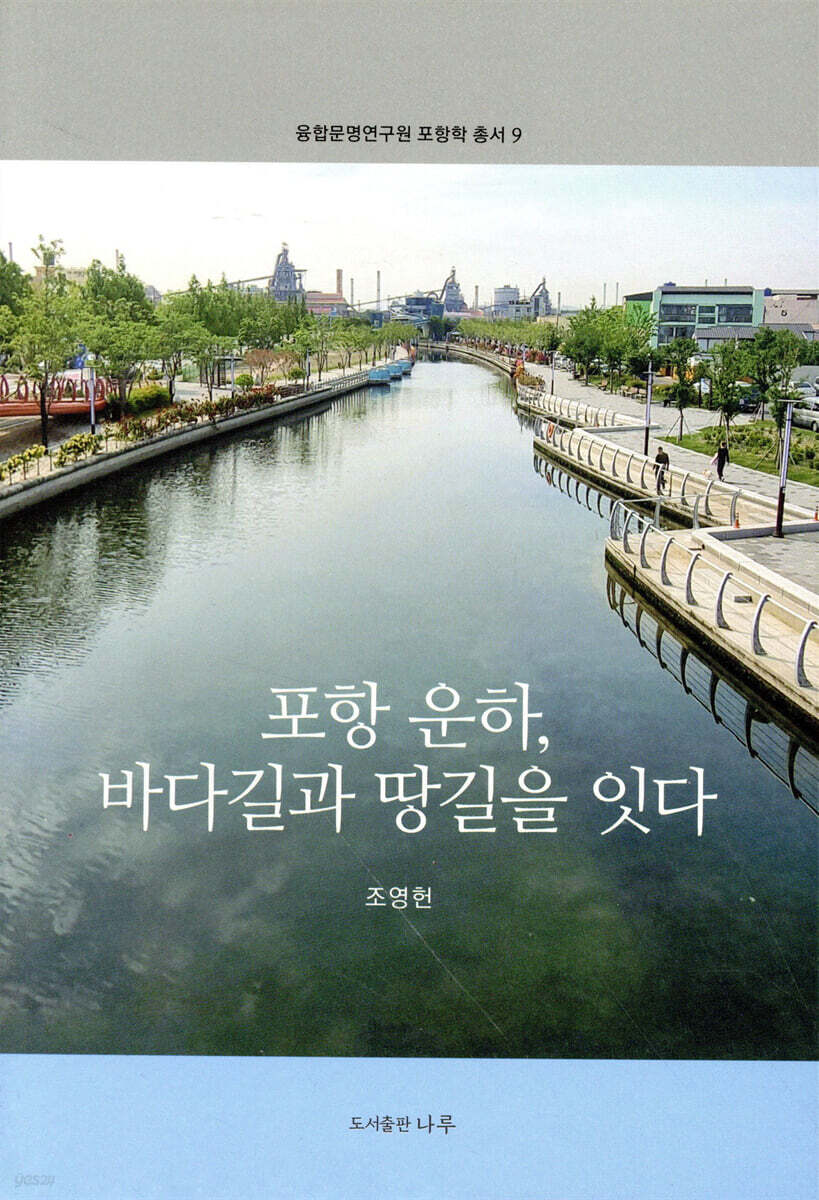
Pohang Canal: Connecting Sea and Land
 |
Description
Book Introduction
“Where does the Suez Canal end?” This book’s question about the Pohang Canal begins with a question about the Suez Canal.
For an answer to this question, we will hear from Isabella Bird Bishop (1831-1904), a British woman widely known to us as the author of “Korea and Her Neighbors.”
And then the question changes again to, “If the Suez Canal ends at Hong Kong, where does the Grand Canal end at?”
Of course, the final question ends with, “Where does the Pohang Canal end?”
For an answer to this question, we will hear from Isabella Bird Bishop (1831-1904), a British woman widely known to us as the author of “Korea and Her Neighbors.”
And then the question changes again to, “If the Suez Canal ends at Hong Kong, where does the Grand Canal end at?”
Of course, the final question ends with, “Where does the Pohang Canal end?”
index
Entering
Introduction: Where does the Suez Canal end?
Suez Canal Terminus 17
23 Reasons Why Britain Valued the Suez Canal
How should we view the Pohang Canal? 30
Structure of this book 35
1.
The History of Waterways that Opened Civilization and the Role of Man-Made Waterways
Is it Earth or Water? Water isn't distributed equally. 41
Civilization 48: A River-Cultivated Space
Waterways and the "Space Revolution": A Key Resource That Shapes History 54
Britain's 62nd Space Revolution with the Suez Canal
The US 69 connected the Pacific and Atlantic oceans with the Panama Canal
2.
China's canals connecting sea and land routes
Where does the Grand Canal end in China? 81
Five Stages of Transition in Chinese History as Seen Through the Grand Canal (Part 87)
The Relationship Between the Grand Canal, a World Heritage Site, and the Belt and Road Initiative 96
The Grand Canal: A Connection Between Continental and Maritime Civilizations 105
3.
Pohang Canal Connects Dongbinnae Port and Hyeongsan River
The beginning of Pohang's history, connected to the road: the establishment of Pohang Changjin 115
Pohang 123, a thriving fishing hub during the Japanese colonial period
Construction of Pohang Iron and Steel Company (POSCO), a new driving force for Pohang, begins 130 years ago.
Ecological Crisis in Pohang, a Coastal Industrial City 137
Dongbinnae Port and Hyeongsan River 145 connected via the Pohang Canal
Strolling along the Pohang Canal 163
Watching "Still Horse" brings to mind "Seo-yuk-dong-hae, Sacha-deungseon" 180
Conclusion: Where does the Pohang Canal end?
Pohang Canal's terminal point 191
From the spatial revolution to the connectivity revolution 196
Dreaming of a Crossroads of Maritime and Continental Civilizations Through the Pohang Canal 199
Introduction: Where does the Suez Canal end?
Suez Canal Terminus 17
23 Reasons Why Britain Valued the Suez Canal
How should we view the Pohang Canal? 30
Structure of this book 35
1.
The History of Waterways that Opened Civilization and the Role of Man-Made Waterways
Is it Earth or Water? Water isn't distributed equally. 41
Civilization 48: A River-Cultivated Space
Waterways and the "Space Revolution": A Key Resource That Shapes History 54
Britain's 62nd Space Revolution with the Suez Canal
The US 69 connected the Pacific and Atlantic oceans with the Panama Canal
2.
China's canals connecting sea and land routes
Where does the Grand Canal end in China? 81
Five Stages of Transition in Chinese History as Seen Through the Grand Canal (Part 87)
The Relationship Between the Grand Canal, a World Heritage Site, and the Belt and Road Initiative 96
The Grand Canal: A Connection Between Continental and Maritime Civilizations 105
3.
Pohang Canal Connects Dongbinnae Port and Hyeongsan River
The beginning of Pohang's history, connected to the road: the establishment of Pohang Changjin 115
Pohang 123, a thriving fishing hub during the Japanese colonial period
Construction of Pohang Iron and Steel Company (POSCO), a new driving force for Pohang, begins 130 years ago.
Ecological Crisis in Pohang, a Coastal Industrial City 137
Dongbinnae Port and Hyeongsan River 145 connected via the Pohang Canal
Strolling along the Pohang Canal 163
Watching "Still Horse" brings to mind "Seo-yuk-dong-hae, Sacha-deungseon" 180
Conclusion: Where does the Pohang Canal end?
Pohang Canal's terminal point 191
From the spatial revolution to the connectivity revolution 196
Dreaming of a Crossroads of Maritime and Continental Civilizations Through the Pohang Canal 199
Publisher's Review
The author, a leading researcher on the Grand Canal in China, begins his story by comparing the Pohang Canal to the Grand Canal in China.
“Compared to China’s Grand Canal, Korea’s Pohang Canal is very short in both physical length and history.
Does a small-scale, short-term study lack value? While the research may contain limited content, it's difficult to assert that it lacks value.
Because there are many small but precious things in the world.
However, I soon realized that it would not be easy to fill a book about the Pohang Canal with only stories about the Pohang Canal.
Accordingly, this book aims to present the civilizational significance of the Pohang Canal, which was built in the 21st century, by comparing it with the history of major canals around the world, including those in China.
I sincerely hope that through this book, you will broaden your understanding of the Pohang Canal itself, as well as its impact on human civilization and the essence of the canal itself.”
The Pohang Canal may be the shortest canal in the world.
The total length is only 1.3 kilometers.
The Pohang Canal, which opened on January 8, 2014, is a waterway connecting Dongbinnae Port, Pohang's representative port, and the mouth of the Hyeongsan River.
Although it is a short canal, only 1.3 kilometers long, it is significant in that it restores the waterway between the river and the sea that had been cut off for a long time.
Originally, Dongbinnae Port was an inner port that served as a logistics hub from the Silla Dynasty to the Japanese colonial period and served as a foundation for the development of Pohang. However, with the opening of the Pohang Canal, Dongbinnae Port was connected to the waters of the Hyeongsan River, the largest river in Gyeongbuk.
In other words, the 'sea route' extending from Dongbinnae Port and the inland 'land route' connected to the Hyeongsan River were 'connected' through the Pohang Canal.
The meaning of the Pohang Canal that the author emphasizes is ‘spatial expansion’ through ‘connection.’
“What is important about the Pohang Canal is not its length or history.
Rather, it lies in the symbolic meaning of the Hyeongsan River and Dongbin Port that connect the canal.
The vast inland cultures are connected through the Hyeongsan River, and the numerous maritime resources of the sea are connected through the Dongbin Port.
In other words, the Pohang Canal became a link and node connecting the sea route and the land route, and through this, Pohang's significance as a port city where maritime and continental civilizations intersect can be clearly seen.
The Pohang Canal also resonated with McCullough's concept of a canal as "a work of civilization that connects what is separate and unites humanity."
“The core essence of the canal that this book seeks to emphasize lies right here.”
This is how the title of this book and the concept of the Pohang Canal were decided.
“An artificial waterway connecting sea and land routes”
Accordingly, the title of the book was set as ‘Pohang Canal, Connecting the Sea Route and the Land Route.’
In short, this book reveals that by opening the waterway called the Pohang Canal, Pohang became a port city connecting the sea route and the land route, and a crossroads of civilization where the ocean and the continent met.
During one of his several visits to the Pohang Canal, the author stopped in his tracks upon seeing the sculpture “Standing Horse” placed along the canal.
And, recalling the relationship between canals and horses, he quotes the proverb “Southern boats, northern horses” (南船北馬) from Chinese history.
In the southern region, it means taking a boat, and in the north, it means taking a horse.
The author's thoughts that come to mind through 'stopped speech' were the 'stop' behind 'connection'.
“Whether you get off the boat and transfer to a horse, or from a horse and transfer to a boat, these stages of disembarking and boarding are inevitably accompanied by the experience of ‘stopping.’
The characteristics of canals and waterways are connection and flow, but there needs to be a point where that connection and flow stop for a moment.
This is where the type of road changes or where there is a difference in water level.
There must be rest and change there.
At each of these nodes, stations and ports are created, and in front of the stations and ports, markets, lodging, and other service industries naturally flourish.
The city that became the center of commerce, exchange, and culture developed at that very point.
History has always been like that.
“All major cities with the Grand Canal as their infrastructure have experienced distribution bottlenecks.”
So what about Pohang and the Pohang Canal?
Traditionally, Pohang was a place where a base was set up for maritime defense; after the establishment of Pohang Chongjin, it was a place where ships carrying rice bound for Hamgyeong-do and Gangwon-do waited to call; a place where fishing boats laden with sardines and herring unloaded their catch at Dongbinnae Harbor; a place where merchants coming from inland along the Hyeongsan River unloaded their goods; a place where they paused before moving inland and nearby regions; and now, it is a place where ships and trucks transporting raw materials to POSCO or steel produced by POSCO to all over the country and the world stop and catch their breath.
Pohang is a city that connects these waterways and landways, and the Pohang Canal is located at that very point, where it connects the Hyeongsan River, the East Sea, and POSCO.
Here, the author proposes two terms, parodying “Namseonbukma.”
The first term is “East Sea, West Land, Boat, and Land”.
It means 'There is sea to the east and land to the west, so abandon the ship and go on land.'
Today, as the maritime age is fully dawning, we can welcome those arriving in Pohang by ship from all over the world and convey the message that Pohang will connect to all parts of South Korea.
Another one is “Seo-yuk-dong-hae, Sa-cha-deung-seon (西陸東海 舍車登船).”
It means 'There is land to the west and the sea to the east, so get off the car and get on a boat.'
It has now been proven that the Korean Peninsula is too small as a stage for Korean activities.
Moreover, the Korean Peninsula has been divided for over 70 years, and South Korea exists as an 'island' cut off from the Eurasian continent by North Korea.
Although it has been a long time since Koreans began to look overseas for their activities, their minds are often still stuck in continental mindsets.
So, the more departure points there are where you can get out of your car and onto a boat, overlooking the vast ocean, the better.
Pohang has all of these locational advantages.
The Pohang Canal, as it connects the Hyeongsan River and Dongbin Port, is the perfect space to convey the message of connecting and switching between the land route to the inland and the water route to the sea.
Finally, the author emphasizes that the power of the canal lies in its ‘connection.’
“Britain had complete control of the 164-kilometer-long Suez Canal, allowing it to terminate at Hong Kong, nearly 10,000 kilometers away.
The United States also maintained a well-maintained 82-kilometer Panama Canal, connecting it to major ports around the world.
In this way, the power of the canal lay in the ‘spatial revolution’ that overcame the limitations of geographical space through ‘connection.’
“The same goes for the Pohang Canal.”
Will the Pohang Canal truly become a crossroads between maritime and continental civilizations, a catalyst for a "connectivity revolution" and a "spatial revolution" originating on the Korean Peninsula? Or will it be content with a mere space for cruising and strolling through the world's smallest canal? This book will serve as a first guide for readers seeking to glimpse the immense resistance and potential breakthroughs in this area.
Publishing the Pohang Studies Series
POSTECH's Institute for Convergence Civilization has published the Pohang Studies Series.
I am very pleased to have achieved such a meaningful project.
The Convergence Civilization Research Institute was established to conduct convergence research to diagnose the present state of our society and explore the future at a turning point in modern civilization. Living up to its name, the Institute has carried out various projects.
The publication of the Pohang Studies Series is a very meaningful undertaking, enabling researchers to connect more closely with reality.
This is also significant in that it marks a groundbreaking development in the relationship that POSTECH, Korea's first science and engineering research-oriented university, has maintained with the local community.
Universities and cities have a close relationship.
Many of the world's leading universities have grown alongside the cities that formed around their founding.
Even today, there are many world-renowned universities that are objects of love and pride for citizens, like city landmarks.
Good examples include Cambridge and Oxford in the UK, Princeton, Berkeley, Harvard, and MIT in the US, and Heidelberg and Freiburg in Germany.
These universities are developing a kind of shared destiny with the city.
I hope that the publication of the Pohang Studies Series will further strengthen the mutually beneficial relationship between POSTECH and Pohang City.
To achieve this goal, the Pohang Studies Series of the POSTECH Convergence Civilization Research Institute maintains an open attitude.
First of all, I want to avoid being confined to the framework of the academic discipline called regional studies.
We will not limit our staff to professional scholars.
We also want to broadly embrace the regional studies efforts that citizens who love Pohang have voluntarily undertaken.
Second, I would like to have a flexible attitude in selecting topics.
If it expands knowledge and information useful to the citizens of Pohang and the people of our country, I will actively pursue it, even if it is somewhat outside my academic interests.
Thirdly, we try not to be bound by regional boundaries.
Pohang is not an isolated city, and as exchanges with various regions both domestically and internationally are essential for its development, we will strive to convey the diverse perspectives of diverse writers from both within and outside Pohang.
We will strive to ensure that the Pohang Studies Series of the POSTECH Convergence Civilization Research Institute contributes meaningfully to reflecting on Pohang's past and present and dreaming of a desirable future based on this insight.
By filling the Pohang Studies Series with vivid, living research closely connected to the lives of citizens, and with realistic and concrete research that harmonizes society and academia, we aim to create a forum where not only Pohang citizens but all those interested in Pohang can enjoy reading and engaging in dialogue.
I believe in and look forward to your support, and I would like to take this opportunity to express my gratitude.
POSTECH Convergence Civilization Research Institute
Director Park Sang-jun
“Compared to China’s Grand Canal, Korea’s Pohang Canal is very short in both physical length and history.
Does a small-scale, short-term study lack value? While the research may contain limited content, it's difficult to assert that it lacks value.
Because there are many small but precious things in the world.
However, I soon realized that it would not be easy to fill a book about the Pohang Canal with only stories about the Pohang Canal.
Accordingly, this book aims to present the civilizational significance of the Pohang Canal, which was built in the 21st century, by comparing it with the history of major canals around the world, including those in China.
I sincerely hope that through this book, you will broaden your understanding of the Pohang Canal itself, as well as its impact on human civilization and the essence of the canal itself.”
The Pohang Canal may be the shortest canal in the world.
The total length is only 1.3 kilometers.
The Pohang Canal, which opened on January 8, 2014, is a waterway connecting Dongbinnae Port, Pohang's representative port, and the mouth of the Hyeongsan River.
Although it is a short canal, only 1.3 kilometers long, it is significant in that it restores the waterway between the river and the sea that had been cut off for a long time.
Originally, Dongbinnae Port was an inner port that served as a logistics hub from the Silla Dynasty to the Japanese colonial period and served as a foundation for the development of Pohang. However, with the opening of the Pohang Canal, Dongbinnae Port was connected to the waters of the Hyeongsan River, the largest river in Gyeongbuk.
In other words, the 'sea route' extending from Dongbinnae Port and the inland 'land route' connected to the Hyeongsan River were 'connected' through the Pohang Canal.
The meaning of the Pohang Canal that the author emphasizes is ‘spatial expansion’ through ‘connection.’
“What is important about the Pohang Canal is not its length or history.
Rather, it lies in the symbolic meaning of the Hyeongsan River and Dongbin Port that connect the canal.
The vast inland cultures are connected through the Hyeongsan River, and the numerous maritime resources of the sea are connected through the Dongbin Port.
In other words, the Pohang Canal became a link and node connecting the sea route and the land route, and through this, Pohang's significance as a port city where maritime and continental civilizations intersect can be clearly seen.
The Pohang Canal also resonated with McCullough's concept of a canal as "a work of civilization that connects what is separate and unites humanity."
“The core essence of the canal that this book seeks to emphasize lies right here.”
This is how the title of this book and the concept of the Pohang Canal were decided.
“An artificial waterway connecting sea and land routes”
Accordingly, the title of the book was set as ‘Pohang Canal, Connecting the Sea Route and the Land Route.’
In short, this book reveals that by opening the waterway called the Pohang Canal, Pohang became a port city connecting the sea route and the land route, and a crossroads of civilization where the ocean and the continent met.
During one of his several visits to the Pohang Canal, the author stopped in his tracks upon seeing the sculpture “Standing Horse” placed along the canal.
And, recalling the relationship between canals and horses, he quotes the proverb “Southern boats, northern horses” (南船北馬) from Chinese history.
In the southern region, it means taking a boat, and in the north, it means taking a horse.
The author's thoughts that come to mind through 'stopped speech' were the 'stop' behind 'connection'.
“Whether you get off the boat and transfer to a horse, or from a horse and transfer to a boat, these stages of disembarking and boarding are inevitably accompanied by the experience of ‘stopping.’
The characteristics of canals and waterways are connection and flow, but there needs to be a point where that connection and flow stop for a moment.
This is where the type of road changes or where there is a difference in water level.
There must be rest and change there.
At each of these nodes, stations and ports are created, and in front of the stations and ports, markets, lodging, and other service industries naturally flourish.
The city that became the center of commerce, exchange, and culture developed at that very point.
History has always been like that.
“All major cities with the Grand Canal as their infrastructure have experienced distribution bottlenecks.”
So what about Pohang and the Pohang Canal?
Traditionally, Pohang was a place where a base was set up for maritime defense; after the establishment of Pohang Chongjin, it was a place where ships carrying rice bound for Hamgyeong-do and Gangwon-do waited to call; a place where fishing boats laden with sardines and herring unloaded their catch at Dongbinnae Harbor; a place where merchants coming from inland along the Hyeongsan River unloaded their goods; a place where they paused before moving inland and nearby regions; and now, it is a place where ships and trucks transporting raw materials to POSCO or steel produced by POSCO to all over the country and the world stop and catch their breath.
Pohang is a city that connects these waterways and landways, and the Pohang Canal is located at that very point, where it connects the Hyeongsan River, the East Sea, and POSCO.
Here, the author proposes two terms, parodying “Namseonbukma.”
The first term is “East Sea, West Land, Boat, and Land”.
It means 'There is sea to the east and land to the west, so abandon the ship and go on land.'
Today, as the maritime age is fully dawning, we can welcome those arriving in Pohang by ship from all over the world and convey the message that Pohang will connect to all parts of South Korea.
Another one is “Seo-yuk-dong-hae, Sa-cha-deung-seon (西陸東海 舍車登船).”
It means 'There is land to the west and the sea to the east, so get off the car and get on a boat.'
It has now been proven that the Korean Peninsula is too small as a stage for Korean activities.
Moreover, the Korean Peninsula has been divided for over 70 years, and South Korea exists as an 'island' cut off from the Eurasian continent by North Korea.
Although it has been a long time since Koreans began to look overseas for their activities, their minds are often still stuck in continental mindsets.
So, the more departure points there are where you can get out of your car and onto a boat, overlooking the vast ocean, the better.
Pohang has all of these locational advantages.
The Pohang Canal, as it connects the Hyeongsan River and Dongbin Port, is the perfect space to convey the message of connecting and switching between the land route to the inland and the water route to the sea.
Finally, the author emphasizes that the power of the canal lies in its ‘connection.’
“Britain had complete control of the 164-kilometer-long Suez Canal, allowing it to terminate at Hong Kong, nearly 10,000 kilometers away.
The United States also maintained a well-maintained 82-kilometer Panama Canal, connecting it to major ports around the world.
In this way, the power of the canal lay in the ‘spatial revolution’ that overcame the limitations of geographical space through ‘connection.’
“The same goes for the Pohang Canal.”
Will the Pohang Canal truly become a crossroads between maritime and continental civilizations, a catalyst for a "connectivity revolution" and a "spatial revolution" originating on the Korean Peninsula? Or will it be content with a mere space for cruising and strolling through the world's smallest canal? This book will serve as a first guide for readers seeking to glimpse the immense resistance and potential breakthroughs in this area.
Publishing the Pohang Studies Series
POSTECH's Institute for Convergence Civilization has published the Pohang Studies Series.
I am very pleased to have achieved such a meaningful project.
The Convergence Civilization Research Institute was established to conduct convergence research to diagnose the present state of our society and explore the future at a turning point in modern civilization. Living up to its name, the Institute has carried out various projects.
The publication of the Pohang Studies Series is a very meaningful undertaking, enabling researchers to connect more closely with reality.
This is also significant in that it marks a groundbreaking development in the relationship that POSTECH, Korea's first science and engineering research-oriented university, has maintained with the local community.
Universities and cities have a close relationship.
Many of the world's leading universities have grown alongside the cities that formed around their founding.
Even today, there are many world-renowned universities that are objects of love and pride for citizens, like city landmarks.
Good examples include Cambridge and Oxford in the UK, Princeton, Berkeley, Harvard, and MIT in the US, and Heidelberg and Freiburg in Germany.
These universities are developing a kind of shared destiny with the city.
I hope that the publication of the Pohang Studies Series will further strengthen the mutually beneficial relationship between POSTECH and Pohang City.
To achieve this goal, the Pohang Studies Series of the POSTECH Convergence Civilization Research Institute maintains an open attitude.
First of all, I want to avoid being confined to the framework of the academic discipline called regional studies.
We will not limit our staff to professional scholars.
We also want to broadly embrace the regional studies efforts that citizens who love Pohang have voluntarily undertaken.
Second, I would like to have a flexible attitude in selecting topics.
If it expands knowledge and information useful to the citizens of Pohang and the people of our country, I will actively pursue it, even if it is somewhat outside my academic interests.
Thirdly, we try not to be bound by regional boundaries.
Pohang is not an isolated city, and as exchanges with various regions both domestically and internationally are essential for its development, we will strive to convey the diverse perspectives of diverse writers from both within and outside Pohang.
We will strive to ensure that the Pohang Studies Series of the POSTECH Convergence Civilization Research Institute contributes meaningfully to reflecting on Pohang's past and present and dreaming of a desirable future based on this insight.
By filling the Pohang Studies Series with vivid, living research closely connected to the lives of citizens, and with realistic and concrete research that harmonizes society and academia, we aim to create a forum where not only Pohang citizens but all those interested in Pohang can enjoy reading and engaging in dialogue.
I believe in and look forward to your support, and I would like to take this opportunity to express my gratitude.
POSTECH Convergence Civilization Research Institute
Director Park Sang-jun
GOODS SPECIFICS
- Date of issue: February 15, 2024
- Page count, weight, size: 208 pages | 128*188*20mm
- ISBN13: 9791198226167
- ISBN10: 1198226161
You may also like
카테고리
korean


korean

![GQ KOREA Mark (Monthly): December [2025]](http://librairie.coreenne.fr/cdn/shop/files/8ef265dbbfbf186523ed75ba7319009d.jpg?v=1765340328&width=3840)


