

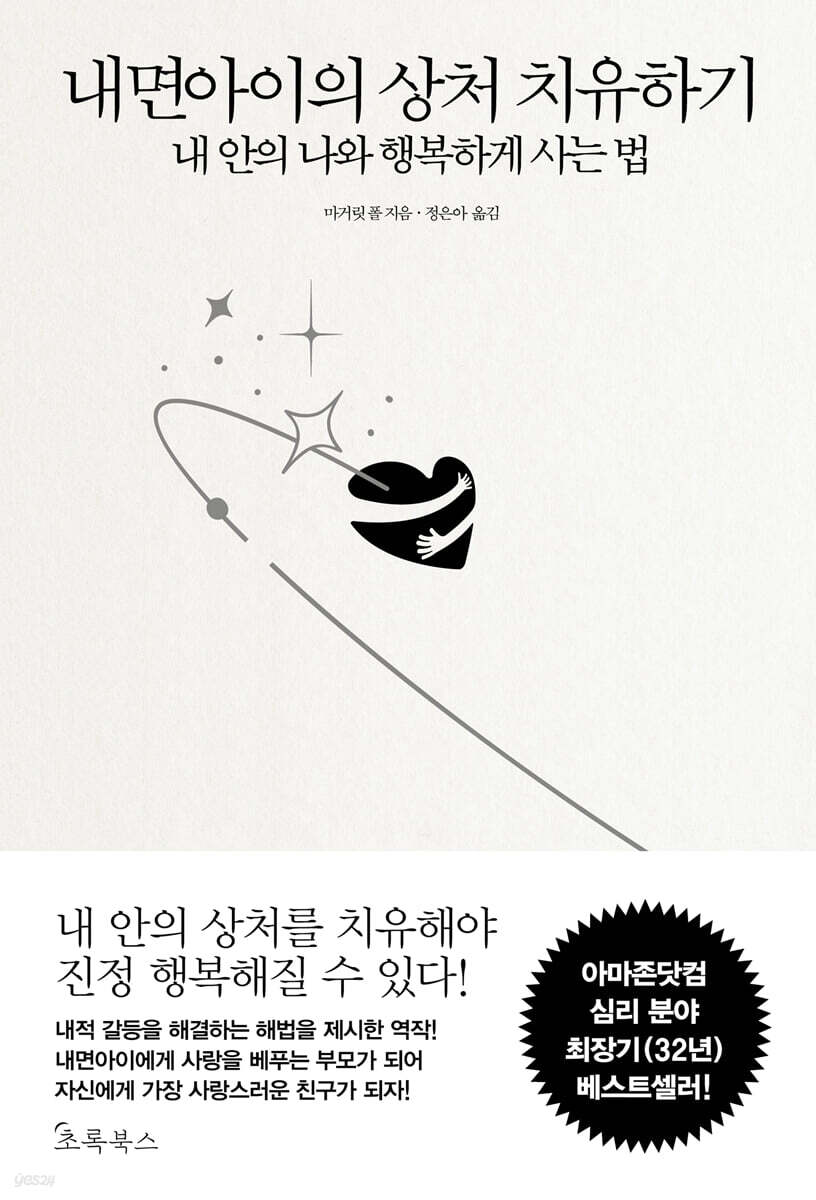
Healing the Wounds of Your Inner Child
 |
Description
Book Introduction
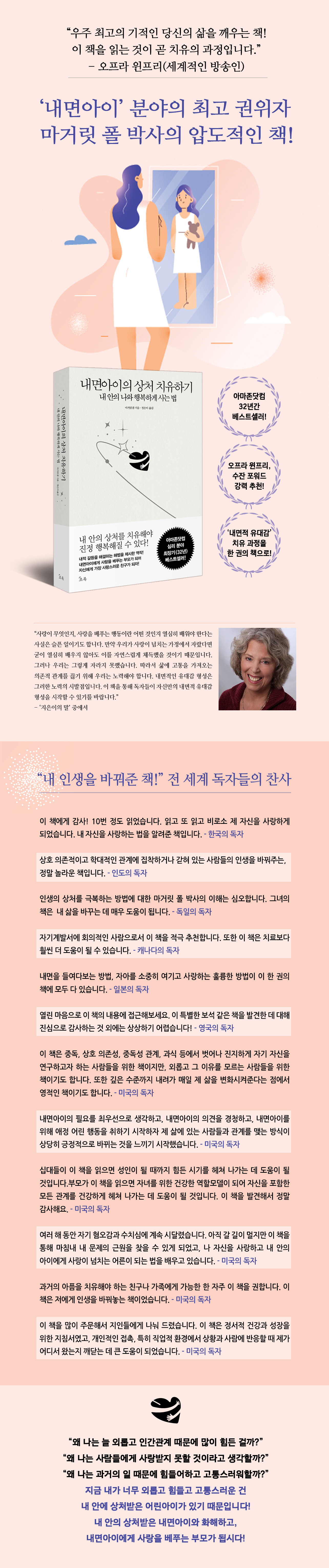
A book that suggests ways to reconcile with your wounded inner child! “Why am I lonely and struggling with relationships?” “Why do I feel unlovable?” “Why do I suffer because of the past?” The reason I am so lonely, struggling, and in pain right now is because there is a wounded child inside me. The 'inner child' is the most vulnerable and vulnerable part of our personality, the 'intuitive' instinct that prioritizes emotions. In other words, the inner child is our original self and innate personality when we are born. There are many books on the market that deal with the inner child, but this one is by far the best. It has been a consistent Amazon psychology bestseller for 32 years, thanks to its deep and insightful content and practical solutions that can be applied in daily life. Dr. Margaret Paul, a world-renowned authority on the "inner child," says that forming an inner bond is the process of connecting our thoughts with the instinctive feelings of our inner child, and that through this, we can minimize painful conflicts with ourselves. Because the inner child within us wants to be acknowledged and loved at every moment, the author suggests ways to love ourselves and others while also caring for ourselves in various situations. Through this, we can minimize painful conflicts with ourselves and give and receive love as inner conflicts disappear. In other words, by acknowledging our inner 'voice', we can fulfill our own needs and not be completely dependent on others for our happiness. The author urges us to reconcile with the wounded inner child within us and give love before it is too late. By building an inner bond introduced in this book, you can heal past wounds and become a strong parent to your inner child. As introduced in this book, by becoming a parent who gives love to your inner child, you can become your own most loving and trustworthy friend. Just by following the five-step process for forming an inner bond presented in this book, you will soon embark on a healing process that will allow you to embrace your wounded inner child and live a life filled with love. Let's feel the joy of no longer being alone through this book! |
- You can preview some of the book's contents.
Preview
index
Author's Note: Let's love our inner child every moment.
Part 1: Happiness Comes When We Let Go of Our Inner Child's Wounds
Chapter 1: Developing an Inner Bond That Leads to a True Life
Where can we find the true life we have lost in our daily lives?
What is inner bonding?
A general overview of forming inner bonds
What is the inner child?
Does everyone have an inner child?
What is the adult self?
What are the actions that express love?
Chapter 2: A Five-Step Process for Building Inner Bonds
Why do we consider ourselves unlovable?
Actions that express love to your inner child
Why do we use the terms adult self and inner child?
We must awaken the adult self with a loving heart.
The key to expressing love is understanding the intention.
It is painful when the adult self and inner child are disconnected.
5 Steps to Building Inner Bonds
Positive outcomes from forming inner bonds
Chapter 3: Practical Advice for Building Inner Bonds
Building inner bonds isn't as easy as it sounds.
Step 1: Recognize your inner conflict.
In step 2, the intention to learn is important.
Step 3: How to Talk to Your Inner Child
In step 3, you must correct your false beliefs.
In step 3, choose your higher self.
In Step 4, talk to higher-dimensional forces.
Step 5: You must take action.
Chapter 4: Don't Try to Protect Your Abandoned Inner Child
Who is crying inside me in the middle of the night?
Protecting yourself disconnects you from your inner child.
4 Ways We Protect Ourselves
Codependent relationships fuel each other's addictions.
The vicious cycle of disconnection from one's inner child
Chapter 5: Becoming a Parent to Your Inner Child and Maintaining a Bond
An example of an adult self showing love to their inner child
An example of an adult self who does not show love to their inner child.
Let's become parents to our inner child again.
What kind of parents have we been to our inner child?
Must fulfill the roles of father and mother simultaneously
Learn how to love your inner child properly
Maintaining inner connection in conflict situations
Part 2: How to Heal Your Inner Child's Wounds in Times Like These
Chapter 6: Healing Wounds in Conflicts with Your Spouse
Why So Many Conflicts Occur in Marriage
A husband who shifts responsibility for his self-esteem onto his wife
A wife who believes she is unhappy because of her husband's behavior
A couple who blame each other in an intense power struggle
A dependent couple who doesn't take responsibility for their own feelings
Advice for a Relationship That Lasts Through the Years
Chapter 7: Healing Wounds in Conflicts with a Lover
Why we feel so insecure about each other
Blaming your partner for taking responsibility for their own feelings
The belief that my lover will take better care of me than I do
Two people who fight once a week and say they want to break up
A lover who complains that he doesn't spend enough time with her
You have to take the risk of losing your lover.
Chapter 8: Healing Wounds in Conflicts with Parents
What responsibilities do we have to our parents?
The idea that no one else can take responsibility for their father
A daughter who only receives criticism from her mother, just like when she was young
A daughter who is still afraid of the father she was afraid of as a child
A son who is having a hard time giving money to his father
Don't give to your parents in a dependent way.
Chapter 9: Healing Wounds in Conflicts with Your Children
Why You Have a Dependent Relationship with Your Child
A daughter who never wants to be alone for a moment
A son who keeps trying to hit his mother
My daughter can't concentrate in class and hits her friends.
Brothers who constantly fight and compete for power
Become a parent who loves your inner child.
Chapter 10: Healing Wounds in Conflicts with Friends
Why We Project Our Dependent Tendencies onto Relationships
I want my friend to take responsibility for my feelings.
Opening your heart to others while ignoring your own feelings
Trying to take responsibility for your friend's feelings
Best friends who don't even call after marriage
A friend who ignores the situation even after being beaten by her husband
New friendships with friends who have healthy bonds
Chapter 11: Healing from Work and Professional Conflicts
Power struggles are everywhere
A dependent relationship that jeopardizes the partnership
A boss who reminds me of my tyrannical father
Tolerate the anger and criticism of others unconditionally
A power struggle with a subordinate who frequently resists instructions
Defending Your Inner Child Through Action Against Authority
Reclaim your rights that you have transferred to others
Chapter 12: Healing Your Wounds When You're Alone
Why I'm Afraid of Being Alone
Loving Your Inner Child When You're Alone
Guilt and betrayal due to her husband's illness
A husband who breaks down due to the absence of his wife who always cared for him.
The misery of being cheated on by your date
Take special care of your health and safety.
A young man ruining himself with alcohol and marijuana
Childhood trauma and abuse
The wounds I tried to suppress with substance addiction
Violence caused by a father's betrayal and abuse
Treat others as I treat myself.
Part 1: Happiness Comes When We Let Go of Our Inner Child's Wounds
Chapter 1: Developing an Inner Bond That Leads to a True Life
Where can we find the true life we have lost in our daily lives?
What is inner bonding?
A general overview of forming inner bonds
What is the inner child?
Does everyone have an inner child?
What is the adult self?
What are the actions that express love?
Chapter 2: A Five-Step Process for Building Inner Bonds
Why do we consider ourselves unlovable?
Actions that express love to your inner child
Why do we use the terms adult self and inner child?
We must awaken the adult self with a loving heart.
The key to expressing love is understanding the intention.
It is painful when the adult self and inner child are disconnected.
5 Steps to Building Inner Bonds
Positive outcomes from forming inner bonds
Chapter 3: Practical Advice for Building Inner Bonds
Building inner bonds isn't as easy as it sounds.
Step 1: Recognize your inner conflict.
In step 2, the intention to learn is important.
Step 3: How to Talk to Your Inner Child
In step 3, you must correct your false beliefs.
In step 3, choose your higher self.
In Step 4, talk to higher-dimensional forces.
Step 5: You must take action.
Chapter 4: Don't Try to Protect Your Abandoned Inner Child
Who is crying inside me in the middle of the night?
Protecting yourself disconnects you from your inner child.
4 Ways We Protect Ourselves
Codependent relationships fuel each other's addictions.
The vicious cycle of disconnection from one's inner child
Chapter 5: Becoming a Parent to Your Inner Child and Maintaining a Bond
An example of an adult self showing love to their inner child
An example of an adult self who does not show love to their inner child.
Let's become parents to our inner child again.
What kind of parents have we been to our inner child?
Must fulfill the roles of father and mother simultaneously
Learn how to love your inner child properly
Maintaining inner connection in conflict situations
Part 2: How to Heal Your Inner Child's Wounds in Times Like These
Chapter 6: Healing Wounds in Conflicts with Your Spouse
Why So Many Conflicts Occur in Marriage
A husband who shifts responsibility for his self-esteem onto his wife
A wife who believes she is unhappy because of her husband's behavior
A couple who blame each other in an intense power struggle
A dependent couple who doesn't take responsibility for their own feelings
Advice for a Relationship That Lasts Through the Years
Chapter 7: Healing Wounds in Conflicts with a Lover
Why we feel so insecure about each other
Blaming your partner for taking responsibility for their own feelings
The belief that my lover will take better care of me than I do
Two people who fight once a week and say they want to break up
A lover who complains that he doesn't spend enough time with her
You have to take the risk of losing your lover.
Chapter 8: Healing Wounds in Conflicts with Parents
What responsibilities do we have to our parents?
The idea that no one else can take responsibility for their father
A daughter who only receives criticism from her mother, just like when she was young
A daughter who is still afraid of the father she was afraid of as a child
A son who is having a hard time giving money to his father
Don't give to your parents in a dependent way.
Chapter 9: Healing Wounds in Conflicts with Your Children
Why You Have a Dependent Relationship with Your Child
A daughter who never wants to be alone for a moment
A son who keeps trying to hit his mother
My daughter can't concentrate in class and hits her friends.
Brothers who constantly fight and compete for power
Become a parent who loves your inner child.
Chapter 10: Healing Wounds in Conflicts with Friends
Why We Project Our Dependent Tendencies onto Relationships
I want my friend to take responsibility for my feelings.
Opening your heart to others while ignoring your own feelings
Trying to take responsibility for your friend's feelings
Best friends who don't even call after marriage
A friend who ignores the situation even after being beaten by her husband
New friendships with friends who have healthy bonds
Chapter 11: Healing from Work and Professional Conflicts
Power struggles are everywhere
A dependent relationship that jeopardizes the partnership
A boss who reminds me of my tyrannical father
Tolerate the anger and criticism of others unconditionally
A power struggle with a subordinate who frequently resists instructions
Defending Your Inner Child Through Action Against Authority
Reclaim your rights that you have transferred to others
Chapter 12: Healing Your Wounds When You're Alone
Why I'm Afraid of Being Alone
Loving Your Inner Child When You're Alone
Guilt and betrayal due to her husband's illness
A husband who breaks down due to the absence of his wife who always cared for him.
The misery of being cheated on by your date
Take special care of your health and safety.
A young man ruining himself with alcohol and marijuana
Childhood trauma and abuse
The wounds I tried to suppress with substance addiction
Violence caused by a father's betrayal and abuse
Treat others as I treat myself.
Detailed image
Into the book
The 'inner child' is the most vulnerable and vulnerable part of our personality, the 'intuitive' instinct that prioritizes emotions.
In other words, it is our original self, our core self, and our innate personality when we were born.
This inner child has talents, instincts, intuition, and emotions.
The inner child can also be likened to the right brain, which is the creative part responsible for emotions and experiences.
One thing to note is that we must distinguish between the concepts of inner child and childhood.
We do a lot of 'childish things' as children.
He speaks with a short tongue, rolls around in the mud, and fights with his brothers when he gets angry.
And when things don't go their way, they pout or stamp their feet.
But the inner child refers to 'purity' rather than the childishness of childhood.
As we age and become adults, the inner child's vulnerability, intuition, sense of wonder, imagination, innate wisdom, and ability to feel emotions do not diminish or change.
Inner child and childhood are completely different concepts.
Therefore, having had an unfortunate childhood does not necessarily mean that your inner nature, your inner child, is unhappy.
--- p.36
In fact, no one consciously decides not to love themselves.
If we were asked how we actually treat ourselves, most of us would say we treat ourselves in a "mature, appropriate, and responsible way."
But these words are only meaningful when backed up by actions.
“Did our choices lead to loving actions?” “Did our actions contribute to the spiritual and emotional growth of ourselves and others?” “Did our self-esteem increase?” If we can’t answer “yes” to these questions, we’ve abandoned our inner child.
If you abandon your inner child like this, you will not be able to take action to help yourself.
Not taking action is avoiding responsibility for yourself.
When the inner child is abandoned by the adult self, it feels unlovable and worthless.
Ultimately, because the adult self does not consider itself a valuable person, it relies on other people or objects to find its own worth.
This kind of dependence on something other than oneself is called dependence.
--- p.62~63
When speaking to your inner child, it can be helpful to use a doll.
First, turn the doll's face outward and hold it to your chest while breathing in.
Focus your consciousness within yourself and imagine yourself as a child.
The doll becomes your inner child.
Picture your adult self sitting in front of you or surrounding your inner child with loving energy.
It may be helpful to have a picture of your current face, that is, an adult face, in front of you.
Especially when you feel pain, it is important to believe that your inner child is not alone, but that your adult self is there with you.
When we were children, we had to endure loneliness and pain alone.
But now, if you show love to your inner child, you can make that loneliness disappear.
When we engage in conversation with our inner child, either verbally or in writing, with the intention of truly knowing and learning about ourselves, we can draw out the loving and caring energy within us and heal our suffering.
--- p.94
What makes us unhappy is not external events or the actions of others, but our own false beliefs.
There is a misconception that most people have.
It is the belief that our happiness and unhappiness come from outside.
That is, how others view us and treat us, and whether they love and accept us.
The mistaken belief is that the emotions we feel are an inevitable reaction to how others treat us, and that we are ultimately victims of others.
As long as we are caught up in these wrong ideas, we cannot be happy on our own.
Because we get stuck in the mindset of wanting someone to make us happy or thinking that changing other people will make us happy.
That is, we become trapped in an unhealthy dependence.
We must recognize the truth that the emotions we feel arise from our thoughts, beliefs, and our actions toward ourselves and others.
Unless we open our hearts to this truth, we remain trapped in the belief that we are powerless and victims of the actions of others.
But when we begin to take responsibility for our own happiness and unhappiness, joy and pain, through a loving bond with our inner child, we can take the first step toward a healthy life.
--- p.100
Whether you were raised well by your parents or not, the truth of life is always the same.
The truth is that the only person who can influence your mind is you.
Making up your own mind is something only you can do.
No one can replace this.
Everyone wants to feel good, safe, and loved by others.
In fact, one of the sad truths of life is that we cannot receive from anyone else as adults what we did not receive from our parents as children.
We can get love from the world or engage in behaviors that make us feel good for a while, like addictions.
But unless we love ourselves and express it through our actions, no matter how much love we receive from outside, we will continue to feel worthless and unworthy of love inside.
Therefore, we must first give love to ourselves before seeking love from outside.
If you do not love with the intention of looking within and learning, your heart will be closed.
If that happens, even if love comes from outside, it won't be properly conveyed to us and will only act as a temporary painkiller.
If you're constantly searching for the perfect parent or ideal spouse to fill the void and alleviate the pain and loneliness, you're probably going to be waiting your whole life.
Also, in the process, you will continue to suffer from the thought that you are missing out on something precious in life.
The key to solving the problem lies within us.
--- p.112~113
Covert manipulation is when we use compliments, care, kindness, and seduction to get others to like or accept us.
Also, to look good in front of others, you may agree with what they say or follow what they want even though you don't want to.
For example, you might sleep with someone you don't want to, force yourself to spend time with them even though you want to do something else, buy something you don't want to buy, or even have children even though you don't want them.
The reason we do these things is to gain love and acceptance from others, or to avoid rejection.
They even convince themselves that only by giving up on themselves in this way can they be loved by others.
But love isn't something you get like this.
If we give something to get approval or to avoid the other person's critical gaze, we are manipulating the other person.
The real intention behind this behavior is not to give to others, but to receive or avoid something.
Only giving with true joy can be said to be an act of love.
--- p.129
When the adult self is an overly permissive parent, they either neglect the inner child by not being there for the inner child, or they just let the child do whatever he or she wants without meeting the child's actual needs.
In this case, rather than facing the fear head-on, we avoid it with other emotions.
“I feel terrible.
So I guess I'll have another drink." When we fail at something, we tend to ignore the hurt feelings themselves.
“I didn’t really want to do that project anyway.” After that, he avoids it with other emotions.
“I need to go shopping to feel better.” Sometimes we fail to properly control our inner child and allow it to yell, threaten, or physically harm others as it pleases.
Disconnecting from your own emotions is like giving up on being a parent to your inner child.
So what happens then? One reason we don't become loving parents is because our adult selves don't want to do it.
You want to leave the work of making yourself happy to someone else.
--- p.165~166
There are some wrong stereotypes that have taken root in modern society.
When you fall in love, you think that love will last forever and that the two people in love will become one.
In other words, it is an illusion that two people will unite and become complete, and there will be no more loneliness.
Anyone who is married knows this is not true.
The most important thing in loving one another is that you must first learn to love yourself.
If you don't love and accept yourself, you won't be able to open your heart to love because you will be protecting and defending yourself.
For a marital relationship to last a long time, both partners must be in touch with their own inner feelings and be open and considerate of the feelings of others.
That said, there is no insurance for relationships, only a process.
In other words, there is no end to our efforts to grow, and our relationships are in the process of those efforts.
If couples can maintain a connection with their inner selves and open their hearts to each other, they will experience infinite richness and joy in life.
--- p.231~232
Because of our own inner disconnection, we often end up in dependent relationships, regardless of how much we love the other person.
Sometimes, people go through marriage with fear inside them.
However, most people begin to show symptoms of a dependent relationship within six months.
Conflicts with a lover have many similarities to conflicts between married couples.
Even in a relationship, like a married couple, there is a fear of losing not only oneself but also the other, and a fear of not being enough for the other.
Sometimes you may fight about time, money, or sex.
Additionally, if one party is already dating or married, they may suffer from a love triangle.
When you live together, issues related to money and household chores come up.
Since they are not married, they usually feel very insecure about each other.
And this insecurity often leads to dependent relationships.
People who fail to form inner bonds express their anxiety and fear through dependent behavior.
Also, there are many cases where they cannot settle down with one person and are always moving from one person to another.
--- p.237~238
If you feel that giving to your parents is the best thing you can do and comes from love, you are not in a dependent relationship.
Conversely, if you give to your parents out of fear, obligation, or guilt, you are in a dependent relationship.
In that case, you can't help but feel angry and resentful all the time.
Forcing yourself to provide for your parents in this dependent way is an unloving act.
There are many parents who, instead of giving love to their children, treat them carelessly and only expect support later on.
In such cases, caring for your parents can actually be an act of self-abuse.
No matter what your relationship with your parents was like growing up, it changes after you become an adult.
Also, as we grow, our ability to care for others increases and our feelings toward our parents change.
Ultimately, only you can decide how much responsibility you want to take on from your parents.
To do this, you must develop a higher level of strength and a bond with your inner child to determine what is right and loving for you.
--- p.302
People often stay in bad or abusive relationships because they are afraid of being alone.
Many people let go of their loved ones in an attempt to manipulate and hold on to them.
So, we need to think hard about how we can bring joy to our inner child when we are alone and put it into practice.
We must find out what our inner child wants, and our adult self must fulfill it through action.
The way we treat ourselves, others will treat us.
There are often people who complain that people around them do not treat them properly.
However, if we look at the relationship they have with their inner child, it is easy to see that the adult self does not treat the inner child properly.
However, if we look at the relationship they have with their inner child, it is easy to see that the adult self does not treat the inner child properly.
Many people also feel that others do not respect them and act rudely.
But if we look inside them, we can see that their adult selves have not set boundaries to protect their inner child.
In other words, it is our original self, our core self, and our innate personality when we were born.
This inner child has talents, instincts, intuition, and emotions.
The inner child can also be likened to the right brain, which is the creative part responsible for emotions and experiences.
One thing to note is that we must distinguish between the concepts of inner child and childhood.
We do a lot of 'childish things' as children.
He speaks with a short tongue, rolls around in the mud, and fights with his brothers when he gets angry.
And when things don't go their way, they pout or stamp their feet.
But the inner child refers to 'purity' rather than the childishness of childhood.
As we age and become adults, the inner child's vulnerability, intuition, sense of wonder, imagination, innate wisdom, and ability to feel emotions do not diminish or change.
Inner child and childhood are completely different concepts.
Therefore, having had an unfortunate childhood does not necessarily mean that your inner nature, your inner child, is unhappy.
--- p.36
In fact, no one consciously decides not to love themselves.
If we were asked how we actually treat ourselves, most of us would say we treat ourselves in a "mature, appropriate, and responsible way."
But these words are only meaningful when backed up by actions.
“Did our choices lead to loving actions?” “Did our actions contribute to the spiritual and emotional growth of ourselves and others?” “Did our self-esteem increase?” If we can’t answer “yes” to these questions, we’ve abandoned our inner child.
If you abandon your inner child like this, you will not be able to take action to help yourself.
Not taking action is avoiding responsibility for yourself.
When the inner child is abandoned by the adult self, it feels unlovable and worthless.
Ultimately, because the adult self does not consider itself a valuable person, it relies on other people or objects to find its own worth.
This kind of dependence on something other than oneself is called dependence.
--- p.62~63
When speaking to your inner child, it can be helpful to use a doll.
First, turn the doll's face outward and hold it to your chest while breathing in.
Focus your consciousness within yourself and imagine yourself as a child.
The doll becomes your inner child.
Picture your adult self sitting in front of you or surrounding your inner child with loving energy.
It may be helpful to have a picture of your current face, that is, an adult face, in front of you.
Especially when you feel pain, it is important to believe that your inner child is not alone, but that your adult self is there with you.
When we were children, we had to endure loneliness and pain alone.
But now, if you show love to your inner child, you can make that loneliness disappear.
When we engage in conversation with our inner child, either verbally or in writing, with the intention of truly knowing and learning about ourselves, we can draw out the loving and caring energy within us and heal our suffering.
--- p.94
What makes us unhappy is not external events or the actions of others, but our own false beliefs.
There is a misconception that most people have.
It is the belief that our happiness and unhappiness come from outside.
That is, how others view us and treat us, and whether they love and accept us.
The mistaken belief is that the emotions we feel are an inevitable reaction to how others treat us, and that we are ultimately victims of others.
As long as we are caught up in these wrong ideas, we cannot be happy on our own.
Because we get stuck in the mindset of wanting someone to make us happy or thinking that changing other people will make us happy.
That is, we become trapped in an unhealthy dependence.
We must recognize the truth that the emotions we feel arise from our thoughts, beliefs, and our actions toward ourselves and others.
Unless we open our hearts to this truth, we remain trapped in the belief that we are powerless and victims of the actions of others.
But when we begin to take responsibility for our own happiness and unhappiness, joy and pain, through a loving bond with our inner child, we can take the first step toward a healthy life.
--- p.100
Whether you were raised well by your parents or not, the truth of life is always the same.
The truth is that the only person who can influence your mind is you.
Making up your own mind is something only you can do.
No one can replace this.
Everyone wants to feel good, safe, and loved by others.
In fact, one of the sad truths of life is that we cannot receive from anyone else as adults what we did not receive from our parents as children.
We can get love from the world or engage in behaviors that make us feel good for a while, like addictions.
But unless we love ourselves and express it through our actions, no matter how much love we receive from outside, we will continue to feel worthless and unworthy of love inside.
Therefore, we must first give love to ourselves before seeking love from outside.
If you do not love with the intention of looking within and learning, your heart will be closed.
If that happens, even if love comes from outside, it won't be properly conveyed to us and will only act as a temporary painkiller.
If you're constantly searching for the perfect parent or ideal spouse to fill the void and alleviate the pain and loneliness, you're probably going to be waiting your whole life.
Also, in the process, you will continue to suffer from the thought that you are missing out on something precious in life.
The key to solving the problem lies within us.
--- p.112~113
Covert manipulation is when we use compliments, care, kindness, and seduction to get others to like or accept us.
Also, to look good in front of others, you may agree with what they say or follow what they want even though you don't want to.
For example, you might sleep with someone you don't want to, force yourself to spend time with them even though you want to do something else, buy something you don't want to buy, or even have children even though you don't want them.
The reason we do these things is to gain love and acceptance from others, or to avoid rejection.
They even convince themselves that only by giving up on themselves in this way can they be loved by others.
But love isn't something you get like this.
If we give something to get approval or to avoid the other person's critical gaze, we are manipulating the other person.
The real intention behind this behavior is not to give to others, but to receive or avoid something.
Only giving with true joy can be said to be an act of love.
--- p.129
When the adult self is an overly permissive parent, they either neglect the inner child by not being there for the inner child, or they just let the child do whatever he or she wants without meeting the child's actual needs.
In this case, rather than facing the fear head-on, we avoid it with other emotions.
“I feel terrible.
So I guess I'll have another drink." When we fail at something, we tend to ignore the hurt feelings themselves.
“I didn’t really want to do that project anyway.” After that, he avoids it with other emotions.
“I need to go shopping to feel better.” Sometimes we fail to properly control our inner child and allow it to yell, threaten, or physically harm others as it pleases.
Disconnecting from your own emotions is like giving up on being a parent to your inner child.
So what happens then? One reason we don't become loving parents is because our adult selves don't want to do it.
You want to leave the work of making yourself happy to someone else.
--- p.165~166
There are some wrong stereotypes that have taken root in modern society.
When you fall in love, you think that love will last forever and that the two people in love will become one.
In other words, it is an illusion that two people will unite and become complete, and there will be no more loneliness.
Anyone who is married knows this is not true.
The most important thing in loving one another is that you must first learn to love yourself.
If you don't love and accept yourself, you won't be able to open your heart to love because you will be protecting and defending yourself.
For a marital relationship to last a long time, both partners must be in touch with their own inner feelings and be open and considerate of the feelings of others.
That said, there is no insurance for relationships, only a process.
In other words, there is no end to our efforts to grow, and our relationships are in the process of those efforts.
If couples can maintain a connection with their inner selves and open their hearts to each other, they will experience infinite richness and joy in life.
--- p.231~232
Because of our own inner disconnection, we often end up in dependent relationships, regardless of how much we love the other person.
Sometimes, people go through marriage with fear inside them.
However, most people begin to show symptoms of a dependent relationship within six months.
Conflicts with a lover have many similarities to conflicts between married couples.
Even in a relationship, like a married couple, there is a fear of losing not only oneself but also the other, and a fear of not being enough for the other.
Sometimes you may fight about time, money, or sex.
Additionally, if one party is already dating or married, they may suffer from a love triangle.
When you live together, issues related to money and household chores come up.
Since they are not married, they usually feel very insecure about each other.
And this insecurity often leads to dependent relationships.
People who fail to form inner bonds express their anxiety and fear through dependent behavior.
Also, there are many cases where they cannot settle down with one person and are always moving from one person to another.
--- p.237~238
If you feel that giving to your parents is the best thing you can do and comes from love, you are not in a dependent relationship.
Conversely, if you give to your parents out of fear, obligation, or guilt, you are in a dependent relationship.
In that case, you can't help but feel angry and resentful all the time.
Forcing yourself to provide for your parents in this dependent way is an unloving act.
There are many parents who, instead of giving love to their children, treat them carelessly and only expect support later on.
In such cases, caring for your parents can actually be an act of self-abuse.
No matter what your relationship with your parents was like growing up, it changes after you become an adult.
Also, as we grow, our ability to care for others increases and our feelings toward our parents change.
Ultimately, only you can decide how much responsibility you want to take on from your parents.
To do this, you must develop a higher level of strength and a bond with your inner child to determine what is right and loving for you.
--- p.302
People often stay in bad or abusive relationships because they are afraid of being alone.
Many people let go of their loved ones in an attempt to manipulate and hold on to them.
So, we need to think hard about how we can bring joy to our inner child when we are alone and put it into practice.
We must find out what our inner child wants, and our adult self must fulfill it through action.
The way we treat ourselves, others will treat us.
There are often people who complain that people around them do not treat them properly.
However, if we look at the relationship they have with their inner child, it is easy to see that the adult self does not treat the inner child properly.
However, if we look at the relationship they have with their inner child, it is easy to see that the adult self does not treat the inner child properly.
Many people also feel that others do not respect them and act rudely.
But if we look inside them, we can see that their adult selves have not set boundaries to protect their inner child.
--- p.428
Publisher's Review
Only by healing the wounds within me can I be truly happy!
Understanding the process of forming inner bonds is not the sole responsibility of counseling professionals.
It is necessary for everyone who wants to love themselves and others and develop themselves.
Acting as a loving adult and parent to your inner child is a key part of a productive and enjoyable life, and it fosters the ability to form close relationships with others.
In some ways, it's sad that we have to work hard to learn what love is and what actions are necessary to show that love.
If we grew up in a loving home, or if our parents showed us loving behavior, we would have naturally acquired this without having to study hard.
But we didn't grow up like that.
Therefore, we must strive to break away from dependent relationships that bring suffering to our lives.
The inner bonding presented in this book is the starting point for such efforts.
It's not enough to tell your inner child that you love them and that their past hurts aren't your fault.
Only when we become parents who love our inner child at every moment can our inner child truly believe that he or she is a lovable being.
I hope that readers will begin to develop their own inner bonds based on the various examples presented in this book.
This book, which covers the concept of 'forming an inner bond' and how to apply it in practice, is comprised of 12 chapters in 2 parts.
Chapter 1 explores forming inner bonds that help us find true life.
Chapter 2 helps readers by detailing a five-step process for forming inner bonds.
Chapter 3 provides practical ways to build inner bonds.
It is effective in presenting and resolving difficulties or situations that may be encountered at each stage.
Chapter 4 teaches you how to manage your inner child well, and Chapter 5 teaches you how to maintain a bond with your inner child.
While Chapters 1 through 5 of Part 1 presented theoretical explanations, concepts, and solutions, Chapters 6 through 10 of Part 2 present specific examples for each situation to show how to heal the inner child's wounds.
It provides methods for healing wounds in conflict situations with those with whom you have the closest and most intimate relationships, such as spouses, lovers, parents, children, and friends, so you can wisely resolve conflicts that commonly occur in everyday life.
Chapter 11 then presents ways to heal wounds in work and professional conflict situations, and finally, Chapter 12 presents ways to heal wounds when you are alone.
Understanding the process of forming inner bonds is not the sole responsibility of counseling professionals.
It is necessary for everyone who wants to love themselves and others and develop themselves.
Acting as a loving adult and parent to your inner child is a key part of a productive and enjoyable life, and it fosters the ability to form close relationships with others.
In some ways, it's sad that we have to work hard to learn what love is and what actions are necessary to show that love.
If we grew up in a loving home, or if our parents showed us loving behavior, we would have naturally acquired this without having to study hard.
But we didn't grow up like that.
Therefore, we must strive to break away from dependent relationships that bring suffering to our lives.
The inner bonding presented in this book is the starting point for such efforts.
It's not enough to tell your inner child that you love them and that their past hurts aren't your fault.
Only when we become parents who love our inner child at every moment can our inner child truly believe that he or she is a lovable being.
I hope that readers will begin to develop their own inner bonds based on the various examples presented in this book.
This book, which covers the concept of 'forming an inner bond' and how to apply it in practice, is comprised of 12 chapters in 2 parts.
Chapter 1 explores forming inner bonds that help us find true life.
Chapter 2 helps readers by detailing a five-step process for forming inner bonds.
Chapter 3 provides practical ways to build inner bonds.
It is effective in presenting and resolving difficulties or situations that may be encountered at each stage.
Chapter 4 teaches you how to manage your inner child well, and Chapter 5 teaches you how to maintain a bond with your inner child.
While Chapters 1 through 5 of Part 1 presented theoretical explanations, concepts, and solutions, Chapters 6 through 10 of Part 2 present specific examples for each situation to show how to heal the inner child's wounds.
It provides methods for healing wounds in conflict situations with those with whom you have the closest and most intimate relationships, such as spouses, lovers, parents, children, and friends, so you can wisely resolve conflicts that commonly occur in everyday life.
Chapter 11 then presents ways to heal wounds in work and professional conflict situations, and finally, Chapter 12 presents ways to heal wounds when you are alone.
GOODS SPECIFICS
- Date of issue: April 3, 2024
- Page count, weight, size: 436 pages | 658g | 153*224*27mm
- ISBN13: 9791160024302
- ISBN10: 1160024308
You may also like
카테고리
korean


korean

![GQ KOREA Mark (Monthly): December [2025]](http://librairie.coreenne.fr/cdn/shop/files/8ef265dbbfbf186523ed75ba7319009d.jpg?v=1765340328&width=3840)


