

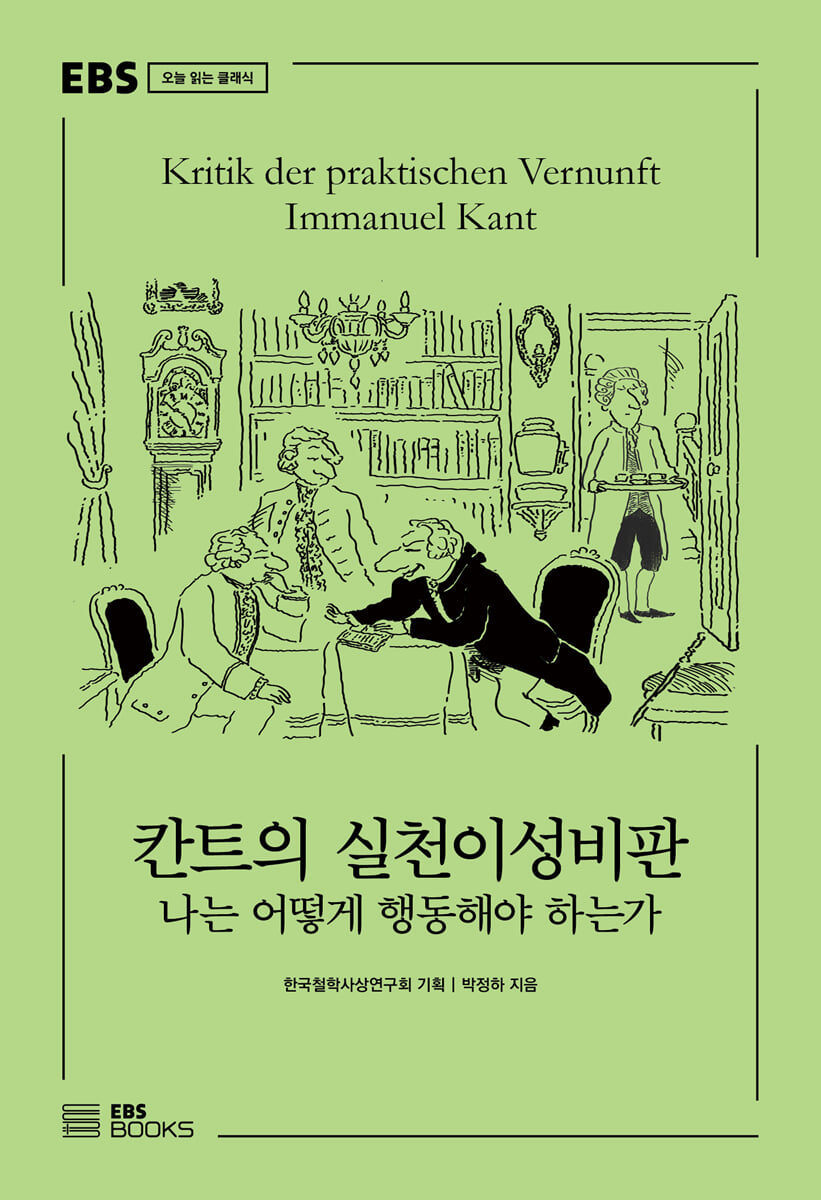
Kant's Critique of Practical Reason
 |
Description
Book Introduction
How should I behave?
We seek the answer from Kant, the reservoir of Western philosophy.
Kant is often likened to the largest reservoir at the center of Western philosophy.
This means that all philosophy before Kant flowed into Kant, and all philosophy after Kant flowed from Kant.
The most famous of Kant's works are the Critique of Pure Reason, the Critique of Practical Reason, and the Critique of Judgment, commonly referred to as the "Three Critiques."
Professor Park Jeong-ha, who has specialized in Kantian philosophy and has run a program for many years in which he directly reads and teaches the three Critiques, attempted to provide a faithful and thorough reading of the core concepts of the Critique of Practical Reason, which is the culmination of Kant's ethics, while encompassing them as much as possible.
Among Kant's books, 『Critique of Practical Reason』 is a book that clearly displays the characteristics of Kant's philosophy, which completed the Enlightenment and matured philosophical modernity.
It also marks the starting point for Kant to fully develop his new philosophy.
This is because Kant used the content obtained here as a stepping stone to expand practical philosophy in a more serious and concrete way.
And in terms of its subsequent philosophical influence and its ongoing influence, the Critique of Practical Reason provides a solid foundation for the universally recognized human dignity of today, and presents the principle of deontology, one of the major ethical theories of modern times.
In the Critique of Practical Reason, the author states that Kant's question is directed towards the 'practical use of reason.'
That is, Kant's task in the Critique of Practical Reason is to explain how practical reason can determine the will and enable us to fulfill our duties; in other words, this means elucidating how practical reason makes us moral beings.
We seek the answer from Kant, the reservoir of Western philosophy.
Kant is often likened to the largest reservoir at the center of Western philosophy.
This means that all philosophy before Kant flowed into Kant, and all philosophy after Kant flowed from Kant.
The most famous of Kant's works are the Critique of Pure Reason, the Critique of Practical Reason, and the Critique of Judgment, commonly referred to as the "Three Critiques."
Professor Park Jeong-ha, who has specialized in Kantian philosophy and has run a program for many years in which he directly reads and teaches the three Critiques, attempted to provide a faithful and thorough reading of the core concepts of the Critique of Practical Reason, which is the culmination of Kant's ethics, while encompassing them as much as possible.
Among Kant's books, 『Critique of Practical Reason』 is a book that clearly displays the characteristics of Kant's philosophy, which completed the Enlightenment and matured philosophical modernity.
It also marks the starting point for Kant to fully develop his new philosophy.
This is because Kant used the content obtained here as a stepping stone to expand practical philosophy in a more serious and concrete way.
And in terms of its subsequent philosophical influence and its ongoing influence, the Critique of Practical Reason provides a solid foundation for the universally recognized human dignity of today, and presents the principle of deontology, one of the major ethical theories of modern times.
In the Critique of Practical Reason, the author states that Kant's question is directed towards the 'practical use of reason.'
That is, Kant's task in the Critique of Practical Reason is to explain how practical reason can determine the will and enable us to fulfill our duties; in other words, this means elucidating how practical reason makes us moral beings.
- You can preview some of the book's contents.
Preview
index
introduction
Chapter 1: Kant, the philosopher who perfected modern reason
Kant's life
The perfecter of modern reason
Theoretical Reason and Practical Reason: Are Reason Two or One?
The Tasks and Character of the Critique of Practical Reason
Modern Ethics: Romance of the Three Kingdoms 1: Utilitarianism
Modern Ethics: Romance of the Three Kingdoms 2: Virtue Ethics
Modern Ethics: Romance of the Three Kingdoms 3: Obligationism
Chapter 2: Reading the Critique of Practical Reason
What is the moral law?
Can happiness be the foundation of morality?
The foundation of morality, freedom
What is the highest good?
The call of practical reason
Chapter 3: Milestones of Philosophy
Immanuel Kant, Groundwork of the Metaphysics of Morals
Immanuel Kant, Kant's Philosophy of History
Immanuel Kant, Perpetual Peace
Baek Jong-hyeon, What is a Human?
John Stuart Mill, Utilitarianism
Life chronology
References
Chapter 1: Kant, the philosopher who perfected modern reason
Kant's life
The perfecter of modern reason
Theoretical Reason and Practical Reason: Are Reason Two or One?
The Tasks and Character of the Critique of Practical Reason
Modern Ethics: Romance of the Three Kingdoms 1: Utilitarianism
Modern Ethics: Romance of the Three Kingdoms 2: Virtue Ethics
Modern Ethics: Romance of the Three Kingdoms 3: Obligationism
Chapter 2: Reading the Critique of Practical Reason
What is the moral law?
Can happiness be the foundation of morality?
The foundation of morality, freedom
What is the highest good?
The call of practical reason
Chapter 3: Milestones of Philosophy
Immanuel Kant, Groundwork of the Metaphysics of Morals
Immanuel Kant, Kant's Philosophy of History
Immanuel Kant, Perpetual Peace
Baek Jong-hyeon, What is a Human?
John Stuart Mill, Utilitarianism
Life chronology
References
Into the book
Among Kant's books, 『Critique of Practical Reason』 is a book that clearly displays the characteristics of Kant's philosophy, which completed the Enlightenment and matured philosophical modernity.
Specifically, it is a book that condenses the contents of Kant's ethics.
Kant's ethics is also presented in the Groundwork of the Metaphysics of Morals, but the Critique of Practical Reason can be said to be the book that truly advanced the philosophical justification of moral philosophy.
(……) The Critique of Practical Reason provides a solid foundation for human dignity, which is universally recognized today, and presents the principle of deontology, one of the major ethical theories of modern times.
--- p.5-6, from the “Preface”
Kant's critical philosophy criticized continental rationalism and British empiricism, thereby synthesizing the long-standing debates and conflicts of modern philosophy and thereby elucidating the philosophical foundations of modern natural science.
And with the emergence of Kant, the European intellectual world entered a period of great revolution, giving birth to German idealism through Fichte, Schelling, and Hegel, and subsequently through the Neo-Kantian school, exerting a tremendous influence on the history of philosophy up to the present day.
--- p.20, from “Chapter 1: Kant, the Philosopher Who Perfected Modern Reason”
Kant viewed the core function of modern reason as the critical function.
The early modern period, when the Enlightenment emerged, was, to borrow Kant's expression, the 'age of criticism.'
(……) Critical reason, on the one hand, appears as a theoretical activity that examines one by one what is proclaimed as truth by existing authorities in an era dominated by authority and power, and on the other hand, appears as a practical activity that seeks to create a society in which human dignity is absolutely recognized.
Because he established and justified this reason, Kant is recognized as the perfecter of modern reason.
--- p.26-27, from “Chapter 1: Kant, the Philosopher Who Perfected Modern Reason”
Kant's ethics presented in the Critique of Practical Reason is not only of historical value today, but is also considered an important model in discussions of mainstream ethics.
Kant is considered an important interlocutor on the justification of moral norms.
That's also a very attractive opponent.
Why? First, Kantian ethics satisfies the minimum conditions that modern normative ethics aspires to have.
In ethics, Kant takes a position opposing relativism, skepticism, and dogmatism.
Kant also makes it clear that moral judgment and moral action are not matters of personal feelings or arbitrary decisions, nor are they matters of social culture, heritage, lifestyle, or custom.
Kant sets out the principles of morality and approaches ethical issues based on these.
--- p.46-47, from “Chapter 1: Kant, the Philosopher Who Perfected Modern Reason”
Kant sees moral laws as based on human reason.
On the one hand, humans are animals governed by nature, but on the other hand, they are beings with the freedom to transcend the laws of nature.
Freedom gives humans the power to overcome their natural instincts and desires and to fulfill their duties.
Kant placed such importance on the concept of freedom that he described it as the cornerstone of his philosophy.
Through the power of this freedom, humans can pursue a world of morality.
So the source of moral law is human reason.
Human reason is practical in itself and has the power to give moral laws.
Kant called this practical reason.
--- p.79-80, from “Chapter 1: Kant, the Philosopher Who Perfected Modern Reason”
Kant's conclusion is different.
Because moral laws are based on human reason.
On the one hand, humans are animals governed by nature, but on the other hand, they are beings with the freedom to transcend the laws of nature.
Freedom gives humans the power to transcend their natural instincts and desires.
Through this power, humans can pursue a world of morality.
So the source of moral law is human reason.
Human reason is practical in itself and has the power to give moral laws.
Therefore, the moral law is autonomous.
Because human reason gave it to itself.
--- p.105-106, from “Reading Chapter 2, Critique of Practical Reason”
In order for a man to feel satisfaction in the thought that he has acted in accordance with the moral law, and to feel bitter rebuke in reproach for having broken it, he must first realize how important duty is, how sacred the moral law is, and how valuable it is to him to keep it.
Kant's analysis is that satisfaction or anxiety cannot be felt before the awareness of this moral responsibility, and that these feelings cannot be used as the basis for responsibility.
--- p.128-129, from “Reading Chapter 2, Critique of Practical Reason”
The whole of creation can be used as a mere means to satisfy human desires.
But only man, and with him all rational creatures, is an end in itself.
Man soon becomes a subject of the divine moral law by the power of his freedom and autonomy.
A rational being can refuse to submit to any intention contrary to the moral law, and is therefore not used merely as a means, but rather is at the same time recognized as an end in itself.
--- p.145, from “Reading Chapter 2, Critique of Practical Reason”
What is the goal of practical reason, or, to put it another way, what is the object of practical reason? According to Kant, it is the highest good.
Practical reason also pursues its own object and objectivity.
Of course, this object is completely different in nature from what our desires or natural needs are.
And the important thing is that, as we have said before, in the case of desire or need, it is entirely determined by the object, but in the case of practical reason, it is not the goal and object that determine practical reason.
The only thing that determines our pure will and practical reason is the moral law.
Practical reason can be determined by moral laws on the one hand, while on the other hand it can have its own object, object, or goal.
At this time, the object of practical reason is the highest good.
Specifically, it is a book that condenses the contents of Kant's ethics.
Kant's ethics is also presented in the Groundwork of the Metaphysics of Morals, but the Critique of Practical Reason can be said to be the book that truly advanced the philosophical justification of moral philosophy.
(……) The Critique of Practical Reason provides a solid foundation for human dignity, which is universally recognized today, and presents the principle of deontology, one of the major ethical theories of modern times.
--- p.5-6, from the “Preface”
Kant's critical philosophy criticized continental rationalism and British empiricism, thereby synthesizing the long-standing debates and conflicts of modern philosophy and thereby elucidating the philosophical foundations of modern natural science.
And with the emergence of Kant, the European intellectual world entered a period of great revolution, giving birth to German idealism through Fichte, Schelling, and Hegel, and subsequently through the Neo-Kantian school, exerting a tremendous influence on the history of philosophy up to the present day.
--- p.20, from “Chapter 1: Kant, the Philosopher Who Perfected Modern Reason”
Kant viewed the core function of modern reason as the critical function.
The early modern period, when the Enlightenment emerged, was, to borrow Kant's expression, the 'age of criticism.'
(……) Critical reason, on the one hand, appears as a theoretical activity that examines one by one what is proclaimed as truth by existing authorities in an era dominated by authority and power, and on the other hand, appears as a practical activity that seeks to create a society in which human dignity is absolutely recognized.
Because he established and justified this reason, Kant is recognized as the perfecter of modern reason.
--- p.26-27, from “Chapter 1: Kant, the Philosopher Who Perfected Modern Reason”
Kant's ethics presented in the Critique of Practical Reason is not only of historical value today, but is also considered an important model in discussions of mainstream ethics.
Kant is considered an important interlocutor on the justification of moral norms.
That's also a very attractive opponent.
Why? First, Kantian ethics satisfies the minimum conditions that modern normative ethics aspires to have.
In ethics, Kant takes a position opposing relativism, skepticism, and dogmatism.
Kant also makes it clear that moral judgment and moral action are not matters of personal feelings or arbitrary decisions, nor are they matters of social culture, heritage, lifestyle, or custom.
Kant sets out the principles of morality and approaches ethical issues based on these.
--- p.46-47, from “Chapter 1: Kant, the Philosopher Who Perfected Modern Reason”
Kant sees moral laws as based on human reason.
On the one hand, humans are animals governed by nature, but on the other hand, they are beings with the freedom to transcend the laws of nature.
Freedom gives humans the power to overcome their natural instincts and desires and to fulfill their duties.
Kant placed such importance on the concept of freedom that he described it as the cornerstone of his philosophy.
Through the power of this freedom, humans can pursue a world of morality.
So the source of moral law is human reason.
Human reason is practical in itself and has the power to give moral laws.
Kant called this practical reason.
--- p.79-80, from “Chapter 1: Kant, the Philosopher Who Perfected Modern Reason”
Kant's conclusion is different.
Because moral laws are based on human reason.
On the one hand, humans are animals governed by nature, but on the other hand, they are beings with the freedom to transcend the laws of nature.
Freedom gives humans the power to transcend their natural instincts and desires.
Through this power, humans can pursue a world of morality.
So the source of moral law is human reason.
Human reason is practical in itself and has the power to give moral laws.
Therefore, the moral law is autonomous.
Because human reason gave it to itself.
--- p.105-106, from “Reading Chapter 2, Critique of Practical Reason”
In order for a man to feel satisfaction in the thought that he has acted in accordance with the moral law, and to feel bitter rebuke in reproach for having broken it, he must first realize how important duty is, how sacred the moral law is, and how valuable it is to him to keep it.
Kant's analysis is that satisfaction or anxiety cannot be felt before the awareness of this moral responsibility, and that these feelings cannot be used as the basis for responsibility.
--- p.128-129, from “Reading Chapter 2, Critique of Practical Reason”
The whole of creation can be used as a mere means to satisfy human desires.
But only man, and with him all rational creatures, is an end in itself.
Man soon becomes a subject of the divine moral law by the power of his freedom and autonomy.
A rational being can refuse to submit to any intention contrary to the moral law, and is therefore not used merely as a means, but rather is at the same time recognized as an end in itself.
--- p.145, from “Reading Chapter 2, Critique of Practical Reason”
What is the goal of practical reason, or, to put it another way, what is the object of practical reason? According to Kant, it is the highest good.
Practical reason also pursues its own object and objectivity.
Of course, this object is completely different in nature from what our desires or natural needs are.
And the important thing is that, as we have said before, in the case of desire or need, it is entirely determined by the object, but in the case of practical reason, it is not the goal and object that determine practical reason.
The only thing that determines our pure will and practical reason is the moral law.
Practical reason can be determined by moral laws on the one hand, while on the other hand it can have its own object, object, or goal.
At this time, the object of practical reason is the highest good.
--- p.146-147, from “Reading Chapter 2, Critique of Practical Reason”
Publisher's Review
Kant, who brought about the 'Copernican shift' from God to man
Perfecting modern reason
Kant is a philosopher who is considered the perfector of modern enlightenment.
One of the most important characteristics of modernity is the establishment of each individual as a subject.
The transition from medieval theocentrism to modern anthropocentrism is the famous 'Copernican turn' achieved by Kant.
However, it is important to note that when we say that humans are at the center of the world, the word 'human' refers to an individual.
So what does it mean for an individual to become a subject?
The autonomous modern subject is one who uses his or her own reason without being coerced by any authority or force.
Ultimately, the real content that makes a subject a subject is reason.
Only when an individual can use his own reason can he become a subject.
Therefore, establishing each individual as a subject also means establishing that each individual is a being with the ability to use reason autonomously.
Kant viewed the core of modern reason as ‘criticism.’
Critical reason, on the one hand, is a theoretical activity that examines each and every thing proclaimed as truth by existing authorities in an era dominated by authority and power, and determines what is right. On the other hand, it is a practical activity that seeks to create a society in which human dignity is absolutely recognized.
It is precisely because he established and justified this kind of reason that Kant is evaluated as the perfecter of modern reason.
Kant philosophically argued the 'establishment of the subject,' a core proposition of modern philosophy.
At this time, the source of morality lies in autonomy, that is, the self-legislation of the will.
Autonomy means freedom (Freiheit).
Freedom, a key concept that provides a clue to understanding modernity, received its philosophical foundation from Kant.
In that respect, 『Critique of Practical Reason』 is evaluated as a work that laid the foundation for modern philosophy.
What is practical reason?
Uncovering the Secrets Surrounding the Practical Use of Reason
The fact that the titles of Kant's representative works, the 'Three Critiques' ('Critique of Pure Reason', 'Critique of Practical Reason', and 'Critique of Judgment'), all contain the word 'critique' clearly shows that the primary faculty of reason is criticism.
But here, two types of reason, 'pure reason' and 'practical reason', appear, and one wonders why Kant divided reason into two, whether they are different or the same, and if they are the same, why they are given different names.
In conclusion, the two reasons are the same.
So why are they divided into two names and given different names? The reason is that the same reason functions differently when used in different areas of interest and domain.
Reason can be used both theoretically and practically.
When we use reason in the realm of theory, which seeks to grasp existing objects and gain knowledge about the world, reason provides us with certain principles, or 'a priori principles', that are already given to us prior to experience and make this knowledge possible.
On the other hand, when we use reason in the realm of practice, we strive to achieve the ultimate goal of our actions.
So reason aims to determine our will.
Ultimately, practical reason is the ability to direct our will toward the ultimate ends of life, such as the good.
In other words, the practical use of reason means regulating and guiding our will through reason so that it pursues only the good.
Since reason plays two entirely different roles: on the one hand, providing the most fundamental framework and principles of our knowledge, and on the other, guiding our will to pursue the good, we cannot help but explore these two functions of reason in different ways.
The first of these tasks was explored in the Critique of Pure Reason, and the second task was explored in the Critique of Practical Reason.
Ultimately, Kant's task in the Critique of Practical Reason was to uncover the entire world of the moral world and the world of duty.
This was the realm of action, the realm of morality, the realm of values.
For Kant, this domain was not limited to the realm of science and facts, but was another rich and even more important domain.
Therefore, Kant argued that although it cannot fit into the framework of science, we need a proper philosophy that can properly deal with the more important issues for humans.
The important contents of such correct philosophy, that is, ‘true metaphysics,’ are presented in the Critique of Practical Reason.
A solid foundation for human dignity,
The meaning of the living, breathing work, Critique of Practical Reason
Kant's ethics presented in the Critique of Practical Reason is not only of historical value today, but is also considered an important model in discussions of mainstream ethics.
Kant is considered an important interlocutor on the justification of moral norms.
Why? First, Kantian ethics satisfies the minimum conditions that modern normative ethics aspires to have.
In ethics, Kant takes a position opposing relativism, skepticism, and dogmatism.
Kant also makes it clear that moral judgment and moral action are not matters of personal feelings or arbitrary decisions, nor are they matters of social culture, heritage, lifestyle, or custom.
Kant sets out the principles of morality and approaches ethical issues based on these.
And it concretely presents an alternative approach to moral principles by putting forward autonomy and categorical imperatives in contrast to the utilitarian theory that dominates modern discussions in the field of ethics.
Furthermore, the Critique of Practical Reason provides a solid foundation for the universally recognized human dignity of today, and also presents the principle of deontology, one of the major ethical theories of modern times.
Therefore, the Critique of Practical Reason can be evaluated not only as a historical work in the history of philosophy, but also as a living work that must be practically confronted in today's theoretical reality.
Perfecting modern reason
Kant is a philosopher who is considered the perfector of modern enlightenment.
One of the most important characteristics of modernity is the establishment of each individual as a subject.
The transition from medieval theocentrism to modern anthropocentrism is the famous 'Copernican turn' achieved by Kant.
However, it is important to note that when we say that humans are at the center of the world, the word 'human' refers to an individual.
So what does it mean for an individual to become a subject?
The autonomous modern subject is one who uses his or her own reason without being coerced by any authority or force.
Ultimately, the real content that makes a subject a subject is reason.
Only when an individual can use his own reason can he become a subject.
Therefore, establishing each individual as a subject also means establishing that each individual is a being with the ability to use reason autonomously.
Kant viewed the core of modern reason as ‘criticism.’
Critical reason, on the one hand, is a theoretical activity that examines each and every thing proclaimed as truth by existing authorities in an era dominated by authority and power, and determines what is right. On the other hand, it is a practical activity that seeks to create a society in which human dignity is absolutely recognized.
It is precisely because he established and justified this kind of reason that Kant is evaluated as the perfecter of modern reason.
Kant philosophically argued the 'establishment of the subject,' a core proposition of modern philosophy.
At this time, the source of morality lies in autonomy, that is, the self-legislation of the will.
Autonomy means freedom (Freiheit).
Freedom, a key concept that provides a clue to understanding modernity, received its philosophical foundation from Kant.
In that respect, 『Critique of Practical Reason』 is evaluated as a work that laid the foundation for modern philosophy.
What is practical reason?
Uncovering the Secrets Surrounding the Practical Use of Reason
The fact that the titles of Kant's representative works, the 'Three Critiques' ('Critique of Pure Reason', 'Critique of Practical Reason', and 'Critique of Judgment'), all contain the word 'critique' clearly shows that the primary faculty of reason is criticism.
But here, two types of reason, 'pure reason' and 'practical reason', appear, and one wonders why Kant divided reason into two, whether they are different or the same, and if they are the same, why they are given different names.
In conclusion, the two reasons are the same.
So why are they divided into two names and given different names? The reason is that the same reason functions differently when used in different areas of interest and domain.
Reason can be used both theoretically and practically.
When we use reason in the realm of theory, which seeks to grasp existing objects and gain knowledge about the world, reason provides us with certain principles, or 'a priori principles', that are already given to us prior to experience and make this knowledge possible.
On the other hand, when we use reason in the realm of practice, we strive to achieve the ultimate goal of our actions.
So reason aims to determine our will.
Ultimately, practical reason is the ability to direct our will toward the ultimate ends of life, such as the good.
In other words, the practical use of reason means regulating and guiding our will through reason so that it pursues only the good.
Since reason plays two entirely different roles: on the one hand, providing the most fundamental framework and principles of our knowledge, and on the other, guiding our will to pursue the good, we cannot help but explore these two functions of reason in different ways.
The first of these tasks was explored in the Critique of Pure Reason, and the second task was explored in the Critique of Practical Reason.
Ultimately, Kant's task in the Critique of Practical Reason was to uncover the entire world of the moral world and the world of duty.
This was the realm of action, the realm of morality, the realm of values.
For Kant, this domain was not limited to the realm of science and facts, but was another rich and even more important domain.
Therefore, Kant argued that although it cannot fit into the framework of science, we need a proper philosophy that can properly deal with the more important issues for humans.
The important contents of such correct philosophy, that is, ‘true metaphysics,’ are presented in the Critique of Practical Reason.
A solid foundation for human dignity,
The meaning of the living, breathing work, Critique of Practical Reason
Kant's ethics presented in the Critique of Practical Reason is not only of historical value today, but is also considered an important model in discussions of mainstream ethics.
Kant is considered an important interlocutor on the justification of moral norms.
Why? First, Kantian ethics satisfies the minimum conditions that modern normative ethics aspires to have.
In ethics, Kant takes a position opposing relativism, skepticism, and dogmatism.
Kant also makes it clear that moral judgment and moral action are not matters of personal feelings or arbitrary decisions, nor are they matters of social culture, heritage, lifestyle, or custom.
Kant sets out the principles of morality and approaches ethical issues based on these.
And it concretely presents an alternative approach to moral principles by putting forward autonomy and categorical imperatives in contrast to the utilitarian theory that dominates modern discussions in the field of ethics.
Furthermore, the Critique of Practical Reason provides a solid foundation for the universally recognized human dignity of today, and also presents the principle of deontology, one of the major ethical theories of modern times.
Therefore, the Critique of Practical Reason can be evaluated not only as a historical work in the history of philosophy, but also as a living work that must be practically confronted in today's theoretical reality.
GOODS SPECIFICS
- Date of issue: December 30, 2023
- Page count, weight, size: 200 pages | 270g | 128*188*14mm
- ISBN13: 9788954782692
- ISBN10: 8954782698
You may also like
카테고리
korean


korean

![GQ KOREA Mark (Monthly): December [2025]](http://librairie.coreenne.fr/cdn/shop/files/8ef265dbbfbf186523ed75ba7319009d.jpg?v=1765340328&width=3840)


