

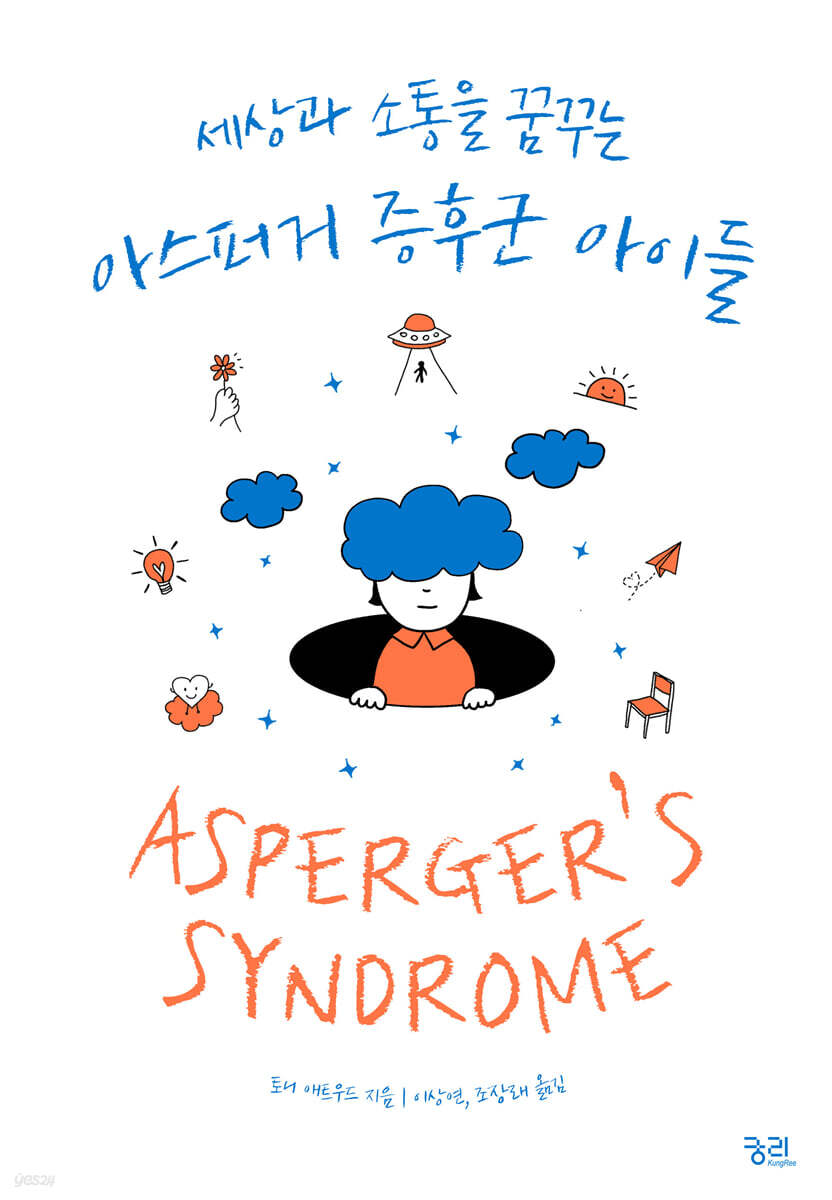
children with Asperger syndrome
 |
Description
Book Introduction
Everything You Need to Know About Asperger Syndrome, From Diagnosis to Treatment
A practical and inspiring guide from the world's leading experts.
From specific cases of Asperger's syndrome to diagnosis and coping strategies, "Children with Asperger's Syndrome Who Dream of Communicating with the World" has been republished by Gungri.
Author Tony Atwood is a British clinical psychologist with a world-renowned authority on Autism Spectrum Disorder (ASD). He has worked as a clinician in the UK, Australia, and New Zealand for over 50 years, and has met over 8,000 people with ASD and their families, ranging in age, ability, and background from infants to those in their 90s.
Although the term "Asperger's syndrome" became familiar in Korea thanks to a drama, accurate understanding of the disease is still lacking.
Examples include savant syndrome and high-functioning autism (HFA), which, like Asperger's syndrome, have poor communication and social skills but exhibit exceptional abilities in specific areas such as memory and mental arithmetic.
In 2006, when this book was first published in Korea, there was little awareness of Asperger syndrome.
Although the number of children with this syndrome was increasing silently, the medical community at the time considered it a new field with no known cause, and therefore simply accepted it as a 'strange child' or 'a child with a slight deficiency.'
The first person to study the behavior and abilities of children and adults with Asperger's syndrome was Hans Asperger, a pediatrician from Vienna, Austria.
He noticed that there were certain patterns in the unusual behaviors and abilities exhibited by children with this syndrome.
The term Asperger syndrome was first used by British child psychiatrist Lorna Wing in a 1981 paper.
A practical and inspiring guide from the world's leading experts.
From specific cases of Asperger's syndrome to diagnosis and coping strategies, "Children with Asperger's Syndrome Who Dream of Communicating with the World" has been republished by Gungri.
Author Tony Atwood is a British clinical psychologist with a world-renowned authority on Autism Spectrum Disorder (ASD). He has worked as a clinician in the UK, Australia, and New Zealand for over 50 years, and has met over 8,000 people with ASD and their families, ranging in age, ability, and background from infants to those in their 90s.
Although the term "Asperger's syndrome" became familiar in Korea thanks to a drama, accurate understanding of the disease is still lacking.
Examples include savant syndrome and high-functioning autism (HFA), which, like Asperger's syndrome, have poor communication and social skills but exhibit exceptional abilities in specific areas such as memory and mental arithmetic.
In 2006, when this book was first published in Korea, there was little awareness of Asperger syndrome.
Although the number of children with this syndrome was increasing silently, the medical community at the time considered it a new field with no known cause, and therefore simply accepted it as a 'strange child' or 'a child with a slight deficiency.'
The first person to study the behavior and abilities of children and adults with Asperger's syndrome was Hans Asperger, a pediatrician from Vienna, Austria.
He noticed that there were certain patterns in the unusual behaviors and abilities exhibited by children with this syndrome.
The term Asperger syndrome was first used by British child psychiatrist Lorna Wing in a 1981 paper.
- You can preview some of the book's contents.
Preview
index
Recommendation 6
Entering 8
1.
diagnosis
·Step-by-step diagnosis 24
Step 1: Evaluation Scale | Step 2: Diagnostic Assessment
Six Paths to Diagnosis 35
When autistic traits are shown in infancy | When characteristics appear after school | When signs of other syndromes are shown | When there is a family history of autism or Asperger syndrome | Secondary mental disorder in adolescence | Diagnostic evaluation in adulthood
2.
social behavior
Diagnostic criteria 45
·Play 48
·Code of Conduct 51
·The Role of Families in Behavior Improvement 57
·The role of schools in improving behavior 60
·Group 64 to develop social adaptability
Friendship 74
·Eye contact 88
·Emotion 91
·93 Ways to Help You Understand Emotions
·99 Ways to Help You Express Your Emotions
★ 106 Strategies for Acquiring Social Behavior
3.
language
·Conversation Techniques 112
·Understanding it literally 125
· Monotonous tone 130
·Academic remarks 133
·Use of unique words 135
·Speaking out your thoughts 136
Auditory Discrimination and Distortion 138
·Eloquence 141
★ 144 Strategies to Help Improve Language Skills
4.
Interests and Mechanical Behavior
Diagnostic criteria 154
·Excessive interest 155
·How to Deal with Excessive Attention 158
·Mechanical Action 165
★ Strategies for Coping with Interests and Mechanical Behaviors 169
5.
motor skills
· Damaged ability 174
Motor skills | Ball handling skills | Balance | Dexterity | Writing | Movement coordination | Joints | Rhythm | Movement imitation
Associated movement disorders 181
Tourette Syndrome | Cerebellar Dysfunction | Tension Syndrome and Parkinson's Disease
★ Strategies to Boost Your Dull Motor Skills 186
6.
recognition
·Theory of Mind 191
·Memory 196
Alternative Thinking 197
·Vocabulary and number comprehension 200
·Imagination 205
Visual Thinking 210
·Identifying Abilities through Intelligence Tests 213
★ Strategies to Enhance Cognition 216
7.
sense
·Hearing 222
·Tactile 228
·Taste 232
·Visual 233
·Smell 235
·Response to pain and temperature 235
·Synesthesia 236
★ Strategies for Coping with Sensitive Sensations 238
8.
Frequently Asked Questions
1.
Could it be genetic? 243
2.
Is it due to difficult labor or pregnancy problems? 245
3.
Are certain brain regions malfunctioning? 246
4.
Is it possible that the caregiver contributed to the problem? 247
5.
Are there any other disabilities? 248
6.
What defines ordinariness and uniqueness? 249
7.
Is this a secondary manifestation of language impairment? 250
8.
Does it involve attention deficit disorder? 251
9.
Is this a type of schizophrenia? 253
10.
What's the difference between high-functioning autism and high-functioning autism? 257
11.
Are there differences between girls and boys? 258
12.
How to Reduce Anxiety? 262
13.
Do you tend to get depressed easily? 271
14.
How to Manage Anger and Fear? 273
15.
What changes occur during puberty? 280
16.
Can you form normal human relationships? 281
17.
Are you more likely to be involved in crime? 287
18.
What measures are needed at the government level? 289
19.
What are the roles of schools and teachers? 293
20.
What help is available after being diagnosed with Asperger's syndrome? 297
21.
How should I share my diagnosis with those around me? 299
22.
What career is right for you? 304
23.
What does their future hold? 308
Appendix 315
Reference 333
Entering 8
1.
diagnosis
·Step-by-step diagnosis 24
Step 1: Evaluation Scale | Step 2: Diagnostic Assessment
Six Paths to Diagnosis 35
When autistic traits are shown in infancy | When characteristics appear after school | When signs of other syndromes are shown | When there is a family history of autism or Asperger syndrome | Secondary mental disorder in adolescence | Diagnostic evaluation in adulthood
2.
social behavior
Diagnostic criteria 45
·Play 48
·Code of Conduct 51
·The Role of Families in Behavior Improvement 57
·The role of schools in improving behavior 60
·Group 64 to develop social adaptability
Friendship 74
·Eye contact 88
·Emotion 91
·93 Ways to Help You Understand Emotions
·99 Ways to Help You Express Your Emotions
★ 106 Strategies for Acquiring Social Behavior
3.
language
·Conversation Techniques 112
·Understanding it literally 125
· Monotonous tone 130
·Academic remarks 133
·Use of unique words 135
·Speaking out your thoughts 136
Auditory Discrimination and Distortion 138
·Eloquence 141
★ 144 Strategies to Help Improve Language Skills
4.
Interests and Mechanical Behavior
Diagnostic criteria 154
·Excessive interest 155
·How to Deal with Excessive Attention 158
·Mechanical Action 165
★ Strategies for Coping with Interests and Mechanical Behaviors 169
5.
motor skills
· Damaged ability 174
Motor skills | Ball handling skills | Balance | Dexterity | Writing | Movement coordination | Joints | Rhythm | Movement imitation
Associated movement disorders 181
Tourette Syndrome | Cerebellar Dysfunction | Tension Syndrome and Parkinson's Disease
★ Strategies to Boost Your Dull Motor Skills 186
6.
recognition
·Theory of Mind 191
·Memory 196
Alternative Thinking 197
·Vocabulary and number comprehension 200
·Imagination 205
Visual Thinking 210
·Identifying Abilities through Intelligence Tests 213
★ Strategies to Enhance Cognition 216
7.
sense
·Hearing 222
·Tactile 228
·Taste 232
·Visual 233
·Smell 235
·Response to pain and temperature 235
·Synesthesia 236
★ Strategies for Coping with Sensitive Sensations 238
8.
Frequently Asked Questions
1.
Could it be genetic? 243
2.
Is it due to difficult labor or pregnancy problems? 245
3.
Are certain brain regions malfunctioning? 246
4.
Is it possible that the caregiver contributed to the problem? 247
5.
Are there any other disabilities? 248
6.
What defines ordinariness and uniqueness? 249
7.
Is this a secondary manifestation of language impairment? 250
8.
Does it involve attention deficit disorder? 251
9.
Is this a type of schizophrenia? 253
10.
What's the difference between high-functioning autism and high-functioning autism? 257
11.
Are there differences between girls and boys? 258
12.
How to Reduce Anxiety? 262
13.
Do you tend to get depressed easily? 271
14.
How to Manage Anger and Fear? 273
15.
What changes occur during puberty? 280
16.
Can you form normal human relationships? 281
17.
Are you more likely to be involved in crime? 287
18.
What measures are needed at the government level? 289
19.
What are the roles of schools and teachers? 293
20.
What help is available after being diagnosed with Asperger's syndrome? 297
21.
How should I share my diagnosis with those around me? 299
22.
What career is right for you? 304
23.
What does their future hold? 308
Appendix 315
Reference 333
Into the book
People with Asperger's syndrome perceive the world differently than most people.
Rather, they find themselves and others strange and embarrassed.
Why don't we speak our hearts? Why do we say so many things we don't mean? Why do we say so many meaningless things so often? How can people tolerate the chaotic sensations of light, sound, smell, touch, and taste without screaming? (...) Why do people have such complex emotional relationships and send and receive so many social signals? And how do they understand them all? Why don't they treat everyone the same? And why are they so unreasonable compared to us with Asperger's?
--- p.6
While waiting in line at the checkout counter, a teenager with Asperger's syndrome points to someone in front of him and exclaims, "That girl is really big!"
When parents quietly try to persuade them not to do that, they raise their voices and say, “But that girl is really big!”
Not only does the child not notice the parent's embarrassment the first time he utters the word, he also fails to realize how the other person feels when he says it that way twice.
These kids are just wondering why people don't agree when they've accurately described the person's size.
--- p.20
The child may have an exceptional memory, exceptional concentration when pursuing interests, and ingenious ways of solving problems.
On the other hand, they may lack motivation or interest in activities that fascinate other children in the class, and may be evaluated as having learning disabilities in specific areas and underdeveloped motor skills.
(…) Parents and teachers discover that this seemingly normal and intellectually normal child, for some inexplicable reason, does not develop the level of understanding expected of a child his or her age or form social relationships with others.
--- p.21
Having a child with Asperger's syndrome can change a parent's social life, conversations, and home atmosphere.
Social contact may also be reduced because parents must continually explain and apologize for their child's unusual behavior.
The child's interference and questions cause conversations to become academic and child-dominated, and the rest of the family becomes rigid and stifling in an attempt to relieve the child's stress.
(…) The situation for parents becomes increasingly difficult as there are very few people who help them purely and unconditionally.
(…) What they need most is comfort and support.
--- p.247-248
Features of Asperger syndrome are also found in people with Tourette syndrome, cerebral palsy, neurofibromatosis, and tuberous sclerosis.
(…) Once Asperger syndrome is confirmed, it is advisable to have the child continuously diagnosed to check for other disorders related to the syndrome.
Rather, they find themselves and others strange and embarrassed.
Why don't we speak our hearts? Why do we say so many things we don't mean? Why do we say so many meaningless things so often? How can people tolerate the chaotic sensations of light, sound, smell, touch, and taste without screaming? (...) Why do people have such complex emotional relationships and send and receive so many social signals? And how do they understand them all? Why don't they treat everyone the same? And why are they so unreasonable compared to us with Asperger's?
--- p.6
While waiting in line at the checkout counter, a teenager with Asperger's syndrome points to someone in front of him and exclaims, "That girl is really big!"
When parents quietly try to persuade them not to do that, they raise their voices and say, “But that girl is really big!”
Not only does the child not notice the parent's embarrassment the first time he utters the word, he also fails to realize how the other person feels when he says it that way twice.
These kids are just wondering why people don't agree when they've accurately described the person's size.
--- p.20
The child may have an exceptional memory, exceptional concentration when pursuing interests, and ingenious ways of solving problems.
On the other hand, they may lack motivation or interest in activities that fascinate other children in the class, and may be evaluated as having learning disabilities in specific areas and underdeveloped motor skills.
(…) Parents and teachers discover that this seemingly normal and intellectually normal child, for some inexplicable reason, does not develop the level of understanding expected of a child his or her age or form social relationships with others.
--- p.21
Having a child with Asperger's syndrome can change a parent's social life, conversations, and home atmosphere.
Social contact may also be reduced because parents must continually explain and apologize for their child's unusual behavior.
The child's interference and questions cause conversations to become academic and child-dominated, and the rest of the family becomes rigid and stifling in an attempt to relieve the child's stress.
(…) The situation for parents becomes increasingly difficult as there are very few people who help them purely and unconditionally.
(…) What they need most is comfort and support.
--- p.247-248
Features of Asperger syndrome are also found in people with Tourette syndrome, cerebral palsy, neurofibromatosis, and tuberous sclerosis.
(…) Once Asperger syndrome is confirmed, it is advisable to have the child continuously diagnosed to check for other disorders related to the syndrome.
--- p.248
Publisher's Review
Behavioral and Temperamental Characteristics of Asperger Syndrome
· Lack of empathy
· Foolishly naive, inappropriate, and one-sided behavior
· Little or no ability to make friends
· Use of esoteric and repetitive language
· Lack of nonverbal communication
· Strong commitment to a specific issue
· Clumsy and unnatural body movements and unusual postures
Asperger syndrome is characterized by near-average intellectual ability, but poor communication and social adaptability.
This includes not noticing gestures or jokes from people around you, repeating the same actions, and being overly fixated on certain objects, actions, or topics.
Also, we sometimes interpret metaphors or idioms at face value without understanding their meaning.
Originally, Asperger syndrome was classified as a separate diagnosis as one of the clinical features of autism spectrum disorder, but since the 2013 revision of the Diagnostic and Statistical Manual of Mental Disorders, 5th Edition (DSM-5) (published by the American Psychiatric Association), it has been diagnosed as an integrated diagnosis of autism spectrum disorder.
Rather than approaching this disease through a diagnosis, this book focuses on its overall characteristics and provides guidelines to help caregivers and professionals understand it.
Let's break away from the dichotomy of being a freak or a genius.
Understanding One Unique Person with Asperger's
“One foot in and one foot out
That's the children with Asperger's syndrome.
I don't look like other kids.
But the little differences make me rough.”
―A poem written by a child with Asperger's syndrome
This book diagnoses the characteristics of children with Asperger's syndrome and presents strategies for caregivers and educators to cope with their sensitive senses in daily life or improve their language skills in eight chapters.
Diagnosis (Chapter 1), Social Behavior (Chapter 2), Language (Chapter 3), Interests and Mechanical Behavior (Chapter 4), Motor Neurons (Chapter 5), Cognition (Chapter 6), and Sensory (Chapter 7).
The final eight chapters contain a selection of 23 frequently asked questions related to this syndrome.
Whether Asperger's syndrome can be genetic, whether it is accompanied by other disorders such as attention deficit disorder, how it differs from high-functioning autism, whether girls and boys present differently, what jobs are suitable for them, and what government measures are needed. We correct information that people are curious about or have misunderstood.
Additionally, the appendix includes a checklist of four diagnostic criteria along with reference books.
Albert Einstein, Ludwig Wittgenstein, Vincent van Gogh, Bill Gates… What do these figures have in common? Besides their pioneering achievements in science and art, they all exhibited symptoms of Asperger's syndrome.
The world only focuses on the innate abilities of these people and others with Asperger's syndrome.
But now we need to move beyond the dichotomy of 'genius' or 'freak' and accept each and every one of them as a unique person with Asperger's.
This book, which will enhance their language and social communication skills, will become a classic guide to Asperger's syndrome.
· Lack of empathy
· Foolishly naive, inappropriate, and one-sided behavior
· Little or no ability to make friends
· Use of esoteric and repetitive language
· Lack of nonverbal communication
· Strong commitment to a specific issue
· Clumsy and unnatural body movements and unusual postures
Asperger syndrome is characterized by near-average intellectual ability, but poor communication and social adaptability.
This includes not noticing gestures or jokes from people around you, repeating the same actions, and being overly fixated on certain objects, actions, or topics.
Also, we sometimes interpret metaphors or idioms at face value without understanding their meaning.
Originally, Asperger syndrome was classified as a separate diagnosis as one of the clinical features of autism spectrum disorder, but since the 2013 revision of the Diagnostic and Statistical Manual of Mental Disorders, 5th Edition (DSM-5) (published by the American Psychiatric Association), it has been diagnosed as an integrated diagnosis of autism spectrum disorder.
Rather than approaching this disease through a diagnosis, this book focuses on its overall characteristics and provides guidelines to help caregivers and professionals understand it.
Let's break away from the dichotomy of being a freak or a genius.
Understanding One Unique Person with Asperger's
“One foot in and one foot out
That's the children with Asperger's syndrome.
I don't look like other kids.
But the little differences make me rough.”
―A poem written by a child with Asperger's syndrome
This book diagnoses the characteristics of children with Asperger's syndrome and presents strategies for caregivers and educators to cope with their sensitive senses in daily life or improve their language skills in eight chapters.
Diagnosis (Chapter 1), Social Behavior (Chapter 2), Language (Chapter 3), Interests and Mechanical Behavior (Chapter 4), Motor Neurons (Chapter 5), Cognition (Chapter 6), and Sensory (Chapter 7).
The final eight chapters contain a selection of 23 frequently asked questions related to this syndrome.
Whether Asperger's syndrome can be genetic, whether it is accompanied by other disorders such as attention deficit disorder, how it differs from high-functioning autism, whether girls and boys present differently, what jobs are suitable for them, and what government measures are needed. We correct information that people are curious about or have misunderstood.
Additionally, the appendix includes a checklist of four diagnostic criteria along with reference books.
Albert Einstein, Ludwig Wittgenstein, Vincent van Gogh, Bill Gates… What do these figures have in common? Besides their pioneering achievements in science and art, they all exhibited symptoms of Asperger's syndrome.
The world only focuses on the innate abilities of these people and others with Asperger's syndrome.
But now we need to move beyond the dichotomy of 'genius' or 'freak' and accept each and every one of them as a unique person with Asperger's.
This book, which will enhance their language and social communication skills, will become a classic guide to Asperger's syndrome.
GOODS SPECIFICS
- Date of issue: November 10, 2023
- Page count, weight, size: 348 pages | 586g | 145*215*20mm
- ISBN13: 9788958207962
- ISBN10: 8958207965
You may also like
카테고리
korean


korean

![GQ KOREA Mark (Monthly): December [2025]](http://librairie.coreenne.fr/cdn/shop/files/8ef265dbbfbf186523ed75ba7319009d.jpg?v=1765340328&width=3840)


